A Mother Dog Pleaded in the Blizzard — The Veteran Refused to Leave Her Behind – Part 1
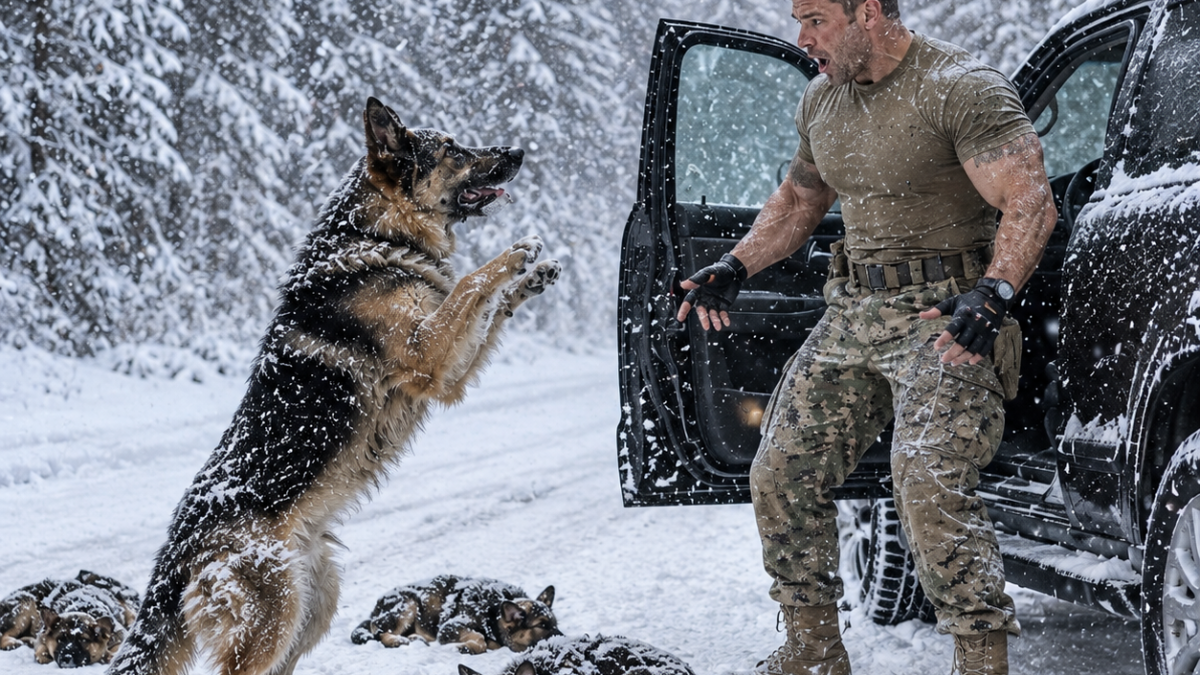
A Mother Dog Pleaded in the Blizzard — The Veteran Refused to Leave Her Behind
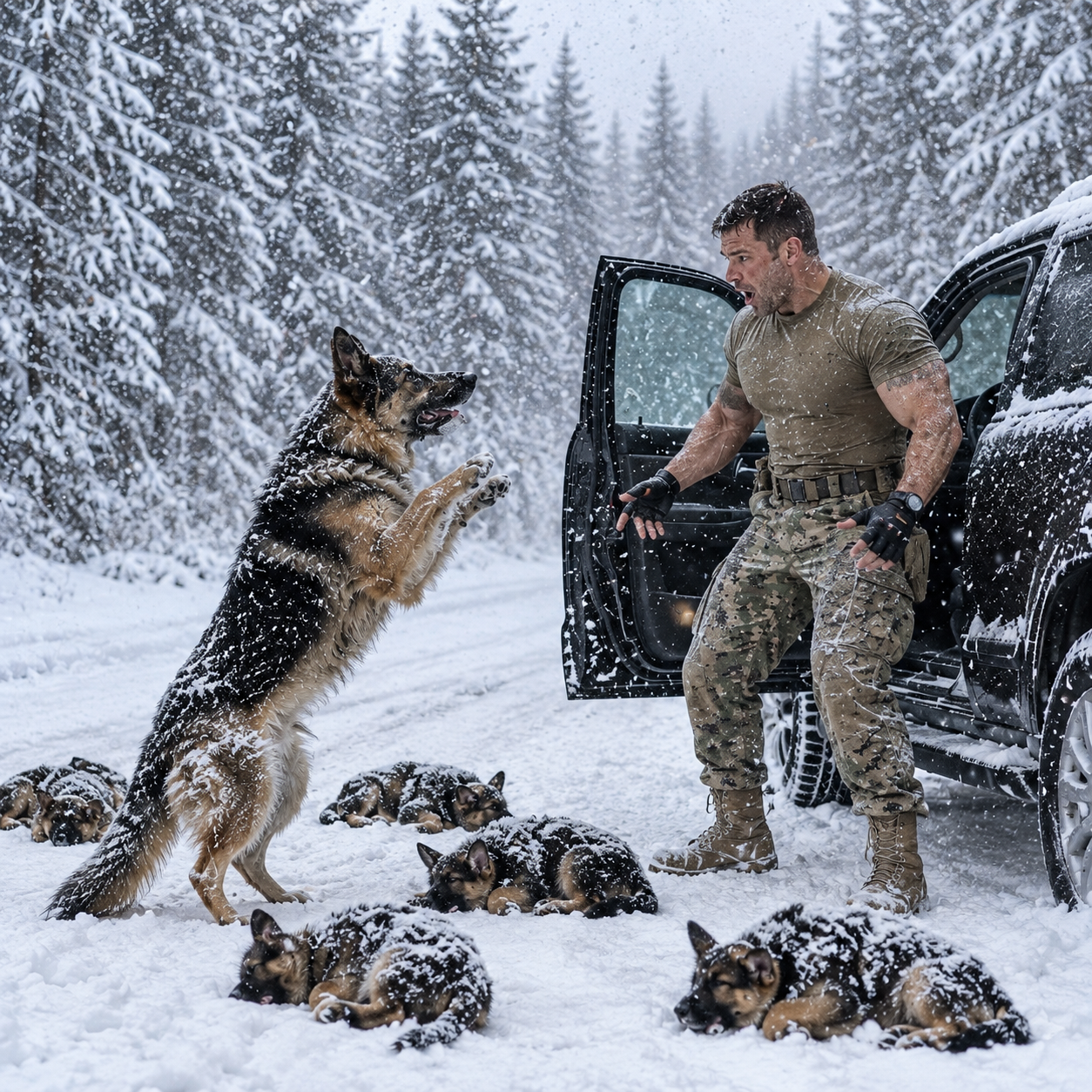
In a white out above Levvenworth, a retired Navy Seal stopped his truck for what looked like a shadow in the road. It was a German Shepherd mother, chained, bleeding, and curled around six freezing pups. Cole Mercer thought he was saving them from the storm.
But the storm had brought him a mission that would save him, too. Heavy snow fell over the Cascade Mountains in thick, breathless sheets.
turning the road above Icicycle Creek into a pale tunnel of headlights and black pine trunks. Outside Levvenworth, Washington, the whole valley seemed to be holding its breath under the weight of winter.
Cole Mercer drove with both hands on the wheel of his old black pickup, though the right shoulder under his waxed canvas coat had been burning since mile 6. He had bought lamp oil, dog food for no dog in particular, a bag of coffee, and the kind of pain pills that did not really help, but gave a man permission to pretend. He was 38, retired from the Navy Seal teams before anyone around town could decide whether to admire him or leave him alone, and he preferred the second option.
His cabin sat 2 mi beyond the last plowed turnout, where the creek ran cold and angry under ice, and the pines made a wall between him and the polite questions of strangers. In town they knew him as the quiet veteran who paid in cash, nodded once, and never stayed long enough for small talk to grow legs. That suited him.
Silence did not ask him why he still woke at 217 every morning with his fingers clenched around empty air.
Silence did not say Nathan Brooks’s name.
The road climbed, vanished, then reappeared under the truck like something Cole had to earn yard by yard. Snow struck the windshield so hard the wipers sounded tired of living. He leaned forward, jaw tight, reading the road by the faint rise of plow banks and the leaning ghosts of fence posts.
A gust shoved the truck sideways. His shoulder flashed white.
Cole breathed through his teeth and did not curse until the tires caught again. Then he cursed once softly for balance.
The heater smelled of dust and hot rubber. The coffee in the cup holder had gone cold.
He was thinking about the wood stacked beside the stove, about whether the south window would hold against the wind. About anything except the memory waiting under the day.
On a hairpin bend where the trees crowded close, his headlights caught a shape in the road. Not a branch, not a trash bag, something alive. Cole hit the brakes before thought finished forming.
The pickup slid fishtailed and stopped crooked across the lane with the engine coughing like an old smoker. For a moment, the world outside the windshield was only snow. Then the wipers dragged the glass clear, and he saw her.
A German Shepherd lay near the ditch, half buried along one side, her sable coat iced flat against her ribs, black saddled dark with wet snow, cream chest rising in shallow, uneven poles. Her ears were pricricked, though one ear had a torn edge that made it tilt.
Her muzzle was black, her eyes amber and bright with pain. Around her belly, pressed so close they looked like lumps of dirty wool, were six puppies.
Some moved, some did not. One had a pale gold wash through its fur and lay with its mouth open against the snow as if trying to drink warmth from the air.
Cole sat still. The old emptiness opened under his ribs, sudden and familiar.
There were moments in life that did not shout for a decision. They simply stood in the road and waited to see what kind of man you were after all your stories about yourself had gone quiet. His hand went to the door handle, then stopped.
A German Shepherd mother in pain was not a wounded pet waiting for a kind voice. She was teeth, terror, milk, and duty. He could see the broken length of chain dragging from her front leg, frozen in places to the slush.
The skin around it looked raw. There was blood in the snow.
Not much, but enough to make the storm feel colder. Cole turned off the engine.
The silence came down hard. He opened the door slowly, letting the dome light spill over his boots.
Wind slapped snow into his face and stole the warmth from the cab in one rude breath. He stepped out with his hands low and open, palms forward, the way he had approached frightened civilians, half- wild dogs on foreign bases, and once a boy with a grenade in a doorway. That boy had lived.
Nathan had not. Do not go there.
Not now. Cole moved sideways, never straight at the dog, each boot sinking deep.
“Easy, girl,” he said, his voice low enough that the wind almost carried it away.
“I see them.
I see you.”
The shepherd lifted her head a few inches. A growl came from her chest, thin, broken, and still serious.
“Good,” Cole thought.
Angry meant alive. He crouched 10 feet away and lowered his gaze. The nearest puppy twitched.
Tiny ribs fluttered under a film of snow. Cole could smell wet fur now. Blood, cold dirt, and something chemical beneath it, sharp as old disinfectant.
He looked toward the treeine. No house, no porch light, no tire tracks except his own fading under new snow. A dog like this did not walk here from town with newborn pups in a blizzard.
Someone had brought trouble to the mountain and left it breathing beside the road. Cole shrugged out of his coat, and the cold went through his flannel like a knife. His shoulder hated the movement.
He ignored it. Slowly with two fingers, he set the coat on the snow between himself and the shepherd, then nudged it forward inch by inch.
She snarled when the sleeve touched the pale pup. Cole froze. His knees achd.
Snow gathered on his eyelashes.
“You can bite me later,” he whispered.
“Fair arrangement.”
The dog’s eyes did not soften.
They measured him. Another puppy made a sound so small it seemed less like a cry than a thread snapping.
Cole felt his chest lock. He had heard men call for their mothers in voices bigger than that.
He had heard Nathan say his name once, not loud, because blood in the lungs makes a man economical. Cole reached for the pale pup.
The shepherd lunged with what strength she had left, teeth flashing an inch from his glove. He did not jerk back.
He let his hand stay in the snow, open, useless, patient. The dog trembled so hard her collar tag rattled.
Though there was no tag, only a metal ring and the broken chain. Her breath smoked in rough bursts. Cole waited.
One second. 5 10. The pale pup moved again, barely.
The mother looked at the pup, then at Cole’s hand.
She did not give permission. She simply failed to stop him.
That was enough. Cole slid the code over the puppies, careful not to trap them under its weight, and scooped the pale one into his palm. It weighed almost nothing.
That was the terrible part. Almost nothing. And yet, his whole life shifted around it.
He tucked the pup inside the coat near his chest and reached for the next. The shepherd made a low sound, not quite a growl this time, more like pain being asked to wait its turn.
I know, Cole said. I know. He gathered the pups one by one, counting under his breath.
1 2 3 4 5 6. The sixth did not move at all until his thumb found a faint tremor beneath its jaw. He wrapped them together and stood too fast.
His visions sparked. The shoulder screamed. He took two stumbling steps back to the truck, placed the bundle on the passenger seat, turned the heater vents toward them, then came back for the mother.
She tried to rise. Her back legs slid out from under her. She hit the snow with a sound that went through him.
Cole knelt beside her, close enough now for her teeth to take his wrist if she chose.
“I am not leaving you,” he said.
The words surprised him. He had said them before in another country under another sky, and the world had made a liar of him. The shepherd stared at him, and in her eyes was the plain animal truth that promises meant nothing until hands proved them.
Cole slid his arms under her chest and hips. She snapped once weakly at his sleeve. Then her head dropped against his forearm.
She was lighter than she should have been. All bone, wet fur, milk, and stubbornness. He carried her to the back seat, laid her where she could see the coat bundle, and shut the door against the storm.
As he climbed behind the wheel, a sound rose from the woods behind him. Not wind, an engine. Low, rough, coming closer through the trees.
Cole looked in the mirror. Far back among the pines, a pair of small headlights winked on, went dark, then appeared again, closer than before. Snow closed over the mountain road behind the pickup, erasing tire tracks almost as fast as Cole made them.
The cabin by Icicle Creek waited in the dark with one porch light burning, a small square of amber against a world gone white. Cole drove the last two miles with the heater blasting and one eye on the mirror.
The lights in the trees did not follow all the way, or maybe the snow swallowed them, which did not comfort him much. In the back seat, the German Shepherd mother lay stretched on an old wool blanket he kept for emergencies he never named.
Her eyes stayed fixed on the bundle of pups warming on the passenger seat. Every few seconds, she lifted her head, checking, then dropped it again when pain took the strength from her neck. Cole spoke to her through the rearview mirror.
Almost there, girl. You hold that line.
The words were simple, but his voice found a rhythm he had not used in years. The low cadence men use in the dark when panic has to borrow their breath.
At the cabin, he backed close to the porch, left the truck running, and opened the front door before unloading anything. Heat rolled from the stove in a smoky wave. The room smelled of pine ash, coffee grounds, oiled tools, and the loneliness of a place where one person used only what he needed.
and nothing more. Cole cleared the floor with one sweep of his arm, knocking a stack of mail and an old field manual onto a chair.
He brought the pups in first, still wrapped in his coat, and laid them on a towel near the stove, but not too close. Too much heat could finish what cold had started. He knew that from training.
He knew too many things from training. The mother came next. She growled when he lifted her, and he could not blame her.
Put it in writing,” he told her, grunting as his shoulder caught.
“I will file a complaint.”
Her jaws parted, but no bite came. He carried her inside and set her near the doorway, facing the pups.
That mattered. A mother who could see her young might stay in this world a little longer. coal fetched towels, a basin, the emergency heat packs he kept in a drawer, and a bottle of electrolyte solution left from a winter search years ago.
He did not own baby bottles. He did not own puppy formula. He barely owned dishes that matched.
The pale pup twitched under the coat. Cole dropped to one knee and rubbed its chest with two fingers. Slow circles, careful as prayer.
Come on, little one,” he murmured.
“No dramatic exits.”
The pup gave a thin squeak. The sound hit the room like a match. The mother lifted her head.
Cole looked at her.
“See, complaining already.
Takes after you.”
Her ears flicked. Not trust, not even close.
But the growl loosened by half a thread. He found the nearest working phone under a pile of receipts and called Snowy Rescue, though he knew the place had been half closed since the fire. Clare Bennett answered on the fourth ring, breathless and annoyed.
If this is about a raccoon in a chimney, “Tell the raccoon I respect his choices.”
“It is Cole Mercer,” he said.
“I found a German Shepherd mother and six newborn pups on Icicle Road.
Heavy exposure. Mother injured, chain wound, possible sedation.
I need help. Silence snapped clean on the other end.
Then the annoyance vanished. How long exposed?
Unknown. Pups cold, some responsive, too weak.
Mother conscious, protective, dehydrated, sable coat, black saddle, torn ear, broken chain still on front leg. Do not remove the chain unless it is cutting circulation.
It is close. Then do not be heroic.
Keep them warm, not hot. Rub the pups. Check gums if you can.
I am coming. Road is ugly.
So am I before coffee. The line went dead.
Cole almost smiled. Almost.
He worked until his hands lost feeling. One pup, dark with a black muzzle, rooted blindly against the towel. Another had a white blaze on its chest and made angry little punching motions with its paws.
The pale one, the weakest, breathed wrong. Each inhale a hill too steep.
Cole warmed a drop of electrolyte on his finger and touched it to the pup’s mouth.
Nothing. He tried again.
A tiny tongue moved. Good, he said too sharply. The mother tried to drag herself closer and failed.
Her front leg shook around the broken chain. Cole got low beside her, never reaching over her head. I am going to look.
Just look. She bared her teeth. He turned his face aside and placed his hand flat on the floor between them.
It was a ridiculous negotiation, but Payne understood posture better than language. The chain had rubbed raw under her due claw and along the wrist joint. There were older marks, too, half-healed bands around the neck where a tight collar had sat too long.
Near her shoulder was a small puncture, too neat for a bite. Injection.
Cole felt anger rise, clean and dangerous. He pressed it down. Anger had uses, but not near newborn lungs.
Outside, wind shoved snow against the cabin walls. The roof creaked. The creek under the ice made a dull knocking sound, like someone beneath the floor asking to be let out.
Cole did not look at the clock. Clocks had been unreliable since Afghanistan.
Time came in other measurements.
Now, a pup’s breath, the stove’s glow, the distance between a growl and silence.
When headlights finally washed across the front window, the shepherd jolted upright and nearly collapsed. Cole stood between her and the door. Easy.
Mine. He heard himself say it before he meant to.
Mine, not ownership, position, responsibility. The knock came once, brisk. Clareire Bennett entered with snow crusted to her gray knit cap, a red parka zipped to her chin, and a leather medical bag that looked older than both of them.
She was 34, lean, dark-haired, and sharpeyed in the way of people who had learned tenderness did not require softness around the edges.
She took in the cabin, the dog, the pups, Cole’s bare arms, the blood on the towel, and said, “You took your coat off in a blizzard for a dog that wanted to remove your hand.”
She made a persuasive argument. Most good mothers do. Clare moved slowly after that.
She did not rush the shepherd. She did not stare into her eyes. She knelt sideways, opened the bag, and let the smell of cotton, antiseptic, and medicine enter the room before her hands did.
“Hey, beautiful,” she said to the dog.
“You look like you have opinions.
” The shepherd growled.
Clare nodded as if receiving a formal introduction.
“Srong opinions.”
Cole helped where he could. Clare checked the pups one by one, warming, listening, counting heartbeats.
She mixed formula from packets in her bag and fed the two strongest by dropper, then the weakest with a patience that made Cole’s chest ache.
Pale male, she said. Badly chilled.
He may not make it. Cole looked at the pup, then away.
He opened his mouth earlier. That helps.
Name a scout, Cole said. Clare glanced at him already.
Temporary. That is how they get you.
The mother watched every movement. When Clare examined the chain wound, the shepherd snapped so close the air clicked.
Cole lowered his hand to the floor again. The dog shifted her gaze to him, trembling.
Clare saw it. She has chosen you as the least terrible person in the room.
High honor for a German Shepherd. Yes. Clare trimmed fur around the wound, cleaned what she could, and found a sliver of white plastic tangled deep in the sable coat near the collar line.
She eased it free with tweezers, and held it under the lamp. Numbers: A torn strip from a transport seal. Her face changed just a little.
Enough. Cole saw it. You recognize that?
Clare set the plastic on a clean cloth. Maybe that is not an answer.
No, it is the beginning of trouble. She scanned the dog for a microchip. The reader beat, searched, failed, searched again.
No registered chip, not even an old one.
Claire’s jaw tightened.
A breeder’s dog with no chip, a broken chain, injection mark, newborn pups in a blizzard, and a numbered seal.
That is a story somebody does not want told. Cole looked toward the window.
Snow pressed against the glass, thick and blind. For a second, he thought he saw movement beyond the porch light.
A dark figure where no branch should be. Then the wind shifted and the shape was gone. On the table, the strip of plastic shone under the lamp like a small white bone.
By morning, the snow had not stopped. It had only changed its mind about direction, falling sideways across Icicle Creek and piling against the cabin until the lower windows looked out into a white wall. Inside, the room had become warmer, messier, and more alive than it had been in years.
Towels hung from chairbacks, a saucepan of water steamed on the stove. Six puppies lay in a wooden crate padded with flannel shirts Cole had not worn since before the Navy sent him places he still visited in dreams.
Nova, as Clare had begun calling the German Shepherd mother after seeing the white star-shaped patch hidden low on her chest, lay beside the crate with her injured leg stretched stiffly forward. She did not like the name at first, or maybe she liked it and hated that humans had guessed anything about her. Either seemed possible.
Cole had slept 20 minutes in a chair, if that counted. He woke with his hand hanging near the crate and the pale pup scout nosing weakly at his knuckle. That small damp pressure nearly undid him.
Clare noticed and wisely pretended not to. She was bent over the torn transport seal with a magnifying lens from her kit, her hair escaping from its tie in dark strands, her eyes narrowed.
“Cascade K9 security,” she said at last.
Cole poured coffee into two mugs and handed one over. That means something to me.
It will. She set the plastic down. Wade Turner runs it out past Pashastan on private land behind the old fruit warehouse.
Officially, he trains security dogs, guard work, patrol basics, obedience packages for people who like black gates and cameras. unofficially. Breeding without records.
Dogs sold across state lines under other names. Fighting lines mixed into working lines. Sedatives used when temperament is inconvenient.
I tried to report him last winter. Cole watched Nova shift her head toward the pups, counting them by scent. Tried.
Clare blew on her coffee but did not drink. My rescue burned two nights later.
Electrical, they said. I had old wiring, so the explanation wore clean shoes. No proof of anything else.
Her voice stayed steady, which made the wound in it easier to hear. Cole knew that trick. Put the pain in uniform, make it stand still.
Why is he still open? money, friends, fear, and the kind of paperwork that looks complete if nobody reads it with a flashlight. A puppy sneezed.
Cole looked down. The black muzzled female had rolled on her back and was kicking at nothing, furious with the air. Clare smiled despite herself.
“That one is going to run a small kingdom someday.
She can have the taxes.”
The smile faded when Scout coughed. It was not much, just a small hitch. But Clare moved at once.
She lifted him, touched his gums, checked his temperature, and her expression went professional in the way that made Cole’s stomach drop.
He is slipping colder again. What do you need?
More heat packs, antibiotics if the cord sight turns, and anti-convulsant if that tremor becomes a seizure. I have some here, not enough.
My clinic has the rest. Road bad. So we wait.
If we wait too long, he may not. Cole looked at the pup in her palm.
Scout’s eyes were sealed, his muzzle no longer than Cole’s thumb.
His whole body fought for warmth with a bravery too small to be fair. Then we do not wait too long. Clare heard the edge in his voice and looked up.
Cole, you are running on pain and coffee. Been worse places with worse breakfasts.
That is not the same as being able to help. He almost snapped.
The words rose fast, bitter, and ready. Then Nova made a sound. Not a growl, not a whine, but a low rumble directed at both of them as if she had no patience for human pride.
while her child was cold. Cole let the words die. Smart dog.
Irritating dog. He crossed to the shelf where an old radio sat beside a box of screws. The county cell signal had vanished before dawn, smothered by storm and terrain.
The radio still worked when it felt generous. He adjusted the antenna, turned the dial, and caught static. Then a burst of a weather warning, then more static.
Clare gave him a frequency for the sheriff’s office.
He tried it.
On the third attempt, a man’s voice broke through.
Chalan County Pike speaking.
Claire’s shoulders tightened.
Cole glanced at her. Deputy Pike, this is Cole Mercer off Icicle Creek Road. We have an injured German Shepherd mother, six pups.
Possible evidence connected to Cascade K9 security. Severe exposure. Need road status and possible assistance.
Static chewed the line. Then the voice returned heavier.
Mercer.
Nathan’s.
Cole Mercer. Cole went still.
Clare looked from him to the radio. Snow hissed against the window.
Nathan’s name entered the cabin like cold water under a door.
Yes, Cole said it caused more than it should have. Owen.
Yeah. The voice changed again, smaller for half a second.
Road crews are blocked at the lower wash out. I can try snowmobile once visibility clears.
Do not move the dogs unless life critical. Do not release them to anyone claiming ownership.
Clare leaned toward the radio. Owen, we found a transport seal. Numbers begin CS7.
Silence. Claire. Yes.
Another crackle. Lock your doors. That was all.
Not surprise, not doubt. Lock your doors.
Cole’s gaze lifted to the wall where his old rifle hung above the coat hooks.
He did not reach for it. He had promised himself years ago that not every problem would begin with metal in his hands. Still, he marked its place.
You know something, he said into the radio. Owen exhaled, the sound rough through static. I know enough to tell you I should have listened earlier.
Clare’s face shut down.
Not angry. Exactly.
Worse. Tired.
That is a conversation for when dogs are not dying, she said. Agreed, Owen replied. I am coming when I can.
Nobody gets inside until I arrive. The connection broke.
The cabin seemed to lean inward. Cole set the radio down and checked the lock on the front door, then the back.
The back door opened toward the wood pile and the narrow path to the creek. Snow had drifted high against it.
He wedged a chair beneath the knob. Anyway, Clare watched him without comment. Her silence was not fear.
It was calculation. Wade will know she is missing, she said.
If Nova was his breeder, and those pups are worth money, yes. If she is evidence, more than money.
Cole rubbed the scar line beneath his shoulder through his shirt. He left her in a storm. Maybe she escaped.
Maybe someone dumped her after she welt. Maybe they were moving her and the storm did what storms do, turned plans into wreckage.
Nova raised her head when Clare said her name.
The shepherd’s amber eyes moved to the window, sharp despite exhaustion.
Cole followed her gaze. Nothing but snow.
Then the radio, still on the table, crackled without anyone touching it. A different voice came through low and close as if the speaker stood just outside the glass. Return the mother and stay warm, hero.
Cole turned slowly.
Clare’s hand closed around the edge of the crate.
The puppies stirred, sensing the change in the room without understanding it. On the hill beyond the cabin, half hidden by blowing snow, a pair of headlights blinked once, went out, then came back on nearer the treeine. The afternoon over Icicle Creek turned dim before it should have.
the sky lowering until the cabin seemed tucked inside a snow cave. Wind moved through the pines with a dry, scraping voice, and every branch that brushed the roof sounded like a hand testing for weakness. Cole turned the radio volume down, not off.
A threat could become information if a man did not let fear do all the listening. Clare moved the puppy crate away from the window and closer to the stove, then covered three sides with a dark towel so the pups kept heat without being sealed from air. Nova watched the whole operation with the severe expression of a queen displeased by renovations.
When Clare reached for scout, the shepherd’s lips lifted.
Cole lowered himself to the floor beside Nova, shoulder complaining. She is not stealing him, he said.
She is the one with the tiny bottles and terrible bedside manner. Clare did not look up. My bedside manner is excellent.
I only insult patients who improve. The black muzzled female squeaked as if offended. The sound startled a laugh out of Cole.
Quick and rusty. It surprised him so much he stopped. Clare noticed that too and did not mention it.
She had the discipline of a good medic. Let the living show signs of life without pointing a lantern in their faces. They worked through the day.
Feed, warm, check gums, change towel, check Nova’s wound, start again.
The rhythm steadied the room. Cole had forgotten that order could be kind.
In the teams, order had been survival, a way to make chaos obey for a few minutes. Here, it was smaller, softer.
A bottle warmed in a cup.
A pup placed back beside its mother’s belly.
A log added before the fire sank too low. Scout made it to another feeding. The pale fur along his neck dried into soft spikes, and his mouth latched once, weak, but real around the dropper.
Cole looked away so fast, Claire’s mouth twitched.
Temporary name, huh? Operational designation. Of course.
Nova gave a tired huff. If dogs could call men fools, that huff did the work.
Near dusk, the first hard knock came against the window behind the stove. Cole moved before he knew he was moving.
His hand went to the table, knocked over a mug, and his body was no longer in the cabin. It was snow, but not this snow.
Rock walls, white breath in a night vision glow.
Nathan saying, “Left side, Cole,” and then the bright crack that turned the world into pieces.
He could smell cordite, burnt dust, blood warming under body armor. his right shoulder locked so hard pain roared up his neck. He did not hear Clare at first.
Then her hand wrapped around his wrist, not gripping like restraint, just present. Here, she said.
Cole, here. Stove, wood floor, puppies. My voice.
You are in Washington. His lungs refused. She did not raise her voice.
Find five things. He wanted to tell her he had done harder things than count furniture.
He wanted to be angry because anger made a better wall than shame. His eyes caught the stove door.
Orange coals. The blue mug rolling under the chair.
Nova’s torn ear.
Scout’s tiny paw against the towel.
Claire’s hand on his wrist.
steady even though her own fingers were cold. The cabin returned in rough pieces.
He dragged in a breath that hurt.
“Branch,” Clare said, nodding toward the window.
“Only a branch,” Cole looked.
A pine limb heavy with snow had fallen against the glass.
“Not a shot, not a breach, just weather.”
He pulled his hand back slowly. I know.
Now you do. She gave him that much dignity and let go. Across the room, Nova had risen halfway despite her injured leg.
She stood between the humans and the crate, swaying, hackles lifted. Cole exhaled, almost a laugh.
Almost not. You, too, huh? The shepherd stared at him as if to say she had been managing him from the beginning.
A little after dark, Owen Pike arrived on a snowmobile with blue lights taped off under a layer of snow and a face made red by weather. He was 42, stocky with a trimmed beard and the uneasy eyes of a man carrying old hesitation like a hidden injury.
He stepped inside and removed his hat when he saw Nova. Not for Cole, not for Claire, for the dog.
That counted for something. Nova growled.
Owen stopped at the threshold. Fair, he said. Clare kept feeding a pup.
You look older. Storms do that. Ignoring reports does too.
The words landed without drama. Owen accepted them.
Yes. Cole watched him. The name Nathan sat between them, heavy and waiting, but nobody touched it.

