The Billionaire CEO Confused Him for Her Blind Date — One Kiss Changed Everything (Part 1)
The Billionaire CEO Confused Him for Her Blind Date — One Kiss Changed Everything (Part 1)
PART 1
He kissed me, Maya. A stranger kissed me and I let him. And then I found out who he really is. Olivia’s voice broke on the last word. Not from shame, from something far more terrifying than shame. Because the man who had kissed her under the rain-soaked lights of Chicago, the man who had made her feel for the first time in years like she was exactly where she was supposed to be, was not just successful. He was Ethan Blackwell. And she had stolen his blind date, sat at his table, drunk his wine, and kissed him like she had every right to. And now she couldn’t stop shaking.
Olivia Chen had a rule about Friday nights. Simple rule. Non-negotiable. Sacred. Friday nights belonged to her. Not to her sister’s disasters. Not to her mother’s suggestions. Not to the well-meaning co-workers who kept telling her she needed to get back out there, as if love were a swimming pool she’d simply stepped out of and could step back into whenever she decided the water was fine. Friday nights belonged to her flannel pajamas, her half-finished novel, and the absolute silence of an apartment where no one needed anything from her.
She was 34 years old. She had survived one broken engagement, two truly terrible years, and the slow, grinding process of rebuilding a life that felt like her own again. She was not going on a blind date. Then her phone rang at 6:15.
She looked at the screen. “Maya,” she answered. “No,” she said before her sister could speak.
“Olivia, whatever it is, no.”
“You don’t even know what I’m going to ask.”
“You’re calling me on a Friday at 6:15, which means something has gone wrong and you need me to fix it. And the answer is no.” A sound on the other end. Not quite a sob. Worse than a sob. The sound of someone trying very hard not to cry and failing.
Olivia closed her eyes. “Don’t do it,” she told herself. “Don’t you dare do it.” “What happened?” she said.
It came out in pieces, breathless and overlapping. Emergency client meeting. Henderson account. Sixty percent of quarterly revenue. Boss had given her 30 minutes notice. Blind date already booked at Marchetti’s. The Marchetti’s. The one with the waiting list. The one with the crystal glasses and the $40 pasta. Reservation under Maya’s name. Table already paid. Man already on his way.
“I just need you to go,” Maya said. “Just sit there, be me, have dinner, say you had a wonderful time, and leave. That’s all, Maya. I can’t pretend to be you.”
“You’ve been pretending to be fine for two years. You can pretend to be me for two hours.”
The silence that followed was the kind that lands like a stone in still water. “That was too far,” Maya said immediately. “I’m sorry. That was—I’m sorry, Olivia, but please. He doesn’t know what I look like. Nobody will know. Just go.”
Olivia looked at her pajamas. She looked at her book. She looked at the rain beginning to fall outside. “Two months,” she finally said.
“What?”
“You clean my apartment for two months. Every Saturday.”
“Done.”
“And you never call me again on a Friday night.”
“Absolutely done.”
“And Maya, if this is terrible, you owe me something I haven’t thought of yet, but it will be significant.”
“Agreed. Olivia, thank you. The reservation’s at seven. Please wear something. Don’t push it.”
She hung up. She sat there for exactly 45 seconds. Then she got up and found her black dress.
The rideshare driver was silent, which she appreciated. She sat in the back and looked at her reflection in the rain-streaked window and had a brief, clear conversation with herself. You don’t want to do this. I know. You are going to walk into a restaurant where you don’t belong. Pretend to be someone you aren’t. Sit across from a stranger you have nothing in common with and spend two hours performing a version of yourself you gave up years ago. I know.
So why are you going? She thought about Maya’s voice, the way it cracked at the edges when she was trying to hold herself together. Because she’s your sister, she told herself. And you’re all each other has.
The car stopped. She looked up at Marchetti’s. Amber light spilling from tall windows. A door held open by a man in a dark coat. She took one breath. She got out.
The maître d’ was smooth and practiced, and he led her through the main room. She felt approximately 16 pairs of eyes tracking her passage and told herself firmly that she was imagining it, and into a series of private alcoves near the back. He stopped at one, gestured, left. She stepped inside.
The table was set for two. Intimate. Candle-lit. Flowers she couldn’t name. Menus she was almost afraid to open. She sat down. She opened the menu. She stared. “$42,” she whispered to herself. “For pasta. You are charging me $42 for pasta.”
“It’s exceptional pasta.”
She looked up so fast she nearly knocked over her water glass. A man stood at the entrance of the alcove. Tall. Dark blazer. The kind of face that belonged in a magazine. Structured. Controlled. The sort of handsome that looked like it had been curated rather than inherited. He was looking at her with an expression she couldn’t immediately classify. Not arrogant. Not warm, exactly. More like curious. Like she was something he hadn’t expected and was trying to decide what to do about.
“Do you work here?” she said.
Something shifted in his expression. “No.”
“Oh.” She glanced at the empty chair, back at him. “Are you—”
“I believe I’m your blind date.” He paused. “Unless you’re in the wrong alcove.”
She was, in fact, in the wrong alcove. She didn’t know that yet. “No,” she said. “I’m—this is the right table.”
He studied her for another moment. Then he pulled out the chair and sat down with the easy, unhurried confidence of someone who had never once in his life felt out of place. “I’m Ethan,” he said.
She met his eyes. “Maya,” she said. The name of her sister sat in her mouth like a borrowed coat. Uncomfortable. Slightly wrong. But she’d committed now. She smiled.
He looked at her for a moment longer than was quite normal. Then, almost imperceptibly, he smiled back.
The waiter arrived and Ethan ordered without looking at the menu. Sparkling water. The branzino. A specific wine she’d never heard of. And she watched him do it with the particular efficiency of someone who spent very little time on things that didn’t require his full attention.
“You’ve been here before,” she said.
“A few times.”
“Of course you have.” It came out before she could stop it.
He looked at her. “Should I be offended by that?”
“Not at all.” She set her menu down. “I’m just observant. Occupational hazard.”
“What do you do?”
“I manage a bookstore.” She said it straight, without apology or softening, the way she’d learned to say things she used to feel defensive about. “Small independent place on the north side. You probably haven’t heard of it.”
He leaned back slightly. “Try me.”
“The Third Chapter. On Hallstead.”
A pause. “I know it,” he said. “I bought a book there once. Maybe four years ago. The owner has strong opinions about where the biography section should go.”
“That’s Eleanor. She’s 71 and she’s been winning that argument for 30 years.”
For the first time, something genuinely warm moved across his face. “She told me I was shelving my own life wrong.”
“That sounds exactly like her.”
They looked at each other and something, some small, quiet thing, shifted in the air between them.
The wine arrived. The waiter poured. She took a sip and immediately understood that it was extraordinary in ways she didn’t have the vocabulary to describe.
“Okay,” she said, setting the glass down. “That’s unfair.”
“The wine?”
“The wine costs more than I make in a day, and it’s worth it. And that’s deeply inconvenient information.”
He almost smiled. “Inconvenient. How?”
“Because now I know what I’m missing. Before tonight, I was perfectly happy not knowing.”
He looked at her with that careful, measuring expression again. And this time, she saw something else in it. Something almost like recognition.
“You’re not what I expected,” he said.
“What did you expect?” A pause. Honest. “Someone easier to read.”
“Is that good or bad?”
“I genuinely don’t know yet,” he said. “That’s unusual for me.”
“Let me guess,” she said. “You usually know exactly what you think about everything within about 30 seconds.”
He considered that. “Closer to 15.”
She laughed. It surprised her, the laugh. It came up from somewhere real and unguarded, and she watched his face change when he heard it. Watched something behind his eyes shift like a room suddenly given more light.
The food came. She’d ordered the branzino without entirely meaning to. It had just come out of her mouth when the waiter asked because Ethan had mentioned it and her mouth had been moving faster than her pride. She was not going to acknowledge this. So she said, cutting into the fish, “What do you do when you’re not sitting in $40 pasta restaurants?”
“I work in finance.”
“Finance?” she repeated. “That tells me nothing.”
“That’s intentional.”
“Why?”
A pause. “Because when people know the specifics, they stop talking to me and start talking to the idea of me. I prefer—” He stopped. Started again. “I prefer this.”
She put her fork down. “This,” she said. “Someone who looks at me like I’m ordinary.”
The words came out quieter than he’d intended. She could hear it, the surprise in his own voice, like he hadn’t planned to say it and wasn’t sure what to do now that he had. She didn’t fill the silence immediately. She thought about what it would cost a person to say that. What years of not being seen as ordinary might do to someone who had, underneath all the careful control, simply wanted to be known.
“You’re not entirely ordinary,” she said finally. “But you’re more human than I expected.”
He looked at her. “Is that a compliment?”
“It’s the best one I know how to give,” she said honestly.
An hour passed. Possibly more. She stopped tracking it. He told her about his grandmother’s garden in Evanston, the tomatoes she’d grown against all Midwestern logic. The specific smell of soil after July rain. The way she’d said, “Work that matters leaves dirt under your fingernails, Ethan. Even if it’s the invisible kind.”
She told him about Mr. Kowalski. 92 years old. Came to The Third Chapter every Tuesday at 10:15. Bought one mystery novel. Refused the loyalty card because he didn’t trust databases. And last month had quietly told her that her recommendations were the only thing he looked forward to each week.
“He lost his wife,” she said. “Three years ago. He doesn’t say it, but you can tell. He holds the books like they’re keeping him company.”
Ethan was quiet for a moment. “You remember all of that?” he said.
“He matters. He’s a customer. He’s a person,” she said simply.
Something moved across Ethan’s face. Something she couldn’t name, but recognized. The expression of someone encountering a thing they’d forgotten was possible. He looked at her like she’d said something extraordinary. She’d only said something true.
Her phone buzzed. She glanced at it under the table. Maya: “How is it going? What’s he like?” And then, two seconds later: “Maya. Also, I just Googled him. Olivia. Olivia, call me the second you leave.”
Her stomach dropped. She looked up. Ethan was watching her.
“Good news or bad?” he asked.
“Neither,” she said, sliding the phone back into her bag. “Just my—” She stopped. “Just a friend checking in.”
He nodded slowly. He didn’t believe her. She could see that he didn’t believe her, but he didn’t push. And somehow that, the restraint of it, the respect of it, was more unnerving than if he had.
“Where were we?” she said.
“You were about to tell me what you actually read,” he said. “Not what you think you’re supposed to read. What you actually read.”
She looked at him. “How do you know there’s a difference?”
“Because there’s always a difference,” he said, “and most people never admit it.”
She studied him for a long moment. Then she told him the truth.
They were still talking when she realized the restaurant had emptied around them. Not completely. A few tables still held couples. A group near the bar. But the dinner rush had dissolved while they weren’t paying attention, and their waiter had refilled her wine twice without her noticing, and the candle between them had burned down to a stub.
“It’s late,” she said.
“It is,” he agreed.
Neither of them moved. “I should—” she started.
“Probably,” he said.
Still, neither of them moved. This was the moment she should have told him. She knew it. Sitting there with her wine glass and her borrowed name and this entire evening built on a foundation of her sister’s emergency and a wrong table and a host who hadn’t checked carefully enough. She should have said, “My name isn’t Maya. I’m her sister. This was a mistake and I’m sorry and you should know.”
She should have said it. “Should we get the check?” she said instead.
Outside, Chicago had washed clean and bright. They stood on the sidewalk without quite walking away from each other. The city moving around them like water around two stones.
“This wasn’t what I expected,” he said.
“You said that already.”
“I know.” A pause. “I’m still processing it.”
She looked up at him. The street lights caught the angles of his face. He looked, she thought, like a man standing at the edge of a decision he hadn’t anticipated having to make. She knew the feeling.
“Ethan—can I ask you something?”
“You’re already asking it.”
“Is any of this—” He stopped. Started again. “Was tonight real for you?”
The question hit her somewhere she hadn’t been hit in a long time. Was tonight real? She thought about the flannel pajamas and the unfinished novel. She thought about Maya’s panicked voice. She thought about the wrong alcove and the borrowed name and the $42 pasta she’d never actually ordered. She thought about Mr. Kowalski and Evanston tomatoes and a wine that cost too much and was worth every penny. She thought about the way this man had said, “I prefer someone who looks at me like I’m ordinary.” Quietly. Almost reluctantly. Like a confession he hadn’t meant to make.
“Yes,” she said. “It was real.”
His expression changed. And then he said, very quietly, “Can I kiss you?”
She should have said no. Any reasonable person would have said no. She said yes.
He kissed her the way she hadn’t been kissed in years. Not performatively. Not carelessly. Not with the distracted half-attention of someone going through a motion. He kissed her like he meant to. Like he’d decided to. Like she was something worth being completely present for. It lasted only a moment, but it was the kind of moment that leaves a mark.
She stepped back first. Her heart was doing something architecturally unsound. Her hands, she realized, were trembling slightly inside her coat pockets. He looked at her with an expression that was completely unguarded, and she thought, “This man has no idea how to protect himself right now. And neither do I.”
“I need to tell you something,” she said.
“Okay,” he said quietly.
She took a breath. “My name, Ethan—”
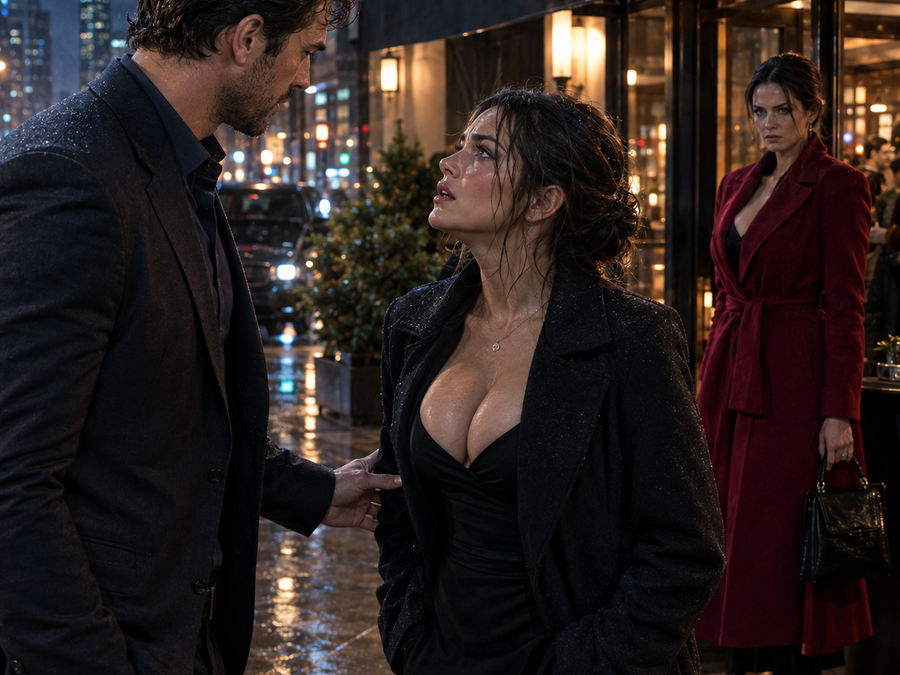
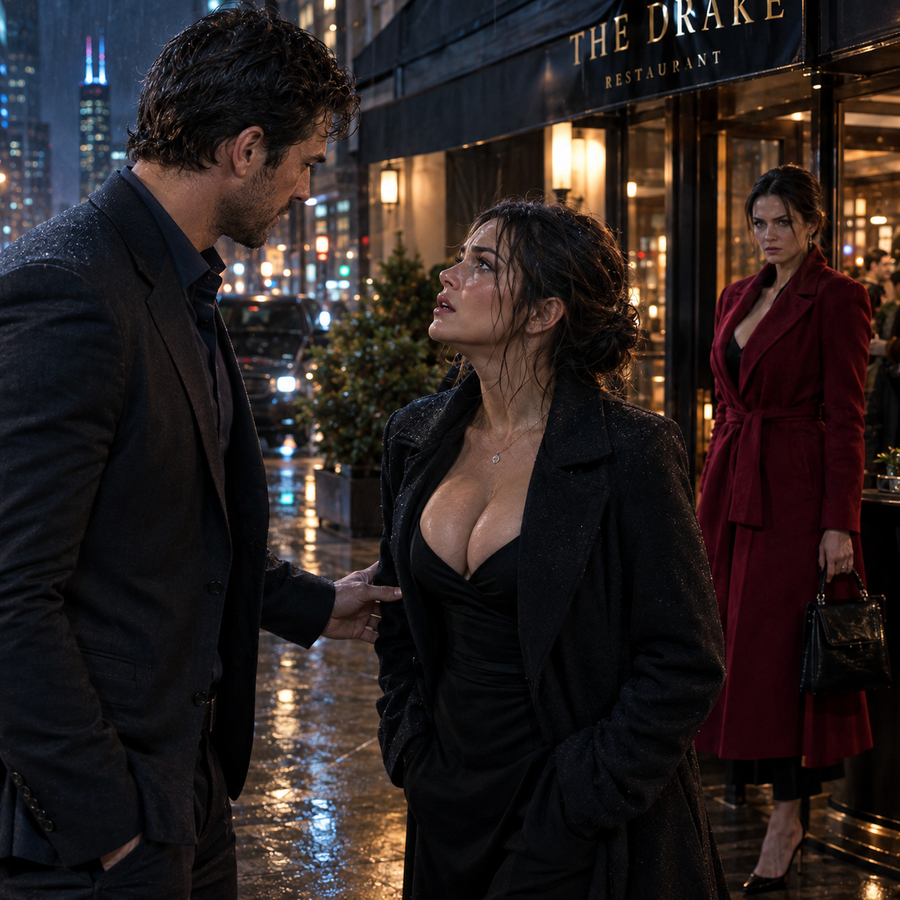
The voice came from behind them like a door slamming shut. They both turned. A woman stood at the entrance of the restaurant. Tall. Immaculate. Crimson coat. The kind of beautiful that looked engineered rather than inherited. She was looking at them with eyes like surgical instruments. Cold. Precise. Cutting.
“I’ve been waiting inside for 23 minutes,” she said. Her voice was perfectly controlled. “The host told me you’d stepped outside.” Her eyes moved to Olivia. They didn’t move away. “I wasn’t aware you had company.”
The silence that followed lasted approximately three seconds. In those three seconds, Olivia understood several things simultaneously. This woman was Ethan’s actual blind date. Which meant Ethan was not Maya’s blind date. Which meant she, Olivia, who was pretending to be Maya, who had sat at the wrong table in the wrong alcove in the wrong restaurant situation, had just spent three hours with a complete stranger, drunk his wine, told him true things she hadn’t told anyone in two years, and kissed him on a public sidewalk.
“Oh, God,” she said. It came out barely above a whisper.
Ethan turned to look at her. She could see the moment he understood, too. The rapid, silent recalculation moving behind his eyes. The table number. The reservation name. The way she’d paused before saying her name. Maya. He watched him understand that wasn’t her name.
“Wait—” he said.
She was already moving. She didn’t run. She wasn’t going to run. She had some dignity left. But she moved with the focused, deliberate speed of someone who has decided that forward is the only direction available.
“Wait.” His voice behind her, closer than she expected.
She didn’t stop. She merged into the Friday night crowd. The city swallowing her with the casual efficiency it had always offered. Just another person in a black dress moving through light and noise, becoming nobody. Behind her, she heard his voice once more. And then the sound of the woman in the crimson coat saying something sharp and controlled. And then nothing. Just Chicago. Just the wet street and the Friday night and the sound of her own pulse.
She walked four blocks before she stopped. She stood under a street light in the rain that had started again and she pressed her hand flat against her sternum like she could slow the thing happening inside it. Her phone rang.
“Maya,” she answered.
“How did it—”
“I kissed him, Maya.” Her voice came out strange. Thin. “I sat at the wrong table and I didn’t know. And I spent three hours with him and I kissed him and his real blind date showed up and I ran.”
Silence.
“Olivia.”
“And I still don’t know his last name.” A pause that lasted exactly long enough to mean something.
“Olivia,” Maya said, very carefully. “What did he look like?”
“Tall. Dark blazer. He said his name was Ethan.”
The sound her sister made then was not a word. “Maya, what?”
“Olivia.” Maya’s voice had dropped to something between a whisper and a warning. “The man David set me up with—”
“What about him?”
“His last name is Blackwell.”
The name landed. It shouldn’t have meant anything to her. She didn’t follow business news. She didn’t read financial magazines. She managed a bookstore on the north side of Chicago where a 92-year-old man came to buy mysteries and an old woman had strong opinions about the biography section. But even she knew that name. Because there were names that existed beyond industries, beyond circles, beyond the particular world of people who tracked such things. Names that had simply entered the air of a city and stayed there. Blackwell.
“He’s—” she started.
“One of the youngest billionaire CEOs in the country,” Maya said quietly.
“Yes.”
Olivia stood in the rain. The city moved around her, indifferent and brilliant. She thought about what he’d said. “I prefer someone who looks at me like I’m ordinary.” She thought about the essay in his desk drawer, the grandmother’s garden, the wine that cost too much. The way he’d laughed, really laughed, at something she’d said, like it had surprised him out of himself.
She thought about, “Was tonight real for you,” and she had said yes and meant it. To a man who was not ordinary in any way at all. A man who had kissed her not knowing her name was a lie. A man who didn’t know her name was a lie. A man who, she was just now understanding, had the resources, the determination, and the particular quality of focus she had seen in his eyes tonight to find absolutely anything he decided to look for.
“Olivia,” Maya said into the phone. “Are you still there?”
She looked up at the sky. At the rain falling through the city light. “Yes,” she said.
“Are you okay?”
She thought about it honestly. “No,” she said. A pause. “Do you want me to—”
“No,” she said again. “I’m fine. I just need to walk.”
She hung up. She started walking. She told herself she would never see him again. She told herself the evening was over. Sealed. Finished. A strange and beautiful mistake she would carry quietly for years and eventually tell no one. She told herself that. She believed approximately none of it.
Forty-third floor. City below. Rain on glass. Ethan Blackwell stood at his window and did not look at his phone. Did not check his messages. Did not review tomorrow’s schedule or think about Monday’s infrastructure deal or consider the board call he’d been putting off for six days. He stood very still and thought about a woman who had looked at $42 pasta like it had personally offended her. Who had said “he matters” about a 92-year-old stranger. Who had told him things that were true. Who had said her name was Maya and had paused. Just slightly. Just barely. Before she said it.
His phone was in his hand. He didn’t call his assistant. He called Marcus. His head of security. The man who had worked with him for 11 years. Who had found things and people and information in places that appeared to have no information available.
“Marcus,” he said when the line picked up.
“Sir.”
“I need you to find someone.” A pause.
“What do I have to work with?”
Ethan thought. “The reservation for alcove 6 at Marchetti’s tonight,” he said. “Whatever name it was booked under.” And a woman. Early 30s. Dark hair. Black dress. She knows the owner of a bookstore called The Third Chapter on Hallstead. She might work there. Another pause. Longer.
“That’s not much,” Marcus said.
“I know,” Ethan said. “Find her anyway.”
He hung up. He looked at the city. He thought about her voice. Her laugh. The way she’d said, “You’re more human than I expected.” Straight and simple and without any agenda behind it. Just a true thing offered freely. He thought about 30 seconds on a wet sidewalk that had rearranged something fundamental in a life he’d spent 15 years building with absolute precision. He had made decisions that moved markets. He had built things that lasted. He was not a man who let important things disappear into the night and called it finished. Somewhere in this city, she was walking. She thought the evening was over. She had absolutely no idea that for him, it had only just begun.
She didn’t sleep. Not really. She lay in bed with her eyes closed and replayed the evening in fragments. The candlelight. The wine. The way he’d laughed, like it surprised him. The 30 seconds on the sidewalk that she could not, no matter how firmly she instructed herself, stop feeling in her hands.
At 2:00 in the morning, she gave up and made tea. At 3:00, she opened her laptop and typed Ethan Blackwell. She stared at the search results for a long time. Forbes profile. Bloomberg interview. A photograph from a gala. Him in a tuxedo. Looking at something slightly off-camera. An expression controlled and remote. And nothing like the man who had told her about his grandmother’s tomatoes. Blackwell Capital. Founder and CEO Ethan Blackwell, 38, whose firm manages over $40 billion in assets.
She closed the laptop. She sat in her kitchen in her flannel pajamas with her tea going cold, and told herself very clearly and very firmly that this was finished. That the evening had been a beautiful accident. That men like Ethan Blackwell did not go looking for women like her. That the city was large and indifferent and full of people who kissed strangers and never saw them again and were perfectly fine. She believed this. She went back to bed. She did not sleep.
Monday morning. The Third Chapter smelled like it always did. Old paper and coffee and the particular quiet of a place that existed slightly outside the pace of the rest of the world. Eleanor was reorganizing the poetry section with the focused intensity of someone defusing a bomb. Two regulars were browsing. Mr. Kowalski hadn’t come in yet. It wasn’t Tuesday.
Olivia unlocked the back office, hung up her coat, and started her day. She was fine. She was completely fine.
“You’re not fine,” said Dany, her assistant manager, appearing in the doorway with two coffees and the expression of someone who had known Olivia Chen for six years and could read her face like a used paperback.
“I’m fine.”
“You’ve rearranged the new arrivals table three times since you got here, and it’s been 20 minutes.”
“I’m particular, Olivia.” She took the coffee. “It was a strange weekend.”
“Strange how?”
She thought about how to answer that. “I went on a blind date that wasn’t mine. I sat at the wrong table. I spent three hours with a man who wasn’t even the right man. And then I—” She stopped. Dany waited. “And then I found out who he actually was.”
“Who was he?”
Olivia wrapped both hands around her coffee cup. “Someone I was never supposed to meet.”
Dany stared at her. “Olivia, I need more than that.”
“No,” Olivia said. “You really don’t.”
She walked back out onto the floor and rearranged the new arrivals table a fourth time and told herself that was the end of it.
It was not the end of it.
Wednesday evening, her phone rang. Number she didn’t recognize. She almost didn’t answer. She was closing up, counting the register, running through tomorrow’s delivery list. She answered.
“Is this Olivia Chen?” A man’s voice. Professional. Careful.
Her stomach tightened. “Who’s asking?”
“My name is Marcus Webb. I work for—” A pause. “I’m calling on behalf of someone who would like to reach out to you directly, if you’re open to it.” He asked me to be clear that there’s no pressure and no obligation.
Her hand had gone very still on the register. “Who?” she said.
Another pause. “Ethan Blackwell.”
Marcus said. The silence that followed was approximately four seconds long and felt considerably longer.
“He found me,” she said. Not a question.
“He was motivated,” Marcus said neutrally.
She looked at the empty bookstore around her. Eleanor’s carefully reorganized poetry section. The biography shelves that had been a battleground for 30 years. The worn armchair near the window where Mr. Kowalski sat on Tuesdays while he chose his mystery.
“Tell him,” she said slowly, “that I appreciate he’s—” Outside, Marcus said.
She turned around. Through the front window of The Third Chapter, on the other side of the glass, Ethan Blackwell stood on the sidewalk in a dark coat, hands in his pockets, watching her with an expression that was nothing like the controlled, curated face in the Forbes photographs. He looked, she thought, exactly like a man who had made a decision and was not entirely sure it was rational and had made it anyway.
Her heart did something it had no business doing. “He has terrible timing,” she said into the phone.
“He’s aware,” Marcus said. “He said to tell you he’s also aware that you might close the blinds and pretend you’re not here, and he’d understand.”
She looked at Ethan through the glass. He raised one hand. Not a wave. More like an acknowledgement. I see you. I know you can see me. Your move.
She pressed her fingers flat against the side of her phone. “Give me five minutes,” she said.
She let him in through the front door, and the bell above it made its small, ordinary sound. And for a moment, they just stood there in the bookstore with the smell of old paper and coffee between them and absolutely nothing to say.
“You found me,” she said finally.
“I did.”
“That’s either impressive or alarming.”
“Probably both,” he said. “I’m sorry if it’s alarming.”
She crossed her arms. Not defensively. More like she needed something to hold on to. “How?”
“The reservation was under your sister’s name. It wasn’t hard to find The Third Chapter from there.” He paused. “I wasn’t going to come. I told myself I wasn’t going to come.”
“What changed your mind?”
He looked at her directly. “I kept thinking about what you said. About Mr. Kowalski. About how he holds books like they’re keeping him company.” A pause. “I kept thinking that the kind of person who notices that about a stranger is someone I’d like to know. Under honest circumstances.”
She held his gaze. “My name is Olivia,” she said. “Not Maya. Maya is my sister. She had an emergency and I went in her place and I sat at the wrong table and I should have told you the truth and I didn’t. And I’m sorry.”
He took that in. Let it settle. “Which part are you sorry for?” he said. “The name? Or the table?”
“Both.”
“The conversation was real,” he said. “The things you told me were real.”
“Yes.”
“Then I’m not interested in being angry about the rest.” He said, “I’m interested in starting over. With the real name. At a table we both actually belong at.”
She stared at him. “You flew past that very smoothly,” she said.
“I practiced on the drive over.”
She almost smiled. Against her better judgment. Against every sensible instinct she possessed. “I Googled you,” she said. “I assumed. $40 billion in assets, Ethan. Give or take. That is not—” She stopped. Started again. “That is not a small difference between us.”
“I know,” he said. “I’m not pretending it isn’t there. I’m asking you to have dinner with me anyway.”
The bookstore was very quiet. Outside, Chicago moved past the window, indifferent and alive. “One dinner,” she said.
“One dinner,” he agreed. “Somewhere without $40 pasta.”
She smiled. For the first time since he’d walked through the door. He smiled. And it was the same smile. The real one. The one that had surprised itself into existence on Friday night when she’d said something that caught him off guard. She noticed that she’d been looking for exactly that smile. She decided not to examine what that meant.
“I know a diner on Wacker,” he said. “Best pie in the city. $8 a slice.”
“That,” she said, “is the correct answer.
The diner was loud and bright and smelled like coffee and butter and the specific warmth of a place that had been feeding people for decades without apology. They slid into a booth and a waitress named Bev appeared within 30 seconds, called them both “hon,” and recommended the cherry pie with the authority of someone who had been right about this for 30 years. They ordered cherry pie. They talked.
And here was the thing that Olivia had been afraid of driving over in the rideshare, watching the city pass the window. She’d been afraid that Friday had been a fluke. That the conversation had been magical precisely because it was built on a mistake, on borrowed names and wrong tables, on the particular freedom of being someone you weren’t in a place you didn’t belong. She’d been afraid that Ethan Blackwell, in real life, without the candlelight and the misunderstanding, would be the man in the Forbes photograph. Controlled. Remote. Looking at something slightly off-camera.
He was not that man. He was sitting across from her in a booth with Formica countertops and a laminated menu, eating cherry pie with genuine concentration and telling her about a deal he’d almost walked away from last year. Not the financial specifics, but the human part of it. The part where a company’s founder had shaken his hand and said, “My employees have families. Please don’t forget that.” And how he hadn’t forgotten it. How he thought about it more than he thought about the numbers.
“People usually don’t tell me things like that,” she said.
“What do you mean?”
“The real version.” She said, “The human version. People usually tell me the version they want me to believe about them.”
He looked at her. “How do you know this is different?”
“Because the version you want me to believe would sound better than that.”
He was quiet for a moment. “You’re very hard to be comfortable around,” he said. “In the best possible way.”
“I get that a lot,” she said. “Mostly from people who stop calling.”
“I’m not going to stop calling.” He said it simply. Not as a declaration. Not as a promise. Just as a fact. He was stating it the way you’d state that the pie was good or the coffee was hot. Certain. Unperformed. She looked down at her plate. She was in very serious trouble and she knew it.
They began seeing each other. Not in any dramatic or announced way. Just in the ordinary accumulation of evenings that started adding up to something. Tuesday dinners. Saturday afternoon walks along the lakefront. A Sunday morning where he showed up at the bookstore with coffee and spent three hours reading in the worn armchair near the window while she worked. And the rightness of it was so quiet and unremarkable that it frightened her.
He took her places she’d never been. A private tour of the Art Institute after hours, just the two of them moving through rooms that were hushed and enormous and full of things that had survived centuries. A charity gala where she wore a borrowed dress and felt like a tourist until he put his hand at the small of her back and said quietly, “You’re the most interesting person in this room, and about 12 people have already noticed.” And she’d laughed at him and secretly, privately, felt it land somewhere warm.
She took him places he’d forgotten existed. The volunteer project she ran twice a month at a community center on the south side. Reading programs for kids whose school libraries had been defunded. She hadn’t planned to invite him. It happened because he’d asked what she was doing on a particular Saturday and she’d told him the truth and he’d said, “Can I come?” And she’d said, “It’s not what you’re used to.” And he’d said, “Good.”
He sat in a too-small plastic chair for two hours and helped a seven-year-old named Marcus—no relation—sound out a picture book about a bear who couldn’t find his honey. The kid read the last page himself, slowly and triumphantly, and looked up at Ethan with the expression of someone who had just done something they hadn’t been sure they could do. Ethan looked at Olivia over the kid’s head. She had never seen that expression on his face before. Something open. Undefended. Quietly undone. She looked away first because she had to.
It was his assistant, Caroline, who first said it out loud. Three weeks in, Ethan had stepped out of his office for a call, and Caroline had appeared in the doorway and said, without preamble, “She’s different.”
Ethan looked at her. “Excuse me?”
“The woman you’re seeing. Olivia.” Caroline had worked with him for seven years and had long since passed the point of filtering herself. “She’s different from everyone else you’ve—”
“Caroline.”
“I’m just observing. You’ve rescheduled three Friday meetings. You left a board dinner early last week. You ate lunch here on Tuesday instead of your desk.” A pause. “You seem like yourself.”
He looked at her for a moment. “I am always myself,” he said.
“No,” she said, kindly and without cruelty. “You’re really not. But you have been lately.”
She left. He stood in his office and looked at the city through the floor-to-ceiling glass and thought about a woman who had sat in a too-small plastic chair and watched a seven-year-old discover that he could read, and had looked in that moment like the truest version of herself he’d ever seen anyone be. He picked up his phone. He called her.
She answered on the second ring. “I’m at the store.”
“I know. I just wanted to—” He stopped. “How’s Eleanor?”
A pause. “She’s reorganizing the travel section. She says memoirs are getting too close to the self-help shelf and it’s philosophically offensive.”
“She’s not wrong.”
He could hear the smile in her voice. “Why are you calling, Ethan?”
“I don’t know,” he said honestly. “I just wanted to hear your voice.”
The silence that followed was warm and a little terrifying, and she didn’t fill it, and neither did he, for a long moment. “I’ll see you Friday,” she said finally, softly.
“Friday,” he said.
He hung up and sat with the feeling. The particular feeling of someone who has spent a long time moving very fast in a straight line and has just, for the first time in years, stopped and looked around and found the world larger than they remembered.
She first heard the name Victoria Sterling from Maya. They were on the phone a Thursday evening. Maya in full research mode, which was how Maya processed things she was excited about and worried about simultaneously.
“I’m not trying to alarm you,” Maya said, which meant she was absolutely trying to alarm her. “Maya.”
“Victoria Sterling. Her family’s been connected to the Blackwells socially for years. They run in the same circles. She was at that gala you went to three weeks ago.”
Olivia thought back to the gala. The crimson coat. The surgical eyes. “I know who she is,” Olivia said.
“She’s been talking. Not publicly. Privately. In those circles where private talk does all the real damage.”
“Talking about what?”
A pause. “About you,” Maya said. “About where you’re from. What you do. About whether you belong in Ethan’s world.”
The words settled in Olivia’s chest like something cold. “What exactly is she saying?”
“That you’re a bookstore manager who got lucky with a wrong table. That you’re out of your depth. That women who come from money understand that world and women who don’t—” Maya stopped. “I’m sorry. I’m just telling you so you’re prepared.”
“Prepared for what?”
“For it to get louder,” Maya said quietly. “Olivia, men like Ethan—their lives are public whether they want them to be or not. And the people in that world protect the borders of it. She’s not the first person to talk and she won’t be the last.”
Olivia was quiet. “Are you okay?” Maya said.
“I’m thinking,” she said. She was thinking about a booth in a diner and cherry pie and a man who had sat in a too-small chair for two hours because a seven-year-old needed to learn that he could read. She was thinking about “the most interesting person in this room.” She was thinking about “I just wanted to hear your voice.”
“I’m fine,” she said.
“Olivia—”
“I said I’m fine, Maya.” Her voice was steady. “Let her talk.”
She hung up. She stood very still in her apartment. She was not entirely fine. But she was not afraid. There was a difference. And somewhere across the city, in a building that reached 43 floors into the Chicago sky, she suspected that a storm was coming. Not from any external source. Not from any tabloid or social circle or woman in a crimson coat. But from the simple, dangerous fact that two people who had no business falling in love were falling in love anyway. And love, she had learned, had never once cared about what made sense.
The photographs appeared on a Thursday morning. Olivia found out the way most people find out that their life has become public property. Not from a warning. Not from a phone call from someone who cared. But from a stranger.
A customer who came into The Third Chapter at 9:15 set her phone face up on the counter and said, with the particular breathless energy of someone delivering news they knew was bad, “Is this you?” Olivia looked at the screen. It was her. Outside Ethan’s building three weeks ago. Leaving at 7:00 in the morning after they’d fallen asleep watching a documentary about deep-sea fish that neither of them had been paying attention to. She was in yesterday’s clothes, carrying her shoes, squinting against the early light.
The headline read: “Blackwell’s Mystery Woman: Gold Digger or Genius?” She stood very still. The customer was still talking. She didn’t hear any of it. She picked up her phone and called Ethan. He answered on the first ring.
“I already know,” he said. “I’m sorry. I found out 20 minutes ago. My team is—”
“How many?” she said. “A pause. How many what? Photos. Sites. How many?”
A longer pause. “Olivia—”
“Tell me.”
“Fourteen outlets have picked it up. Two major tabloids. It’s hitting social media now.” His voice was controlled, but tight. The way it got when he was managing something he was furious about. “My PR team is already working on a response. This is Victoria.”
“I know it’s her. I can’t prove it yet, but—”
“Ethan.” She stopped him. “What are they saying about me?”
The silence that followed told her everything before he said a word. “They’re saying you engineered the blind date mix-up on purpose,” he said quietly. “That you knew who I was. That you targeted me.”
She sat down on the stool behind the counter. The bookstore was quiet around her. Eleanor hadn’t come in yet. Dany was in the back. The morning regulars hadn’t arrived. She felt very suddenly completely alone.
“That’s not true,” she said.
“I know it’s not true, Ethan. I didn’t even know your last name until Maya told me.”
“I know, Olivia.” His voice was steady. “I know. I believe you. That is not the question.”
“Then what is the question?”
“The question,” he said carefully, “is how we handle the next 24 hours. Because it’s going to get louder before it stops.”
She looked at the phone screen the customer had set on her counter, still face up. Someone in the comments had written: “Classic social climber behavior. These women are all the same.” It already had 400 likes.
“I have to open the store,” she said.
“Olivia—”
“I have to open the store, Ethan. That’s what I do. I open the store.” Her voice came out steadier than she felt. “Call me later.”
She hung up. She turned the phone face down on the counter. She opened the store.
By noon, it was everywhere. Dany came out of the back office with her laptop and her face arranged into the careful, neutral expression of someone delivering a terminal diagnosis.
“It’s trending,” she said. “Chicago section. Nationally now.”
“I see it,” Olivia said. She was shelving returns. Methodically. One book at a time.
“There are people outside,” Dany said.
Olivia stopped. “What kind of people?”
“Two photographers. One woman with a microphone who keeps looking at her phone. They’re on the sidewalk.”
Olivia put the book in her hand back on the cart. She thought about Eleanor, who would arrive at 1:00 and who was 71 years old and had never in 30 years of running this bookstore had a camera pointed at her front door. She thought about Mr. Kowalski, who came on Tuesdays and didn’t trust databases. She thought about the seven-year-old named Marcus, who had sounded out his last page with his whole body leaning forward, triumphant. She thought about all the ordinary, essential, irreplaceable things that existed in the life she had built quietly, carefully, after two hard years of rebuilding. And she felt something shift inside her. Not fear. Something colder and cleaner than fear. Anger.
“Call Eleanor,” she said. “Tell her to come in the back way. Then call the building. They can ask the photographers to move off the property line.”
Dany nodded. “And you?”
“I’m going to keep shelving,” Olivia said. “Because that is my job and this is my store and I am not going to let anyone take that from me today.”
Ethan called at two. “I want to make a statement,” he said directly. “Put this down immediately.”
“What kind of statement?”
“The kind that makes clear exactly what Victoria is doing and why.” His voice had an edge she hadn’t heard before. Not anger, exactly. But the particular cold precision of someone who has spent years knowing how power works and has just decided to use it. “My lawyers are ready. Ethan, stop.”
She moved to the back office. Closed the door. “If you come out swinging publicly, it becomes a war. And wars like that have collateral damage.”
“You are the collateral damage right now.”
“I know.” She sat down. “I know that. But I need you to listen to me. If you make this a public fight, it feeds it. Every statement, every counter-statement, it keeps the story alive. It keeps my name in it.”
A silence. “So what do you want me to do?” he said.
“Nothing. I want you to let me think,” she said. “For 24 hours. Can you do that?”
“I can,” he said. “I don’t want to.”
“I know.” A pause. “Ethan, do you trust me?”
The question surprised him. She could hear it, the slight shift in his breathing, the half-second before he answered.
“Yes,” he said. And then, more quietly, “More than I’ve trusted anyone in a long time.”
“Then give me 24 hours.”
He gave her 24 hours.
She spent the night on Maya’s couch, because she didn’t want to be alone and couldn’t say that to anyone except her sister, who understood without being told and made tea and didn’t say anything useful, which was exactly what was needed.
At midnight, Maya turned off the television—the entertainment news had picked it up—and sat cross-legged on the other end of the couch and said, “Tell me how you’re actually doing.”
“I’m furious,” Olivia said.
“Good.”
“I’m also scared.”
“Also good. Scared means you care.”
“I keep thinking—” She stopped. Started again. “I keep thinking about whether he’s worth it. Not Ethan. The situation. Whether any person is worth becoming a headline.”
Maya was quiet. “Is he?” she said finally.
Olivia looked at the ceiling. She thought about a too-small plastic chair and a seven-year-old named Marcus. She thought about “I just wanted to hear your voice.” She thought about the essay in the desk drawer and the grandmother’s tomatoes and the 30 seconds on a wet sidewalk that she had been measuring every other moment against for weeks without fully admitting it.
“Yeah,” she said. “He is.”
“Then you already know what you’re going to do,” Maya said.
“I’m not sure I do.”
“You do,” Maya said. “You’ve always known. You’re just deciding if you’re brave enough.”
Olivia looked at her sister. “When did you get wise?” she said.
“Somewhere between your second cup of tea and the 11:00 news.” Maya said. “It happens.”
The second wave hit Friday morning. Worse than the first. Someone—and Ethan’s team confirmed within hours that it traced back to a source close to Victoria Sterling—had leaked Olivia’s employment history. Her salary range. The broken engagement from three years ago. And a photograph from her lowest year. A year she did not discuss. A year she had survived and moved forward from. That had been pulled from a private social media account she’d thought was locked.
The narrative shifted. “Gold digger” became something crueler. More personal. The kind of language that didn’t leave marks you could point to, but left marks nonetheless. Her phone wouldn’t stop. Numbers she didn’t know. Comments she’d stopped reading after the third one. A woman she’d gone to college with, hadn’t spoken to in years, sent a message that said simply, “I’m sorry this is happening to you.” Which was somehow the thing that almost broke her.

