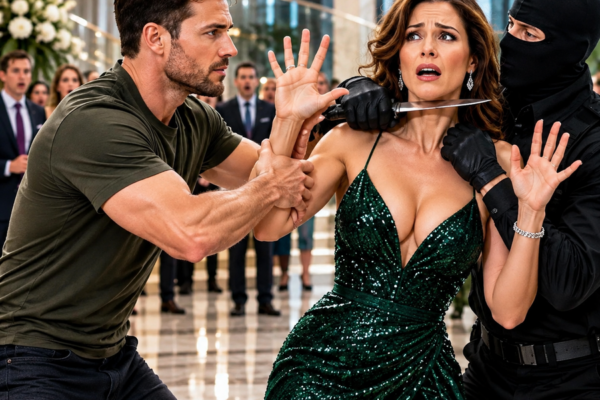
The Hostage Taker Chose the Single Dad—The Female CEO Had No Idea He Was a Former Navy SEAL
The Hostage Taker Chose the Single Dad—The Female CEO Had No Idea He Was a Former Navy SEAL
The man they picked as the easiest target in the room was the last person on earth they should have touched. Five armed men, one locked bank, dozens of hostages, and somewhere in that cold marble lobby, a little girl named Ava sat alone, clutching her backpack straps, waiting for her father to come back from the counter.
Her father wasn’t coming back the way they expected because the man the mercenaries just dragged into that soundproof room, the quiet one in the worn jacket, the one who flinched when they grabbed him, the one they laughed at, had spent 11 years doing things for his country that will never appear in any public record.
They wanted a bargaining chip. They picked a weapon.
The alarm on Ryan Mercer’s phone went off at 6:14 in the morning, 16 minutes before it was supposed to because Ava had been messing with his settings again.
He lay there for a moment, staring at the ceiling of their apartment, a two-bedroom on the third floor of a building that always smelled faintly of whoever was cooking on the second floor, and thought about how much he didn’t want to do this today.
Not the bank visit, not the 45minute commute downtown, not the conversation he was going to have to have with some underpaid customer service rep about why a clerical error in a direct deposit account had been sitting unfixed for 3 months while his daughter’s college fund quietly bled interest.
He heard Ava before he saw her. She appeared in the doorway in mismatched socks, one striped, one solid purple, holding a cereal bowl with both hands like an offering.
I already ate, she announced. I can see that you were slow.
I was sleeping. You were staring at the ceiling.
She patted across to the foot of his bed and sat down uninvited.
“You do that a lot.
” Ryan pushed himself upright and rubbed his face with both hands.
“She wasn’t wrong.
He did do that a lot.
You’re coming with me today,” he said.
“Bank?
Then you get to pick lunch.”
Ava considered this with the gravity of a small judge. Anywhere within reason.
That’s not anywhere.
That’s the deal.
She hopped off the bed. Fine, but I want the place with the good bread.
Ryan didn’t know which place with the good bread she meant.
He’d figure it out later.
Well, the morning was cold the way Chicago mornings in late October are cold.
Not the brutal cold that would come in another 6 weeks, but the early kind, the kind with edge, the kind that gets into the collar of your jacket and reminds you it’s coming.
Ryan walked with his hands in his pockets, and Ava walked beside him with her hands not in her pockets because she’d left her gloves at home again, and she refused to admit her fingers were cold.
“They’re not cold,” she said when he offered his.
“Your knuckles are white.”
“That’s just how they are.”
He let it go.
They took the blue line downtown and Ryan stood the whole way even though there were seats because Ava had decided she wanted to stand too and she couldn’t reach the overhead bar.
So he held it and she held his arm and they swayed together through the dark tunnels under the city without saying much. The bank was on Michigan Avenue, First Continental Private Banking, which was the kind of name that made Ryan feel faintly ridiculous walking through the doors.
He’d opened the college account there 7 years ago because his late wife Clare had done her research and decided it was the best option and he’d never moved it because changing it felt like undoing something she’d set up and he wasn’t ready for that.
And maybe he never would be. So here he was, man in a worn canvas jacket in a bank with marble floors and the kind of lighting that made everyone look like they were being softly photographed. The lobby was quieter than he expected for a Tuesday morning.
Maybe 15 people. A couple of suits near the back. A woman at the far window talking at a low volume into her phone.
An elderly man filling out a form at one of the standing desks with the focused intensity of someone diffusing a bomb. Ryan led Ava to the seating area near the entrance, a cluster of low chairs around a glass table with financial magazines from 2 months ago, and crouched down to her level.
I’m going to the counter.
He said, you sit here.
Don’t move.
I know. I mean it this time. I always know what you mean.
Last time you wandered into the safe deposit room. I was curious. Ava.
She dropped into one of the chairs and pulled out the battered paperback she kept in her backpack, some fantasy novel she’d already read twice, and opened it without looking up at him.
I’ll be here.
Go fix your account. He went.
So, the counterrep was a young guy named Marcus, according to his name tag, who had the slightly glazed expression of someone who’d already handled four difficult customers before 9:00 a.m.Ryan kept it simple, explained the issue, gave the account number, watched Marcus type things in, and frowned slightly and type more things.
There’s a routing discrepancy, Marcus said.
Yeah, I know.
That’s what I’m here to fix.
It looks like it’s been flagged.
It’s been flagged for 3 months.
That’s also what I’m here to fix.
Marcus typed more things.
I’m going to need to pull in my supervisor.
This is a That’s fine.
It might take a few minutes.
That’s fine, too.
Ryan leaned against the counter and looked back at the lobby. He did this without thinking about it.
Habit so old it had stopped feeling like a habit. Counted the exits. the two main doors at the front, a staff door behind the tellers, a second door to the right of the loan offices, probably a corridor to the back.
Four security cameras he could see.
One guard near the entrance, older guy, maybe 60, with the soft posture of someone who’d been standing in the same spot for 15 years and hadn’t needed to do much else.
He located Ava, still in the chair, still reading. He exhaled slowly and turned back to the counter. Marcus was gone, presumably getting the supervisor.
Isabella Vaughn arrived at First Continental at 8:47 for a 9:00 meeting.
She hadn’t put on her public calendar, which was the point.
She wore a dark blazer over a charcoal turtleneck, hair pulled back in the kind of no fuss way that took effort to achieve, and she carried a single leather portfolio because she’d learned years ago that carrying a lot of things made people assume you needed help with them.
She didn’t need help with them.
She was 30 years old and she ran Vaughn Logistics Solutions which had started as a regional freight coordination firm when she was 24 and had in the 6 years since become something considerably more complex. The defense contract her company had just finalized, a multi-billion dollar arrangement involving encrypted routing infrastructure for military supply chains, had taken three years of negotiation, two failed attempts, and one lawsuit to secure.
The signing had happened quietly 2 weeks ago in a conference room in DC that she was fairly certain was swept for devices before every meeting.
Today’s meeting was with Martin Hail, the bank’s director of private asset management, about restructuring her company’s financial architecture, now that the contract was live, routine, necessary, boring in the way that much of running a company was boring once you stripped away the headlines.
She crossed the lobby without making eye contact with anyone, also a habit, and a junior bank employee materialized at her elbow to guide her toward the private meeting suites in the east wing.
She didn’t notice the man in the canvas jacket at the counter.
Why would she? D. It came apart at 9:04.
Ryan heard the doors first, both sets, front and side, almost simultaneously. And before his mind had fully processed the sound, his body had already taken half a step back from the counter and angled itself instinctively toward the threat.
Five men, black tactical gear, no insignia.
Two through the front, two through the side, one through the staff entrance, which meant they had access to the building’s layout, which meant this was planned, which meant this was not a robbery.
The one who came through the front moved like someone who’d done this before.
Not nervous, not rushed.
Calm in the way professionals are calm, which is the worst kind of calm because it means they’ve already considered every way this could go wrong and decided they can handle it.
Everybody down.
He had a slight European accent Ryan couldn’t immediately place.
The voice was even. Phones on the floor.
Don’t make me ask twice.
People froze.
That’s what people do.
They freeze just for a half second because the brain takes a moment to accept that something impossible is happening. Then the screaming started from a woman near the window and the man at the front let off one round into the ceiling and the screaming stopped, replaced by a silence that was much heavier.
Ryan was already on the floor, not because he was afraid, because you don’t stand up when you’re outgunned and you’re without cover and your 8-year-old daughter is sitting 30 ft away.
He looked toward the seating area. Ava was under the chair.
She’d moved fast, smarter than most adults.
She’d gone horizontal and made herself small.
And she was looking at him across the marble floor with huge dark eyes, and he held her gaze for exactly 2 seconds, gave her the smallest shake of his head.
Don’t move.
Don’t make noise.
I see you. She gave him the smallest nod back. Good girl.
The mercenaries moved through the lobby with practice deficiency. One stayed at the front door. One herded the hostages toward the center of the room.
12 people, Ryan counted, not including himself and Ava, not including the bank staff now being pushed out from behind the counter. The other three disappeared deeper into the bank. The leader, the one with the accent, walked through the hostages slowly, not looking at wallets or jewelry or anything that would suggest a conventional robbery.
He was looking at faces. He was looking for something specific. Ryan kept his face down.
He kept his posture soft, shoulders rounded, the universal body language of a man who is frightened and harmless and not worth anyone’s attention.
He was very good at this.
He’d had a lot of practice being underestimated.
It didn’t work.
You. The voice was above him.
Ryan looked up slowly. The commander was looking at him directly.
He pointed with two fingers. Stand up.
Ryan stood slowly.
He kept his hands visible and his expression slightly confused, which wasn’t hard to manufacture.
The commander studied him for a moment. the jacket, the ordinary face, the complete absence of anything remarkable, and seemed to make a decision.
“You’re coming with me,” he said.
“Don’t do anything that makes this more interesting than it needs to be.”
Ryan heard Ava make a small sound from under the chair.
He didn’t look at her.
Looking at her would tell this man she mattered.
“Okay,” Ryan said.
“Whatever you want.”
They took him to the security monitoring room in the corridor behind the tellers, a small space that smelled of old coffee and cooling electronics. Three monitors showing feeds from a dozen cameras.
A metal desk bolted to the wall.
The guard who’d been stationed there was zip tied in the corner, looking embarrassed and scared in equal measure.
The man who brought Ryan in was not the commander. He was younger, maybe late 20s, wide through the shoulders with the impatient energy of someone who wanted to be somewhere more important. He shoved Ryan into a chair and zip tied one wrist to the armrest.
“Stay,” he said, which was the whole of his interest in Ryan.
He turned back to the monitors. Ryan looked at the screens.
The lobby feed showed the hostages sitting in a rough cluster on the marble floor, arms around each other, a few with their faces buried in their hands.
He found Ava still under the chair, slightly obscured by someone’s legs, but visible to him because he knew what he was looking for.
She had her paperback pulled to her chest, and she was doing what he told her to do once years ago when he’d explained something to her in a way that no reasonable parent explains things to a 7-year-old.
If anything ever happens and I’m not there, you make yourself small, you stay quiet, and you trust that I’m working on it.
She was trusting him. He looked at the other feeds. Two men visible in what appeared to be a conference corridor.
They were outside a door, one of them talking into a radio. The third had gone deeper toward what Ryan guessed was the private suite section of the east wing. The commander was not on camera, which meant he was in the meeting room itself, which meant the target was in the meeting room.
Ryan had been doing math since the moment they walked in. Five men assault weapons.
He’d made two for HKMP5s and two for something shorter, possibly scorpions or compact AR variants.
Tactical gear that was good but not special forces quality. They moved well but not perfectly. There were gaps, moments of overconfidence, the small tells of men who were trained but not elite.
What he didn’t know was why.
The guard’s radio on the desk crackled.
A voice, the commanders said something brief in a language Ryan couldn’t catch from this distance and at this angle.
The young mercenary picked it up and answered in the same language.
Ryan didn’t have the translation.
He didn’t need it yet.
What he needed was for the man watching the monitors to make one mistake.
He didn’t have to wait very long.
Du.
15 minutes into the standoff, the mercenary’s phone buzzed in his chest pocket.
The phone, not the radio. Personal call. He reached for it with his right hand, which meant he had to half turn away from the monitors, which meant his angle to Ryan opened up and his weapon, an MP5 on a single point sling, swung forward and to the left away from his body.
He glanced at the screen, hesitated. Whatever was on that screen had his attention for approximately 4 seconds. 4 seconds is a long time.
Ryan had already slipped the zip tie.
He’d done it in the first 5 minutes, rolling his wrist against the plastic at exactly the right angle.
The way you can if you’ve been trained to do it, and the person tying you doesn’t know to leave no slack.
The free hand had been resting in his lap, hidden by the angle of the desk. He came out of the chair without sound. The first thing he did was take the weapon arm, controlled it before anything else.
Because a man with a gun pointed somewhere, he didn’t intend it can still pull a trigger in surprise.
His right hand clamped the wrist.
His left went to the back of the man’s neck and he used the desk edge and it was fast and it was quiet and the man was unconscious before the phone finished buzzing.
Ryan held him as he went down, lowered him to the floor without a sound. He stood in the silence for a moment listening. Nothing from the corridor.
Nothing changed on the monitors.
He took the MP5, took the radio, took the secondary weapon, a compact pistol in a hip holster, took the earpiece from the man’s ear, and put it in his own.
He stood in front of the monitor bank and spent 90 seconds studying every feed, memorizing positions, movement patterns, lines of sight. Then he moved to the door, put his hand on the latch, and paused.
On the lobby feed, he could see Ava still tucked under the chair, her paperback hugged against her chest, her eyes moving every few seconds toward the corridor, toward where she knew he’d been taken.
“I’m working on it,” he said quietly to no one.
He opened the door and went to work. The corridor behind the tellers was narrow and badly lit. Fluorescent panels that buzzed faintly, one of them flickering with the half-hearted rhythm of something that had been broken for months and never fixed.
Ryan moved along the left wall, which kept his silhouette out of the direct line of the lobby camera he’d identified as having the widest sweep.
He disabled the feed to the security room already simply by pulling the cable from the back of the recorder on his way out, but he had no way of knowing whether the mercenaries had a secondary display somewhere else in the building. He assumed they did.
He operated as if everything he did was being watched because that assumption had kept him alive in places considerably more hostile than a bank in downtown Chicago. The earpiece was a standard commercial radio unit, the kind you could order from any tactical supply catalog.
basic encryption. The communications traffic was low, short bursts, mostly position check-ins, and the language was a mix he was starting to recognize. Eastern European, he thought.
Not Russian, something closer to it. He caught a few words he understood and used the rest as texture, building a rough picture of what was happening.
Two men were holding the corridor outside the private meeting suite. One was at the emergency exit at the far end of the east wing, which told Ryan they had the building well mapped to where that exit was not obvious from the floor plans posted publicly.
The commander was inside the suite with the target. The man Ryan had put down in the monitoring room was expected to check in every 10 minutes.
He did the math 6 minutes before the missed check-in became a problem. He needed to be somewhere else by then. The first thing he did was not go toward the east wing.
He went toward the staff break room he’d clocked on the camera feed.
Small room, no windows, microwave on the counter, and a coat rack by the door. He pushed inside, kept the light off, and stood in the dark for 30 seconds just listening.
Water in the pipes. The distant muffled sound of someone crying in the lobby.
He identified it as coming from the direction of where the hostages were clustered, and something tightened in his chest that he pushed back down because there was no room for it right now. He checked the MP5, full magazine, round chambered, safety where he expected it. He ejected the magazine from the pistol and counted rounds by feel, seated it again.
He found a roll of electrical tape on the breakroom counter, the kind maintenance people leave everywhere, and used a length of it to tape the radio to his forearm where he could feel the vibrations without needing the earpiece at full volume. Then he thought about Ava.
He let himself do it for exactly 10 seconds because he’d learned that trying not to think about something used more mental space than letting yourself think about it briefly and deliberately.
She was under that chair. She was scared.
She was 8 years old and she was scared and she was doing exactly what she was supposed to do because she trusted him and that trust sat in his chest like a stone that he was not going to let himself drop. 10 seconds.
Then he put it away and went back to work.
The east wing corridor was longer than it looked on the monitor and quieter than he’d expected.
The bank’s construction was old, pre-war bones under the renovated surface, and the walls were thick enough that sound didn’t travel the way it did in modern buildings.
That was useful. That was the kind of thing that made a difference. He found the first man from the east-wing pair around the corner from the meeting suite, standing with his back to Ryan, weight on his left foot, weapon held loose across his chest.
bored posture, the posture of someone who’d drawn the dull assignment and knew it.
Ryan watched him for 40 seconds from the shadows at the corridor bend, timing his breathing, studying the angle of the camera bracket above the fire door.
The camera itself was dark, which meant someone had cut the bank’s main security feed to the external monitoring company before they came in, which was another data point about how planned this was.
He moved when the man shifted his weight to the right foot and let his head drop slightly.
The micro dip that people do when they’re fighting the beginning of boredom and losing.
Ryan came in from behind and low, and it was fast enough that the man didn’t have time to be surprised.
He went down without a sound, and Ryan caught him and guided him to the floor and held the position for a full count of five, listening. Nothing changed in the earpiece.
one. He pulled back around the corner and waited because the second man from the east wing pair had to be somewhere.
The monitors had shown two in this corridor and a man standing in a corridor doesn’t just disappear.
20 seconds later, he heard footsteps unhurried from the direction of the restrooms at the far end. The second man came around the corner checking his phone, not looking up until he was 10 ft away.
And by then, Ryan had already closed the distance. That one was harder. The man reacted faster than his partner, got a hand up, turned partially, started to bring the weapon around.
Ryan had to redirect the barrel first, which he did with his left forearm, and the suppressor on the weapon discharged once into the ceiling.
A sharp crack that was not as quiet as movies make suppressors sound, and Ryan finished it in the next two seconds, but that sound had gone somewhere, and he didn’t know where.
He stood completely still in the corridor for 15 seconds, heartbeat in his ears. The earpiece crackled, a voice, a question, then from behind the reinforced door of the meeting suite, muffled but audible.
The commander’s voice raised slightly, Ryan exhaled.
He had maybe 2 minutes before the mischief with that sound into a situation that changed the parameters. He dragged both men into the restroom, which was less dignified than he would have liked, but effective, and was back in the corridor in 40 seconds.
The door to the private meeting suite was heavy. Solid core, keypad entry, the kind of door that communicated to clients that their conversations in this room were private and stayed private.
Ryan had no code and no time to look for one. He had something better.
The key card clipped to the belt of the first man he’d taken down, which he’d pocketed on instinct.
He looked at it. Corporate logo on the front. It was a staff pass.
He swiped it anyway. The light went green.
Somebody inside had already bypassed the lock from the inside, probably to prevent staff from walking in. The bypass had left the latch open. The key card just released the secondary magnetic hold.
He pushed the door inward slowly, staying out of the opening, and listened. not asking you to make a decision right now.
The commander’s voice in English now measured and almost pleasant in the way that people who are used to getting what they want can be pleasant.
I’m asking you to consider the position you’re in.
A woman’s voice answered.
Steady, but not entirely steady.
The system you’re describing is encrypted at a level that I know what level it’s encrypted at.
Then you know you can’t use it without the authorization keys and I don’t have those on me.
I don’t carry them.
You have remote access. Not from here.
Not without a secure terminal. A pause. Ryan used the pause to move the door another 3 in and get a partial sight line into the room.
He could see the conference table. Long oval dark wood, the kind that cost more than his car.
He could see the commander standing near the far end.
He was maybe 45, lean with closecropped gray at his temples and the stillness of someone who’d spent a lot of time making consequential decisions without visible effort.
His weapon was holstered.
He was holding a tablet in both hands, and he set it on the table and slid it toward the woman across from him, the way you’d slide a contract.
Ryan couldn’t see her face from this angle.
He could see her hands, both flat on the table in front of her. the deliberate posture of someone keeping themselves from reaching for something.
Ms.Vaughn, the commander said, you’re an intelligent person.
I’ve read a great deal about you.
I know you understand that this ends one of two ways, and in one of them, you walk out of here and continue doing what you do. The other one is more complicated.
For both of us, she said. Yes, he acknowledged, which surprised Ryan slightly.
For both of us. Ryan let the door close to its original position and moved back a step. So that was it.
Not a robbery, not a terrorism event in the conventional sense. Someone had hired these men to extract proprietary technology from a logistics CEO in the middle of a meeting at a private bank, which meant someone had known she was here, which meant either her meeting had been compromised or one of the people who arranged it had been.
He thought about what she’d said.
remote access, secure terminal.
If she gave them that access, this resolved quickly and badly for everyone who hadn’t anticipated what she might hand over.
If she didn’t, the commander would eventually make the kind of decision that commanders in his position make.
The man Ryan had put down in the security room was now 9 minutes past his expected check-in window. The earpiece crackled again, more urgent this time. In the lobby, Ryan knew were 12 hostages and an 8-year-old girl under a chair reading a fantasy novel with the cover pressed to her chest.
And somewhere in the building’s back sections, there were at least two more men he hadn’t reached yet.
He stepped away from the meeting suite door and went to find them. The man at the emergency exit was easy to locate and harder to take because emergency exits are by design in areas with poor concealment.
Ryan found him at the end of a short service corridor that had nothing useful in it. No aloves, no supply closets, nothing except fire extinguishers mounted at intervals on the wall and the heavy pushbar door at the end.
He was big this one, bigger than the others.
He had his back mostly to the door and he was facing the corridor which meant Ryan couldn’t get behind him.
He was also paying attention which was more than could be said for the two in the east wing. He had his head up and he was scanning, which told Ryan this was probably their best man on perimeter.
Ryan didn’t rush it.
He moved as far back as the corner allowed and crouched down near the floor where the angle of the overhead light cast the deepest shadow. He had the pistol in his right hand. The MP5 would make too much noise in this enclosed corridor, even with suppressor.
and he thought about the problem the way he’d been trained to think about problems, which was by not thinking about them directly, but letting the variables arrange themselves.
He was still working on it when the earpiece came alive with something that changed the situation.
The commander’s voice in English, which meant the transmission was intended to be understood by someone specific.
Position two, bring the other one to me now. a response.
Then a second voice, and it took Ryan a half second to place it. The man in the lobby, the one keeping the hostages. He was asking for a description.
“The father,” the commander said.
“The one we separated.
Marcus says he’s not in the room.”
A long silence.
“Find him.”
Ryan straightened up. The big man at the emergency exit had heard it too and was already moving, turning to raise his radio to his mouth. Ryan was already moving.
He came in fast and low, and the big man got his arm up and they went sideways together into the fire extinguisher bracket with a sound that was not as quiet as Ryan would have liked. And the man was strong, genuinely strong.
And it took several ugly seconds in a collision with the wall before it resolved in Ryan’s favor, and by then his shoulder hurt in a way that meant he’d find a bruise the size of a dinner plate there tomorrow.
He crouched over the man and breathed for a moment.
If tomorrow you’re looking at bruises, then today you survived.
Save the inventory for tomorrow.
That wasn’t his thought.
It was something an instructor had told him years ago.
A man whose name he hadn’t heard spoken in a decade.
He stood up, rolled his shoulder, winced, and moved. Three down, two left, plus the commander.
And now they knew he was loose. He went back toward the lobby the long way through the service areas because that was the direction no one would expect.
He could hear radio traffic picking up in the earpiece, controlled urgency, the sound of professionals adjusting to a problem they hadn’t anticipated.
The commander was not panicking. Ryan had expected that.
Men like that don’t panic.
They recalibrate.
What they didn’t know, what the commander couldn’t know from any intelligence about Ryan Mercer of Chicago was what Ryan was actually capable of.
His Navy service record existed. His discharge was honorable.
His standard classification was available if you ran a thorough background check. 8 years of service, two deployments, early exit.
Nothing in the public record indicated what his actual work had been, what unit he’d served with, what he’d done, and where he’d done it.
That was the point. That had always been the point.
After Clare died and Ava was four years old and Ryan was 36 months out of the service and still having nights where he’d wake up at 2:00 a.m.with his hand already reaching for a weapon that wasn’t there.
He had made a deliberate decision to be unremarkable, not to hide, to actually become, as much as possible the man the record said he was. Normal job, normal apartment, normal school for Ava, grocery shopping on Sundays, parent teacher conferences, the place with the good bread.
He had mostly succeeded. He had missed the work sometimes, the way people miss things that have been removed from their life. Not the violence, not the specific acts, but the clarity.
The moments when everything else fell away and there was only the problem in front of you and the solution and the distance between them.
He wasn’t missing anything right now.
He was entirely, uncomplicatedly present. He came out of the service corridor into the side area behind the teller stations and paused in the shadow of a doorframe.
From here, he had a partial view of the lobby through the gap in the teller window partition. He could see the cluster of hostages, could see the man standing over them, weapon across his chest, watching the group with the expression of someone who was now also watching the perimeter.
The man was nervous.
The missing check-in and the commander’s radio message had reached him and changed the quality of his attention.
He couldn’t see Ava from this angle.
He moved to a slightly different position.
Still couldn’t see the chair cluster.
He felt the first real spike of something that was not quite fear, but was adjacent to it.
The specific anxiety of not knowing, of having all the professional composure in the world, and still being a father who couldn’t see his kid.
He made himself stop looking and focus on the man with the weapon. The lobby guard was his problem right now.
The man was positioned well. Open sightelines in three directions, wall at his back, the hostages in front of him as a deterrent.
But he was covering too wide an arc and his pattern wasn’t disciplined.
He swept left then right then came back to center. And the rhythm of it was consistent, which meant predictable, which meant exploitable. Ryan studied it for another 30 seconds.
Then the radio crackled again.
Commander’s voice, and this time the content was clear enough that Ryan caught most of it, even without knowing the language, because the word for execute and the word for hostage do not vary as much across Eastern European languages as people assume.
And the word the commander used was one Ryan had heard before.
He wasn’t going to wait anymore.
He went through the gap in the teller partition at the moment the lobby guard sweep was pointed left. He came across the open floor in the silence that good footwear on marble allows.
If you know how to place your weight, heel down first, roll to the ball, no impact, nothing that the human ear catches as footstep.
And he was inside the man’s peripheral vision before the sweep came back to center.
2 seconds. The lobby guard hit the floor without a sound that would carry to the hostages 10 ft away.
Ryan controlled his landing and held him still. And the whole thing from the moment he left the teller partition to the moment it was finished was under 5 seconds. He stayed crouched, checking the group.
12 people, heads down mostly. A woman in a gray blazer had her hands over her ears.
An older man was sitting with his back perfectly straight, staring at nothing. The kind of shock that looks like composure.
Two people were holding hands without looking at each other. Ryan scanned the chairs near the entrance.
Ava was still under the chair. She was looking at him.
He held up one open hand. Stay.
And she pressed back into the shadow of the chair and disappeared. He turned to the nearest hostage, a young man in his 20s, who looked like he was trying not to hyperventilate. Ryan crouched to his level and kept his voice below a murmur.
“I need you to listen to me very carefully,” Ryan said.
The young man stared at him, stared at the unconscious man on the floor behind Ryan, looked back at Ryan.
“Who are you?”
he whispered.
“Not important.
How many phones in this group that still have battery?”
“I maybe three or four.”
They didn’t check everyone.
Get them out. Keep them face down.
Low. When I move away from you, I need someone to call 911 and stay on the line, but not talk.
You understand? Leave the line open.
Don’t say anything.
Just stay connected.
Won’t they hear?
There’s one man in the back and one in the meeting suite.
Neither of them is an earshot of this room right now.
You have a window and it’s going to close.
Ryan looked at him steadily. Can you do this?
The young man swallowed, nodded. Yeah.
Yeah. Okay.
Don’t bunch up.
Stay spread. If anyone comes through that door, Ryan gestured at the main entrance.
You go through the chairs and you get low. Stay away from the windows. Okay, good.
Ryan started to move. The young man grabbed his arm. Not aggressive, desperate.
There’s a little girl, he said.
Under the chair over there.
She’s been there since the beginning.
She hasn’t said a word.
Ryan looked at him. I know, he said.
She’s mine.
He pulled his arm free and was already moving before the young man could say anything else.
Um, the fifth mercenary, the one Ryan hadn’t placed yet, turned out to be in the bank manager’s office, which was a small room off the main lobby corridor that Ryan had categorized earlier as low probability, and now was reassessing.
He found him by sound.
The faint but distinctive creek of a desk chair under someone’s weight, combined with the dim glow of a laptop screen visible under the office door.
He was working on something.
The laptop, Ryan guessed, was an attempt to access the bank’s internal server, either to pull financial records that could be used as leverage, or more likely to find a pathway to whatever external accounts or data systems Isabella Vaughn might have connected to through the bank’s secure terminals.
These men had come prepared.
Ryan didn’t rush this one, either.
He stood outside the door for a moment with his hand on the latch, listening to the chair creek and the occasional soft tap of keys, and he thought about angles. The door opened inward, hinged on the left.
The desk was probably centered or toward the back wall based on standard branch office layouts. The screen glow was coming from the left side of the room, which put the man at a desk against the left wall facing the door. Facing the door was a problem.
He thought about it for another 3 seconds and then solved it the way most direct problems get solved, which is directly. He opened the door fast and low because people instinctively aim at chest height and dropping a foot puts you below the instinct.
The man at the desk did exactly what Ryan expected. Reacted to the sound, started to push back from the desk to stand, reached for the weapon on the desk surface rather than the one in the holster.
Reaching for the desk meant his hands were occupied. It was over quickly, not cleanly. The desk lamp went over and the chair went over and there was a sound that was probably audible from the lobby.
A thud and then another thud and then silence. Ryan knelt on the floor in the dark of the overturned lamp and breathed through his nose and checked himself. Shoulder still bad.
Knuckles scraped from the desk edge collision. Nothing that was going to stop him.
He straightened up and looked at the laptop screen.
It was showing the bank’s internal directory, navigating toward what looked like a list of premium client accounts.
The access was partial.
They’d gotten through the first layer of the bank’s security, but hadn’t reached the deeper architecture yet.
Ryan closed the laptop. He stood up and thought about the math. Four men down.
The commander in the meeting suite with Isabella Vaughn. No more flanking threats on the perimeter.
The emergency response would be coming.
Even without the open phone line he’d asked the young man to set up, a bank alarm in downtown Chicago in the middle of a Tuesday morning was the kind of thing that didn’t stay unnoticed for long.
He estimated 20 minutes before exterior coordination became serious, probably less. 20 minutes was enough time for the commander to do what commanders in failing operations do.
Consolidate, eliminate loose ends, and attempt to exit with whatever they’d come for.
Ryan needed to be back in that east wing corridor before that process started. He picked up the fallen desk lamp and set it back on the desk, more out of habit than any practical reason.
Then he went out the door and back toward the marble corridor and the heavy door at the end of it, where a woman named Isabella Vaughn was still buying time she was running out of. The earpiece had gone quiet for the last 4 minutes. Quiet was worse than traffic.
Quiet meant the commander had switched to a different channel or switched to hand signals or stopped needing to communicate because he’d already made his decision.
Ryan moved faster behind him. Somewhere in the direction of the lobby, he could just barely hear, or maybe imagined he could hear, the faint sound of a child turning a page.
The east wing corridor was exactly as he’d left it.
Both men still in the restroom, door pulled shut, no visible disturbance on the surface.
Ryan moved through it fast, but not running because running creates sound, and sound creates problems, and he’d already pushed his noise budget further than he wanted with the desk lamp incident in the manager’s office.
The door to the private meeting suite was closed. The keypad light was red now.
Someone had re-engaged the lock from the inside, which told him the commander had heard or felt the shift in what was happening and had pulled back into a defensible position. That was the rational move.
That was exactly what Ryan would have done. He stood outside the door and put his ear close to the surface without touching it.
Voices, two of them. The commander, lower now, the pleasantness gone out of it, and something harder underneath.
And Isabella Vaughn, still talking, still in it, still buying whatever time she could manufacture out of the conversation. Ryan had a decision to make and not much time to make it.
He could breach the door.
The key card had worked once and might work again, but the commander would be expecting entry now and would have repositioned himself to face the door, which meant the half second of disorientation he’d been counting on was gone.
He could wait for an opportunity to open from the inside, which required Isabella to create that opportunity without knowing he was there. Or he could do something that changed the parameters of what was happening inside that room without going through the door at all.
He looked down the corridor at the electrical panel he’d clocked on his first pass through.
A gray metal box set flush into the wall about 15 ft from the meeting suite. Standard commercial installation, the kind of thing that controlled circuit distribution for a section of the building.
He’d noted it then without knowing why.
The brain catalogs things before it understands why they’re relevant.
He understood now. He went to the panel and opened it. Inside the rows of breakers were labeled in the small optimistic handwriting of whoever had done the installation with labels that were partially accurate and partially aspirational.
He found the one marked east conf and the one next to it marked emergency/ east and he looked at them for 2 seconds. Cutting the main east wing power would kill the lights in the corridor and in the meeting suite simultaneously.
Emergency backup lighting would kick in after approximately 8 to 12 seconds, which was standard for commercial installations on battery backup. That was a window. The problem was that the emergency lighting would also kick in in the meeting suite.
And 8 seconds in a confined space with one armed man and one unarmed woman was 8 seconds where anything could happen. The advantage was that Ryan would be moving through the dark and the commander would not be expecting movement through the dark. And there was a functional difference between a man who had trained to operate without light and a man who merely knew how to tolerate it.
The other problem was the key card. In a power interruption, electronic locks defaulted to one of two positions depending on how they were configured. Either locked solid, which was security protocol, or released, which was fire egress protocol.
He had no way of knowing which this door was configured for. He thought about it for exactly the amount of time he could afford to, which was not much. He went back to the door and swiped the key card.
Red light. He pressed his palm flat against the door surface for a moment.
Not a gesture, just a check. The door was heavy enough that his shoulder hurt thinking about it.
He went back to the panel.
If the lock released on power failure, he’d have the door open before the commander found his footing in the dark.
If it locked solid, he’d have 8 seconds of darkness and a locked door and nothing to show for it except a situation that had gotten worse.
He pulled the breaker. The east wing went dark all at once. Not gradually, not with a flicker, just an immediate total absence of light that was more complete than people who have never been in a windowless interior space in the dark usually anticipate.
Ryan was already moving before the sound of the electrical shut off finished echoing.
His hand on the wall, counting steps because he’d counted them on the way in, and the number was reliable.
12 steps to the door. He felt the frame on step 11, which was close enough.
He found the key card reader by touch. The panel was dead.
No power, no indicator light. He felt for the door latch instead, and it moved. Fire egress protocol.
He was through the door in the next second, staying low and to the left, away from the center of the room where the commander’s last position had been.
The dark in here was the same complete dark. No windows, no light sources, nothing.
He heard breathing. Two people, one directly ahead and to the right. The sound of someone trying to control it.
The careful, deliberate rhythm of a person who was frightened and working not to show it. That was Isabella. The other breathing was closer to the far end of the table and it was not controlled at all.
It was the sharp elevated breathing of someone whose situational awareness had just been removed from them and who did not like it. The commander said something in his language short and sharp.
Not to Ryan.
He didn’t know Ryan was in the room.
He was talking to himself or issuing an instruction to no one. The verbal tick of a man whose composure was cracking at the edges.
Ryan didn’t move yet.
He listened to the commander’s breathing and tracked it, building a spatial map from sound, and he thought about the layout of the room as he’d seen it through the door.
The oval table, the chairs on both sides, the credenza against the far wall, the position of the tablet the commander had slid across the table. The commander was moving.
Ryan could hear it.
Careful steps, the creek of the carpet underweight, and he was moving toward where Isabella’s breathing was coming from, which made sense.
She was the asset in the dark with his operation collapsing. She was the only thing left.
Ryan moved at the same time.
The problem with moving in the dark toward a sound is that you become a sound yourself and the commander heard him or heard something, some displacement of air or creek of the carpet under Ryan’s own weight because the breathing pattern changed and then
there was the unmistakable sound of a weapon being raised.
The shot when it came was high and to Ryan’s left.
The commander was firing at a sound that was no longer where the sound had been because Ryan had moved left and down in the instant he heard the weapon clear the holster and the muzzle flash gave him exactly what he needed. Position, distance, angle.
He covered the distance in two steps and got inside the man’s reach before he could reacquire a target.
And from there it became something that wasn’t elegant or quick or anything that would look right in a movie.
It was hard and close and the commander was not small and he was trained and he fought back in ways that told Ryan he’d done this before.
That this was not a man who managed teams from a distance but someone who had personal experience in small, dark, ugly situations. They went into the conference table.
Ryan felt the edge of it slam into his hip hard enough that his leg went briefly unreliable and they went sideways and the commander got a forearm across Ryan’s throat and Ryan got his fingers into the wrist and rotated out of it and something an elbow the edge of the table he couldn’t tell caught him across the cheekbone and that eye went temporarily useless with the
kind of white flash pain that announces impact before the actual pain arrives.
Ryan got the weapon arm again.
This time he didn’t let go of it.
What happened next took about 4 seconds and was not something he was going to describe to anyone. And at the end of it, the commander was on the floor and Ryan was on one knee beside him and his shoulder and his hip and his cheekbone were a three-part inventory of damage that he was already setting aside to deal with later.
He stayed on one knee and breathed. The emergency lighting came on.
a thin amber tinted glow from the ceiling panels that turned the meeting suite into a scene from a noir film. All shadows and sharp edges. Ryan could see the room properly for the first time.
The conference table shoved off center, two chairs overturned, the tablet face down on the floor near the credenza, a spreading dark smear on the carpet where someone’s head met the floor.
He looked up. Isabella Vaughn was standing at the far end of the table with her back against the credenza and her hands pressed flat against the surface behind her. She was looking at him.
Her blazer was pulled at the shoulder where someone had grabbed it and there was a red mark along her jaw. Not a cut, but the kind of mark that comes from being pressed against something hard.
And her hair had come halfway out of whatever it had been pulled back into.
and she was looking at him with an expression he recognized because he’d seen it on faces before in situations not unlike this one, which was the expression of someone whose mind was moving faster than the situation could keep up with.
“You’re,” she started.
“Okay,” he said.
His voice came out rougher than he expected. He cleared his throat.
“Are you okay?”
It wasn’t a question exactly, more of an assessment.
She blinked.
“I yes.”
She looked at the man on the floor. Is he alive?
He’s not getting up for a while.
She looked back at Ryan. You were at the counter, she said when they came in. I saw you at the counter.
You were you had a problem with an account. Still do, he said. He pushed himself upright.
The leg had come back, but the hip protested and he put his weight on the other foot. We need to move. Emergency response is going to be at the doors in the next few minutes and I need to be back in the lobby before that happens.
There were five of them. There were were, she said.
She understood what the word meant in this context. She was quiet for a moment. The others not going anywhere.