Nurse Was Mocked as a Liability — Her Combat Medic Skills Saved Everyone and Exposed the Truth
Nurse Was Mocked as a Liability — Her Combat Medic Skills Saved Everyone and Exposed the Truth
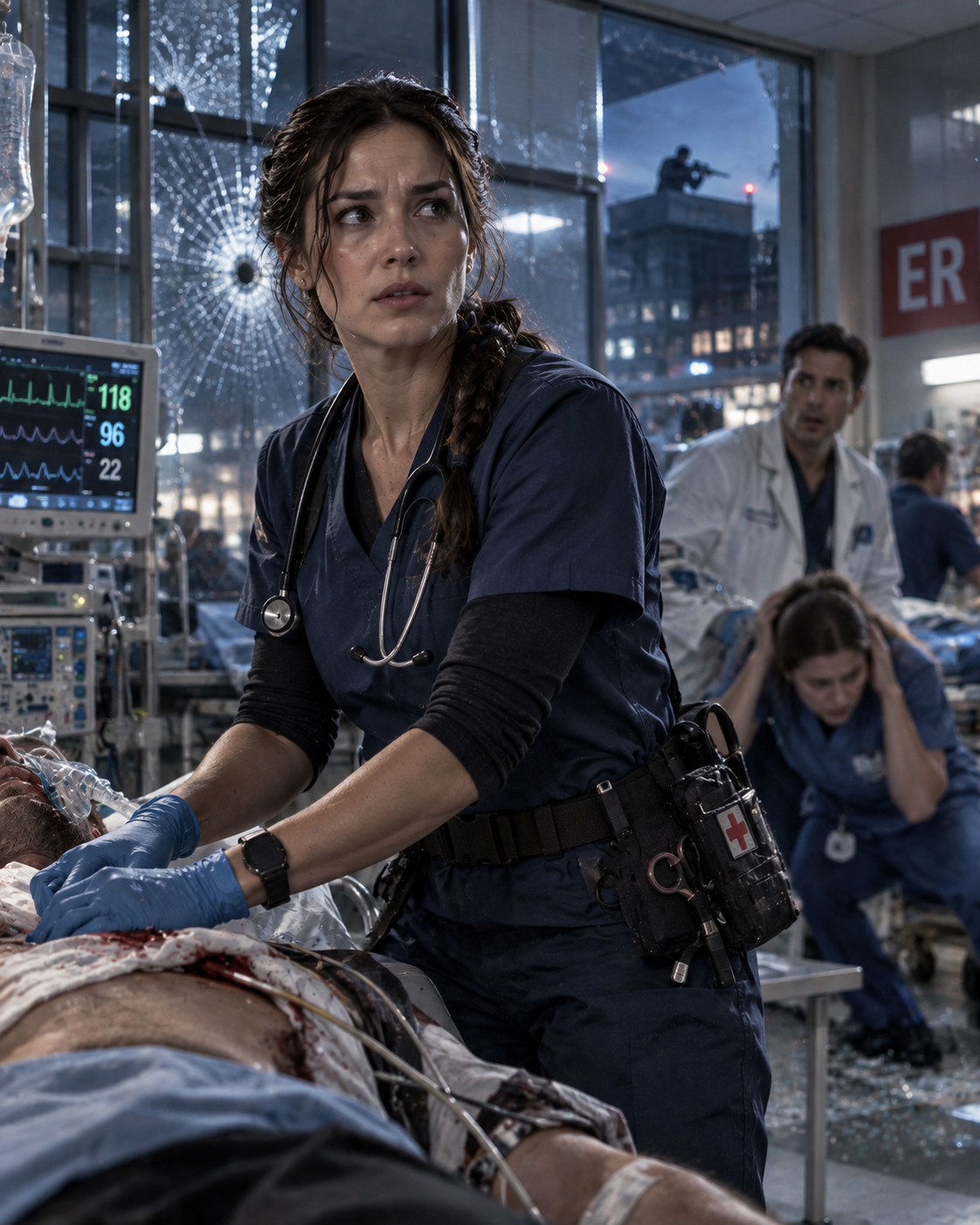
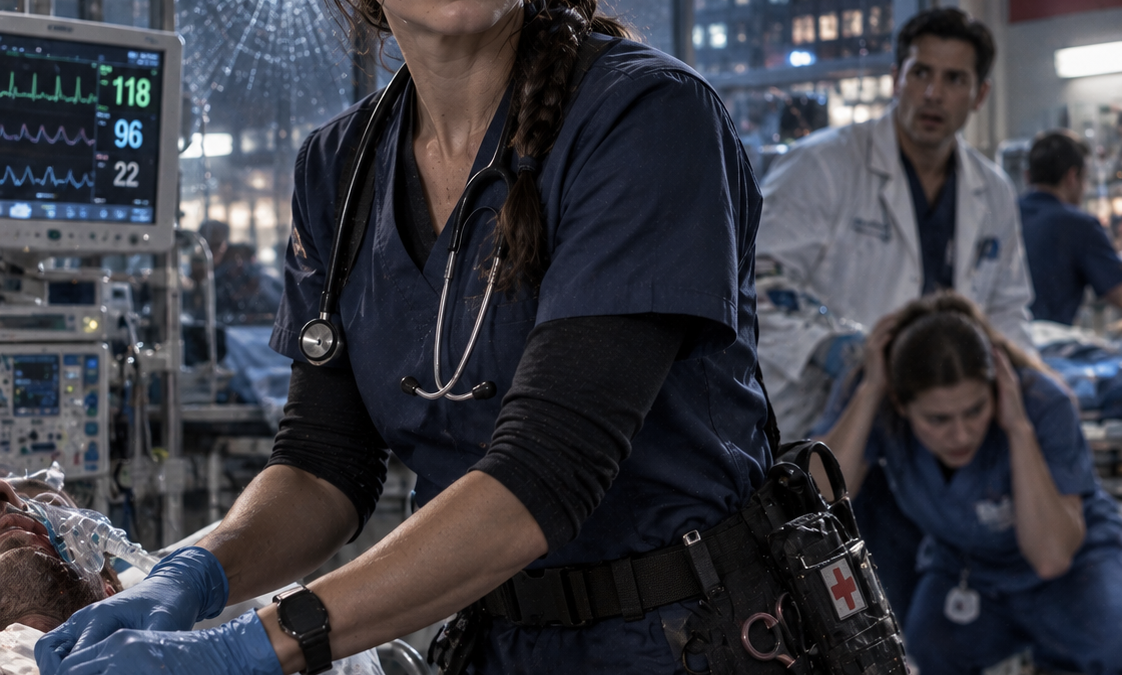
Sniper’s bullet punched through the emergency room window at 11:47 p p.m.M on a Tuesday and every single person in that room dropped to the floor screaming doctors.
Orderlys, security guards, all of them except for one nurse standing beside bed 4.
She didn’t flinch.
She didn’t duck.
She tracked the entry angle of the shattered glass with her eyes. turned her head 30° toward the south corridor and said quietly to no one in particular.
He’s on the rooftop of the parking structure, second level, northeast corner.
Nobody heard her. They were all too busy bleeding and praying, but she was already moving.
The thing about Hardrove Valley Medical Center was that it looked from the outside exactly like what a hospital should look like. clean concrete facade, wide glass entrance, the kind of institutional authority that made people feel, at least briefly, that they were in capable hands.
It’s sat on the eastern edge of Denton Falls, Wyoming, where the foothills crept up behind the building, and the winters came hard and stayed long.
And the staff who worked there had the particular brand of toughness that came not from having everything figured out, but from surviving when things went wrong.
Mar Ellison’s had been working the night shift in the ER for 11 months.
She was 36 years old with dark hair she kept pulled back in a tight braid and pale green eyes that seemed to people who bothered to look like they were always doing quiet math on everything around them. She walked with a slight drag on her left side, her ankle rolling a little on each step.
The result she’d told HR during her intake interview of a sports injury years ago.
Her right hand had a fine tremor that appeared when she was tired. Noticeable enough that other nurses had mentioned it behind her back. That doctor Patrick Voss, the head of trauma services, had mentioned it directly to her face.
You dropped the IV line again. Voss said one morning in October outside room seven while a patient waited inside.
He said it said it the way people say things when they’ve already decided the conversation is over.
Third time this month.
Mara didn’t argue.
She bent down and retrieved the line from the floor, replaced it from the supply cart, and went back to work. That was the pattern.
Voss spoke. Mara absorbed it.
She apologized when it was faster to apologize than to explain. She adjusted, adapted, and found workarounds.
She’d learned to brace her right wrist against her palm when inserting IVs, which gave her a steadiness that almost looked effortless, though it took substantial concentration.
She didn’t tell anyone that.
She didn’t explain anyone that.
Didn’t offer the real reason or the limp.
didn’t offer the real reason for either because the real reason wasn’t something she’d brought with her into the walls of Harrove Valley.
She had left that life in another building in another state with a duffel bag of personal effects and a discharge paper she kept folded in the bottom of her kitchen drawer.
She wasn’t ashamed of it.
She just wanted something quieter. Quieter, as it turned out, was relative.
Patrick Voss had been running the Hargrove Valley trauma department for seven years and in that time he had cultivated the kind of that gets protected rather than questioned. He was brilliant in the surgical sense, fast hands, good instincts, a memory for drug interactions that impressed residents and he was difficult in the institutional sense.
the way that difficult people with impressive records tend to get accommodated rather than corrected. He had a habit of framing his assessments as objective when they were plainly personal.
He had, in Mara’s case, decided within her first two weeks that she was a liability.
I don’t know why administration keeps her on, he said to the charge nurse one evening in November.
not quietly enough. While Mara was charting at the station 6 ft away, tremor, balance issues, she hesitates on calls.
That’s three strikes already.
Mara kept her eyes on the screen. She finished her note, closed the chart. The charge nurse, a woman named Sandra Hol, who was essentially a decent person caught between a difficult doctor and an institutional culture that rewarded compliance, said nothing.
She had apologized to Mara about it later privately in the breakroom. Mara had told her it was fine.
It wasn’t fine.
But Mara had lived in conditions where what was fine and what was survivable were two different categories and she had learned to operate in the gap between them.
By March, Voss had written three formal performance notes into Mara’s file.
Each one documented a specific incident framed in clinical language that suggested a pattern of inadequate response, a medication delay, a missed assessment window, an instance of poor clinical judgment during a multi-patient intake. Reading the notes without being in the room. They were damning.
Being in the room told a different story.
The medication delay had been a deliberate hold while Mara waited on a contry indication flag she’d correctly identified.
The missed assessment window had been created when Voss himself had redirected her to another patient. The judgment call had saved a patient from a premature discharge that Voss later quietly had reversed.
None of that appeared in the documentation. Other nurses knew, residents knew or suspected.
Nobody had put anything in writing. Mara had considered filing a formal grievance twice.
Both times she’d pulled the form up on the hospital portal, stared at it, and closed the window.
Not because she was afraid of Voss.
She wasn’t afraid of Voss.
She’d been in places where fear was a tactical response to a specific threat, calibrated and useful, and Patrick Voss didn’t qualify.
closed the window because she understood with the clarity of someone who had studied how institutions work under pressure that a formal grievance without corroborating witnesses was a document that would follow her longer than any performance note. She needed more than a complaint.
She needed something solid. She was still waiting for it when Tuesday arrived.
The patient in bay 12 had been admitted at 9:30 in the evening, brought in through a side entrance rather than the the main ER bay, which was the first thing Mara noticed. The intake paperwork listed him as Gerald FTH, age 54, presenting with chest pain and an irregular heartbeat. He was escorted by two men in plain clothing, who had the specific kind of stillness that Mara associated with training.
rather than temperament, they stood at the right angles to the door. They both clocked her when she entered, and neither of them relaxed when she identified herself as the attending nurse.
“I’ll need to take vitals,” she said, pulling on gloves.
The man nearest the door nodded, then moved just far enough to let her through. Gerald Furth was a compact man with gray at his temples and the kind of controlled blankness in his expression that Mara had seen on people who were working very hard to seem comfortable. His hands were folded on the hospital blanket.
His blood pressure when she took it was 128 over 82. His pulse was 71 and steady.
His oxygen sat at 97. Mara made a note of all of this.
She did not say anything directly to the two men when she left the bay. She went to the station uh and pulled up intake chart and read the cardiology notes that had come in with the admission. Then she read them again.
The numbers didn’t fit the presentation.
Patient in acute cardiac distress with an irregular heartbeat didn’t come in with a pulse of 71 and sat levels that clean.
EKG tracing in the file showed a mild anomaly that could under certain interpretive conditions be read as a precursor to something more serious, but it could also be read by someone with enough clinical context as a normal variant in a man his age with a sedentary occupation. The inconsistency was small enough to miss it on a busy night.
Mara hadn’t missed it.
She flagged the chart for physician review and went to find doctor Voss. She found him at the central station halfway through a coffee talking to one of the secondy-ear residents about a case in bay 3.
She waited for a break in the conversation. Dr.Voss, I have a concern about the patient in Bay 12.
He looked at her with the expression she’d come to recognize, the one that said he was already formulating his response before he’d heard the sentence finish.
What about him?
His vitals don’t match the cardiac presentation in his intake.
Pulse is normal sinus. His SAT is 97. The EKG shows a variant that I think is being overread.
I don’t think he has an acute cardiac condition.
Voss set his coffee down. He looked at the resident, then back at Mara.
You’ve been a nurse here for 11 months.
Yes, I’ve been reading cardiology notes for 15 years.
He picked the coffee back up. Stick to nursing, Ellison.
I’ll handle the diagnosis.
The resident looked at the floor. Mara looked at Voss for two more seconds, then nodded and went back to her station. She documented her concern in the nursing notes with a timestamp.
She did that partly because it was the correct protocol and partly because she had learned in a different context that documentation was the thing that survived when everything else burned. 10:52 p.m.The sound came at 11:47.
It wasn’t the explosion that most people described afterward.
It was more compressed than that. A flat hard crack followed immediately by the implosion of the window in the south wall of the ER. Glass fragmenting inward in a diagonal spray.
The patient in bay 6, a 60-year-old man being treated for a laceration, lost a piece of his earlobe to flying glass. Nobody realized that for another 4 minutes.
What they realized immediately was that a bullet had entered the emergency room and the screaming started before the glass finished falling. Mara was at the station when it happened. She was on her feet before the sound fully registered.
Not running, not ducking, just standing, her body oriented toward the window and her eyes doing the calculation she didn’t have to consciously perform anymore.
entry angle, glass pattern, velocity. She was already turning, already moving by the time the second wave of sound hit people dropping to the floor, chair scraping, some someone yelling for security over the intercom with the kind of breathless panic that communicated nothing useful.
Get down. Get down. Everybody down bay 6 is exposed.
The window line is minus. Someone called 911 Mara moved through the chaos in a straight line, which was the first thing people later described as strange.
Not because she didn’t know there was a shooter, but because she wasn’t reacting to the shooter, she was working the geometry of the room, and geometry didn’t require ducking.
She went to bay six first, pulled the curtain to block the sighteline, put her hand on the patient’s shoulder, and said flatly, “Don’t look at the window.”
“You’re okay.”
She checked his ear in 4 seconds, applied pressure with gauze, taped it, and moved on. Bay 8 had a pediatric patient, 7-year-old, with a broken arm who was now under the gurnie, which was reasonable, but placed her directly below a window. Mara pulled the gurnie away from the wall, repositioned it, and told the girl to stay flat and count to 100.
Count out loud, Mara said.
Don’t stop.
One, the girl said. Two, three.
Mara was already at bay 10 by the time she’d moved four patients away from window exposure and directed two orderlys to start transport on the patients in bays 9 and 11.
Doctor Voss had emerged from behind the nursing station where he’d been crouched with three residents.
He stood up and looked around at the controlled motion happening in his emergency room. And for a moment, his face did something complicated.
Surprise, reassessment.
Something that was almost recognition before it resolved back into the default authority he’d been carrying for 15 years.
“Someone needs to take charge here,” he said loudly.
We need to clear this department.
It’s being cleared, Mara said without looking at him.
Phase 6, 8, 9, and 11 are repositioned. 10 is being moved now.
We need to lock down the south corridor. The shot came from the northeast elevation.
Parking structure, second level. South corridor gives a secondary sighteline. Voss stared at her.
the angle of entry, she said, because he looked like he needed the premise explained the glass pattern.
It’s basic geometry.
Someone said, “How do you know that?”
Mara didn’t answer.
She was already on the radio. The second crack of gunfire came 17 minutes later, and it was outside the parking structure based on the position and the echo return.
No entry into the building this time. By then, two city police units had arrived and were setting up a perimeter and the ER had been placed on lockdown. Patients not in critical condition were being moved to interior rooms.
The staff was operating in a state that lived to some that lived somewhere between controlled and barely controlled, and Mara was the reason it hadn’t slid further toward the second option.
She had moved through the department with a quietness that was different from the timidity people usually assigned to her.
It was the quietness of someone who had already run the calculations and wasn’t wasting energy on calculations she’d already run.
She gave directions with an economy of words that the residents had started following without questioning, which was its own indicator.
People in genuine crisis don’t analyze the credentials of the voice telling them to move.
They just move.
Sandra Hol found her in the medication corridor at 128A and her face had the particular particular look of someone who was only now sorting through what they’d been watching for the last 20 minutes.
“Mara,” she said, and then stopped, like she’d reached the edge of the sentence and discovered she hadn’t written the rest of it yet.
“We need the access log for Bay 12,” Mara said.
Sandra blinked. What? The patient in bay 12.
Someone needs to pull who accessed his chart in the last 4 hours, and it needs to happen before anyone decides to clean up records. She was pulling a trauma kit from the wall cabinet while she said it, checking contents with the same steady automation she used on anything that needed to be counted.
The shot was targeted. Someone inside this hospital knew which bay he was in.
Mara, he’s a cardiac patient.
He’s not a cardiac patient.
Mara closed the kit and turned.
His vitals don’t support it.
Those men with him weren’t family or private security hired by a wealthy cardiac patient.
Posture, the positioning, the fact that he was brought in through the loading entrance.
He’s being protected.
And whoever is shooting at him knew exactly where to aim. Sandra looked at her for a long moment.
Who are you? Was a real question, not a rhetorical one.
Mara could hear the difference.
“I’m the nurse who flagged his chart at 10:52,” she said.
“Pull the access log.”
She picked up the trauma kit and went back toward the main floor. The military vehicles arrived at 12:31A. M.
There were three of them, two dark SUVs, and a larger vehicle that looked like a command unit, government plates, no insignia visible from the ER entrance. They came in through the ambulance bay which the local police had cleared.
And the people who got out of them moved with the specific coordinated efficiency that Mara recognized the way some people recognize a dialect from their hometown.
Not because they’d studied it, but because they’d lived inside it.
She was standing at the central station when they came through the inner doors. of them, five in tactical gear and one in the kind of civilian clothing that was really just a quieter form of tactical gear with a rank that lived in the way he carried himself before it appeared on anything he was wearing.
He was around 50, broad shouldered with the cropped gray hair of someone who’d been in long enough for the field to have aged him faster than the calendar.
He swept the ER with the kind of eyes that categorized quickly and moved on. And when they reached Mara, they stopped.
She didn’t move.
He crossed the floor in eight steps, and when he was close enough that she could see the vertical line of old scar tissue that ran from his left jawline down toward his collar.
She felt something in her chest that wasn’t fear.
It was closer to the feeling of being found after a long time spent convincing yourself you preferred not to be looked for. Staff Sergeant Ellison, he said, and the emergency room, which had been operating at the particular loud frequency of controlled crisis, went quiet in the way that only happens when something lands that changes the shape of the room.
Mara looked at him. Colonel Daniel Puit. The residents and nurses who were close enough to hear it to hear it later described it differently.
One said she turned pale.
One said she didn’t react at all.
One said she let out a breath like she’d been holding it for 11 months, which was of the three probably closest to accurate.
Voss, standing 6 ft away with a blood pressure cuff still in his hand from an interrupted patient assessment said, “I’m sorry, what?”
Pruette didn’t look at him.
He was still looking at Mara. We have a situation.
I know. She said Bay12.
How much do you know? Enough.
His presentation doesn’t match his diagnosis.
The shot was targeted from the northeast elevation. Someone in this building fed the shooter to elevation.
She paused.
And you got here fast enough that this wasn’t a surprise.
Cruette’s expression didn’t change, but something behind it shifted.
We received threat intelligence 40 minutes ago.
We weren’t fast enough.
He glanced around the room at the taped window, the repositioned gurnies, the patients moved away from sight lines, the staff operating in formation rather than chaos.
You’ve been busy.
Someone had to be.
A nurse behind the station knew her barely 6 months in whispers whispered to the woman beside her, “Who is she?”
The woman beside her didn’t answer because she didn’t know.
And that was the point. That had always been the point.
Puette turned to his team. I need this floor cleared to essential personnel. Full access restriction on bay 12.
No exceptions. He turned back to Mara.
Your essential personnel. Voss stepped forward.
Excuse me.
I’m the head of trauma services.
This is my department. Any decisions about patient care are being handled.
Puit said. Two words had the weight of a door closing.
He didn’t raise his voice.
He didn’t need to.
Dr.Voss, we’ll need to speak with you shortly.
Please stay available. The way he said stay available was not a request.
Voss looked at Mara. His face had moved through several expressions in the last 90 surprise.
confusion and something she hadn’t seen from him before, which was a particular flavor of uncertainty that lived in people who had built their authority on a foundation they’d never expected anyone to examine.
She didn’t give him anything back.
Not satisfaction, not reassurance, not the small mercy of looking away.
She just looked at him the way she’d spent 11 months, wishing someone would look at her.
Then she followed Puit toward bay 12 and the er closed ranks behind her. The man in bay 12 was sitting up when they entered. He looked at Puit with the expression of someone who had been waiting for the next pex of bad news and had decided to get it over with.
Mr.Fth Puit said we’re moving you.
I heard the shots. Two.
Neither was a direct strike on this floor. We have a secondary location prepared. FTH looked at Mara.
Who’s this nurse Ellison?
Puet said she’s the reason this floor didn’t turn into a casualty event.
FTH studied her the way people study someone they’re reassessing.
Your military. I was Mara said. What branch?
Army combat medical support. Two tours. FTH nodded slowly like a detail was slotting into place.
Voss. He said the doctor.
He accessed my file. The room shifted.
Puette turned slowly. What did you say? The big one.
The one in charge. He came into my bay around 11. Said he was doing a secondary assessment.
He asked questions that weren’t about my heart.
F looked at his hands. Testified in three federal cases.
I know what a fishing expedition looks like.
Mara thought about the chart she’d been reviewing at 10:52.
She thought about the time stamp. She thought about Voss, who had dismissed her concern at the station, who had told her to stick to nursing, who had gone back to his coffee.
And then she thought about the 17 minutes between her concern text being dismissed and the glass shattering. I need to see the access log, she said. Puette looked at her.
I asked for it already, she said. Sandra Holt can pull it.
Dr.Voss accessed bay 12 at approximately 11 p. M.
If we compare that timestamp to the shooter’s communication window, “You’re alleging that my attending physician coordinated a federal witness assassination,” Puit said.
His voice was flat.
“I’m saying the access log will tell us whether I’m right,” Mara said.
“And I’ve been right about this patient since 10:52.”
Cruette looked at her for a long beat. Then he turned to the tactical officer behind him.
pull every access log for bay 12. All of them from intake forward.
Now the officer moved first looked at Mara from the gurnie.
What’s your name?
He said your actual name. Ellison, she said. Mara Ellison.
Ellison. He repeated like he was making a note of it.
Thank you. She nodded once.
The way she’d learned to receive thanks from people meant it, not deflecting it, not performing humility, just acknowledging it and moving on.
There was still a shooter in or around this building.
There was still a floor full of patients who didn’t know what was happening.
There was still 11 months of documentation in a file that had her name on it. One thing at a time, she checked the trauma kit.
She checked the corridor.
She checked the window angles in bay 12, confirmed the room’s interior position was did clean, and looked back at Puit.
We need to move him in the next 15 minutes, she said.
The shooter hasn’t been confirmed located if he switches position.
The radio on Puit’s vest crackled.
The voice on the other end said four words, “Shooter is no longer on the rooftop.”
Temperature in the room seemed to drop 3°. Mara was already moving toward the door.
The radio crackle hung in the air of bay 12 for exactly 2 seconds before Mara was through the door. Running in a hospital corridor during an active shooter situation was how you became a target at an intersection.
She knew that the same way she knew her own heartbeat, which was steady and a little too slow for someone who hadn’t slept in 6 hours, which was normal for her.
She moved fast and low, keeping her body angled toward the wall, tracking the sight lines ahead of her the way she tracked the sight lines of every corridor she’d ever worked in, which was a habit she’d spent 2 years at Harrove Valley, trying to convince herself was unnecessary.
It wasn’t unnecessary.
Puit’s team was deploying behind her.
She could hear the coordinated movement, compressed radio communication, the particular sound of tactical boots on Lenolium that she associated with specific moments in her life that she had until 40 minutes ago decided were behind her. She reached the main ER floor and stopped at the corridor junction, scanning left and right.
The department was substantially cleared. Four nurses remained at the station.
Two residents, Sandra Hol at the charge desk with her hand on a phone she hadn’t picked up yet.
South entrance, Mara said. Loud enough to carry. Lock it now.
Patient transport is to interior rooms. Only nothing on the ground floor with exterior window access.
One of the residents started to say something. Sandra put her hand up and the resident stopped.
“Do what she says,” Sandra said.
and the weight in her voice was not something she’d had.
At 9:00 that evening, Mara turned to the tactical officer who had followed her out a woman early 30s with the compact efficiency of someone who had learned to be underestimated and had stopped caring about it. Her name tag said Decker.
Exits.
Mara said, “We have the main entrance, the ambulance bay, and the east service door covered.”
Decker said loading dock is on the west side.
It’s got one officer local P not one of ours.
That’s not enough.
I know there’s a stairwell access off the west corridor that connects to the pharmacy level.
It’s not on the main floor plan.
It was added during the 2019 renovation and I don’t think it made it in to whatever building schematic you’re working from.
Decker looked at her steadily. How do you know that?
I’ve worked nights month for 11 months.
I know where every exit is. Mara paused. I also know where every hiding place is.
Decker put her radio to her mouth and relayed the stairwell information. Someone on the other end confirmed and moved.
Mara was already heading toward the west corridor, her left left ankle rolling on the turn the way it always did, and she adjusted without breaking stride because she’d been adjusting for it for 3 years.
and that the adjustment was automatic. Now, the west corridor was one of the parts of Harrove Valley that the public never saw long.
Florent lit with the slightly worn quality of institutional spaces that exist for function rather than presentation. The pharmacy was up half a level via a short stairwell. And the stairwell door had a push bar that rattled when when it opened, which Mara had noticed the first week she worked there and had reported as a maintenance issue that had never been addressed.
She was 20 ft from the stairwell door when she heard it rattle. She stopped.
The door opened slowly, not fast slowly, with the measured pace of someone who was controlling their noise output. The man who came through it was not in hospital clothing. He was in dark clothing that was close enough to a maintenance uniform to pass a fast glance, but not a real one.
He had a bag over one shoulder, and he was looking at the floor ahead of him, tracking his own step pattern, and he hadn’t seen her yet.
Mara assessed in approximately 1 and 1/2 seconds. Tall, heavy, moving with purpose, but not with the trained economy of someone who did this for a living. It was scared.
Scared people with weapons were more dangerous, more dangerous than professionals in certain ways and less in others. The bag was the question.
She didn’t know what was in it.
And she didn’t want to find out by guessing wrong.
She took one step back, putting herself partially behind the supply cart that sat against the left wall and keyed the communication badge on her chest. West corridor, pharmacy stairwell, one male, unknown equipment. She said it quietly.
He still heard it. His head came up. They looked at each other for a moment that lasted longer than it was.
Then Mara said in the same flat voice she used when she was managing a patient who was afraid. The building is surrounded.
There are six federal tactical officers on this floor.
There’s a perimeter on every exit, and the stairwell you just came through has two more covering the pharmacy level.
She kept her hands still and visible.
“This is the part where you decide how the next 5 minutes go.”
Dared at her. His jaw was working.
“The bag,” she said.
“Put it on the floor.
You’re a nurse,” he said.
He sounded confused, which was a reasonable reaction and not the most tactically dangerous one. So, she kept going. Yes.
And in about 30 seconds, six people with considerably more equipment than me are going to come around that corner, and the conversation gets a lot shorter. She tilted her head towards the supply cart on the floor, slow.
He was breathing hard. She could hear it ragged, shallow, the kind of breathing that meant a decision was being made in real time and it could go either direction.
She watched his hands. She watched his shoulders.
She’d been watching shoulders before hands since her first deployment because shoulders committed before hands every time.
His left shoulder dropped. He put the bag on the floor. Decker came around the corner 30 seconds later with two officers behind her and to her credit she took in the scene man on his knees.
Bag on the floor. Mara standing against the supply cart with her hands at her sides without expressing what she was thinking. She cuffed him with a professional efficiency.
One of the officers picked up the bag and opened it carefully. Camera equipment.
Long range lens. A secondary radio.
A burner phone. Not the shooter. A spotter.
He’s been feeding positions.
Mara said. Decker looked at the equipment. Yeah.
She looked at Mara. Yeah, he has.
Peret was in the corridor outside Bay 12 when Mara got back and he was on the phone, which meant the conversation had moved upstream from the level he usually operated at, which meant the situation had been elevated, which meant things were moving faster than the initial threat intelligence had anticipated. He ended the call when he saw her and turned with the expression of someone who was recalibrating on the fly.
B, she said. West corridor, pharmacy stairwell.
Decker’s team has him.
Puit absorbed this without visible surprise. Camera and radio. Burner phone, too.
He was feeding real-time location updates. She paused, which means someone was telling him where to point the camera.
Inside source, the camera was set up toward the ER. Bay positioning staff movement.
He needed an interior reference point to know which bay was 12 because from the parking structure you can’t see bay numbers.
She watched his face. Someone inside was coordinating.
Puet was quiet for a moment. He had the particular stillness of someone processing a large amount of information very quickly and not letting any of it show on the surface.
The access log came back. He said she waited.
Voss accessed FTH’s file at 11:04 p.m.M.
That’s 17 minutes before the first shot.
He looked at her. He also accessed it at 9:47, 3 minutes after FTH was admitted.
Standard attending review, she said. The second access is the one that matters.
The 947 access included FTH’s room assignment.
Bay 12, Southside, visible from the northeast parking elevation.
Puet’s jaw was set.
The 11:04 access was a file open and close. Under a minute, no documented notes.
Mara thought about Voss at the nursing station. His coffee. The dismissal.
Stick to nursing. Ellison.
I’ll handle the diagnosis.
She thought about how he had said it. Not irritated, not defensive, just final. The way you close a cabinet.
She thought about how when the glass had shattered, he had been behind the station, not in a bay, not treating a patient. Behind the station, where the monitors were, where the floor map was, where the realtime patient positions displayed on the charge screen.
Where is he now? She asked. We had him in the consult room.
Officer posted at the door. Pretted.
He he requested to use the restroom connected to the consult room 5 minutes ago.
Officer allowed it because there’s no exterior access.
Something moved in Mara’s chest.
There’s a service panel in that restroom.
She said above the second stall. It connects to the HVAC service line that runs to the east equipment room.
She was already turning.
There’s an access ladder in the equipment room that leads to the basement.
Puet’s radio was up before she finished the sentence.
The answer came back in 8 seconds. Consult room is empty. Restroom door is open.
He’s gone.
The basement of Harrove Valley Medical Center was not a place that appeared on the visitor map. It was the kind of space that hospitals accumulate rather than designed supply corridors, equipment storage, the network of service paths that allowed the building to function without the functional parts being visible.
What’s Mara had been down there twice, both times during equipment moves that needed an extra set of hands.
She knew the layout in the way she knew things, not precisely, not as a memorized map, but as a felt sense of spatial relationship that she trusted more than she trusted most documents.
She went down the east stairwell, Decker, three steps behind her and one of Puit’s officers on the radio relaying position to the rest of the team.
Basement lights were motionactated and she could see them triggering ahead of her a sequence of pools of light coming on 20 ft apart which was not subtle but was also not in her control. She followed the lights. The service corridor branched twice.
First branch she stopped, listened, heard nothing.
The second she stopped and heard footsteps, hard sold shoes on concrete, which Voss was wearing because he’d been on shift and trauma attendings didn’t wear sneakers.
Footsteps were moving fast and not quite even, which meant he was nervous or he’d turned an ankle on the uneven floor or both.
The right branch Decker touched her shoulder. We should wait for full.
He’s heading for the loading dock connector, Mara said.
There’s a tunnel from the basement that connects to the external loading area.
It’s used for body transport from the morg.
If he gets to the loading dock, there’s an unmanned vehicle access point that he can exit through.
She looked at Decker.
The local PD officer at the loading dock doesn’t know about the tunnel.
Decker spoke into her radio. The response told her what Mara had already guessed. The officer had been repositioned to cover the main dock entrance, leaving the tunnel access unmonitored.
“How do you know about the tunnel?”
Decker asked.
“A patient died on my second month here,” Mara said and started moving.
I had to coordinate with the morg.
“Nobody tells you ex tells you about the tunnel.
You find it when you need it.”
Footsteps ahead of them were getting louder. Mara tracked the sound the way she tracked everything without urgency, without panic, just data. He was slowing down.
He’d hit the final corridor, which curved before it reached the loading dock connector and had a low ceiling section that required ducking.
And he either didn’t know about the ceiling or he’d hit it because the footsteps had that brief irregular pattern of someone recovering from impact.
She came around the curve and saw him. Voss was at the tunnel door, which was a heavy fire rated door with a push bar.
And he had the push bar depressed, but hadn’t moved through because there were sounds on the other side.
The the radio crackle of Puet’s team repositioning, which meant they’d gotten there from the exterior.
He turned when he heard her. The thing about seeing someone in a moment they never planned for was that the performance fell away.
All of it the authority, the clinical detachment, the 15 years of practice superiority that Mara had been absorbing since October. What was left was a man in his late 40s with his shirt half untucked and his face doing the unguarded arithmetic of someone who has just run out of options.
“Ellison,” he said.
His voice was not the voice he used in the ER.
“Dr.Voss,” she said.
The pause stretched. Whatever you think you know, he started.
The access log is already pulled, she said.
The spotter’s equipment has your burner communication on it.
The federal team has been tracking transaction records since before tonight. She watched him.
You sold protected medical records. You identified a federal witness and gave his location to people who were paid to make sure he never testified. She kept her voice even.
Not because she wasn’t angry.
She was angry, had been angry for 11 months, though the shape of it had changed in the last hour, but because even was more effective than he did, and she knew it. You put every patient on this floor in danger to protect a transaction. He looked at her and in his face she saw something shift past the fear in to something uglier.
The particular defensiveness of a person who had spent long enough being right in public that being wrong felt like an assault.
You’re a nurse.
He said, “You’ve been a substandard nurse in my department for 11 months.
Nobody is going to. You called me a liability.
” She said, “Tonight, I identified your patients actual status, predicted the threat vector, repositioned this floor’s patients before the second shot, and found your spotter.”
She paused.
“You were behind the charge station during the shooting.
I was in the bays.”
He didn’t have anything for that.
The tunnel door opened from the other Singh side, and two of Puit’s tactical officers came through.
And whatever Voss had been about to say or do dissolved into the reality of people with significantly more operational authority, then either of them, I’m standing in a basement corridor with nowhere left to go.
Mara stepped back. She let the officers do what they were there to do.
She didn’t watch Voss’s face when they told Bean, “Detained.
She’d already seen what she needed to see.
She turned and walked back toward the stairwell and her ankle hurt and the fluorescent lights were doing the thing they did at 2 in the morning which was buzz at a frequency that got under your skin and she was tired not in specific way of some who has been running on precision rather than adrenaline and has now hit the end of the precision. Behind her she heard Voss say this is a mistake.
She kept walking. Puet found her in the ER equipment al cove.
20 minutes later, she was she was sitting on the of left leg extended.
Her left leg extended, running her thumb along the edge of a trauma dressing she’d pulled from the kit without quite realizing she’d done it.
The lights in this al cove were regular bulbs rather than fluorescents, and she’d been grateful for that without having a conversation about it.
Voss is in federal custody, Puit said. He sat across from her on an overturned supply bucket, which was not the posture of a colonel and was, she thought, probably deliberate.
The spotter is cooperating.
We’ve got enough to expand the warrants.
How many records? She asked.
He accessed at least 34 protected patient files over the past 8 months. We know of three that were sold.
The others are still being reviewed. He paused.
FTH is secure.
He’s been moved to a secondary location.
Mara nodded. She set the trauma dressing down. Your performance file, Puit said.
She looked at him. The Federal Review is going to flag every action taken by medical personnel who are now under investigation, he said.
That includes the performance evaluations Voss filed against you. All three of them. He held her gaze.
The legal team is going to want to review them in the context of whether they were filed in good faith.
They weren’t, she said.
I know. How do you know?
Because I’ve been watching you for 2 hours, he said.
And what I’ve been watching isn’t someone who has performance issues.
It’s someone who was being managed out of a department because she was too observant.
He waited a beat.
You flagged FTH’s chart at 10:52.
Voss dismissed you. 45 minutes later, someone shot through the ER window. If Voss had listened to you, we might have moved fur before the shooting started.
Mara absorbed this.
You can’t know that.
No, he agreed. But the timeline is what it is. She looked at her hands.
The tremor was present, fine and steady, the way it was when she was exhausted.
Didn’t put her hands under her thighs or behind her back.
She just looked at the tremor the way she looked at most things as information rather than judgment.
Staff Sergeant Ellison Puette said he hadn’t said the rank since the ER floor and the sound of it was different here.
Quieter without an audience. When you separated from the army, the record said you requested discharge for personal reasons.
That’s correct.
You were 3 months from promotion. Also correct. You want to tell me why?
She looked at him for a moment.
He was one of the people who had the answer in a file somewhere, which meant this wasn’t a question about information.
It was a question about whether she’d say it out loud.
I was tired, she said. Not of the work, of what the work cost.
She paused. I wanted to take care of people in a context where the goal was to keep them alive rather than to keep them functional enough to deploy again. She looked at the supply crate.
I wanted to matter in a smaller way, queer, and instead instead I spent 11 months being told I was a liability by a man who was selling patient records to people who wanted a witness dead. She exhaled, not quite a laugh.
Quer didn’t take.
Pouette was quiet for a moment. Outside the alcove, she could hear the ER resuming the controlled return of noise. That meant things were moving back toward functional patients being resettled.
The local PD wrapping their immediate scene work while the federal investigation moved into its next phase.
There’s something else, he said.
She waited. The access logs. He leaned forward slightly.
Voss accessed 34 files, but the spotter’s burner phone has 41 unique communication events logged.
He let that sit.
Seven of those communications don’t match any of the file accesses.
She was already ahead of it, someone else inside the hospital.
The communications were routed through the hospital’s internal network, which means they came from someone with building access and system credentials.
He looked at her steadily. The seven additional events, one of them happened tonight.
At 11:38 p p.m.m 9 minutes before the first shot, Mara ran through the staff on shift.
She ran through who had been where, who she’d seen at the station, who had been in the corridor when she’d moved patients.
She ran through it with the same systematic quality she’d applied to the triage bay assignments, the patient repositioning, the sighteline calculations.
👉 [Tap here for the Next Part ] 👈