“You’re a coward.” “I’m a survivor. There’s a difference.” “No. A survivor fights. A survivor protects. You just hid behind your money and your power and let other people suffer.”
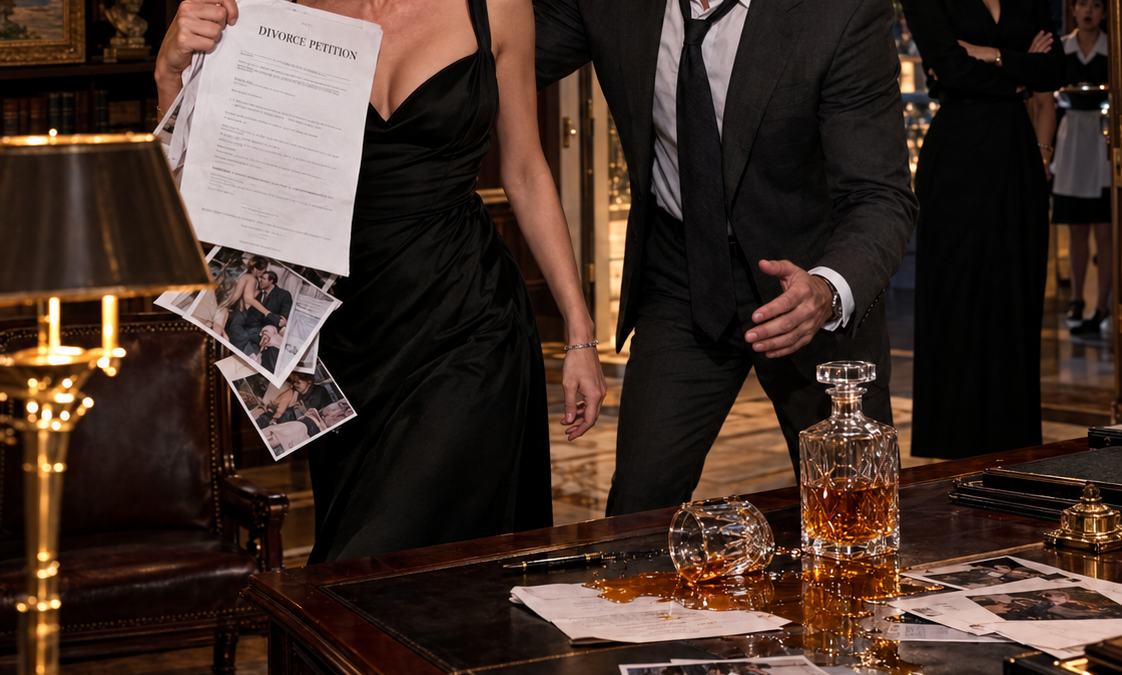
“You’re a coward.” / “I’m a survivor. There’s a difference.” / “No. A survivor fights. A survivor protects. You just hid behind your money and your power and let other people suffer.”
She thought she’d lost everything when she found the divorce papers on his desk. She never expected to find a purpose, a fight, and a love worth keeping.
The envelope was already open when Elena Moretti walked into her husband’s study.
She’d known something was wrong the moment she saw the door ajar—Rafael never left his study open, never left anything to chance, never left a single thread of his carefully controlled life unspooled. But there it was, the heavy mahogany door pushed back three inches, and through the gap she could see the corner of his desk, the edge of a leather chair, and a woman’s silk scarf draped over the armrest like a snake sunning itself.
Breathe, she told herself. There’s an explanation. There’s always an explanation with Rafael.
But her feet were already moving, carrying her through the door before her brain could catch up, and then she was standing in the center of the room, staring at the envelope on his desk. It had her name on it—Elena Vasquez Moretti—written in the careful, legal hand of his family’s attorney. The seal was broken. The contents were spread across the blotter like a hand of cards.
Divorce petition.
Irreconcilable differences.
Cruel and inhuman treatment.
She picked up the first page, her fingers steady even as something inside her chest began to splinter. The language was sterile, clinical—the kind of words that turned twelve years of marriage into a series of numbered paragraphs. But it was the attachment that stopped her heart.
Photographs.
Rafael with a woman she didn’t recognize—tall, blonde, laughing at something he’d said. They were at a restaurant she’d never been to, sitting close enough that their shoulders touched. In another photo, they were leaving a hotel. In another, his hand was on the small of the woman’s back, guiding her through a door.
The dates were printed in the corner of each image. Last month. Last week. Two days ago, while Elena had been at the clinic, reviewing patient files, thinking about how to tell him she was finally ready to try again—ready to talk about the baby they’d lost, ready to stop pretending that grief hadn’t hollowed them both out.
“Elena.”
His voice came from the doorway. She didn’t turn around.
“I can explain.”
She laughed—a raw, broken sound that didn’t feel like it belonged to her. “Can you? Because from where I’m standing, it looks like you’ve already explained everything. To your lawyers, at least.”
“Those aren’t what they look like.”
“No?” She held up the photograph of him and the blonde woman outside the Hotel Cortez. “So you’re not having an affair. You’re just… what? Conducting business? In a hotel? With a woman who looks at you like she’s already tasted you?”
His silence was answer enough.
She turned then, and the sight of him—tall and immaculate in his charcoal suit, his dark hair swept back from his face, his jaw set in that way it always was when he was calculating his next move—made her want to throw something. Preferably the crystal paperweight on his desk. Preferably at his head.
“Twelve years,” she said. “Twelve years, Rafael. I gave you everything. I gave up my career, my family, my name. I sat by your side at every dinner, every gala, every excruciating board meeting while your mother looked at me like I was something she’d scraped off the bottom of her shoe. I buried a child with you. I buried our daughter, and you—” Her voice cracked. She forced herself to stop, to breathe, to not give him the satisfaction of seeing her fall apart.
“Elena.” He stepped toward her, hand outstretched. “If you’ll just let me—”
“Don’t.” She held up the photograph like a shield. “Don’t you dare touch me.”
He stopped. Something flickered in his eyes—pain, maybe, or guilt, or just the irritation of a man whose plans had gone sideways. With Rafael, it was always hard to tell.
“The divorce petition,” she said. “You were going to serve me. At the anniversary dinner tomorrow night. In front of your entire family.”
His jaw tightened. “Who told you that?”
“I’m not an idiot, Rafael. I know how your family works. I know how you work.” She dropped the photograph back onto the desk. “You wanted to humiliate me. You wanted to make sure everyone saw me get discarded, so there’d be no question about who was at fault. So your mother could tell everyone I’d failed you, failed the family, failed to produce an heir—”
“That’s not—”
“—and then you’d ride off into the sunset with your blonde, and I’d be left with nothing. No husband, no home, no reputation. Just the Vasquez name, which your family has spent decades erasing.”
He was quiet for a long moment. When he spoke again, his voice was lower, rougher. “You think I wanted this?”
“I think you wanted out. And I think you didn’t care what it cost me.”
“That’s not true.”
“Then what is?” She crossed her arms, digging her nails into her own skin to keep from shaking. “What’s the truth, Rafael? Because I’ve been living in your world for twelve years, and I still don’t know what that word means to you.”
He looked at her—really looked, the way he used to when they first met, when she was just a girl from Little Havana with a nursing degree and too much hope, and he was the heir to the Moretti empire, slumming it at a charity clinic where she volunteered. He’d told her she was different. He’d told her she was the only real thing in his life.
She’d believed him.
“The truth,” he said finally, “is that my mother has been working to remove you from this family since the day we married. The truth is that she’s been feeding information to the board, to the press, to anyone who would listen—telling them you’re unstable, that you’re a liability, that you’re the reason I’ve been distracted, the reason the company’s stock has dipped, the reason—”
“Stop.” Elena held up her hand. “Don’t you dare put this on your mother. Don’t you dare make this about the company. You brought another woman into our marriage. You let your lawyers draft a petition that calls me cruel and inhuman. You were going to destroy me in front of everyone we know, and you want me to feel sorry for you?”
“I’m not asking for your sympathy.”
“Good. Because you don’t have it.”
She walked past him, toward the door. She needed to get out of this room, out of this house, out of this life. She needed to breathe air that didn’t smell like his cologne and his lies.
“Elena.” His hand caught her arm—gentle, but firm enough to stop her. “The petition isn’t what you think. I didn’t file it. I didn’t even know it existed until this morning.”
She turned her head, looked at him over her shoulder. “Then who did?”
“My mother.”
The name hung between them like smoke.
“Of course,” Elena said softly. “Of course it was her.”
“I’m handling it.”
“Handling it.” She pulled her arm free. “You’re always handling things, Rafael. Handling the company, handling the board, handling your mother, handling me. But you know what? I’m done being handled.”
She walked out of the study, down the long hallway, past the portrait of his grandfather that had always seemed to watch her with disapproval. She didn’t stop at the front door. She didn’t grab her coat or her purse or her phone. She just kept walking, out into the Miami night, where the air was thick with salt and heat and the distant sound of traffic.
Behind her, the house loomed—a Mediterranean Revival monstrosity that had been in the Moretti family for four generations. It had never felt like hers. She’d known that from the first night she spent there, when Rafael’s mother had shown her to a guest room instead of the master suite, explaining that the family had traditions about where new brides slept.
She’d slept in that guest room for six months before Rafael finally insisted she move into his bedroom. Six months of being a guest in her own marriage.
Well, she thought, walking faster, that’s over now.
She didn’t know where she was going. She didn’t know what she would do. But for the first time in twelve years, she felt something other than trapped.
She felt free.
And then her phone buzzed in her pocket—she must have grabbed it after all—and she looked down to see a text from an unknown number.
Dr. Vasquez. I know you’ve been investigating the clinic. I have information about the patient turnover you’ve been asking about. But you need to be careful. The Moretti family isn’t the only one watching. —A friend.
Elena stared at the screen, her heart hammering.
The clinic. Serenity Springs, the rehab facility where she’d been working as a clinical director for the past three years—the one that Rafael’s family had helped fund, the one that had always felt a little too convenient, a little too perfect. She’d started asking questions six months ago, after a patient had disappeared from the records without any discharge paperwork, and she hadn’t stopped since.
She’d thought she was being paranoid. She’d thought she was just looking for something to distract herself from the slow death of her marriage.
But now, standing on the sidewalk outside her husband’s house, staring at a text from a stranger who knew her secret, she realized something she should have known all along:
She’d stumbled into something much bigger than her marriage.
And someone wanted to make sure she didn’t find out what it was.
CHAPTER 2: The Clinic
Serenity Springs didn’t look like a rehab clinic. It looked like a boutique hotel—all white stucco and palm trees, with a fountain in the courtyard and valet parking for the celebrities who checked in under fake names. The sign out front said Wellness Retreat, and the brochures in the lobby talked about holistic healing and restorative care, but everyone in Miami knew what it really was: a place where the rich and famous went to dry out, away from the paparazzi and the court-mandated reporters.
Elena had been working there for three years. She’d been hired to overhaul the clinical programs, to bring evidence-based practices to a facility that had been coasting on its reputation for far too long. Rafael had pulled strings to get her the job—she’d known that at the time, resented it, but she’d been desperate for something of her own, something that wasn’t just being Mrs. Moretti.
Now, walking through the lobby at seven in the morning, she wondered if the job had been a setup all along.
“Dr. Vasquez!” The receptionist, a bubbly blonde named Marnie, waved her over. “You’re here early. I thought you were taking the day off for your anniversary.”
“Change of plans.” Elena forced a smile. “I’ve got some paperwork to catch up on.”
She headed for her office, but her mind was on the text from the night before. I know you’ve been investigating the clinic. Who could have sent it? One of the nurses? A patient? Someone on the inside who’d noticed her digging through files?
She’d been careful—she thought. She’d only accessed the records after hours, only asked questions in casual conversation. But someone had noticed. Someone knew.
And that someone wanted to help her.
Her office was small but comfortable, with a window that looked out onto the courtyard. She closed the door behind her, locked it, and pulled out the file she’d been hiding in the back of her bottom drawer.
Patient 47-B.
That was the designation in the system—no name, no admission date, no discharge summary. Just a room number and a series of treatment notes that didn’t add up. According to the records, Patient 47-B had been admitted for exhaustion and anxiety, but the medications listed were the kind used for severe trauma. The therapy notes mentioned trafficking recovery and witness protection—phrases that didn’t belong in a celebrity rehab clinic.
Elena had found the file six months ago, while looking for something else. She’d been shocked at first, then confused, then suspicious. She’d started asking questions—careful ones, casual ones—but no one seemed to know anything. The nursing staff deflected. The administration claimed ignorance. And when she’d tried to access the file again, she’d found it deleted from the system.
But she’d made a copy. A paper copy, hidden in her desk, because she didn’t trust the digital records.
Now, she spread the pages out in front of her and studied them again. The handwriting was unfamiliar—not any of the doctors she knew. The treatment plan was unusual, too—intensive, long-term, focused on identity reconstruction and safe reintegration. It read like something from a different world entirely.
A knock at her door made her jump.
“Dr. Vasquez?” It was Julian, one of the peer counselors—a young man with kind eyes and a quiet manner who’d been at the clinic for two years. He’d come through the program himself, she knew, though he never talked about it. “Sorry to bother you. There’s a patient who wants to speak with you. She says it’s urgent.”
Elena quickly gathered the papers, shoved them back into the drawer. “Which patient?”
“Room 12. Maria.”
Elena frowned. Room 12 was one of the long-term rooms, reserved for patients who needed extended care. But according to the schedule, it should have been empty.
“I’ll be right there.”
She followed Julian down the hallway, past the therapy rooms and the meditation garden, to a wing of the clinic she rarely visited. The doors here were heavier, the windows smaller. The air smelled different—cleaner, somehow, like the scent of a hospital rather than a spa.
Room 12 was at the end of the hall. Julian stopped outside, his hand on the door.
“She’s been here for three weeks,” he said quietly. “She’s not on the official roster. Dr. Reyes has been handling her case personally.”
Dr. Reyes. The medical director. A man Elena had never quite trusted, with his smooth smile and his evasive answers.
“Thank you, Julian.”
He hesitated, like he wanted to say something else, then nodded and walked away.
Elena pushed open the door.
The woman inside was sitting by the window, wrapped in a blanket despite the warmth of the morning. She was young—early twenties, maybe—with dark circles under her eyes and bruises fading on her wrists. When she turned to look at Elena, her expression was wary, guarded.
“You’re the one asking questions,” she said. It wasn’t a question.
“I’m Dr. Vasquez. I’m the clinical director here.”
“I know who you are.” The woman’s voice was soft but steady. “I know you’ve been looking into the patient records. The ones that don’t make sense.”
Elena’s heart rate spiked. “How do you know that?”
“Because I’m one of them.” The woman pulled the blanket tighter. “I’m not here for rehab. I’m here because someone wanted me to disappear.”
CHAPTER 3: The Truth About Serenity Springs
Elena sat down in the chair across from the woman, her mind racing. “Start from the beginning.”
The woman—Maria, though she said that wasn’t her real name—took a breath. “I was brought here three weeks ago. I didn’t come voluntarily. I was… placed. By a man who said he was helping me.”
“Helping you how?”
“I was in a bad situation. I’d been… I’d been trafficked. For two years. When I finally got out, I didn’t know where to go. The police couldn’t protect me—the people who had me, they had connections. So I was sent here, to this clinic, under a false name. The idea was that I’d stay here until it was safe to leave. Until I could start a new life.”
Elena’s blood ran cold. “Who sent you?”
“I don’t know his name. He said he worked with an organization that helps survivors. He said this clinic was a front—that it looked like a celebrity rehab, but underneath, it was a safe house for people like me.”
“That’s…” Elena shook her head. “That’s not possible. I would know. I’m the clinical director.”
“You’re new,” Maria said. “The program’s been running for years. Before you came. The man who set it up—he’s still here, running things. He just doesn’t advertise it.”
“Who?”
“I don’t know his name. But he’s connected to the family that owns this place. The Morettis.”
The name hit Elena like a physical blow. The Morettis. Rafael’s family. Of course.
“The Morettis own the land,” she said slowly. “They lease it to the clinic. But they’re not involved in operations.”
“That’s what they want you to think.” Maria leaned forward. “Look, I don’t know all the details. I just know what I was told—that this place was safe, that I’d be protected. And I have been. But I’ve also seen things. Patients who come in with fake names. Records that don’t match. People who work here who aren’t on any official roster.”
“Like who?”
Maria hesitated. “The guy who brought me here. He comes and goes. He’s not a doctor—I don’t think he has any medical training—but he has access to everything. He knows everyone’s real names, everyone’s real stories. And he’s scared of something. I don’t know what, but I’ve seen it. He’s always looking over his shoulder.”
“Can you describe him?”
“Tall. Dark hair. He dresses like he’s going to a board meeting—suits, expensive shoes. But he doesn’t act like a businessman. He acts like… like someone who’s been through something. Like someone who knows what it’s like to be hunted.”
Elena’s mind was spinning. A man connected to the Morettis, running a secret safe house inside a clinic that Rafael’s family funded. A man who was scared of something—or someone.
“Maria,” she said, “I need you to think carefully. Did this man ever mention anyone else? Anyone who might be a threat?”
Maria’s eyes flickered. “He mentioned a name once. He didn’t think I was listening. He was on the phone, and he said… he said ‘If Salvatore finds out, we’re all dead.'”
Salvatore. The name was familiar, but Elena couldn’t place it. She’d met dozens of people in Rafael’s world over the years—business associates, family friends, rivals. Salvatore could be anyone.
“I’ll look into it,” she said. “But Maria—I need you to be careful. Whoever’s running this program, they’ve gone to a lot of trouble to keep it secret. If they find out you’ve been talking to me…”
“I know.” Maria’s voice was steady. “But I had to tell someone. I’ve been here three weeks, and I’ve seen enough to know that something’s wrong. The program is supposed to help people like me, but lately… things have been changing. Patients are leaving earlier than they should. The man who brought me here—he’s been arguing with someone. Someone who wants to cut costs.”
“Cut costs?”
“By reducing the long-term care. By sending people back out into the world before they’re ready. I heard him on the phone—he was furious. He said if they did that, people would die.”
Elena felt sick. The clinic’s owner—she knew who that was. Rafael’s mother, Vittoria Moretti, had been pushing for budget cuts for months. She’d complained that the clinic wasn’t profitable enough, that it was a drain on the family’s resources. Elena had assumed it was just Vittoria being Vittoria—controlling, miserly, always looking for ways to tighten her grip.
But if the cuts were affecting a secret safe house program…
“I need to go,” she said, standing. “I’ll come back later, when it’s safer. In the meantime, don’t talk to anyone else about this. Not even Julian.”
“Julian knows,” Maria said quietly. “He’s part of it. He was placed here, too—same as me. He just got out earlier. Now he works here, helping others.”
Elena stared at her. Julian—the quiet, kind peer counselor who’d walked her to this room. The man she’d trusted.
“He’s the one who told me to talk to you,” Maria continued. “He said you were asking questions, that you might be able to help. He said… he said he’s been waiting for someone like you to come along.”
Elena’s hand was on the doorknob, her mind reeling. Julian was part of the program. Julian had been trafficked, recovered, and now worked at the clinic to help others. Julian had been the one to guide her here, to Maria, to the truth.
And Julian was the one who’d sent her the text the night before. A friend.
She opened the door and stepped into the hallway.
And found herself face-to-face with Dr. Reyes.
“Dr. Vasquez,” he said, his smile not reaching his eyes. “I didn’t expect to see you here. Room 12 is supposed to be unoccupied.”
“I was just checking on a patient.”
“There’s no patient in Room 12.”
They stared at each other. Elena felt the weight of the secret pressing down on her, the knowledge that she was standing on the edge of something dangerous.
“I think we need to talk,” Reyes said. “In private.”
CHAPTER 4: The Man Behind the Curtain
Reyes led her to his office—a spacious room on the second floor, with a view of the courtyard and a door that locked from the inside. Elena noted the lock, noted the way Reyes positioned himself between her and the door.
“I know you’ve been investigating the patient records,” he said. “I know you’ve been asking questions. And I know you’ve been talking to people you shouldn’t.”
“I’m the clinical director. I have every right to review patient files.”
“Not these files.” Reyes sat down behind his desk, folded his hands. “You’ve stumbled into something that doesn’t concern you. Something that’s been carefully managed for years. I’m asking you—nicely—to stop.”
“And if I don’t?”
Reyes sighed. “Then I’ll have to escalate. And you won’t like the people who get involved.”
“Are you threatening me?”
“I’m warning you.” He leaned forward. “You think you know this family, Elena. You think because you married Rafael, you understand how the Morettis operate. But you don’t. You’ve been sheltered—kept on the periphery. You have no idea what they’re capable of.”
“I know they’re running a secret program inside this clinic. I know they’re hiding trafficking survivors under false identities. I know someone’s trying to cut costs by reducing the care these people need.”
Reyes’s expression didn’t change. “And what do you think you can do about it?”
“I can go to the authorities. The state health board. The FBI.”
“You could try.” He stood, walked to the window. “But you’d be putting a lot of people at risk. Not just yourself—the patients. The survivors. The people who’ve been helped by this program. You’d be exposing them, endangering them. Is that what you want?”
Elena’s hands clenched at her sides. He was right, and she hated it. If she went public, the program would be shut down. The survivors would be scattered, vulnerable, easy targets for the people who’d hurt them.
But if she did nothing, the cuts would go through. Patients would be sent back into the world before they were ready. Some of them would die.
“There has to be another way,” she said.
“There isn’t.” Reyes turned back to face her. “The program exists because the Moretti family allows it to exist. If you want to protect these people, you need to work within the system. You need to convince the family to maintain their support.”
“Vittoria Moretti is the one pushing for cuts.”
“Then you need to change her mind.”
Elena laughed—a harsh, bitter sound. “You don’t know Vittoria. She’s been trying to get rid of me for twelve years. She’ll never listen to anything I have to say.”
“Then find someone who can.” Reyes walked back to his desk, sat down. “I’ve been running this program for six years. I’ve helped dozens of survivors rebuild their lives. I’m not going to let it be destroyed because of a budget dispute. But I also can’t protect it alone.”
“What are you asking me to do?”
“I’m asking you to help me. To use your position—your connection to the family—to fight the cuts. To find allies. To keep this program alive.”
Elena stared at him. An hour ago, she’d been ready to expose everything, to burn it all down. Now she was being recruited into the very conspiracy she’d been investigating.
“Why should I trust you?”
“Because I’m not the one you should be afraid of.” Reyes’s voice dropped. “There’s someone else—someone who’s been taking an interest in the program. Someone who wants to use it for their own purposes. If they get control…”
“Who?”
“I don’t know his name. But he’s connected to the family. He’s been meeting with Vittoria, pushing for the cuts, trying to get access to the patient records. I think… I think he’s trying to find someone. A specific person who’s been hidden here.”
Elena’s blood ran cold. “Who?”
“I don’t know. But whoever it is, they’re important. Important enough that someone’s willing to tear this whole program apart to find them.”
The pieces were clicking into place—the cuts, the missing records, the threats. Someone was hunting for a patient. Someone who had enough influence to manipulate Vittoria Moretti, to pressure the clinic, to make Elena’s life hell.
“Salvatore,” she said.
Reyes’s face went pale. “Where did you hear that name?”
“Maria. The patient in Room 12.”
“You need to forget that name. You need to forget everything you’ve heard today.” Reyes stood, walked to the door, unlocked it. “Go home, Elena. Go back to your husband. Pretend you never saw any of this.”
“I can’t do that.”
“You have to.” He opened the door, gestured for her to leave. “For your own sake. And for the sake of everyone you’re trying to protect.”
Elena walked out of the office, down the stairs, through the lobby. The morning sun was bright, the air warm, the world unchanged. But she felt different—marked, somehow. She’d stepped into something dangerous, and there was no going back.
Her phone buzzed. Another text from the unknown number.
Meet me at the marina. Slip 47. Come alone. —J
Julian. The one person in this whole mess she might actually be able to trust.
She looked at her watch. Ten o’clock. She had time.
And she had questions that needed answers.
CHAPTER 5: The Insider
Slip 47 was at the far end of the marina, past the gleaming yachts and the tourist boats, in a section where the vessels were older, more practical. Julian was waiting on the deck of a small sailboat—a beautiful thing, well-maintained but not flashy, the kind of boat that didn’t draw attention.
“You came,” he said.
“You texted.” Elena stepped aboard, steadied herself on the railing. “What is this about, Julian? What’s really going on at the clinic?”
He gestured for her to sit. She did, perching on a bench near the stern, watching him carefully. In the daylight, he looked younger than she’d thought—mid-thirties, maybe, with a face that had seen too much and learned to hide it.
“I’ve been at Serenity Springs for two years,” he said. “Before that, I was a patient. I was trafficked when I was nineteen, kept for three years, then rescued by the man who runs the program. He brought me to the clinic, gave me a new identity, helped me heal. When I was ready, I stayed on as a counselor. I wanted to help others the way I’d been helped.”
“And the program? What is it exactly?”
“It’s a safe house. A place where survivors can stay while they rebuild their lives. Some of them stay for weeks, some for months. They get therapy, medical care, job training. And when they’re ready, they leave with new identities, new lives.”
“How many people know about it?”
“Not many. Dr. Reyes, obviously. A few of the nurses. Me. And the man who founded it—the one who brought me here. He’s the only one who knows all the details. He handles the placements, the funding, the security.”
“Who is he?”
Julian hesitated. “I don’t know his real name. He goes by a code name—’El Guardián.’ The Guardian. He’s connected to the Moretti family somehow, but I don’t know how. He never talks about his past.”
“But he’s the one who sent you to me? The one who told you to reach out?”
“No.” Julian shook his head. “I reached out on my own. I’ve been watching you for months, Dr. Vasquez. I saw you asking questions, digging through files. I knew you were getting close to the truth. And I knew you were in danger.”
“Danger from who?”
“From whoever’s been pushing the cuts. From whoever’s been trying to find our patients. From Salvatore.”
There was that name again. “Who is Salvatore?”
“I don’t know. But El Guardián is terrified of him. I’ve never seen him scared of anything, but when he talks about Salvatore…” Julian shuddered. “He says Salvatore is a monster. A man who traffics not just people, but information. A man who’s been hunting him for years.”
“And now he’s found him? Through the clinic?”
“I think so. Someone’s been feeding information to the Moretti family—telling them the clinic is losing money, that the program is a liability. That’s why they’re pushing for cuts. They want to shut us down, to expose what we’re doing. And I think… I think Salvatore is behind it.”
Elena’s mind was racing. “If Salvatore is trying to find El Guardián, and he’s using the Morettis to do it…”
“Then he’s closer than we think. He’s in the family, Dr. Vasquez. He’s someone Rafael trusts.”
The words hit her like a blow. Someone Rafael trusted. Someone inside the family, inside the business, close enough to manipulate Vittoria, close enough to access the clinic’s records.
“Who?” she asked. “Who could it be?”
“I don’t know. But you’re in a better position to find out than I am. You’re married to Rafael. You have access to the family, to their meetings, to their secrets.”
“Rafael and I aren’t exactly on speaking terms right now.”
Julian’s expression flickered. “I heard about the divorce petition. I’m sorry.”
“Don’t be. It’s been a long time coming.” She paused. “But it complicates things. If I’m not part of the family anymore, I lose access.”
“Then don’t lose access. Fight it. Stay in the marriage long enough to find out who’s behind this.”
Elena stared at him. “You’re asking me to stay married to a man who cheated on me, whose mother has been trying to destroy me for twelve years, so I can spy on his family?”
“I’m asking you to protect the people we’ve been hiding. The ones who have no one else. If the program goes down, they’re dead. Do you understand that? Dead.”
The weight of it settled on her shoulders. She thought of Maria, sitting in that room, bruised and scared. She thought of all the other patients she’d never met—the ones hidden in plain sight, the ones whose lives depended on the clinic staying open.
“I’ll do it,” she said. “But I need something from you in return.”
“Name it.”
“I need to know everything. Every detail about the program, every person involved, every secret. I can’t protect something I don’t understand.”
Julian nodded slowly. “Okay. But not here. Not now. We need to be careful—we don’t know who’s watching.”
“When?”
“Tonight. There’s a safe house in Little Havana—an apartment above a bodega. I’ll text you the address. Come after dark, and come alone.”
He stood, offered her his hand. She took it, let him help her to her feet.
“Dr. Vasquez,” he said, “I know this is a lot to ask. I know you have your own problems, your own pain. But you’re the only one who can do this. You’re the only one with access to both worlds.”
“No pressure,” she said dryly.
He almost smiled. “I’ll see you tonight.”
She climbed off the boat, walked back down the pier, her mind churning. The sun was high now, the marina bustling with tourists and locals. A normal day, a normal world.
But nothing was normal anymore.
Her phone buzzed. She looked down.
Where are you? —Rafael
She stared at the message, her thumb hovering over the screen. She should ignore it. She should go home, pack her bags, leave this city and never look back.
But Julian’s words echoed in her mind. You’re the only one who can do this.
She typed a reply.
I’m fine. I’ll be home later. We need to talk.
She hit send, then slipped the phone back into her pocket and walked toward the parking lot, toward the rest of her life.
CHAPTER 6: The House on Star Island
The Moretti estate sat on the tip of Star Island, a sprawling Mediterranean compound surrounded by manicured gardens and guarded gates. Elena had lived there for twelve years, and she’d never once felt like she belonged.
Tonight, walking through the front door, she felt the weight of the house pressing down on her—the history, the expectations, the cold, polished perfection of a family that had never accepted her.
Rafael was waiting in the living room.
He was standing by the fireplace, a glass of whiskey in his hand, his tie loosened, his hair slightly disheveled. He looked tired—more tired than she’d seen him in months. But then, she supposed, orchestrating your wife’s public humiliation could be exhausting.
“You came back,” he said.
“I live here.”
“For now.” He took a sip of his whiskey. “I wasn’t sure you would.”
“I wasn’t sure either.” She walked past him, sat down on the sofa. “We need to talk.”
“About the divorce petition—”
“About everything.” She looked up at him. “About us. About your mother. About what’s really going on at the clinic.”
His expression flickered. “The clinic?”
“Serenity Springs. The place you got me a job at. The place your family funds. The place where someone’s been hiding people for years.”
Rafael set down his glass. “What are you talking about?”
“Don’t play dumb with me, Rafael. I know about the program. I know about the survivors. I know about the cuts your mother is pushing for.”
He was quiet for a long moment. Then he crossed the room, sat down across from her.
“How did you find out?”
“I’m the clinical director. I pay attention.” She leaned forward. “What I want to know is how much you know. Are you part of it? Are you helping them?”
“I’m not part of it.” His voice was low. “But I know about it. I’ve known for years.”
“And you never told me?”
“It wasn’t my secret to tell.”
“It was a secret that could have gotten me killed!” She stood, paced toward the window. “I’ve been digging into those records for months. I’ve been asking questions, talking to people. If someone had decided I was a threat—”
“They wouldn’t have hurt you. You’re a Moretti.”
“Am I? Because your mother seems to think otherwise. She drafted a divorce petition that calls me cruel and inhuman. She’s been working to destroy me since the day we met.”
Rafael stood, walked toward her. “My mother is… complicated.”
“Your mother is a monster.”
“She’s protecting the family.”
“From what? From me? From the woman who gave up everything to be part of this world?”
“From Salvatore.”
The name stopped her cold. She turned, stared at him.
“You know about Salvatore?”
“I know he exists. I know he’s been trying to find the man who runs the program—the one they call El Guardián. I know he’s using the family to do it.”
“Then why haven’t you stopped him?”
“Because I don’t know who he is.” Rafael’s jaw tightened. “Salvatore is a ghost. He has no face, no fingerprints, no record. He operates through intermediaries—people who don’t even know they’re working for him. My mother may be one of them.”
“Your mother is pushing for cuts that would destroy the program. She’s helping him without even knowing it.”
“I know.” He reached out, touched her arm. “That’s why I need you to stay.”
She pulled away. “What?”
“I need you to stay in the marriage. Just for a little while longer. Until I can figure out who Salvatore is and stop him.”
“You’re asking me to pretend nothing’s wrong? To play the happy wife while you—what? Continue your affair?”
“There is no affair.” His voice was sharp. “The woman in those photographs—she’s an investigator. I hired her to help me find Salvatore. The hotel, the restaurant—those were meetings. Nothing more.”
Elena stared at him. “You expect me to believe that?”
“I expect you to look at the evidence.” He walked to his study, returned with a folder. “Here. Her name is Cassandra Wolfe. She’s a private investigator, licensed in three states. I hired her six months ago, after I started getting threats.”
“Threats?”
“Against the family. Against you.” He opened the folder, showed her the documents. “Someone’s been sending letters, making phone calls. They want money—a lot of it—and they want access to the clinic’s records. If I don’t comply, they’ll go public with everything.”
“Everything about the program?”
“Everything about the program. And everything about us.” He closed the folder. “They know about the baby, Elena. They know what happened.”
She felt the blood drain from her face. The baby—their daughter, stillborn at thirty-two weeks. The loss that had shattered them, that they’d never really talked about, that had driven a wedge between them that she’d thought was permanent.
“Who?” she whispered. “Who would do that?”
“That’s what I’m trying to find out. Cassandra’s been tracking the communications, trying to trace them back to their source. But whoever’s behind this is smart. They cover their tracks.”
“And the photographs?”
“Cassandra took them. She was documenting our meetings—building a case. I didn’t know she’d left copies in my study. My mother must have found them and used them to draft the petition.”
“Your mother drafted a divorce petition based on photos of you with another woman?”
“My mother wants you gone, Elena. She’s always wanted you gone. She saw an opportunity and she took it.”
Elena sank onto the sofa, her legs suddenly weak. It was too much—the program, the threats, the photographs, the divorce. She felt like she was drowning, like the ground was shifting beneath her feet.
“I need a drink,” she said.
Rafael walked to the bar, poured her a glass of wine. She took it, drank deeply.
“Why didn’t you tell me?” she asked. “About any of this? Why did you let me think—”
“Because I was trying to protect you.” He sat down beside her. “I didn’t want you involved. I didn’t want you to become a target.”
“I’m already a target. I’ve been asking questions for months. I’ve been talking to patients, digging through files—”
“You’ve been what?”
She looked at him. “I found the file. Patient 47-B. I’ve been investigating the program on my own.”
“You—” He ran a hand through his hair, a gesture of pure frustration. “Do you have any idea how dangerous that is? If Salvatore found out—”
“He already knows. Someone texted me last night, warning me to be careful.”
Rafael went still. “Who?”
“I don’t know. But I’m meeting someone tonight—someone who might have answers.”
“Who?”
“I can’t tell you that.”
“Elena—”
“No.” She stood, set down her glass. “You’ve kept secrets from me for years. You’ve let me believe the worst about you. You’ve let your mother humiliate me, threaten me, try to destroy me. And now you want me to trust you? To stay in this marriage and play nice while you run around with your investigator and your secrets?”
“I’m asking you to help me protect our family. The people we’ve been hiding. The survivors who depend on us.”
“I’ve already agreed to help them. But I’m not doing it for you.” She walked toward the door. “I’m doing it because it’s the right thing to do. And when this is over—when Salvatore is caught and the program is safe—I’m leaving. For good.”
She walked out of the room, up the stairs, to the bedroom she’d shared with Rafael for twelve years. She closed the door, leaned against it, and let herself finally cry.
Not for the marriage. Not for the man.
For the girl she’d been when she’d walked into this house, full of hope and love and the belief that she could make a place for herself in this cold, glittering world.
That girl was gone now.
And Elena Vasquez Moretti—the woman who remained—was going to make sure she never came back.
CHAPTER 7: The Safe House
The apartment above the bodega was small but clean, with a kitchenette, a bathroom, and a single window that looked out onto the street. Julian was waiting for her when she arrived, along with a woman Elena hadn’t met before—a woman in her fifties with sharp eyes and a quiet, commanding presence.
“This is Beatriz,” Julian said. “She’s the one who actually runs the day-to-day operations of the program. El Guardián handles the placements, but Beatriz handles everything else.”
Beatriz nodded at Elena, didn’t offer her hand. “You’re the clinical director.”
“I am.”
“And you’re married to Rafael Moretti.”
“I am.”
Beatriz studied her for a long moment. “Why should we trust you?”
Elena met her gaze. “Because I’ve spent the last six months risking my job, my reputation, and my safety to find out what’s happening to the patients in my care. Because I’ve seen the cuts that are coming, and I know what they’ll do. Because I believe in what you’re doing—even if I didn’t know about it until recently.”
Beatriz’s expression didn’t change. “That’s a nice speech. But words are cheap.”
“Ask me anything.”
“Fine.” Beatriz sat down at the small kitchen table, gestured for Elena to do the same. “What do you know about Salvatore?”
“Only what Julian told me. He’s a trafficker—not just of people, but of information. He’s been hunting El Guardián for years. He’s using the Moretti family to find him.”
“And who in the family do you think is working for him?”
“I don’t know. But I’m going to find out.”
“How?”
Elena leaned forward. “I’m going to stay in the marriage. I’m going to attend the family meetings, listen to the conversations, watch the people around Vittoria. I’m going to find the person who’s been feeding information to Salvatore—and I’m going to stop them.”
Beatriz was quiet for a moment. Then she nodded slowly. “It might work. You have access that we don’t. You have a reason to be in those rooms.”
“The anniversary dinner is tomorrow night. The whole family will be there—Vittoria, Rafael’s cousins, the board members. If there’s going to be a move against the program, it’ll happen there.”
“Then you need to be ready.” Beatriz reached under the table, pulled out a small black device. “This is a recorder. It’s encrypted, undetectable. Use it tomorrow night. Record everything.”
Elena took the device, turned it over in her hands. “You’re asking me to spy on my own family.”
“I’m asking you to protect ours.” Beatriz’s voice was quiet but fierce. “The people we’ve been hiding—they’re not just patients. They’re survivors. They’re mothers, daughters, sons. They’ve been through hell, and they’re finally getting a chance to heal. If Salvatore finds them, if the program gets exposed, they’ll be sent back to the people who hurt them. Or worse.”
“I understand.”
“Do you? Because you’re not just risking your marriage, Dr. Vasquez. You’re risking your life.”
Elena slipped the recorder into her pocket. “I know.”
Julian walked her to the door. “Be careful tomorrow night. Don’t trust anyone—not even Rafael.”
“He’s trying to help.”
“He’s a Moretti. His family built their empire on secrets and lies. You might love him, but you can’t trust him.”
“I don’t love him anymore,” Elena said. “Not after everything.”
Julian looked at her for a long moment. “You keep telling yourself that.”
She left the apartment, walked down the stairs, stepped out into the Miami night. The streets were quiet, the air heavy with humidity. She thought about what Beatriz had said, about the survivors, the mothers, the daughters.
She thought about her own daughter—the one she’d lost, the one she’d never gotten to hold.
She thought about what it would mean to protect other people’s children, to give them a chance she’d never had.
And she knew, with a certainty that settled into her bones, that she would do whatever it took.
Even if it meant staying married to a man she no longer loved.
Even if it meant risking everything.
 [Tap here for the Next Part ]


