“Hide her.”
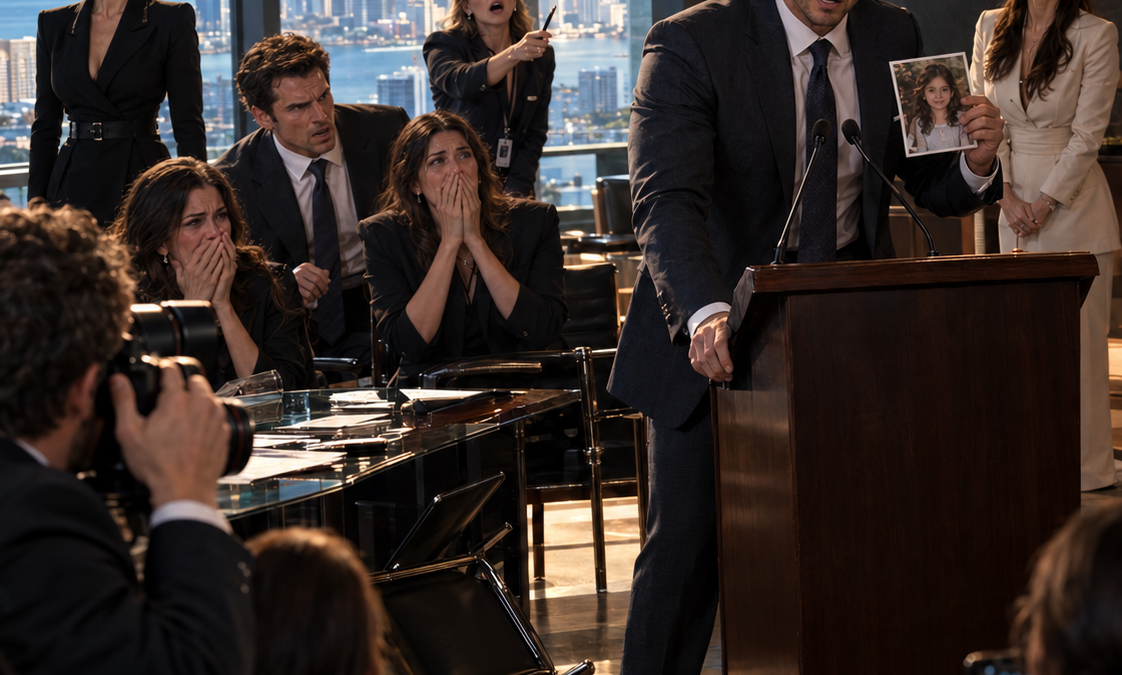
“Hide her.”
She was sent to expose his crimes. She ended up protecting his daughter. She thought she’d destroy him. She married him instead.
The first thing I notice is that the donor’s box has been cleaned out.
Not trashed. Cleaned out. Every drawer of the mahogany credenza hanging open, every file folder gone, the wall safe behind the seascape painting standing wide with nothing inside but a single velvet box that someone forgot to take.
“What do you mean, it’s empty?” My supervisor’s voice crackles through my earpiece, tinny and distant. “Elena, that box is supposed to contain eighteen years of donor records.”
“I know what it’s supposed to contain.” I step over a scattering of shredded paper on the carpet—not shredded, I realize, torn. Hand-torn, edges ragged, like someone was in a hurry. “It doesn’t.”
“Get out of there. Now. Before someone—”
The door behind me opens.
I don’t turn around. I’m still holding the velvet box, still crouched beside the open safe, still wearing the blazer I bought specifically because it has inside pockets deep enough to hide a phone and a backup recorder. Through the floor-to-ceiling window, I can see the football stadium lit up for tonight’s game, the field a bright green rectangle surrounded by the dark sprawl of Miami. The scoreboard reads HURRICANES 21, VISITORS 7. The crowd noise is a distant roar, muffled by the glass.
“Miss Marchetti.”
I know his voice before I turn. Everyone in this city knows his voice—that low, unhurried baritone that sounds like it’s never had to ask for anything twice. Dominic Varela. Chairman of the Varela Group. The man whose name is on half the buildings downtown and the other half of the philanthropic plaques in every hospital and university from Coral Gables to Palm Beach.
The man whose donor box I just found empty.
I stand up slowly, tucking the velvet box into my blazer pocket without breaking eye contact. He’s taller than he looks in photographs. Broader. The tuxedo he’s wearing probably costs more than my monthly rent, and he wears it like it’s a work uniform—no cufflinks, no pocket square, just clean lines and absolute stillness. His hair is silver at the temples, dark elsewhere, and his face gives away nothing except that he’s been expecting me.
“You’re early,” he says.
“You’re supposed to be at the game.”
“I was.” He steps into the room, and I notice two things: the door swings shut behind him with a soft click, and there’s a man in the hallway outside—dark suit, earpiece, the unmistakable posture of private security. “Then I heard there was an uninvited guest in my box.”
“I’m not uninvited. I have a warrant.”
“You have an administrative subpoena from the NCAA.” He says the words like they taste bad. “Which is not a warrant, Miss Marchetti. It’s a request. One I’ve been ignoring for six weeks.”
“Seven.”
“Seven.” He almost smiles. Almost. “I stand corrected.”
I’ve been an NCAA compliance investigator for four years. In that time, I’ve been lied to, threatened, stonewalled, and once—memorably—locked in a supply closet at a Division II school in Mississippi. I’ve learned to read the specific kind of silence that means someone is about to offer me a bribe, and the specific kind of smile that means someone is about to threaten my job.
Dominic Varela isn’t offering either. He’s just standing there, hands loose at his sides, watching me like I’m a chess piece he’s already accounted for.
“I need the donor records,” I say. “All of them. Going back to 2007.”
“You don’t need all of them. You need the ones related to the Varela Scholarship Fund.”
“Which would be all of them.”
“Which would be none of them.” He moves past me—close enough that I catch the scent of him, something clean and expensive, cedar and something sharper underneath—and stops in front of the open safe. “The Varela Scholarship Fund is a separate legal entity. Its records aren’t stored here.”
“Then where are they?”
“With the fund’s independent auditor. Who will be happy to provide them once your subpoena goes through the proper legal channels.” He turns to face me. “Which it hasn’t.”
I feel the velvet box in my pocket like a live thing. I shouldn’t have taken it. I know I shouldn’t have taken it. But something about this man—the way he moves, the way he talks, the way he looked at me like I was already a problem he’d solved—makes me want to take something from him.
“What’s in the box, Mr. Varela?”
“Nothing that concerns you.”
“It was in your safe.”
“It was in my safe because it’s valuable. Not because it’s relevant.” He tilts his head slightly. “You’re bleeding.”
I look down. There’s a thin line of red across my knuckles—I must have cut myself on the edge of the safe, or on one of the torn papers. I hadn’t noticed.
“It’s nothing.”
“There’s a first aid kit in the bathroom.” He gestures toward a door I hadn’t noticed, tucked into the corner. “Or you can stand there pretending you’re not hurt and keep asking me questions I won’t answer. Your choice.”
I don’t move. “Why did you clean out the box?”
“I didn’t.”
“Someone did.”
“Someone did.” He agrees with me like it costs him nothing. “Which is why I’d like to know who, and why you’re standing in the middle of it.”
“I’m here because your scholarship fund has donated four point six million dollars to this university’s athletic program over the past three years. In that same period, three recruits from low-income backgrounds—all of whom were personally recruited by you—received full scholarships, housing stipends, and what the university calls ‘leadership development grants’ that total just under two hundred thousand dollars each.” I pause. “That’s not how NCAA compliance works, Mr. Varela. That’s not how any of this works.”
His expression doesn’t change. But something in the room shifts—a pressure change, like the air before a storm.
“You’re very thorough,” he says.
“I’m very good at my job.”
“Then you’ll understand why I can’t help you.” He walks toward me, and I have to fight the urge to step back. “You’re looking for a crime. I’m not going to hand you one.”
“I’m not looking for a crime. I’m looking for an explanation.”
“Same thing, in my experience.” He stops a few feet away. “You’re young. You’re ambitious. You’re trying to make a name for yourself by taking down the biggest donor in South Florida. I respect that.”
“I don’t need your respect.”
“No.” A pause. “You need my records. Which you’re not going to get tonight.”
“I’m not leaving without something.”
“Then you’re going to be here for a long time.” He glances at his watch—a plain gold thing, nothing flashy. “I have a game to watch. You’re welcome to stay. There’s champagne in the fridge, if you can find it under all the empty space.”
He turns toward the door.
“The box,” I say. “The velvet box. What’s in it?”
He stops. For a long moment, he doesn’t move. Then he turns his head just enough that I can see his profile—the strong jaw, the silver at his temple, the completely unreadable expression.
“My wife’s jewelry,” he says. “A wedding gift. Nothing that would interest the NCAA.”
He leaves.
The door closes behind him with a soft click, and I’m alone in the donor’s box with the roar of the stadium and a velvet box in my pocket that I’m almost certain doesn’t contain jewelry.
I don’t open the box until I’m back in my car, parked three blocks from the stadium in a paid lot that costs more per hour than my first apartment.
The velvet is soft under my fingers, worn at the edges like something handled often. I tell myself I’m just checking. I tell myself I’ll put it back. I tell myself the story about the wedding jewelry is true, because the alternative is that I just committed theft from a man who could have me arrested, disbarred, and blacklisted from every compliance office in the country before morning.
I open the box.
Inside, there’s no jewelry. There’s a photograph—small, creased, black and white. A woman I don’t recognize, maybe thirty, dark-haired and sharp-featured, standing in front of a building I do recognize: the Varela Group headquarters downtown. She’s holding a baby. The baby is wrapped in a blanket, and the blanket has a small embroidered logo in the corner.
The Varela Group logo.
On the back of the photograph, in handwriting I don’t recognize, someone has written a date—eighteen years ago—and two words.
Hide her.
I stare at it for a long time. Then I put it back in the box, put the box in my glove compartment, and start the engine.
I should call my supervisor. I should report what I found. I should hand this over to the proper authorities and let them deal with it.
I don’t.
Instead, I drive home to my apartment in Little Havana, where the rent is cheap and the neighbors are loud and no one knows my name. I make tea. I sit on the couch. I think about Dominic Varela’s face when I asked him what was in the box, and the way he said my wife’s jewelry, and the way his hands stayed completely still the entire time.
Hide her.
Who?
And why did it feel like a threat?
Chapter 2: The Wife in the Photograph
The next morning, I’m at my desk by seven, which is early enough that the office is empty and I can pull up the Varela Group’s public filings without anyone looking over my shoulder.
The Varela Group is a family conglomerate—real estate, hospitality, shipping, a dozen subsidiaries that all trace back to a holding company registered in Delaware and a family trust that’s been in place since the 1960s. The chairman is Dominic Varela, sixty-one, who took over from his father at thirty-two after a decade of what the Miami Herald once called “aggressive expansion.” He’s married to Paulina Varela, née Paulina Reyes, of the Reyes hotel family in Spain. They have two children: Mateo, twenty-eight, who runs the hospitality division, and Sofia, twenty-five, who runs the foundation.
The foundation. The Varela Foundation, which administers the scholarship fund.
I pull up the foundation’s tax filings. They’re clean. They’re almost too clean—every donation accounted for, every grant documented, every scholarship recipient properly vetted. The four point six million to the university’s athletic program is listed as “community development and youth athletics.” The three recruits who received the additional “leadership grants” are listed by name, with their scholarship amounts and their family income brackets. All three come from families below the poverty line. All three were personally recruited by Dominic Varela.
I stare at the screen for a long time.
The NCAA has rules about this. Boosters can’t have direct contact with recruits. They can’t offer anything of value—cash, cars, housing, clothing—beyond what the university provides. The rules exist for a reason: to prevent the kind of pay-for-play system that turns college athletics into a bidding war. But the rules also assume that the money is coming from someone who wants something in return.
What if it isn’t?
What if Dominic Varela is just… giving money to poor kids?
It doesn’t make sense. Men like him don’t give money without strings. Men like him don’t clean out their own donor boxes and lie about jewelry.
Hide her.
I pull up the photograph on my phone—I took a picture before I put it back in the box—and zoom in on the woman’s face. Dark hair, sharp cheekbones, a direct gaze. She’s standing in front of the Varela Group headquarters, holding a baby. The date on the back is eighteen years ago, which means the baby would be eighteen now. College age.
The right age to be a recruit.
I open a new tab and start searching.
“You’re chasing ghosts.”
My supervisor, Marcus Webb, is standing in my cubicle with his arms crossed and the expression he gets when he’s about to tell me I’m wasting the department’s time and resources. He’s a former compliance officer at a Division I school, which means he’s seen every trick in the book and has zero patience for anything that looks like a conspiracy theory.
“I’m not chasing ghosts. I’m chasing donor records.”
“You’re chasing a hunch based on a photograph you shouldn’t have taken from a box you shouldn’t have opened.” He lowers his voice. “Elena, do you understand how much trouble you could be in? Varela could file a complaint. He could have you arrested.”
“He won’t.”
“How do you know?”
Because he looked at me like he knew something I didn’t. Because he left the box in the safe. Because he wanted me to find it.
I don’t say any of that. “I just know.”
Marcus sighs. He’s been my supervisor for two years, and in that time, I’ve brought him three major violations—a booster paying players at a Division II school, a coach falsifying academic records, a recruiting coordinator running a slush fund through a car dealership. He’s learned to trust my instincts even when he doesn’t understand them.
“What do you need?” he asks.
“I need you to request the full financial records for the Varela Foundation. Not just the public filings—the internal audits, the board minutes, everything.”
“That’s a lot of paperwork for a hunch.”
“It’s not a hunch.” I pull up the photograph on my phone and show it to him. “This was in Varela’s safe. A woman I don’t recognize, holding a baby, in front of the Varela Group headquarters. The back says ‘Hide her.'”
Marcus looks at the photo for a long moment. Then he looks at me. “And you think this has something to do with the scholarships?”
“I think it has something to do with everything.”
He hands the phone back. “I’ll put in the request. But Elena—be careful. Men like Varela don’t get to where they are by playing fair.”
“I know.”
“I mean it. He’s not just rich. He’s connected. I’ve heard things.”
“What kind of things?”
He shakes his head. “Just… be careful.”
That night, I dream about the woman in the photograph.
She’s standing in front of the Varela Group headquarters, holding the baby, and she’s crying. Not the kind of crying you do when you’re sad—the kind you do when you’re terrified. The baby is wrapped in the Varela Group blanket, and she’s holding it so tight that her knuckles are white.
Hide her, she says. Please. Hide her.
I wake up with my heart pounding and my phone buzzing on the nightstand.
It’s an unknown number. I almost don’t answer. But something—instinct, curiosity, the same thing that made me open the velvet box—makes me swipe the screen.
“Hello?”
“Miss Marchetti.” The voice is smooth, unhurried, and completely familiar. Dominic Varela. “I apologize for calling so late.”
“How did you get this number?”
“I have access to many things.” A pause. “I’d like to speak with you. In person.”
“We can speak at the NCAA offices. During business hours. With my supervisor present.”
“I don’t think that would be wise.” His voice is calm, almost pleasant. “What I have to say isn’t for your supervisor. Or for the NCAA. It’s for you.”
“Why?”
“Because you opened the box.” Another pause. “And you’re smart enough to understand what it means.”
I sit up in bed, my heart still racing from the dream. “What does it mean?”
“Not over the phone.” He gives me an address—a restaurant in Coral Gables, upscale and quiet. “Tomorrow. Seven o’clock. Come alone.”
“Why should I trust you?”
“You shouldn’t.” A sound that might be a laugh, or might be something else entirely. “But you will anyway. Because you want to know what’s in that box as much as I want to keep it hidden.”
He hangs up.
I stare at my phone for a long time. Then I get up, make tea, and start planning what I’m going to wear.
Chapter 3: The Man in the Restaurant
The restaurant is called Verdades, and it’s the kind of place where the hostess knows your name before you give it and the menu doesn’t have prices. I’m ten minutes early, which means I’m sitting at a corner table with a glass of sparkling water, watching the door, trying to look like I belong here.
I don’t belong here. My blazer is from a discount store. My shoes are scuffed. I grew up in a two-bedroom apartment in Hialeah with a mother who cleaned houses and a father who left before I was old enough to remember his face. I’ve spent my entire career fighting for people who don’t have money or power or connections, and I’ve learned to be comfortable in rooms where I’m the only one who can’t afford the wine list.
But this is different. This is Dominic Varela’s world, and I’m walking into it with a photograph in my pocket and a dozen questions I’m not sure I want answered.
He arrives exactly at seven.
He’s wearing a suit, not a tuxedo—dark gray, perfectly cut, no tie. He looks like he’s come from a board meeting, or a funeral, or something equally serious. He doesn’t smile when he sees me. He just walks to the table, pulls out the chair across from mine, and sits down.
“Thank you for coming,” he says.
“I didn’t come for you. I came for answers.”
“Same thing, in this case.” He signals to the waiter, who appears instantly with a bottle of wine that I didn’t order and probably costs more than my rent. “You don’t have to drink it. But it would be rude not to offer.”
“I’m not worried about being rude.”
“No. I don’t imagine you are.” He pours himself a glass, takes a sip, and sets it down. “You’re worried about the scholarship fund. The recruits. The four point six million dollars that doesn’t make sense.”
“Among other things.”
“The photograph.” He says it flatly, like it’s a fact he’s already accepted. “You found it.”
“I found it.”
“And you want to know who she is.”
“I want to know a lot of things.”
He nods slowly. He’s not looking at me—he’s looking at the wine glass, or the table, or something I can’t see. For a moment, he looks almost human. Almost tired.
“Her name was Isabel,” he says. “Isabel Reyes.”
“Reyes.” I recognize the name. “Like your wife’s family?”
“Like my wife’s family.” He takes another sip of wine. “Paulina’s younger sister. She died eighteen years ago, a few months after that photograph was taken.”
I feel the floor shift under me. “She died?”
“Childbirth.” His voice doesn’t change. “The baby survived.”
“What happened to the baby?”
He looks at me then—really looks at me, for the first time since he sat down. His eyes are dark, almost black, and there’s something in them I can’t read. Something old. Something careful.
“The baby was adopted,” he says. “By a family in California. She doesn’t know anything about her biological parents. She doesn’t know anything about me, or Paulina, or the Varela Group. And she never will.”
“Why are you telling me this?”
“Because you’re investigating my scholarship fund.” He sets down his wine glass. “And you’re going to find out that one of the three recruits who received those leadership grants is that baby.”
I can’t breathe. I can’t think. The restaurant is suddenly too loud, too bright, too much.
“The recruit,” I say. “The one from California. The one you personally recruited.”
“Her name is Camila.” He says it gently, like it’s something fragile. “She’s eighteen. She’s a point guard. She’s the best player in her conference, and she’s going to go pro, and she’s going to have a life that’s better than anything her mother could have given her.” A pause. “That’s what Isabel wanted. That’s what she died for.”
“You’re her uncle.”
“I’m her uncle.” He leans back in his chair. “And I’ve spent eighteen years making sure that no one—not the NCAA, not the press, not my wife’s family—ever finds out.”
“Why?”
“Because the Reyes family is not kind to bastards.” He says the word without flinching. “Isabel was unmarried when she got pregnant. The father was a married man, a business associate of mine. When the Reyes family found out, they disowned her. Threatened to take the baby. Threatened to destroy everything she had.” He pauses. “She came to me for help. I helped her. And then she died.”
“I’m sorry.”
“Don’t be. You didn’t know her.” He picks up his wine glass again, but he doesn’t drink. He just holds it. “Now you know why the scholarships exist. Why the money flows the way it does. It’s not a bribe. It’s not a violation. It’s just… protection.”
“Protection from what?”
“From the life she would have had.” He looks at me. “From people like you.”
I should be angry. I should be furious. He’s been lying to the NCAA, lying to the university, lying to everyone. He’s been using his foundation to funnel money to a relative, which is exactly the kind of thing the compliance rules are designed to prevent.
But I’m not angry. I’m something else—something I don’t have a name for.
“You could have told me this from the beginning,” I say.
“No. I couldn’t have.” He sets down his glass. “If I had, you would have reported it. The NCAA would have investigated. The Reyes family would have found out. And Camila would have lost everything.”
“She’s an adult. She has a right to know.”
“She has a right to be safe.” His voice hardens. “You’ve seen what happens to people who cross the Reyes family. You’ve seen it in your own files—the donors who suddenly disappeared, the coaches who suddenly resigned, the investigators who suddenly found themselves unemployed.” He pauses. “You’re smart. You know what I’m talking about.”
I do know. There have been rumors for years—the Reyes family, the Varela Group, the cartel connections that no one talks about. I’ve seen the pattern in my own cases: donors who give millions to athletic programs and then vanish when the NCAA starts asking questions. Coaches who take jobs at small schools and then move to South America. Investigators who get too close and then get transferred to Alaska.
“I’m not afraid of the Reyes family,” I say.
“You should be.” He stands up, pulling a card from his pocket and setting it on the table. “If you decide to pursue this, that’s your choice. But I want you to understand what’s at stake. Not for me—for Camila. She’s a good kid. She’s worked hard. She’s earned everything she has.” He pauses. “Don’t take it away from her because you don’t like me.”
He walks out of the restaurant.
I sit there for a long time, staring at the card. It has his name and a phone number on it, nothing else. No title, no address, no logo. Just Dominic Varela and a ten-digit number.
I put it in my pocket with the photograph.
Then I call Marcus.
“I need you to dig up everything you can on the Reyes family,” I say. “And I need you to be careful. Don’t use your work phone. Don’t use your work email. Don’t tell anyone what you’re doing.”
“What did you find?”
“I’ll tell you when I see you.” I hang up before he can ask more questions.
Then I order a glass of the wine Dominic Varela left behind, and I drink it slowly, and I think about a woman named Isabel who died for a baby she never got to hold.
Chapter 4: The Name in the Ledger
Three days later, I’m sitting in my apartment with a laptop, a stack of printed documents, and a headache that won’t quit.
Marcus came through. He’s good at his job—better than me, maybe—and he knows how to find things that aren’t supposed to be found. The Reyes family has a long history in Spain, most of it legitimate, some of it not. They own hotels, resorts, a couple of wineries. They also have connections to a shipping company that’s been investigated three times for smuggling and never charged.
And Paulina Varela—Dominic’s wife—is the eldest daughter.
She’s also, according to the society pages, a devoted wife and mother who spends most of her time in Miami and Madrid, chairing charity galas and appearing at her husband’s side for business functions. There are photos of her at a gala last month, wearing a red dress that probably cost more than my car. She’s smiling, her hand on Dominic’s arm, looking like the luckiest woman in the world.
I wonder if she knows about Isabel.
I wonder if she knows about Camila.
I’m about to close the laptop and try to sleep when my phone buzzes. A text from an unknown number.
Have you made a decision?
Dominic.
I stare at the message for a long time. Then I type back.
I need more information.
Dinner. Tomorrow. Same place.
I’m not going to dinner with you again.
Then come to my office. Tomorrow. 2 PM.
I don’t respond. But I already know I’m going to go.
Chapter 5: The Office in the Sky
The Varela Group headquarters is a glass tower downtown, fifty-six floors of steel and sunlight. I’ve walked past it a hundred times—everyone in Miami has—but I’ve never been inside. The lobby is all white marble and security guards, and when I give my name, the guard doesn’t even blink. He just hands me a visitor’s badge and points me toward the elevators.
“Fifty-second floor,” he says.
The elevator ride is long enough that my ears pop. When the doors open, I’m in a reception area that looks more like a museum than an office—art on the walls, a receptionist who looks like she stepped out of a fashion magazine, a view of Biscayne Bay that stretches all the way to the horizon.
“Miss Marchetti.” The receptionist smiles. “Mr. Varela is expecting you. Follow me.”
She leads me down a hallway, past offices with glass walls and people who don’t look up as I pass. The whole place feels like a different world—quiet, expensive, dangerous in a way I can’t quite name.
The receptionist stops at a door at the end of the hall. “He’s inside.”
I open the door.
Dominic Varela is standing at the window, looking out at the bay. He’s wearing a white shirt with the sleeves rolled up, and for a moment—just a moment—he looks almost ordinary. Like a man who works too much and sleeps too little and has too many secrets.
“Thank you for coming,” he says without turning around.
“You didn’t give me a choice.”
“There’s always a choice.” He turns. “You made the one I hoped you would.”
I close the door behind me. “What do you want?”
He gestures to a chair. I don’t sit.
“The NCAA has opened a formal inquiry into the Varela Foundation,” he says. “Your supervisor filed the request last week.”
“I know. I was there.”
“You were.” He almost smiles. “And you didn’t tell him about Isabel. Or Camila.”
“No.”
“Why?”
“Because I don’t know if it’s true.” I cross my arms. “Because you could be lying to me. Because I’ve been doing this job long enough to know that rich men don’t tell the truth unless it benefits them.”
“That’s fair.” He walks to his desk—a massive slab of dark wood that looks like it’s been in his family for generations—and sits down. “I’m going to tell you something that I’ve never told anyone. Not my wife, not my children, not my closest advisors. And I’m telling you because I need you to understand what’s at stake.”
“I’m listening.”
He opens a drawer and pulls out a folder. It’s worn, creased at the edges, like something that’s been handled many times over many years.
“Eighteen years ago, Isabel came to me because she was pregnant and terrified. The father was a man named Enrique Reyes—no relation to my wife’s family, but a business associate of mine. He was married. He had children. He was also a violent man with connections to the cartel.” He pauses. “Isabel didn’t want to keep the baby. She was going to give it up for adoption. But then Enrique found out, and he threatened to kill her. He said he’d rather see the baby dead than raised by anyone else.”
“But it wasn’t dead.”
“No. Isabel went into hiding. I helped her—gave her money, a place to stay, protection. She had the baby in a small hospital in Broward County, under a false name. And then she died.” His voice doesn’t change, but something in his face tightens. “I was the only one there. I held the baby. I made a promise to Isabel that I would keep her safe. And I have.”
“By giving her a scholarship?”
“By giving her everything.” He opens the folder and pulls out a photograph. It’s Camila—I recognize her from the NCAA files—standing on a basketball court, holding a trophy. She’s smiling, her hair pulled back, her face open and hopeful. “She’s the best thing that ever came out of this family. And I will do anything to protect her.”
I look at the photograph. Then I look at him.
“You’re not her uncle,” I say. “You’re her father.”
He doesn’t flinch. He doesn’t even blink.
“Yes,” he says. “I am.”
The room is very quiet. I can hear the hum of the air conditioning, the distant sound of traffic from fifty-two floors below.
“Does your wife know?”
“No.”
“Does anyone know?”
“You. And me.” He closes the folder. “And now you have a choice. You can take this to the NCAA, and Camila’s scholarship will be revoked, and she’ll be investigated, and her face will be in the news, and the Reyes family will find out. Or you can keep the secret, and let her have the life she deserves.”
“That’s not a choice. That’s blackmail.”
“Is it?” He leans back in his chair. “I’m not threatening you. I’m asking you to consider the consequences. You have the power to destroy her. I’m asking you not to.”
I think about Camila. I think about her file—the transcripts, the test scores, the letters of recommendation from teachers who said she was the hardest-working kid they’d ever met. I think about the life she’s built for herself, the future she’s earned.
I think about my own mother, cleaning houses for rich people, coming home with bleach on her hands and dreams she never got to live.
“Fine,” I say. “I’ll keep your secret. For now.”
“Thank you.”
“But I’m not done with you.” I step closer to his desk. “I want to know everything—the cartel connections, the money laundering, the shell companies. I want to know what you’re really doing with that foundation, and I want to know if any of it puts Camila at risk.”
He looks at me for a long moment. Then he nods.
“All right,” he says. “I’ll tell you everything.”
Chapter 6: The Truth in the Ledger
He tells me over the next three hours.
The cartel money comes through the shipping company—the one the Reyes family has been investigated for three times. It’s washed through a series of shell companies in the Caymans and Panama, then funneled into the Varela Group’s legitimate businesses. Some of it goes into real estate. Some of it goes into the hotels. And some of it—a small, carefully accounted-for fraction—goes into the foundation.
“The scholarships are legitimate,” he says. “Every cent is documented. Every recipient is vetted. The money comes from the legitimate side of the business, not the cartel side. I’ve been separating the funds for years—building a firewall between the dirty money and the clean money. If I’m ever indicted, the foundation survives. The scholarships survive. Camila survives.”
“You’ve been planning for this.”
“I’ve been planning for everything.” He rubs his eyes—a small gesture, almost human. “When you’re in my position, you learn to think ten steps ahead. You learn to protect the people you love, even if it costs you everything.”
“Who else knows about the cartel money?”
“My brother. My CFO. A few people in the Reyes family who are still involved in the shipping business.” He pauses. “And now you.”
“Why are you telling me this?”
“Because I need your help.” He leans forward. “The NCAA investigation is getting too close. The Reyes family is getting suspicious. And there’s a rival—a man named Sebastian Cortez—who’s been trying to take over my shipping business for years. He knows about the cartel money, and he’s been feeding information to the FBI.”
“How do you know?”
“Because I have sources.” He stands up and walks to the window. “I need someone on the inside. Someone the NCAA trusts. Someone who can help me manage the investigation, keep it focused on the scholarships, keep it away from the cartel money.”
“You want me to be your mole.”
“I want you to be my ally.” He turns to face me. “I know it’s not fair. I know I’m asking you to compromise your integrity. But I’m also asking you to save a young woman’s life—and maybe more than one.”
I should say no. I should walk out of this office, call Marcus, and report everything. I should do my job.
But I’m thinking about Camila. I’m thinking about the ledger on his desk—the one he showed me, the one with the clean money and the dirty money separated into neat columns. I’m thinking about the firewall he’s built, the years he’s spent protecting a daughter he can never acknowledge.
“Fine,” I say. “I’ll help you. But on my terms.”
“What terms?”
“You give me full access to the foundation’s records. You answer every question I ask, honestly, no matter how uncomfortable. And if I find something that puts Camila in danger—or anyone else—I’m going to the authorities, no matter what you say.”
He looks at me for a long moment. Then he nods.
“Agreed.”
He holds out his hand.
I shake it.
His palm is warm, his grip firm. He doesn’t let go for a second longer than necessary, and when he does, I feel something shift in the room—a change in the air, a new kind of tension.
“One more thing,” he says.
“What?”
“You can’t tell anyone about this. Not your supervisor, not your colleagues, not your friends. If this gets out, everything falls apart.”
“I know.”
“And you can’t investigate me anymore. Not officially. You have to stay away from the foundation’s records, at least until the NCAA inquiry is resolved.”
“That’s going to be hard to explain.”
“I know.” He almost smiles. “But I have faith in you.”
I leave his office with a folder full of documents and a knot in my stomach that won’t go away.
I’m in too deep. I know I’m in too deep.
And I don’t know how to get out.
Chapter 7: The Dinner with the Enemy
Two weeks later, I’m standing in the Varela mansion, holding a glass of champagne I don’t want to drink, watching Paulina Varela hold court in the center of the room.
She’s exactly what I expected—tall, elegant, perfectly put together, with the kind of smile that never reaches her eyes. She’s wearing a white dress that probably costs more than my entire wardrobe, and she’s surrounded by a group of women who all look like they’ve stepped out of a magazine.
“Miss Marchetti.” She turns to me, her smile widening. “I’ve heard so much about you.”
“All good things, I hope.”
“All interesting things.” She takes a sip of her champagne. “My husband tells me you’re investigating his scholarship fund. How fascinating.”
“I’m just doing my job.”
“Of course.” She leans closer, lowering her voice. “But between us, I’ve always wondered why Dominic cares so much about those children. The ones from California. The ones he recruits personally.” She pauses. “It seems almost… personal.”
I keep my face neutral. “I wouldn’t know.”
“No. I don’t suppose you would.” She smiles again. “Enjoy the party, Miss Marchetti. And do let me know if you find anything… interesting.”
She walks away, and I’m left standing there with a cold feeling in my chest.
She knows. She doesn’t know what she knows, but she knows something. And she’s watching me.
I find Dominic by the bar, talking to a group of men in suits. He catches my eye and excuses himself, walking over.
“You look like you’ve seen a ghost.”
“Your wife just threatened me.”
“She does that.” He hands me a fresh glass of champagne. “Don’t worry. She threatens everyone.”
“She asked about the scholarships. The California recruits.”
His expression doesn’t change, but I see something flicker in his eyes. “What did you tell her?”
“Nothing. I don’t know anything.”
“Good.” He takes a sip of his drink. “Stay close to me tonight. And don’t talk to Paulina more than you have to.”
“Why?”
“Because she’s dangerous.” He looks at me. “And she’s been looking for a way to destroy me for years.”
I think about the photograph in my pocket. The woman holding the baby. The words on the back.
Hide her.
“I need to ask you something,” I say.
“Ask.”
“Does Paulina know about Isabel?”
He’s silent for a long moment. Then he shakes his head.
“No,” he says. “And she never will.”
Chapter 8: The Mistress in the Mirror
The party ends at midnight.
I’m walking to my car when a woman steps out of the shadows—dark hair, sharp cheekbones, a red dress that matches the one Paulina was wearing. She’s beautiful in a way that’s almost aggressive, like a weapon.
“Miss Marchetti.” Her voice is low, accented—Spanish, maybe. “I’ve been waiting for you.”
“Who are you?”
“My name is Valentina.” She smiles. “I’m a friend of the family.”
“What do you want?”
“I want to warn you.” She steps closer. “You’re playing a dangerous game. Dominic Varela is not what he seems.”
“I know what he is.”
“Do you?” She tilts her head. “Do you know about the cartel? The money laundering? The people he’s killed?”
My blood runs cold. “He hasn’t killed anyone.”
“Haven’t you wondered why his wife is so bitter? Why she drinks so much? Why she looks at him like she’s planning his funeral?” Valentina laughs softly. “Because she knows. She knows everything. And she’s been waiting for the right moment to destroy him.”
“What does this have to do with me?”
“You’re the key.” She reaches out and touches my arm—a light touch, almost gentle. “You’re the investigator. You’re the one who can expose him. And when you do, Paulina will be free. And so will I.”
“Who are you to Paulina?”
“I’m her sister.” She smiles. “Isabel was my sister too. And Dominic Varela destroyed both of them.”
She walks away before I can respond.
I stand there in the dark parking lot, my heart pounding, my mind racing.
Isabel was her sister.
Which means Valentina is Camila’s aunt.
And she wants revenge.
Chapter 9: The Sister Who Came Back
I don’t sleep that night.
I lie in bed staring at the ceiling, replaying Valentina’s words in my head. Isabel was my sister too. Dominic Varela destroyed both of them. I think about the photograph in my pocket—the woman with the sharp cheekbones and the terrified eyes. I think about Camila, who doesn’t know any of this. I think about Dominic, who looked me in the eye and told me he was her father.
And I think about Paulina, who’s been married to him for thirty years and doesn’t know the truth.
Or does she?
At six a.m., I give up on sleep and call Dominic. He answers on the second ring, his voice rough with sleep.
“Marchetti. It’s early.”
“I need to see you.”
“Come to the office.”
“No. Somewhere private. Somewhere we won’t be overheard.”
A pause. “There’s a marina in Coconut Grove. Slip forty-two. I’ll be there in an hour.”
The marina is quiet at this hour, the water flat and gray under a sky that hasn’t decided if it wants to rain. Dominic’s boat is a sleek white thing that looks like it costs more than my apartment building. He’s standing on the deck when I arrive, wearing jeans and a dark sweater—the most casual I’ve ever seen him.
“You look terrible,” he says.
“I didn’t sleep.”
“Neither did I.” He gestures to the cabin. “Come inside. I made coffee.”
The cabin is small but luxurious—leather seats, a polished wood table, a galley kitchen that looks like it’s never been used. He pours me a cup of coffee and sits across from me, waiting.
“Valentina came to see me last night,” I say.
His expression doesn’t change, but his hand tightens around his coffee cup. “What did she want?”
“She wanted to warn me about you. She said you destroyed Isabel. She said you’re dangerous.” I pause. “She also said she’s Paulina’s sister. And Isabel’s.”
He sets down his cup. “Valentina is… complicated.”
“Complicated how?”
“She’s the youngest Reyes sister. She was always the wild one—drugs, bad relationships, trouble with the law. Paulina cut her off years ago. She’s been living in Madrid, or Buenos Aires, or wherever she can find someone to pay her bills.” He rubs his jaw. “I didn’t know she was in Miami.”
“She said you killed Isabel.”
“I didn’t kill Isabel. Isabel died in childbirth. I was there. I held her hand.” His voice is flat, but there’s something underneath it—something raw. “Valentina has never forgiven me for that. She thinks I could have saved her. She thinks I should have tried harder.”
“Could you have?”
“No.” He looks at me. “Isabel had a condition—a heart problem she’d had since childhood. The pregnancy put too much strain on her. The doctors did everything they could. But she was never going to survive.”
I think about the photograph—the woman holding the baby, the terror in her eyes. She knew. She knew she was going to die.
“She asked you to protect Camila,” I say.
“She asked me to hide her. From Enrique, from the Reyes family, from everyone who would have used her as a weapon.” He picks up his coffee again, but he doesn’t drink. “I promised her I would. And I’ve kept that promise for eighteen years.”
“Valentina wants revenge.”
“Valentina wants money.” His voice hardens. “She’s been trying to blackmail me for years. She knows about Camila—she figured it out a few years ago, after Isabel died. She’s been threatening to tell Paulina, to tell the press, to tell anyone who’ll listen. I’ve been paying her off.”
“You’ve been paying her?”
“Two hundred thousand a year. For the past six years.” He sets down his cup. “It’s not in the foundation’s records. It’s not in the company’s records. It comes from my personal accounts, and it’s perfectly legal.”
“But it’s still blackmail.”
“Yes.” He looks at me. “And now you know why I’ve been so careful. Why I’ve been separating the money. Why I’ve been building that firewall. If something happens to me, the foundation survives. Camila survives. But only if Valentina doesn’t get what she wants.”
“What does she want?”
“She wants to destroy me.” He stands up and walks to the window. “She wants to destroy Paulina. She wants to destroy the whole family. And she’ll use you to do it.”
“She already tried.”
“I know.” He turns to face me. “Which is why I need you to be careful. Don’t talk to her again. Don’t meet with her alone. If she contacts you, tell me immediately.”
“She’s not going to stop.”
“No. She’s not.” He pauses. “But neither am I.”
Chapter 10: The Quiet Drive
He offers to drive me back to my apartment.
“I have a car,” I say.
“Your car is parked at the marina. I’ll have someone pick it up.” He grabs his keys from the counter. “Come on. I don’t bite.”
I should say no. I should call a cab. I should put as much distance between us as possible.
Instead, I follow him to a black SUV parked at the end of the dock.
The drive is quiet at first. He doesn’t turn on the radio, and I don’t try to make conversation. We pass through Coconut Grove, past the mansions and the banyan trees, past the marina and the waterfront restaurants. The sky is still gray, the streets still empty. It feels like we’re the only two people in the world.
“You grew up in Hialeah,” he says, breaking the silence.
“That’s right.”
“I looked you up.” He glances at me. “Your mother cleaned houses. Your father left when you were three. You put yourself through Florida State on scholarships and part-time jobs. You graduated top of your class. You’ve been with the NCAA for four years.”
“You’ve been investigating me.”
“I’ve been trying to understand you.” He turns onto the highway. “You’re not like the other investigators I’ve dealt with. You don’t want money. You don’t want fame. You want the truth.”
“That’s my job.”
“It’s more than your job.” He glances at me again. “You care about the kids. The recruits. The ones who don’t have anyone else fighting for them.”
“Someone has to.”
“Yes.” He pauses. “I’ve been that person for Camila. For eighteen years. And I’ve done things—terrible things—to keep her safe. But I’ve never regretted any of it.”
I look at him—really look at him—for the first time since we met. He’s not the monster Valentina described. He’s not the saint the newspapers make him out to be. He’s something in between. Something complicated.
“You love her,” I say.
“She’s my daughter.” His voice is quiet. “I’ve never been able to be her father. Not in the way she deserves. But I’ve loved her from the moment she was born. I’ve loved her every day since.”
“Does she know? About you?”
“No.” He pulls up in front of my apartment building. “And she never will. That’s the price I pay for keeping her safe.”
He turns off the engine. We sit there for a moment, neither of us moving.
“Thank you,” I say.
“For what?”
“For telling me the truth. Even when it would have been easier to lie.”
He looks at me. In the gray morning light, his face is tired, unguarded. For a moment, he looks almost vulnerable.
“I don’t lie to people I trust,” he says.
“And you trust me?”
“I’m starting to.”
I get out of the car. I don’t look back.
But I feel his eyes on me all the way to the door.
 [Tap here for the Next Part ]

