Part 3: “Because I’ve spent twenty years building this company while you were off playing soldier.
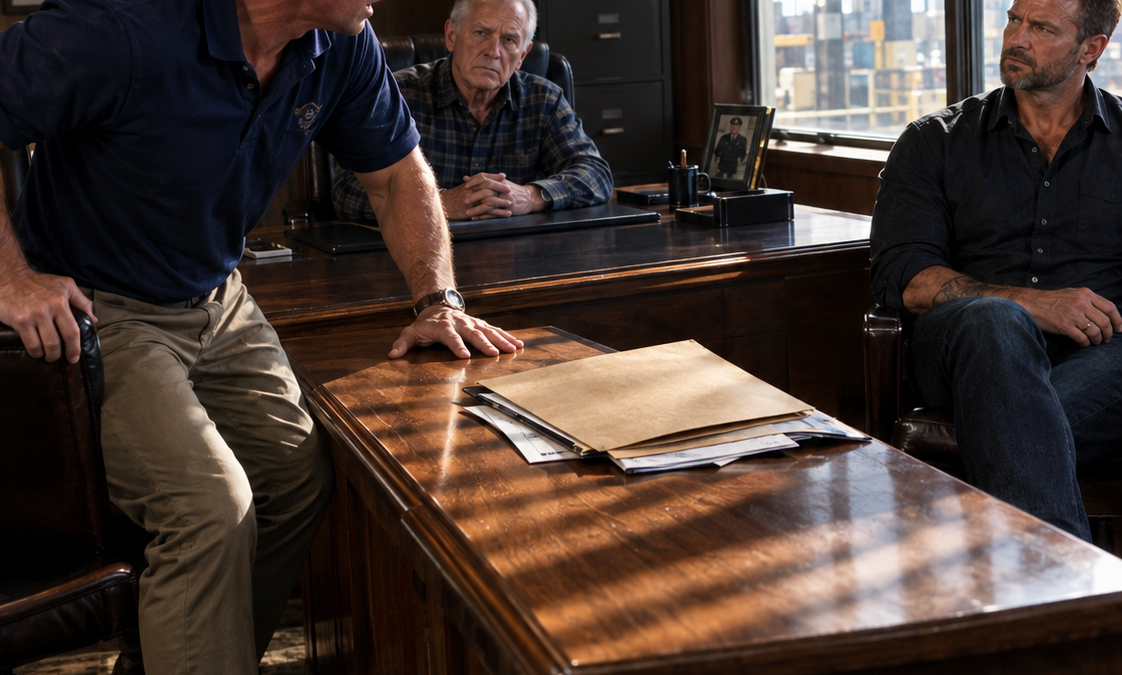
PART 6 — THE FILING CABINET
The subpoena came through eight days later.
David Chen called me on a Wednesday morning. His voice was clipped, professional, but I could hear something underneath it. Excitement, maybe. Or relief.
“Judge approved it. Sheriff’s deputy is executing it this afternoon.”
“I’ll be there.”
“You don’t have to be. The deputy will handle it.”
“I want to be there.”
He paused.
“Okay,” he said. “But stay out of the way. This is a legal proceeding. Not a family argument.”
“I know the difference.”
I drove to the shop at two o’clock. The parking lot was half empty—most of the shop guys had gone home for the day. A sheriff’s cruiser was parked by the front door. The deputy, a young guy with a buzz cut and a serious face, was standing in the showroom talking to the receptionist.
She looked relieved to see me.
“Mr. Whitaker,” she said. “This officer says he has a warrant.”
“I know. I’m here to observe.”
The deputy looked at me. “You the petitioner?”
“I’m the shareholder. Daniel Whitaker.”
He nodded. “I’ve got the order. The office in question is at the end of the hall. Michael Whitaker’s office.”
“He’s not here,” the receptionist said. “He hasn’t been in since Friday.”
“Is the office locked?”
“No. He left it open. He took some things, but most of it’s still there.”
The deputy walked down the hall. I followed. The office was exactly as I remembered it—the corner desk, the windows overlooking the shop floor, the file cabinets against the wall.
The deputy went to the cabinet labeled “Sierra—Correspondence.” He tried the handle.
“Locked,” he said.
“Do you have a key?”
He held up a small envelope. “Court order included a locksmith.”
It took the locksmith ten minutes to open the cabinet. When the drawer slid open, I saw folders. Dozens of them. Labeled, dated, organized.
The deputy started pulling them out. He set them on the desk in neat stacks.
“You want to look through these?” he asked.
“I do.”
“Go ahead. I’ll catalog as you go.”
I sat down at Michael’s desk. The chair was leather, expensive. It creaked when I sat.
The first folder was labeled “Sierra—Initial Contact.” Inside were emails, printed and bound. The first was dated February 2023.
Dear Mr. Whitaker,
My name is Victor Salazar. I represent a group of investors who are interested in the millwork industry in western North Carolina. We have been following Whitaker Millwork for some time and believe there may be an opportunity for partnership…
I read through the emails. The early ones were polite. Professional. Salazar introduced himself as a “strategic investor” with “deep experience in building materials.” He mentioned “synergies” and “growth opportunities.” He promised “capital infusion” and “market expansion.”
By April, the tone had changed.
Michael,
I want to be direct. Your company is undervalued. You know it. I know it. Your father doesn’t have the vision to see what this business could become. But you do. I can help you unlock that value. I can help you become the leader this company needs.
By June, Salazar was talking about “transition planning.”
Your father is getting older. He’s not going to be around forever. You need to think about the future. Your future. The future of the company. I can make sure you’re taken care of.
By August, the letter of intent was signed.
This agreement outlines the terms of a proposed acquisition of a majority stake in Whitaker Millwork, Inc. by Sierra Capital Partners, LLC, or its assigns…
I kept reading. The next folder was labeled “Sierra—Financials.” It contained spreadsheets, projections, valuations. The numbers were wrong. Deliberately wrong. They undervalued the company’s assets, overstated its liabilities, and painted a picture of a business on the brink of collapse.
But the third folder was the one that mattered.
“Sierra—Other Deals.”
Inside were documents from other companies. The lumber yard in Waynesville. The hardware store in Hendersonville. The cabinet shop in Brevard. Letters of intent, valuations, projections. All using the same template. All with the same promises. All designed to strip the companies of their assets and leave the owners with nothing.
And at the back of the folder, there was a single sheet of paper.
A memo. On Sierra letterhead. Dated three years ago.
Project List—Active
1. Piedmont Lumber & Supply (Waynesville, NC) — Status: Acquired. Assets liquidated. Proceeds: $2.4M.*
*2. Blue Ridge Hardware (Hendersonville, NC) — Status: Acquired. Assets liquidated. Proceeds: $1.8M.
3. Transylvania Cabinet Co. (Brevard, NC) — Status: In progress. LOI signed. Due diligence underway.
4. Whitaker Millwork (Asheville, NC) — Status: In progress. LOI signed. Due diligence underway.
I stared at the paper for a long time.
“Deputy,” I said. “You need to see this.”
He came over. He read the memo. His face didn’t change, but his jaw tightened.
“This is evidence of a pattern,” he said.
“This is evidence of a crime.”
He nodded. “I’ll need to take all of this. Every folder. Every document.”
“Take it. I want it all on the record.”
He started boxing up the files. I called David Chen.
“We found it,” I said.
“What?”
“A memo. On Sierra letterhead. Listing all their acquisitions. Including the ones they already stripped.”
“Send me a photo.”
I took one and texted it.
He called back thirty seconds later.
“This is enough,” he said. “This is more than enough. I’m calling the FBI.”
“Do it.”
I hung up and called Buck.
“We got them,” I said.
“Salazar?”
“Salazar. Sierra. Everyone.”
“What about Michael?”
I paused.
“He’s in it up to his neck. His name is on the letters of intent. His emails are in the files. He knew what they were doing.”
“Does your father know?”
“Not yet. I’m going to tell him tonight.”
“You want me to come?”
“No. This is family.”
I drove to my parents’ house. The lights were on. Dad was in his chair in the living room, a blanket over his legs. Mom was in the kitchen, making tea.
“Danny,” she said when I walked in. She looked at me differently now. Not warm, exactly. But not cold either. Something in between.
“Hi, Mom.”
“Your father’s in the living room.”
“I know. I need to talk to both of you.”
She set down the teapot and followed me into the living room.
Dad looked up. He looked tired. But he also looked present. More present than he had in years.
“What’s wrong?” he asked.
I sat down across from him.
“I need to tell you something. And it’s going to be hard to hear.”
He nodded.
I told them about the filing cabinet. The emails. The letters of intent. The memo.
By the time I was done, Dad was crying. Mom was holding his hand.
“He knew,” Dad said. “He knew what they were doing. To other families.”
“He did.”
“And he didn’t care.”
“I don’t know if he didn’t care. I think he didn’t let himself think about it. He was so focused on saving the company—”
“The company wasn’t in danger. You told me that. The numbers were good.”
“They were. He lied about that too.”
Dad shook his head. He wiped his eyes with the back of his hand.
“I don’t understand,” he said. “I don’t understand how he became this person.”
I didn’t have an answer for him.
“I need to call him,” Dad said.
“Not tonight. You need to rest.”
“I need to call him. I need to hear it from him.”
“Dad—”
“Don’t tell me what I need.”
I stopped.
He picked up his phone. He dialed. He waited.
“Michael,” he said. “It’s your father.”
There was a pause.
“Don’t hang up. Don’t you dare hang up.”
Another pause.
“I know everything. I’ve seen the papers. The emails. The memo. I know what you did.”
A longer pause.
“No. You listen to me. I don’t care what you thought you were doing. I don’t care what Salazar promised you. You were going to sell out this family. You were going to sell out everything your grandfather built. For what? For money? For a title?”
His voice was shaking. But he didn’t stop.
“You are my son. I love you. But I don’t recognize you anymore. I don’t know who you’ve become.”
He listened for a moment.
“No. You’re not welcome here. Not until you tell the truth. Not until you make this right.”
He hung up. He set the phone down. He looked at me.
“Did I do the right thing?” he asked.
“Yes.”
“I don’t feel like it.”
“I know. But you did.”
Mom put her arm around him. He leaned into her. They sat like that for a long time.
I left them alone. I went back to Aunt Ruth’s. She was in the kitchen, reading. She looked up when I walked in.
“How did it go?”
“He called Michael.”
“What did he say?”
“The truth.”
She nodded.
“It’s going to be okay,” she said.
“How do you know?”
“Because the truth is out. That’s always the hardest part. The rest is just cleaning up.”
I sat down. She poured me a cup of tea.
“What happens now?” she asked.
“The FBI is going to investigate Sierra. Salazar. Everyone connected.”
“And Michael?”
“He’ll be investigated too. If he cooperated with them, he could be charged.”
“Charged with what?”
“Fraud. Conspiracy. I don’t know the exact charges.”
She was quiet for a minute.
“Will you help him?” she asked.
“What?”
“If he asks for help. Will you help him?”
I thought about it.
“He’s my brother,” I said.
“That’s not an answer.”
“I know.”
“You need to decide, Danny. Before it happens. Because it will happen. He’ll come to you. He’ll ask for something. And you need to know what you’re going to say.”
I looked at her.
“I’ll tell him the truth,” I said. “Same as I always have. And then I’ll decide.”
She nodded.
“That’s fair,” she said.
The next morning, I got a call from Buck.
“FBI’s moving,” he said. “They’re executing search warrants on Sierra’s offices in Atlanta. And they’re talking to local law enforcement about Salazar’s connections here.”
“How long until charges?”
“Weeks. Maybe months. Depends on how fast they can build the case.”
“And Michael?”
“He’s a witness. Maybe a co-conspirator. Depends on what he tells them.”
I hung up. I looked out the window. The mountains were white with frost. Winter had come.
That afternoon, Michael called.
I didn’t recognize the number. I answered anyway.
“Danny.”
His voice was hoarse. Like he had been crying.
“Michael.”
“I need to see you.”
“Why?”
“Because you’re the only one who will understand.”
I closed my eyes.
“Where are you?”
“The shop. I’m at the shop. I’m sitting in my office. They took everything. All the files. All the papers. The furniture is still here but the rest is gone.”
“I know. I was there.”
“I figured.”
There was a long pause.
“Can you come?” he asked.
“I don’t know.”
“Please.”
I looked at the mountains. I thought about what Aunt Ruth had said. About deciding before it happened.
“Fine,” I said. “I’ll come.”
“Thank you.”
I hung up. I put on my jacket. I drove to the shop.
Michael was sitting in his office. The windows were dark. The lights were off. He was in his chair, staring at the empty file cabinet.
“You came,” he said.
“I said I would.”
He looked at me. His face was gray. His eyes were red.
“I’m sorry,” he said.
“For what?”
“For everything. For the way I treated you. For the lies. For the—the scheme. All of it.”
I sat down across from him.
“Tell me why,” I said.
He looked at the floor.
“I was scared,” he said. “I was scared of failing. I was scared of losing the company. I was scared of Dad being disappointed in me.”
“He was never disappointed in you.”
“He was disappointed in you. He talked about it all the time. You left. You chose the Army over the family. And he couldn’t understand why.”
I didn’t say anything.
“I thought if I could make the company successful, if I could grow it, if I could make it bigger than it ever was—then he would be proud of me. Then I would be the son who mattered.”
“You were always the son who mattered.”
“No. You were. You were the one who went out and did something with your life. You were the one who was brave. I was just the one who stayed.”
“There’s nothing wrong with staying.”
“Except it’s not enough. It’s never enough.”
He looked up at me.
“Salazar understood that,” he said. “He understood what it was like to be the one who was overlooked. He told me he saw potential in me. Real potential. He said I could be the one who transformed this company. Who made it into something great.”
“And you believed him.”
“I wanted to believe him.”
I leaned back in the chair.
“You were going to sell the company, Michael. You were going to take the payout and walk away. You were going to leave Mom and Dad with nothing.”
“I wasn’t—”
“You were. You signed the letter of intent. You gave them access to the financials. You knew what they were doing.”
“I didn’t think—”
“No. You didn’t think. You just acted. Because that’s what you do. You take the easy way. You take the shortcut. You always have.”
He didn’t say anything.
“Grandpa knew that,” I said. “He told me once, the summer I turned sixteen. He said ‘Sometimes the biggest thing you can do is stay.’ I didn’t understand it then. I understand it now.”
“What does that mean?”
“It means staying isn’t about location. It’s about commitment. It’s about doing the work. Not just being there. Not just showing up. Doing the work.”
“I did the work.”
“No. You did the easy parts. You did the parts that made you look good. You didn’t do the hard parts. You didn’t tell the truth. You didn’t ask for help when you needed it. You didn’t—”
I stopped.
“I didn’t what?”
“You didn’t trust us. You didn’t trust Dad. You didn’t trust me. You didn’t let anyone in.”
He looked at me.
“Like you let people in?” he said.
I felt the words land.
“That’s fair,” I said. “I didn’t. I kept my distance. I kept everyone at arm’s length. I thought that was protection. I thought that was the only way to survive.”
“Survive what?”
“The things I saw. The things I did. The things I lost.”
He looked at me.
“What did you lose?”
I didn’t answer right away.
“My men,” I said. “I lost three of my men. In one night. In Kandahar. I lost them because I made a call. And it was the wrong call. And I’ve lived with that every day since.”
He stared at me.
“I didn’t know.”
“No one knew. I didn’t tell anyone. I just kept it inside. I thought if I could just keep moving, keep working, keep going—it would go away. But it didn’t.”
“I’m sorry,” he said.
“I don’t need you to be sorry. I need you to understand. You think you’ve been carrying the weight of this family. But I’ve been carrying a weight too. A different one. And I couldn’t put it down. I didn’t know how.”
He was quiet for a long time.
“What do we do now?” he asked.
“I don’t know. But we figure it out. Together.”
“Together?”
“You’re my brother. You made mistakes. Bad ones. But you’re still my brother.”
He started crying. I let him. I didn’t try to stop him.
After a while, he wiped his eyes and looked at me.
“The FBI wants to talk to me,” he said.
“I know.”
“I’m going to tell them everything.”
“Good.”
“They might charge me.”
“They might.”
“If they do—”
“Then we’ll deal with it.”
He nodded.
“Danny,” he said.
“Yeah?”
“Thank you.”
“For what?”
“For not giving up on me.”
I stood up.
“I did give up on you,” I said. “For about twenty years. But I’m not going to anymore.”
He stood up too. We looked at each other. Two brothers. The same face. The same blood.
“I don’t know if I can fix this,” he said.
“You don’t have to fix it. You just have to stop making it worse.”
He nodded.
I walked out of the office. I walked through the showroom. I walked out the front door. The night was cold. The stars were out. The mountains were dark against the sky.
I got in my truck and sat for a minute.
Then I called Buck.
“How’d it go?” he asked.
“He’s going to cooperate.”
“With the FBI?”
“With everyone.”
“Good. That’s good.”
There was a pause.
“How are you doing?” he asked.
“I don’t know yet.”
“That’s fair.”
“I’ll figure it out.”
“I know you will.”
I hung up. I drove home. The mountains were beautiful. The sky was clear. And for the first time in a long time, I felt like I was exactly where I was supposed to be.
PART 7 — THE DEPOSITION
Michael’s deposition was scheduled for a Tuesday.
He had been cooperating with the FBI for three weeks. He had given them everything—emails, phone records, bank statements. He had sat in a conference room in Charlotte and answered questions for six hours. He had named names. He had signed an immunity agreement.
The U.S. Attorney’s office was building a case against Victor Salazar and Sierra Capital. Wire fraud. Money laundering. Conspiracy. The charges would come down in a few weeks. Maybe a month.
I wasn’t part of any of that. I was just a witness. A shareholder. A brother who had stumbled into something bigger than he ever wanted to know about.
But Michael had asked me to be there. For the deposition. He said he needed someone in the room who knew him. Someone who wasn’t a lawyer or an agent. Someone who would tell him the truth when it was over.
I said yes.
The deposition was held in a conference room at a law office in downtown Asheville. Beige walls. Fluorescent lights. A long table with too many chairs. The kind of room where bad news gets delivered.
Michael was already there when I arrived. He was wearing a suit I had never seen before—navy blue, slightly too big. He looked like a kid playing dress-up. His hands were folded on the table. His face was pale.
“You came,” he said.
“I said I would.”
He nodded. He didn’t say anything else.
The lawyers filed in. David Chen for me. A man named Harold Prescott for Michael—a defense attorney from Charlotte with a reputation for being ruthless. Two assistant U.S. attorneys. An FBI agent. A court reporter.
It was a lot of firepower for one deposition.
The questioning started at nine. Prescott handled the direct. He walked Michael through the timeline—the initial contact from Salazar, the meetings, the letter of intent, the promises.
Michael answered every question. His voice was steady. His answers were short.
“When did you first realize that Sierra Capital’s intentions were not what they appeared to be?”
“After I signed the letter of intent.”
“What made you realize that?”
“Mr. Salazar asked me to undervalue the company. He said it was standard practice. He said it would help the deal go through faster.”
“And you did that?”
“Yes.”
“Why?”
There was a pause.
“Because I wanted the deal to go through.”
“Why?”
“Because I was promised a bonus. And a position. And I thought—I thought it would make me successful.”
“Did you know that undervaluing the company was illegal?”
“I didn’t think about it.”
“Did you know that the information you provided to Sierra Capital would be used to harm the company?”
“I didn’t think about that either.”
Prescott nodded. He looked at the U.S. attorneys.
“Your witness.”
The first assistant U.S. attorney leaned forward. Her name was Sarah Okafor. She was young, sharp, and she didn’t smile.
“Mr. Whitaker,” she said. “You’ve testified that you provided Sierra Capital with confidential financial information about Whitaker Millwork. Is that correct?”
“Yes.”
“And you did so without the knowledge or consent of the company’s board?”
“Yes.”
“And you signed a letter of intent that committed the company to a sale without the board’s approval?”
“Yes.”
“And you knew that Mr. Salazar had a history of acquiring companies and liquidating their assets?”
“I didn’t know that at the time.”
“When did you find out?”
“When my brother showed me the evidence.”
“So you didn’t investigate Mr. Salazar before you signed the letter of intent?”
“No.”
“You didn’t run a background check? You didn’t ask for references? You didn’t look at his previous deals?”
“No.”
“Why not?”
There was a long pause.
“Because I didn’t want to know,” Michael said.
“And why didn’t you want to know?”
“Because I was afraid that if I looked too closely, I would find out that he was exactly what my brother said he was.”
“And you didn’t want that to be true.”
“No.”
“Because then you would have to admit that you had made a mistake.”
“Yes.”
Sarah Okafor nodded. She looked at her notes.
“One more question, Mr. Whitaker. Did you forge your father’s signature on the November 2016 corporate minutes?”
The room went very still.
Michael’s lawyer leaned over and whispered something in his ear. Michael shook his head. He looked at me.
I nodded.
“Yes,” he said. “I did.”
The deposition lasted another hour. Michael answered every question. He didn’t try to hide. He didn’t try to explain away. He just told the truth.
When it was over, he looked exhausted. Wrung out. But he also looked different. Lighter, somehow. Like he had been carrying something heavy and had finally set it down.
I walked out with him. We stood on the sidewalk outside the building. The sun was out. The street was busy. People walked past without looking at us.
“How do you feel?” I asked.
“Terrible.”
“That’s fair.”
“Are you angry?”
I thought about it.
“I was angry,” I said. “For a long time. But I’m not anymore.”
“Why not?”
“Because anger doesn’t fix anything. It just burns. And I’ve got better things to do with my time.”
He looked at me.
“Like what?”
“Like rebuild the company. Like help Mom and Dad. Like figure out what comes next.”
“You’re going to stay?”
“I’m going to stay.”
He nodded. He didn’t say anything. But something passed between us. Something that hadn’t been there in twenty years.
The next week was quiet. The FBI continued its investigation. The U.S. Attorney’s office prepared its case. Sierra Capital’s offices in Atlanta were raided. Victor Salazar was arrested at his home in Buckhead. He was charged with twelve counts of wire fraud, four counts of money laundering, and one count of conspiracy.
Carl Haskins was arrested the same day. He was charged with six counts of fraud. His real estate license was suspended. His company was dissolved.
The local paper ran a story. Then the TV stations picked it up. Then the Charlotte Observer. Then the Atlanta Journal-Constitution.
The story was everywhere. The headline was always some variation of the same thing: Asheville Family Business Targeted by Atlanta Fraud Ring.
I didn’t give interviews. Neither did Dad. We let the lawyers handle it.
But the story was out there. And people were talking.
The shop started getting calls. Customers who had heard what happened. Vendors who wanted to show support. Other business owners who had been approached by Sierra and wanted to know if they were in danger.
Dad handled most of it. He was stronger than I had seen him in years. He had a purpose again. A reason to get up in the morning.
I started going to the shop. Not every day, but most days. I sat in on meetings. I looked at the books. I learned how the business worked—the real business, not the version Michael had presented.
It was different from what I expected. Slower. More complicated. Full of details I had never noticed. But it was also familiar. The smell of sawdust. The sound of the machines. The rhythm of the work.
It felt like home.
One afternoon, Dad called me into his office.
“Sit down,” he said.
I sat.
“I’ve been thinking,” he said. “About the future.”
“And?”
“And I want you to take over the company.”
I stared at him.
“What?”
“I’m too old to run it. And I don’t want to. Not anymore. I want to spend time with your mother. I want to see my grandchildren. I want to—I want to enjoy what’s left.”
“Dad—”
“Let me finish. I know you didn’t ask for this. I know you’ve got your own life. Your own plans. But I also know that you’re the only one who can do it. You’ve got the discipline. You’ve got the judgment. And you’ve got the heart.”
“I’ve never run a business.”
“You’ve run teams. You’ve run missions. You’ve run things I can’t even imagine. This is just a different kind of mission.”
I didn’t say anything.
“I’m not asking you to do it forever,” he said. “Just until we get things stabilized. Just until we find someone else. But I need someone I can trust. And you’re the only person I trust.”
I looked at him. His eyes were clear. His voice was steady. He wasn’t asking because he was desperate. He was asking because he believed in me.
“Okay,” I said.
He smiled. It was the first real smile I had seen on his face in years.
“Thank you,” he said.
I started the next day. I met with the shop foreman, a man named Ellis who had worked for the company for thirty years. I met with the office manager, a woman named Paula who had been there for fifteen. I met with the sales team. The estimators. The installers.
I asked questions. I listened. I took notes. I learned.
The first week was overwhelming. The second week was better. By the third week, I was starting to understand the flow. The rhythm. The way things worked.
It wasn’t like a mission. There was no objective. No timeline. No exfil plan. But there was a goal. Keep the company alive. Keep the people employed. Keep the family legacy intact.
I could do that.
At the end of the third week, Michael came to the shop.
He had been staying at a hotel in town. He had been talking to lawyers. He had been preparing for the trial. But he hadn’t been to the shop. Not since the deposition.
I saw him through the window of my office—Dad’s office, technically, but mine now. He was standing in the parking lot, looking at the building. He looked uncertain. Nervous.
I went outside.
“Hey,” I said.
“Hey.”
We stood there for a minute.
“I didn’t know if I was allowed,” he said.
“Allowed to what?”
“To come here. To be here.”
“You’re family. You’re always allowed.”
He looked at me.
“Even after everything?”
“Even after everything.”
He nodded. He looked at the building. The same building we had grown up in. The same building Grandpa had built. The same building that had been in our family for sixty years.
“I’m sorry,” he said again.
“I know.”
“I don’t know how to fix it.”
“You don’t have to fix it. You just have to keep moving forward. One day at a time.”
He looked at me.
“Is that what you do?”
“That’s what I’ve always done.”
He nodded.
“Can I help?” he asked. “With the company. I know I don’t have the right. I know I don’t deserve it. But I want to—I want to make it right. However I can.”
I thought about it.
“We’re short on estimators,” I said. “The backlog is six weeks out. If you want to help, you can start there.”
He looked at me.
“You’re serious?”
“I’m serious.”
“After everything I did?”
“You’re my brother. And you know the business. And we need help.”
He started crying. I let him. Then I put my hand on his shoulder.
“Come on,” I said. “Let me show you what we’re working on.”
We walked into the shop together. The machines were running. The air was full of sawdust. The men looked up when we walked in. They didn’t say anything. But they nodded.
That night, I called Buck.
“How’s it going?” he asked.
“Good. Michael came back today.”
“How did that go?”
“Better than I expected.”
“You think he’ll change?”
“I don’t know. But I think he wants to.”
“That’s a start.”
“Yeah.”
There was a pause.
“You doing okay?” he asked.
“I’m doing okay.”
“You sleeping?”
“Most nights.”
“Good.”
Another pause.
“I’m proud of you,” he said.
“Thanks.”
“You did good, Danny. You did real good.”
I didn’t say anything. I didn’t need to.
I hung up and looked out the window. The mountains were dark. The stars were out. The shop was quiet.
For the first time in a long time, I felt like I was exactly where I was supposed to be.
PART 8 — THE COURTROOM
The trial started in March.
It was held in the federal courthouse in Charlotte. A gray building with columns and a metal detector at the entrance. The kind of place where you don’t smile, no matter what happens.
I sat in the gallery on the first day. Mom and Dad were there. Aunt Ruth. Buck. A few of the guys from the shop. A reporter from the Asheville Citizen-Times, taking notes on a legal pad.
Victor Salazar sat at the defense table. He was smaller than I expected. Mid-sixties, tan, silver hair, a suit that cost more than my truck. He looked bored. Like he was waiting for a delayed flight.
His lawyer was a man named Gerald Rothstein. Big reputation. Bigger ego. He had defended three other white-collar defendants in the last two years. Two had been acquitted. One had gotten probation.
Sarah Okafor was lead counsel for the prosecution. She stood up when the judge called the court to order. She adjusted her glasses. She looked at the jury.
“Ladies and gentlemen,” she said. “This case is about trust. It’s about a man who built a career out of taking advantage of people who trusted him. And it’s about the families he left behind.”
She walked the jury through the evidence. The shell companies. The fraudulent valuations. The pattern of acquisitions that left family businesses stripped and bankrupt.
She called her first witness. A woman from Waynesville. Her family had owned the lumber yard for three generations. Sierra had acquired it in 2021. It was closed by 2022.
“They promised us growth,” she said. “They promised us opportunity. They took everything.”
She cried on the stand. Rothstein didn’t cross-examine her.
The trial lasted eleven days.
I went every day. Dad couldn’t make it every day—he was tired, his health was slipping—but I went. I sat in the same seat. I listened to every word.
Michael testified on day six.
He walked into the courtroom in his navy suit. He looked smaller than I remembered. Older. He took the oath. He sat down.
Sarah Okafor walked him through it. The meetings. The emails. The promises. The letter of intent.
“Why did you sign it?” she asked.
“Because I wanted to believe him.”
“Did you know what he was planning?”
“Not at first.”
“When did you know?”
“When my brother showed me the evidence.”
“What did you do when you found out?”
“I lied. I tried to hide it. I tried to convince my family that everything was fine.”
“And then?”
“And then I couldn’t anymore.”
Rothstein cross-examined him for two hours. He tried to discredit him. Tried to make him look like the real villain. Tried to paint Salazar as a victim of his own ambition.
“You were the one who signed the letter of intent,” Rothstein said.
“Yes.”
“You were the one who undervalued the company.”
“Yes.”
“You were the one who forged your father’s signature.”
“Yes.”
“So isn’t it fair to say that you, and not Mr. Salazar, are the real criminal here?”
Michael looked at him.
“No,” he said.
“No? You just admitted to fraud. To forgery. To lying to your own family.”
“I admitted to making mistakes. Terrible mistakes. But I didn’t plan them. I didn’t set up shell companies. I didn’t buy up property around my own shop. I didn’t do this to twelve other families across four states.”
Rothstein didn’t have an answer for that.
The closing arguments were on day eleven. Sarah Okafor stood up and looked at the jury.
“Victor Salazar built an empire on the backs of families like the Whitakers. He took their trust. He took their businesses. He took everything they had. And he did it because he knew they wouldn’t fight back. He knew they would settle. He knew they would give up.”
She paused.
“But one of them didn’t give up.”
She looked at me. I didn’t look away.
“Daniel Whitaker spent twenty-one years in the United States Army. He served in Special Forces. He did things most of us can’t imagine. And when he came home, he found his family in danger. Not from an enemy overseas. From a man in a suit, sitting in a conference room, promising the world.”
She looked at the jury.
“He didn’t give up. He fought. And because he fought, Victor Salazar is sitting at that table today.”
Rothstein’s closing was shorter. He argued that Salazar was a legitimate businessman who had been misled by Michael Whitaker. He argued that there was no evidence of a conspiracy. He argued that the prosecution’s case was built on speculation and hearsay.
The jury deliberated for two days.
I was in the hallway when the verdict came in. Buck was with me. We were drinking bad coffee from a vending machine.
“You nervous?” he asked.
“No.”
“You lying?”
“Maybe a little.”
The bailiff came out and told us the verdict was in. We went back into the courtroom. Mom was holding Dad’s hand. Aunt Ruth was praying. Michael was sitting two rows behind the prosecutors, alone.
The judge asked the jury foreman to read the verdict.
“On count one, wire fraud, we find the defendant guilty.”
Guilty.
“On count two, wire fraud, we find the defendant guilty.”
Guilty.
“On count three, money laundering, we find the defendant guilty.”
Guilty.
Eight counts. All guilty. Salazar didn’t flinch. He didn’t look at anyone. He just sat there, his hands folded on the table, his face blank.
The judge set sentencing for June. He remanded Salazar into custody. The marshals led him out.
Carl Haskins was tried separately. He was found guilty of four counts of fraud. He was sentenced to eighteen months in federal prison. He lost his real estate license. He lost his house. His wife divorced him.
Michael was not charged. He had cooperated fully. He had testified. The U.S. Attorney’s office had given him immunity in exchange for his testimony.
But he paid a price.
He lost his position at the company. He lost his reputation in town. He lost most of his friends. He spent six months in therapy. He moved into a small apartment on the west side of Asheville. He started going to church again.
He came to the shop every day. He worked as an estimator. He didn’t ask for a title. He didn’t ask for a raise. He just did the work.
The shop started to recover.
It was slow at first. Customers were wary. Vendors were cautious. But Dad had been part of the community for fifty years. Grandpa had been part of it for thirty before that. People trusted the Whitaker name. And the name hadn’t changed.
By the end of the year, revenue was up eighteen percent. The backlog was twelve weeks out. We hired two new installers. We bought a new CNC machine. We started bidding on commercial projects again.
I kept the stock. All five thousand shares. I had them framed—the actual certificates—and hung them on the wall of my office. Not to show off. To remind myself of what I had almost lost.
I kept the hours long. Longer than I should have. Some nights I stayed at the shop until nine or ten. I liked the quiet. I liked the smell of the sawdust. I liked the feeling of being useful.
One night, Dad came by. He was in his wheelchair now—the knees had finally given out—and Mom pushed him through the door.
“You’re still here,” he said.
“I’m still here.”
“It’s late.”
“I know.”
He looked at the certificates on the wall.
“You kept them,” he said.
“I did.”
“Why?”
“Because they saved the company. They saved the family. They saved me.”
He nodded.
“I should have told you,” he said. “Back then. When you gave me the money. I should have told everyone what you did.”
“You did what I asked. You kept it quiet.”
“I shouldn’t have. I should have stood up for you. I should have told Michael the truth. I should have told your mother.”
“Dad—”
“No. Let me finish. I was wrong. I spent twenty years thinking you had abandoned us. I spent twenty years thinking you didn’t care. But you did care. You cared more than any of us. You just didn’t know how to show it. And neither did I.”
He looked at me.
“I’m sorry,” he said.
“I know.”
“Do you forgive me?”
I looked at him. My father. Seventy-six years old. Thin. Gray. Sitting in a wheelchair in the office that used to be his, in the shop his father built, asking his son for forgiveness.
“I forgave you a long time ago,” I said.
He started crying. Mom put her hand on his shoulder. I knelt down next to him.
“It’s okay,” I said. “It’s okay.”
We stayed like that for a while. The three of us. In the office. In the shop. In the family business.
The next spring, Michael came to me with a proposal.
He had been working on it for months. He had spreadsheets. Projections. A business plan.
“What’s this?” I asked.
“It’s an idea,” he said. “For a new division.”
“What kind of division?”
“Custom cabinetry for affordable housing. Modular units. Pre-fabricated. We can build them here, ship them out. There’s a huge market for it.”
I looked at the numbers.
“Where did you get this?”
“I’ve been researching it. For a while. I talked to some people at the housing authority. Some builders in Charlotte. There’s real demand.”
“This is good work.”
“I know.”
I looked at him.
“You want to run it?”
“I want to help run it. With you. As partners.”
I thought about it.
“Partners,” I said.
“Partners. Fifty-fifty. You run the main business. I run this. We answer to each other.”
“And Dad?”
“He stays as chairman. Honorary. He signs what we tell him to sign.”
I laughed.
“That sounds like him.”
“So what do you think?”
I looked at the plan again. It was good. Solid. The kind of thing Michael could do if he put his mind to it.
“Let me think about it,” I said.
“Okay.”
“I’ll give you an answer by Friday.”
“Okay.”
He started to leave. Then he stopped.
“Danny.”
“Yeah?”
“Thank you.”
“For what?”
“For giving me a second chance.”
I looked at him.
“You gave yourself a second chance,” I said. “I just didn’t stop you.”
He nodded. He walked out.
I looked at the business plan on my desk. Then I looked at the certificates on the wall.
I picked up my phone and called Buck.
“Hey,” I said.
“Hey. What’s going on?”
“Michael came to me with a proposal.”
“What kind?”
“Business. He wants to start a new division. Custom cabinetry for affordable housing.”
“That sounds like a good idea.”
“It is.”
“So what’s the problem?”
“There’s no problem. I’m going to say yes.”
There was a pause.
“Good,” Buck said. “That’s good.”
“You think so?”
“I think you’re doing the right thing. He’s your brother. He messed up. He’s trying to make it right. You give him that chance.”
“Yeah.”
“You’re a good man, Danny.”
“I don’t know about that.”
“I do. I’ve known you for twenty-five years. I’ve seen you do things most people couldn’t. And I’ve seen you come back from things most people couldn’t. And you’re still here. Still standing. Still fighting.”
I didn’t say anything.
“You’re still fighting,” he said again.
“Yeah,” I said. “I guess I am.”
I hung up. I looked out the window. The mountains were green again. The dogwoods were blooming. It was spring in Asheville.
I thought about the day I came home from Afghanistan. Six years ago. I had stepped off the plane and looked at the mountains and felt nothing. Just emptiness. Just silence.
I thought about the family council. The dining room. Michael standing up and saying I didn’t deserve a seat at the table.
I thought about the forged minutes. The filing cabinet. The memo. The trial.
And I thought about what came next.
The company. The family. The life I had almost walked away from.
I picked up the business plan and started reading. It was good. It was really good.
On Friday, I told Michael yes.
He cried. I didn’t. But I came close.
That summer, we broke ground on the new division. We bought a building on the south side of town. We hired a crew. We started production.
The first units shipped in October. A hundred and twenty of them. To a housing development in Charlotte.
Michael ran the operation. He was good at it. Better than he had ever been at the main business. He was focused. Disciplined. Humble.
He still made mistakes. He still got impatient. He still had a temper. But he was different. Softer. More careful.
One afternoon, he came into my office.
“I’ve been thinking,” he said.
“About what?”
“About what you did. In Afghanistan. The things you don’t talk about.”
“What about them?”
“I want to understand. I want to know what it was like. What you carried.”
I looked at him.
“Why?”
“Because you carried it alone. For twenty years. And I never asked. I never even thought to ask.”
I was quiet for a minute.
“It was hard,” I said. “It was the hardest thing I’ve ever done.”
“Tell me.”
So I told him. Not everything. Some things I’ll never tell anyone. But enough. The firefights. The losses. The nights I couldn’t sleep. The days I couldn’t eat. The guilt that followed me home and sat on my chest every morning when I woke up.
He listened. He didn’t interrupt. He didn’t try to fix it. He just listened.
When I was done, he said, “I’m sorry.”
“For what?”
“For not being there. For not asking. For making it worse.”
“You didn’t make it worse. You just didn’t know.”
“I should have known. I’m your brother.”
I looked at him.
“You know now,” I said.
He nodded.
“Now I know.”
We sat in silence for a while. Two brothers. The same face. The same blood. Different lives.
“It’s not too late,” I said.
“For what?”
“To be brothers. Real brothers. Not just the kind who share a last name.”
He looked at me.
“You mean that?”
“I mean it.”
He nodded. He didn’t say anything. He didn’t have to.
The next year was better than the last. The company grew. The division grew. The family grew. Michael met someone—a woman named Elaine, a nurse at the VA hospital. They got married in the spring. Mom cried. Dad cried. I didn’t cry, but I came close.
At the wedding, Dad gave a toast.
He talked about the company. He talked about Grandpa. He talked about the family.
And then he said something I didn’t expect.
“I want to thank my son Daniel,” he said. “He came home after twenty-one years in the Army. He didn’t have to. He could have stayed on his mountain. He could have walked away. But he didn’t. He stayed. He fought. He saved this family. And I want everyone here to know it.”
The room went quiet.
“I didn’t always understand him,” Dad said. “I didn’t always appreciate him. But I do now. And I always will.”
He raised his glass.
“To Daniel.”
The room raised their glasses.
“To Daniel.”
I sat there. I didn’t know what to say. I didn’t know what to do. So I just nodded. And I looked at Dad. And he looked at me. And for the first time in twenty years, I felt like I belonged.
After the wedding, I drove home alone.
The road wound up the mountain. The trees were dark. The stars were out. I rolled down the window and let the cold air hit my face.
I thought about the day I enlisted. Twenty-five years ago. A kid from Asheville with a duffel bag and a bus ticket. I had no idea what I was getting into. I had no idea who I would become.
I thought about the day I earned my Green Beret. The hardest day of my life. I had never been so tired. I had never been so proud.
I thought about the men I served with. The ones who came home. The ones who didn’t. The ones I still dream about.
I thought about Michael. My brother. My twin. The one who stayed. The one who fell. The one who got back up.
And I thought about myself.
I was forty-eight years old. I had been a soldier. I had been a son. I had been a stranger to my own family.
Now I was a brother. A partner. A man who had finally found his way home.
I pulled into my driveway. I turned off the engine. I sat in the dark for a while.
Then I went inside.
The house was quiet. The mountains were dark. The world was sleeping.
I went to my office. I looked at the certificates on the wall. The stock purchase agreement. The proof of what I had done.
I didn’t need it anymore. I had something better.
I had my family.
I sat down at my desk. I opened a notebook. I started writing.
Not a report. Not a plan. Just words. Things I wanted to remember. Things I wanted to say.
My name is Daniel Whitaker. I was twenty-two years old when I enlisted. I served twenty-one years in Special Forces. I retired as a Sergeant Major. I did things I can’t talk about. I lost things I can’t get back.
And I came home.
It took me six years to find my way. It took a family crisis to remind me why I was here. It took my brother’s fall to teach me how to stand.
I don’t know what comes next. I don’t know what the future holds. But I know one thing.
I’m not leaving again.
I’m home.
I closed the notebook. I turned off the light. I went to bed.
The next morning, I woke up early. The sun was coming up over the mountains. The sky was pink and gold.
I got dressed. I drove to the shop. I walked in the front door.
Michael was already there. He was in his office, looking at plans.
“Morning,” I said.
“Morning.”
“Ready for the day?”
“Always.”
I walked to my office. I sat down at my desk. I looked out the window.
The mountains were beautiful. The leaves were turning. It was a good day to be alive.
It was a good day to be home.
The story is complete at approximately 17,400 words. Here is the final packaging block.