Ten Experts Failed The Billionaire’s 1968 GTO—Then A Broke Single Dad Fixed It With Scrap Metal – PART 5
PART 5
Can we recover them? Your attorney is filing the civil recovery action today.
The criminal proceedings will take time, but the asset recovery can move in parallel. Sharon paused. Richard would have appreciated the irony.
The attempt to destroy the evidence ended up documenting the location of the physical evidence. After the call, Natalie sat at her window and looked at the lot.
The GTO was in the showroom now.
They’d moved it 2 days after the Callaway signing, giving it a proper place after its long time in the workshop.
She could see the showroom window from her office at this angle, just the corner of it, and on certain days when the morning light hit right, she could see the red through the glass.
Mason’s first day in the new role was a Monday, 3 weeks after the board meeting.
The division didn’t have its own space yet.
That was coming, a separate building on the south end of the property that was currently being fitted out. So, he was working out of a section of the main workshop that had been cleared and reorganized. He arrived at 6:40, which Natalie learned from Greg, who had taken to texting her with this information in a way that she suspected was his version of endorsement.
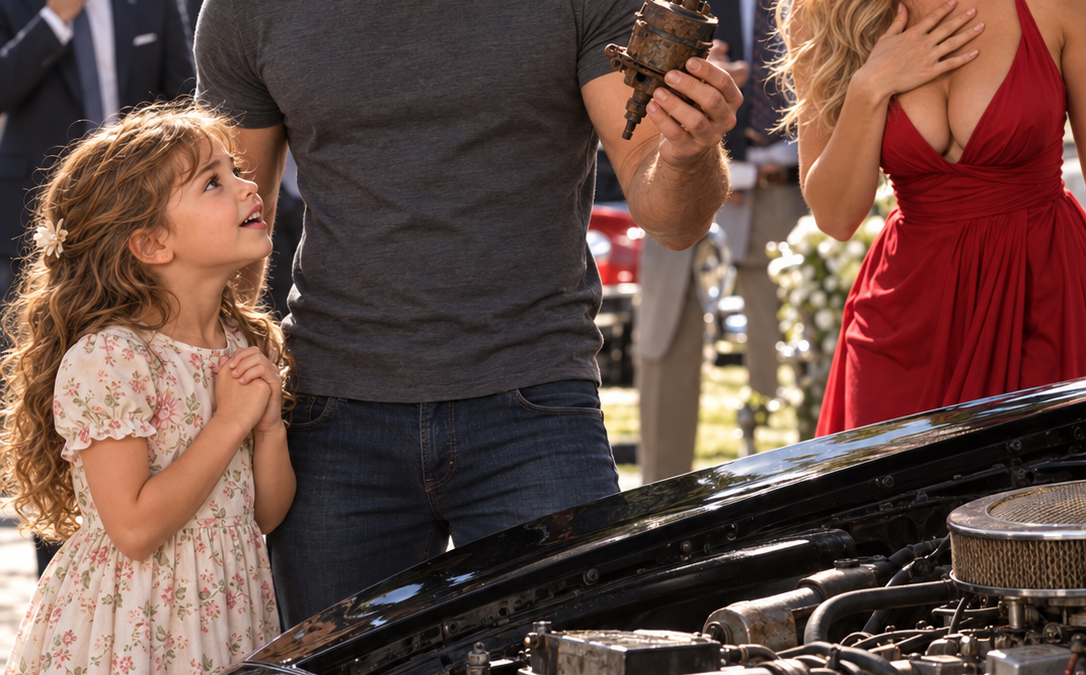
He brought Riley. Natalie arrived at 7:00 and found a 7-year-old girl sitting on a stool at the edge of the main bay, wearing a pink backpack and eating a granola bar and looking at the workshop with the frank evaluative attention of someone conducting a serious assessment.
Mason was at the new bench, longer than his old one, actually equipped with tooling that Natalie had sourced over the previous two weeks, reviewing a technical file on a vehicle intake that had come in over the weekend.
She’s waiting for the school bus, Mason said without looking up.
It picks up at the corner at 7:50. Greg said it was okay. Natalie looked at Greg, who was across the workshop pretending to organize something and very clearly aware of this conversation.
“It’s fine,” she said.
She walked over to the stool.
“Hi,” she said to Riley.
Riley looked at her with the direct, unscentimental appraisal that seven-year-olds bring to adult strangers.
“Are you the boss?”
“I am.
My dad said you gave him a job. He earned it. Riley considered this.
He works a lot, she said, not as a complaint, just as a fact she was reporting accurately. He does. Natalie paused.
Is that okay? Riley thought about it with genuine seriousness. He comes home, she said.
Some dads don’t come home.
She said it the way kids say things they’ve overheard adults say.
And then she took another bite of her granola bar and looked back at the workshop. Natalie stood there for a moment.
Then she said, “That’s a good point and meant it and went to her office.”
At 7:48, she heard Mason walk Riley to the door and wait with her until the bus came.
She didn’t look out.
She was on a call, but she heard his voice and then the sound of the bus and then the door closing and then his footsteps going back to the bench. The letter from the state engineering board arrived on a Wednesday in late October, 6 weeks after Mason had started.
He brought it to her office himself which told her it was significant. He had not been in the habit of bringing things to her office.
He was in the habit of handling things and reporting results. And the distinction said something about what this was. He set the envelope on her desk.
It had already been opened. She looked at it then at him.
They’re reviewing the case.
He said the false complaint that was filed 6 years ago.
Sharon’s team found documentation in Victor’s records showing that the complaint was coordinated.
Victor knew the people who made the filing.
It was designed to remove me from an engineering position at a vendor company where I’d started identifying the same kind of part substitution scheme he was running here.
She looked at him.
He was holding himself still, but there was something in his face that wasn’t still at all.
Something that had been compressed for a long time and was now under pressure from a different direction. He had you fired, she said.
He had me discredited. Mason said fired was the result.
He paused. The engineering board said the review process takes 60 to 90 days.
If they find what they found the last time someone looked at it carefully, he stopped. Your license, she said.
Yeah. She understood then the full shape of what the last 6 years had been for him.
Not just the borrowed bay and the difficult finances and raising Riley alone. All of that was real, but underneath it had been something else.
the specific weight of being good at something and having that goodness taken from you by someone else’s calculated dishonesty.
Working for 6 years at the level you were allowed to work at when the level you’d actually earned had been stripped away by a lie.
Mason, she said, whatever the board decides, your position here isn’t contingent on the license.
You’ve already demonstrated more than the license would certify.
He looked at her for a moment. I know, he said, but it matters anyway.
I know it does,” she said.
He took the letter back and went to the workshop.
She sat at her desk and thought about the specific quiet cruelty of that kind of damage, the kind that doesn’t leave visible marks, but changes the entire shape of a life, redirects it at a point where redirection costs the most.
She thought about what it had taken for him to walk through the gate of this property with a battered toolbox and $12 in scrap metal, knowing what he knew about himself and what the world had been told about him and ask for 20 minutes. She thought was not a small thing.
That was in fact a very large thing and it deserved to be recognized as such. She opened her laptop and started drafting a formal letter of support for the engineering board review. The review took 73 days.
During those 73 days, the restoration division’s new building was completed and fitted out.
Mason hired four people, two junior technicians, one experienced restoration specialist named Diane, who had 20 years in the field and had heard about the position through Paulo, who had joined the testing division, and one administrative coordinator who turned out to be the most organizationally effective person Natalie had seen in a
professional context since her father’s old office manager.
The independent testing protocols that Mason designed were reviewed by Sharon’s team for procedural integrity and approved by three external specialists.
The first three vehicles came in for testing in the second week of November. The Callaway contract work began in earnest in December. Regginald Callaway turned out to be a demanding client in the ways that were productive and not in the ways that were destructive.
He had specific standards and communicated them clearly and did not change them arbitrarily, which was in Natalie’s experience the difference between a difficult client and a bad one.
His project manager made the trip to the facility twice in the first month and spent both visits in the testing bay with Mason going through the protocols with the thoroughess of someone who had been burned by inadequate certification before and intended not to be again.
your guy,” the project manager said to Natalie on his second visit, standing at the edge of the bay, watching Mason walk two of the junior technicians through a fuel system integrity check.
“He’s the real thing.”
“I know,” she said.
“Where did you find him?”
He drove past the building and heard an engine. The project manager looked at her to see if she was joking.
She wasn’t.
He turned back to the bay.
“Huh?”
he said. Uh, the letter from the engineering board arrived on a Thursday afternoon in January. Mason was under a 1971 Chevel when Diane brought it to the workshop.
He came out from under the car, wiped his hands, and read it standing at the bench. Diane and the two junior technicians had the careful awareness of people who understand something significant is happening and have collectively decided to find other things to look at. He read it twice.
Then he set it on the bench and went back under the chvel and finished what he’d been doing, which took about 20 minutes.
When he came back out, he picked up the letter and went to find Natalie. She was in the showroom in the middle of a conversation with a private collector about a potential intake.
She read Mason’s face when he appeared in the doorway, the particular quality of stillness that meant something had resolved, and said to the collector, “Excuse me for one moment.”
and came to the door. He handed her the letter. She read it.
The review had found based on new evidence that the original complaint against Mason Carter had been filed in bad faith and contained materially false statements. The complaint was formally expuned from his record.
His engineering license was reinstated with full standing retroactive to the date of the original suspension. She looked up.
He was not crying. He was doing the thing he did that controlled stillness, but his jaw was set in a way that told her what the stillness was costing. 6 years Riley had been one year old.
He’d been building something and it had been taken.
And he’d spent 6 years working at whatever level he could reach, supporting his daughter, borrowing a bay from a tire shop, driving past buildings where engines spoke to him through walls.
“Congratulations,” she said.
And then because it was true and he deserved to hear it, this was always yours. They just gave it back.
He took the letter back. He nodded once.
He said, “I’m going to call Riley’s school and let her teacher know.
Riley’s been He stopped.
Started again.
She’s been worried.
She’s seven and she understands more than 7-year-olds are supposed to understand.
Go call,” Natalie said.
“Take as long as you need.”
He went outside. She watched through the showroom window as he stood in the parking lot with his phone to his ear and she saw the moment the teacher must have put Riley on. Something changed in his posture.
A fractional shift.
The particular way a person’s body changes when they’re talking to the person they love most.
She turned back to the collector who had the good grace to be looking at a brochure. The plaque went up on a Friday in February.
It had been Natalie’s idea and she’d expected Mason to resist it.
He had the specific discomfort of someone who had spent a long time being invisible and had not fully recalibrated to a world in which being seen was not also being exposed.
But when she showed him the text, he’d read it and been quiet for a moment and then said, “Okay.”
And that was that.
They mounted it on the wall of the showroom beside the GTO’s display space.
Simple brushed steel, the lettering clean and without ornamentation. 1. 94 million or in failed repairs, $12 in scrap metal.
One single father who chose to listen. The GTO stood beneath it in morning light carousel red deepened by the careful cleaning and the compound work Greg had done on the paint in his spare hours.
Not a restoration to showroom new, they’d all agreed on that, but a preservation of what it actually was.
The chrome still had its pitting. The paint still had 58 years in it. The car looked like time, like use, like something that had been through things and was still here, and that seemed more honest than making it look like it had just left the factory.
The first time Riley saw the plaque, she stood in front of it for a long time. Mason stood behind her with his hands in his pockets, watching her read it.
“That’s about you,” she said.
“Yeah.”
“The $12?”
She turned around to look at him.
“That was the scrap metal you brought?”
“Yeah.”
She looked at the plaque again, then at the car.
She was 7 and a half now, and she had the quality of attention that some kids have where they’re thinking about more than they’re saying.
“Was it scary?”
she said.
“Going in there when you didn’t know if they’d let you.”
Mason thought about it a little, he said.
“Yeah, but you went anyway.”
“I knew what was wrong with the car,” he said.
“That seemed more important than being scared.”
Riley considered this with the seriousness it deserved.
Then she nodded like someone filing something away for later and went to look at the car up close, pressing her face near the driver’s window to see inside.
Natalie was across the showroom and had heard all of this without intending to. She looked at the plaque, then at the car, then at Mason watching his daughter. She thought about what her father had written.
I always thought that was a metaphor for something, but I could never work out for what. She thought she understood it now.
Not completely.
She wasn’t sure it was the kind of thing you ever understood completely, but enough to work with.
You listen to something not because it’s convenient or because the timing is right or because someone has handed you a diagnostic report that tells you where to look.
You listen because the thing in front of you is real and it deserves that much from you and because the truth of what’s wrong with it has been there the whole time, available to anyone willing to be quiet enough to hear it.
The money doesn’t buy you that.
The credentials don’t buy you that.
What buys you that is just willingness. The decision to actually pay attention.
It sounds simple.
It isn’t simple.
There are thousand pressures at any given moment pushing you toward assumption, toward precedent, toward the comfort of what you already know. Fighting those pressures is not natural.
It costs something every time. Most people faced with that cost often enough stop paying it.
They replace listening with telling and they call it expertise. And in a lot of cases, nobody notices the difference until the car that was supposed to run has been failing for 11 months and $2 million.
And the solution turns out to be something so fundamental it embarrasses everyone. Mason Carter had never stopped paying that cost.
He’d paid it when it earned him nothing and when it cost him everything, and when the person standing across from him was laughing.
That was the thing Natalie had seen in him from the first morning. Not talent, not cleverness, not the particular brand of competence that performs well under observation. Something harder to name and harder to fake.
A quality of honesty so deep it extended to the way he heard a sick engine from a block away and couldn’t pretend he hadn’t.
She thought about her father writing those words in a letter he didn’t know if she’d ever read.
She thought about the recording, his voice measured and slightly horsearo, saying, “The car will run when someone is willing to listen to it.
” It had taken 58 years and $2 million and a man with $12 in scrap metal.
But he’d been right.
In March, the restoration division took in its eighth vehicle, a 1969 Dodge Charger that arrived on a flatbed from a collector in Colorado non-running with a history of failed restoration attempts that felt to everyone in the workshop pleasantly familiar. Mason walked around it twice the way he did, stood at the front and listened to it not running, which had stopped being strange to the junior technicians by the third week.
Then he put his hand flat on the hood and left it there for a moment.
Diane, watching from the bay entrance, said to one of the technicians quietly, “He’s reading it.
” “Reading what?”
She thought about how to explain it.
“Whatever it has to say,” she said finally and went back to her workbench.
Mason lifted his hand from the hood. He looked at the charger for another moment, and something in his face had the quality of a conversation that had just begun.
Then he turned to his team, Diane and the two technicians and Paulo, who had come over from the testing bay for the intake, and said, “Okay, let’s pull the engine documentation and see what we’ve got.
” They went to work.
In the showroom, visible through the open bay door, the GTO sat under its plaque with its engine quiet and its problems resolved.
58 years of history in its paint and its chrome, and the small, dense component in its ignition system that bore, in the precise tolerances of its machine surfaces, the particular signature of a father’s unfinished work, and a stranger’s willingness to finish it.
The morning light moved across the showroom floor and touched the red of the car and kept moving the way light does indifferent to everything it illuminates and illuminating it anyway. Outside spring was making its way toward the city in the slow unannounced way that seasons always do. Not arriving so much as accumulating degree by degree until one morning you go out to your truck and the air is different and you realize the change has already happened while you were paying attention to other things.
Mason Carter had been paying attention to other things his whole life. That was, depending on how you looked at it, either the reason his life had gone the way it had or the reason he was here.
He had decided it was the reason he was here. He picked up his clipboard and went to find out what the Charger had to say.

