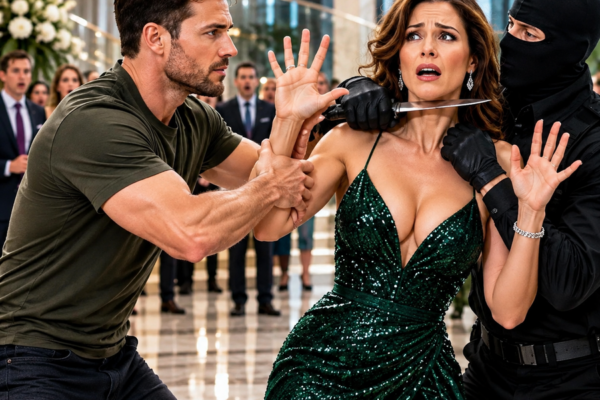
Three MMA Fighters Threatened a Female CEO—Until a Single Dad’s Hidden Navy SEAL Past Took Over – PART 2
PART 2
They stepped together into the alley, into the rain, into the 40 ft between themselves and the street, while above them, in a building that was still in the process of deciding how this night would end, Merrick Shaw was making arrangements that neither of them could fully see yet. The roll-up door lowered behind them on its spring mechanism with a final definitive sound.
They were out of the building.
But Calder knew with the certainty of someone who had learned to trust the part of his mind that processed threat without fanfare that Merrick Shaw’s worst move was still ahead of them, and it had his daughter’s name on it.
The alley smelled like wet concrete and restaurant grease from the kitchen exhaust vents two buildings down, and the rain came at them sideways, driven by the kind of low pressure system that settled over Seattle in the fall, and refused to apologize for itself.
Vesper had her
phone to her ear before they’d taken 10 steps from the loading dock door, and called her walked slightly ahead of her, scanning the alley in both directions while he listened to her side of the conversation.
“Marcus, it’s me.
I need extraction right now. Not in 10 minutes now. A pause.
East alley off Mercer between the Oralene building and the parking structure. Yes, that building.
No, don’t call building security.
Don’t call anyone affiliated with Oralene.
Just come. Another pause. Shorter.
Two of us. Come to the alley entrance on the Mercer side.
You’ll see us.
She lowered the phone. 8 minutes.
She said that’s a long 8 minutes.
Marcus drives fast. Mhm. Calder moved them toward the Mercer Street end of the alley, staying close to the building wall where the shadows were deepest and the rain had less room to find them.
His phone was in his hand, and he was watching the screen, the sitter’s contact, no new messages, which meant Brin was still asleep, and nothing had happened at his apartment in the 7 minutes since he’d called.
7 minutes could change a lot of things. He knew that better than most people.
“Tell me about what Merrick said,” Vesper said, keeping her voice low.
They were stopped near a dumpster at the alley’s midpoint, a position that gave them sight lines in both directions.
The exact words you heard.
I told you, he said, “The daughter.”
That was all I caught clearly. In what context was he giving an instruction, asking a question?
Called her thought back, replaying the fragment of radio transmission from the shaft. Instruction.
He was telling someone to do something, and the last two words I heard were the daughter.
Could be a threat he’s planning to make against us.
Could be.
He’s already moved on it.
Your daughter’s name isn’t on any Oralign records.
No, my personnel file has an emergency contact, but it’s listed as a phone number, not a name or address.
He paused. But if someone ran a search on me, a real search, not the HR database.
Brin would come up. Her school, the address. He kept his voice level, but she heard something underneath it because she was watching him with the specific attention of someone taking careful inventory of another person.
I’ve been in this building for over a year.
Long enough for someone who knows what they’re doing to find out everything about me.
Vesper was quiet for a moment.
I’m sorry that this came back on her.
Don’t be sorry yet.
Just if your people are as good as you say they are, can one of them get to my apartment building tonight? Already thinking about it. Marcus will have a second unit available.
I’ll have them positioned at your building within 20 minutes of him picking us up.
She looked at him steadily.
She’s not alone, sitters there.
She’s solid.
Former EMT. Then Brin has someone with her right now who knows how to handle an emergency.
She said it not as comfort he’d asked her not to offer comfort, but as a factual assessment, one competent person to another.
20 minutes and she’ll have professional security on the door as well.
He nodded.
He didn’t feel better exactly, but he felt like the problem was being addressed at the correct speed, which was the most he could ask for.
The far end of the alley, the end that backed onto the Oralene building service entrance, showed a rectangle of dim light from the loading dock. As he watched it, changed the door opened and a figure appeared in it briefly before pulling back inside.
Someone checking the alley.
We’ve got company looking, he said, and moved them three steps further behind the dumpster.
The figure in the loading dock doorway appeared again. A flashlight swept the alley, catching raindrops and the glitter of wet asphalt.
It didn’t reach their position.
The door closed. They know we came out this way, Vesper said.
They’ll figure it out eventually.
We needed the head start more than we needed them not knowing. Calder kept watching the loading dock.
Once Marcus gets here, what’s the plan?
Where do we go?
My attorney’s office.
He has a crisis protocol suite, a secure room where sensitive business matters get handled when confidentiality is critical.
It has its own encrypted communication systems and it’s not connected to anything that touches Oraline’s corporate network.
She was still watching the alley. We take everything we have the recording on my phone, the footage you rerouted to the maintenance server, and we build the documentation package that goes to the board before Merrick can get ahead of it.
You’re thinking about going back on the offensive.
I never stopped. She said it without heat, without drama, as a simple statement of her natural resting position.
Surviving tonight isn’t enough.
If I just survive tonight, Merrick has time to clean up, adjust the narrative, and by mourning the story is that I had some kind of breakdown, that I made fraud allegations I can’t substantiate.
That the real question is why the CEO was found wandering out of her own building with a maintenance worker at 10:00 at night. She looked at him directly.
That’s the story he wants.
I’m not giving it to him.
Calder had to admit, despite everything, that she was right.
He’d been thinking in terms of extraction.
and get out, get safe, deal with the rest later.
But later had a way of becoming Merrick Shaw’s time zone, not theirs.
There’s one problem, he said.
The maintenance server.
The footage I rerouted, it’s sitting on a standalone server in subb 2.
It’s not accessible remotely.
To get that footage out of the building, someone has to physically go back in and pull it. Vesper absorbed this without expression. Someone meaning you.
I know where it is. I know how to access it without using any system that Veil controls.
Your people wouldn’t know the layout.
You just got out of the building.
I know Merrick’s contractors are still in there.
I know that, too. She was quiet and he could see her working through it. The risk, the necessity, the fact that the footage on that server was the difference between documented evidence of a conspiracy and a situation that could be framed 40 different ways by a man who was very good at framing things.
I have the audio recording on my phone, she said.
That’s substantial.
It’s one piece.
Your word that you recorded it, his lawyers arguing about admissibility, a chain of custody that started inside a building where you were under duress. Calder shook his head. The server footage is different.
It’s the building’s own emergency system.
Independent authentication.
Every time stamp, every camera angle, every moment of what happened in that conference suite, the corridor, the stairwell, all of it with automated metadata that can’t be disputed.
Vesper looked at her phone, then at the loading dock, then at him. How long would it take you? 15 minutes in the building.
If nothing goes wrong, subb 2 is below the floors they’ve been searching.
It’s facilities territory.
No reason for Shaw’s people to be down there.
And if something goes wrong, then it takes longer.
She almost said something and then didn’t and then said it anyway.
I don’t like sending you back in there.
You’re not sending me.
I’m deciding.
Called her. I decided to come up to 42 tonight.
I decided to open that access panel. Every choice since then has been mine. He looked at her.
This one is too. You get in the car with Marcus.
You go to your attorney’s office.
You stay with your people.
I’ll get the footage and meet you there.
She was quiet for long enough that a delivery truck somewhere on Mercer Street went through a full light cycle.
“How do I know you’ll make it out?”
she said finally.
“Because I know that building better than anyone currently inside it, and because I have a daughter waiting for me, and I don’t intend to make her wait longer than necessary.
” It was not an inspiring speech.
It was not meant to be, but it was true, and she knew it was true.
And he’d found that truth tended to land more solidly than inspiration.
A pair of headlights appeared at the Mercer Street end of the alley. Moving slow, no light bar, the kind of vehicle that looked deliberately unremarkable. A dark gray SUV with tinted glass.
It rolled to a stop 20 ft from their position.
The driver’s window came down.
A man leaned out, broad-shouldered, closecropped hair, the specific alert posture of someone trained to read a space very quickly. He looked at Vesper, then at Calder, then back at Vesper.
You’re okay, he said.
I’m fine, Marcus.
This is called Reigns. He works in the building he got me out.
She stepped toward the vehicle.
He’s going back in to retrieve evidence from a server in the subb.
I need your second unit at his apartment building right now tonight.
Marcus didn’t blink.
Address. Calder gave it to him. Marcus was on his radio before Calder finished the street name.
He exchanged a look with Vesper Brief Professional. The look of two people who had worked through emergencies together before.
Then he looked at Calder with an expression that was not quite concerned but was adjacent to it. You need backup in there? No.
Extra bodies would slow me down and make more noise. Calder looked at Vesper.
My cell numbers in the building’s facilities directory.
When your people are at my apartment, text me confirmation. I will. She held out her hand.
He looked at it for a moment. An odd thing to do.
Shake hands in an alley in the rain after what they just navigated together. And then he shook it.
Her grip was firm and brief, and she didn’t try to make it more than it was.
15 minutes, he said.
I’ll be timing, she said.
He turned back toward the building. Behind him, he heard the SUV door close. And then he was alone in the alley, moving back toward the one place in Seattle that he had very recently escaped from.
The loading dock door was the problem.
He couldn’t use it again.
Whoever had been checking the alley from it would be watching that entry point now, and the manual bolt on the inside would have been secured after they left.
He moved past the dock entrance without slowing and continued along the building’s east face, past the dock to a secondary utility access panel he’d spotted during a maintenance inspection 4 months ago.
A small steel door barely 5 ft high, designed for equipment cable, runs into the building’s east mechanical room.
The lock was a keyed cylinder. He had the key.
He was inside in under a minute. The east mechanical room was on the ground floor.
Behind the main lobby infrastructure, the backside of the building’s guts, pumps, and junction boxes, and the industrialcale HVAC components that served the lower floors.
No people, nothing but machinery doing what machinery did, indifferent to everything. He moved through it and found the stairwell access on the far side, the one that led down to the subb.
This stairwell wasn’t the main building stairwell.
It was the mechanical staircase, a purely functional concrete shaft that existed for maintenance access and wasn’t on any visitor map.
Shaw’s contractors wouldn’t know it was there unless they had better building intelligence than he thought they did.
And he was betting they didn’t.
He was right.
Subb was the main mechanical plant, the building’s primary systems, boilers, chillers, electrical distribution.
He passed through it quickly, staying to the maintenance corridor along the north wall.
Subb 2 was below it, reached by a second short staircase at the corridor’s end.
He’d spent a lot of time in subb 2 over the last 14 months.
It was his territory in the most fundamental sense, a level of the building that almost no one from the office floors ever visited, where the facilities team logged equipment data and stored maintenance records, and where, in a rack of standalone servers along the south wall, the maintenance operation server sat exactly where it always had. He found it in the dark by feel and by the indicator lights a small rack unit, the third from the left with a blue power light and a blinking amber that indicated active write operations.
The footage was still routing, still coming in.
He connected his tablet to the server’s local port and pulled up the directory.
The emergency recording files were there, named by timestamp, an hour and 40 minutes of footage from the 42nd floor cameras, the corridor, the conference suite, every angle.
He started a copy to his tablet’s local storage drive.
His phone buzzed.
Vesper’s number.
A text unit at your building. Sitter confirmed contact. Brin is safe.
He read it twice, then put the phone away and watch the copy progress bar. 40%.
50. The files were large highdefinition footage from multiple cameras, uncompressed.
Somewhere above him, the building hummed.
He was very aware of the fact that he was in a basement, that the exits were limited, and that if someone figured out he was down here, the options for getting out quickly were considerably worse than they’d been on floor 43.
He kept this awareness in its place, not suppressed, just assigned to the correct part of his mind where it could be useful without being paralyzing, and watched the progress bar, 65%. He heard the mechanical staircase door open above him, not directly above one level up, subb, someone had found the mechanical staircase.
He heard one set of footsteps, then a second.
Two people taking the stairs carefully, not rushing, which was the way trained people, descended stairs in a building they didn’t fully know, 78%.
He looked around the server room, one door in, which was the door at the top of the short staircase. No windows, no secondary access.
The only other exit was a cable chase in the back wall that was approximately 12 in wide and served no purpose as an escape route unless he wanted to become permanently wedged between two walls. The footsteps reached subb 1. He heard them move across the floor above, checking the space.
Methodical, taking their time, 89%. His tablet screen was the only significant light source in the room. He angled it toward the floor, reducing its visibility from the staircase opening.
93. The footsteps in subb stopped.
Silence. Then a voice male into a radio. Sub one is clear.
Checking sub 2. 96.
the short staircase. Calder moved to the wall beside the server rack, pressed himself flat against it, and killed his tablet screen. Full dark 98.
The door at the top of the short staircase opened. A flashlight beam entered the room, sweeping left to right across the server racks. The amber light on the maintenance server was blinking steadily.
The flashlight found it and paused.
Calder didn’t breathe.
A second man entered behind the first. Anything?
Server equipment. Looks like a facilities operation.
The flashlight moved across the rack, across the maintenance server, across the space where Calder was standing against the wall, just outside the beam’s angle.
Nobody down here. Hold on.
The first man moved closer to the server rack. The flashlight settled on the maintenance server on the amber blink of its active right light. This thing is currently writing data.
Who’s running a right operation to a facilities server at 10:30 at night?
A pause. we should call it in. Calder heard them both moving toward the server rack and he understood that in approximately 12 more seconds, one of them was going to disconnect the server from its power supply and whatever percentage of the footage had transferred to his tablet would be all they got.
He connected his tablet, pulled the transfer cable, pocketed the tablet, and stepped out from the wall in one continuous movement. The first man turned and his flashlight found Calder immediately a gray uniform, a tool bag, a man who looked like he worked here because he did work here.
For one full second, nobody moved. Then the first man reached for something at his hip.
Calder was already moving.
He crossed the distance between them in three steps and did not do anything flashy or complicated because the spaces he’d been in were too tight for flashy and too urgent for complicated.
He controlled the man’s reaching arm at the wrist, redirected it away from his body, applied pressure to the elbow joint in a direction.
Elbows were not designed to travel, and held the position until the man went to his knees. The second man came from the left.
Calder released the first man’s wrist and turned, catching the second man’s forward momentum and using it, guiding him past into the corner of the server rack, metal edge to shoulder.
The man hit it hard and stopped moving for long enough. The first man was back on his feet, breathing hard, his right arm held against his side. He looked at Calder with an expression that had recalibrated completely.
This was no longer a maintenance worker he was looking at, and he knew it.
“You should go back upstairs,” Calder said.
He kept his voice even because yelling didn’t add useful information and frequently complicated situations.
“The first man looked at his partner, who was leaning against the server rack with a hand pressed to his shoulder.
We’re going to find the girl, the first man said.
She lives on Westlake, third floor.
Calder’s jaw tightened.
He had his daughter’s address.
More specifically, Merrick Shaw had it, and he’d made sure Calder knew it.
And the purpose of making Calder know it. It was the same as the purpose of all psychological pressure in a tactical situation. To degrade decision-making, to introduce fear into a calculus where fear was a liability.
No, you’re not, Calder said.
Because you’re going to stay here until I’m gone.
and then you’re going to call your boss and tell him it’s over.
It’s not check your phone, Calder said.
Go ahead, check it. The man hesitated, then looked at his phone.
It took him a moment to process what he was seeing, the security notification, the alert that would have gone to every contractor’s device if they were tied into the Oraline system because Orson Vale was still theoretically running security for this building.
And security alerts went to active personnel.
Calder had no way of knowing for certain what the man was seeing, but he knew what he’d done to the building’s emergency recording system, and he knew what Vesper had said she was going to do once she was in her attorney’s crisis suite with a complete documentation package.
He was betting the alert on that phone was the first sign that the board had been contacted. The man looked up from his phone.
Something in his expression had shifted.
Not capitulation exactly, but a recalculation of exactly the same kind the first man had done when he’d stopped seeing a maintenance worker and started seeing something else.
“Go back upstairs,” Calder said again.
“This is done.
” He walked past them, up the short staircase, through subb up the mechanical staircase, through the east mechanical room, and out through the cable run door into the alley.
The rain had eased to a drizzle. He was three blocks away before he let himself look at his tablet and confirm what he already knew.
The transfer had hit 100% in the 3 seconds between when he’d connected the cable and when the first contractor had turned around.
He had everything.
He flagged a cab on Westlake, not a ride share, a physical cab, the kind that didn’t log GPS routes to an app server and gave the driver the address of Vesper’s attorney.
In the cab, he finally let himself feel the length of the evening, not the stress of it.
He’d been trained to manage stress under operational conditions and the training held even now 10 years out but the physical weight of it.
His shoulder achd where he’d taken an impact in subbase 2.
His knuckles were split on his right hand. He had no memory of when that had happened which meant it had happened early and adrenaline had filed it away. He looked at his phone.
A text from the sitter sent 15 minutes ago. Brinn woke up again asking for you.
Told her you were finishing work. She said okay and went back to sleep. There are two men in the lobby.
Your security people, I assume. Very polite.
Brinn doesn’t know they’re there.
He typed back, “I’ll be home soon.
You’re doing great.
Thank you.
” She responded in 12 seconds with a single thumbs up, which was exactly the right response and made him feel briefly like the world contained reasonable people.
The attorney’s office was in a mid-rise on 4th Avenue, the kind of building that was deliberately anonymous.
No prominent signage, no decorative lobby, the architecture of a place that valued privacy as a business proposition. Marcus met him at the street entrance, gave him a once over that registered the split knuckles and the general state of his uniform without comment, and walked him up to the fourth floor. The crisis suite looked like a conference room that had been designed by someone who understood that conference rooms in a crisis needed to feel functional rather than impressive.
a long table, good lighting, a wall of screens, a separate locked room that Marcus said was the communications room. Three people were already seated.
Vesper, a small sharp-featured man in his 60s who introduced himself as Gerald Fitch, Vesper’s attorney, and a woman called her, didn’t recognize who was working a laptop with the focused efficiency of someone doing several things at once.
Vesper looked up when he came in. She looked at his knuckles.
She didn’t say anything about them.
“You have it,” she said.
He put the tablet on the table. All of it.
Gerald Fitch reached for the tablet with the specific eagerness of a man who’d been waiting for it.
How complete is the footage? From the moment the cameras were overridden until about 20 minutes ago.
The emergency system kept recording even through the blackout. It has its own power supply.
You’ll have the conference room, the corridor, the elevator area, all of it.
Fitch was already connecting the tablet to the table’s display system, his reading glasses appearing from his breast pocket as if by reflex.
And the audio recording on your phone, he said to Vesper.
It wasn’t a question.
Playing it for you now. Vesper connected her phone.
A moment later, Merrick Shaw’s voice filled the room slightly muffled, as she’d said, but entirely intelligible.
His measured, almost gentle tone, the specifics of what he demanded, Vesper’s refusals, his threats.
Sign it and you walk out. Fitch listened with his eyes half closed.
The posture of someone whose mind was already three moves ahead.
When it ended, he opened his eyes and said, “The combination of the audio recording, the server footage, and the access logs we can pull from the building management system gives us a package that is very difficult to argue against.”
He’s going to try, Vesper said.
He is, but he’s going to do it from a position of significant legal exposure, which will focus his energy on himself rather than on attacking your credibility.
Fitch took off his glasses. We contact the board tonight.
Emergency protocol.
The company’s bylaws require an emergency board session within 4 hours of a CEO.
Reporting a material threat to corporate governance. I draft the notification now. You sign it and it goes out within the hour.
Who on the board is clean? Calder said. Everyone at the table looked at him.
He registered that he was a maintenance worker in a wet gray uniform in an attorney’s crisis suite asking about board composition and he didn’t revise the question.
The liaison who called me this afternoon, Vesper said slowly.
Robert Fen, he’s been on the board for 11 years.
He’s the one I’m not certain about.
Leave him off the initial notification.
Calder said, “Send it to every other board member simultaneously.
If Fen is part of this, the first sign will be that Shaw knows about the notification within minutes of it going out, and you’ll have identified your leak.
If Fen is clean, he’ll find out with everyone else.”
Fitch looked at Calder with the particular expression of a man who has just encountered someone in an unexpected context who is considerably more useful than they appear.
“That’s sound strategy,” he said.
“I’ve had a long night to think,” Calder said.
The woman with the laptop Fitch’s associate, it turned out, a specialist in corporate forensic documentation, had the server footage up on the wall screens by now.
42nd floor, conference suite 4,201, timestamp beginning at 9:47P m.
The footage was clear, high definition, the automated camera angle cycling through the suit’s four coverage positions.
The table felt quiet as they watched it. There was Merrick Shaw, impeccable even on a security camera. There were the two contractors by the doors.
There was Visper at the far end of the table, both hands flat on the surface, completely still, and there was the document in front of her, the proxy transfer, untouched, unsigned, exactly as it needed to be.
Shaw’s mouth moved on the footage.
The cameras were audio equipped. His voice came through the room speakers. Sign it and you walk out.
Nobody at the table in Gerald Fitch’s crisis suite said anything for a moment.
Then Vesper reached across the table and picked up a pen, not to sign anything, to add her notation to the documentation log that Fitch’s associate was building a page-by-page annotation of the evidence package in Vesper’s own handwriting, timed and dated, that would establish her firsthand account as a contemporaneous record.
She wrote steadily without hesitation and Calder watched her and thought that whatever he’d expected when he heard her voice through the wall of sweet 4,21 2 hours ago some version of a person who needed saving a role he’d never particularly wanted to play.
What he’d actually found was something different.
A person who needed help. There was a distinction and it mattered.
His phone buzzed. Unknown number.
He stepped to the corner of the room and answered it. Mr.reigns.
Merrick Shaw’s voice, calm, clean, the voice of a man who had spent his career measuring the distance between what he said and what he meant and closing it completely.
I wanted to speak with you directly. Go ahead.
You’ve been resourceful tonight, more than I anticipated.
A brief pause. I also want you to know that I understand you have a daughter, Brin.
She’s in third grade.
Yes. Calder kept his voice even.
If you’re about to make a threat involving a child, I want you to think very carefully about whether that’s the path you want to be on.
It’s not a threat.
I want you to understand what tonight looks like from a certain perspective. You broke into a secured executive conference suite. You assaulted two security contractors.
You accessed confidential company server infrastructure without authorization. Another pause unhurried. Those are serious allegations, Mr.Reigns.
A single father, ex-military with a young daughter, the complications of a legal proceeding could be significant for someone in your situation. Is that everything? A silence.
Shaw hadn’t expected that particular response.
I’m offering you a way out of this that doesn’t.
What server did the footage from tonight get rerouted to? Calder said.
Take a guess. Silence.
Gerald Fitch’s Vesper’s attorney.
Calder said. You might know the name.
He’s drafting the board notification right now.
the footage, the audio recording, the access logs, and Vesper’s contemporaneous written account are being compiled into a documentation package that goes to the boardin.
He looked at Fitch across the room, who held up two fingers less than 2 hours. He heard Shaw breathing.
You’re a maintenance worker, Shaw said finally.
The gentleness was gone now, replaced by something that was the verbal equivalent of a closed door.
You You have no idea what you’ve involved yourself in.
I heard someone who needed help, Calder said. I made a decision.
I’m comfortable with it.
He paused. You should call your attorney.
He ended the call. Every person in the room was looking at him.
He put the phone in his pocket and walked back to the table. He called you directly. Vesper said he did.
What did he say? He reminded me I have a daughter and suggested that cooperating with him would be better for my long-term stability as a single parent.
The room was quiet for a moment. He used your daughter, Vesper said.
It was flat and specific, not a question. Yes, while we have him on a building security system threatening mine.
She looked at Fitch. Add that to the log. The call, the time, the content.
Called her will write his account. Already noted, said the associate with the laptop. Fitch was on his feet, moving toward the communications room, phone in hand.
I’m drafting the board notification now.
Vesper, I’ll need you in the communications room in 10 minutes to review Vinc.
I’ll be there.
The room shifted into a different kind of motion. The motion of people who had moved from reaction to action. From responding to a threat to dismantling it.
Papers, devices, communication threads opening up.
The wall screens running the footage on a loop that nobody was watching anymore because they’d seen it and understood it and were now using it.
Calder sat down in a chair at the far end of the table. He put his tablet down and his tool bag on the floor beside him and his hands on the table in front of him.
And for the first time in 3 hours, he allowed himself to simply sit without calculating what came next. His shoulder hurt, his hand hurt.
He was wet and tired. And there was a coffee machine on the credenza against the wall that he was going to visit in about 60 seconds. Vesper came and sat in the chair next to him, not across the table beside him, which was different.
She put a hand on the table near his split knuckles, but didn’t touch them.
“What did you tell him?”
she said at the end of the call. I told him to call his attorney.
She almost smiled. Not quite, but almost.
That’s all.
I also told him I heard someone who needed help and I made a decision. He looked at her, which is true.
You keep saying that. It keeps being true. She was quiet for a moment.
Outside the windows, Seattle was doing what Seattle did.
The rain, the lights, the indifferent continuation of a city that didn’t know or care what had happened inside a skyscraper on Mercer Street tonight.
The board notification goes out in 2 hours, she said. By morning, everything is documented.
By midday, the board convenes. By tomorrow evening, she paused, organizing the sequence.
Merrick Shaw is going to be answering questions that don’t have good answers.
And Vale, Vale’s exposure is worse.
He had direct operational control of the building systems. Every override, every camera kill, every elevator lockown, all of it runs through his credentials.
His name is on it in a way that Merrick can’t attribute to anyone else.
Calder nodded. He thought about the man who told him to stand down on the radio casual, authoritative, the tone of someone certain that a maintenance worker would simply obey and go back to the basement.
He thought about what would have happened if he had. Go get some coffee, Vasper said.
You look like you need it. I was about to called her.
She said it in the same flat serious way she had said it twice before tonight and he looked at her. Thank you.
I know that’s I know it doesn’t cover it, but thank you.
He looked at her for a moment in the clean functional light of Gerald Fitch’s crisis suite, with the evidence assembled and the board notification being drafted and her company no longer in immediate danger of being stolen from her.
She looked different than she had in the alley, in the dark, in the shaft. She looked like someone who was going to be okay. Not because the crisis was over.
It wasn’t, but because she’d made up her mind to make it okay.
and that particular kind of determination had a specific quality to it that he recognized.
“You’re welcome,” he said.
He got up, crossed to the credenza, and poured himself a cup of coffee that turned out to be the kind of corporate office coffee that tasted like it had been brewed at some point in the previous century, but was hot and
caffeinated, and therefore, at this particular moment, exactly what was needed. He stood by the window with it, looking out at the city and thought about Brin sleeping in her bed with two security professionals in the lobby of their building and a sitter who used to be an EMT watching the door.
She was safe. The evidence was safe.
And somewhere across the city, Merrick Shaw was on the phone with his attorney trying to build a response to a documentation package that had been assembled against him by the one CEO he’d underestimated and one maintenance worker whose name he hadn’t known before.
tonight. Calder drank his coffee.
In 2 hours, the board notifications would go out, and the longest night of his very deliberately ordinary life was finally grudgingly beginning to turn. The board notifications went out at 12:47 a.m.Gerald Fitch sent them simultaneously to 11 board members.
Each message identical, each carrying the same attached documentation package, the footage from the emergency server, the audio recording from Vesper’s phone, the access log showing every system override Vale had executed, the fraudulent supplier payment records that Vesper had
been compiling for 6 weeks before tonight, and a 14-page written account signed by both Vesper and Calder describing the sequence of events from 947P.
M forward. Robert Fen, the board liaison Vesper had flagged, received his notification at 12:47A. M along with everyone else.
If he was going to be a leak, they’d know within the hour.
Fitch had also quietly and without being asked, forwarded a separate package to a contact at the Securities and Exchange Commission field office and another to a federal investigator he described only as someone who had handled corporate fraud cases for 20 years and owed him a favor.
He explained this to Vesper while she was reviewing the board notification, and she had looked at him over the top of her reading glasses, reading glasses she had borrowed from his desk because her own were somewhere on the 42nd floor, and said simply, “Good.”
Calder
was on his second cup of terrible coffee when his phone rang. The sitter, he stepped into the hallway to take it. She woke up again.
The sitter said, “She wants to talk to you.
Put her on.”
a rustling sound, the specific acoustic texture of a child moving a phone from one adult hand to her own small one.
Then, “Daddy, hey, bug, where are you?”
Brin’s voice had the slightly rough quality of someone woken from a deep sleep, but underneath it was the specific frequency of anxiety that she’d developed after her mother died a
particular kind of alertness that appeared whenever Calder was late coming home.
“I’m at work.
Something came up tonight and I had to stay.
Are you okay?”
“I’m fine.
My hand’s a little sore.
He looked at his knuckles, still split, slightly swollen now that the adrenaline had been out of his system for an hour. Nothing serious.
How’d you hurt your hand?
I’ll tell you the story when I get home.
Okay. The short version is I helped someone tonight and it got a little complicated. A pause.
He could hear her thinking.
Brinn thought the way she did everything thoroughly and at her own pace and she’d inherited that from Dana rather than from him, which was one of the reasons he tried to give her the time she needed.
Was it scary? She said. He leaned against the hallway wall a little bit at the start.
It got less scary once I had a job to do.
Cuz you’re good at jobs.
Because I’m good at jobs, he agreed.
Go back to sleep.
I’ll be home in a couple of hours.
Can you wake me up when you get here?
Even if it’s late.
He almost said no. She needed sleep. she had school.
The responsible answer was, “No.”
“Yeah,” he said.
“I’ll wake you up.”
She said, “Okay.”
Said good night in the small, satisfied voice of someone whose specific worry had been addressed, and handed the phone back to the sitter. Calder stood in the hallway for a moment after he hung up, his back to the wall, and his phone in his hand, and let the weight of the night settle briefly before he put it back where it belonged. He went back into the crisis suite.
The first board member response came in at 114A.
M a woman named Carol Hang who’d been on the Oraline board for 7 years and who Fitch described as someone with both the temperament and the legal standing to invoke the emergency session provision.
She’d reviewed the documentation package, she said, and she was invoking it effective immediately.
The emergency board session was scheduled for 9A M by 135 more board members had confirmed by 208 of the 11 had responded.