He Saved a Biker’s Disabled Daughter for Free — Next Day Hells Angels Changed His Life
He Saved a Biker’s Disabled Daughter for Free — Next Day Hells Angels Changed His Life
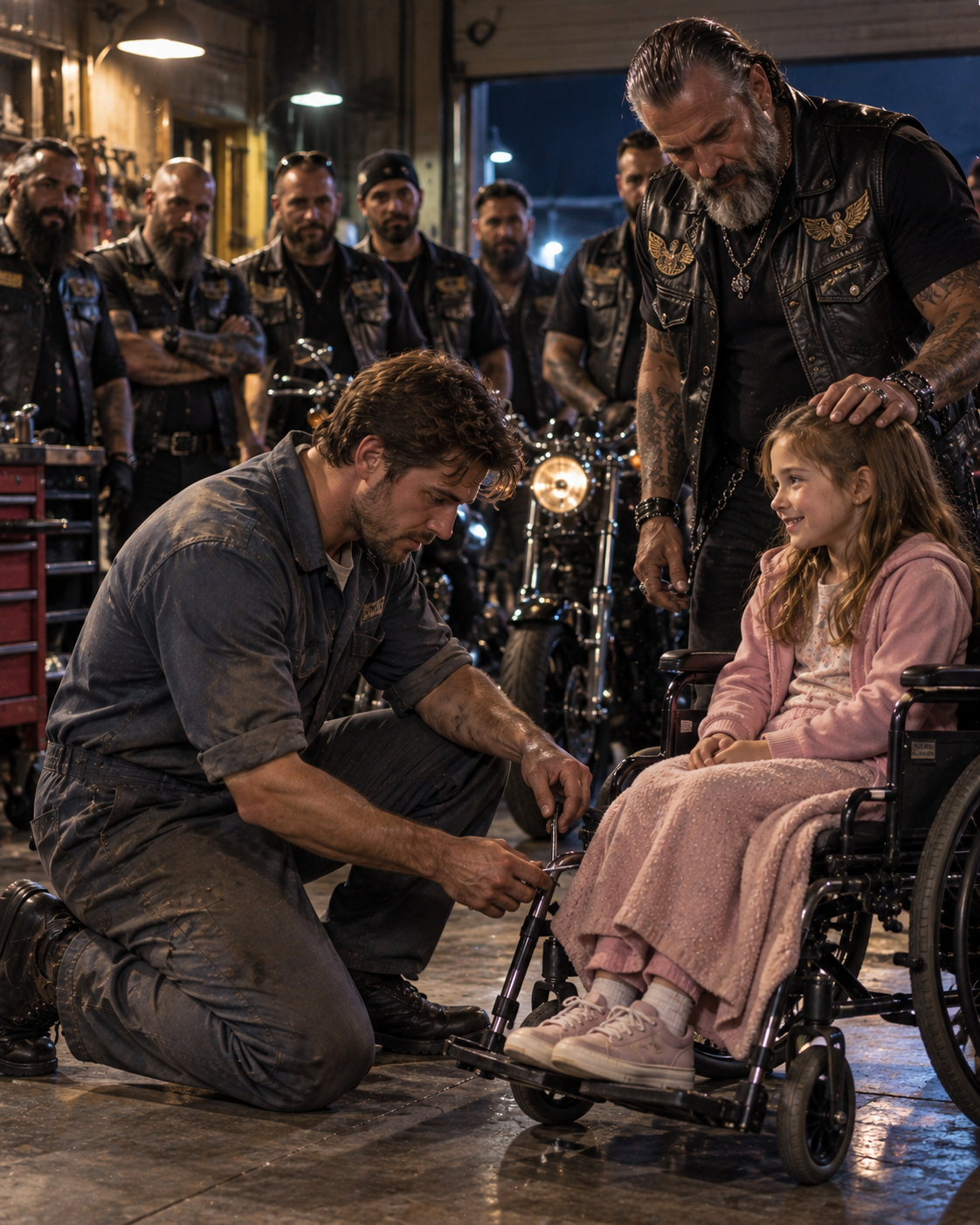
You touched my daughter’s chair without permission.
The voice came low and steady.
The kind of voice that didn’t need to be loud to make a man’s blood run cold.
Lucas Bennett didn’t move.
His hands were still covered in grease. Behind him, his garage smelled like motor oil and desperation. On him, the rumble of Harley engines shook the windows like thunder rolling through a valley.
He had spent all night fixing something nobody asked him to fix. Now 50 bikers in leather vests stood between him and the only exit runners and he had no idea if he was about to be thanked or buried.
Thus, last customer had left 3 hours ago.
That wasn’t unusual anymore.
Lucas Bennett wiped his hands on a rag that had long since stopped being useful for wiping anything clean, tossed onto the workbench, and stood in the middle of his garage, staring at the numbers he’d written on a piece of notebook paper that afternoon.
Numbers didn’t lie.
They never did. He had 11 days of operating money left. If he skipped buying coffee for a week, already been doing for 2 weeks anyway.
Electric bill was passed due.
The water heater in the back room had been making a sound for six days that he didn’t want to think about too hard because thinking about it meant paying to fix it.
Guy from the bank, not a loan officer, not a manager, regular guy named Phil, who wore khaki pants and looked genuinely sorry, had left a voicemail that morning that started with, “Lucas, I hate to be the one to do this, but Lucas hadn’t listened to the rest of it.
already knew what came after.
But there is a specific kind of silence that fills a garage at night when nobody’s coming.
It isn’t peaceful.
It isn’t restful.
It sits in the corners and on the shelves between the cans of brake fluid and the sets of wrenches hanging on pegboard and it presses on a man’s chest in a way that feels less like quiet and more like something closing in.
Lucas had been feeling that pressure for 8 months. on the stool he kept near the main lift and looked at his hands.
32 years old, a decade of knowing how machines work better than most people in a 3count radius. He could diagnose an engine problem by sound alone. He could feel a misalignment in a suspension system the way some people feel a headache coming on something slightly off in the way the world was sitting that told him exactly where to look.
Gift hadn’t saved his garage.
He tried everything he could think of, his prices until he was barely covering parts.
He started offering mobile repairs, driving out to people’s driveways on his lunch hour.
He’d even printed flyers, actual paper flyers with little tear off tabs at the bottom and put them up at the diner and the hardware store and the laundromat on Route 9.
Three people called wanted quotes. They never followed up on was a wrong number.
His father had owned this garage before him. A business and before the business side of the world had turned complicated and the big chain shops had opened up 20 minutes down the highway have been enough. Not rich but enough.
His father used to say, “A man who can fix things will never be without purpose.”
Lucas at the notebook paper again 11 days was about to fold it up and put it in his back pocket when he heard the motorcycle. A fleet of them. Not yet, just one.
It came off the highway slow, like the rider wasn’t in a hurry.
Like the rider had done enough riding for one day and was just looking for a place to stop moving. Lucas listened to the engine and without even thinking about it, he registered.
Vwin running a little rough on the right side, probably the carburetor. Nothing serious, but worth looking at if it had been a while.
Old habits. The headlight swung across the garage windows and then the engine cut.
Lucas stood up.
He wasn’t nervous about lone riders.
He’d worked on plenty of motorcycles over the years.
Everything from vintage Hondas to custom Harleys. In his speurious, the men who rode them were usually just men.
The leather and the tattoos and the patches were a costume. The same way a business suit was a costume.
Think people wore to tell the world who they were or who they wanted to be.
ly they just wanted their bikes running right and they paid the same as anyone else but he noticed couldn’t help but notice the patch on the back of the vest when the rider came through the door.
Angels the man was big not in a gond fat way the sway that said he had done hard physical things for a long time and his body had kept a record of all of them probably in his mid50s his hair was silver at the temples. His face had the kind of deep lines that come not just from age, but from years of being outdoors in every season. He moved carefully, deliberately, like a man who had learned a long time ago that rushing things cause problems.
Looked around the garage once. Then he looked at Lucas, he said. Technically closed, Lucas said.
Light was on. What do you need?
It’s not the bike, the man said.
Waited. The man went back outside. Lucas followed a truck parked behind the motorcycle, a big model truck, the kind with the extended cab.
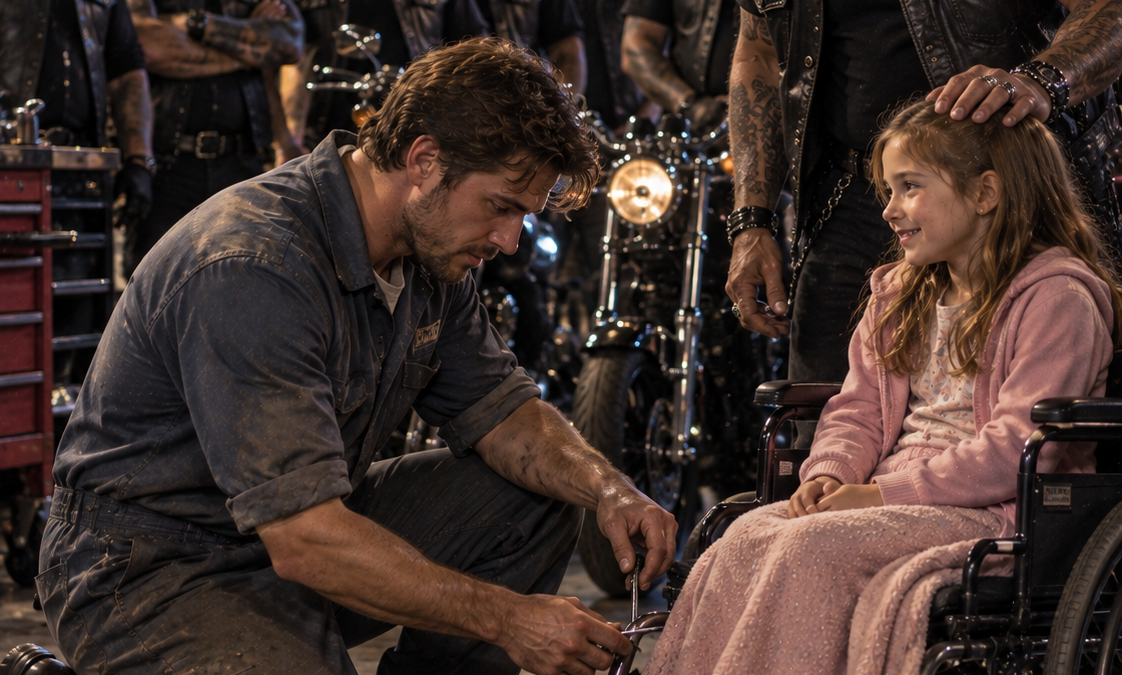
And when the man opened the passenger side doors, Lucas saw the young woman sitting inside. She was maybe 19.
Darkhair, she was slight the way some young women are when something has happened to them that took weight off them in ways that had nothing to do with eating. She was seated in the passenger seat but arranged carefully and it took Lucas only a second to register that getting in and out of vehicles was not simple for her and to notice without staring without making it a moment the lightweight manual wheelchair folded and strapped in the truck bed.
This is my daughter Emily. Lucas nodded at her. Hi Emily.
She nodded back, carefully polite, a little guarded.
The way people get when they’ve been looked at too many times in ways that made them feel like an exhibit rather than a person.
Oh, the man said.
He didn’t offer a last name.
He didn’t extend his hand, but his tone had shifted, not softer.
Exactly. Different.
The way a man’s voice changes when the thing he’s talking about is the thing that actually matters to him.
having trouble with the chair causing pain. Looked at three times, twice by the company that made it, a specialist up in Portland. Nobody found anything wrong.
But there is something wrong, Lucas said. Not a question.
Cole looked at him steadily, but she says it’s worse after she’s been in it more than an hour.
Lucas nodded slowly. Already thinking, can I take a look?
He said. We stopped. Cole said just that.
No, please.
It wasn’t unfriendly.
It was the way a man talked when he was used to saying exactly what he meant and had given up on patting it out.
Emily came out of the truck with the practiced efficiency of someone who had learned to do it herself and did not want help she hadn’t asked for.
Unloaded the chair without being asked and without making a production of it. She transferred into it smoothly.
Lucas crouched down next to the chair. Yours.
He didn’t say anything right away.
He just looked about this was a thing he’d done his whole life with engines with transmissions with anything mechanical that somebody said was wrong.
Where he touched it, he just looked.
Let his eyes move over it the way you’d read something.
Not skimming, but reading, looking at how each part related to every other part. The chair was expensive. He could tell that without knowing the brand.
Custom configuration. Lightweight frame. The seat cushion had been specified for her specifically.
He could see that in how it was shaped. Foot rests at a precise angle.
Rests that looked like they’d been adjusted multiple times.
He looked at it for almost a full minute without speaking. Said the specialists.
I know.
Lucas said, “Let me just think.”
Cole stopped.
Emily was watching Lucas with the particulate attention of someone who had learned not to get their hopes up, but couldn’t quite stop themselves from paying attention.
Anyway, Lucas reached out and put his hand on the push handle at the back of the chair. He pressed it gently, applied lateral pressure, and felt something.
Dramatic, not obvious. Just something.
Can I push you a few feet? He asked Emily.
Sure, she said. He moved her slowly down the flat concrete of the garage floor and back.
10 ft each way. He was feeling through his hands, the way the chair tracked, the way it rolled.
The tiny variations in resistance that you’d never notice if you weren’t looking for them and would absolutely notice if you were stopped the chair and crouched again.
He looked at the left rear axle housing and the right. Um, he looked at the seatback mounting points. He stood up.
Can I ask you something personal? he said to Emily, glanced at her father, then back at Lucas.
Depends what it is. The pain, he said.
Where exactly is it? And does it move?
Like, is it in the same place every time or does it travel? She was quiet for a second.
He had the impression that people usually asked her different questions about the pain. Uh, does it come and go? Have you tried the thing the last specialist suggested?
Nobody had asked her to be that specific.
She said, “Tarts at my left hip and then it moves up into my lower back.
I’ve been in it a few hours.
It’s all the way across.
Always left side first.
Always.”
Lucas nodded. There your left axle is set 2 mm lower than your right.
He said, “Not much.
You’d never see it by looking at it straight on.
But it means that every time you propel yourself forward, putting fractionally more load on the left side. Left hip compensates.
After an hour, it can’t compensate anymore.
Pain starts. The garage was quiet.
Cole said honey that made it said all the measurements were within spec. They probably are within spec. Lucas said a speck leaves room for variation because mass production has to leave room for variation.
I isn’t a spec.
Emily’s a specific person with a specific body that sits a specific way.
Millimeters matters to her, even if it doesn’t matter on the manufacturing floor.
Another silence. This time, Cole looked at his daughter as Emily was looking at Lucas with an expression that was doing several things at once. something hopeful and something careful and something that might have been the very early arrival of tears that she was absolutely not to let happen in front of a stranger in a garage.
“Can you fix it?”
Cole said.
Lucas thought about his 11 days of operating money about Phil from the bank and the voicemail he hadn’t listened to.
About the electric bill. Yes, he said. Cole said.
Lucas looked at the chair.
He looked at Emily about the three times they’d already paid specialists who hadn’t found what he’d found in 10 minutes.
He said Cole’s expression shifted.
Not gratitude. Something more complicated.
The look of a man who was used to people having an angle and couldn’t immediately locate what the angle was.
Just fix it for free.
He said, “I want to fix it right.”
Lucas said, “If that works for you, it’s going to take a few hours.
” Emily said quietly, “Why?”
Lucas looked at her.
“Because I can see what’s wrong,” he said.
“I can fix it.”
“That’s enough.”
She held his gaze for a moment.
Then she looked away and he could see her jaw tighten the way people’s jaws tighten when they’re managing something.
Said, “We’ll wait.
” And that was how the night began.
Pulled the truck into the garage bay. Emily stayed in the chair while Lucas worked.
And Cole sat on the bench against the wall, not hovering, not getting in the way, but present in the way a man is present when the thing at stake is everything he has. It worked methodically.
He rechecked his measurements three more times before he touched a single adjustment bolt.
As he’d learned long ago, that confidence without confirmation was just another word for mistake.
He confirmed the 2 mm differential on the left axle housing. Then he looked further because finding one thing wrong had taught him years ago that it was almost never just one thing machines failed in clusters.
One small compromise leading to compensations that led to other compensations. He found something else.
The seat back angle had been set at what looked like a correct position probably had been correct when the chair was first configured.
The mounting hardware on the left side had very slightly deformed, not broken, visibly damaged, something you’d never catch by eye.
Only by comparing torque resistance, which meant that over months of use, the seatback had microscopically shifted. 3° to a machine, everything to a body using it 6 hours a day. How long have you had this chair?
Emily looked up from the book she’d been reading.
She hadn’t asked for the book.
Cole had pulled it from the truck without comment and handed it to her. But Lucas had registered that as the kind of quiet that came from years of paying attent attent to what someone needed without making an event of it.
18 months she said and the pain started about 6 months in she said then she stopped looked at him differently. How did you know?
I didn’t he said honestly asked because what I’m finding took time to develop.
She closed the book. What else did you find?
He told her. He explained it plainly without dumbing it down.
Because she was 19 years old and clearly intelligent and he had no interest in explaining things to her the way people sometimes explain things to people in wheelchairs and with unnecessary softness as if the chair somehow meant the mind inside it needed special handling. As she listened, she asked a question that was sharper than he expected.
something about whether the seatback angle would stay corrected or whether the same hardware fatigue would recur and he answered it honestly the honest part which was that without replacing the mounting bracket their currents was possible over another 18 months we should replace the bracket okay Cole said immediately hesitation no asking the cost Lucas said I can order it be here in 2 days he paused that’s also going to be at no charge Charge.
Cole
looked at him for a long moment. There.
You running some kind of charity?
He said, “It wasn’t quite a question.
Like a man working through a puzzle out loud.”
Lucas said, “I’m running a garage.
A poorly timed one.”
Something crossed Cole’s face.
Quite a smile. But something in that direction. Pay for the part.
Cole said.
“Fair enough.
” Lucas said, “He wasn’t stupid about it.
The bracket was $62 wholesale and he didn’t have $62 that wasn’t spoken for three times over.
He went back to work. It was after midnight when he finished the axle correction and the emergency seat back adjustment he could do that night.
He’d stabilized the brat with a technique he’d learned working on field equipment in the service not permanent enough that it would hold true until the replacement arrived.
He set Emily up in the reconfigured chair. She moved it forward, back, made a small loop around the garage.
She stopped.
She didn’t say anything for a moment.
Lucas watched her and kept his face neutral because he understood than anything that this was not his moment and he needed to stay out of it. Then she said very quietly. It feels different.
Different better or different? Weird? He asked, looked up at him.
different like it should have always felt like this. Cole made a sound. Words, just a sound.
Lucas didn’t look at him because that was Cole’s moment and Cole clearly was not a man who was comfortable being seen in it.
Emily said, “Thank you.
” She said it simply and directly.
The way a person says something they mean entirely.
Said, “Come back when the brackets in.”
Cole stood up from the bench. He was a big man and the weight of the moment seemed to make him bigger somehow.
Remember, or maybe that was just the way he filled space when he was feeling something he didn’t have language for.
He walked toward Lucas and stopped in front of him, out his hand. Lucas shook it.
Cole’s grip was what you’d expect, firm.
I The kind of handshake that was also a form of communication that a half second longer than a normal handshake. Time do you open? he said.
See seven, Lucas said, I’ll nodded.
He helped Emily get the chair back into the truck with the same efficient quiet as before. On his bike and they left. Lucas stood in the empty garage after they were gone.
He looked at his workbench at the tools he’d used, wrote paper with the 11 days numbers still sitting on the corner of the bench.
That was the right thing to do. He thought hope that was the right thing to do.
He thought, “Pretty sure I’ll know by morning.”
He turned off the lights.
He went to the back room where he had a cot set up because the apartment he’d been renting had become the first casualty of the financial slide.
And a man with a garage had options, even if those options weren’t comfortable ones.
He laid down on the cot. He listened to the silence and somewhere between the thought that he was exactly where he needed to be and the thought that he had nothing left to lose asleep.
He was up at 6:00. He made coffee not skipping it this morning, not this particular morning.
And he opened the garage and he started on the small jobs he had scheduled. Change for a retired teacher named Mrs.Patton who was the most reliable customer he had left.
break job for a kid from the community college who’d paid a deposit 2 weeks ago and was going to be surprised by how reasonable the final number was.
Lucas had found a way to source the parts cheaper and he wasn’t the kind of man to keep the difference.
Look, he worked.
He didn’t think too much about the night before was thinking too much about things you couldn’t control was a habit he’d broken in the service and hadn’t picked back up.
You did the right thing. Then you kept moving.
Mrs.arrived at 8:15. She was 73 and drove a Crown Victoria.
She called Margaret and talked to it. The third person addressing her complaints directly to the car as though Lucas were merely an interpreter.
She stayed for the whole oil change sitting in the waiting area chair.
He’d put out just one chair, a padded folding one from a church sale and talking about her garden and her grandchildren, and a documentary she’d watched about deep sea creatures that had both disturbed and fascinated her.
Lucas listened while he worked, asking a question when she paused. And the conversation moving because he liked her and because she was lonely and because the oil change only took 22 minutes and she clearly had more to say than that.
When she left, she pressed a $20 tip into his hand.
The kind of person the world doesn’t make enough of, she said.
Almost told her to keep it, but she was already getting into Margaret. He put the 20 in the register and thought about the bracket he needed to order.
917. He heard them.
The sound started as something you felt more than heard a low rhythmic vibration that bypassed the ears and registered somewhere in the chest wall. It became sound. Then it became unmistakable.
Motorcycles, not one, not 10. Lucas walked to the open bay door and looked out.
They were coming off the highway, a column of them, an organized formation, keeping pace with each other in the way that said, “This was not an accident or a coincidence, but something deliberate, something with a plan behind it.
” He could see the leather vests from this distance.
He could see the patches. He kept his face still.
He counted. He stopped counting around 40 and they were still coming into his lot onto the road in front onto the shoulder of the highway wherever there was space.
Engines cut one by one a series of small silences that somehow added up to the loudest kind of quiet. Then Cole was walking toward him.
Lucas stood where he was wearing what he’d worn the night before.
The vest over a dark shirt. His expression was the same as it had been in the garage. careful or read reading, giving nothing away.
But there was something different about him this morning in his face in the way he was carrying himself.
Something was resolved that hadn’t been resolved when he’d left.
He stopped in front of Lucas.
You touched my daughter’s chair without permission, he said.
Was low and even and absolutely still. The way a stretch of road is still in the 5 seconds before a stormfront hits it.
Lucas held his gaze. She gave me permission, he said.
Asked first. A long pause. The 50 bikers behind Cole were not moving.
They were just there. A presence the size of a walling. Lucas kept his eyes on Cole.
Cole said, “You also didn’t charge us.
I told you that up front,” Lucas said.
Also worked until 1 in the morning on equipment that wasn’t yours.
A problem that three professionals with more credentials than you had missed. Lucas waited, looked at him for another moment.
And then it was subtle, a kind of thing you would miss if you were watching his mouth instead of his eyes.
Something in Cole Harrison’s face changed.
She slept last night. Cole said first time in 4 months without waking up from the pain and there it was.
Lucas felt something moved through him. Not pride exactly satisfaction exactly.
Something quieter and older than both of those thing you feel when something that was broken gets fixed. and the fixing of it mattered to someone before not often enough. Good.
He said that Cole was quiet for another moment.
Then he said, “I need to ask you something.”
Lucas said, “Okay.”
And Cole Harrison who led one of the most feared biker brotherhoods in America, a 32-year-old mechanic standing in front of a failing garage and said the thing Lucas would spend the rest of his life being surprised by. How do we help you?
The question landed in the morning air and sat there. Lucas opened his mouth, closed it. He looked past Cole at the rows of men in leather vests.
All of them watching, all of them with the same quiet weight of purpose in how they were standing. Back at Cole, help me with what he said.
He didn’t know how else to start.
That Cole said, and he nodded at the garage. Then he reached into the chest pocket of his vest and pulled out a folded piece of paper.
it out. Lucas took it.
He opened it. It was a list, 13 names, addresses, and next to each name, a note, two or three words in handwriting that was angular and deliberate. Wheelchair frame, power chair, charging failure, walker, weld, prosthetic, alignment problem.
Lucas looked up. These are people in our area, Cole said. Some of them have been struggling with damaged equipment for months.
older folks, families that can’t afford the specialists.
He paused already seeing them. Lucas looked at the list again about the night before about what it had meant to Emily to have someone look at what was actually wrong instead of telling her the specs were within range about Mrs.Patton pressing a 20 into his hand for being a certain kind of person.
About 11 days, he looked up at Cole.
I can’t do all of this at once, he said honestly.
Asking you to, Cole said.
We’re asking if you’ll do it at all.
Lucas folded the list carefully and held it about at the men who had come this morning from somewhere ridden however far taken up the parking lot of a failing country garage to on a Tuesday morning because one of their own had come home and told them something had changed. woman they all knew and cared about had slept through the night about his father.
A man who can fix things will never be without purpose. Yeah, he said.
I’ll do it.
Cole nodded once enthusiastically, not with relief. The nod of a man who had expected this answer and needed to hear it confirmed before the next thing could start. He said he looked back at the men, looked back at Lucas.
and let’s get started, he said.
And 50 Hell’s Angels turned toward the garage of Lucas Bennett.
11 days of operating money and a list of 14 names and absolutely no idea what his life was about to become. The first time in a very long time, the silence inside that garage had stopped pressing on his chest. Something else was filling it, and it felt, against all odds, like the beginning of something.
The first name on the list was Roy Decker. Just read it twice then looked up at Cole. You know these people personally?
Some of them. Cole said of them I know through people who know them.
Of them is a man who served three tours in Afghanistan and came home without a left leg and has been walking on a prosthetic that hasn’t fit right in 8 months because he can’t afford to go back to the prostatist.
Lucas said nothing. His name is Dennis Frell.
Cole said he’s 54 years old.
He lives alone.
He doesn’t complain about it, but one of my guys delivers firewood out that way in the fall and noticed the way he was moving and asked about it.
Dennis said it was fine.
My guy said it wasn’t.
Cole paused. Dennis Frell jumped on a grenade in Kandahar Province in 2009. U the leg saving four men.
He has never once asked anyone for anything. Lucas looked down at the list again.
There’s Dennis Frell.
The note next to his name said prostheticment won’t say how bad.
He folded the paper and put it in his shirt pocket. Was watching him. You know anything about prosthetics?
Cole asked. Lucas said not as much as a certified prostadist. Alignment is alignment.
The physics don’t change based on what’s being aligned.
He paused.
I’m not going to pretend I’m something I’m not.
If someone needs a clinical evaluation, that Cole nodded. Honest answer.
Only kind I have. One of the bikers had moved closer, not threateningly, just with purpose.
He was younger than most of the others, late 30s, with a beard that hadn’t been trimmed in a while, and eyes that missed nothing.
He said, “We’re not asking you to replace their doctors.
We’re asking you to look the way you looked at Emily.”
Lucas looked at him.
“Your name?”
Lucas asked. Rafe.
The man said or Lucas said when did you last see Dennis Frell?
Rafe didn’t hesitate.
Two weeks ago. He was limping bad enough that he stopped halfway across his own yard to catch himself on the fence post.
It was a good day. The three words hit the air and sat there.
It was a good day. Lucas breathed out through his nose. He looked at the garage around him, at the tools on the pegboard lift that was 12 years old and still worked perfectly because he maintained it the way he maintained everything with more care than it strictly required as he decided a long time ago that if something was worth using, it was worth
taking care of properly.
He said, “I need to call Dennis before I just show up at his house.”
Rafe said, “Sir, he won’t pick up.
He’ll pick up if I’m calling from a number he recognizes, Cole said.
Out his phone and dialed before Lucas could respond. The phone out.
It rang twice.
A man’s voice answered.
Oh, a little guarded. The voice of someone who had learned that unexpected calls usually meant something wanted from him.
“Oh,” the voice said.
“Dennis,” Cole said into the speaker at Lucas.
Lucas took the phone.
He said, “Sir, Mr.Frell, my name is Lucas Bennett.
I’m a mechanic in your area.
That sounds strange, but Cole Harrison asked me to reach out to you about your prosthetic. I just want to be straight with you.
I’m not a doctor, a prostatist, but I know how things fit together, and I know when something’s causing a problem it shouldn’t be causing.
To come take a look. No charge, no obligation, no paperwork, just a look. Silence on the line, a long silence.
Then Dennis Frell said, “How do you know something’s wrong with it?”
“I don’t,” Lucas said.
“I don’t want to look.”
“Another silence.”
“Shorter.”
“Fine,” Dennis said.
Thursday, “I can come today,” Lucas said.
“Pause.”
“Today’s Tuesday.”
“Yes, sir.”
The pause stretched.
“You’re serious,” Dennis said.
“About fixing things always.”
Something shifted in the quality of the silence. Warmth exactly.
Something more like a man recalibrating.
Dennis said, “Don’t bring a crowd.”
Lucas looked at the 50 bikers in his parking lot.
“Lar me,” he said.
He handed the phone back to Cole.
Cole put it in his pocket without comment, but there was something in the set of his jaw that said he’d registered every word of that conversation and measured it.
“You know you’re going out there in a car, right?”
Lucas said.
“Convoy wasn’t planning a convoy,” Cole said mildly.
Lucas said because Dennis Frell sounds like a man who spent his whole career being in situations he didn’t choose.
Least I can do is give him one he does.
Rafe made a sound that wasn’t quite a laugh but was adjacent to one.
Said, “What do you need from us right now?”
Lucas looked around his garage at the truth of it. The oil stains on the floor that told the history of 20 years of work. A shelf that was more gap than parts.
the single waiting area chair that worked on the corners, the lift that perfectly.
The workbench where he’d spent the night repairing something everyone else had called fine.
I need to finish Mrs.Patton’s tire rotation, he said.
She’s coming back at 11:00 and she’s a woman who values punctuality.
After that, we can talk about what actually helps. Something happened in the group.
That movement exactly, but a shift. The quality of attention changed. A room full of men who had been waiting to see what kind of man this was had gotten their first real data point.
“Oh,” almost smiled.
“We’ll wait,” he said.
And that was how Lucas Bennett ended up doing a tire rotation on a 2003 Crown Victoria named Margaret with 47 Hell’s Angels watching in various degrees of interest from his parking lot.
But Mrs.Patton arrived at 11 on the nose. She stepped out of Margaret in the parking lot situation with the absolute composure of a 73year-old woman who had seen too much of life to be rattled by motorcycles to Lucas.
You’ve been busy little bit.
He said Cole who nodded at her with the particular respect that large men in leather vests sometimes show to small elderly women which is a respect that is genuine and complete. She looked back at Lucas. Are these friends of yours?
she said, working on it, Lucas said. But she considered this. Then she opened her purse and produced a tin of shortbread cookies, the good kind with the tartan lid, and handed it to Lucas.
You’re guests, she said.
Lucas took the tin. He looked at Cole.
Cole looked at the tin.
Thank you, ma’am.
Cole said as Patton got back in Margaret and drove away. Rafe stared at the tin of shortbread. Lucas set it on the workbench.
Help yourselves,” he said.
Somehow, with a tin of Scottish shortbread on a workbench in a failing country garage, became something different. Men drifted in and out. Brought coffee from a drive-thru 2 miles up the highway.
Not one or two cups. Well, two carriers of them distributed without announcement.
sat on the bench against the wall in the same spot he’d sat he’d sat the night before and made calls it at once.
His voice too low to make out the words. Lucas worked.
He didn’t perform it.
He didn’t narrate it.
He worked the way he always worked, which was with his full attention on the thing in front of him.
And what whatever part of his mind wasn’t needed for that running quietly through the list in his shirt pocket.
Decker Dennis Frell 12more. Around noon, Rafe wandered over to where Lucas was working and stood at a respectful distance.
The distance that said he’d been in spaces like this before and knew the rules about not crowding a man’s work.
Can I ask you something? Rafe said. Sure, Lucas said.
Not looking up.
Why’d you do it for free?
Rafe said last night.
You didn’t know us.
You didn’t know Cole or you didn’t know Emily.
Most people they see that vest.
They’re trying to get something from us or they’re trying to to to get away from us.
You just looked at the chair. Lucas set down the tool he was using about it honestly the way the question deserved. She was hurting.
He said and I could see why I could fix it. He paused. What was I supposed to do?
To come back during business hours. Rafe was quiet for a moment.
Specialist didn’t fix it.
Specialists see a lot of patients. Lucas said of equipment after a while things become normal. Spec is the speck and if the measurement is within the spec then the spec is what matters.
He picked up the tool again. Have enough patience for anything to become normal.
I look at everything like it’s the only thing.
Rafe nodded slowly a stool over and sat down without being invited and without it feeling like an imposition which Lucas noted because it was actually a skill than that. What happened to your garage? Rafe said a nosy question.
It was the question of someone who was genuinely trying to understand the full picture of the person in front of them. Big chain shop opened up on the highway. Lucas said prices because of volume, better marketing room with a TV and a coffee machine that actually works.
Things that matter to people even when they don’t think they do.
You can’t compete with that.
Not on price, on appearance. Lucas looked at what he was working on.
Charge $68 for an oil change and they’re done in 12 minutes.
And the last three times my neighbor went there back with something wrong that wasn’t wrong.
When she went in, he paused. 55 and I take 22 minutes and nothing comes back wrong.
So why are you losing? Lucas thought about that.
You have to know I exist first, he said. Then you have to decide that 22 minutes of someone actually paying attention is worth driving past the chain shop to get to me.
Baptist.
And most people don’t have bandwidth for that decision.
They just stop at the first place they see. He went back to work.
Rafe stayed on the stool. The silence between them was comfortable in the way.
Silence gets comfortable when two men have said a true thing and don’t need to keep talking about it.
A while Rafe said Cole wants to send people here. Lucas stopped working people.
He said his people. Rafe says eyes. Their families, their bikes, their trucks, cars, whatever needs fixing, he wants to send it all here.
Lucas looked at the empty bays about what that would mean in terms of volume, about what it would mean in terms of his account balance, about something else, too. About what it meant to have customers because someone powerful had told him to come.
That was different from having customers because they chose to. They appreciate that, he said carefully.
But I’d rather they came because the work was worth coming for, not because they were told to.
Rafe looked at him for a moment.
Those aren’t mutually exclusive.
No, Lucas admitted.
Cole’s been sending people to places he trusted for 30 years, Rafe said.
And when he sends them, they tell people. And those people tell people. In 6 months, your bays are full because Cole Harrison told two people you were straight.
Two people became 20. He paused.
That’s not charity.
Anything gets built. Lucas was quiet about his father again. The way this garage had been built, customer at a time, one repaired car at a time, told one person who told another person that the man at the garage off Route 9 was straight and did good work.
That worked for 20 years and then the chain shops had come and the steady trickle of word of mouth had hadn’t been fast enough to compete with highway signage and a rewards app.
He said, “Okay, you’ll take the work.”
Okay, I’ll take the work.
He said the same terms as anyone else. Same price, honesty.
If something’s wrong, I say so.
Something’s fine.
I say that, too.
I’m not going to tell people they need repairs they don’t need because they’re connected to someone who can fill my bays.
Rafe nodded. Would have it no other way.
Then he said he’s going to want to hear you say that to him directly.
I will. Lucas said.
He finished what he was doing and wiped his hands and walked over to where Cole was sitting. Looked up from his phone.
Lucas said, “Rafe tells me you want to send business here.”
“Yes,” Cole said.
“Well, the same terms as anyone,” Lucas said.
“I’ll tell you what’s wrong, but the tell you what it costs.
Tell you if something’s fine that you thought was broken.
Inflate a bill because I’m working for someone connected.”
Cole looked at him steadily. I know that.
I just needed to say it out loud, Lucas said. Cole said, I know that, too.
A beat. Good, Lucas said. Cole said, and that was apparently the entirety of that conversation.
Lucas went back to his workbench. He picked up the list and read it again.
14 names, 14 people whose equipment was failing them. 14 people who had been told in one form or another was within spec or that the wait for an appointment was 6 weeks that repair would cost more than they had or some combination of all three.
about Emily in the waiting truck the night before.
The way she’d transferred into the chair with that practiced efficiency that was really just a performance of normaly a thing learned because the alternative letting every transfer be a visible production was exhausting.
The way she’d held herself carefully while he worked, complaining, not prompting, just waiting about what it must feel like to move through the world and equipment that was supposed to help you.
and instead was adding a new layer of pain to everything that was already hard. Out loud, but mostly to himself.
I’m going to need more tools.
Cole heard it. Kind, he said.
Lucas turned around. Cole had his phone out already.
The way a man reaches for a tool he uses constantly. Celebration equipment mostly, Lucas said.
Better torque measurement. A few specialty bits for different chair hardware standards. He paused.
exotic, but I don’t have them.
List them, Cole said.
You’re going to help 14 people in the next month, Cole said.
Probably more after word gets out. Write down what you need. Lucas opened his mouth, closed it.
This isn’t charity, Cole said before Lucas could say it.
This is you needing the right tools to do the job. Same as any shop.
Lucas looked at him for a moment. Then he picked up a pen and a piece of paper and wrote down the list. photographed it with his phone.
40 minutes later, the Hell’s Angels, a quiet man in his 40s who had barely said three words all morning, came in from the parking lot with three boxes from an online order that had been dropped shipped to a hardware store two towns over and picked up.
The man set the boxes on Lucas’s workbench, nodd at once, and went back outside.
Lucas opened the boxes. Everything on his list exactly.
He stood with a calibrated torque wrench in his hand and felt something shift inside him that was partly gratitude and partly something less comfortable than gratitude.
The feeling of having been seen his actual need identified and met without fanfare by people he’d known for less than 18 hours.
It was easier, he thought, when you were the one doing the giving. Being on the receiving end of something real was harder to hold. He set the wrench down carefully and got back to work.
At 2:15, he told Cole he was heading to Dennis Frells. Cole stood up.
Just you, Lucas reminded him. Cole looked at him. I know, he said, but he was quiet in a way that said there was something he wanted to add.
The routers, he added it.