Little Girl Signed “HELP” to a Biker in a Blizzard — What 163 Hells Angels Did Next Shocked Everyone
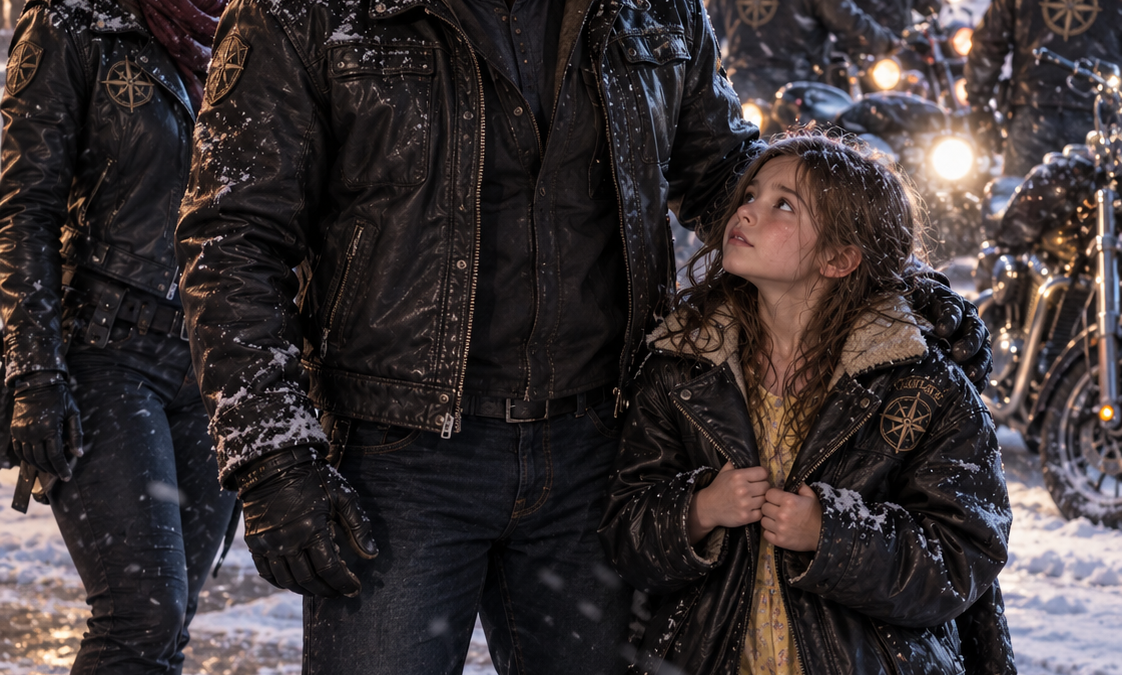
Little Girl Signed “HELP” to a Biker in a Blizzard — What 163 Hells Angels Did Next Shocked Everyone
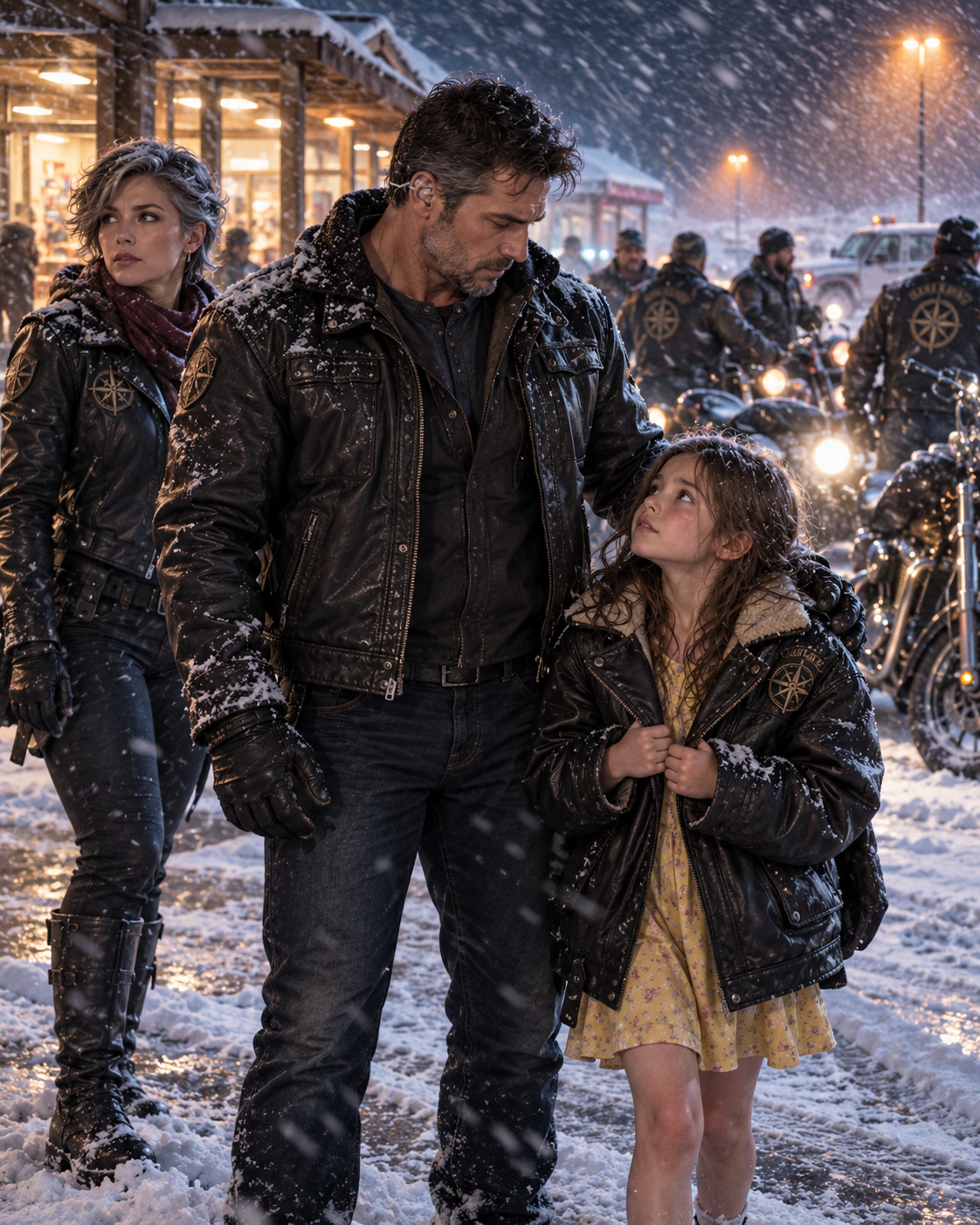
She was 8 years old, standing in a Wyoming blizzard, wearing a yellow sundress.
And nobody in that rest stop parking lot was going to save her. Not the trucker who looked right through her. Not the woman behind the counter who never glanced up.
Not the state trooper who drove past without slowing down. Nobody.
Because the woman gripping her wrist looked like a mother, smiled like a neighbor, and Cali Mercer had learned in 19 hours of silence that monsters don’t announce themselves.
But then a biker walked out of the cold, leather jacket dusted white, hearing aid catching the fluorescent light, and Callie did the only thing she had left.
She raised her frozen fingers and she signed, “Help!”
The blizzard came in from the northwest like something with a grudge. By the time it hit the I80 corridor outside Rollins, Wyoming, visibility had dropped to 40 ft and the temperature was sitting at 11° F with a wind chill that made it feel like8.
The kind of cold that doesn’t just bite.
It reaches inside your chest and squeezes. The kind of cold that reminds you the Earth has been here 4 billion years and has never once cared whether you survived the night. The rest stop was called Elk Ridge Station on the highway signs, though nobody who worked there had ever seen an elk within 20 mi of the place.
It was a flat windcoured slab of concrete and fluorescent light squatting beside the interstate like an afterthought, two bathroom blocks, a vending al cove, a service counter that sold gas station food and diesel, and a parking lot large enough for six semis and maybe a dozen passenger vehicles. In good weather, it was unremarkable.
In a blizzard, it became something else. A lifeboat.
The last lit window before nothing. The parking lot held 11 vehicles when the Iron Compass MC rolled in at 9:47 p.m.Seven of those vehicles had been there for at least 2 hours, their engines cold, windshields buried under 4 in of fresh accumulation.
Nobody was going anywhere tonight. The storm had made that decision for everyone. Rowan Creed pulled his Road King into the far end of the lot and killed the engine.
He sat for a moment without moving, one boot on the asphalt, feeling the cold come through his jacket in waves.
He was 53 years old, 6’2, and built like someone had assembled him from leftover military hardware, and then left him out in too many kinds of weather.
There was a hearing aid in his right ear, a small matte gray device that he’d worn for 11 years, ever since a roadside bomb in Kandahar province had rearranged the bones in his inner ear and taken 30% of his hearing with it.
Most people never noticed the device. Rowan had never decided whether that was good or bad. He dismounted and stood in the wind for a moment, letting his eyes move across the parking lot the way they always did.
Slow, deliberate, the habit of a man who had spent too many years in places where what you didn’t notice could end you.
Two semis near the diesel pumps, both dark. A family minivan with Colorado plates, fogged windows, a car seat visible through the glass. an older Chevy pickup that looked like it had been parked here long enough to become part of the landscape.
And near the entrance to the service building, a woman and a small child standing in the cold. He almost looked away.
The woman had her hand on the child’s wrist.
Not holding hands, not the loose, easy grip of a parent keeping track of a wandering kid.
Her fingers were wrapped around the girl’s wrist in the way you hold something you’re afraid of losing or afraid of what it might do if you let go.
She was maybe 35, dark coat, hair pulled back tight, eyes moving across the parking lot with a restlessness that didn’t match the rest of her carefully composed expression.
The kind of restlessness that lives in the gap between what a person’s face is doing and what their eyes are actually thinking.
Rowan looked at the child. Yellow sundress, no coat, no boots, canvas sneakers, the cheap kind, already dark with wet. Her arms were at her sides, and she was holding very, very still in the way that children hold still when they have learned that movement costs them something.
Her hair was tangled. Her lips had passed blue and were heading somewhere worse. She was looking at the ground.
Then she looked up and for just a moment before she caught herself and dropped her gaze again, Rowan Creed saw her eyes.
Brown, wide, completely clear, no tears, no panic, just a terrible practice stillness, the kind that doesn’t come from being calm.
It comes from being terrified for so long that terror becomes the baseline, becomes the weather you live in. He knew that look.
He’d seen it in the mirror once a long time ago.
He kept walking toward the building entrance, didn’t change his pace, didn’t look back, stepped through the door into the fluorescent warmth and the smell of burned coffee and diesel and the particular brand of existential sadness that clings to highway rest stops at 10:00 at night.
The woman at the service counter was named Deb. He knew this because her name tag said so in block letters. She was maybe 60, reading something on her phone, and she did not look up when the door opened.
Rowan moved to the vending machines, stood in front of the water display, did not buy anything. Through the glass of the entrance door, he could see the woman and the child still standing in the same spot. The woman had her phone out now, texting with her free hand.
The grip on the child’s wrist had not changed.
Behind him, the door opened again. Cold air, bootsteps. Then a hand touched his shoulder blade, one tap, firm, deliberate, and he felt the familiar weight of his riding sister falling into position beside him.
Norivance was 47, short and compact, with silver streked hair cut close, and the kind of face that looked like it had heard every version of every lie, and had stopped being surprised. She wore a leather jacket with the iron compass patch, a circle bisected by a compass needle, the letters icy curved above and below in block script.
She’d been riding with the club for 9 years since her ex-husband had made her life small enough that she’d needed to find something that made her feel large again.
She’d found it.
She didn’t regret a single mile.
She stepped up beside him and looked at the vending machines.
“You seeing what I’m seeing?”
she said.
It wasn’t a question.
with Nora.
It rarely was “Yellow dress,” Rowan said.
“No coat.
No coat.”
They stood there a moment. The fluorescent light hummed above them. Somewhere in the back of the building, a toilet flushed.
She looked at me.
Rowan said, “Kids look at people.”
She looked at me the way people look at exits. Norah said nothing for a moment. Then the woman with her.
You read her? Tight grip, phone out, eyes working the lot.
He paused.
She’s not a mother.
It was the kind of statement that in a different context from a different person might sound like an assumption. From Rowan Creed, it was a report.
He had spent four years in army intelligence before his deployment cycle took him somewhere that intelligence didn’t help much.
And the habit of reading people, the micro expressions, the body geometry, the gap between what a person showed and what their posture confessed had never left him. It was one of the things that made him useful to the club. It was also one of the things that made sleep difficult.
Could be a custody thing, Norah said. Could be. Another silence.
Outside through the glass, the woman glanced at her phone again and then looked up and scanned the parking lot in a slow arc. Thorough, systematic. Not the look of someone worried about the weather.
She’s checking for something, Rowan said.
Or someone. He picked up a bottle of water from the vending machine, paid, turned back toward the door, stopped.
The little girl was looking at him again, and this time she didn’t look away.
She was maybe 8 years old, small for her age, or maybe the cold had just compressed her. The yellow sundress had a small pattern on it.
He was too far away to make out what maybe flowers and it was completely inappropriate for the temperature outside in the month of January and the state of Wyoming and every fact about the current situation.
Her free hand, the one the woman wasn’t gripping, was at her side, and as Rowan watched, she raised it slowly, carefully, with a particular kind of slowness that meant she was watching to see if the woman noticed.
The woman was looking at her phone.
The girl’s fingers moved.
Rowan Creed had been many things in his life.
A soldier, a sergeant, a drunk for a period he didn’t like to revisit.
A biker, a chapter president. He had never been a sign language interpreter.
He’d never studied ASL, never taken a class, never had any reason to learn the language beyond a single specific practical exception.
3 years ago, his mechanic’s 12-year-old daughter had been born profoundly deaf, and Rowan had spent two months learning enough to have a basic conversation with her because he didn’t like the idea of a kid coming to the shop and not being able to talk to anybody.
What the girl’s fingers made was not complicated.
It was not a nuanced sentence or a long message.
It was a single word formed in standard ASL, the kind of word so fundamental that it’s one of the first things anyone learns.
the kind of word that doesn’t require fluency to recognize.
Help. He read it instantly.
Nothing changed on his face. Everything changed in his mind.
He turned back to the vending machines, bought a bag of chips he didn’t want, kept his back to the door and pressed his hand flat against the cold glass of the vending machine front and spoke without turning his head, his voice low and even.
Get Mack and Shepherd in from the lot quietly.
Tell them it’s a soft situation.
Norah was already reaching for her phone.
Don’t spook the woman, Rowan said.
She’s monitoring.
Any wrong move and the girl pays for it. Understood.
And find out where the nearest trooper is. Norah stepped away. Rowan straightened up and walked slowly back toward the counter, the water bottle in one hand and the chips in the other.
Moving with the unhurried deliberateness of a man who has absolutely nowhere to be and absolutely nothing on his mind.
He set the chips on the counter, looked at Deb, who still hadn’t looked up from her phone.
“Coffee,” he said.
“Machine’s at the end,” she said.
“The machine’s out.”
She looked up then with the expression of someone who has heard this complaint 400 times and still doesn’t care.
And she said, “I can check the back.
” “Take your time,” Rowan said, and smiled.
Smiled, which was something his face did rarely enough that it tended to unsettle people. Deb went to the back. Rowan turned and leaned against the counter and looked out through the glass at the parking lot.
The woman and the child were still there, but now the woman had shifted position slightly, half turning away from the building entrance and in the movement. Rowan could see a new tension in her shoulders.
Something had changed in the last 2 minutes. Her phone handed. Her head was angled slightly as if she was listening to something beyond the wind.
She was getting ready to move.
He didn’t have much time.
The door behind him opened and he heard Max’s boots, size 13, heavy tread.
The man walked like he was trying to punish the earth. And then the slightly lighter step of Shepherd, who was 29 and the youngest full patch member of the Iron Compass, and who moved with the coiled economical quietness of someone who had spent three years doing things for the government that still showed up in his dreams without names.
Rowan didn’t turn around.
He spoke to the glass. Two of you far end of the lot.
Check your bikes. Take the long way around the south side of the building.
A pause. Slow.
Reading it as Max said. His voice was very quiet for a man his size.
Probable abduction. 8-year-old girl.
The woman’s the threat.
A silence that lasted exactly 1 second. Copy, Shepherd said.
Then boots retreating and the sound of the door. Rowan watched through the glass as they emerged from the far side of the building and moved across the lot with the unhurried ease of bikers who needed to check their machines, heads down against the wind, hands in pockets. Nothing remarkable about them except that they were bracketing the lot from the south without making it look like anything.
Mack had been in the Marine Corps and had done two tours in Fallujah before a knee wound sent him home, and he had a talent for moving through spaces in a way that occupied them without appearing to.
Shepherd had been in a different part of the government’s business and didn’t talk about it.
Both of them knew how to execute without asking for the full picture first. This was why Rowan trusted them. He turned back to the counter.
Deb had returned with a paper cup of coffee that looked like it had been brewed sometime during the previous administration. He paid for it without looking at it.
Quiet night, he said. Deb shrugged.
Storm like this, people don’t move.
Seen that woman and the little girl before? One outside? Deb glanced toward the door.
They came in maybe an hour ago.
Kid didn’t say anything.
Lady bought water and some crackers. I thought she stopped. Something crossed her face.
I thought the kid looked cold. Did you say anything?
It’s not my business.
Rowan nodded slowly. No, he said.
I guess it’s not.
He picked up his coffee and walked to the far corner of the waiting area. A row of plastic chairs bolted to the wall beneath a rack of tourist brochures for attractions.
Nobody in this part of Wyoming had ever actually visited. He sat down, crossed one boot over his knee, looked like a man waiting out a storm.
His eyes never left the door. 2 minutes passed.
Three. The wind outside the building and gust that made the fluorescent lights flicker once, twice, then hold.
In the back somewhere, a heating unit cycled on with a sound like a large animal waking up. Then the door opened and the cold came in, and with it came the woman and the child.
The woman had made a decision.
He could see it in her body, the forward lean, the purposeful stride, the way the grip on Callie’s wrist had shifted from monitoring to directional.
She was moving them, changing position. The woman crossed to the vending machines and stood there with her back to Rowan, feeding bills into the slot. And as she did, the little girl turned her head, found him.
Those brown eyes again, clear, awake. Inside them, something that was not hope yet, not quite, but was the thing that comes just before hope.
The moment when you see a door in a wall you thought was solid. Rowan held her gaze, gave nothing away in his face. Then slowly he raised one hand from his knee and held it at waist level, fingers loose, palm inward, and he signed a single word back to her.
Safe.
The girl’s expression didn’t change, but he watched something move behind her eyes.
A shift, a recalibration, the way a compass needle swings when it finds north. She blinked once, twice.
Then she looked away, back to the floor, back to her practiced stillness. But her chin had come up just a fraction, just enough. The woman at the vending machine made her selections and turned around.
Her eyes moved across the waiting area in that practice sweep. Gas station worker at the counter.
Old man in the corner with a coffee. Nothing notable.
Her gaze passed over Rowan without stopping. He took a sip of his terrible coffee and looked at the brochure in his hand and did not exist. She guided the child to a chair near the door, sat, kept the wrist grip, put her phone on her knee, and began scrolling.
Rowan counted his breaths. Outside, through the glass, he could see the storm had thickened. The parking lot lights had blurred into orange halos.
The temperature was dropping. Somewhere out there, Mac and Shepherd were moving.
His phone vibrated in his jacket pocket. He pulled it out without looking at the woman.
Text from Nora. Trooper 40.
Mins out minimum. road conditions. He put the phone away.
40 minutes. He looked at the girl in the yellow dress.
She was sitting very still, knees together, sneakers not quite touching the floor, one hand in her lap, the other in the woman’s grip, but the hand in her lap.
He watched it. After a moment, carefully, with the same deliberate slowness as before, her fingers began to move.
Not signing at him. The woman was in the way. The angle was wrong.
She was doing something else. Her fingertips traced shapes against her own palm.
Over and over, the same sequence. He watched her do it twice before he understood what he was seeing. She was writing letters, spelling something out against her own skin, a message she was carrying in her body because it was the only place she had left to keep it.
He couldn’t read it from here, couldn’t see the shapes clearly enough.
But the methodical repeating nature of it, the same sequence, the same rhythm told him she wasn’t doing it to calm herself.
She’d moved past the point where self soothing helped.
She was rehearsing. She was rehearsing something she intended to tell someone.
The woman shifted in her seat, and Callie’s hand went still immediately, dropping flat against her thigh, and the practiced blankness came back down over her face like a mask she’d had a long time to perfect.
Rowan looked back at his coffee. 40 minutes was too long.
He put the cup on the floor and reached into his jacket and pulled out his phone again and typed a single message to Nora. Then put the phone away and sat back and let his eyes go around the room one more time.
Counter, bathroom, door, vending al cove, exit, mapping it the way he’d been taught to map rooms in places where the exits mattered.
He was 53 years old. His right knee achd when it got cold, which was often.
He had a hearing aid and a scar along his left forearm that he never explained and tinidis that sounded like distant static on bad days. He had not slept more than 5 hours in a single night since 2009. And he had not been completely sober for the first four years after he came home from his last deployment.
And he had done things in between those years that he did not put in any category he felt comfortable naming. He was not a hero. He had never wanted to be a hero.
Heroes were people who made speeches and appeared in news segments and said the right things into cameras. And Rowan Creed had no use for cameras or speeches or the right things. But he was here in this room on this night.
And there was a child in a yellow dress who had raised her frozen fingers in a blizzard and asked the only question that mattered.
The door to the women’s bathroom opened and Norah came through it, moving with the casual unhurriedness of a woman who’d just freshened up.
And she crossed the waiting area and dropped into the chair beside Rowan without looking at the woman near the door. She picked up a brochure about Vidawu rock formations and pretended to read it.
“Max at the south end,” she said quietly without moving her mouth much.
Shepherds got eyes on the vehicle. Silver Subaru Montana plates.
Montana. He ran a visual on the plates called Darcy.
Darcy was their contact, a former state trooper who had left the force under circumstances he didn’t discuss and now did occasional work for the club that occupied a legal gray area.
He also didn’t discuss.
I was fast and he was reliable and he owed Rowan a favor that would never fully be repaid. How long? Rowan said.
He’s already looking.
A pause. Rowan.
Yeah. The woman bought crackers and water when she came in.
That’s it.
No food for the kid.
She’s been here an hour.
Rowan said nothing. 19° outside, Norah said.
I know.
She’s 8 years old in a sundress.
I know, Nora. A silence.
The heating unit cycled again. Somewhere near the counter. A phone rang once and stopped.
What’s the play?
Norah said. We create a reason for the woman to separate from the girl.
And if she won’t, Rowan looked at the woman near the door, looked at the grip around the child’s wrist, looked at the child who was sitting perfectly still, chin slightly raised, eyes on the middle distance, carrying whatever she was carrying.
“She will,” he said.
“Everybody has a pressure point.”
His phone vibrated.
“Darcy.”
He looked at the screen under the edge of his jacket so the light didn’t show.
and he read the message twice. And when he put the phone away, his jaw had tightened and his breathing had changed.
And something moved behind his eyes that wasn’t quite anger.
It was something older and colder and more deliberate than anger. The silver Subaru with Montana plates had been reported stolen from a Billings parking lot 3 days ago. The same day, an 8-year-old girl named Callie Mercer had been reported missing from a school pickup line in Casper, Wyoming, 230 mi south.
Rowan Creed looked at the little girl across the room. She was looking back at him. And this time, for just one second before the mask came down again, he saw in her face something that broke through every layer of practiced stillness she had built.
A flicker of something raw and desperate and achingly young, the face underneath the face, the child she still was inside all the survival she’d been forced to learn.
He held her gaze and he made her a promise without words, the way he’d been making promises his whole life.
Not with speeches, not with ceremonies, but with the thing in his eyes that said, “I see you.
I’m not leaving.
Not until this is done.”
She blinked, looked away. But her chin stayed up. And at that exact moment, the woman near the door received a phone call.
And the look that moved across her face when she saw the screen, sharp, electric, the look of someone who has been waiting for bad news and is now receiving it, told Rowan that whatever window they had was narrowing faster than he’d calculated.
He was already moving before he decided to move because some decisions don’t live in the thinking part of the brain.
And beside him, Norah was standing, too. And somewhere outside in the blizzard, Mack and Shepherd were exactly where he told them to be.
And the only question left was whether what Callie Mercer had been rehearsing on her palm was enough to do what he suspected she’d been building toward for the entire 19 hours she’d been trapped in someone else’s silence.
The woman stood up, phone pressed to her ear, her grip on Callie’s wrist, pulling the child upright with her, and she said something into the phone in a low, clipped voice that Rowan couldn’t fully catch across the room.
But the last word he heard clearly enough.
Now uh and then he saw what was written on Callie’s palm.
Not letters, not a name, a license plate number. Seven characters memorized and traced over and over against her own skin for 19 hours because an 8-year-old girl had decided that if she ever got the chance to tell somebody something, she was going to tell them everything.
What he didn’t know yet, what nobody in that rest stop knew yet, was that the plate wasn’t the only thing she’d memorized.
And what she remembered was going to change everything. The word now hung in the cold air for exactly 2 seconds before Rowan Creed made the decision that would unravel the next 72 hours of his life.
He didn’t think about it.
Thinking was for situations where you had time, and time was the one thing in that fluorescent lit room that had just run out.
He crossed the waiting area in eight steps, unhurried enough not to register as a threat, purposeful enough to close distance, and he stopped at the vending machine 2 ft to the left of the woman and the child, and he fed a dollar bill into the slot and pressed a button and waited for the machine to deliver something he didn’t want.
The woman had her phone pressed to her ear.
Her grip on Callie’s wrist was pulling the child toward the door.
Her eyes had moved to the exit and stayed there.
“Excuse me,” Rowan said.
She didn’t look at him.
Ma’am.
His voice was flat and even, the voice of a man asking a parking question.
She turned barely, just enough to acknowledge the interruption, and what Rowan saw in her face at close range was something he hadn’t been able to read from across the room.
She was not panicked. She was not unraveling. She was operating, functioning with the precise pressure efficiency of someone who had done this before and understood exactly how much could go wrong and had pre-calculated her responses to most of it.
Her eyes were pale green and they moved over him in less than a second, reading him, assessing him, filing him under obstacle and then manageable obstacle and then dismissing him. She was good. She was also not good enough.
Roads closed north of here, Rowan said. Just came in. Trooper turned us back about 6 mi up.
She blinked. The phone hand dropped a/ inch from her ear. What?
I 80 westbound. Total shutdown.
Jack knifed semi about a mile past the wombutter exit. He shrugged the gesture of a man delivering inconvenient but not catastrophic information.
They’re saying 4 hours minimum before they clear it.
Counterlady knows. Her eyes went to the counter.
Deb was still there still looking at her phone which was the problem with the lie but it was a calculated problem.
From here, with the distance and the angle, Deb’s in attention looked like the inattention of someone who had already told this story several times and didn’t need to tell it again.
The woman’s jaw moved once.
She looked at the door, then at her phone, then at the door again, and in that moment of recalculation, Rowan looked down. Callie was looking straight up at him.
Her palm was still pressed against her thigh.
He could see the edge of the characters she’d been writing there.
Not enough to read, but enough to confirm what he’d already understood.
She had stopped tracing them because she didn’t need to rehearse anymore.
She had found her person. The woman said something into the phone, too low, too fast.
He caught the shape of it, but not the words.
And then pulled the phone from her ear and dropped it into her coat pocket and tightened her grip on Callie’s wrist and said, “Move.
” and Callie moved and they were heading for the door.
Rowan didn’t follow.
He turned back to the vending machine and collected the item he’d bought and walked back to where Nora was standing and handed her a package of peanut butter crackers and said quietly, “She’s going to the car.”
Max’s on the south side.
Get him to the vehicle. Shepherd on her six the second she comes through the door.
Nobody moves on her until I’m outside.
And if she drives, he was already moving toward the door. Outside, the cold hit him like a wall collapsing.
The wind had picked up in the time he’d been inside.
It was coming in hard from the northwest, driving snow horizontally across the parking lot, reducing the orange glow of the overhead lights to soft, meaningless halos in the white. He could hear the semis groaning against the wind.
He could hear his own breath. He could not feel his ears.
He could see the silver Subaru. It was parked at the far end of the lot, maybe 60 ft from the building entrance, angled toward the exit ramp.
Smart. You park toward your exit.
You don’t put anything between you and the road.
He knew the logic because he used the same logic, just for different reasons. Shepherd materialized from the south side of the building, moving along the wall, and Rowan raised two fingers without looking at him.
and Shephard altered his angle and came up on the passenger side of the Subaru and crouched behind the rear quarter panel like he’d done this everyday for years, which was roughly accurate.
The building door opened behind him. The woman came through with Callie, and the cold hit them both.
The woman pulled her collar up, eyes already scanning the lot, and Callie’s free hand came up instinctively to wrap around herself, fingers tucking into her armpits, the reflex of a child who had been cold for so long that warmth had become theoretical.
Rowan stepped into their path, not aggressively, not blocking. He positioned himself at a slight angle that required the woman to acknowledge him or physically alter her route, which forced a choice, and choices cost time.
Lady at the counter says there’s a warming shelter in the annex building, he said.
Back of the lot.
They’re opening it up for people stuck in the storm.
The woman stopped. Get out of my way. Just trying to help.
I said, get out of my way. Up close, her voice was tight and precisely controlled. And underneath the control was something that he recognized.
Not fear exactly, but the cousin of fear, the thing that lives next to it, urgency. The urgency of someone whose timeline was collapsing.
The road’s closed, he said again.
You already said that. Just making sure you heard it. Her eyes had gone hard and very still, and he could see her processing him now in a different way.
Not dismissal, not manageable obstacle, something sharper. She had picked up on the fact that he was in her path twice, and people who understood how threats work know that coincidence has a limit.
“Who are you?”
she said.
“Nobody,” Rowan said.
just a biker in a snowstorm.
She pulled Cali to her right side, putting herself between the child and Rowan, and pushed forward, and he let her go, stepped aside, gave her the path, and watched her move across the lot toward the Subaru with Cali being hauled at a pace just slightly too fast for the child’s legs.
He turned and walked in the opposite direction toward the cluster of iron compass bikes at the far end of the lot. And as he walked, he pulled out his phone and typed two words to Shephard.
Don’t let her leave.
He heard the Subaru’s remote unlock chirp through the wind, heard a door open, and then he heard something stop.
A specific percussive kind of not moving, and he turned.
Shephard was standing at the driver’s side door.
He wasn’t touching the woman.
He wasn’t threatening the woman.
He was simply standing at the driver’s side door of the Subaru with his hands in his jacket pockets and his face completely neutral, which was somehow more unsettling than aggression would have been.
but was 29 years old and he had a scar that ran from his left ear to his jaw that he didn’t talk about and in the cold and the snow and the orange parking lot light.
He looked like exactly what he was, someone who had been trained to stop things from moving, who could do it a dozen different ways, and who was currently choosing the one that was least visible from the highway. The woman froze.
“Move,” she said.
“Ma’am, my bike’s leaking something onto your passenger side,” Shephard said.
I just need to check whether it’s on your tire.
Your bike isn’t anywhere near my car.
My mistake.
He didn’t move.
She looked from Shepherd to Rowan, who had stopped 30 ft away, and then to Mac, who had appeared from somewhere to her left in the way that Mac had a talent for appearing, just suddenly there, large and quiet, carrying a coffee cup he definitely hadn’t had before.
Three people, three different positions, triangle.
I’m calling the police, she said.
Good idea, Rowan said. Roads are bad. Might take them a while to get here.
Her face did something complicated.
And in the half second when her eyes moved to her phone and her grip on Callie’s wrist shifted infinite decimally, Callie moved.
Not away, not toward Rowan.
She turned and grabbed the woman’s coat with her free hand, and in the same motion she signed fast and low in the space between their bodies where the woman couldn’t see her hand, but Rowan could.
He read it. three things in sequence, a name, a location, and a number. Then Callie dropped her hand and went still, and the woman yanked her toward the car door, and Shepherd stepped aside because Rowan had signaled him to because what Rowan had just read had changed the entire geometry of this night.
He stood in the snow and he said loudly enough to carry across the lot, “Cali,” the woman stopped.
He watched her stop, watched the name land in her like something physical, watched her turn very slowly, and look at him, and in her pale green eyes, the calculation had gone away completely, and what was underneath it was nothing like humanity.
You don’t know that name, she said.
I know a lot of things, Rowan said, including where you’re supposed to be right now, and the fact that you’re 40 minutes late to wherever that is.
A silence. The wind drove snow between them. Walk away, she said.
You don’t understand what you’re involved in.
Probably not, he agreed. But the girl stays. What happened next happened in a way that compressed time.
Not the movie version of compression where everything becomes slow and graceful, but the real version where everything becomes fast and ugly and hard to account for afterward. She reached into her coat pocket and Mac was already moving and Shephardd was already moving and Rowan was already moving.
And what she pulled out was not a weapon.
It was a phone and she was dialing, but Mac’s hand closed over hers before the call connected and the phone went into the snow and she made a sound that was nothing like fear and everything like fury and Cali Mercer stepped sideways one step, two steps until she was no longer between the woman and anybody.
And she stood in the snow in her yellow sundress with her arms at her sides.
And she looked at Rowan and she said for the first time in 19 hours in a voice that was very small and very steady and very clear, “I remember everything.”
The three words dropped into the cold like stones into deep water.
And the silence around them lasted exactly long enough for Rowan to understand that they were not a child’s cry for help.
They were a weapon. They were the most dangerous thing in this parking lot. Norah had come out of the building behind him at some point and she was at his shoulder now and she heard it too because he felt her shift her weight.
Everything Norah said, her voice low. Everything, Callie said.
She said it the way a person says a word they’ve been holding in their mouth for 19 hours.
The way a person says something, they decided to survive long enough to say.
They got the woman into the service building’s back office in less than 4 minutes.
Not violently. That was the thing that Rowan would think about later.
The thing that defined the Iron Compass in the way that people who only understood bikers through what they’d been told would never quite believe.
They didn’t use force.
They used geometry, presence, the arrangement of large, quiet, scarred people in spaces that made options disappear one by one until the only option left was the one you wanted them to take.
Deb had been sent to the annex with a cash tip and a request to check the generator that probably didn’t need checking.
The back office was a room about the size of a generous closet with a metal desk and a space heater and a chair. And the woman sat in the chair not because anyone told her to sit, but because the room had no other places to be.
And standing in a room with Mac was an experience that tended to make people want to sit down. Rowan sat on the edge of the desk.
Shepherd was at the door.
Norah had taken Callie to the vending al cove, which was around two corners and out of earshot, and she had bought the child hot chocolate from the machine, and taken off her own jacket and put it around the girl’s shoulders.
And Callie had accepted the jacket without speaking, and had wrapped both hands around the cup and had sat down and started talking.
Rowan could not hear what Callie was saying, but he didn’t need to yet.
He had the woman. He looked at her for a long moment without speaking. She was looking at her hands.
“What’s your name?”
he said. Silence.
Not the one you use for work, he said. The one your mother gave you.
She looked up.
You think you’ve done something smart tonight?
I think I’ve done something necessary.
There’s a difference usually.
Yeah.
She smiled, which was the wrong response, and which told him something about her that he hadn’t fully calculated yet.
People in her situation, caught, contained, options reduced to a chair in a closet-sized office while a blizzard erased the roads outside, didn’t smile unless they believed the situation was still manageable.
Unless they had assets that hadn’t been revealed yet.
“You have no idea what you’ve walked into,” she said.
“Then tell me.”
Walk away, take your people, get back on your bikes, and ride south, and don’t stop until you’re out of Wyoming.
Can’t do that.
Why not?
Rowan said, “Because there’s a kid in the next room who signed to me in a blizzard, and I made her a promise.
” The woman looked at him for a long time.
“You’re going to regret this,” she said, and her voice had lost its careful control.
Not into emotion, but into something else, something factual, the tone of a person reporting a weather condition.
“Not from me, from the people who sent me.
Give me a name. Give you a name.
” She repeated it as if he’d said something in a foreign language she found mildly amusing.
Start there. And then what?
You call the state police? File a report? You think this ends with a report?
She shook her head.
Whatever you think you know about how the world works, I promise you the version you think you know is not the version that’s running this.
Rowan looked at her for another beat.
Then he stood up and said, “Watch her.”
to Mac. And he walked out of the office and around two corners and into the vending al cove.
and what he found there stopped him in the doorway.
Cali Mercer was sitting in a plastic chair with Norah’s jacket over her shoulders and a paper cup of hot chocolate in her hands.
And she was talking, not in the hesitant, fragmented way of a traumatized child who isn’t sure what’s safe to say.
She was talking methodically in sequence with the focused precision of someone delivering a report. Norah was across from her with her phone out, not recording, just taking notes the old-fashioned way, and her face had gone very still in the way it went still when something was serious. Rowan stopped in the doorway and listened.
Two of them came to the house. I was there because mom was late.
The door was unlocked.
I don’t know why it was unlocked.
The first one was a woman, her. A small nod toward the direction of the office.
Not a gesture of anger, just a compass bearing. The second one was a man.
I never heard his name.
They called him V when they thought I couldn’t hear.
They put me in the back of the car and they drove for a long time and they stopped twice.
First stop was a gas station in a town I couldn’t read the signs for.
Second stop was a place that looked like a house but had a lot of cars parked around it and the woman went inside alone and V stayed with me.
Norah said, “Did you hear anything at the second stop?”
A name, a woman’s name, Hrix, and a number, not a phone number.
It was two numbers together. 2611. They said it twice and wrote it on something.
She paused. And the license plate of the car parked next to us was Montana plates.
Not the same as this car. Different. I memorized it.
She recited it. Seven characters, clean and immediate. No hesitation.
Norah typed without looking up. Callie, how did you remember all this?
My grandma.
The girl’s hands tightened slightly around the cup.
She’s deaf.
She taught me to pay attention because you can miss things when you only listen.
She said, “The best rememberers are the ones who watch.”
Norah looked up at that. Her eyes found Rowan in the doorway.
Rowan looked at the child, 8 years old, yellow sundress under a biker’s jacket, hot chocolate warming her frozen hands, and felt something move in his chest that had no name.
He was willing to give it. something old, something that had been very quiet for a very long time. He stepped into the al cove and crouched down to her eye level.
She looked at him without flinching. Callie, the plate you signed to me in this parking lot. The third thing.
She looked at him steadily.
That wasn’t a plate.
I know. You read it.
I read it. Then you know what it means.
He did because the third thing she’d signed in that narrow space between her body and the woman’s coat in the 3 seconds of distraction she’d manufactured like someone who had been planning it for hours was not a license plate and not a
location.
It was a number. A specific number. Nine digits.
The kind of number that in a specific context meant only one thing. A federal case number. An 8-year-old girl had memorized a federal case number.
He said, “Where did you see it?
on a paper on the seat of the car at the second stop.
When V wasn’t looking, she said it simply.
I thought it might be important. Rowan looked at the cup in her hands.
He looked at her fingers, slowly returning to their normal color as the warmth worked through her.
He looked at her chin, still up, the same fraction it had been since he’d signed safe to her across a rest stop waiting room.
“You did good,” he said.
“I know,” Callie said.
And then something happened in her face. Not a collapse, not tears, but a release.
The specific kind that comes when the body finally believes what the mind has been refusing to believe. When the proof accumulates past the point where survival mode can keep the lid on everything underneath it.
Her bottom lip moved once. Her eyes went bright.
She didn’t cry.
She just sat there in the oversized jacket and looked at him and let it be real for one second. the fact that she was alive and warm and had delivered her report to someone who understood it.
“My mom,” she said.
“We’re calling her right now,” Norah said.
“I promise.
” Callie nodded, looked back at her cup.
“Back to business.”

