The Bodyguard Mocked a Single Dad’s Old Jacket—Then the CEO Realized He Was a Former SEAL (part 2)
Part 2
Brent’s face had gone a particular shade of pale.
She’s bluffing, he said, but he didn’t say it with conviction.
He said it the way people said things when they were hoping very hard that the thing was true. The system documentation would have that specification in it, the older man said, nodding at the portfolio.
There isn’t time to read through all of there isn’t time to take her across the building and find out she was telling the truth either.
The older man’s voice had a controlled edge.
You told us the biometric access was unconditional. It is.
She’s cuz if it isn’t, the whole acquisition plan falls apart.
He stepped closer to Brent. You gave us 18 months of access information. You gave us the evacuation route data.
You gave us the building credentials.
If the one thing you guaranteed us turns out to be wrong, I said she’s bluffing.
Brent’s voice had gone higher.
She does this. She deflects under pressure.
I’ve worked with her for 3 years.
I know how she operates. You worked for me, Sloan said.
There’s a difference.
Brent turned to her.
And in his face was something that Cole hadn’t expected.
Not the flat, professional detachment of a man who had made a calculated decision. and was living with it.
What was in Brent’s face was messier than that.
It was the expression of someone who had been building a justification for a long time and was only now in this room starting to feel it come apart. You have no idea, Brent said, what it costs to do this job.
Apparently, it costs about 18 months of my employees safety and whatever they paid you, Sloan said. That is not He stopped.
His jaw worked. You know what I make?
You know what my pension looks like?
I’ve spent 20 years keeping people like you alive, and the math has never once added up to Brent.
The older man’s voice cut through the room.
Not Brent stopped.
He pressed his mouth together and looked at the floor for a moment, and Cole watched the justification reassemble itself behind his eyes, brick, brick by brick, because that was what people did when the alternative was looking at what they’d actually done.
Cole was still on the floor. His knees were beginning to ache.
Concrete was unforgiving. and he was 37, not 25, and the cartilage in his right knee had a complaint it had been filing since a training incident in his 8th year of service that nobody had ever properly addressed.
He noted the ache and set it aside the way he set aside everything that wasn’t immediately relevant.
He was thinking about the room. He had been thinking about the room since the two men entered it, but now he was thinking about it with more focus because the conversation had told him what he needed to know about the dynamic.
Brent and the older man were in tension. The older man was the decision maker.
The younger man with the drawn weapon was following the older man’s lead.
And Sloan had just introduced a variable that none of them had prepared for and that two of the four of them didn’t know whether to believe.
The room was approximately 4 m x 5 m. The desk was solid metal, old, heavy, the kinds of facilities furniture that outlasted the companies that bought it. The storage shelving on the left wall held cleaning supplies, including two pressurized spray canisters.
The monitors were on a rolling cart, not bolted to the desk. The door opened inward, which meant it functioned as a cover from outside, but as an obstacle from inside.
The younger man was standing approximately 2 and 1/2 m from Cole, slightly to his left, with the weapon aimed at a point between Cole’s shoulders.
The older man was near the desk.
Brent was 3 m to Cole’s right.
Three men, one drawn weapon, one undrawn weapon on Brent, one undrawn on the older man. Cole had no weapon. What he had was an understanding of how rooms worked and how people moved inside them when things went wrong.
He also had the specific quiet awareness that had been growing in him since the older man looked at his jacket. The man had recognized something.
He hadn’t said what.
He hadn’t acted on it.
But recognition was its own kind of variable, and Cole didn’t know yet whether it was going to work for him or against him.
“We’re moving,” the older man said, settling whatever internal debate he’d been running.
“We’ll address the biometric issue when we have her in a controlled environment.
There are other methods of ensuring cooperation.”
He looked at Sloan with an expression that was deliberately blank.
“Bring her.”
The younger man shifted his weapon toward Sloan. Brent moved toward her.
Cole said the stress detection system isn’t a bluff.
Everyone looked at him. He was still on the floor.
He hadn’t moved his hands.
He was looking at the older man because the older man was the person in the room worth talking to.
North’s prototype has a DoD security requirement attached to it.
Cole said, “If you’ve been planning this for 18 months, you know what DoD security requirements look like.
Physiological stress detection in biometric systems has been standard on defense classified access controls since 2019.
She’s not making it up.
The older man’s face had gone very still.
And you know that,” Cole continued.
So, you either have a workaround that Brent didn’t tell us about, which means Brent’s been managing information in both directions, not just one, or you’ve brought a technical asset who can spoof the biometric system, in which case you didn’t actually need her voluntary participation in the first place.
He paused. Which is it?
Silence.
Brent’s expression had moved from pale to something closer to gray.
The older man looked at Brent. It was a long look, and what was in it was not the controlled professional irritation of before. It was something harder and less forgiving.
You said the access was unconditional, the older man said again very quietly this time.
I the system specs I had access to didn’t include you said unconditional.
The version I reviewed was from 18 months ago. If they updated the security protocol, you said unconditional. Three repetitions of the same two words, each one landing with more weight than the last.
Brent looked at Cole and in his eyes was something unexpected.
Not hatred exactly, but the closest thing to it that came from a man realizing he’d been outmaneuvered by someone he’d tried to eliminate.
“You don’t know what you’re talking about,” he said.
“You’re a mechanic.
You’re a ride share driver.
You don’t know anything about this system.
I know enough to watch your face when I said it,” Cole said.
The older man had turned away from Brent. He He was looking at Cole now with the particular attention of someone who was rapidly revising their assessment of a situation.
Cole held his gaze.
There was something in the older man’s face that was not quite readable, a quality that sat at the edge of several different things.
He was making a decision. Cole could feel the shape of it without knowing what it was.
Then the older man looked at the younger one and said in a low voice, “Pick up his jacket.”
The younger man blinked. Is the jacket on the floor?
Pick it up.
Cole’s jacket had slipped from his shoulders during the process of getting to his knees.
the old field coat, heavy canvas, repaired sleeve, $30 from a surplus store. It was lying in a half-colapsed pile on the concrete beside him. The younger man reached down and picked it up with his free hand, holding it awkwardly while keeping the weapon in his other hand.
Inside left panel, the older man said, “There should be a pocket.”
The younger man found it. He reached in and his fingers closed around something.
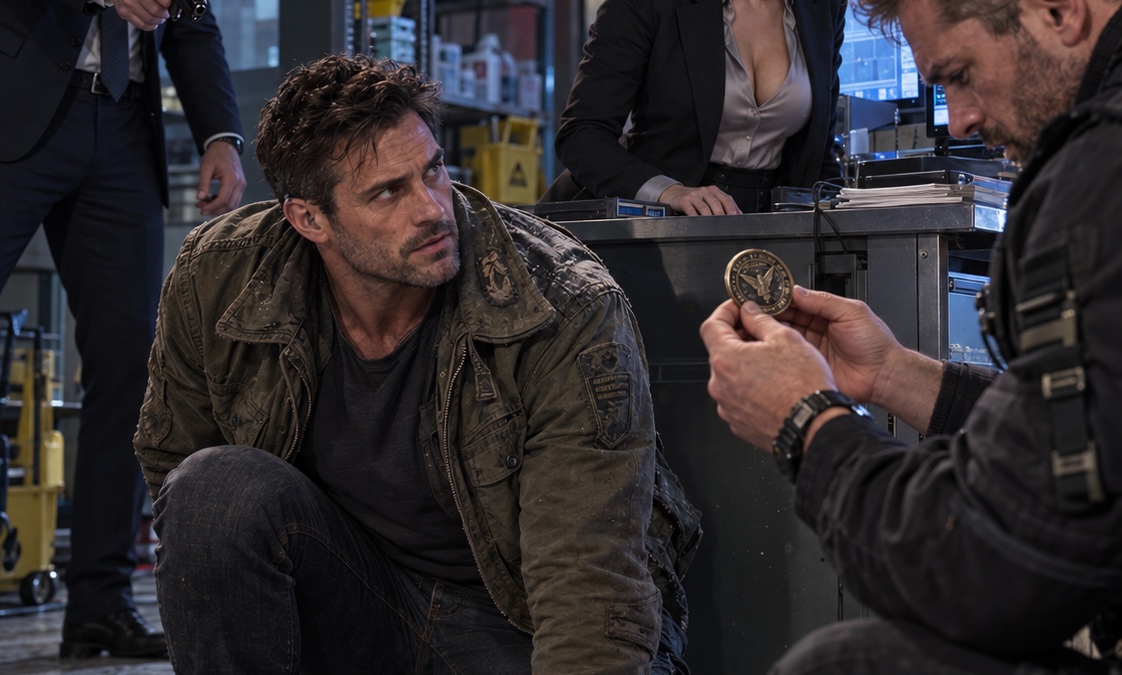
He pulled it out and looked at it. It was small and round and heavy for its size.
A military challenge coin approximately the diameter of a half-dollar, worn smooth on the face from years of handling. The insignia was still visible if you knew what you were looking at.
A trident over an eagle, over a pistol, over an anchor. Below it, nearly rubbed away by time and contact, seal team.
The younger man’s hand went still.
He looked at the coin for a long moment.
Then he looked at Cole on the floor, really looked at him in a way that was different from the way he’d been looking at him before.
The drawn weapon didn’t move, but the quality of the man’s attention changed.
He looked at the older man. The older man was already looking at Cole with an expression that had shifted entirely from what it had been.
“Seal team,” the younger man said.
Almost a whisper.
“Nobody spoke for a moment.”
“Brent’s head turned between the two contractors and Cole, reading the room and not liking what he was reading.
“It doesn’t matter what he was,” Brent said.
“Whatever he used to be, he drives a car now.
He fixes engines.
He’s got a kid in elementary school.
He’s not.
Shut up, Brent. The older man said.
Brent’s mouth closed.
The older man was still looking at Cole. Something complex was moving across his face.
Not sympathy, exactly. Not admiration.
Something more complicated than either of those, the specific look of a man from a particular world, encountering another man from that same world in circumstances that neither of them had expected. Which team? He said to Cole.
Cole looked at him steadily.
That’s not a conversation we’re having right now.
The older man absorbed this.
You’ve been down here the whole time.
Yes, you weren’t trying to be threatening.
No, the older man was quiet for a moment.
Then he said, “That’s what makes it worse.”
Cole said nothing, but his eyes never left the older man’s.
What happened in the next 4 seconds happened in the specific compressed way that things happened when they had been building for long enough, not explosively, because explosion implied chaos. And what Cole did was the opposite of chaotic. It was the accumulated product of 11 years of training, six years of trying to forget that training and the 37 years of being himself that ran underneath all of it.
He did not lunge. He did not shout. He did not do any of the things that movies had made people expect for moments like this.
He simply moved.
The younger man’s weapon hand was occupied with the challenge coin.
His grip on the weapon had shifted to a one-handed hold when he reached into the jacket, and a one-handed hold on a drawn weapon was a fundamentally different mechanical problem than a two-handed hold.
Cole’s right hand came up and redirected the weapon’s muzzle while his left hand drove into the younger man’s elbow joint from the side.
Not hard enough to break it, but hard enough to compromise the grip, and the weapon came free.
and Cole had it in under two seconds and the younger man was stepping back with his hand tucked against his chest before he’d fully processed what had happened.
The older man reached for his own weapon. Cole was already moving.
He stepped inside the older man’s draw arc inside the radius where the weapon was mechanically useless and put him against the metal shelving with a controlled impact that brought down a cascade of cleaning supplies and a pressurized
canister that hit the floor and rolled but didn’t discharge.
The older man’s weapon skittered across the concrete.
Brent fired.
The shot hit the metal shelving 6 in from Cole’s head.
The sound in the enclosed room was enormous. Not the flat crack of an outdoor discharge, but a compressed physical thing that hit the ears and the chest simultaneously. Sloan dropped behind the desk.
Cole pulled the older man between himself and Brent, using the man’s own momentum, and Brent’s second shot he fired again.
Less controlled this time, went into the wall above the door. Stop.
Cole’s voice cut through the room.
Brent, stop. Brent stopped. He was breathing fast.
The weapon was still raised. His eyes were moving between Cole and the older man.
Cole was holding and the younger man against the opposite wall and Sloan behind the desk.
And he was doing the math badly because he was panicking and panic was arithmetic’s natural enemy.
“You shoot again in this room,” Cole said, and the next one goes somewhere it can’t be undone.
You know that.
You’re trained.
Think.
Brent’s weapon hand was trembling.
Not badly, but visibly.
You can’t.
Brent started. Sloan, Cole said, not looking at her. The emergency panel is in the corridor.
Red handle 40 ft to your right when you exit. Go.
I’m not leaving you in here.
I’m not asking.
Cole, I am asking you to go restore communications so that the federal agents who are 15 minutes out know exactly where to come.
That’s all.
Can you do that? A pause. Two seconds.
Three. Yes, she said.
Then go.
The door was to Brent’s left.
Sloan came from behind the desk in a low, fast movement and was at the door before Brent had fully processed that she was moving. He swung the weapon toward her.
Cole drove the older man forward into Brent’s weapon arm, not at Brent himself, but at the arm at the mechanical link that connected intention to action, and the weapon discharged into the ceiling, and Sloan was through the door and gone.
Brent shoved the older man away and leveled the weapon at Cole. Cole stood still. The weapon was 2 m away.
Close enough that it wasn’t a question of accuracy.
Far enough that there was nothing to do about it except be very still and very careful and trust that Brent was not actually going to shoot him in a room with two witnesses while federal response was 12 minutes out.
You’ve made everything worse, Brent said.
His voice was ragged. You understand that?
You walked into this building to to return a folder. You could have left. Nobody would have known you were here.
Nobody would have cared. I know, Cole said. Then why?
Because I saw something wrong and I didn’t leave.
Cole’s voice was even tired, maybe, but even.
I’ve already explained that.
A folder.
Brent’s voice broke slightly on the word, not with emotion exactly, but with the specific fracture of someone confronting the absurdity of their own situation.
An $8 ride share fair. 12. Cole said it was $12.
Brent stared at him.
The older man had and was Nissan standing near the the expression of someone who had thoroughly reassessed the situation and found it substantially different from what he’d been briefed.
The younger man was against the wall with his weapon hand still tucked close watching Cole with eyes that held something that might have been in different circumstances a different kind of recognition. Brent still had the weapon on Cole, but his grip had changed again.
It had gone from the active tension of someone about to fire to the exhausted grip of someone who was holding a decision they hadn’t yet made.
What happens to me?
Brent said, “That depends on a lot of things,” Cole said.
“None of which I control.
But you know, I know what the evidence looks like. I know what Sloan saw in those logs.
I know what your radio is set to, and I know how your card has been performing.”
He paused.
You’re smart enough to know what that adds up to.
Brent’s arm lowered.
Not all the way. Not a surrender.
Not yet, but enough to mark the change in the room’s physics.
Enough that Cole could breathe one degree more normally. I have a daughter, Cole said.
She’s eight.
Her name is Piper.
I work two jobs to cover her school and her health insurance and the apartment we live in, and I haven’t had a week off in 2 years.
And some mornings, the math genuinely doesn’t work, and I sit at the kitchen table after she’s asleep trying to figure out which bill gets paid this month.
He wasn’t saying this to generate sympathy.
He was saying it because it was true. and because Brent had used it as an insult, and Cole had decided it was worth addressing.
That’s my life.
It’s not glamorous, but it’s mine, and I chose it.”
He looked at Brent steadily.
“You had choices, too.”
Brent looked at the floor. The older man moved quietly to the corner of the room and sat down on an overturned crate, which was the posture of a man who had concluded that the situation was over and was waiting for its formal conclusion.
The younger man remained where he was, against the wall. Nobody reached for any of the weapons on the floor. From the corridor outside came a sound, not footsteps this time.
A low hum, then a click, then a different quality to the building’s ambient sound.
The kind of shift that came when a system that had been suppressed was suddenly restored. Lights that had been dimmed in the secondary systems brightened slightly. Somewhere above them, an intercom made a single static burst and went silent.
And then, faint but growing, the sound of a fire alarm that had been cut somewhere during the incursion restarted on a different circuit, louder, clearer. The full alert tone that the building was designed to broadcast. Sloan had reached the panel.
Cole exhaled.
Outside the facility’s office, somewhere in the layers of the building, the radio on the floor crackled once on its non-standard frequency and then went silent.
Cole looked at it and thought about the coordination structure that had built this operation. The months of planning, the credentials, the vehicles, the timing, and felt the particular flatness that came after tension dissolved. Not relief, not satisfaction, just the return of normal weight, of ordinary gravity, of being a person in a room rather than a set of positions and calculations.
His knee still achd. He was going to be very late to the garage. Brent sat down on the edge of the desk with his weapon now hanging from one hand, barreled toward the floor, the grip loose and purposeless.
He was looking at the wall.
Whatever internal structure had been holding him in position for 18 months was visibly coming apart now, and Cole didn’t watch it happen because it wasn’t something that needed an audience.
The older man spoke from his corner. I want to be clear about one thing. He looked at Cole.
We were not going to hurt her. Cole looked at him. You brought explosive charges into a building full of people.
Shaped charges calibrated. We knew the blast radius.
And if one of those 40 people in the lobby had been on the 14th floor when it went off, the older man didn’t answer.
Nobody in this profession gets to be clean.
Cole said, “You know that whatever you told yourself about the conditions, he said it without heat, without judgment in the performative sense.”
He said it the way someone said a fact that was simply true.
Conditions are the thing you invent when you need to live with what you’re doing.
The older man was quiet for a long time.
Then he said, “I served.”
I know, Cole said. 8 years.
I know. The older man looked at his hands.
Doesn’t end clean, does it?
Cole looked at him for a moment, then.
No, it doesn’t.
They sat with that for a minute. The building was loud around them.
Alarms, distant voices, the thud of something heavy being moved on an upper floor.
The world outside the small facility’s office was still moving through its emergency.
And in approximately 10 minutes, federal agents were going to enter this building. and this room was going to become something different from what it currently was. Evidence record the beginning of a long formal process.
Cole picked up the challenge coin from where it had fallen when the younger man dropped it during the disarming. He held it for a moment the familiar weight of it in his palm.
He’d carried it for 11 years, not as a talisman, not as a reminder of anything grand, just as the thing that had been in his pocket the day he left, and had stayed there because he’d never bothered to put it somewhere else.
He put it back in the inside pocket of his jacket. The jacket that a man in a charcoal suit had told a room full of people looked like something pulled from a recycling bin.
Cole put the jacket back on. Not as a statement, not as anything. Just because the building was cold and he was tired and it was his coat.
From somewhere above them, several floors up through the concrete and the steel and the insulated walls. The sound of the exterior door on the north face opened.
and then voices official and purposeful and moving fast. The sound of people arriving who had been called and had come.
Cole looked at the door of the facilities office.
He thought about Piper, about the school fundraiser she’d mentioned last week, the one where she’d asked if he could come, and he’d said he’d try.
He always he’d try, which both of them knew sometimes meant he couldn’t.
He thought about whether he would make it home at a normal hour to tonight, or whether the next several hours would be what he thought they were going to be. statements, federal interviews, forms, the long administrative aftermath of a morning that had started as a $12 fair.
He thought about the folder now sitting on the metal desk with the older man’s hand resting near it, but not on it the dark brown leather, the brass snap closures, the embossed monogram that had started all of this.
He thought about finding it wedged between the seat and the door last night at 11:43 after a 12-hour shift with his back aching and Piper already 3 hours asleep. He had picked it up and driven it across the city because it belonged to someone else. That was all.
That had always been all. The voices from above were growing louder.
Cole stood up from where he’d been crouching and straightened his jacket and waited for what came next.
the same way he’d spent most of his adult life waiting for what came next steadily without drama with the particular patience of someone who had learned that most of what mattered happened in the waiting rather than the arriving.
Brent was still sitting on the desk.
He hadn’t moved.
He was going to have a very long afternoon. They all were. The federal agents came through the north face entrance the way trained people entered uncertain buildings, not running, not announcing, but but moving with the compressed deliberate speed of individuals who had done this enough times that urgency no longer required velocity.
Cole heard them before he saw them. The cadence of footsteps, the short clipped exchanges of a team clearing corridor sections, the specific sound of doors being checked and held. He stayed exactly where he was.
In his experience, the most dangerous moment in any operation was the transition from active threat to official response because responding agents arrived with incomplete information and elevated adrenaline and a strong professional bias toward treating everything in front of them as a potential problem. The correct behavior was to be completely visible, completely still, and completely unsupprising, which was a harder combination to achieve than it sounded. When you were standing in a room with two men on the floor, one man sitting on a desk with a weapon in his lap and the residue of two discharged rounds visible in the wall and ceiling above the door.
Cole set the recovered weapon on the ground in front of him, stepped back two paces and put his hands at shoulder height with his palms open and forward.
He said to Brent, “Weapon on the floor.
Do it slowly.”
Brent looked at him for a moment with the hollow gone somewhere else expression of a man whose internal narrative had finally run out of road. Then he leaned forward and set the weapon on the concrete without drama and straightened back up and put his hands on his knees. The older man in the corner was already sitting with his hands visible.
The younger man against the wall had not moved since Cole disarmed him. The door came open.
Two agents entered in rapid sequence, weapons up, moving to angles. A third followed immediately. They were in unmarked tactical gear with federal identification on a lanyard and they read the room in approximately 3 seconds with the kind of professional speed that came from pattern recognition.
Hands up, weapons down, no active movement, no immediate threat. Federal agents, nobody move. Identify yourself.
Cole Merrick Cole said I called in the incident.
I’m the one who found Ms.Everheart.
Where is she? She went to restore building communications approximately 8 minutes ago. Emergency panel in this corridor 40 ft to your right when you exit.
She should be there or in the lobby. The lead agent kept his weapon raised while the other two moved through the room checking positions. These three, two are the contracted operators who entered the building with the device.
The third is Brent Callaway, head of Northvale Executive Security.
He’s the internal source.
All three are unarmed. The weapons are on the floor.
A pause.
The lead agent looked at Cole’s hands, his jacket, his posture.
Making his own read. You have ID? Back left pocket.
I’m going to reach for it slowly.
Go ahead. Cole retrieved his wallet and held it out.
Driver’s license, mechanic’s shop ID card.
Nothing official. The agent took it, looked at it, handed it back.
Then his radio crackled and a voice said, “We have the CEO.
Lobby level.
She’s secure.”
Cole’s hands came down.
The next hour was the specific administrative aftermath that he had known was coming a long unglamorous procession of statements and verifications and the careful repetitive questions that federal investigators
used to build a picture of an event from the multiple and often contradictory perspectives of everyone who had been inside it. Cole gave his statement twice.
Once in the corridor outside the facility’s office and once in a makeshift interview space.
The agents established in one of the lower floor conference rooms that hadn’t been near the blast zone.
He told it the same way both times, which was the way it had happened in sequence without editorializing or compressing or expanding any part of it. The second agent who interviewed him was a woman named Reyes, who had the particular patience of someone who had learned a long time ago that rushing a witness produced worse information than waiting them out. She let him talk at his own pace.
When he finished, she looked at her notes for a moment.
“You were a seal,” she said.
“Not accusatory, just establishing.”
“Yes.”
And after you left, “Mechanic, I own 20% of a shop in Atoria.
I drive rid share three nights a week.”
She looked up. You have no current federal clearance? No.
No security license in New York State? No. You walked into this building to return a leather folder?
Yes. She looked at him for a long moment.
Then she wrote something in her notes and said, “Mister Merrick, I want to be straightforward with you.
The way this morning developed the identification of the internal threat, the communications restor restoration, the containment of the three subjects if you hadn’t been in this building, the outcome looks significantly different.
” Cole said nothing.
I just want you to understand that we understand that.
She said, “I appreciate it.”
He said, “He wasn’t being modest.
He genuinely did not need it acknowledged.”
The acknowledgement didn’t change the morning or what had happened or what might have happened.
It was a kind thing for her to say, and he received it as that kindness appropriately scaled, not transformation. He asked if he could make a phone call, and she gave him a phone, and he called Mrs.Doway to tell her he was running very late and Piper should go to the Doway apartment after school.
Mrs.Doway, who was 71 and had known Cole since he moved into the building 4 years ago, and who treated every piece of unusual information he gave her with the same unruffled equinimity, said that was fine and she’d make extra pasta.
Cole thanked her. He sat with the phone in his hand for a moment after hanging up, thinking about pasta. The garage had already called.
He’d missed his morning shift.
He texted his manager a brief explanation. Family emergency.
We’ll explain.
And put the phone down. Sloan found him. 40 minutes later.
She came around the corner of the corridor with an agent at her side who peeled off at the doorway, and she stopped when she saw Cole sitting on a folding chair that someone had produced from a supply room and sat against the wall. He had his jacket on. His hands were resting on his knees.
He looked, she thought, like a man waiting for a bus, not resigned, not impatient, just present and quiet. and occupying exactly the space he was in.
She sat down in the chair beside him. There was a second folding chair against the wall and she pulled it over without asking if the space was available.
For a moment, neither of them said anything. They let you out of the interview, Cole said.
For now, they’ll want to go through the logs with me later.
She had a paper cup of coffee that someone had given her building dim staff had started a coffee station in the lobby once it was confirmed the threat was contained because people needed something to do with their hands. She held it with both hands without drinking from it.
Are you all right? Yes.
That’s not a complete answer.
It’s the true one, he said.
I’m tired.
My knee hurts.
I’m going to be stiff tomorrow.
He looked at the cup in her hands. Is that any good?
It’s terrible.
Can I have some? She handed it to him. He drank from it, made a brief expression that confirmed her assessment, and handed it back.
My statement took 40 minutes, she said. Yours about the same twice.
They interviewed you twice. Different agents. Second time was more detailed.
He shrugged slightly.
It’s fine.
That’s how they build a clean record.
Sloan turned the cup in her hands. Brent is in federal custody. I know the other two as well.
Yes, she was quiet for a moment. I hired Brent 3 years ago.
His references were excellent. He was professional and capable, and he genuinely seemed to understand the security requirements of this company.
She paused. I had no idea.
That’s not a failure of judgment on your part, Cole said.
Someone who did what he did for 18 months without detection was working hard to not be detected. I should have noticed.
Maybe, but probably not.
The people who are best at this kind of thing are the people you’d most trust.
That’s the prerequisite for the job.
She looked at him. Is that supposed to make me feel better?
It’s supposed to be accurate, he said.
Whether it makes you feel better is separate. She almost smiled.
It didn’t quite make it all the way to her face, but it got close.
Inside the North Veil building, which was now fully inhabited by federal agents and building engineers and a hazmat team that had been dispatched to assess the blast site on the 14th floor. The morning had settled into the long, thorough work of aftermath.
The sprinklers had been shut off. The fire alarm had finally been silenced. Through the glass walls of the lower level, Cole could see people on the sidewalk outside employees who had evacuated and were waiting for information.
Some on their phones, some in small clusters talking. A few news cameras had appeared at the perimeter the agents had established on the street.
They’re going to ask you to do interviews, Sloan said.
The press, once this is public, I won’t.
No. No.
She studied him. Why not?
because there’s nothing I need to say to cameras.
He looked at the window.
My daughter doesn’t need to see her father on television talking about something that scared him.
Sloan absorbed this. It scared you.
Yes, you didn’t look scared.
Looking scared and being scared are different. She was quiet for a moment.
Then, what were you scared of specifically? Cole looked at his hands.
The question was more direct than people usually were with him, and he found he didn’t have a reflexive deflection ready cuz he hadn’t expected it.
He sat with it for a moment.
That I wouldn’t be enough, he said finally.
That I’d been out long enough that whatever I had left wouldn’t cover the situation.
He paused. And Piper, I thought about Piper in the middle of all of it. At the beginning, once at the beginning, and then I had to put it down.
He looked at the window again.
You can’t carry that and be present at the same time.
The agent who had been with Sloan reappeared at the corridor entrance and gestured to her. She stood, then stopped.
The portfolio is with the federal investigators now, she said.
They’re treating it as part of the evidence package.
That’s appropriate.

