The CEO’s Bodyguards Ran From Intruders—Until a Single Dad Ex SEAL Saved Her Life (part 3)
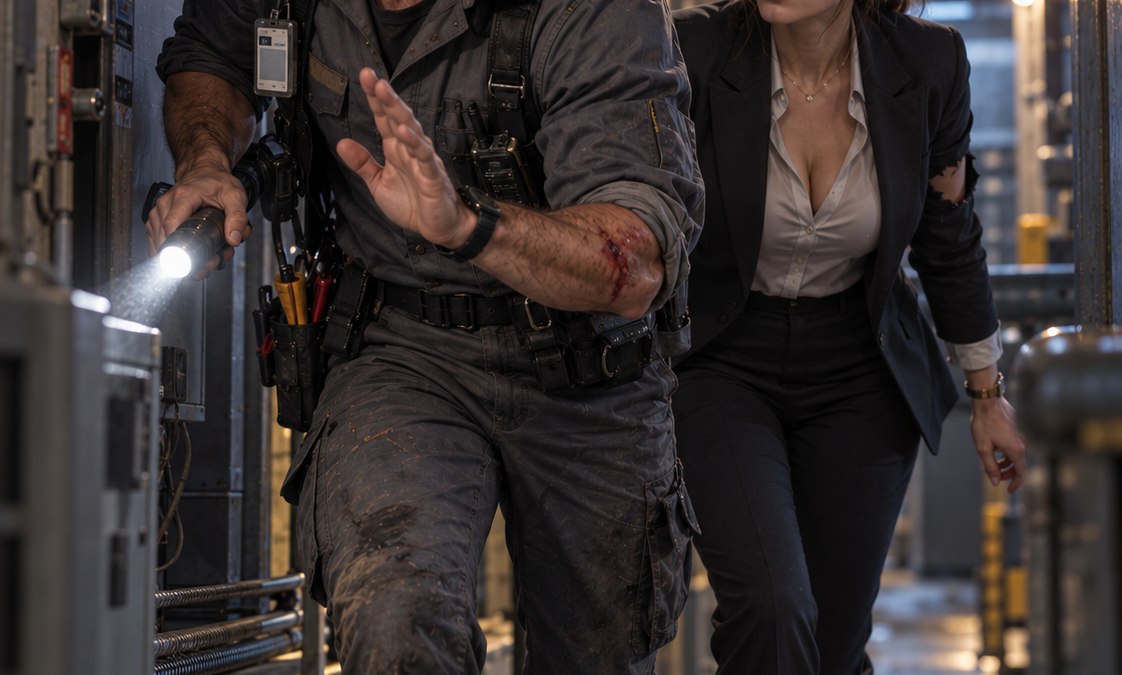
Part 3
Okafor looked at Ethan with an expression that was appraising without being unkind. Your transmitter signal is what put us in motion.
The photographs you sent to your facil’s inbox were forwarded to our field office by the IT security contact at 12:07.
We were already staging when the hardline call came in. She paused. Mr.Mr.Drake, the preliminary count from the subb indicates three disabled charges on the central structural column and one interrupted secondary detonation device.
Is that a complete accounting? To my knowledge, yes.
I swept the perimeter of S3 before I found the charges on the column.
The floor joints along the east wall should be physically inspected by a structural engineer before anyone occupies the basement levels, but I didn’t find any additional devices.
Okapor made a note. The charges are being assessed by disposal specialists now.
She looked at Adrien. Vincent Hail is in the executive conference room.
He’s been there since we arrived on this floor.
He hasn’t been detained yet.
We were waiting for you.
Adrienne held Okafor’s gaze for a moment.
Something passed across her face that wasn’t quite satisfaction and wasn’t quite grief.
The expression of someone arriving at the end of a conclusion they had been forming for a long time without enough evidence to act on it. Thank. Thank you.
She said, “We’ll need full statements from both of you.
The building will need to be cleared before employees can return. Structural assessment, environmental check for the smoke dispersal agents.
Complete security system audit.”
Okafor glanced at Ethan.
The security system audit is going to require someone with detailed knowledge of the building’s network infrastructure.
Your photographs indicate a sophisticated intercept setup. The tap is still on the secondary junction panel on floor 22.
Ethan said, “I left it in place to preserve the chain of evidence.
” The access log on this panel will show the spoofed credential entry from 4 days ago.
Okapor looked at him the way people occasionally looked at him when he said something that didn’t fit the laminated card on his chest.
He was familiar with the look.
He didn’t address it.
“I’ll need you available for the technical walkthrough,” she said.
“I’ll be available.”
Adrienne had already moved past Okaphor toward the conference room door.
Ethan followed, not because he had been asked to, but because the situation wasn’t finished, and he was still in it, and because whatever was going to happen in that conference room was something he had been building toward since 1:49 in the afternoon, and it felt wrong to stop at the door.
The conference room was large, the same room where the meridian signing had been staged, now without the delegates, the catering, or any of the energy that had occupied it before 2:00. The long table was still set with water glasses and document folders.
The unsigned contract was still there, sitting at Adrienne’s chair where she had left it.
Vincent Hail was seated at the far end of the table. He was 61 years old, and he looked at in a way that expensive grooming usually concealed, and today did not.
His jacket was off, folded over the chair beside him, and his tie was loosened, and he had the particular stillness of a man who has been sitting in a room for a long time, going through the stages of understanding how badly something has failed. He had his phone in front of him, screen dark, presumably at the instruction of the agents who had been with him, and his hands were flat on the table, and when the door opened, he looked up with eyes that moved from Okaphor to Adrien and then briefly to Ethan.
The look he gave Ethan lasted approximately 1 second before he looked away. In that s Ethan saw the moment of recognition, not of Ethan specifically, but of the category Ethan occupied, the thing Hail had failed to account for, the variable that had not been in the plan.
Adrien, Hail said. His voice was measured, the voice of a man who had decided that if he was going to sit in this room, he would sit in it with his posture intact.
I’m glad you’re safe.
Adrienne stood at the opposite end of the table.
She didn’t sit down.
Vincent.
She said his name with the same quality she’d used in the subb.
Accurate, not dramatic. How long have you been planning this?
I think that’s a conversation that should happen with legal counsel present.
I’m not asking for the record.
She pulled out the chair in front of her but didn’t sit.
Just rested her hand on the back of it.
I’m asking because I’d like to know.
Six years on this board. 6 years of whatever this is underneath it.
I’d like to know when it started.
Hail looked at her. Whatever calculation he was running resolved to something that looked almost like cander, the kind that surfaces when the practical case for concealment collapses.
The Meridian contract, he said, when you brought it to the board 14 months ago, I saw what it would do for the company’s valuation, and I saw that the person driving it was someone who was not going to share control easily.
He said it without venom, just assessment.
You’re very good at what you do, Adrien.
That was always going to be the problem. So, you decided to take it.
I decided to position myself to protect the company’s long-term interests with mercenaries and explosive charges in the foundation.
Hail said nothing. Adrienne pulled the chair out the rest of the way and sat down. She opened the unsigned contract and looked at the last page, the signature line, empty, her name printed beneath it in 12-point type.
She closed it again.
“You know what I keep thinking about?”
she said, “Is the employees who sheltered in conference rooms on the upper floors for 2 hours because the building’s security system went dark and they didn’t know if it was safe to leave.
people with families, with commutes, with ordinary lives that had nothing to do with board governance or billion-dollar contracts. She looked at him.
That’s what your plan actually looked like from the inside, Vincent.
Not a corporate maneuver. People hiding in conference rooms. Hail looked at the table.
Okafor stepped forward from the doorway.
Mr.Hail, I’m placing you under arrest.
She nodded to the agent beside her.
You’ll be read your rights and transported for processing.
Hail stood. He buttoned his jacket with the automatic gesture of a man whose physical habits had outlasted the context that formed them.
And then he walked to the door with the agent, and he didn’t look at Adrien again, and he didn’t look at Ethan at all.
The room was quieter after he left.
Adrien sat at the end of the table with her hand on the closed contract and didn’t move for a moment.
Ethan stood near the door.
He wasn’t sure if he should leave.
The situation had a quality of completion that felt like a natural exit point, but also a quality of unfinished that he couldn’t entirely define.
14 months, Adrienne said.
She wasn’t talking to him specifically, just saying it.
I’ve been running this company for 14 months, and the whole time she stopped, started again.
I had a board member, a security director, and an entire contracted security team working against me. And the person who actually kept this building standing was the maintenance technician whose photographs nobody bothered to look at.
Ethan thought about saying something, decided against it. Your daughter, Adrien said.
She looked up at him.
What’s her name?
He blinked.
Of everything she might have said, that was not what he’d prepared for.
Ka. How old? 8.
She’s expecting you at 450.
He checked his watch. It was 4:22.
He looked at the watch for a moment with the expression of a man doing math that wasn’t about numbers.
I’ll call the school, he said.
They have an afterare program until 6:00. Adrienne looked at him steadily. There was something in her expression that was not pity.
He would have noticed pity, but something adjacent to recognition, the specific recognition of one person seeing clearly what another person is actually made of. Go, she said.
There’s still the statement for director Aaphor.
I’ll tell her you’ll come in tomorrow morning first thing.
She picked up her phone, battery at 11%, she noted with a glance, and pulled up a contact. Go get your daughter.
He stood there for another moment with his tool belt and his scraped arm and his 43 viewings of a movie about a girl who turns into a bear. And something happened in his chest that was not quite emotion and not quite relief, but existed in the same neighborhood as both of them.
the secondary junction tap.
He said when the technical team does the audit, the tap was wired in parallel with the primary network, but there’s a secondary signal branch that routes through the elevator control system.
If they miss it, the elevator cab hesitation between 14 and 15 will continue and eventually cause a fault in the cab leveling mechanism. Adrienne stared at him. I noticed it on my first week, he said.
Never got a work order for it. She let out a breath that was almost not quite but almost a laugh.
I will tell them. He nodded, picked up his tool belt, walked to the door. Drake, he stopped.
The report you left on Marcus Webb’s desk this morning.
The grounding issue on circuit breaker 7, floor 18. Yes.
Is it urgent? He thought about it honestly.
Within the week, I’ll make sure it gets addressed.
He left. The corridor outside was still busy.
Agents moving, employees being escorted, the general organized complexity of a federal operation, processing a large space. Ethan moved through it the way he moved through everything. Neither pushing nor deferring, just occupying the path of least resistance with the economy of someone who had learned a long time ago that efficiency was its own form of invisibility.
At the elevator bank, a tactical officer was managing the manual override on one of the cabs, restoring the primary power routing from the emergency panel. Ethan stopped.
“The cab on the far left,” he said.
“When you restore the routing, you’ll want to run a leveling test before you put passengers in it.
There’s a known hesitation between 14 and 15 that I’ve been meaning to write up.”
The officer looked at him.
“You the maintenance tech?”
“Yes, I’ll flag it.”
Ethan took the stairs. He was in the lobby at 4:31, moving past the last federal checkpoint, his laminated key card doing its final useful work of the day when he heard his name.
He turned. Marcus Webb was standing near the lobby security desk with his clipboard and his expression of perpetual mild inconvenience, and for once the clipboard was hanging at his side rather than being actively wielded.
“Drake,” Marcus said.
He looked at the scrape on Ethan’s arm, at the tool belt, at the general state of a person who had been in a building for 9 hours and spent several of them in places buildings aren’t meant to have people.
Ethan waited. Marcus opened his mouth, closed it, tried again.
The report I got from it this morning about the photograph you sent.
It’s handled, Ethan said.
The federal people are saying. Marcus stopped. He looked at his clipboard back at Ethan.
They’re saying you were in the subb.
Yes. And the maintenance tunnels. Yes.
Marcus was quiet for a moment. He was a man who was not accustomed to not knowing what to say. And the unfamiliarity of it showed in a way that was almost sympathetic.
I should have. He stopped.
The report this morning. I should have.
It worked out, Ethan said. Because it had.
And because the alternative framing was not one he wanted to spend time in. Marcus nodded slowly. The grounding issue on 18.
I saw it on the log.
I’ll write it up properly tomorrow.
Take the day, Marcus said. Whatever the federal people need from you, take the day.
Ethan looked at him. This was by some margin the most considerate thing Marcus Webb had ever said to him in 3 years. And they both understood that the circumstances were sufficiently unusual that it would probably not establish a precedent.
“Thank you,” Ethan said.
He pushed through the lobby doors and into the late afternoon light. The city outside was doing what cities do at 4:30 on a weekday, moving, loud, completely indifferent to the specific drama that had just concluded inside one of its 52story towers.
There were news vans on the far side of the police perimeter that had been established around the building, cameras pointed at the entrance, reporters doing the preparatory work of telling a story they didn’t fully understand yet.
Ethan walked past all of it without breaking stride, his tool belt at his hip, his key card back in his chest pocket. He called the school from the sidewalk.
The afterare coordinator, a woman named Sandra, who had the patient exhaustion of someone who had been managing other people’s children for many years, answered on the second ring.
He explained briefly that he had been held at work and would be there before 6. Sandra said that was fine and that Ka had been asking every 15 minutes and had also drawn three pictures which she was keeping for him.
Tell her I’m coming, he said.
I’ll tell her.
He put the phone in his pocket and kept walking. The subway entrance was two blocks from the building and he took the stairs down without thinking about it.
The muscle memory of 3 years of commuting. The platform was crowded with the early wave of rush hour. People in workc clothes with tired faces and phones out.
the ordinary compressed humanity of a city moving itself from one place to another. He stood among them and felt the specific unremarkable quality of it, of being a man in a gray maintenance uniform on a subway platform, indistinguishable from anyone else, and found it, as he always did, genuinely settling.
On the train, he stood and held the overhead bar and watched the city pass in the window and thought about the building behind him, about the charges in the subb that were now being handled by people with the right equipment and the right authority. About Darius, who was somewhere in a federal processing facility working out what the next years of his life were going to look like. About Vincent Hail in a jacket he had buttoned out of habit.
about Adrien Kaine, who was probably still on the 41st floor with federal agents and a contract that was unsigned and a company that needed to be rebuilt from the security framework out. He thought about the 14 months she had been running Helix Vanguard and the specific exhaustion that would arrive later after the adrenaline cleared and the debrief ended and she finally sat down somewhere quiet and understood the full shape of what had been underneath her the whole time. He thought about the elevator between 14 and 15.
The way a building tells you what it needs if you listen. He got off at his stop.
Kora’s school was four blocks from the station, a low brick building with a chainlink fence around the playground and a mural on the east wall that had been painted by a graduating class several years ago and depicted, for reasons that had never been fully explained to Ethan’s satisfaction, a parade of animals carrying musical instruments.
Cora loved the mural. She had opinions about which animals were best at their instruments that she had shared with him in significant detail.
He signed in at the afterare desk at 5:48. Sandra handed him three drawings without comment. The first was a horse.
The second was also a horse, but this one had wings, which Sandra had apparently accepted without editorial input. The third was a gray figure with a tool belt and a large head disproportionate to its body that Ethan recognized as himself.
She was very specific about the belt,” Sandra said.
Ethan looked at the drawing.
The gray figure had a small smile that Kora had clearly labored over, visible, even at a size that couldn’t have been easy to render with a crayon.
He folded it carefully and put it in his breast pocket.
“Thank you,” he said.
Kora appeared from the back room at a pace that was not quite running because she had been told not to run inside and was making a genuine effort to comply while moving as fast as structurally possible without technically running.
She was small for eight with her mother’s eyes and Ethan’s stubborn jawline and hair that was currently escaping a braid in three different directions.
She stopped in front of him and looked at his arm.
“You have a scrape,” she said.
“I know.
A big one. It looks bigger than it is.
She looked at him with the specific evaluative intensity that 8-year-olds bring to the question of whether adults are telling them the truth. Then she appeared to decide.
Not that she fully believed him, but that she would accept the situation as presented for the time being. Sandra said you were held at work, she said. Yes.
What happened? He crouched down to her level, looked at her face, the tiredness around her eyes that meant she had pushed through her afternoon without a proper rest, the slight smear of what appeared to be red crayon on her left cheek, the braid that was doing its best.
There was a problem at the building, he said.
Something wasn’t working right.
I had to stay and fix it. Did you fix it?
He thought about S3. About the relay contact and the insulated pliers. about a device with a stop display reading 2631.
Yeah, he said I fixed it. She considered this.
Okay. She held up the drawing of the winged horse. I made this one for you, but I also made it for me, so we share it.
That seems fair. The wings are because sometimes horses want to fly.
That’s a good reason.
She took his hand, the one that wasn’t on the scraped arm, and they walked out of the school and down the sidewalk in the late afternoon light.
and she talked about the winged horse and about a disagreement she’d had with a friend about the correct way to draw a tail and about a game they’d played after lunch that she had won decisively.
And Ethan listened to all of it with the full attention that it deserved. The city was doing what cities always do, moving, loud, indifferent.
He was home by 6:15. He made dinner, pasta with the sauce from a jar that Kora preferred to the one from scratch, a preference he had initially tried to correct and eventually decided was not worth the effort. And they ate at the kitchen table, and Kora told him about the musical animal mural at school and which elephant she thought was playing the trumpet wrong.
And he told her the elephant was probably doing its best, and she accepted this with the measured skepticism of someone who expected more from elephants. After dinner, he washed the dishes, and she sat at the kitchen counter doing homework.
Long division, which she was approaching with the focused displeasure of someone who felt the entire system was unnecessarily complicated, and the kitchen was warm in the evening was quiet, and the distance between this table and the subb of a 52-story tower was approximately 11 mi, and felt, in all the ways that mattered,
considerably greater. His phone buzzed at 8:43 after Cora was in bed.
A number he didn’t recognize.
He answered, “Drake.”
Adrienne’s voice clear, not tired, though she must have been exhausted.
The specific non-tired quality of a person still running on something stronger than rest.
“I wanted to let you know.
” Meridian called at 7:00.
Caldwell personally. Ethan sat down at the kitchen table. The drawings were still there.
horse, winged horse, gray figure with tool belt. And they want to reschedule the signing next week if the building is cleared.
A pause.
He said, and I’m quoting directly, that he had never seen a corporate security response of that quality, and that they had complete confidence in Helix’s ability to protect sensitive operations.
Ethan looked at the drawing of himself that Kora had made, the one with the small, careful smile. He thought it was planned, he said.
Apparently, he thought the entire thing was a demonstration. Another pause, and in it, he could hear something that was almost amusement, but had too much weight behind it to be only that.
I didn’t correct him.
Probably wise. The building will be cleared for limited access by tomorrow afternoon. Structural assessment came back on the foundation.
The joint where the third charge was placed has minor surface damage, cosmetic only. The column is sound. She paused.
You were right about the placement. If those charges had fired, the junction failure would have been catastrophic.
He didn’t say anything to that.
Fitch gave a full statement this evening, she continued.
He confirmed Hail’s involvement going back 8 months.
Financial records, communications, the contractor coordination, all of it documented.
The federal prosecutor’s office is calling it one of the most thoroughly documented corporate sabotage cases they’ve seen.
She stopped. which I suppose is something. It is, he said, something.
Outside his kitchen window, the city was doing its nighttime version of itself. Quieter, the traffic sounds lower, the specific acoustic quality of a place settling without ever fully stopping.
He had lived in this apartment for 2 years, and he knew the sounds of it the way he knew the sounds of every space he occupied. The particular way the pipe spoke when the upstairs neighbor ran water.
the exact pitch of the elevator in the lobby, the interval between the traffic light changes on the corner. He knew buildings he always had.
“Get some sleep,” he said.
A brief pause.
“You, too, Drake.”
Her voice had something in it that was neither professional nor personal, but existed accurately in the space between.
“And tell Cora the winged horse concept has real merit.”
He looked at the drawing.
“She’ll be glad to hear it,” he said.
He ended the call. The kitchen was quiet. The drawings were on the table.
Outside the city moved the way it always moved, forward without ceremony, carrying everything inside it without distinction or comment, the way cities do. Ethan Drake sat at his kitchen table for a few minutes more, and then he turned off the light and went to bed. The building reopened on a Thursday.
not with ceremony.
Adrienne had specifically declined the suggestion from Helix’s communications team that a formal reopening event would be good for employee morale and media optics.
The suggestion had come from a junior PR coordinator who had not been in the building during the attack and therefore had a somewhat different relationship to the word ceremony than the people who had. Adrienne had listened to the pitch, thanked the coordinator for her thinking, and said no with the specific finality that ended conversations rather than pausing them. What happened instead was ordinary.
The security checkpoint in the lobby was staffed by a temporary contracted team, vetted through a process that Adrienne had personally reviewed, which was not how CEO involvement in contractor vetting typically worked, but which felt under the circumstances like the minimum appropriate level of attention. Employees badged in.
The elevators ran. People got coffee from the third floor kitchen and carried it to their desks and opened their laptops. and the building did what buildings are supposed to do, which is function without being noticed.
Ethan was at work by 7:00. The building had a backlog, 4 days of deferred maintenance during the federal assessment period, plus the specific damage from the operation itself.
smoke dispersal residue and three ventilation systems.
A camera housing on floor 38 that had been physically compromised by one of Darius’s team during their sweep.
The elevator cab on the far left of the executive bank that still needed its leveling test, and circuit breaker 7 on floor 18, which had been waiting patiently for someone to address its grounding issue for longer than it should have.
He had a work order for each of them generated by Marcus’ department the previous afternoon and he started with the elevator because it was the ones that affected the most people and because he had been thinking about it intermittently for 3 years.
The leveling test took 40 minutes and confirmed what he’d suspected.
The cab’s counterweight guide rail had a slight deflection at the 14 to 15 floor junction, the result of years of minor building settle that had gone uncompensated.
The fix was a guide rail shim adjustment. 35 minutes of work once the cab was locked out of service.
When he released the lockout and ran the test cycle, the elevator moved between 14 and 15 without hesitation for the first time.
And he didn’t actually know how long, longer than he’d been here.
He stood in the mechanical room and listened to it run. Then he moved on to the next work order. Marcus found him on floor 22 at 10:15, which was where Ethan was completing the camera housing replacement on 38.
He’d rerouted his morning to combine the camera job with a ventilation inspection on 22 that used the same access panel.
And Marcus stood in the maintenance corridor with his clipboard in a slightly different posture than usual. A posture that suggested the clipboard was being carried more out of habit than operational necessity.
Federal technical team finished their audit yesterday.
Marcus said, “Full report goes to Director Okafor and Miss Kaine.
They pulled the tap off the secondary junction and processed it for evidence.”
I know. They asked me to walk them through the panel configuration Tuesday morning.
Marcus nodded.
They also found a secondary relay you didn’t mention in your original report.
I found it during the walkthrough.
It was installed in a separate conduit that wasn’t part of the initial tap setup.
I think it was a backup monitoring line rather than part of the trigger architecture. I included it in my Tuesday statement.
Marcus looked at him. You found it during the walkthrough?
Yes. The Federal Technical team missed it on their initial sweep.
Ethan didn’t say anything to that.
Marcus looked at his clipboard at the wall back at Ethan.
I’m going to say something and I need you to just let me say it.
Okay. I should have looked at your photographs.
He said it without elaboration, without the cushioning language that people usually surround an acknowledgement like that with. Just the statement plain. I had them at 11:15.
I filed the thing and sent it up the chain and I didn’t look at them.
If I had looked at them, he stopped. It might not have changed anything given that Fitch was the end point, but I should have looked. Ethan held the camera housing in both hands and thought about what to say to that.
You didn’t know what you were looking at, he said finally.
Most people don’t.
You knew.
I’ve seen things like it before.
Marcus seemed to want to pursue that. The question of where and when and under what circumstances a maintenance technician develops familiarity with militarygrade network intercept devices and then seemed to decide correctly that this was not his question to ask. The afteraction summary is going to reference your role.
Marcus said, “The Federal Report.
I’ve already gotten three calls from reporters who somehow got my name as the facilities contact.
Don’t talk to them.”
“I wasn’t planning to.”
Marcus finally let the clipboard drop to his side.
Miss Kane’s office called my department this morning.
They want your personnel file updated to reflect.
And I’m quoting the email here.
Additional technical competencies and accommodation for crisis response. He looked at Ethan.
Do you know what that means practically? It means someone wrote an email. It means a pay adjustment, Drake, and a title review.
Ethan finished securing the camera housing and tested the mounting.
I’m a maintenance technician.
You might be something else now if you want to be. Ethan picked up his tool bag. Is the circuit breaker on 18 still on my list for this afternoon?
Marcus looked at him for a long moment.
The expression on his face was the specific expression of a man who has arrived at a conclusion that he doesn’t entirely know what to do with.
“Yes,” he said.
“It’s on your list.”
“Then I’ll see you tomorrow morning,” Ethan said and continued down the corridor.
The meeting with Adrien happened at 3:00 in her office on the 41st floor, which was the same office she had been standing in at 7:15 on the day of the attack, looking out at a city still gray with early light. She was at her desk when he arrived, and Priya, who had been found safe in a third-f floor conference room during the federal sweep, having sheltered there with a group of administrative staff after the smoke started, showed him in with an expression that was professionally neutral in a way that suggested it was working hard to be so.
The office looked the same as he imagined it always looked, clean, organized, the three tablets on the desk showing different data streams. The floor toseeiling windows framing the city in afternoon light.
Nothing about it telegraphed that the person sitting behind the desk had spent 2 hours in a subb or that the building they were in had been 47 minutes from a structural collapse that nobody else would have prevented. Adrienne looked up when he came in.
She looked rested in the way that people look rested when they have been running on structured sleep rather than genuine recovery, which was probably the best anyone could manage this week.
“Sit down,” she said.
He sat.
She had a folder on the desk that she didn’t open immediately.
She looked at him across the desk with the same quality of attention she had brought to the maintenance corridors and the subb ladder. Direct, not performing anything, just looking. I want to offer you a position, she said.
I heard from Marcus there was a title review.
What I’m offering is larger than that.
She opened the folder. Chief security officer, the title, the office, the executive authority, and a compensation package that I had HR put together based on market rate for equivalent positions in our sector. She turned the folder to face him.
He looked at the number on the top page.
That’s base salary.
Equity and benefits are on page two. Ethan looked at the page for a moment. Then he looked up.
“No,” he said.
She had expected this.
He could tell by the fact that her expression didn’t change.
“Tell me why,” she said.
He thought about how to say it accurately because accuracy mattered here.
“Not modesty, not performance, just the true reason.”
“I’m not a security director,” he said.
“I’m not a strategist or an executive.
I know how buildings work. I know how systems fail and how people move through spaces under pressure and where the gaps are between what a security plan says on paper and what actually happens when something goes wrong.
That’s a specific kind of knowledge.
It doesn’t come with a corner office.
Most of what a chief security officer does is exactly what you just described. The rest of it is meetings and budget presentations and managing a department of people who mostly resent being managed. He looked at her.
I’m not good at any of that.
Adrienne sat back slightly. She picked up a pen and turned it between her fingers, not nervously, just thinking with her hands, which he had noticed she did. Then what do you want?
He had thought about this, not in the abstract way that people think about what they want, the vague aspirational thinking that doesn’t have a specific shape, but the practical way.
the way he thought about circuit boards and load paths and the specific stress points in a system under pressure. The security rebuild, he said the structural assessment on the foundation identified three other areas of the subb level that have similar access vulnerabilities to the one that was exploited.
The secondary network junction on 22 isn’t the only one in the building.
There are four others that run on comparable architecture and could be compromised the same way. The maintenance tunnel network that I used to move through the building is also accessible to anyone with a facilities level credential.
And the credential system hasn’t been audited for inactive accounts in at least 18 months.
He paused. I want to fix those things. Not on paper.
Actually fix them. Adrien looked at him.
I want to work through the building the same way I’ve been working through it for 3 years.
He continued, systematically from the bottom up. every access point, every network junction, every credential pathway and physical vulnerability. I want to build a security architecture that starts with how buildings actually function rather than how security presentations say they function.
He stopped.
That’s the job I want.
She was quiet for a moment.
That’s also the job of a chief security officer, she said.
The chief security officer gets a title and a department and a seat at the executive table. I want the work without the rest of it.
My uniform, my tool belt, my floor access. Different pay scale if you think the work warrants it, but not an office, not a department, not a title that means people treat me differently than they did before. Why does that part matter to you?
It was a real question, not a rhetorical one. He had noticed that about her.
She asked real questions and then waited for real answers rather than filling the space herself. Because the thing that made Tuesday useful was that nobody knew who I was.
He said, “The mercenaries didn’t account for me because I was invisible to them.
I walked through that building for 3 years and fixed things and listened to systems and learned every inch of the infrastructure because that’s what the job required, not because I was trying to be a hero in reserve.
” He looked at the folder on the desk.
“The minute I become something with a title and a profile, I stop being useful in the same way.”
Adrienne looked at the folder, too. Then she closed it. I want to push back on one thing, she said.
Okay.
The invisibility you’re describing, it’s real, and I understand why you value it, but it also meant that on Tuesday morning, your photographs went to the bottom of a stack because nobody knew they should take you seriously.
Nobody looked at them. She held his gaze.
I don’t want a helix vanguard where the person who actually understands the building has to fight to be heard because nobody can see them.
He thought about Marcus in the corridor, the email that went unread. Torres at the lobby desk with the photograph sitting next to a halfeaten protein bar.
That’s fair, he said.
So, here’s what I’m actually proposing.
She pulled the folder back and turned to page three. independent security infrastructure consultant, not a department head, not an executive, a single person advisory role that reports directly to me with full building access and the authority to require action on any vulnerability assessment you submit.
Your workspace stays in the maintenance area because that’s where the work is.
Your compensation reflects the actual value of what you do.”
She pushed page three toward him. and your name is on the security briefing as the primary systems consultant, which means when something goes wrong, the people who need to know who to call can find you in under 30 seconds. Ethan looked at page three.
One condition, he said. She waited.
The work stays out of press releases.
I can’t promise that entirely.
The federal case against Hail and Fitch is going to generate coverage, and your role in Tuesday is part of the record. I understand that.
I mean going forward the security rebuilding work.
I don’t want it in company communications or external announcements.
It works better if the outcomes are visible and the process isn’t.
Adrien considered this. Agreed. She said on one condition of my own.
He waited. The elevator between 14 and 15.
If you find something like that again, something that’s been running wrong for years and nobody noticed, you tell me directly.
Not through the facility’s inbox.
He looked at her.
Something in his expression shifted in a way he wasn’t entirely in control of.
Not a smile, not quite, but adjacent.
“Deal,” he said.
She extended her hand across the desk. He shook it.
The Meridian contract signing happened the following Tuesday, exactly one week after the original ceremony date. There were no cameras, no media access, no catering beyond a table of coffee and water that Priya had organized.
The Meridian delegation came in through the regular lobby entrance, badged through the security checkpoint with visitor credentials that had been generated through a process Ethan had reviewed the night before, and took the elevator, the one that now ran smoothly between 14 and 15 to the 41st floor.
Caldwell, the silver-haired lead negotiator, shook Adrienne’s hand and said that Helix Vanguard had demonstrated in his 40 years of contract negotiation a level of operational resilience he had rarely encountered.
He said it with the sincere enthusiasm of a man who genuinely believed the building’s response to a coordinated mercenary attack had been a planned security demonstration.
Adrienne thanked him without correcting him. The contract was signed at 11:17 in the morning, $8.
4 billion.
the Meridian Group’s largest single infrastructure security contract in the company’s history.
Adrienne put her pen down on the table and looked at the signature for a moment, just a moment before Priya collected the documents for processing. Ethan was on floor 22 at 11:17, finishing the installation of an upgraded access panel on the secondary network junction, a hardened housing with a dual authentication latch and a tamper detection sensor that would flag to the security monitoring system within 4 seconds of unauthorized contact.
He was working alone, which was how he preferred it, with a portable speaker on the floor beside him playing a low-volume radio station that Kora had programmed into his phone because she had strong opinions about what he
listened to during work. She was not wrong about the music.
He had been forced to concede this. He finished the installation and tested the tamper sensor three times before he was satisfied with its response time. Then he photographed the completed installation from four angles and uploaded the images to the new documentation system he had set up over the weekend.
A straightforward digital log that kept a timestamped record of every access panel, network junction, and security component in the building cross- refferenced with maintenance history and vulnerability status. Not complicated, not expensive, just thorough.
He moved to the next work order. The investigation into Vincent Hail and Ronald Fitch proceeded through the federal system at the pace federal systems move, which is to say deliberately and without drama.
By the end of the first month, the indictments had been filed. Hail on six counts, including corporate conspiracy, obstruction, and criminal endangerment. Fitch on eight counts that additionally covered fraud and violations of his licensed security contractor status.
Four members of the Helix security team who had accepted payments to abandon their positions faced separate charges.
The prosecutors, who had described the evidentiary record as unusually comprehensive, indicated that the combination of Darius Cole’s cooperation agreement and the financial documentation recovered from Hail’s communications made the cases straightforward by the standards of corporate criminal proceedings, which were not a category known for simplicity.
Darius Cole received a cooperation agreement that the federal prosecutor described in a hearing Ethan did not attend as reflecting substantial assistance to the investigation and a demonstrated willingness to accept responsibility. He would serve time.
Ethan had known that was the likely outcome from the moment in S2 when Darius handed over the device.
He didn’t have strong feelings about it.
Not forgiveness, not its opposite, something more complicated and less named than either.
Darius had made choices over 11 years that had accumulated into a Tuesday afternoon in a subb, and the accounting for those choices was not Ethan’s to manage.
What he did do on a Thursday evening, 3 weeks after the attack, was write a letter, not to the court. He had no standing in the legal proceedings and no desire to acquire any to Darius directly, through the federal facility where he was held pending sentencing.
He wrote it by hand because that seemed right and because he was not a person who communicated important things by typing them. He wrote that he understood the one more contract logic.
He wrote that he had been closer to it himself than most people knew. He wrote that Darius had a 12-year-old son in Portland who would be 14 or 15 by the time the sentencing and appeals process resolved, which was not a good age, but was not an impossible age either.
He had known fathers who had come back from worse absences and rebuilt something real. He wrote that building something real was slower and less dramatic and more boring than any of the things they had both done in the years before, and that in his experience, the boring was the point rather than a drawback. He sealed the envelope and mailed it.
He didn’t know if Darius would read it.
He didn’t know if it mattered.
He had said what seemed true and accurate, and that was the thing he had control over. 3 months after the attack, Adrien called a companywide meeting in the Helix Vanguard atrium.
All 412 employees gathered in person or connected by internal video for the satellite offices. Ethan was not in the atrium.
I was on floor 34 running a diagnostic on the building’s fire suppression sensor network, which had been flagged in his audit as having three nodes with degraded response times that needed recalibration before the quarterly safety inspection.
He had the meeting
running on his phone propped against his tool bag because Priya had sent him a calendar invitation with the subject line, “Your attendance requested,” and a follow-up message that said, “Please, Ethan.”
He listened while he worked. Adrienne spoke for 11 minutes.
She talked about what had happened in the building on that Tuesday. Not the version that the press coverage had assembled from federal statements and corporate communications, but the actual version, the one that started with photographs nobody looked at and ended in a subb with a man in a gray maintenance uniform and a pair of insulated pliers. She was specific.
She named Fitch. She named Hail.
She described the security team’s departure from the executive floor in plain language that left no interpretive room.
And then she pulled up the security footage.
Ethan’s hands stopped moving.
He had known abstractly that the camera network had been offline during the blackout. What he had not known, what nobody had told him was that the backup camera system on the executive floor ran on an independent circuit and had continued recording throughout the 12-second blackout and everything that followed. That footage showed in the
flat amber glow of emergency lighting, four security contractors in Helix uniforms moving toward the stairwell while the smoke came in.
and it showed one person in a gray maintenance uniform moving in the opposite direction. He listened to the atrium go quiet. He kept his eyes on the sensor node he was recalibrating because the work was there and it needed doing regardless of what was happening on 34 floors below him and because he had been a person who moved toward problems rather than away from them for long enough that it was not the
remarkable thing to him that it apparently was to other people.
Adrienne said, “Every person who walked out of this building safely on that Tuesday afternoon owes that safety in some part to someone who had no obligation to stay, no authority to act, and no guarantee that anything he did would work.
He stayed anyway. He acted anyway. He fixed it anyway.
The atrium was very quiet.”
“His name is Ethan,” she said.
“He fixes things in this building.
If you see him, you don’t need to say anything to him because he will find it uncomfortable and will immediately find a reason to be somewhere else in the building.
Ethan looked at his phone. But I wanted you to know his name, she said. He set the phone face down on top of his tool bag.
He finished the sensor recalibration. The fourth node took longer than the others. The housing was older and the calibration port was slightly corroded, which required cleaning before the adjustment tool would seat properly.
He worked through it methodically, and when the node’s response time registered correctly on his diagnostic reader, he made a note in the documentation system and moved to the next one.
When the meeting ended and the atrium below him filled with the sound of people returning to their afternoon, Ethan Drake was on floor 34 doing what he had been doing for 3 years and what he would continue doing tomorrow and the day after that, listening to a building, hearing what it needed, and fixing the things that were broken.
He thought about what Adrienne
had said, not the part about him, that part he was putting somewhere he didn’t plan to revisit, but the part at the end of her remarks, which he had heard while his hands were on a sensor housing, and which had landed with the particular accuracy of something true.
She had said, “The most important person in any system is usually the one you don’t see, not because they’re hiding, because they’re working.
” He had thought, hearing it, about all the things that kept a building running.
the systems that functioned without announcement, the mechanisms that held weight without credit, the 10,000 small repairs that accumulated over years into the fact of a structure that stood and did what it was supposed to do. He had thought about how few people walking into an elevator or swiping a badge or looking out a window at a city that held itself together through 10 million invisible interdependencies ever thought about the specific human labor underneath all of it.
He thought about his own father, who had worked maintenance in a hospital for 31 years, and who Ethan had watched come home with his uniform the same color as Ethan’s own uniform, and who had never described his work as anything other than what needed doing.
His father had fixed the things that were broken in a building full of sick people, and had done it quietly and without recognition, and had come home each evening and made dinner and asked Ethan about his day. And the asking had been, looking back on it now, the thing that made everything else possible.
He understood that now in a way he hadn’t at 8 years old.
The way you understand things by arriving eventually on the same ground where someone else stood before you. He thought about Kora who is in school right now drawing horses and arguing about elephant musicianship and building the kind of ordinary childhood that was only ordinary because the things that could interrupt it were mostly held at bay by the accumulated effort of people nobody noticed. He thought about the specific weight of that, not his burden, but his purpose.
The thing that got him out of bed at 6:00 in the morning and into the building by 7.
The thing that made a circuit breaker’s grounding issue feel worth addressing carefully rather than cursorally.
The thing that made him press a transmitter at 149 instead of walking away from information that wasn’t his job to act on.
He didn’t think of himself as a hero.
The word had a shape that didn’t fit the experience.
The experience was cold concrete floors and the smell of machine oil and the specific anxiety of a relay contact that might complete a circuit if you moved wrong. It was not dramatic from the inside. It was just a series of problems that needed solving and a set of skills that happened to be available to solve them.
What he was was someone who showed up. That was the whole of it.
The rest was just details. He finished the fourth sensor node and moved to the fifth and last one, which was mounted near the ceiling of a maintenance corridor and required the step stool from his tool bag. He set it up, climbed it, and began the process again, cleaning the housing, seating the calibration tool, waiting for the diagnostic reader to register.
The corridor was empty and quiet and hummed with the low electrical presence of a building doing its work. on a rooftop.
Four weeks later, on an evening in October, when the city had its first real cold snap, and the light was going early and the wind had that quality of purpose that October wind gets, Ethan stood with Adrien Cain and looked at the skyline and said almost nothing for a long time, which was comfortable rather
than awkward because they had established somewhere in the maintenance tunnels of a building under siege that silence between them was a functional mode rather than a social failure. Adrienne had a coffee that was getting cold.
Ethan had his hands in his jacket pockets. The foundation assessment final report came in this morning.
She said, “The engineering firm is recommending a preventive reinforcement on the east loadbearing elements in the S2 level.
It’ll take about 3 weeks and requires partial closure of the parking structure.
I saw the draft.
They’re right about the east elements.
There’s also a drainage issue in the northwest corner of S3 that isn’t in their report.
I found standing water during my last inspection.
I’ll write it up.
Send it directly to the engineering firm.
I’ve added you to the project contact list.
Okay. The wind moved across the rooftop and the city held its noise below them and the lights were coming on in the buildings across the skyline, one window at a time, the particular way a city lights itself for evening.
Do you ever miss it? Adrienne asked.
He looked at the skyline. The military, he said.
Not necessarily. just the other version of this, the version where the stakes were always this high. He thought about it honestly, which was the only way he thought about things.
No, he said, and then because that wasn’t entirely complete.
I missed the people, some of them, the ones who were worth missing. He thought about Darius in S2 sitting on the floor with his hands on his knees, about a 12-year-old in Portland who was 14 months away from his father showing up.
But the work itself, the high stakes, the constant pressure, the idea that what you’re doing matters because people might die if you don’t.
He stopped. You can find that anywhere if you do the work right.
The stakes are always real.
They’re just quieter.
Adrienne looked at him. A grounding issue on circuit breaker 7, she said.
Exactly. She drank the cold coffee, made a face about it being cold.
Drank it anyway. Below them, 412 people had gone home to their families.
The building was settling into its nighttime self. Reduced load, lower lighting, the mechanical systems dialing back to their overnight configurations.
It breathed differently at night. Ethan had noticed that from his first week and had never lost the awareness of it. Go home, Drake, Adrien said.
Cora is going to have opinions about dinner. She always has opinions about dinner. Is that a problem?
He thought about the jar of pasta sauce in the cabinet and the horse drawings on the kitchen table and the braid that was always coming apart and the 43 viewings of a movie he now knew by heart.
“No,” he said.
“It’s not a problem.”
He left the rooftop. He took the elevator down, the one that now ran smoothly between 14 and 15, and walked through the lobby and badged out at the security checkpoint, and pushed through the front doors into the October cold, and the city received him the way it
always did, without comment, without ceremony, as one more person among millions moving through it at the end of an ordinary day. He walked to the subway.
He went home and the building stood behind him, solid and lit and full of the invisible work of a hundred systems that functioned because someone understood them. Holding everything inside it the way buildings are supposed to, quietly without being asked, without expecting to be thanked.
That was the job. It always had been.
—END—