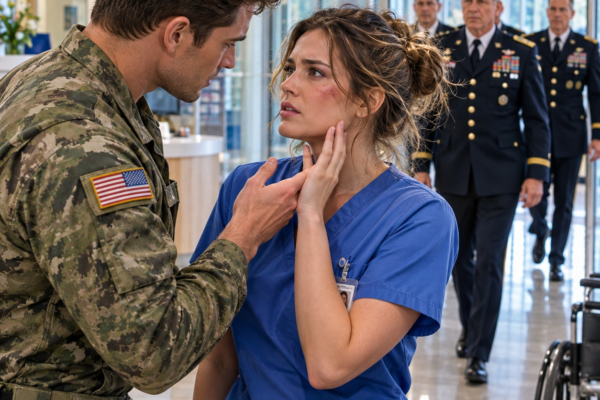
They Fired the Nurse He Assaulted—Then Her Secret Combat Medic Identity Silenced the Room (part 2)
Part 2
Vargas, you’re alive.
So are you. He looked at her with an expression that she could not entirely catalog.
It had too many layers to process in real time. Something like relief.
Something like 9 years of something that didn’t have a single clean name.
something like the specific expression of a person who has been carrying a particular weight and has just understood for the first time that they might be able to set it down.
He crossed the room in the careful way of a man who moves deliberately now and he sat in one of the chairs and she sat in the one across from him and Voss quietly left the room and closed the door which she registered and appreciated and didn’t look away from Theo to acknowledge.
They told me you were dead, he said. They told me the same about you.
I know, Boss explained. He was quiet for a moment, looking at his hands.
The left one had a visible tremor that came and went, which he noticed her noticing and didn’t try to hide or explain.
When did you find out I was alive? Today.
About 4 hours ago. He looked up.
Today? Yes.
And you’re here?
I’m here.
The room was quiet in the specific way of a place that absorbs a great many significant moments and has simply become accustomed to holding them. Theo looked at her with the same direct assessing attention. She remembered the TBI had not taken that whatever else it had changed and she found somewhat unexpectedly that the the familiarity of that look was difficult to absorb all at once.
You became a nurse, he said. I was always training for it. Medicine was always I was always going to do something in medicine.
The combat medic work was the thing I was built for, but the ER is the thing I chose. She paused.
You became a patient. A small dry sound from him.
Not quite a laugh, but adjacent to it, which was, she remembered now, exactly how Theo Vargas laughed.
I’ve been a lot of things since Kandahar.
Patient is the most recent one. He looked toward the window. I kept transmitting, by the way, after you just told me to.
I transmitted for 11 hours on a damaged radio with two broken ribs and a fractured femur, and I kept the signal going until someone answered.
She’d given him that order in the final minutes before the site went dark.
Keep transmitting until someone answers. Do you understand me? Keep the signal going.
and she had not known, had spent 9 years not knowing whether he’d heard her or whether it had mattered.
It worked, she said. It worked.
He met her eyes. You saved my life.
You saved your own life. I just told you what to do.
Mara, the name, not the call sign deliberate. You came back for me.
I know you did. They found your kit at the extraction point.
They found blood evidence for 9 years.
I thought you came back and didn’t make it.
She held his gaze. I came back.
The sight was gone.
I don’t know what happened to the blood evidence.
I was injured in the egress. Not severely, but enough. I made it out through a secondary route and then things got complicated.
And then I was in Germany and then I was told my unit was largely gone and I she stopped organized. I made decisions about who Mara Sutton was going to be going forward. Nursing was part of that.
The ER was part of that. She paused.
It didn’t occur to me that you survived.
I was told one person survived and was not told who. They had reasons.
I’m sure they did.
He was quiet for a moment. Then are you angry? She thought about it honestly.
Not at you. Not at Voss. The institutional reasons for information management in those circumstances are I understand them.
Do I think someone could have found a way to tell me at some point in 9 years that you were alive? Yes. Am I going to spend significant time on that right now?
She looked at him directly. No. Something in his expression shifted slightly and easing barely visible.
Voss said, “Something happened at your hospital this morning.
A physician assaulted me. The administrator suspended me.
Then Voss walked in and now badge is back. Formal complaints been filed.
The physician’s future is currently a legal question.
She said it plainly.
I didn’t hit him.
I could have. I chose not to. Theo looked at her for a long moment.
Yeah.
He said, “That sounds exactly like you.”
She stayed for 3 hours.
They talked in the way of two people who have a great deal of information to exchange and have agreed without saying so to take it in stages because the full weight of 9 years can’t be processed in an afternoon and trying to force it would just create a different kind of damage.
Theo told her about the recovery in broad strokes.
Germany, Walter Reed, the gradual difficult work of reclaiming function, the TBI squle that had taken longest to stabilize, the 14 months in Portland working on mobility and independence, and the particular cognitive recalbration of learning what he could and couldn’t trust his brain to do reliably.
He told it without self-pity, which she recognized as a choice rather than an absence of feeling the same choice she’d watched him make under fire.
The decision to stay functional by staying factual to deal with what was rather than what should have been. She told him about Bell Marsh, about the three years at Harrove Memorial, about the slow accretion of a civilian life that was genuinely hers, even if had been built part on the act of leaving something else behind. When Voss knocked and entered at the 3-hour mark, both of them had moved from the chairs Theo to the small couch along the wall.
Mara to the floor with her back against the bed frame, which was where she always ended up in rooms that didn’t have enough seating.
a habit Theo apparently remembered because he’d simply handed her a pillow from the without comment.
Voss looked at them both and had the expression of a man and had the expression of a man who had hoped for specific outcome and was seeing it was allowing himself quietly to register that there’s something we need to discuss.
He said both of you together. Mara looked at him now.
It’s better now than later.
She stood. Theo shifted on the couch and looked at Voss with the attentive patience of a man who had been in enough highstakes briefings to know that the preamble was telling. Voss sat in one of the consultation chairs.
He looked at Mara. The the formal complaint against Ror was filed this afternoon.
State medical board and hospital board of directors both. He paused.
What the board review revealed in the preliminary assessment is that this wasn’t the first incident.
Mara went still. There are three prior documented complaints against ROR involving physical or verbal conduct toward nursing staff. All three were administratively resolved without formal escalation.
One involved a patient, a patient complaint about Ror’s conduct during a procedure which was recorded by a charge nurse and then he paused.
Specifically, the recording disappeared from the file before review. The room was quiet.
Holt, she said. Holt signed off on the administrative resolutions for all three prior complaints.
There’s no direct evidence yet that he destroyed or removed the recording, but the board is asking questions and the hospital’s legal counsel is he chose his next word with some care.
Uncomfortable, Theo said, “What happens to them?”
Ror is suspended pending formal investigation. The assault footage from this morning is unambiguous, and the prior complaint pattern makes it significantly worse.
He’s looking at a state board proceeding and potentially criminal referral for the this morning incident.
He looked at Mara.
Holt’s position is less clear legally, but probably untenable institutionally.
The board convenes an emergency session tomorrow morning. Mara absorbed all of this.
She was sitting in a chair now, elbows on knees, looking at the floor. Somewhere in the building, someone was being called to a room and the PA system announced it in the flat specific tone of institutional urgency. Three prior complaints, she said.
Three, and they all went away. They did, she looked up.
Who filed them? Voss met her eyes.
Two nurses, one physician assistant. All three are still employed at Harrove Memorial.
She thought about that about the specific weight of working in a place where you’d filed a complaint that had been quietly disappeared and then continued working there because the alternative was leaving and the institution had successfully communicated that leaving was the only option you had.
I want to
talk to them, she said.
The board’s investigators will want to do that first.
After the investigators, I want to talk to them. Voss looked at her for a moment.
That’s your choice.
Yes, she said. It is.
Theo had been quiet through this, which she recognized as the operational version of Theo listening, storing, processing. He had always been better at strategic patience than she was.
Her instinct was forward motion, and his was accumulation. They had been in the field complimentary in that specific way.
He said, “What happens to Mara’s position?
Her termination is voided. Her reinstatement is formal as of this morning.
He paused. But there are going to be conversations.
And I’ve spoken with the hospital board chair.
There there’s going to be a review of the department culture that produced this morning, which is going to require witnesses, people who were present.
I was present, Marad. So were six interns and four nurses.
And the security footage. He paused. and Roy Decker, whose testimony about being ignored for 2 hours while bleeding is going to be significant.
She thought about Roy back at Harrove, his sutures done and his X-rays processed, sitting in the care of a system that had failed him twice this morning and was now under the pressure of a rear admiral and a formal investigation attempting to correct course.
She’d checked his X-ray results before leaving two fractured ribs, neither displaced, which was genuinely the best version of that outcome.
He’d been admitted for overnight observation and pain management.
There’s one more thing, Voss said.
Both of them looked at him. He was quiet for a moment in the particular way of someone organizing something they know is going to land heavily.
I had a conversation this afternoon, he said with the commanding officer of the Army Medical Center in Cattle.
We’ve been developing a program, a formal curriculum for special operations combat medic training, drawing on post-operation debrief data and clinical outcome analysis from the past decade of conflicts.
He paused.
We’ve been trying to find someone to lead the clinical development component, someone who has the field experience to understand what the gaps are and the medical credentials to translate that into trainable protocols.
Mara looked at him.
I’m not leaving the ER, she said.
I’m not asking you to.
You’re about to ask me something.
I’m asking you to consider a consultation role part-time advisory.
The curriculum development happens largely on paper and in workshops.
It doesn’t require you to return to full-time military service.
It doesn’t require you to relocate.
He held her eyes. It requires you to be willing to tell people what you know.
What you’ve learned, what the difference is between a person who treats wounds in a controlled environment and a person who treats wounds while someone is actively trying to kill them.
The room was quiet.
Theoa was looking at her with the specific expression of someone who is choosing not to say what they’re thinking, which she could read clearly enough from 11 years of working beside him.
What?
She said, “Nothing, Theo.
” He met her eyes.
“I think you should do it.”
He said it simply without ornamentation. Not because Voss is asking.
because you’ve been carrying what you know in the ER by yourself for 3 years and nobody there has understood what they had.
Somebody should understand what they have. She looked at the fake plant in the corner at the window at her hands.
There were things she’d learned in Kandahar that she had never written down, never formally debriefed, never given to any curriculum or training system because the debriefing process had been interrupted by the fact that she was supposed to be dead.
There were decisions she’d made in the field about triage sequencing, about trauma management under fire, about the specific cognitive demands of keeping your clinical judgment intact when your body is running on adrenaline and fear that she had thought about many times in the ER.
And that had more than once made
the difference between a patient who made it and a patient who didn’t.
She had kept it to herself because it was hers, because it was the only part of that version of herself that she’d carried forward intact.
“I’ll think about it,” she said.
“That’s all I asked,” Voss said.
She stood, looked at Theo.
He looked back at her with that same direct assessing attention unchanged essentially by nine injury and and 14 months of rehabilitation which was the thing that surprised her most and also surprised her least because some qualities are structural and Theo’s attention had always been one of those.
I’ll come back, she said.
I know, he said. She believed that he did.
She was almost at the door when her phone buzzed. the Hard Grove memorial number, the main hospital line, not a personal number, which meant someone had looked up her cell from the personnel file, she answered.
It was Priya, the intern from that morning, the one who had said, “Clearly and on the record, doctor.”
Rorbed nurse Sutton. Her voice was steady, but there was something underneath it.
Mara, I don’t know if I should be calling you directly.
I didn’t know who else to call.
What happened? Ror came back into the department 20 minutes ago. He was told he was suspended, but he a pause.
He told the charge nurse he needed to retrieve personal items from his office and then he went to the secondary nursing station and pulled files, patient files, and the charge nurse tried to stop him and he Mara’s hand tightened on the phone.
He grabbed her. Priya said different nurse, same thing in front of everyone.
And now she’s in the supply closet and she won’t come out and I don’t know what to do.
Mara was already moving toward the door.
Don’t do anything, she said.
Don’t let anyone touch those files he pulled.
Call security and tell them to secure his office.
I’m on my way.
She looked back at Voss, who had stood when she started moving and was already reading her expression. He went back to the department, she said. He grabbed another nurse.
He pulled files.
Vos’s face changed in a way that Mara had not seen from him in two days.
Something cold and specific and final moving beneath the surface of his composure. The expression of a man who has extended a very clear warning and watched it be disregarded.
Peterson, he said. Peterson was already at the door.
Theo Vargas looked at Mara from the couch with the expression she remembered from Kandahar, the look he got when a situation had just escalated past the point of planning and into the territory of response. When the options had narrowed and the decision had been made, and all that remained was execution. Go, he said, she went.
The elevator took 14 seconds, which she counted. In the SUV, boss made two calls.
One to the hospital board chair, one to someone she couldn’t identify from the half of the conversation she could hear, but whose response, audible even from the back seat, had the particular quality of institutional un authority snapping to attention.
53 minutes back to Bell Marsh, Peterson did it in 41. The ambulance bay at Harrove Memorial was lit up.
Not emergency lit, not yet.
but the specific heightened activity of a place that knows something has gone wrong and hasn’t finished determining how wrong.
Two security officers she recognized were near the ambulance entrance. The charge nurse from the evening shift was outside which was wrong.
Charge nurses don’t leave the floor except under pressure.
Mara got out of the SUV before it fully stopped.
She went through the ambulance bay doors and into the ER and the first thing she saw was Priya standing near the nurse’s station with her arms crossed tasked across her chest and her face showing the specific expression of a person maintaining composure through significant effort.
The second thing she saw was the file folders on the secondary nursing station. Five of them pulled and stacked in a way that was not the way files get pulled for clinical reasons. The third thing she saw was Callum Ror standing at the end of the hallway near his office door on the phone, speaking in the low urgent tone of a managing a problem he created.
He looked up when she walked in.
For a moment he looked at her the way he’d looked at her that morning, the automatic recalibration of a man who was used to people moving out of his way.
Then something else moved through his expression because Voss had just come through the doors behind her and um behind Voss was Peterson and the hospital board chair’s personal assistant had apparently called ahead because Bernard Hol was already um walking down the hallway from the administrative wing with the expression of a man who has run.
Out of versions of
this situation that he can manage, Ror lowered his phone. Dr.Ror, Mara said, and her voice was exactly what it had been at 6:00 in the morning.
Calm, direct, containing nothing that wasn’t necessary.
Step away from your office door.
He didn’t move.
The files you removed from the station, she continued, are going back where you found them.
The charge nurse you assaulted has already given a statement to the security officer, and I’m told she did it from in inside the supply closet because that was the safest place available to her.
which is a sentence I shouldn’t be saying about anywhere in this building.
Ror’s jaw was tight.
You don’t have authority in this department right now.
My badge was reinstated at 9:47 this morning, which you would know if you’d been present for the conversation about it rather than sitting in the lounge.
She looked at him directly. Step away from the door.
Something moved in his face that she couldn’t name precisely.
Not fear, not quite. But the thing that lives next to fear, when a person who has operated without consequence for a long time begins to understand that the consequences have arrived and are not leaving, he took one step back.
Voss moved past Mara toward Hol, and whatever he said was quiet enough that she couldn’t hear it from where she stood.
But Hol went pale in a way that said the content was not ambiguous.
Priya appeared at Mara’s elbow.
The nurse in the supply closet is asking for you specifically. Which one is it?
Sandra Quan. Third year.
She filed one of the previous complaints. Priya paused. The one that disappeared from the file.
Mara closed her eyes for exactly one second. Then she opened them.
Take me to her. They walked past Ror.
Mara didn’t look at him.
She had looked at him enough for one day. The supply closet was at the end of the secondary corridor and the door was closed from the inside. And when Mara knocked and said her name, there was a pause and then the lock turned.
Sandra Quan Sandra Kwan was 34, Filipino American, with dark eyes that had been crying recently and were now doing the determined work of not crying anymore. She was she was sitting on an overturned supply crate with her back against the shelving, arms around her knees, wearing scrubs that showed she was 3 hours into a shift that had just been significantly derailed.
She looked at Mara with an expression that Mara recognized she had seen it in mirrors at certain specific points in the past 9 years.
the expression of a person who did the right thing and was punished for it and is now doing the right thing again and isn’t certain yet whether this time will be different.
I filed a complaint 18 months ago. Sandra said her voice was steady, not calm steady.
There’s a difference.
He grabbed my wrist during an argument about a patient transfer order. I documented it.
I filed it through HR. She paused. 3 weeks later, I was told the complaint had been reviewed and no evidence of misconduct was found.
“Your original documentation,” Mara said.
“Did you keep a copy?”
Sandra looked at her for a long moment.
Then she reached into the pocket of her scrubs and produced a folded paper, a photocopy slightly worn at the edges from being carried in the specific way that people carry things they don’t trust institutions to hold.
Mara took it, held it carefully.
You’ve you’ve been carrying this for 18 months, she said.
I didn’t know what else to do with it.
Outside the supply closet, she could hear the movement and voices of a department in the process of being fundamentally altered Voss’s voice somewhere.
The particular administrative commotion of people who are being held accountable in real time and are not accustomed to it.
Mara looked at Sandra Kwan’s sitting on her supply crate with her arms around her knees and her evidence in someone else’s hands for the first time in a year and a half.
You’re not alone in this anymore, Mara said.
I need you to know that before anything else. Sand Sandra looked at her, the specific careful look of someone who has been told something they want to believe and has not yet decided whether to let themselves believe it. How many others?
She asked. Mara thought of the two other complaints Voss had mentioned of the charge nurse with a statement in progress of Priya who had said the name out loud in the ER this morning when nobody else would. She handed the folded paper back to Sandra.
Keep this.
You’ll need it when the investigators ask.
She stood, opened the supply closet door.
Callum Ror was no longer in the hallway, which should have been a relief, but wasn’t because Mara heard a voice she recognized coming from the direction of the parking garage stairwell’s voice.
Low and urgent and sharp in the way of a man making a phone call he believes is private and she couldn’t hear the content, but she heard two words clearly enough, the recording.
She went still. Voss was 20 ft away.
She caught his eye. He crossed to her in five steps.
The prior complaint, she said quietly. The one with the recording that disappeared from the file.
He’s on the phone.
He said the recording. Voss looked at her for one second.
Then at Peterson, “Get on that stairwell,” he said.
Peterson moved and Mara stood in the hallway of the ER she had worked in for 3 years.
under the lights that were still flickering because the work order still hadn’t been fulfilled and felt the specific sensation of a situation.
Arriving at its pivot point, the moment when everything that has been building finally has enough weight to determine which way it falls.
She just didn’t know yet exactly what Rurk had said or to whom or what the recording contained.
But she knew with the particular certainty of a person who had learned to trust certain kinds of internal signals in certain kinds of situations that what she was about to find out I thought was going to change everything. Peterson came back 4 minutes later.
He didn’t say anything when he returned to the hallway.
He looked at Voss with the specific economy of someone who has been trained to communicate significant information in the smallest possible space.
And what his face communicated was enough that Voss said simply, “Where is he?”
“Parking garage level two.”
He ended the call before I could get close enough to hear content, but I got a partial on the number. He handed Voss a folded notepad page.
Landline local exchange. Voss looked at it.
Something shifted in his expression. Not surprise exactly, but recognition, which in some ways was worse.
“That’s the hospital’s legal council,” he said.
Mara looked at him.
He called the hospital’s own lawyer, she said.
“The hospital’s legal council is a firm.
They represent the institution, not individual physicians.”
He folded the paper carefully, which means if Ror is calling them about a recording, he either thinks they’ll um protect him because protecting him protects the hospital or he knows something about that firm’s prior involvement in the complaint resolutions that makes him believe they’re already compromised in this.
The hallway was quiet for a moment, except for the background noise of a department trying to function normally under conditions that were not normal. Both of those things can be true at the same time, Mara said. Yes, Voss said.
They can. She thought about what she knew about the prior complaints. Three of them all administratively resolved without escalation.
Holt signing off on each one, a recording that disappeared. a legal firm that had presumably been involved in drafting whatever language the administrative resolutions used, which would have been the language of institutional protection, carefully worded to be technically accurate and substantively evasive. How long has the firm represented the hospital?
She asked.
I don’t know.
The board chair would. Can you ask him now?
Voss was already reaching for his phone. While he made the call, Mara walked back towards the secondary nursing station.
The five files Ror had pulled were still there, stacked in the way she’d seen them from across the room.
She didn’t touch them.
They were potential evidence now, and touching them without documentation was the kind of mistake that that that created problems later, but she stood close enough to read the tab labels.
They were patient files, specific patients, five names she recognized because she’d worked this department for 3 years and she’d treated all of them at some point.
What she couldn’t immediately determine was why these five specifically, what connected them?
Priya appeared at her elbow again, which Mara was beginning to understand was simply how Priya understand how Priya operated. She arrived at the relevant moment with relevant information, and she did it quietly, which was a quality that Mara suspected would serve her very well if she survived residency.
“I looked up those patient files in the system,” Priya said while he was pulling the physical copies.
And all five have documented complaints in their patient records, not staff complaints, patient complaints about doctor ROR, specifically bedside, manner, procedure explanation, consent documentation. She paused. All five complaints were closed with administrative notation.
No follow-up action recorded. Mara looked at the stack of files.
He wasn’t pulling them to take evidence.
He was pulling them to see what was in them or to remove what was in them before anyone else looked. Were you able to screenshot the digital records? Priya held up her phone sent to my personal email before he got the physical files off the shelf.
Mara looked at her for a moment.
Pria’s 26 years old.
Fu was 26 years and 3 months into her residency and was currently standing in a hospital corridor holding digital evidence.
she’d had the presence of mind to secure before anyone thought to tell her to.
While the department around her processed an ongoing institutional crisis that that she’d been part of triggering by saying a true thing out loud at 6:00 in the morning.
You did well today, Mara said.
Priya’s expression flickered.
Not pride exactly, more the specific look of someone who did what they thought was right and is only now beginning to understand the full weight of what they did.
I don’t know how much trouble I’m in.
You’re not in any trouble.
Dr.Ror is Dr.Ror’s trouble is exclusively his own.
She met Priya’s eyes directly.
You told the truth in front of witnesses.
That’s all you did.
Send that email to the hospital board chair’s office and copy Admiral Voss’s assistant.
I’ll get you the address.
Priya nodded, the careful nod of someone filing an instruction precisely because they don’t trust themselves to remember it later under stress.
Voss finished his call and crossed back to Mara. The legal firm has represented Harrove Memorial for 11 years. The partner who handles their hospital compliance work has been the same individual the entire time a man named Gerald Fitch.
Hol went to law school with Fitch. There it was not complicated in the end. These things rarely were when you finally got the whole shape of them.
Holton Fitch, a relationship that predated the institution, a convenient arrangement the person designated to protect the hospital’s legal interests, had a personal reason to protect Hol specifically, which meant the complaints that went through Hol went to Fitch, and Fitch’s job became making them disappear in ways that were technically defensible.
the recording that went missing.
She said if it went missing through the legal process, then Fitch’s firm had access to it and Ror just called Fitch.
Voss was quiet for a moment. The board chair is convening an emergency session tonight. Not tomorrow morning tonight.
He called me back while I was on with him and said, “Rork returning to the department after suspension and the second assault on Sandra Quan seat.
” He paused.
That changed the timeline. Where is Ror now?
Security has him in the administrative conference room.
He’s not under arrest.
That’s a police matter.
And the Bell Marsh PD has been notified, but he’s not leaving the building until the board representative arrives.
She nodded slowly. Thought about Sandra Quan, who was no longer in the supply closet.
She’d come out 20 minutes ago.
and Spur and was now was now Spart now sitting at the nurse’s station writing her statement in the specific careful handwriting of someone who understands this document matters thought about Roy Decker two floors up in an overnight bed his ribs wrapped his sutures clean resting in a building that had tried to ignore him this morning and was now under pressure doing the work it should have done from the beginning thought about Theo Vargas in Portland sitting on
a couch in a rehabilitation center alive.
There was a lot to hold. She was holding it.
The Bell Marsh PD arrived at 6:47 p.m.Two officers, plain planes closed detectives, which meant someone had already made a determination about the category of the incident before they walked through the door. Detective Anna Reyes led was 40 years old with short dark hair and the particular economy of movement that Mara had noticed in a certain type of experienced investigator.
Nothing wasted, everything deliberate. Her partner, a younger man named Ferris, who said almost nothing the entire time, appeared to function primarily as witness and notetaker, which Mara suspected was a deliberate division of labor. Reyes spent 40 minutes in the administrative conference room with Ror.
Mara didn’t hear what was said.
She wasn’t supposed to.
She sat at the secondary nursing station and finished the chart documentation she’d fallen behind on because the department didn’t stop needing documentation because its surgeons had assaulted two staff members in one day and because the act of doing the ordinary work of the job was the thing that kept her functional kept her functional when everything else was moving.
When Reyes came out, she found Mara nurse Sutton. She had a notepad, not a digital device, actual paper, which Mara noted.
I’d like your account of the incident this morning, the first incident.
So Mara gave it the same way she’d given it to Voss in the parking lot.
Sequenced, specific, factual, without editorializing. What happened, in what order, involving whom, with what immediate outcome?
Reyes listened without interrupting, wrote steadily, and asked three clarifying questions at the end that were precise enough to tell Mara she’d been paying
close attention.
The security footage, Reyes said, “You’ve seen it.”
Admiral Voss and I reviewed it this afternoon some afternoon.
I’ll need a copy from the hospital.
Is Is there anyone likely to obstruct that request? Mara thought about Bernard Holt, who had been largely invisible for the past two hours, which was its own kind of information.
I’d make that request through the board chair’s office rather than hospital administration.
Reyes wrote something.
The second incident this evening, the charge nurse, Sandra Quan, she’s at the nurse’s station.
She has a written statement and a photo and a photocopy of a complaint she filed 18 months ago that was subsequently removed from the institutional record. Reyes looked up from her notepad. She has documentation of the original complaint in her scrubs pocket.
A beat. Okay.
Reyes closed the notepad. Dr.Ror is not under arrest tonight. I want to be clear about that because these situations can move faster than the paperwork supports and I prefer not to create problems down the line, but he will be asked to surrender his passport and he will be receiving a formal notice to appear.
She paused.
Based on what I’ve seen so far, I expect charges to be filed within 72 hours.
The recording, Mara said, the one that went missing from the file.
Ray’s expression didn’t change exactly, but her attention sharpened in a visible way.
What recording? Mara explained the prior complaint.
The notation in the file referencing an audio recording made by a charge nurse. The subsequent disappearance of that recording before the administrative review.
Ror’s phone call from the parking garage to Gerald Fitch.
Reyes wrote for longer this time. The law firm, she said.
Hol and the senior compliance partner went to law school together. She stopped started again.
That’s a separate investigative thread.
Yes, you understand.
I can’t make promise about where that goes.
I’m not asking for promises.
I’m giving you information.
Reyes looked at her for a moment with a specific evaluating look.
The look of someone who is revising upward their assessment of who they’re talking to.
What’s your background, Nurse Sutton?
before the ER. Military medicine.
How long? Long enough.
Reyes held her gaze for another second, then nodded once with the specific nod of someone who has decided that the additional information available to them is sufficient.
I’ll need a formal written statement from you tonight, if possible.
I’ll have it ready in an hour.
The board met at 8 p in the hospital’s main conference room on the fourth floor, a room that Mara had walked past many times without ever being inside.
It had the look of a room that was used for significant decisions and knew it good chairs, a long table, the specific acoustic quality of a space designed to hold serious conversations without echoing. She was not in the room for the meeting itself.
She was in the hallway outside it with Voss for the first 40 minutes while the board reviewed the footage and the documentation and whatever Hol had said when they questioned him, which she wasn’t privy to.
At 8:43 p.m., the door opened and the board chair, a tall woman in her 60s named Doctor Patricia Oay, who had the bearing of someone who had made difficult institutional decisions for long enough that the difficulty no longer surprised her, but hadn’t stopped mattering, looked into the hallway.
Nurse Sutton, please come in. She went in.
The board was seven people. They looked at her with the particular collective attention of a group that has been reviewing a situation for 40 minutes and is now looking at the person at the center of it. She had been in rooms like this before under different circumstances and she understood that what the room required from her was the same thing it had always required.
Clarity, economy, and the specific kind of stillness that communicates that the person in front of you is not going to be managed. Dr.Oi spoke first.
We’ve reviewed the security footage from this morning and from this evening.
We’ve reviewed the prior complaint files.
We’ve spoken with Mr.Holt.
She paused.
I want to ask you directly, is there anything in your experience over the past 3 years at this institution that didn’t make it into a formal complaint or documentation that you believe is relevant to what this board needs to understand?
Mara thought about it honestly. That was the thing she could have answered quickly. But honesty required the moment of actual consideration rather than the performance of it.
There are patterns I noticed that I attributed to personality and hierarchy rather than misconduct because there was no single incident significant enough for me to formally document. She paused.
In retrospect, I think the pattern itself was significant. The way vulnerable patients, homeless, uninsured, elderly, non-English-speaking were systematically deprioritized in doctor.
ROR’s clinical decisions, not always, not in ways that were individually indefensible, but consistently enough to constitute a pattern that someone should have been watching for.
Did you report the pattern?
No, I didn’t have the framework for it until today.
And today I was occupied with not being assaulted and then being fired and then being reinstated. She said it plainly without edge.
I’m reporting it now.
Dr.Oi wrote something. Then she looked up.
Mr.Holt has submitted his resignation. Effective immediately. The room was quiet for a moment.
The board will be issuing a formal referral to the Oregon State Medical Board regarding Doctor Ror which will accompany the police investigation rather than proceed or follow it. He is suspended without pay with immediate effect pending the outcome of both proceedings. She paused.
Your reinstatement is confirmed and a formal letter will be in your personnel file by 9A m tomorrow. The board wishes me to express that what happened to you this morning was unacceptable, that the institutional response to it was insufficient, and that the procedures that allowed that response will be reviewed and reformed.
” She held Mara’s gaze.
Those aren’t words.
There will be an external review of our complaint handling procedures conducted by an independent firm, and the results will be made public.
Sandra Quan’s complaint from 18 months ago, Mara said, “And the two others that were administratively resolved, those nurses should receive formal acknowledgement that their complaints were mis mishandled.”
Agreed. And the patient complaints in those five files, ROR, pulled tonight. Those patients should be contacted.
A brief pause.
That’s more complex legally.
I understand it’s complex.
I’m noting that it needs to happen.
She didn’t soften it.
Patients who complained about Ror’s conduct and had those complaints buried deserved to know that someone eventually took it seriously.
Dr.Oi looked at her for a long moment.
We’ll address it.
Mara nodded. She stood.
I have a statement to finish for Detective Reyes. She left the room. In the hallway, Voss fell into step beside her without saying anything.
They walked the length of the corridor before he spoke. You did well in there.
I said what needed to be said. I know.
That’s what I meant.
She thought about that for a moment. They reached the stairwell and she pushed the door open and they went down the stairs in the way of two people who have both independently decided that the elevator takes too long. Hol resigned.
She said, “I expected that.
Did you expect it tonight? When the second incident happened, yes, he paused on the landing.
Holt’s calculus was always about institutional protection.
When the institution itself started moving against Ror, which it did the moment the board chair saw, that footage halt became the expendable element. He knew it before we did.
Fitch, she said the lawyer.
That’s a longer process.
Disbarment proceedings, potential obstruction charges. months, not days.
He looked at her. You understand that some of this is going to take a long time. I know how institutions work.
You don’t seem he paused, choosing his word.
Frustrated by that.
I’m frustrated by all of it.
I’m also familiar with the difference between frustrated and useless.
Sheay started down the next flight, the recording.
If it existed and Fitch’s firm has it somewhere, how does Reyes get to it?
Sapoena once charges are filed which is why Ror calling Fitch tonight was he paused not intelligent he panicked he’s been operating without consequences for long enough that consequences arriving looked like a temporary problem he could manage he tried to manage it Voss’s voice level men like Ror tend to believe the tools that protected them before will protect them again they don’t update for changed circumstances they pushed through the ground floor door and into the ER
corridor.
The department had settled into the rhythms of a late Tuesday evening quieter than the morning, the specific operational pace of a shift that hasn’t been hit yet with whatever the night brings.
Mara scanned it automatically. The habit of 3 years, the baseline check, board status, visible patients, staff positions.
Sandra Quan was at the nurs’s station.
She had a cup of tea that someone had brought her and her written statement was in a sealed envelope beside it. She looked up when Mara walked by.
How’d it go upstairs?
Hol resigned. Ror suspended and the board referred him to the state medical board. Sandropper absorbed this.
Something in her face moved in the careful way of a person who is letting themselves believe something they’ve stopped.
letting themselves believe the complaint from 18 months ago formally acknowledged as mishandled.
You’ll receive written confirmation.
Mara paused. It mattered.
I want you to know that it’s in the record now and it’s going to be part of what the police investigation builds on.
Sandra looked at her teeth for a moment.
Then she said quietly, “I almost didn’t file it the first time.
I sat with the form for a week. I know.
And then I did and it disappeared and I thought she stopped.
I thought that’s just how it goes.
It’s not how it goes.
Mara said it went wrong here specifically because specific people made specific decisions to protect themselves.
That’s not the nature of things.
It’s a failure of specific people.
Sandra Sandra looked at her for a long moment.
Is that something you actually believe or something you’re saying because it’s useful?
Mara considered it. Both, she said honestly.
And I don’t think that’s a contradiction.
Sandra almost smiled. Not quite, but close enough to be legible.
Okay. Mara left her to her tea and her statement and the slow process of unwinding a day that had been running on adrenaline for 10 hours.
She sat at the secondary nurse’s station and wrote her statement for Detective Reyes.
She wrote it the way she wrote everything that mattered in the first person in sequence without hedging or embellishment because the plain account of what had happened was sufficient and adding to it would only create questions about what she’d chosen to interpret rather than observe.
It took 55 minutes. When she was done, she read it twice and changed two words and printed it.
It was 9:38 p.m.She was sealing the envelope when Peterson appeared at her elbow.
Admiral’s got the car ready when you are.
I’m not going anywhere tonight.
I have a shift at 7:00 a.m.Peterson processed this.
He’d like to speak with you before he goes.