Single Dad Pulled CEO From a Broken Cable Car—Her Reaction to His Name Shocked Everyone (Part 1)
Single Dad Pulled CEO From a Broken Cable Car—Her Reaction to His Name Shocked Everyone (Part 1)
PART 1
Ethan Cole drove his truck off the road, jumped out before it even stopped, and sprinted toward a cable tower in the middle of a whiteout blizzard because nobody else was moving. Not the executives, not the safety crew, not the men in expensive jackets holding radios they didn’t know how to use. Just him, a maintenance worker, a single dad, a man nobody at that resort had ever bothered to learn the name of.
And when he finally pulled Victoria Harrington, billionaire CEO of Evercrest Mountain Resort, out of a tilting cable car hanging 400 ft above a frozen valley, she asked his name. The moment he told her, she went completely still.
The morning started with a lie. Not a dramatic lie. Not the kind of lie that comes with shouting or slammed doors. It was the quiet kind. The kind that gets buried in corporate memos and maintenance logs and budget approval forms. The kind that nobody questions because it came from someone with a title and a corner office and a handshake that costs more per hour than most men make in a week.
But Ethan Cole knew what a lie felt like when it vibrated through steel. He pressed his bare hand flat against the outer housing of cable drive station number three, the oldest mechanical junction on the entire Evercrest Mountain system, and he felt it. A tremor, irregular, inconsistent. Not the steady rhythm of a properly tensioned line running at temperature.
Something else, something wrong. “You feel that?” he said, his breath clouding in the cold air. It was 6:47 in the morning. The resort wouldn’t open for another hour. The mountain above him was still gray and quiet. The kind of quiet that felt less like peace and more like warning.
Standing next to him was a 22-year-old seasonal tech named Marcus Webb, a college kid. Smart enough, but new. He pressed his hand against the housing, held it there, and frowned. “I don’t know,” Marcus said carefully. “Could be normal.” “It’s not.” “How do you know?”
Ethan pulled his hand back and wiped the residual grease on his workpants. “Because I’ve put my hand on this machine probably a thousand times. Winter, summer, ice like this. In heat you wouldn’t believe. And it doesn’t feel like that.” He paused. “It never feels like that.”
Marcus looked up at the cable line disappearing into the white morning sky above them. “So, what do we do?” “We go talk to Hargrove.” Marcus winced like Ethan had just suggested something unpleasant, which in a way he had.
Director of Mountain Operations Dale Hargrove had an office that smelled like synthetic pine and ambition. Framed photos of himself at industry conferences lined one wall, a whiteboard covered in colored arrows and timelines covered another. He was the kind of man who believed that if you scheduled something confidently enough, the universe was obligated to cooperate.
When Ethan knocked on the open door and walked in, Hargrove didn’t look up from his laptop. “Cole, you’re early.” “I need to talk to you about station 3.” “Station 3 is fine.” “It’s not.” Hargrove looked up then. He had the practiced expression of a man who had spent years mastering the art of appearing patient while actually being furious.
“The system passed its last inspection.” “When?” A pause. “November.” “It’s February. And that inspection was visual. Nobody pressure tested the secondary tension line after the temperature drop we had last week.”
Hargrove leaned back in his chair and folded his hands on his desk. “Ethan, do you understand what today is?” “I understand what today is.” “Then you understand that I need that line running at full capacity by 9:00 a.m. The CEO of this company is personally—” “I know who’s coming.” “—personally riding the heritage line for the expansion announcement. There are photographers. There are journalists. There’s a live stream set up at the summit lodge.”
Hargrove’s voice stayed calm, but underneath it, Ethan could hear the edge, the steel beneath the smile. “This is the biggest day this resort has had in 20 years. I need you to tell me everything is fine.” Ethan stood very still. “I can’t tell you that.” “Why not?” “Because it isn’t.”
The silence between them had weight. Hargrove stared at him. Ethan didn’t look away. “I want the heritage line shut down,” Ethan said. “Full inspection before anyone gets on that cabin. If we find something, we fix it. If we don’t find anything, we run it. But you don’t put passengers on that line until I’ve had 2 hours to pull the secondary housing and check the tensioner myself.”
Hargrove stood up slowly. He was taller than Ethan by 3 in. And he used every one of them when he said, “You’re a contract tech, Cole. You fix what I tell you to fix. You don’t shut down equipment. You don’t make calls about operations.” He walked around the desk, close enough that Ethan could smell his coffee. “And you absolutely do not walk into my office on the most important morning of this company’s year and tell me that some vibration you felt with your bare hand is a reason to embarrass us in front of a billion-dollar audience.”
Ethan didn’t step back. “It’s not about embarrassment.” “No,” Hargrove said quietly. “It’s about you. You’ve had a chip on your shoulder since the day you took this job. You walk around this mountain like you understand it better than everyone else. Like the Cole name gives you some kind of—” “Don’t.” The word came out low and flat. And it stopped Hargrove mid-sentence.
“Don’t bring my name into this,” Ethan said. “My name has nothing to do with that tension line. Either it’s safe or it isn’t. And right now I’m telling you it isn’t.” Hargrove studied him for a long moment. Then he walked back to his desk, sat down, and opened his laptop again. “Station 3 will run as scheduled,” he said. “If you have concerns, file a written report by end of day. Now get back to your shift.”
Ethan didn’t move for three full seconds. Then he turned and walked out. In the hallway, Marcus was waiting. He read Ethan’s face and didn’t need to ask. “He said no,” Marcus said. “He said no.” “So what do we do?”
Ethan thought about his son. Caleb was 11 years old. He’d packed his own lunch that morning. Peanut butter and honey on wheat, an apple, and a small bag of crackers because he’d read somewhere that crackers were good for energy. He’d left a note on the kitchen counter that said, “Have a good day, Dad. Don’t let the mountain beat you.” Ethan had folded that note and put it in his front shirt pocket. It was still there.
“We document everything,” he said. “Timestamped, written record of every reading, every measurement, every warning I gave. If something happens, the paper trail exists.” Marcus lowered his voice. “And if something happens before we—” “Then we deal with it.” Ethan was already walking. “Come on. I want to check the secondary anchor points on the upper station before the line powers up.”
Victoria Harrington arrived at Evercrest Resort at 8:15 in a black SUV convoy that made the parking attendants stand up straighter just by existing. She was 53 years old and she moved like someone who had long ago stopped apologizing for taking up space. Not arrogant, not exactly, but precise. Certain. She wore a charcoal gray ski jacket with the Evercrest logo on the chest—the company’s logo on the company’s mountain at the company’s event—and she shook hands with the resort managers who lined up to greet her with the kind of efficient warmth that left people feeling seen without wasting anyone’s time.
The journalists loved her. They always did. “Miss Harrington, can you give us a preview of the expansion announcements?” “You’ll have everything you need at the summit briefing,” she said, smiling, moving. “Is it true the investment is over a billion dollars?” “I never confirm numbers before I’m ready to confirm numbers.” She stopped and looked directly at the camera. “What I will tell you is that what we’re announcing today will change this mountain for the better. For everyone.”
She meant it. That was the thing about Victoria that the journalists couldn’t always capture. She actually meant the things she said. She had built Evercrest from a struggling regional resort into one of the most profitable outdoor recreation companies in North America. And she had done it not by cutting corners, but by knowing exactly which corners were load-bearing.
Her assistant, a sharp young woman named Priya, fell into step beside her as she moved toward the Heritage Line terminal. “Schedule,” Victoria said. “Cable car departs at 9:15, summit arrival 9:32, briefing at 10:00, lunch at 12:30, return line at 2. Who’s doing the technical walkthrough before we depart?”
Priya checked her tablet. “Resort operations cleared the line this morning. Director Hargrove signed off personally.” Victoria nodded. She had no reason not to trust that. She had no way of knowing what Ethan Cole had said to Hargrove 2 hours earlier. She had no way of knowing what was hiding inside the housing of Cable Drive station number three. And she had no way of knowing that in exactly 47 minutes she would be hanging 400 ft above a frozen valley listening to the steel above her groan like something dying.
The heritage line was the oldest operating cable car route in the mountain region, built in the 1960s. It had been upgraded in pieces over the decades—new cabins, updated drive systems, modernized safety sensors—but the bones of it were old. The bones were original, which was part of why people loved it. There was something about the original heritage cabin that the resort’s marketing department had always understood intuitively. The dark wood interior, the wide viewing windows, the brass fittings, the sense that you were connected to something that had existed before you and would exist after you. It made people feel small in a good way, like the mountain was generous enough to let you see it.
The cabin held 12 passengers comfortably. That morning, it held nine. Victoria sat near the front window. Beside her was her head of legal, a man named Robert Channing, who had been with Evercrest for 14 years and who still got vaguely nervous on cable cars. Two photographers, a journalist named Sandra Lee from Mountain West Business magazine, three resort executives who had won an internal lottery for the invitation, and Priya, who was already typing notes on her tablet before the cabin doors had fully closed.
“Good morning, everyone,” said the cable car operator, a man in his 60s named Raymond, who had worked the Heritage Line for 11 years. “Weather is looking clear to the summit. Should be a beautiful ride up.” “Raymond,” Victoria said, “how long have you been running this line?” He glanced back with a small smile. “11 years, ma’am.” “Do you love it?” He thought about it for a genuine moment, which she appreciated. “I love what people look like when they see the valley from up there,” he said. “First time or hundredth time. That look doesn’t change.” “No,” she said. “It doesn’t.”
The cabin doors sealed. The cable went taut, and the heritage line began to climb. Ethan was at the secondary anchor station on the upper tower when he heard the cable engage below him. He felt it through the structure before he heard it—a pulse through the steel, transmitted up through the legs of the tower, through the platform he was standing on, into the soles of his boots.
And within that pulse was the thing he had been afraid of all morning. The rhythm was wrong. Not catastrophically wrong, not yet. But wrong in the way that a heartbeat can be wrong. Not stopped, not racing, just slightly offbeat in a way that a cardiologist would recognize and a patient would dismiss. “Marcus,” he said quietly. Marcus was 3 ft away, holding a flashlight while Ethan examined the anchor housing. “Yeah?” “The line’s running.” A pause. “I know they’re on it.” Another pause. Heavier this time. “I know.”
Ethan straightened up. He pulled out his phone and checked the time. 9:17. The cabin would be 200 ft up by now, maybe 250. He looked down the tower toward the valley below. He looked at the cable. He looked at his phone. He called Hargrove straight to voicemail. He called the resort mainline. It rang four times, and a receptionist answered with the scripted greeting. “Good morning, Evercrest Resort. How can I direct your—” “This is Ethan Cole, maintenance tech, contractor ID 4,471. I need you to stop the Heritage Line immediately and connect me with operations right now.” A pause. “Sir, I—” “I’m not asking. The Heritage Line has a mechanical fault in the primary drive station. There are passengers on the cabin. I need operations.”
The line clicked. Hold music. The tiny, cheerful kind. Ethan stared at the cable above the valley. The cable kept moving. He stayed on hold for 90 seconds, then 2 minutes. Then the line clicked again and a different voice came on. Young, clearly not someone with authority. “Sir, this is Ryan in guest services. I understand you have a concern—” Ethan hung up.
He looked at Marcus. “Get down to the base station. Don’t run. Don’t make anyone panic, but get to the control panel and find whoever has the emergency override code. Tell them Ethan Cole says to shut it down. And if they won’t listen to me either, then find the binder in the bottom left cabinet of the control room. Red cover, page 14, secondary manual brake protocol, and call me the second you have it in your hands.” Marcus was already moving.
Ethan turned back to the cable. He watched it for exactly 30 seconds, and then he saw it. At the junction point where the primary cable met the compensator pulley—the mechanical component for maintaining consistent tension as temperature changed—there was a motion that shouldn’t have been there. A small oscillation, a shiver in the steel that was invisible to anyone who wasn’t looking for it and unmistakable to anyone who was. The compensator was slipping. Not completely, not all at once, but slipping. Losing its grip on the calibrated tension that kept the system balanced in exactly the way that Ethan’s father had once described in a safety report that nobody had wanted to read.
“When the compensator begins to slip under cold weather load,” it said, “it does not fail immediately. It fails gradually. And then it fails completely.” “Oh no,” Ethan said quietly. Not to Marcus, not to anyone. Just to the mountain. He was already reaching for the old rescue harness clipped to the side of the tower.
Inside the heritage cabin, everything was fine. That was the thing about mechanical failures of this type. They announced themselves not with drama but with subtlety. And then all at once. Victoria was watching the valley fall away below them, watching the resort buildings shrink to the size of children’s toys, watching the white expanse of the mountain open up above them.
Beside her, Robert Channing had stopped looking out the window after the first 100 ft and was now examining his phone with the focused attention of a man who was absolutely 100% not thinking about heights. “Robert,” Victoria said. “Yes?” “Look at the valley.” “I’m good.” “You’ve worked for this company for 14 years and you’ve never looked at it from up here.” “I’ve seen pictures.” “It’s not the same.” “The pictures are great.” She almost smiled.
Sandra Lee, the journalist, was taking notes, and one of the photographers was shooting through the forward window. Priya was composing an email. The cabin was quiet in the way that cable cars always were—a soft hum, the distant sound of wind against the glass, the nearly subliminal sense of height. And then Raymond said, very carefully, from the front. “Hm.” Victoria looked at him. “Raymond.”
He was looking at the control panel. His hands were steady, which she respected. His voice was steady, too, but his eyes weren’t. “We’ve got a—the tension indicator is showing something I haven’t seen before.” “What does that mean?” He picked up his radio. “Evercrest base, this is Heritage One, over.” Static. “Heritage One, go ahead.” “I’m showing a secondary tension anomaly on the drive side indicator. Can you confirm readings at your end?” A pause, longer than it should have been. “Heritage One, stand by.”
Raymond’s jaw tightened very slightly. He kept his eyes on the panel beside him. Victoria had straightened in her seat. “Raymond,” she said quietly, “tell me what’s actually happening.” He didn’t answer immediately. He was watching the panel. And then the cabin lurched.
Not violently, not a crash, not a jolt—just a single, sickening hesitation, like a heartbeat skipped. The kind of motion that takes three full seconds for the human brain to process and then sends cold electricity down every nerve in the body simultaneously. Robert Channing grabbed the seat rail. One of the photographers made a sound. Sandra Lee looked up from her notepad.
The cabin swayed once, gently, and stopped. And then it stopped moving altogether. The hum of the cable died. The mountain was completely silent. “Raymond,” Victoria said. Her voice was very calm. “Where are we?” He checked his instruments. “430 ft. Give or take.” She looked out the window at the valley 430 ft below. “And what has stopped us?”
He picked up his radio again. His knuckles were white, but his voice wasn’t. “Evercrest base, Heritage 1 is stopped at 4:30. Emergency protocol not engaging. I need—” He paused. He was looking at a specific indicator on the panel. “I need someone to tell me the emergency braking system is functioning.”
The radio returned static. Then a voice, distant and uncertain. “Heritage One, we’re working on it. Sit tight.” The cabin tilted just slightly, two or three degrees, enough that every person in that cabin felt gravity shift in their bodies. That primal recalibration, the inner ear screaming what the brain wasn’t ready to accept. Robert Channing said, very quietly, “Victoria.” “I know,” she said. She unbuckled her seat belt and stood up. Her legs were steady. That surprised even her.
“Everyone listen to me,” she said. Not loud, not panicked, just clear. “We are going to stay calm. We are going to stay seated. Raymond is in contact with the base station, and help is coming.” She looked at Raymond. “Help is coming.” “Yes, ma’am,” he said. And then, beneath his breath, so quietly that only she could hear it, “I hope so.”
Ethan had the rescue harness on in under a minute. It was old equipment, a crossover system designed for tower technicians, not for theatrical rescues, but it was rated for the load. And Ethan knew how to use it. He’d used it twice before. Once during a maintenance inspection in bad weather, once four years ago, in a situation he didn’t talk about that had ended with everyone going home.
He clipped the primary line to the upper cable runner and tested the weight. His hands were already cold. The temperature up here was probably 12° and dropping. The wind was coming from the northwest at a sustained 20 with gusts above 30. “Cole,” a voice from below. He looked down and saw Marcus at the base of the tower, looking up. “They won’t give me the override code. They’re saying I need management authorization.” “Where’s Hargrove?” “He’s with the media group. They’re saying the situation is under control.” “It’s not under control,” Ethan said it without raising his voice. “The secondary compensator is slipping. When it fails completely, the primary brake will engage, but the momentum on that cabin—” He stopped. He didn’t need to finish the sentence.
“Marcus, get the binder.” “I have the binder.” “Page 14. Do exactly what it says. The override doesn’t require management authorization. That’s a policy rule, not a safety rule. Page 14 supersedes policy. Read it to whoever is standing next to that panel and don’t move until it’s done.” “Ethan, I’m going up.” He started climbing.
The maintenance ladder ran along the inside of the cable tower. A series of steel rungs bolted into the structural frame, never designed for ascent in winter conditions. Ice had formed on the lower rungs from the morning’s freezing fog. And by the time Ethan was 30 ft up, his gloves were wet and his grip was burning with cold. He didn’t stop.
He thought about his father. Daniel Cole had been the kind of engineer who treated every component of a mechanical system as a moral object. Not metaphorically, literally. He believed that the way you built something, the care you put into it, the honesty you brought to its maintenance, was a form of integrity that existed independent of whether anyone was watching. He used to say that a machine didn’t know who owned it. It only knew who respected it.
He had been chief safety engineer at Evercrest for 9 years. He had filed a report—a detailed, specific, technically documented report—warning that the secondary compensator system being installed in the drive stations during the 1998 renovation was not rated for the temperature variance specific to this mountain’s climate profile. That it would, under certain cold weather load conditions, develop a gradual slippage failure that would accelerate.
Three months later, a minor cable incident had occurred on a different section of the line. The company had needed someone to blame. Daniel Cole’s report had made him the obvious target. It was presented as evidence—not of foresight, but of negligence. Proof that he had known there was a problem and hadn’t acted quickly enough to prevent it. He was let go. His reputation was destroyed. The investigation findings were sealed.
Ethan was 12 years old that year. He remembered his father sitting at the kitchen table the night after the termination. Not crying—his father didn’t cry—just sitting very still with his hands flat on the table, looking at nothing. And Ethan had asked him what happened. And his father had said, “I told them the truth, son. They needed someone who would tell them something else.” Ethan had spent 20 years not knowing whether his father was a hero or a fool.
He was 60 ft up the tower now. The wind hit him from the side, and he gripped the rung with everything he had and pressed his body flat against the frame and waited for it to pass. It passed. He kept climbing. 70 ft. 80. Below him, the valley opened in his peripheral vision, white and vast and indifferent to whether he made it or not. He didn’t look down. Not because he was afraid of heights. He’d never been afraid of heights. But because looking down took time and attention he didn’t have.
90 ft. He could see the cabin now. It was maybe 300 yd along the cable from the upper tower, hanging still, tilted slightly to the north side, the large viewing windows catching the morning light. He could see movement inside. People moving. No panic—not yet—but the stillness of people who have run out of things to do while waiting to be saved.
He reached the access platform at the top of the tower and stopped to assess the cable runner. The trolley system that would carry him from the tower to the cabin was designed for maintenance access. It was a horizontal traverse system operated by a hand crank mechanism, rated to 250 lb. Ethan was 180. He had a rescue pack with him—ropes, harness components, a secondary braking system that added maybe 30 lb.
He clipped on. He tested the runner. It moved. And then his phone buzzed. “Marcus.” “I’ve got page 14,” Marcus said, breathing hard. “The technician at the panel, Denise, she’s reading it now.” “Good.” “Ethan, she says when they activate the secondary brake, it’s going to put additional load on the compensator. If it’s already slipping—” “I know.” “You know what that means.” “I know what it means.” He tested the runner again.
“Marcus, tell Denise to wait for my signal. I need to be at that cabin before she activates. Can she hold for 8 minutes?” A pause. He heard Marcus relaying it. Heard a woman’s voice, calm, professional, in the background. “She says 8 minutes starting now.” “Tell her thank you.” He tucked his phone away.
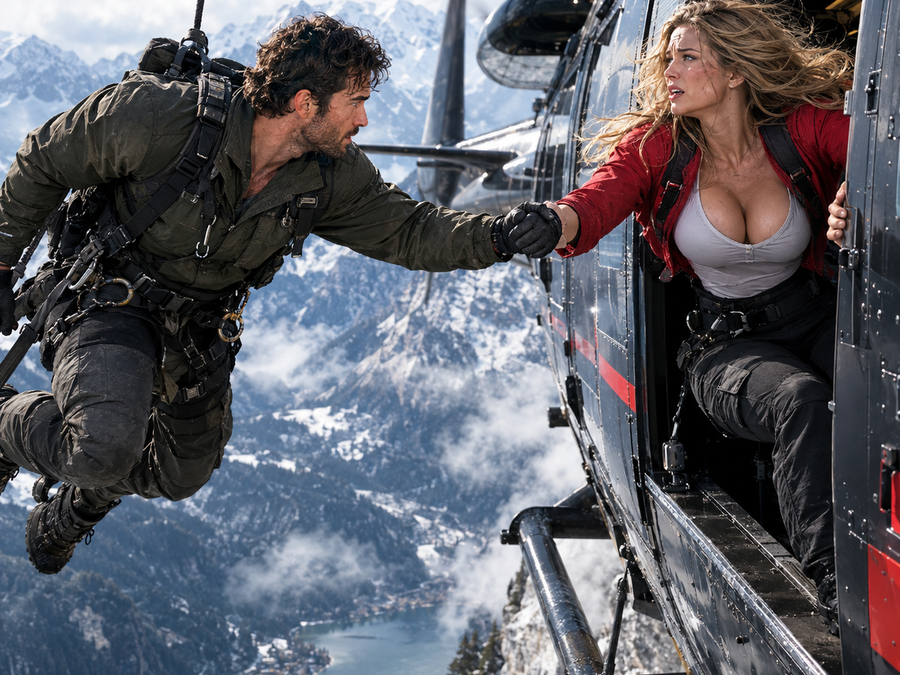
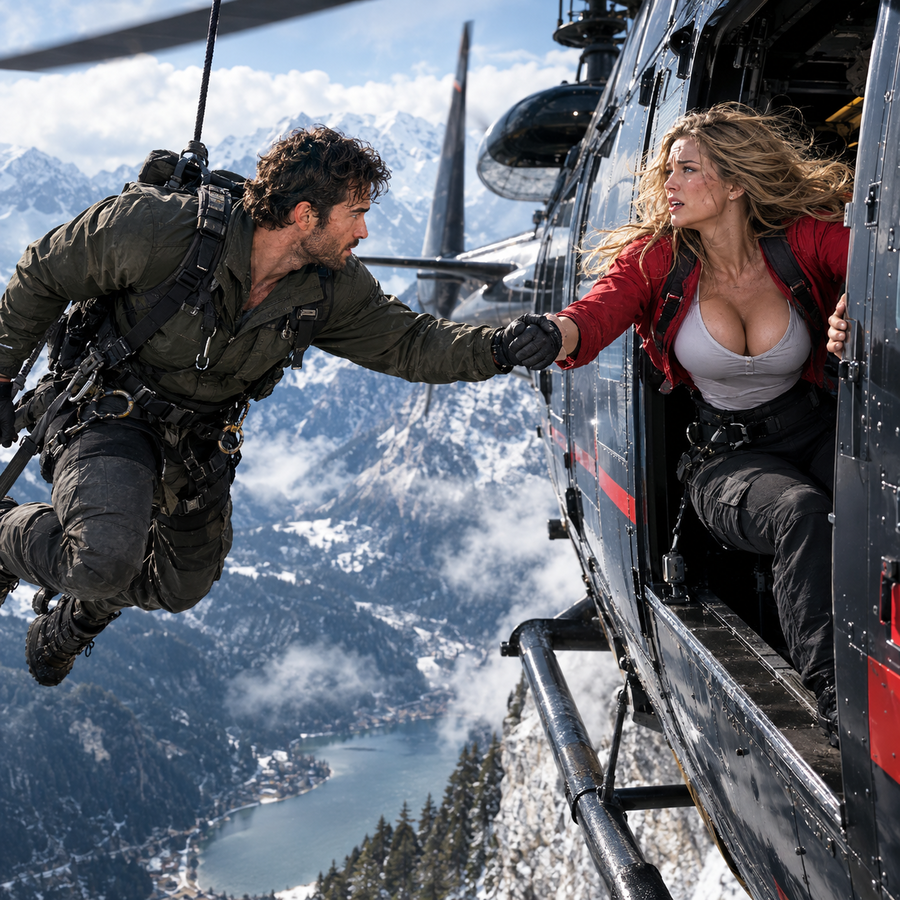
He looked at the cable above him. The traverse runner. The long, empty air between the tower and the cabin. He took one breath. He started across.
The traverse was the part nobody who wasn’t a tower tech ever thought about. Most people, when they imagined a cable car rescue, imagined something cinematic—dramatic movements, speed, urgency. What they didn’t imagine was the grinding, methodical, hand-over-hand labor of moving along a traverse runner 200 ft above the earth in 20° wind while your fingers were losing feeling and the steel above you made sounds you didn’t want to interpret.
Ethan moved steadily. The first 200 ft were the hardest because the cable angle put him slightly downhill, meaning the runner wanted to drift and he was fighting it the entire way. His shoulders burned. His hands, even in the wet gloves, were working on a level of grip that would hurt tomorrow. He focused on that—on the mechanical reality of it. Cable, grip, pull, repeat. Don’t think about the height.
Don’t think about Caleb eating lunch right now in a school cafeteria somewhere, completely unaware that his father was doing something extraordinarily stupid on the side of a mountain. Don’t think about Daniel Cole sitting at that kitchen table. Pull. Repeat.
He was 150 yards out from the tower when the cable vibrated. Not the steady vibration of a running system. A different vibration. Irregular. Urgent. The mechanical equivalent of a voice saying something is about to change. The compensator. It was accelerating. Ethan moved faster. His shoulder screamed. He moved faster. The cabin was 50 yards ahead of him.
He could see through the windows clearly now. He saw faces looking up. Someone pointing. He could see a woman standing near the front. And even from this distance, through the glass, in the cold and the wind, there was something about the way she was standing—absolutely still, absolutely upright—that told him she was the kind of person who spent most of her life being the calmest one in the room, and that today she was working harder at it than she ever had before.
30 yards. 20. He reached the cabin’s upper access hatch, a maintenance panel on the roof that most passengers never knew existed, and he hammered on it with the flat of his hand. “Inside!” He heard movement, a voice—Raymond’s, he guessed—called up. “Who’s there?” “Ethan Cole, independent maintenance contractor. I’m opening this hatch. Stand clear.” A pause. Then, “Okay.”
He unsealed the hatch and dropped inside. The cabin went quiet the moment he entered. Nine people looked at him. He was not what anyone had pictured. He was 38 years old, medium height, with calloused hands and a face that showed weather and work and not a lot of sleep. He was wearing a contractor’s insulated jacket with a company logo nobody in the cabin would recognize. His gloves were wet and his cheeks were red from the cold. He looked nothing like a rescue. He looked exactly like a rescue.
“Okay,” he said. He wasn’t loud. He didn’t need to be. “Here’s where we are. The primary drive system has a tension fault, and the emergency brake isn’t going to engage the way it’s supposed to. I have a colleague at the base station who is going to activate a secondary brake protocol.” He checked his watch. “6 minutes. Before she does that, I need to have everyone off this cabin.”
Robert Channing said, “Off the cabin? We’re 400—” “430,” Ethan said. “And yes. I have a rope and harness system. It takes about 90 seconds per person. We have 6 minutes. We can do this.” He looked around the cabin. “Who has any experience with rappelling, rock climbing, any kind of descent system?”
One of the photographers raised his hand. “I’ve climbed indoor walls. Some outdoor.” “Good. You go last. You can help me with anyone who’s nervous. Is there anyone here with a physical limitation—knee, shoulder, anything that would make a harness descent difficult?” Robert Channing said, “I’ve had back surgery.” “I’ll personally manage your descent,” Ethan said. He was already opening his pack.
“Everyone else, when I come to you, you put on what I hand you. You do exactly what I tell you. And you don’t look down unless I tell you to.” He looked up at the group again. “Any questions before we start?” And the woman near the front of the cabin, the one he’d seen through the glass, standing still and straight, said, “What’s your name?”
Her voice was even, not frightened, not shaking, just present. He looked at her directly for the first time. “Ethan Cole,” he said. He watched her face, and in that fraction of a second—in the moment between hearing the name and whatever came after—something moved across Victoria Harrington’s expression that he couldn’t read. It wasn’t recognition. Exactly. It wasn’t confusion. It was more like the look on a person’s face when they hear a piece of music they almost remember. Something reaching for something else. Something just beyond the fingertip.
“Cole,” she repeated. “Yes, ma’am.” She held his gaze for one long beat. And then she said, “Then let’s get to work.”
The next 6 minutes were the most precise of Ethan’s life. He worked through the passengers methodically. He moved fast but not frantically, the way a surgeon moves, or a pilot, or anyone for whom speed and steadiness are not opposites but the same thing. The first passenger, one of the junior resort executives, a man in his 30s named Derek who was paler than the snow outside, was down the line in 92 seconds. Ethan talked him through every step in a flat, calm voice. “Clip here. Wait here. Don’t grip with your arms. Let the harness do it. There you go. Keep going. You’re down.”
The second passenger, a woman—one of the photographers—was faster because she’d done it before. Third, fourth, fifth. Robert Channing, who had back surgery and was terrified in a quiet, dignified way that Ethan found genuinely admirable, took a little longer, but he made it. Sixth. Seventh. The journalist, Sandra Lee, paused at the hatch opening and looked down at the valley below and said, “I can’t.” “You can,” Ethan said. “I’m sorry. I can’t.” “Sandra,” he said her name deliberately. And she looked at him. “You’ve already done the hardest part. You’ve been calm this entire time. You’ve been braver than most people would be. All I need you to do now is trust that a rope. The rope doesn’t know you’re scared. It just holds.”
She looked at him for a moment. “The rope just holds,” she said. “That’s all it does.” She went. Priya was next. Then Raymond, who insisted on going before Victoria, which said everything about who he was.
And then there was one. Victoria Harrington stood at the access hatch in a 430 ft cable car with a man she had met 6 minutes ago, and she looked at him with an expression that was at once entirely composed and entirely human. “I imagine you’d like me to go first,” she said. “Actually,” Ethan said, “I’m going to ask you to go last. If you’re willing.” A pause. “Why?” “Because you’re the most calm person here. And if someone panics halfway down, I may need someone at the top who can talk to them.”
She looked at him steadily. “You’ve been doing this alone today?” “Yes.” She nodded slowly. “All right.” He handed her the harness. She put it on without asking for help, which also said something. And while he clipped her connections and checked each one the way you’re supposed to—twice, methodically, no shortcuts—she said, quietly, conversationally, “Cole. Your father was Daniel Cole.” It wasn’t a question.
Ethan’s hands kept moving. Check the primary. Check the secondary. Check the backup. “Yes,” he said. He heard her exhale. “I think,” she said, “that we have something to talk about.” He helped her to the hatch. She descended. He stayed at the top until she reached the rescue platform below.
And then his phone buzzed. “Marcus.” “She’s ready. Signal.” Ethan typed back. Everyone’s out. Go. He heard, distantly, the sound of the secondary brake engaging. The cabin shuddered once and then it held. Ethan looked out through the open hatch at the mountain, the valley below, the sky above, the cable that had held today but might not have. The cold air came in and he breathed it. Then he started down.
At the rescue staging area—a flat section of the maintenance path about 60 ft below the cable line—the passengers stood wrapped in emergency blankets. Shaken but unhurt. Resort personnel had arrived. Someone was calling for medics. Someone else was calling for communications. Ethan walked through all of it like a ghost. He checked on each passenger briefly. He confirmed with Marcus that the secondary brake was holding. He called the base station and gave them specific instructions about what not to do to the primary compensator until a full investigation team was on site.
And then he turned around. Victoria Harrington was standing 10 ft away, looking directly at him. She was still wearing the emergency harness over her ski jacket. She hadn’t let anyone take it off yet. Her assistant was beside her with a blanket and a phone and probably 17 urgent messages, all of which were apparently being ignored. She walked toward him. She stopped in front of him.
The wind was quiet for a moment—the way mountain wind sometimes goes still between gusts, as though the mountain itself was listening. “You warned them this morning,” she said. It wasn’t a question. “They didn’t listen.” “No.” She looked at him. “Why didn’t you walk away?” He thought about it. He could have given her several answers. All of them true. He could have talked about professional responsibility, or liability, or the fact that he had a documented warning on file and a legal obligation to follow up. Instead, he said, “Because there were people on that line.”
She held his gaze for a long moment. “Your father filed a report,” she said. “In 1998. A safety report about this exact system.” Something very still moved through Ethan. “I know he did.” “What he predicted,” she said, “is what almost happened today.” He didn’t answer. “I found something,” she said. “Last month. Going through my father’s papers. Documents I didn’t know existed.” She paused. “I haven’t known what to do with them yet.”
He looked at her. “Mr. Cole,” she said, “your father wasn’t wrong.” The mountain was silent. The wind came back, light, from the north, and moved through the trees at the edge of the maintenance path. Ethan Cole stood very still. He had spent 20 years carrying the weight of a name that everyone said meant failure. 20 years. And here, on the side of the mountain his father had once tried to protect, a woman he had met an hour ago looked him in the eye and said the four words that 20 years hadn’t been able to produce.
He didn’t say anything for a moment. He nodded once. And then he said, quietly, “I know.”
The mountain air was still cold when Ethan Cole walked back down the service path alone. Behind him, the rescue staging area was becoming something else—something louder, more complicated, full of people with clipboards and radios and the particular kind of controlled urgency that large organizations manufacture when something has gone wrong and they need to appear to be handling it before anyone asks too many questions.
Ethan let them have it. He had said what he needed to say to Victoria Harrington. She had said what she needed to say to him. And now he needed somewhere quiet to sit down and let his hands stop shaking, because they had been shaking since he came off the traverse, and he hadn’t let anyone see it yet.
He found a maintenance bench just inside the service access door at the base of the upper station, and he sat down and pressed both palms flat against his knees and breathed. His phone buzzed. Marcus. “You okay?” Marcus said when he answered. “Fine.” “You don’t—fine. I’m fine.” Marcus. A pause. “Denise wants to know if you’re going to file the incident report yourself or if she should start one.”
“Tell her I’ll file it. Tell her to document every reading from this morning. Timestamp everything from when I first flagged the anomaly. Every single reading. I want it bulletproof.” “Already on it.” Another pause. “Hargrove’s been looking for you.” Ethan exhaled. “I know.” “He’s got that face.” “What face?” “The one where he’s already decided it’s your fault.”
Ethan looked at his hands. Still shaking, slightly. He pressed them harder against his knees. “Let him come find me,” he said. “I’ll be right here.” He hung up. He sat alone for about three minutes. Then the door opened, and Dale Hargrove walked in.
Hargrove looked the way powerful men always look when they’ve been frightened and are trying to convert the fear into anger before anyone notices the fear. Jaw set. Eyes moving slightly too fast. He had his jacket zipped all the way up and his hands in his pockets, and he stood in the doorway for a moment like he was deciding something. Then he walked in and closed the door behind him.
“You pulled passengers off that cabin without authorization,” he said. Ethan looked at him. “Yes.” “That’s a liability issue, Dale.” Ethan said his name quietly. “There are nine people alive right now because I pulled them off that cabin. So, whatever conversation you want to have about authorization, let’s have it, but let’s be clear about what we’re talking about.”
Hargrove’s jaw tightened. “You went around me.” “I tried not to. I called you this morning. You sent me back to my shift. I called the main line. I got hold music.” Ethan stood up slowly, because his legs were tired and he was going to do this standing. “I did everything in the right order. Dale. When the right order failed, I did what needed to be done.”
“You don’t get to make that call.” “Then who does?” Ethan said. “Who was making that call when the line was running? When the compensator was slipping? When nine people were 430 ft in the air and the emergency brake wasn’t engaging?” He paused. “Because I didn’t see you on that traverse.”
The room went quiet. Hargrove’s face did something complicated. “This isn’t over,” he said. “No,” Ethan agreed. “It’s not.” Hargrove left. Ethan sat back down. His hands had stopped shaking.
Victoria Harrington did not go back to the resort with the rest of the group. Priya had assumed she would have already rescheduled the summit briefing, already sent notifications to the media team, already ordered the SUV convoy back to the main lodge. She had done all of this efficiently and without being asked, because that was what Priya did, and she was very good at it.
What she had not anticipated was Victoria saying, “Quietly tell the cars to go ahead. I’ll come separately.” “Miss Harrington, the medical team would like to—” “I’m fine.” “Even so, protocol—” “Priya.” Victoria looked at her. “Tell the cars to go.” Priya told the cars to go.
And Victoria walked back along the maintenance path, past the rescue staging area—now mostly cleared—past the service access point, until she found the door that a resort worker told her led to the maintenance station. She knocked. When Ethan opened the door, he was holding a cup of coffee that had appeared from somewhere—maintenance rooms always had coffee, it was one of the few universal truths of physical labor—and he looked at her with the expression of a man who was not entirely surprised but also had not quite expected this.
“Miss Harrington,” he said. “Victoria,” she said. “Please.” She looked at the bench. “Can I sit down?” He stepped back. “Of course.” She came in. She sat. He stood with his coffee and looked at her and waited.
“I want to tell you about the documents,” she said. “Not the version I’ll tell the board. Not the version the communications team will write. The actual thing.” She met his eyes. “I think you deserve that.” He sat down across from her. “Okay,” he said.
Victoria’s father, Edward Harrington, had built Evercrest from a regional ski operation into the first stage of what would eventually become a substantial company. He was a builder, a dealmaker, a man who understood vision and capital and the particular art of making other people believe in something hard enough to fund it. He was not an engineer. This was, Victoria had understood from a very young age, both his greatest strength and his most dangerous blind spot.
He trusted the numbers. She said it always—revenue projections, cost analyses, efficiency margins. If the numbers said something was fine, it was fine. If the numbers said something was cheaper, cheaper was better. She paused. When the renovation came in 1998, the board was choosing between two secondary compensator systems. The one Daniel Cole recommended was rated for our specific climate profile. It cost 40% more.
Ethan said nothing. He was very still. “The one they chose,” she continued, “was cheaper. It met standard industry specifications, but standard industry specifications weren’t written for this mountain.” She looked at him. “Your father wrote a report explaining exactly why. He ran the numbers. He showed the projected failure rates under cold weather load cycles specific to this altitude and this temperature variance. He submitted it formally to the board with his name on it.”
“I know,” Ethan said quietly. “I found a copy when I was 24. In a box of his things.” Victoria went still. “You found it?” “He kept a copy hidden.” Ethan looked at the floor for a moment. “I read it. I didn’t understand all of it. I wasn’t an engineer yet. I was just starting to learn the trade. But I understood enough.” He paused. “I understood that he’d been right and that it hadn’t mattered.”
“It mattered,” Victoria said. And her voice had an edge in it that surprised him. “That’s what I need you to understand. That report mattered to my father, but not the way it should have.” She shifted on the bench. “He kept documents. My father kept everything, which I always thought was vanity—records of his own greatness, logs of deals made, letters from important people. After he died, I started going through the papers. Most of it was exactly what I expected.”
She paused. “And then I found the folder with your father’s name on it.” Ethan looked at her. “There was the original report,” she said. “The one Daniel submitted in 1998. But there was also correspondence. Memos. Between my father and the two executives who ran the renovation project.” She studied herself. “Your father had started asking questions after the cheaper system was installed. He was conducting follow-up pressure tests. He was documenting irregularities.”
“He told me that,” Ethan said. “Before it happened, he said he was watching the system. That something felt wrong.” “The executives went to my father,” Victoria said. “They told him that Daniel Cole was creating operational disruption. That he was undermining confidence in a completed project. That they were worried he was building a case to go external—to regulators or to the press.” She stopped. “My father made a decision.”
Ethan waited. “He authorized the incident,” Victoria said. “The cable irregularity that year. The one that got attributed to operator error. My father’s executives found a moment when the system showed a minor anomaly, and they used it. They pulled Daniel’s access codes. They documented it as a response to the anomaly. They made it look like negligence.” Her voice was very controlled. “And then they let him go.”
The room was quiet. Ethan sat with it. It was strange, he thought, how the truth could be something you had always suspected—something you had felt in your bones for 20 years—and still hit you like a physical thing when it finally arrived in actual words. He had known. Some part of him had always known that his father hadn’t made a mistake. But knowing something in the body and hearing it spoken out loud were two entirely different experiences.
He realized his hands were flat on his knees again. He realized they were not shaking. “My father kept those documents because—” Victoria started, and then stopped. She looked at something past his shoulder for a moment. “I’ve spent a lot of time thinking about why he kept them. I think part of it was the same reason people keep confessions. Not to show anyone. Not because they’re planning to do anything with them. Just to know the truth existed somewhere. Even if only in a box in a private room.”
She looked back at him. “He wasn’t a good man in that moment. I want to be honest about that. He was protecting the company. He was protecting the project. And he was wrong.” “He was human,” Ethan said. Victoria looked at him. “You’re being generous.” “I’m being accurate,” he said. “My father was human, too. He made a choice that cost him everything. Your father made a choice that cost my father everything. Both of them were just men making decisions under pressure, with incomplete information about how long the consequences would last.” He paused. “The difference is what we do with it now.”
She held his gaze. “Yes,” she said. “That’s exactly the difference.” What neither of them knew in that moment was that the conversation had already been seen. Not heard—the maintenance station was private and the door was closed—but seen. A resort photographer named Joel, who had been sent to document the rescue for the company’s internal communications, had been standing near the service door, taking what he thought were candid recovery shots. He had a long lens, and he had captured, without quite understanding it, a series of images. The CEO of Evercrest Mountain Resort sitting on a maintenance bench in a borrowed emergency harness. Talking to the contractor who had just climbed across a cable to save her life.
He sent the photos to his editor at Mountain West Business at 4:15 that afternoon, without thinking much about it, because Sandra Lee had texted him from the hospital—she was fine, mild shock, already writing—and asked him to transmit the day’s images. By 6:00, three of those images were on the magazine’s website. By 8, they’d been picked up by the regional wire services. By 10 that night, they were national.
And by the following morning, the image of Victoria Harrington on a maintenance bench with Ethan Cole—both of them in rescue harnesses, his coffee cup on the floor between them, both of them leaning slightly forward in the posture of people saying something important—was on the front page of more outlets than either of them had known existed.
Ethan found out when Caleb called him at 6:45 in the morning. “Dad,” Caleb said. “You’re on the internet.” “I know.” “You’re on a lot of the internet.” “I know, bud.” “Mrs. Patterson showed my class.” “Of course she did.” “She said you were a hero.” A pause. “Are you a hero?”
Ethan thought about his father sitting at the kitchen table with his hands flat and his eyes on nothing. He thought about the copy of the report he’d found in the box at age 24 and carried with him through 12 years of contract work and one child and a hundred mornings on the mountain when the cables vibrated wrong and nobody wanted to hear about it. “No,” he said. “I’m just somebody who paid attention.”
Caleb was quiet for a moment. Then he said, “That’s kind of the same thing, isn’t it?” Ethan didn’t answer right away. “Yeah,” he said eventually. “Maybe.”

