“Touch Her Again, I Dare You” — Ex-SEAL Dad Protected a Wheelchair CEO in Disguise (Part 1)
“Touch Her Again, I Dare You” — Ex-SEAL Dad Protected a Wheelchair CEO in Disguise (Part 1)
PART 1
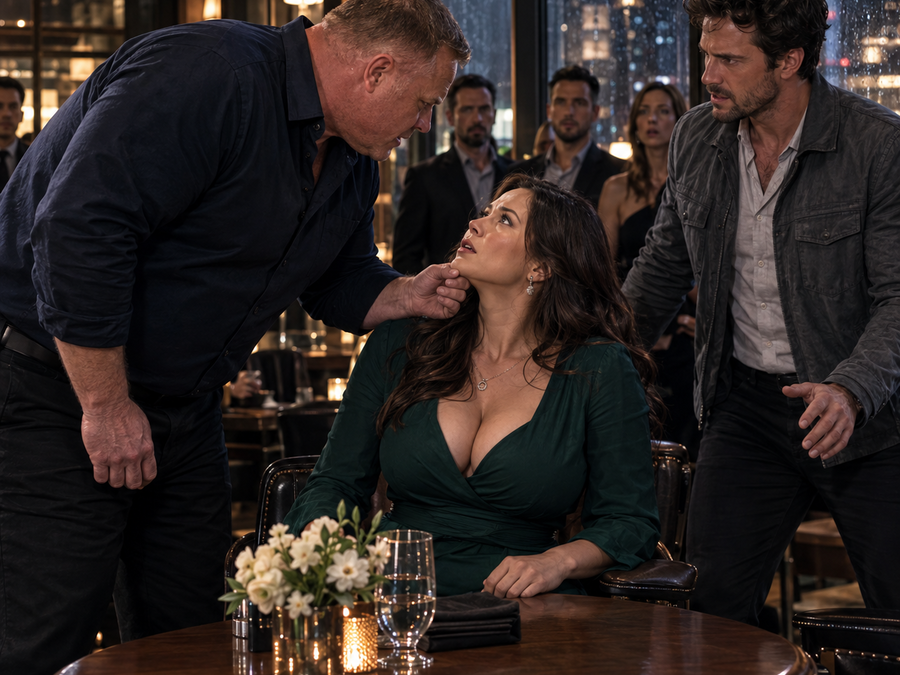
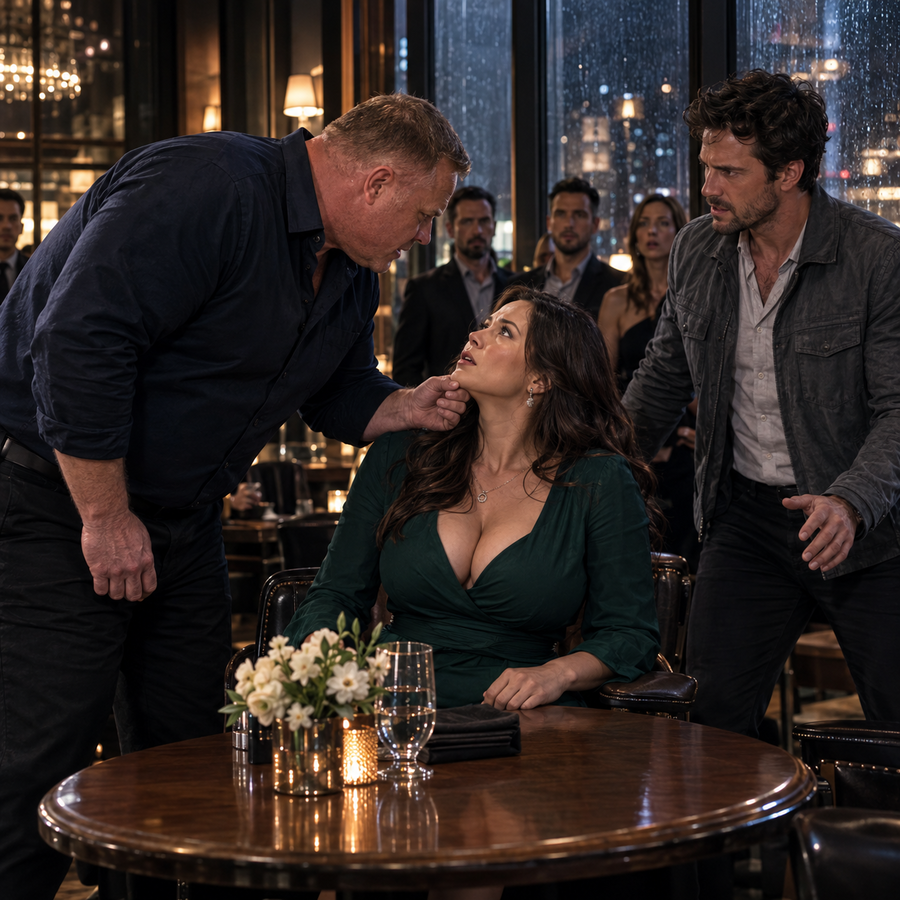
“Touch her again,” Ethan said. His voice so quiet the whole restaurant stopped breathing. “I dare you.” The man’s hand froze on the wheelchair handle. 6’2″, 243 lbs, four friends behind him, and he couldn’t make himself move because something in Ethan’s eyes told him that whatever happened next would not go the way he planned.
Nobody in that room knew who Ethan Walker really was. The grease under his fingernails, the old jacket, the little girl watching from the corner booth. None of it looked like a threat. That was always the mistake people made.
The rain had been falling since 4 in the afternoon. The kind of cold Colorado rain that comes in sideways off the mountains and soaks through a jacket before a man even reaches his truck door. Ethan Walker didn’t mind it. He’d been soaked in worse rivers in the middle of the night, swamps that smelled like rot, oceans that wanted to kill him. A parking lot in Mil Haven, Colorado on a Thursday evening was not going to break him.
He pulled open the door to Paulie’s Diner and let his daughter walk in first. “Dad, you’re dripping on me.” “That’s what fathers do,” he said. Lily was 10 years old and had her mother’s dark eyes and her mother’s habit of noticing everything 3 seconds before anyone else did.
She slid into the corner booth without being told—the one with the clear sightline to the door. And Ethan almost smiled because he’d never taught her that. She’d just absorbed it the way kids absorb everything, through watching a man who always sat with his back to the wall.
“Can I get the grilled cheese?” “You can get whatever you want.” “And a milkshake.” “Don’t push it.” She pushed it. She always pushed it. He always gave in. That was the agreement they had without ever saying it out loud.
Ethan hung his jacket on the hook at the end of the booth and picked up the laminated menu, even though he’d had the same thing every time he came in here for 3 years. Black coffee and the turkey melt. He didn’t need to read the menu. He just needed something to do with his hands while he scanned the room the way he always scanned every room—quietly, quickly, cataloging without appearing to catalog.
14 people, three employees. Two exits: the front door and the service door in the back beside the kitchen. A family of four near the window, the parents both on their phones, the kids drawing on paper placemats. Two older men at the counter talking about the Broncos. A woman alone near the far wall.
He noticed her the way he noticed everything—without staring, without making it obvious. Just a 4-second read that told him the basic story. Wheelchair, manual, not electric, well-maintained, but with road wear on the tires, which meant she used it constantly and wasn’t afraid to go places. Late 20s, maybe 30. Dark hair pulled back simply. A fleece jacket that had been expensive once. She was eating soup and reading something on her phone.
And she had the particular stillness of someone who had learned to be invisible in public places. Not because she was shy, but because she’d chosen it. The stillness of someone accustomed to being watched and who had decided, deliberately, not to perform for an audience. Ethan looked away. Lily was studying the dessert section of the menu with the concentration of a field commander planning an operation.
“The hot fudge sundae comes with whipped cream,” she announced. “That’s what sundaes do.” “I’m just saying.” “You’re just saying a lot of things.” The waitress came—Donna, who had three grandchildren and a laugh that could fill a room, and who always brought Lily a small cup of chocolate milk without being asked, which had secured her a permanent position in Lily’s personal ranking of favorite humans.
She took their order and moved on, and the diner settled back into its ordinary Thursday rhythm. Then the door opened. Not the way doors normally open. Not with the hesitation of someone fighting the rain or the casual push of someone who’s been here before. It opened the way doors open when someone wants the room to notice them. Fast. Wide. With intention.
Five men. Ethan’s read was immediate and automatic. Mid-30s to mid-40s. Business casual that was trying hard. The kind of clothes that said money but not old money. The one in front was the alpha. Not the biggest physically, but the one the others kept looking at for cues, which meant he was either the leader or the one with the most to prove. He had a jaw like a shelf and the haircut of a man who expected people to take photos of him.
The four behind him were arranged like punctuation. Two slightly ahead and two behind. Not random. Not unconscious. Practiced. These men had walked into rooms like this before. They stood just inside the entrance, rain dripping from their coats, and the alpha—Ethan would learn later his name was Marcus Vain—scanned the room.
He found what he was looking for in about 6 seconds. He found her. And the way his face changed when he saw the woman in the wheelchair—the little twist at the corner of his mouth, something between satisfaction and contempt—told Ethan everything he needed to know about why these men were here. This was not a coincidence.
Lily was saying something about the milkshake. Ethan heard her the way you hear background radio when something else has claimed the foreground of your attention. Present. Registered. Not yet processed. “Dad, I’m listening.” “You’re not. Strawberry or chocolate?” He said. She blinked. “How did you know?” “Because those are the only two choices and you always wait until someone’s distracted to try to upgrade.” She grinned. He did not grin back.
Because Marcus Vain was moving through the diner now, threading between tables with his four men behind him, and he was moving toward the woman in the wheelchair with the unhurried confidence of a man who had never once in his adult life had to wonder whether the situation would go his way.
“Clare.” His voice carried across the room without effort. Not loud, just projected the way a man projects when he wants witnesses. “I didn’t expect to find you in a place like this.” The woman—Clare—looked up from her phone. Nothing on her face changed. Not surprise, not fear, not warmth. She just looked at him the way you look at a problem you’ve already solved in your head.
“Marcus,” she said. “I’d say it’s good to see you, but we both know I’ve always been honest with you.” “Always so precise.” He stopped at her table. His men spread slightly—two to her left, two staying back, blocking the path between her table and the front door without making it look like that’s what they were doing. Ethan noted the positioning.
“You know what I appreciate about you, Clare? You never pretend.” “And you never stop,” she said. “Sit down or leave, Marcus. I’m eating.” He didn’t sit down. He stood over her. And that was deliberate. The height, the angle, the physical fact of five standing men and one woman in a wheelchair. And he let that geometry do the work for him before he said another word.
“You’ve been making some interesting decisions lately.” “I make interesting decisions every day. That’s why the company is worth what it is.” “Was worth what it was,” he said. And now the smile was gone. “Before you started pulling threads you don’t have the clearance to pull.” “It’s my company, Marcus. I have clearance for everything.”
One of the men behind him—the wide one, the one built like a refrigerator, who Ethan marked as the physical option, the one Vain would deploy if the conversation needed punctuation—stepped half a step forward. Just half a step. Just enough. Clare didn’t flinch. Ethan picked up his coffee.
“You’re going to pull back from the Henderson audit,” Marcus said. It wasn’t a question. “You’re going to tell your compliance team that the discrepancies were clerical, that the account reconciliations were administrative errors, and you’re going to do this before Monday’s board meeting.” “And if I don’t?” “Then people are going to find out some very unfortunate things about how you manage the company during your rehabilitation period.”
He let that word sit. Rehabilitation. Dragged out just slightly. Just enough to make it land on the wheelchair, on the month she’d spent relearning how to do things she used to do without thinking. “Decisions made while you were, let’s say, impaired.”
The diner had gone quiet. Not completely. The coffee machine behind the counter was still cycling. The family by the window was still ordering. But the tables closest to this conversation had stilled. People were looking at their food, looking at their phones, doing what people in restaurants do when something uncomfortable happens near them, which is to become profoundly fascinated by anything that isn’t it.
Lily had gone quiet, too. Ethan glanced at her. She was watching the men with her mother’s eyes. Seeing everything. Showing nothing. “Stay right here,” he said quietly. “Dad—” “Right here, Lil.” He sat down his coffee. He stood up. And he walked across the diner.
He didn’t hurry. Hurrying changes the energy of a room and he didn’t want to change the energy. Not yet. He walked the way he’d learned to walk in environments where a single wrong signal could end everything. Measured. Unhurried. With the particular calm of a man who has already decided what he’s going to do and is simply giving the other party the chance to make a different choice.
He stopped about 4 ft from the table. “Everything okay here?” he said. Marcus Vain turned. The 4-second read assessed Ethan as a civilian. Grease under the nails, which meant labor. Old jacket, which meant not wealthy. No visible authority. No badge. No uniform. Filed him under: not a factor.
“Private conversation,” Marcus said. “Sure,” Ethan said. He looked at Clare. “Ma’am, you doing all right?” She looked at him the way she’d looked at Marcus. Direct. Assessing. Nothing given away for free. Up close, her eyes were gray-green and sharper than anything in the room. “I’m fine,” she said. “Thank you.”
“You sure?” “She said she’s fine,” Marcus said. “Walk away.” Ethan didn’t walk away. He stood there in the particular way that men who have controlled rooms for a living stand. Without posturing, without aggression, without anything that looked like a performance. Just occupying his four square ft of floor space as though he had every right to it and had no plans to vacate.
“I’ll move when she tells me to,” Ethan said. Marcus stared at him. The refrigerator man shifted his weight. “I don’t know who you think you are,” Marcus said. “Nobody important,” Ethan said. “Just someone eating dinner.” “Then go eat your dinner.” “In a minute.”
The refrigerator man—whose name Ethan would eventually learn was Doyle—moved. Not fast, not explosively. Just a rolling of weight forward that was meant to communicate mass and momentum and the fundamental physics of what happened when 260 lbs of motivated muscle decided something needed to happen. Ethan let him get within arm’s reach. Then he said, quietly, so the room couldn’t quite hear it:
“I need you to understand something. You don’t want to touch me. And you really don’t want to do it in front of my daughter.” Doyle stopped. Something in the voice. Not a threat, exactly. Something worse than a threat. A statement of fact delivered by someone who was entirely at peace with whatever was going to happen next.
“Move the hand,” Ethan said. He wasn’t talking to Doyle anymore. He was talking to Marcus, who had placed one hand on the back of Clare’s wheelchair. Just resting it there. The way you rest a hand on the back of a chair. Casual. Proprietary. Communicating without words that he could move her anywhere he wanted.
“Move it now.” “Or what?” Marcus said. The diner was completely silent. “Or this gets a lot worse for you than it needs to be,” Ethan said. “And it doesn’t need to be bad at all. You could take your hand off her chair. You could take your friends and you could walk out of here. And tomorrow you could find a better way to handle whatever it is you’re trying to handle.” He paused. “That’s the best version of tonight. And the other version—” Ethan looked at him for a long moment. “You don’t want the other version.”
Marcus laughed. It was the laugh of a man performing confidence for an audience. “You’ve got nerve. I’ll give you that. You have any idea what I can do to a man like you? What I can do to your business, your life, your—” “My daughter’s right over there,” Ethan said. Not loud. Not angry. Just informational. “So I’m going to ask you one more time to take your hand off her wheelchair. Because I’ve been patient, and I don’t want to stop being patient. But I will.”
“Is that a threat?” “It’s math,” Ethan said. And then Clare said, quietly, looking at Ethan with those gray-green eyes: “You don’t know what you’re stepping into.” Ethan looked at her. “I don’t need to.” “These men are—” “I don’t care what they are,” he said. “I care what they’re doing right now. In here.”
She held his gaze for a beat. Something moved across her face. Not quite surprise. Not quite recognition. Something more complicated than either of those things. Then Doyle made his decision. He didn’t telegraph it. That was the one thing Ethan gave him credit for. He didn’t load up. Didn’t square his shoulders. Didn’t do the theater that most men do when they decide to put their hands on somebody.
He just moved. Reaching forward to grab Ethan by the jacket collar, committing his weight and his leverage in one economical motion. He had been in fights before. Clearly. He had never been in a fight with Ethan Walker.
What happened in the next 4 seconds was not a brawl. It was not a movie fight with arcing punches and dramatic stumbling. It was quiet and extremely specific, the way technical things are specific. A controlled redirection of Doyle’s momentum. A wrist lock applied at a precise angle. A point of contact on the nerve cluster in the inside of the elbow that made 260 lbs of motivated muscle suddenly, completely, comprehensively stop working the way Doyle expected it to work.
Doyle was on the floor. Not hurt, not unconscious, just on the floor, with Ethan crouched beside him and a hand on his wrist. And the expression on Doyle’s face was the expression of a man discovering for the first time that the map he’d been using his whole life had some significant territories missing from it.
“Stay there,” Ethan said. He stood up. The other three men had not moved. This happens sometimes with people who spent their lives on the winning side of physical situations. The moment the physics stopped going their way, the decision-making froze. They hadn’t trained for this scenario. They’d trained for the one where the other person backed down.
Marcus Vain was staring at Ethan with something that was trying very hard to be contempt and not quite getting there. “You have no idea what you just did.” “I stopped someone from falling,” Ethan said. “Your guy tripped.” “That’s not—” “That’s what happened,” Ethan said. “Ask anyone in this room.” He didn’t look around to verify this. He didn’t need to. He could feel the room. The relief, the shock, the shifting weight of 15 people who had just watched something they weren’t sure how to process.
Donna was behind the counter with her hand on the phone. The older men at the counter had turned on their stools. The family by the window—the parents had finally put down their phones. Marcus looked at Clare. Whatever he saw in her face was not what he expected to see. “This isn’t over,” he said. “No,” Clare said. “It’s not. But you’re leaving now.”
He left. His men followed. Doyle last, rotating his wrist with an expression of focused concentration, getting the feeling back. The door opened and closed, and the cold rain came in for a second and then didn’t, and the diner held its breath for one more beat before releasing it.
Donna came over immediately. “Should I call the police? I can call.” “Please,” Clare said. Ethan sat down at the table across from her. He hadn’t asked permission. He just sat down because his legs were telling him that the adrenaline that had been suppressed and managed and metabolized over the last 4 minutes was now requesting to be acknowledged.
Clare looked at him. “Who are you?” she said. “Ethan Walker.” He picked up her soup spoon from the table, looked at it, set it back down. “Mechanic. Live about six blocks from here. My daughter’s the one in the corner booth staring at us.” She glanced over. Lily gave a small, precise wave. Clare blinked. “You’re a mechanic,” she said. “Yeah.” “You just—” she stopped, started over. “Those men are not small problems.”
“Okay.” “They have resources. Legal resources. The kind that can make a person’s life extremely complicated.” “I know the type,” he said. “And you just—” She stopped again. Her jaw was tight, and Ethan could see the effort it was taking to hold the shock and the gratitude and whatever else was moving through her in a container that didn’t show. “Why?”
Ethan looked at her. Then he looked at his daughter across the room, who was eating her grilled cheese with one eye still on the table, watching the way she watched everything. “Same reason you’d do it,” he said. “If you could have.” The silence between them lasted exactly long enough to mean something.
Then, from the corner booth, Lily’s voice: “Dad, my milkshake is getting warm.” Clare looked at Ethan, and for the first time since he’d sat down, the corner of her mouth moved. Not quite a smile. Not quite. Something guarded and surprised. And underneath both of those things, something that had not expected tonight to end this way.
“Go take care of your daughter,” she said. He stood. “Are you going to be all right until the police get here?” “I’ve been all right a long time on my own,” she said. “I know,” he said. “I’m asking anyway.” She held his gaze another beat. “Yes,” she said. “I’ll be all right.”
He nodded and walked back to the corner booth, where Lily immediately, definitively, and without preamble said, “You’re going to tell me everything.” “I’m going to tell you some of it,” he said. “Everything,” she repeated. He sat down. He picked up his coffee.
Across the diner, Clare Whitmore sat very straight in her wheelchair with her hands folded on the table and her eyes on the door, waiting for the police, with the patience of someone who had learned a long time ago that the world rarely came to you. You had to make it come—through will, and through stillness, and through refusing, absolutely and completely, to be moved.
He didn’t know her name yet. He didn’t know what she was worth or what she’d built or what the men who just walked out the door were trying to take from her. All he knew—the only thing that had ever mattered in any room he’d ever walked into—was that someone needed someone to stand beside them. And he had been standing beside people his entire life.
The police arrived 11 minutes after Donna made the call. Two officers. Ethan knew the type before they even got their jackets off. Local department. Small town. The kind of cops who handled domestic disputes and fender benders and the occasional bar fight on a Friday night, and were quietly, professionally uncomfortable when something walked in the door that didn’t fit any of those categories.
The older one was named Reyes. Mid-50s, thick through the shoulders, with the deliberate, unhurried movement of a man who had learned decades ago that urgency in a room that’s already tense only adds more tension. He took Clare’s statement first, standing beside her table with a notepad, asking questions in a flat, patient voice that gave nothing away.
Ethan stayed in the corner booth with Lily, who had finished her grilled cheese and was now working on the milkshake she had absolutely been given and was watching the whole room with those quiet, dark eyes. “Are they going to arrest those men?” she asked. “Probably not tonight.” “Why not?” “Because they left before the police got here. And what they did, it’s complicated to put charges on.” He wrapped both hands around his coffee cup. “Intimidation isn’t always a crime you can handcuff somebody for.” “That’s dumb.” “Yeah,” he said. “It is.”
Reyes finished with Clare and walked toward Ethan’s booth. He sat down across from them without asking, which Ethan didn’t mind. He’d have done the same thing. “Mr. Walker.” Reyes set his notepad on the table. “You want to walk me through what happened?”
Ethan walked him through it. Straight. Factual. No editorializing. He described the positioning of the men, the escalation, Doyle’s physical move, and what he’d done in response. He kept it clinical because clinical was accurate, and because emotion in a police statement was a door you didn’t need to open. Reyes wrote everything down. He didn’t look up from his notepad while Ethan talked.
When Ethan finished, Reyes was quiet for a moment, still looking at the notepad. Then he said, “Doyle Mercer.” Ethan waited. “The big one. You said he reached for you.” Reyes looked up now, and his eyes were doing something more complicated than the rest of his face. “You put him on the floor.” “He lost his footing.” Reyes almost smiled. “Right.” He clicked his pen. “You were special operations, weren’t you?”
Lily looked at Ethan. Ethan looked at Reyes. “What makes you ask?” “Because I’ve been doing this 23 years and I’ve seen exactly four people move the way you move tonight. Two of them were Army Rangers. One was a Marine Raider.” He paused. “The fourth one was a SEAL commander who pulled six men out of a building in Kandahar when the whole north wall came down.”
The diner was quiet enough now that Ethan could hear the rain on the windows. “That’s a specific thing to know,” Ethan said. “I was one of the six,” Reyes said. The silence between them was different from the silence before. It had weight. Lily was very still beside Ethan, and he could feel her processing the way she processed everything—quickly, and without showing it—the fact that her father was someone she knew and also, apparently, simultaneously someone she didn’t know at all.
“You were there,” Ethan said. “I was the second one out,” Reyes said. “I had a compound fracture in my left leg, and you carried me through 80 m of active fire and told me the whole way that I was going to be fine. I wasn’t sure I believed you.” He looked down at his notepad again. “I believed you enough to keep moving. That’s what mattered.”
Ethan didn’t say anything. “You never filed for the commendation,” Reyes said. “The rest of the unit did the paperwork, but by the time the citations came through, you were already out.” “I didn’t need a piece of paper.” “No,” Reyes said. “I don’t imagine you did.” He looked up one more time. “I just want you to know that I’m going to do my job tonight. And my job is going to be the best I can make it. The woman in the wheelchair—she wouldn’t tell me who she is, which means she’s either in witness protection or she’s somebody who can afford not to tell me. Either way, I’m taking her statement seriously. And yours.”
He stood up, picked up his notepad. “The man she described—Marcus Vain. I know that name. He has a long history of operating right up to the legal line without crossing it. But tonight he crossed it. I’m going to make sure that’s documented correctly.” He held out his hand. Ethan shook it. Reyes looked at Lily. “Your dad’s a good man,” he said.
Lily looked at Ethan the way only a child can look at a parent—with that particular combination of pride and accusation. That means you should have told me more and I’m proud of you and we’re going to have a very long conversation later, all at the same time. “I know,” she said.
Reyes walked back toward Clare’s table, and Ethan picked up his coffee, and Lily said nothing for almost a full minute, which was unusual enough that he watched her out of the corner of his eye, waiting. “Kandahar,” she said finally. “That was a long time ago.” “How long?” “Long enough.” “Dad.” He set down the coffee. He looked at her. Her mother’s eyes. Her mother’s precision. Her mother’s complete unwillingness to accept half an answer when a whole one existed. “14 years,” he said.
“Were you scared?” He thought about it. Not the performance of thinking about it. The actual consideration. The real answer. “Yes,” he said. “What did you do when you were scared?” “I kept moving,” he said. “You keep moving and you do the next right thing and then the next right thing after that. And eventually the scared part doesn’t matter as much as what you did while you were scared.”
She absorbed this, nodded once slowly, the way she nodded when she was filing something away for later. “Okay,” she said. “Okay,” he said.
Across the diner, Clare Whitmore was wrapping up with Reyes, answering his last few questions with the same controlled patience she’d shown through everything else. And even from across the room, even through the noise of the rain and the coffee machine and the family by the window gathering their coats, Ethan could see the effort it cost her. The set of her shoulders. The way her hands stayed very still in her lap. The particular discipline of someone who had learned to manage large things internally because the world had decided somewhere along the way that she wasn’t supposed to need help managing them.
He looked away before she could catch him watching. They paid the check. They put on their jackets. Lily took the last inch of her milkshake in a to-go cup that Donna pressed on her with the warm generosity of someone who had watched the whole evening unfold and wanted to do the one small thing available to her.
They walked toward the door. Clare’s voice stopped him. “Mr. Walker.” He turned. She had moved her chair to the end of her table, positioning herself so she could see the whole room, which told him she’d been watching the conversation with Reyes, too. Her gray-green eyes were direct and unreadable in the way of someone who had learned to keep their interior weather off their face through long practice.
“Those men are not going to disappear because a police report got filed,” she said. “I know.” “They have lawyers that were billing hours before the ink was dry on that report. They have people in positions of access that make what happened here tonight—” She paused. Chose the word deliberately. “Erasable.”
“You think they’ll come back?” “I think they’ll do something more efficient than coming back,” she said. “I think they’ll make sure that the next time they need to deliver a message, they don’t have to show up in person.” Ethan considered this. “Is there somewhere safe you can go tonight?” “I’m staying at the Mil Haven Inn on Route 9. Alone.” She met his eyes. “I travel alone.”
He could hear 300 conversations compressed into those three words. Arguments she’d already had with people who meant well and people who didn’t about what she should do and how she should do it, and what precautions a woman in a wheelchair needed to take. And her answer to every single one of those conversations was the same three words, spoken in the same tone, with the same quiet, absolute finality. “All right,” he said. “Is your car adapted?” “Hand controls. And you can get into the inn from the parking lot without—” “Mr. Walker.” Her voice was patient and sharp at the same time. “I’ve been managing my own logistics for 2 years. I’m reasonably good at it.”
“Right.” He nodded, looked at the door, looked back at her. “I’m going to follow you over there.” “That’s not necessary.” “It’s not about necessary,” he said. “It’s about what I’d want someone to do if it were my daughter in this room and I wasn’t here.” The silence. Lily was watching from beside the door, pretending to examine her coat zipper. Clare’s jaw tightened, almost imperceptibly. Then something in it released. Not surrender. Not acceptance, exactly. But the very specific capitulation of someone who recognizes a line of reasoning they can’t argue against without arguing against their own values.
“Fine,” she said. “But you stay in your truck.” “Yes, ma’am.” “And then you go home.” “Yes, ma’am.” “And I don’t—” She stopped, started over. “This doesn’t create an obligation for either of us.” “Understood,” he said. She looked at him for one more beat with those unreadable eyes. And then she turned her chair toward the door, moving it with the practiced efficiency of someone for whom the motion was as automatic as walking. No visible effort. No performance of difficulty. Just the clean, functional movement of a person navigating the world exactly the way it existed, rather than the way other people thought it should.
Ethan held the door. She didn’t thank him for it, which he appreciated. She just went through. Outside, the rain was still coming, cold and steady. And he watched her get to her car with the headlights of his truck on, so she had light. And then he followed her the three blocks to the Mil Haven Inn. And he waited until her lights were on in the room on the ground floor before he pulled out of the parking lot and pointed his truck toward home.
Lily was quiet for two blocks. Then: “She’s not going to be okay.” Ethan glanced at her. “Why do you say that?” “Because the okay kind of person doesn’t have those kinds of men following her to a diner,” Lily said. “The okay kind of person doesn’t eat soup alone on a rainy night with that look on her face.” “What look?” “Like she’s the only person in the room who knows the building is on fire,” Lily said. “And she’s decided not to say anything because she doesn’t think anyone would believe her.”
Ethan drove for a moment. “When did you get so old?” he said. “I’ve always been this old,” she said. “You just don’t notice because you’re too busy watching out for everybody else.” He didn’t have an answer for that. He drove the rest of the way home in the kind of silence that wasn’t empty. The kind that was full of things that didn’t need to be said out loud because they were already understood.
He put Lily to bed at 9:30. He checked the locks on the house—front door, back door, the window in the garage he’d been meaning to reinforce for 6 months. He made himself a cup of coffee he didn’t drink and sat at the kitchen table for a long time thinking about five men in a restaurant and a woman who traveled alone and a look on her face that his 10-year-old daughter had read in 4 seconds flat.
Then his phone rang. He didn’t recognize the number. He answered anyway. “Mr. Walker.” A man’s voice. Smooth. Unhurried. The voice of someone who had learned to use calm as a weapon. Not Marcus Vain. Someone older. Someone the Marcus Vains of the world reported to. “My name isn’t important. What’s important is that you had an eventful evening, and I’d like to offer you the opportunity to simplify the days ahead of you considerably.”
Ethan said nothing. “You have a daughter,” the voice said. “10 years old. She attends Mil Haven Elementary. Third grade. Classroom of a Mrs. Patricia Dunmore. She walks to school on Tuesdays and Thursdays because your shop is two blocks from the school on those days.” A pause. “I mention this only to establish that we’re having a thorough conversation.”
Ethan’s hand tightened on the phone. Not from fear. From the very specific calculation that happened when a threat appeared in proximity to something that could not be replaced. “What do you want?” he said. “Distance,” the man said. “From the woman in the wheelchair. Whatever you think happened tonight, it was a private business matter and it’s been resolved. And your continued involvement would be inconvenient for everyone.”
“And if I don’t provide that distance?” “Then the conversation becomes less theoretical,” the man said. “We don’t want that. You don’t want that. Your daughter certainly doesn’t want that.” The line was quiet for a moment.
“I’m going to say something to you,” Ethan said. “And I need you to hear it completely.” “Please.” “I’ve had conversations like this before,” Ethan said. “Not on phones in kitchens. In actual places. With actual consequences. With people who had actual capability to back up what they were saying. And in my experience, the people who make calls like this one are not the ones who come to the door when things get concrete. They’re the ones who send someone else.” He paused. “And the someone else is always the problem I’ve already planned for.”
Silence. “You should think carefully,” the man said. “I thought carefully 11 minutes ago when your man Doyle tried to grab my jacket,” Ethan said. “I thought carefully when I followed that woman to her hotel to make sure she got there safely. I think carefully about most things. It’s a habit.” Another silence. Longer this time.
“This won’t end well for you,” the voice said. “That’s been said to me before,” Ethan said. “By people with significantly more resources than you.” He picked up the cold coffee. “Don’t call this number again.” He hung up.
He sat there for a minute. Then he went to his daughter’s room and stood in the doorway for a moment, watching her sleep. The complete, uncomplicated peace of a child who had processed everything she needed to process and closed her eyes without being asked and was now somewhere far away from phone calls and men in diners and the complicated geography of the world her father had spent his life navigating.
He went back to the kitchen, opened his laptop. He wasn’t an investigator. Wasn’t a detective. Didn’t have access to the databases he’d once had access to. But he had the internet, and he had enough training to know how to use it. And he had a name. Marcus Vain.
He typed it in. The search results came back fast, which they always did for men like this. Men who had publicized their success without publicizing how they’d built it. Marcus Vain, 43, partner in a consulting and investment firm called Vain Henderson Group, headquartered in Denver with satellite offices in Phoenix and Chicago. Board memberships on three midsize tech companies. A profile in a Colorado business magazine from 18 months ago describing him as “an aggressive dealmaker with an instinct for undervalued assets.”
Vain Henderson Group. He scrolled back, went to the next result, then the next. And there it was. A business journal article from 8 months ago. Brief. Buried on page nine of the digital edition. Noting that Vain Henderson Group had a significant financial stake in a technology company’s upcoming IPO. The company was described as a major player in adaptive technology and workplace accessibility solutions. He scrolled to the company name. Whitmore Adaptive Technologies.
Ethan sat back. He looked at the screen for a long time. The rain on the windows. The quiet house. Lily sleeping in her room down the hall. He thought about Clare’s face when she’d said they were investigating fraud. The precision with which she’d said it. Not accusation. Not emotion. Just fact. The flat, declarative statement of someone who had done the accounting and arrived at an answer she hadn’t been looking for. Her own company. She was investigating fraud inside her own company. And Vain Henderson had money tied up in Whitmore Adaptive Technologies. A lot of money. The kind that turned into fractions of a billion if the IPO went correctly.
Which meant that whatever Clare was finding in those compliance files wasn’t just a clerical error. It was the kind of thing that could make the IPO disappear. The kind of thing that could make a very great deal of money stop existing. The kind of thing people made phone calls about. At 9:45 at night.
He closed the laptop. He was not going to sleep. He knew that already, so he didn’t try. He made fresh coffee and sat at the kitchen table and thought methodically through everything he knew, which was not enough, and everything he suspected, which was more, and everything he couldn’t prove yet, which was the piece that mattered.
He thought about Lily walking to school on Tuesdays and Thursdays. He thought about the voice on the phone, the smoothness of it, the research behind it. Someone who’d looked up his daughter’s school schedule, her teacher’s name, the specific days she walked. That wasn’t improvisation. That was preparation. Preparation took time, which meant they’d known about tonight before tonight, which meant the five men in the diner had known where Clare was going to be, which meant someone had told them.
He reached for his phone again. Not to call. He wasn’t ready to call. Didn’t have enough. And the people he might have called from his old life weren’t the kind you called at 10:00 unless the building was actively on fire. He set the phone down and picked up the coffee and thought methodically the way he’d been trained to think, through every variable he could identify and every one he couldn’t.
By midnight, he had a decision. Not a plan. Not yet. Not enough information for a plan. But a decision. A clear, simple, non-negotiable one. He was not going to create distance from Clare Whitmore. He was going to do the opposite. He was going to find out exactly what she was sitting in the middle of. And then he was going to make sure she had what she needed to get out of it.
Not because he was anyone’s hero. Not because the evening had made him feel useful after years of feeling anything but. Not because a voice on the phone had told him not to. Because someone needed someone to stand beside them. Because that was the only reason he had ever needed.
He drank the last of the coffee. He rinsed the cup. He turned off the kitchen light and walked down the hall, past his daughter’s room. Through the open door, he could see the pale shape of her face in the dark, peaceful and unworried in the complete trust of sleep. He would not let anything touch that. He would not let anything touch her. And whoever was on the other end of the phone needed to understand that there was a very specific kind of man who, when you used his daughter as leverage, did not become more compliant. He became completely free.
Because a man who has nothing to lose is a problem you can manage. But a man who has everything to protect and has spent a decade and a half learning exactly how to protect it—that is a different conversation entirely. He laid down on his bed with his boots still on and his eyes on the ceiling and he thought about Clare Whitmore in her room at the Mil Haven Inn, sitting in the dark. The way she probably sat. Very straight. Very still. With her hands in her lap and her mind running every calculation available to her.
He wondered if she was afraid. He thought probably not. He thought she was probably the kind of person who had burned through afraid 2 years ago and come out the other side of it into something harder and clearer and more useful. He thought she probably sat in the dark the same way she’d sat in the diner. Like the most controlled person in the room. Even when the room was empty. He thought she was probably planning.
He thought he was right. And in the morning, he decided he was going to find out what she was planning. Because whatever it was, she shouldn’t be doing it alone. Nobody should do anything alone who didn’t have to. That was the thing they never trained you for in the teams. Not the tactics, not the physical conditioning, not the ability to move through hostile environments without making a sound. The thing they never quite got to was what happened after. What you did with the skills when there was no mission. What you were supposed to be in the long, ordinary days between the moments that needed you.
Ethan had been figuring that out for 3 years. And tonight, lying on his bed with his boots on while the rain slowed outside and his daughter slept down the hall and a woman he barely knew sat in a hotel room at the center of something that was much larger than a five-man intimidation visit to a small town diner, he thought maybe the figuring was almost done.
Maybe the answer had just walked through the door of Paulie’s Diner in a wheelchair and told him she was fine on her own. He closed his eyes. He did not sleep, but he rested. And in the morning, everything would move.
He was at his shop by 6:15, not because there was work scheduled. He had a brake job on a Silverado coming in at 9:00 and an oil change at 11:00. Nothing that required him to be there before the sun finished deciding whether it was going to show up. He was there because his house felt too small for what he was thinking, and the shop had always been the place where his brain worked best. The physical work of his hands giving his mind the room it needed to move.
He had the hood of a ’98 Ford Explorer up and was checking the coolant when he heard tires on the gravel outside. He didn’t look up immediately. He finished what he was doing, wiped his hands on the shop rag tucked into his back pocket, and then looked. Clare Whitmore’s adapted car—a gray Subaru with the hand control extensions visible through the windshield—sat in his lot. She was already out of the car by the time he registered the surprise. Her chair rolling across the gravel with the same practiced efficiency he’d seen the night before, navigating the uneven surface without hesitation, taking the slight incline toward the shop door like someone who had long ago stopped letting terrain make decisions for her.
She stopped in the open bay of the shop and looked at him. “You’re up early,” he said. “I don’t sleep much,” she said. “You, not last night.” She nodded like that was the answer she expected. She was wearing the same fleece jacket from the night before, which meant she’d either planned to come here before she went back to her room or she’d gotten up in the dark and driven here without going back for a change of clothes. Either way, it told him something about what the last 8 hours had been for her.
“Someone called you,” she said. Not a question. “Around 9:45. Male voice. Controlled. Educated. Didn’t give a name.” “That’s the one. He called me at 10:15.” She folded her hands in her lap. “Different approach with me. More legal. More specific about what they claim to have on me from the rehab period.” She said “rehab period” the way someone says a word they’ve spent months refusing to let have power over them. Flat. Stripped of drama. Just syllables. “They’ve been building that file for a while. It’s not improvised.”
Ethan pulled a shop stool out and sat on it, putting himself at eye level with her rather than standing over her. He’d made that calculation deliberately and then immediately second-guessed it, wondering if she’d read it as condescension, as though he needed to manage the geometry of the conversation for her. But she didn’t react to it at all, which suggested she’d long since stopped tracking the small adjustments people made and focused only on whether those adjustments affected the actual outcome.
“How long have you known about the fraud?” he asked. She looked at him steadily. “What makes you think I’ll tell you that?” “Because you drove here at 6:00 in the morning,” he said. “And I don’t think it was for the coffee.” The corner of her mouth moved. Not quite the almost-smile from the diner. Something more complicated. More aware of itself. “7 months,” she said. “I found the first irregularity 7 months ago in the Henderson account. I thought it was clerical. I had my CFO look at it and he told me it was clerical. I accepted that for about 3 weeks. And then I couldn’t anymore. So I went back into the files myself.”
She paused. “The irregularity wasn’t clerical. It was a pattern. And the pattern had been running for 2 years.” “Before or after your accident?” She was quiet for a beat. “It started 4 months after,” she said. “While I was in inpatient rehab. While I was learning to do things I used to do without thinking.” She said this without visible emotion, but the precision of it—4 months after, inpatient rehab—told him that she’d gone back and mapped the timeline meticulously. The way you map something when understanding the exact sequence matters more than how it makes you feel.
“Your CFO is involved,” Ethan said. “Raymond Kaplan,” she said. The name like she was identifying a structure that had collapsed. No anger in it. Just the plain acknowledgement of a thing that was no longer what it appeared to be. “Yes. I think Raymond has been the inside mechanism. I think Vain Henderson created the arrangement and Raymond administered it. He had access to the accounts, the authorization levels, the audit trails. He also had the access to tell me it was clerical and expect me to believe him.”
“Did you like him before?” She looked at him. “Yes,” she said. “He worked for me for 6 years. He came to the hospital. He brought flowers.” She paused. “He also apparently opened a shadow account 3 months after I was admitted that has absorbed approximately $11 million in misdirected company funds. So I suppose the flowers were a fair trade.”
Ethan said nothing. He let the silence hold what it needed to hold. “The board meeting is Monday,” she said. “The Henderson audit—if it goes forward, if the compliance team presents what they found—Vain Henderson loses their stake in the IPO. We’re talking about a number with a lot of zeros behind it. Which is why Marcus Vain was in that diner last night. Which is why the phone calls happened. And which is why—” she stopped. “Which is why it’s not going to stop.”
Ethan said, “No.” She said, “It’s not.” He stood up. He moved to the workbench along the back wall of the shop and poured two cups of coffee from the pot he’d started when he came in. Black for him. And he held the second one toward her with a questioning look. “Black is fine,” she said. He brought it over and she wrapped both hands around it the way people wrap their hands around warm things when the world outside is cold, which it was. The morning had come in clear and sharp after the rain. The kind of Colorado morning that was beautiful the way things are beautiful when they don’t care whether you appreciate them.
“You said your CFO told you it was clerical,” Ethan said. “And you accepted that for 3 weeks. What changed?” “I got better,” she said simply. “At everything. The fog that comes with that kind of injury, with that many surgeries, with those levels of medication—it lifts gradually. And somewhere around the 3-week mark, the fog lifted enough that I looked at Raymond’s explanation and I thought: I wouldn’t have accepted that answer before. Why am I accepting it now?”
She drank the coffee. Her eyes went somewhere Ethan recognized. Not away. Not unfocused. But deep into the architecture of something she’d thought about 10,000 times. “That was the hardest part,” she said. “Not the fraud. Not even the betrayal. The hardest part was recognizing that I’d spent months in a diminished state and people around me had made decisions about what I was capable of being told. And I’d let them. Because I was diminished.” She looked at her hands on the coffee cup. “I’ve never let anyone make those decisions for me. In my entire adult life, I’ve been the one who decided what I could handle. And for those months, I wasn’t.”
“And now you’re making up for it,” Ethan said. She looked up at him. “Is that what you think I’m doing?” “I think you’re doing what you said. You’re investigating fraud in your own company. I think you’re doing it carefully and correctly and with full documentation because you know that a woman in a wheelchair uncovering corruption is going to be questioned at every step in ways a man in the same situation wouldn’t be.” He met her eyes. “And I think you’re doing it alone because you don’t know anymore who you can trust.”
She was quiet for a long moment. “Your daughter,” she said. “She’s perceptive.” “She gets it from somewhere.” “Evidently.” She sat down the coffee. “Reyes called me this morning at 5:30. He’d been up most of the night running the documentation on Vain and his associates. He found two prior complaints from other business contacts. Both withdrawn before anything was filed. One of the complainants relocated out of state shortly after withdrawing.” She said this very evenly. “Reyes thinks the pattern is prosecutable. He wants to build a case. But he’s a local officer and what I’m describing is federal. He’s going to need to escalate. And escalating takes time. And the board meeting is Monday.”
“That’s 3 days,” Ethan said. “Yes.” “What happens if you walk into that meeting without having resolved the Kaplan situation?” “Raymond will be there,” she said. “And he’ll have Vain Henderson’s lawyers available by phone. And he’ll have a version of events that says I’ve had months of cognitive impairment and two years of traumatic physical recovery, and that my judgment is compromised and that the audit findings are the work of a CEO who is not operating at full capacity.” She said it flat and direct. “It’s a good strategy. It’s one I would have used if I were on the other side of it.”
“How much do you have documented?” “Enough. Maybe. If I have the right person presenting it.” She looked at him. “Raymond controls the compliance team. He hired them. He reviews their work. He has relationships with every person in that department. If the audit presentation comes from inside my own compliance structure, he’ll find a way to introduce doubt.”
Ethan turned his coffee cup in his hands. Outside, a truck went past on the road, and in the distance, Mil Haven was waking up the way small towns woke up. Gradually. Without announcement. Store by store and car by car until the quiet was replaced by something inhabited. “You need someone outside the structure,” he said. “I need someone he can’t touch,” she said. “Someone with no financial connection to the company, no prior relationship with Raymond or with Vain Henderson, no leverage point. Someone who can look at the documentation I have and validate it independently.” She looked at him steadily. “I also need someone who can make sure I get to that meeting.”
Ethan looked at her. “They know where you’re staying,” he said. “Yes.” “They know the route between here and Denver almost certainly. And you’re going to drive yourself.” “That was my plan this morning. Yes. Before I drove here instead.” He was quiet. She watched him the way she’d watched him in the diner. Direct. Assessing. Nothing presumed. She wasn’t asking him to be her bodyguard. He understood that. She wasn’t asking him to save her. She was presenting a situation to someone whose capabilities she had reasons to believe were relevant, and she was letting him make his own decision about what to do with it. Which was exactly how he would have presented it.
“The man who called me last night,” Ethan said. “He knew Lily’s school schedule. That’s not something you get from a public record.” “No,” Clare said. “It’s not.” “Which means they’ve had someone in Mil Haven or on a database connected to Mil Haven for longer than one evening.” “Yes.” “Which means they prepared this before you came here.” “Before I came to Mil Haven? Yes.” She held his gaze. “I came here because I have a small property outside of town. Nothing significant. An old ranch my grandfather left me that I’ve never sold. I came here because nobody in my professional life knows about it. I come here when I need to think without being managed.” She paused. “I’ve been coming here for 2 years. I’ve never once had a problem. Whatever they used to find me, they found it in the last 2 weeks.”
“Meaning someone inside your organization told them where to look,” Ethan said. “Raymond,” she said. “It has to be. Does he know about the property?” She was quiet for one beat too long. “Yes,” she said. “He does.”
And there it was. The thing that was underneath everything else. The layer of betrayal that made the $11 million almost secondary. Someone who knew where she went when she needed to be safe. Someone who had that information because she had trusted him with it. And who had handed it to the people who wanted to break her.
Ethan stood up. “I need to make two calls,” he said. “To who?” “Reyes. And someone else.” He picked up his phone from the workbench. “The someone else is going to verify the financial documentation. He’s a forensic accountant. Retired now. Lives 40 minutes from here. Used to work federal financial crimes. I’ve done enough work for him over the years that he won’t ask me why I’m calling at 6:30 in the morning.”
She blinked. Just once. The smallest possible acknowledgement of surprise. “You know a forensic accountant who worked federal financial crimes?” “I know a lot of people,” he said. “How?” He looked at her. “Small town,” he said. “Long time.” She processed this. Then: “Ethan.” It was the first time she’d used his name. He noticed it the way you notice when a room changes temperature. Not dramatic. Just a register shift. “Yeah.” “I need to ask you something directly.” “Go ahead.” “Why are you doing this?” She said it without accusation, without suspicion, even. Just the clean, direct question of someone who had learned the hard way that motives mattered as much as actions. “You don’t know me. You have a daughter to think about. The people applying pressure on you are not going to stop because you helped me once. So why?”
He thought about the answer. The real one. Not the easy version. “Because the night my wife died,” he said, “there was no one in the room who could do anything about it. Not me. Not the doctors, who were good people doing everything they could. Nobody.” He paused. “I spent 20 years being the person who could do something. And then I was in a room where my skills weren’t the right skills and I couldn’t fix it. That was almost 4 years ago.” He set down the phone. “I’m not going to stand in a room where I can do something and pretend I can’t.”
The shop was quiet. Outside, another car on the road. Somewhere down the street, someone’s dog announcing itself to the morning. Clare looked at him for a long time. “I’m sorry about your wife,” she said. “I know,” he said. And somehow the way she said it—not “I’m so sorry,” not “what an awful thing,” but just the flat, sincere acknowledgement—was the right version. The version that didn’t require him to manage someone else’s feelings about his loss.
He picked up the phone. “Let me make the calls.”
He called Reyes first. Reyes picked up on the second ring, which meant he hadn’t slept either. Ethan ran him through what Clare had told him. The documented timeline. Kaplan. Vain Henderson’s stake in the IPO. The Monday board meeting. Reyes was quiet through all of it. The professional quiet of someone building a structure in his head as the materials came in.
“I was up until 2:30 pulling the financial connections,” Reyes said. “Vain Henderson has a registered interest in four other companies that are all connected to the same IPO ecosystem. If Whitmore’s IPO goes clean, their total exposure on the other four positions becomes—” he paused—”I had to look up the number three times because I didn’t believe it.” “How much?” “Combined? Somewhere between 80 and $90 million.”
Ethan looked at Clare. She couldn’t hear Reyes, but she read something in his face. “That’s why the diner,” Ethan said. “That’s why everything,” Reyes said. “This isn’t corporate maneuvering, Ethan. This is people doing math and arriving at a number that makes criminal options look rational. You understand what I’m saying?” “I understand completely.”
“The federal piece—I made a call last night to an agent I know in Denver. She’s interested. But interested and moving are two different things, and Monday is Monday.” “Then we work with what’s available before Monday,” Ethan said. “I’m going to bring you the documentation this afternoon. Can you be at the station?” “I’ll be there.” He hung up.
He made the second call to Martin Fair. 71 years old. Retired. 22 years from the FBI’s financial crimes division. Who answered with the irritability of a man who was awake but hadn’t wanted to be, and whose irritability evaporated in the first 30 seconds when Ethan said the word “Vain Henderson.” “I know that name,” Fair said immediately. “Tell me.”
“12 years ago,” Fair said, before my retirement, we had a case. I can’t give you the file specifics, but I can tell you that Vain Henderson as a structure has been used before to move money that needed to not be tracked. The principles at the time were different. But the methodology—” he paused. “Send me what you have.” “It needs to be board-meeting presentable by Sunday night,” Ethan said. “Then I need it by tonight.” He looked at Clare. She was watching him with the expression of someone watching a pattern emerge from data they’d been staring at too long to see clearly. “Tonight,” he said. “I’ll have it to you.”
He hung up, set the phone down. “Martin Fair,” she said slowly. “Are you talking about Martin Fair who led the Consolidated Securities investigation in 2009?” “You know his work.” “Everyone in compliance knows his work.” She stopped. “How do you know Martin Fair?” “He brought a ’71 Chevelle in about four years ago that needed a full restoration,” Ethan said. “We spent about 6 months working on it together. Man knows his cars.” She stared at him. “Small town,” he said again.
Something shifted in her face. Not the almost-smile. Not the controlled assessment. Something else. Something that had been very tightly wound for a very long time and was in this specific moment considering the possibility of release. “Okay,” she said. “Okay,” he said. “I need you to go get your documentation. Everything. Hard copies if you have them. Encrypted drive if you don’t. Can you get it from the hotel safely?” “I have it with me,” she said.
She reached into the bag hanging from the back of her chair and produced a slim external drive and a folder of printed pages, tabbed and annotated in a hand so precise it looked typeset. “I don’t go anywhere without it. Not anymore.” He took it from her. Looked at the folder, the tabs, the annotations. The underlying structure of someone who had been building a case the way you build a case when you know you’re going to have to defend every page of it. Thorough. Meticulous. Designed to withstand someone who would be looking for anything to question.
“This is good,” he said. “I know it is,” she said. Not arrogance. Fact. “I’m going to take Lily to school and then I’m going to come back and we’re going to go through all of this before I take it to Fair. I want to understand every piece before it leaves my hands.” She nodded.
“And tonight,” he said, “you’re not staying at the hotel.” She looked at him. “Not because you can’t handle yourself,” he said quickly. “Because they know exactly where the hotel is. And what room. And what time you leave and arrive. And whatever they’re planning next is going to be planned around the geography they already have. We take you out of the expected geography and they have to improvise.” “Where do you suggest?”
“I thought about it. My neighbor two houses down. Rita Campos. She’s 68. She’s a retired ER nurse. And she would consider it a personal affront if someone tried to get through her front door uninvited.” He paused. “She also has a ground-floor room with a wide doorway. And she makes better food than the Mil Haven Inn.”