“Mom, They Look Hungry,” the Little Girl Whispered as She Pointed Toward the Homeless Family—But When the Single Mother Looked Up and Recognized Who Was Sitting Before Her, She Froze in Shock… – PART 2
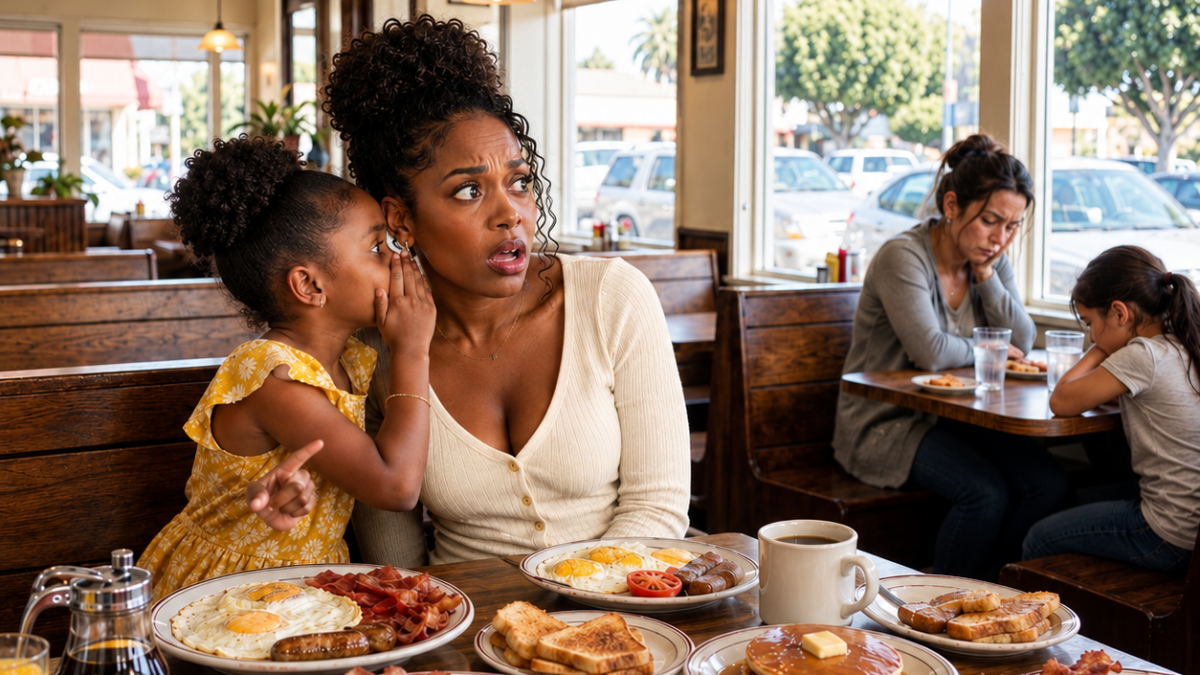
PART 2
For 8 years, she had believed the danger, if there had ever been any, died with her husband.
Sitting in that quiet vault room with evidence of fraud spread across the table and a warning she was only now hearing 9 years too late, Nadia understood for the first time that the story wasn’t finished, and it might never have stopped watching her at all.
She thought back, unwillingly, to small moments over the years that had never quite made sense at the time.
Richard always steering conversations away whenever Nadia brought up wanting to review Marcus’s old work files.
Richard gently discouraging her, more than once, from reaching out to former colleagues at Halden Freight, insisting it would only reopen wounds better left closed. At the time, she had taken it as kindness, a friend trying to spare her more pain. Now, laid out beside a folder of falsified transfers, it looked like something else entirely.
It looked like management.
“He came to Marcus’s funeral,” Nadia said quietly, almost to herself.
“He gave a eulogy.
He said Marcus was the most honest man he’d ever worked with.
” Claire’s expression didn’t hide her disgust.
“People who do this kind of thing are usually very good at looking sincere.
It’s part of how they get away with it for so long.”
Nadia gathered the documents carefully, sliding them back into the folder with hands that had finally stopped shaking, replaced now by something steadier and colder. Grief had made her pliable for 8 years. This felt like the opposite of grief.
“We need to be careful,” Claire said.
“If Richard finds out this box has been opened, he’ll know immediately that someone is asking questions again.
Last time, that cost me my job, my apartment, and nearly 2 years of looking over my shoulder every time I I the house.
” “Then we won’t tell him, Nadia said.
Not yet.
Not until we understand everything we’re looking at.
Mr.Pierce returned to the viewing room a few minutes later to check on them, and Nadia thanked him, careful to keep her voice steady, careful not to let a single flicker of what she now knew show on her face. She had spent eight years being underestimated by people who assumed grief had made her passive. For the first time, she understood that assumption could be useful.
Outside, the late morning sun felt almost aggressively normal against the weight of what she was carrying. Claire walked beside her in silence for several minutes before finally speaking again.
“What happens now?”
she asked. Nadia looked down at the folder in her hands, then up at the ordinary street full of ordinary people who had no idea what she just learned.
“Now,” Nadia said, “I stop letting other people decide what my husband’s death means.”
The days that followed felt like living two separate lives stitched clumsily together. In one, Nadia packed school lunches, answered emails at her desk, helped Daniela with spelling homework, and smiled through the small rituals of an ordinary week.
In the other, she lay awake each night turning over financial records in her mind, replaying eight years of conversations with Richard Hale, searching for every small lie folded inside his kindness.
She hadn’t told anyone else what she’d found.
Not yet. Not until she understood the whole shape of it.
Claire came by one evening after the girls had gone to bed early, worn out from an afternoon spent playing in Nadia’s backyard, a friendship blooming between Lily and Daniela with the easy speed only children seem capable of.
The two women sat at Nadia’s kitchen table with the folder between them and a laptop Claire had borrowed from a friend.
“There’s a name on one of the transfer records I didn’t recognize before,” Claire said, turning the laptop screen toward Nadia.
I looked it up.
It’s a storage facility.
Same city, different branch than the bank.
” Buried among the financial records was a second reference, a unit number, and beneath it, in the corner, initials that matched a code from Marcus’s letter Nadia hadn’t been able to place until now.
They drove out that weekend, telling the girls only that they had errands to run. The storage unit was small, unremarkable, tucked into a long row of identical metal doors on the outskirts of town. Inside, they found a single locked case, and inside that, alongside more documents, a small flash drive taped to the underside of the lid.
Nadia’s hands shook as she plugged it into Claire’s borrowed laptop that night, once both girls were finally deeply asleep.
A video file opened.
Marcus’s face filled the screen, thinner than she remembered, tired in a way that broke her heart all over again, but unmistakably, achingly her husband.
“Nadia, if you’re watching this,” he said, “it means I ran out of time before I could finish clearing things up the right way.
I need you to know something first before anything else. I never stopped loving you and Daniella.
Everything I did these last few months, the late nights, the distance, the things that must have looked like I was pulling away, all of it was because I found something at work I couldn’t ignore, and I was trying to protect you from the fallout before I brought it to you.”
Nadia pressed a hand to her mouth,
tears falling freely now.
“Richard has been moving company funds for over a year,” Marcus continued.
“I found the pattern by accident, and once I started looking, I couldn’t stop.
I’ve been documenting everything I can quietly because I don’t know yet how far this goes inside the company, and I don’t know who else might be involved.
If something happens to me before I can go to the authorities with proof, I need you to trust that I wasn’t careless, and I wasn’t failing you.
I was trying to make sure our family would be safe, no matter what happened to me.
He paused, and for a long moment, he simply looked at the camera, the way a person looks at someone they’re afraid they won’t see again.
Tell Daniela her dad loves her more than anything in this world.
Tell her I was trying to build something worth leaving behind, even if it doesn’t look that way right now.
The recording ended. Nadia sat frozen in the silence that followed, the weight of eight years of quiet, private doubt lifting off her chest all at once, replaced by something both lighter and infinitely heavier. The truth, finally, after nearly a decade of living without it.
“He didn’t fail us,” she whispered.
“He was trying to save us.”
Claire reached over and squeezed her hand, saying nothing because there was nothing that needed saying. Later, after Claire had gone quiet scrolling through the remaining files on the drive, her expression suddenly shifted.
“Nadia,” she said carefully, “there’s more on here.
Marcus named someone else. Someone who helped Richard after your husband died.
Someone who helped make sure nobody kept asking questions.”
Nadia’s chest tightened.
“Who?”
Claire turned the screen toward her, and Nadia read the name typed plainly across a financial disclosure form, a name she had trusted completely for eight straight years. Her face changed instantly, all the color draining from it at once.
Because she knew exactly who that person was.
The name belonged to Marissa Cole, the accountant who had handled Nadia’s own finances in the chaotic months after Marcus’s death.
A woman Richard himself had recommended, praising her thoroughness, her discretion, her willingness to help a grieving widow untangle a household’s worth of paperwork she’d never had to manage alone before.
Nadia had trusted Marissa’s numbers without question for years, never once imagining that the very person organizing her late husband’s estate might have been helping bury the evidence of what had actually happened to him.
“She handled my accounts,” Nadia said slowly, the realization settling over her like ice water.
“For years.
She had access to everything. Every file, every record, every account Marcus ever touched.
“If she was helping Richard cover the transfers,” Claire said, “she’d have had every opportunity to make sure nothing incriminating ever surfaced in your paperwork.
And she’d have known immediately if you ever started asking the wrong questions.
” Nadia thought back to a handful of moments that had once seemed like nothing.
Marissa gently discouraging her from hiring an outside auditor to save on unnecessary fees, Marissa always present at the same dinners and holidays as Richard, the two of them exchanging glances Nadia had never thought twice about.
She had spent eight years surrounded, without realizing it, by the very people responsible for the silence around her husband’s death.
“I let her into my life,” Nadia said, her voice hollow.
“I let both of them into my life.”
“You trusted people who were counting on exactly that,” Claire said gently.
“That’s not a failure on your part, Nadia.
That’s what manipulation looks like when it’s done well.
It doesn’t feel like manipulation while it’s happening.
It feels like kindness.
” Nadia closed the laptop slowly, as though closing it might somehow contain the enormity of what she just learned, even though she knew it wouldn’t.
Down the hall, she could hear the faint, steady sound of Daniella’s breathing through the baby monitor she still kept out of habit.
And something in that small, ordinary sound anchored her enough to keep her from unraveling completely.
“I need to think,” Nadia said, “about how we do this.
About how we prove all of it without putting the girls in danger.”
Claire nodded, gathering the drive and the folder carefully.
“We’ll figure it out together.
You’re not doing this alone anymore.
For the first time since Nadia had opened that sealed envelope, she let herself believe that might actually be true.
Nadia didn’t confront anyone right away.
Instead, over the following 2 weeks, she did something that surprised even her. She waited, watched, and gathered, moving carefully instead of emotionally for the first time since this had all begun.
She reached out quietly to a private investigator named Frank Delgado, a retired financial crimes detective a coworker had once mentioned in passing. Frank listened to her story without interrupting, examined the documents from the safety deposit box and storage unit with a practiced patient eye, and confirmed what Nadia had already begun to suspect.
“This isn’t amateur work,” Frank told her.
“Whoever structured these transfers knew exactly how to stay under audit thresholds.
That takes either real financial expertise or someone with access to the company’s internal systems.
Possibly both.”
“Marissa Cole handled all my personal accounts after my husband died,” Nadia said.
“She would have had exactly that kind of access.”
Frank nodded slowly.
“Then it’s worth finding out whether her fingerprints are on any of this, too.
” Over the following days, Frank helped Nadia and Claire begin quietly building a case, cross-referencing dates, tracing account numbers through public filings, identifying a pattern of shell accounts that all led back, eventually, to signatures belonging to either Richard Hale or Marissa Cole.
It was slow, painstaking work, done mostly late at night after the girls were asleep, fueled by lukewarm coffee and a shared determination neither woman fully articulated but both understood completely. Nadia continued seeing Richard occasionally during this period, careful to behave exactly as she always had, friendly, grateful, unassuming.
She let him believe nothing had changed even as she quietly tested the edges of his story, mentioning offhand that she’d been going through some old boxes of Marcus’s things, watching his reaction carefully.
He didn’t flinch outwardly, but something in his eyes sharpened, just slightly, just long enough for Nadia to notice.
“You should let the past stay in the past,” Richard told her gently over coffee one afternoon in the same soothing tone he’d used for 8 years.
“Digging through old memories rarely brings peace, Nadia.
It just reopens wounds.”
For the first time, Nadia heard those familiar words differently, not as comfort, as a warning dressed up as concern.
“I appreciate you looking out for me,” she said carefully, matching his calm with her own.
“I think I just need closure.
That’s all.”
She watched him relax slightly at that answer, mistaking her composure for the same passivity he’d relied on for years.
Meanwhile, Claire had her own reckoning to face.
One evening, sitting on Nadia’s back porch while the girls chased fireflies across the yard, she finally admitted the deeper reason she’d carried her silence for so long.
“I told myself I was protecting Lily by staying quiet,” Claire said.
“But really, I think I was just protecting myself.
I was scared and it was easier to disappear than to fight.
I don’t want her growing up thinking that’s the answer.
I don’t want her afraid of the truth the way I was.
“You’re not that person anymore,” Nadia said.
“Look at what you did.
You carried Marcus’s letter for 8 years.
You found me.
You didn’t have to do either of those things.”
Claire wiped her eyes quickly, embarrassed, and managed a small laugh.
“I think I was just waiting for someone brave enough to make it easier to be brave, too.”
By the end of the second week, Frank had assembled enough documentation to move forward.
Forged approval signatures, falsified internal transfer records, and financial statements that didn’t match what had actually been filed with regulators.
“It was enough,” Frank said, “to bring in outside authorities without tipping off Richard prematurely.”
But Richard, it turned out, was paying closer attention than any of them realized. He called Nadia late one night, his voice stripped of its usual warmth.
“I heard you’ve been asking around about old company records,” he said.
“I think very carefully before you go any further with this, Nadia.
For your sake, and for Danielle’s.”
The threat, thinly veiled behind concern, confirmed everything Nadia had spent 2 weeks trying to prove.
“You had 8 years to convince me my husband was a failure,” Nadia said, her voice steady despite the pounding of her heart.
“You don’t get another year to keep me quiet.”
She hung up before he could respond, hands shaking, but for the first time in a long while, not from fear. She called Frank immediately, relaying the conversation word for word while it was still fresh, her voice steadier than she expected.
Frank listened carefully, then went quiet for a moment on the other end of the line.
“That’s not a man being cautious,” Frank said finally.
“That’s a man realizing he’s about to lose control of a story he’s been managing for 8 years.
People like that don’t sit still once they feel cornered.
They act.”
“Act how?”
Nadia asked.
“He’ll try to protect himself,” Frank said.
“Which usually means one of two things.
He’ll try to discredit you before you can bring anyone official into this.
Or he’ll try to make sure whatever evidence still exists disappears before anyone else can see it.”
Nadia thought immediately of the remaining files still sitting in Frank’s office, of the flash drive now locked in a a deposit box under Claire’s name at a different bank entirely of every fragile piece of proof that had taken eight years to surface and could apparently still be lost in a single night if they weren’t careful.
“We need to move faster than we planned.”
Nadia said.
“Agreed.”
Frank replied.
“I’ll reach out to a contact I still have at the District Attorney’s Office first thing tomorrow.
In the meantime, keep everything you have somewhere secure and don’t meet with Richard alone, no matter how calm he sounds.
” That night after the call ended, Nadia sat on her back porch long after Claire had taken Lily home, staring out at the dark yard where the girls had been chasing fireflies only hours earlier, trying to reconcile the ordinary shape of her evening with the danger she now understood was circling closer than she’d let herself believe.
She thought of Marcus’s voice on the recording, steady even in fear, still trying to protect her from three days away.
She thought of Daniella’s small hand sliding under the table the moment she’d sensed her mother’s world tilting.
She thought of Claire carrying a secret in a stranger’s grief for eight years because she hadn’t known where else to put it.
Whatever Richard was preparing to do next, Nadia understood with sudden unshakable clarity that she would not be facing it the way she once might have, alone, uncertain, easily managed. She had people beside her now. And she had the truth.
That, she decided, watching the porch light flicker gently against the dark, would have to be enough.
The break-in happened two nights later at Frank’s small downtown office.
A single window forced open, files scattered, his backup drive missing entirely. Nadia got the call just after midnight, and by the time she and Claire arrived, Frank was standing in the wreckage of his own office looking more frustrated than afraid.
“Whoever did this knew exactly what they were looking for.”
Frank said grimly, gesturing at the emptied filing cabinet.
They didn’t touch anything unrelated.
Just the Halden Freight files. Nadia felt the floor tilt beneath her. The flash drive is still safe, Claire said quickly.
It’s in the deposit box under my name.
They don’t know that.
Relief washed through Nadia, quickly replaced by a colder realization. But the physical documents, the bank statements, the transfer records. Copies, Frank said.
I scanned everything the first week you brought it to me.
The originals are what’s missing, but the digital files are backed up somewhere they don’t know to look.
It was a small mercy, but it wasn’t enough.
Without the flash drive’s recording and the full documentation trail properly presented, Frank explained, they still didn’t have quite enough to guarantee an airtight case, especially if Richard and Marissa had already begun covering their tracks in response to Nadia’s questions.
That night, lying awake long after Daniella had fallen asleep beside her, having climbed into Nadia’s bed sensing her mother’s unease without understanding its source, Nadia found herself replaying old memories, searching for anything Marcus might have left behind that she hadn’t yet found.
And then, unexpectedly, it was Daniella who remembered something first. The next morning, over breakfast, Daniella mentioned, almost in passing, a memory from years earlier. Too young at the time to understand its meaning, old enough now to recall the shape of it clearly.
“Dad used to keep things in the old radio in the garage,” she said, “the broken one.
He said it was his secret hiding spot and I could never tell you because it would ruin the surprise.
” Nadia set down her coffee cup very slowly.
“What surprise, sweetheart?”
Daniella shrugged, unbothered.
“He never said.
He just laughed and told me it was a secret.”
Nadia went to the garage before she’d even finished getting dressed, pulling boxes aside until she found the old broken radio Marcus had never gotten around to fixing, sitting untouched on a shelf for nearly a decade.
Inside, tucked behind the speaker panel, was a small memory card wrapped carefully in plastic. She brought it to Frank that same afternoon.
The card contained a second recording, shorter than the first, made just hours before Marcus’s death.
This one more urgent, his voice tighter, more afraid.
He named Richard directly, described specific transactions, and critically mentioned a meeting scheduled for that evening where he’d planned to confront Richard directly with what he’d found, accompanied by a colleague from the
compliance department as a witness.
He never made it to that meeting.
The recording, combined with Frank’s remaining digital copies and Claire’s decade-old testimony, was finally enough.
Frank’s contact at the district attorney’s office agreed to open a formal investigation, quietly enough to avoid tipping off Richard before authorities were ready to act.
Two weeks later, it was over almost faster than Nadia could process.
Richard was brought in for questioning, the falsified records laid out before him with a precision that left little room for the same practiced denials he’d relied on for 8 years.
Marissa’s involvement surfaced soon after, her carefully maintained accounts unable to withstand the scrutiny of investigators who finally knew exactly where to look.
Nadia sat in a small conference room during part of the formal interview process, not required to be there but unwilling to be anywhere else, watching as Richard’s composure finally, completely broke.
“For 8 years,” Nadia told him, her voice calm in a way that surprised even her, “you let me believe my husband died a failure.
You let me grieve a lie you built specifically so I’d never look too closely.”
Richard said nothing. There was finally nothing left for him to say. As officers escorted him out, Nadia turned to Claire, who had come along to give her own statement, and asked the question that had been sitting quietly in the back of her mind since that first Saturday morning.
Why did you finally come to that diner? Nadia asked. That morning of all mornings?
Claire looked over at Lily, who was sitting nearby coloring, blissfully unaware of the enormity of what her mother had just helped uncover. Because I was about to give up, Claire admitted quietly.
I decided that morning would be the last time I let her go hungry pretending it was temporary. I was going to figure something out no matter what it took. I just never imagined the answer would be you.
Nadia felt the full weight of that admission settle over her. The strange quiet way that two families worst mornings had somehow intersected into something neither of them could have predicted. She thought about how easily she could have kept her eyes on her own plate that Saturday.
How easily the whole diner full of people could have looked past the window booth the same way they’d been doing for as long as Claire and Lily had been sitting there.
Danielle is the one who noticed you, Nadia said. I almost missed it entirely.
Kids notice what we’ve trained ourselves not to see, Claire said.
I think that’s part of why it felt safe to let her see us.
Grown-ups look away out of habit.
Children haven’t learned that habit yet.
Frank appeared in the doorway a moment later. Holding a folder of paperwork that represented, Nadia understood, the formal official end of eight years of unanswered questions.
The DA’s office says this is about as clean a case as they’ve seen in a while, he told them.
Between the recordings, the documents, and both your statements, they don’t expect this to drag out.
What happens to the company? Nadia asked.
Restructuring most likely, Frank said. New leadership.
There’s already talk of a settlement fund for affected shareholders and employees, and given the paper trail, your husband’s name is going to be cleared publicly, not just in some quiet internal report nobody reads.
” Nadia hadn’t let herself think that far ahead, that Marcus’s name, tangled for eight years in whispered assumptions about failure and carelessness, might finally be spoken with the respect he’d actually earned trying to protect his family.
“He’d want people to know the truth,” Nadia said.
“Not for his sake, for Daniella’s.
So she never has to wonder if her father was the man people quietly implied he was.”
Claire reached over and squeezed her hand one more time before they gathered their things to leave. The conference room finally emptying of the tension that had filled it for the better part of two weeks.
Outside, the afternoon sun felt almost startlingly ordinary, the kind of light that didn’t seem to know anything monumental had just happened beneath it.
Nadia breathed it in anyway, deeply, like something she intended to remember. The weeks that followed unfolded with a quieter kind of momentum. The investigation into Halden Freight moved forward in the hands of people equipped to handle it.
Auditors, attorneys, a district attorney’s office building a case methodical enough to withstand whatever defense Richard’s lawyers eventually mounted.
For the first time in eight years, Nadia found herself able to step back from Marcus’s story and simply live inside her own again.
She used part of the settlement fund the company had established, once it became available, to help Claire find a small apartment closer to Nadia’s neighborhood.
Close enough that Lily could switch to Daniella’s school without much disruption.
Claire resisted at first, the same instinct for pride and self-reliance that had kept her from asking for help at the diner rising up again.
“I’m not rescuing you,” Nadia told her gently, sitting across from Claire’s kitchen table in the new apartment, boxes still half unpacked around them.
I’m helping you, Stan.
There’s a difference, and I think you know it.
Claire nodded slowly, something in her posture finally relaxing in a way Nadia hadn’t seen since that first Saturday morning in the diner.
Claire found steady work soon after, bookkeeping for a small local business owner who valued her thoroughness and, crucially, never once made her feel like her past struggles defined her present worth. Watching Claire settle into that stability, Nadia felt an unexpected kinship.
Two women who had each spent years being underestimated, quietly rebuilding lives out of circumstances that had tried hard to convince them they couldn’t.
Daniella and Lily, meanwhile, became inseparable in the effortless way young children often do, moving from cautious play dates to full weekends spent back and forth between each others’ homes within a matter of months.
One afternoon, Nadia overheard the two of them talking on the back porch, Lily asking Daniella why she’d noticed her at the diner that morning in the first place.
“Because you looked hungry,” Daniella said simply.
“A lot of people probably saw that,” Lily said.
“Why’d you say something?”
Daniella thought about it for a moment, the way children do when a question is bigger than they initially realized.
“I don’t know.
I guess I just actually looked.”
That small exchange stayed with Nadia longer than almost anything else that had happened over the past 2 months, a reminder that the entire unraveling of 8 years of buried truth had started with something as simple and as rare as a child choosing to actually look.
One quiet Sunday afternoon, Nadia visited Marcus’s grave for the first time in nearly a year, carrying with her for the first time the full and unbroken truth of who he had been.
She sat on the grass beside the headstone the way she used to in the early years, before grief had hardened into something more like distant obligation.
“I know now,” she told him quietly.
“I know you didn’t give up on us.
I know you were trying to protect us the whole time.”
She told him about Daniella, about the fierce, generous kindness their daughter had grown into, about how much of him Nadia still saw reflected in the smallest of Daniella’s gestures, a stubborn insistence on fairness, a refusal to look away from someone else’s hardship.
She told him
about Claire and Lily, about the strange, winding path that had led two struggling families back to the truth he died trying to protect. For the first time in 8 years, she left the cemetery without the familiar ache of unanswered questions trailing behind her.
That following Saturday, Nadia and Daniella returned to the diner where it had all begun, settling into a booth near the window, ordering the same breakfast they’d shared that first morning, pancakes, eggs, bacon, toast, a bowl of fresh fruit between them.
The diner
buzzed with its usual Saturday morning energy, oblivious to the fact that months earlier an ordinary breakfast at this exact table had quietly cracked open a truth buried for nearly a decade. Daniella was halfway through her pancakes when her eyes drifted, almost instinctively, toward another booth near the far wall, where a mother sat with two restless younger children, her expression tight with the particular exhaustion of trying to manage more than she currently had the resources to manage.
Daniella set down her fork
slowly.
“Mom,” she said quietly, leaning toward Nadia the way she had that first unforgettable morning.
Nadia looked at her daughter, already sensing, with a warmth that spread through her entire chest, exactly what was coming.
Before Daniella could finish her thought, Nadia noticed movement near the diner’s entrance, a familiar figure pushing through the door, scanning the room until her eyes landed on their booth.
Claire waved, weaving between tables with Lily trailing close behind her. Both of them dressed for a Saturday that had clearly started with far less uncertainty than the one that had brought them together months earlier.
“We were driving by.”
Claire said, sliding into the booth beside Nadia without waiting for an invitation. The easy familiarity of real friendship having replaced the careful politeness of strangers.
“Lily saw the diner and insisted.”
“I wanted pancakes.”
Lily said matter-of-factly, already eyeing Daniella’s plate with the shameless confidence of a child who knew without question that she’d be fed.
Nadia laughed, waving down the waitress to order another round for the table. Watching as Daniella slid over to make room, the two girls immediately falling into easy conversation about something that had happened at school that week.
It struck Nadia, watching the four of them settle into the booth together, just how completely the diner’s meaning had transformed since that first Saturday morning.
What had once been the site of a quiet, private ache, a woman hiding coins in her palm, a daughter watching plates of food she couldn’t have, had become something else entirely.
A place where two families who might never have crossed paths had found each other, and in finding each other had found their way back to a truth that had been waiting nearly a decade to surface.
“You were about to say something.”
Claire said to Daniella, nodding toward the booth across the room where the tired mother was still managing her two younger children. Daniella glanced over again then back at Nadia.
“Should we help them?”
Nadia felt the question settle into her chest with a quiet, powerful sense of completeness, an echo of the exact words that had changed everything months earlier, now returning not as a crisis but as a choice her daughter had learned to make on her own without needing to be
prompted.
“What do you think?”
Nadia asked her.
Daniella didn’t hesitate.
“I think we should always help when we can.
Nadia reached over and squeezed her daughter’s hand, glancing at Claire, who was already smiling, already understanding exactly what this moment meant without needing it explained.
“Then let’s go see what they need.
” Nadia said.
They approached the tired mother’s table together, Nadia and Claire moving in the easy, practiced rhythm of two people who had learned from hard experience exactly how to offer help without making it feel like pity.
pity.
The woman looked up, startled at first, the same flicker of defensive pride crossing her face that Claire’s had carried months earlier.
“I know this might sound strange coming from strangers,” Nadia said gently, “but we’ve been where you’re sitting.
Can we help with breakfast today?”
The woman’s eyes welled up almost instantly, the exhaustion of the morning finally cracking under the weight of an offer she clearly hadn’t expected.
“You don’t have to do that.
” “We know,” Claire said, smiling.
“We’re doing it anyway.”
By the time they returned to their own booth, the woman’s table had two fresh plates of pancakes on the way, her younger children already brightening at the promise of food, and Daniella and Lily were grinning at each other with the particular satisfaction of having witnessed something they both understood mattered, even if they couldn’t yet put words to exactly why.
Nadia settled back into her seat, watching the whole diner carry on around them, full of its usual Saturday morning noise, utterly unaware that the same booth girl had once whispered five words that changed everything was now the site of another small, quiet act of noticing.
Across the diner, the woman they’d helped caught Nadia’s eye one more time and mouthed a quiet, sincere thank you, the same fragile relief Nadia remembered seeing on Claire’s face months earlier, before either of them had any idea how far that single act of kindness would eventually
reach.
Nadia smiled back, understanding now in a way she never had before that first Saturday morning, that a gesture that small could hold that much weight.
“You know,” Claire said, watching the woman across the room finally relax as her children ate, “maybe we didn’t find each other that morning by accident.
Maybe we were finally brought back to each other.”
Nadia thought about the long, improbable chain of events that had led them here.
Marcus’s late-night visit to a stranger’s accounting office nearly 9 years earlier, a folded letter carried faithfully for eight of those years, a little girl’s hunger catching another little girl’s attention on an ordinary Saturday morning, and a mother’s decision to walk across a diner instead of looking away.
“If Daniella hadn’t noticed you,” Nadia said, “I don’t think any of this would have happened.
Marcus’s name would still be tangled up in a lie.
I’d still be grieving a version of him that was never true.
And I’d still be running,” Claire admitted.
“Still teaching Lily that the safest thing to do with the truth is bury it.
” They sat with that for a moment, the weight of it settling comfortably now instead of painfully, the way truth eventually does once it’s finally been allowed to surface completely.
Nadia looked over at Daniella, who was carefully cutting her pancakes into the same small triangles she always did, utterly unaware of the magnitude of what her simple, instinctive kindness had set into motion months earlier.
“Come here for a second,” Nadia said.
Daniella slid closer, and Nadia wrapped an arm around her, pressing a kiss to the top of her head.
“Never underestimate what happens when you notice someone everyone else has learned to look past,” Nadia told her.
“You did that.
You’re the reason all of this happened, the good and the hard parts both.
” Daniella considered this seriously, the way she considered most things, then looked over at the family across the room, now laughing together over a shared plate of bacon.
So, we should always help when we can.
“Always.”
Nadia said without hesitation.
Claire reached over and took Nadia’s hand across the table, and for a moment the two of them simply sat there, surrounded by their daughters in the same diner where an ordinary Saturday morning had quietly become the beginning of everything.
A buried truth uncovered, a husband’s name finally restored, two families rebuilt not out of tragedy alone, but out of the simple radical decision to actually look at the people everyone else had learned to overlook.
Outside the
diner window, the Saturday morning traffic moved on exactly as it always had, cars pulling in and out, people carrying on with ordinary lives that had no idea what had just unfolded over a shared plate of pancakes. But inside, at a booth by the window, two families who had found each other through nothing more than a whispered observation sat together, finally fully whole.
Later that afternoon, as they gathered their things to leave, Daniella lingered by the window a moment longer, watching the family they’d helped walk out together toward the parking lot.
The mother’s shoulders visibly lighter than when she’d walked in.
Daniella turned back to Nadia with a quiet satisfaction of someone who had learned firsthand now exactly what her mother had been trying to teach her all along.
“I think that’s my favorite kind of morning.”
Daniella said simply.
“Mine, too.”
Nadia said, taking her daughter’s hand as they walked out into the bright afternoon sun, Claire and Lily close behind them.
For lives woven together now by nothing more complicated and nothing more powerful than someone choosing to notice. Sometimes kindness feeds a hungry person for one morning. Sometimes it uncovers a truth buried for nearly a decade.
And sometimes the person you stopped to help is quietly carrying the very answer you’ve spent your whole life searching for.
THE END.

