Single Dad Helped a Wheelchair Woman on the Road—Never Knowing She’d Change His Fate (Part 1)
Single Dad Helped a Wheelchair Woman on the Road—Never Knowing She’d Change His Fate (Part 1)
PART 1
Daniel Carter drove past her. His foot never touched the brake. His eyes caught her—a woman in a wheelchair, rain, mud.
His brain did the math in under two seconds, and his foot stayed on the gas. He made it 40 yards.
Then something he couldn’t name grabbed the wheel and turned him around. He sat in the dark with his hazards blinking, hands tight, jaw tight, watching three other cars blow past without slowing.
And he thought, “That’s me. That was me.” 40 yards ago. That was exactly me.
He got out of the truck. He didn’t know her name. He didn’t know she was worth $4.3 billion. He didn’t know that the 40 yards he almost didn’t come back for were going to change every single thing about his life.
The rain had been falling since 8:00. And by the time Daniel Carter turned his old Ford onto Highway 183, it had gone from bad to mean. Not the soft kind of rain that farmers pray for. The kind that comes sideways, the kind that makes windshield wipers useless and turns dirt shoulders into soup.
Daniel pressed his palm against the defroster vent out of habit. Even though he knew the heat in this truck hadn’t worked right in two winters, he turned the radio up slightly. Not because he wanted music, but because he couldn’t stand the sound of nothing. Silence in a truck cab at midnight means you’re alone.
And Daniel Carter was always alone these days, and he had learned that some things are better covered with noise. His phone was propped on the dash. No calls, no texts. Sophie was with Mrs. Hernandez next door, which meant she was safe, which meant he could exhale, at least until he got home.
He was running the math in his head the way he always did on the drive home. $34 in checking, two overdue invoices, a property tax notice from the county that had been sitting on his kitchen counter for 11 days because every time he picked it up, his hands did something embarrassing.
The shop had been bleeding money for 18 months. He knew it. His accountant knew it. The bank had been very polite about letting him know they knew it, too.
The job tonight had been a long-haul Kenworth with a blown airline on the interchange. And the driver had tipped him $40 in cash, which Daniel had folded carefully into his wallet and told himself he wasn’t going to spend on anything stupid. He meant it. He always meant it.
He was thinking about Sophie’s school shoes. She’d outgrown the last pair. And the left one had a piece of duct tape across the toe that he told himself nobody could see. But he knew they could.
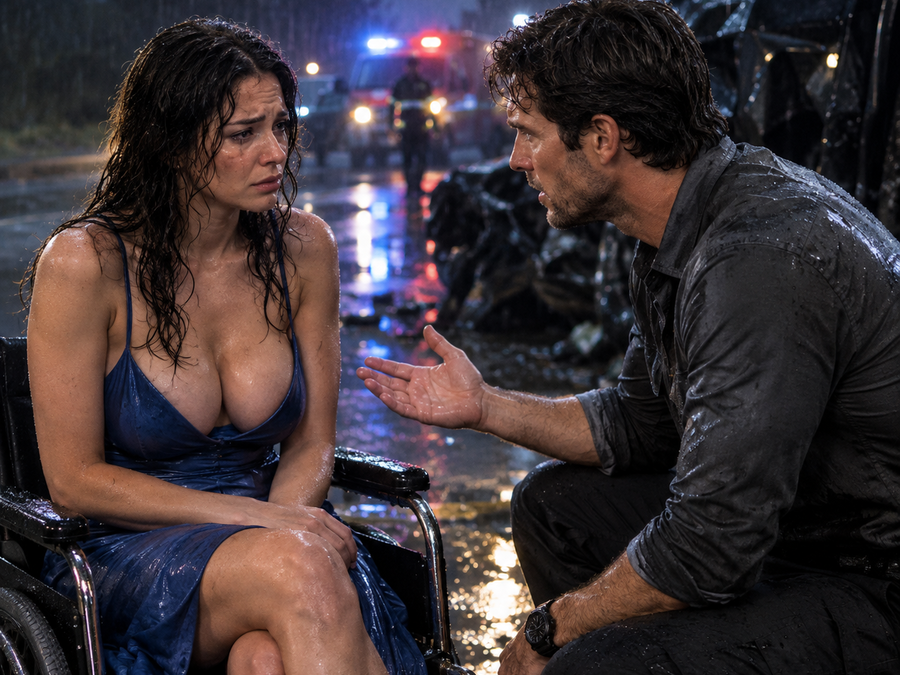
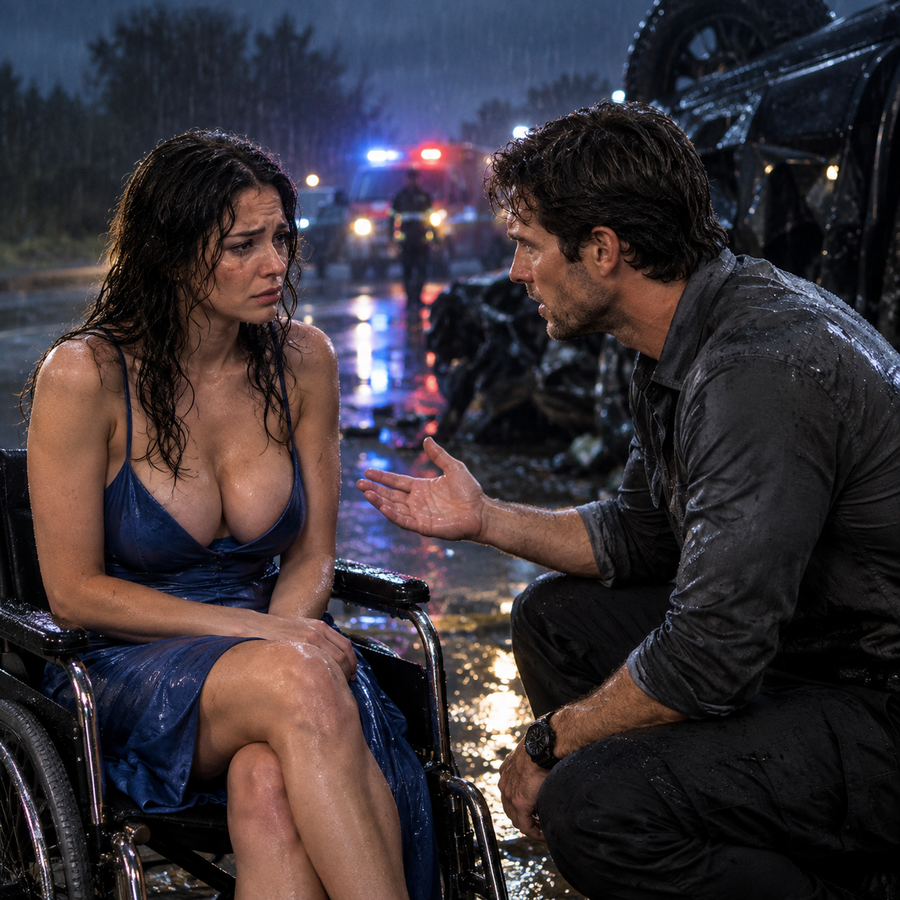
When his headlights caught something on the shoulder of the road that made his foot move to the brake without any instruction from his brain. A wheelchair, not abandoned, occupied. A woman hunched forward, both hands on the rims, trying to push herself out of a patch of mud that had the chair sunk in past the wheels.
She wasn’t screaming. She wasn’t waving. She wasn’t doing anything that would signal distress to most people driving past. She was just trying to solve the problem herself. In the dark, in the rain, alone.
Daniel sat there for two full seconds with his foot on the brake and his hazards blinking, watching three other sets of taillights continue south without slowing. He noticed that. He noticed it the way you notice a thing that you’re going to think about later when you’re trying to sleep.
Then he pulled over. He parked about 20 feet ahead of her because he’d learned a long time ago that pulling right up to a person at night can feel threatening, especially to a woman alone. He’d learned that from his wife.
Rachel had taught him a hundred small things like that. The kind of things that stay with you after the person is gone. He stepped out into the rain. It was cold, not freezing, but cold enough that it had teeth, and his jacket was an old canvas work jacket that didn’t do much against wind.
He jogged back to where she was. She heard him coming and her head snapped up. The look on her face was not the look of someone who was relieved. It was the look of someone calculating a threat.
“Ma’am,” he started. “I’m fine.” Her voice was steady, low, the kind of voice that was used to being listened to.
“You’re stuck, I noticed.” He stopped a few feet away, hands loose at his sides. Visible. He’d learned that one from Rachel, too. Let people see your hands.
“Can I help you get onto solid ground? That’s all.” She looked at him for a moment. Really looked. The way people look when they’re deciding whether someone is dangerous.
“I don’t need anyone to call for me,” she said. “My phone is dead. I just need to—I just need a minute.”
“Okay.” He didn’t move. She tried to push again. The wheels spun. The mud held.
“I can push from behind,” he said. “Just a few feet to the right. The pavement’s right there.” She was quiet.
“I’m a mechanic,” he offered. As though that explained anything. “I’m used to things that don’t move.” Something in her expression shifted. Knots softened. More like recalculated.
“Fine,” she said. “A few feet.” He positioned himself behind the chair, found the handles, and pushed. The mud let go with a sound like a complaint, and within four seconds, the wheels were on pavement.
“There you go.” She turned and looked at him again. Up close, he could see that her coat was expensive, even soaked through. It was the kind of coat that cost more than his monthly truck payment. Her hair was plastered flat against her face. She was somewhere in her mid-40s, maybe, with the kind of bone structure that made you think she’d been considered beautiful by a lot of people for a long time. Her hands resting on the wheels were white from the cold.
“Thank you,” she said. Formal, like she was signing off on a document.
“You got somewhere to be? Somebody I can call?” “My driver was supposed to—” She stopped. “He got the pickup location wrong. He’s 20 minutes out.”
Daniel looked at the sky, looked at her, looked at the shoulder of 183, which was not, by any measure, a safe place to wait 20 minutes in the dark and the rain.
“I’ve got a truck,” he said. “Nothing fancy, but it’s dry.” “That’s not necessary.” “No,” he agreed. “It’s not.”
He walked back to his Ford, opened the passenger door, and got a blanket from behind the seat, the old wool one he kept for emergencies, and walked back to her. He held it out. She looked at it, then at him.
“What’s your name?” she said. “Daniel. Daniel Carter.” “Victoria,” she said, and didn’t offer a last name.
He draped the blanket around her shoulders and she allowed it. Which told him something. When someone who doesn’t want help accepts a blanket, they’re colder than they want to admit.
“The storm’s getting worse,” he said. “Road ahead is flooded past the turnoff. I just came through it. Your driver’s not going to get here in 20 minutes. It might be longer.”
She pulled the blanket tighter. “I have a place,” he said. “10 minutes up the road. My daughter’s at the neighbors. You could wait there. Get warm. Charge your phone.”
She said nothing for a long moment. “You don’t know me,” she finally said. “No, ma’am.” “Then why are you doing this?”
Daniel thought about it. Honestly, not the polished answer, the real one. “Because my daughter’s going to ask me what I did today,” he said. “And I’d like to have something to tell her.”
Victoria stared at him. Then she said, “All right, Daniel Carter. 10 minutes.”
Getting her into the truck took some doing. The Ford had a high step. It was built for hauling, not for accessibility. And Daniel approached the problem the way he approached any mechanical challenge. Study it. Don’t rush. Find the leverage point.
“Tell me what works better for you,” he said. “I don’t want to assume.” She looked mildly surprised by that. “Left side stronger,” she said.
“Okay.” He braced the chair. She transferred herself to the seat with a kind of efficient, practiced motion that made it clear she’d been doing this long enough that she didn’t need commentary about it. And he broke down the wheelchair and loaded it in the truck bed under a tarp. He rigged over it with bungee cords.
By the time he climbed in the driver’s side, she was sitting with the blanket around her shoulders, looking straight ahead. “Seat gets a little cold on the passenger side,” he said, starting the engine. “Heater kicks in after about two miles. I’ve been meaning to fix that.”
“You’re the mechanic who drives a truck with a broken heater.” “The cobbler’s children have no shoes,” he said. She glanced at him. “My daughter’s idea,” he added. “She’s nine. She heard it somewhere and she uses it every time I apologize for something being broken in the house.”
“Smart kid.” “Too smart,” he said. “It’s starting to be a problem.”
He pulled back onto the highway. The rain hammered the windshield. He hadn’t had a passenger in a long time. Rachel used to ride with him sometimes. Back before Sophie was born. When they were first married and everything was new, and taking a drive at night felt like an adventure rather than a commute. She’d put her feet up on the dash and he’d told her not to because of the airbag, and she’d done it anyway, every single time. And now the thought of someone not putting their feet on his dash gave him a hollow feeling that he couldn’t name and didn’t try to.
He kept the radio low. Victoria didn’t speak much, but she wasn’t the uncomfortable kind of quiet. She was the kind of person who only talked when she had something to say. And Daniel respected that immediately because he was the same way.
She did look at his hands on the wheel. “You’ve been working tonight,” she said. “Yes, ma’am. Late call. Blown airline on a semi, interchange 183 and 71. Guy was stuck for three hours before he got to me.” He paused. “Dispatch service runs me for the county. After hours, I take what comes in. And before that, shop. I run a small repair shop off County Road 12. Usually 6 to 6.”
She was quiet. “Long day,” she said. “Most of them are.” He said it without self-pity. Just the facts of his life reported accurately. She seemed to register the absence of complaint in it.
“What happened to your wife?” she asked. He looked at her. “The pictures,” she said quietly. “On your visor.” He glanced up. He’d forgotten about those. Sophie had taped them there years ago. One of the three of them at the state fair. One of Rachel in the backyard holding a sunflower. One of just Sophie as a baby, blurry and perfect.
“Three years ago,” he said. “Ovarian cancer.” A pause. “Me, too.” He meant it the way he always meant it. Not as a social nicety, as a statement of ongoing fact. He was still sorry. He expected he would be for a long time.
The house was dark when he pulled up, which was the way he’d left it. It was a farmhouse from the 1960s that needed work. And in the full spirit of the cobbler’s children, about 60% of that work was still waiting for his attention. The porch light was out. Bulb had been gone for a week, and he made a note to fix that before Sophie came home in the morning.
He helped Victoria down from the truck, got her chair set up. She wheeled herself up the ramp he’d built on the side of the porch. He’d built it originally because his neighbor Jim had come over sometimes, and Jim used a power chair. And you build a ramp when your friend needs one. That’s just what you do. And waited while he unlocked the door.
Inside, he turned on the kitchen light. He saw it with her eyes for a moment. The dish rack with two mugs, the pile of mail on the counter, the crayon drawing on the refrigerator that Sophie had made of the two of them. Him approximately 9 feet tall and her approximately the same height. Both of them round and yellow like suns. The tool catalog stacked on the table. The work boots by the door.
” Coffee,” he said. “God, yes.” He almost smiled. He made coffee the old-fashioned way on the stove because the machine had given out in February and he hadn’t replaced it yet. Victoria had wheeled to the kitchen table and was sitting with the blanket still around her, looking at the room with an expression he couldn’t read.
“You live here alone,” she said. “With Sophie, my daughter. She’s at the neighbors tonight.” “You trust the neighbor, Mrs. Hernandez?” “Since Sophie was born.” He poured water into the pot. “She was the first person at the hospital the night Rachel—the night Sophie was born. She was there before my own mother.”
Victoria nodded. Something moved across her face. Brief and private. “Your hands are still shaking,” he said. Not accusatory, just observational. “It’s the cold.” “How long were you out there?” She hesitated. “About 40 minutes.”
He turned. “40 minutes.” “I called my driver before my phone died. I thought—” She stopped. “It doesn’t matter.” “Why didn’t you wave someone down?” “I did. At first.” Her voice was even. Careful. “Three cars slowed. None of them stopped.”
He turned back to the stove. Let that settle. “People get afraid of what they don’t understand,” he said. “Or they’re just in a hurry.” She said it without bitterness. Which somehow made it worse. “I’ve learned not to take it personally.”
He handed her a coffee mug. It said “#1 Dad” on the side, which Sophie had given him for Father’s Day and which he used exclusively. Even when he was alone and there was nobody to see it. Victoria looked at the mug, then at him. “She gave it to me last year,” he said. “I don’t have the heart to use any other cup.”
“Smart kid,” she said again. “Terrifyingly,” he agreed.
She charged her phone on the kitchen outlet while they sat at the table. He didn’t pry and she didn’t volunteer. The rain got worse and then around 12:30 went quiet the way storms sometimes do when they’ve made their point. Her driver called at 12:45. She answered with a tone Daniel hadn’t heard from her before. Clipped. Professional. The way you talk to someone whose job is to be exact and who has failed at the one thing he was supposed to do.
“The road is still closed at the 71 overpass,” she said. “I’ll send you a pin in the morning.” She paused. “No, don’t come tonight. I’ll arrange something.” She hung up and looked at Daniel. “The roads flooded,” she said. Though he’d already told her that.
“You can stay,” he said. “Sophie’s room.” He stopped. “I mean, Sophie’s got a bed. She won’t be home until morning. You can take her room.”
Victoria looked at him for a long moment. “Mr. Carter. Daniel.” “Daniel.” “You pulled over for me on the side of a highway at midnight. You put me in your truck. You made me coffee and you’re offering me your daughter’s bed.” She paused. “Most people don’t do that.”
He shrugged. “Most people don’t get stuck in the mud.” She was quiet. “What do you want in return?” she said. He looked up. “Nothing.” “Everybody wants something.” “I want to get some sleep,” he said. “And I want the taxes on my shop to be somebody else’s problem for one night. And beyond that, I really can’t tell you because I’m too tired to want anything more complicated.”
She studied him. “You’re either the most decent man I’ve met in 20 years,” she said. “Or you’re a very good actor.” “I can barely get Sophie to school on time,” he said. “I’m not running a con.”
Something changed in her face right then. Not dramatically. Just a small, almost invisible shift, like a bolt releasing under pressure. She took a sip of the coffee, set the mug down. “The bed would be wonderful. Thank you,” she said.
He set up Sophie’s room as best he could, cleared a path for the chair, made sure the bathroom door was wide enough. It was barely. Put fresh towels on the end of the bed, and apologized twice for the stuffed animals on the pillow, which Sophie would have been deeply offended to hear described as something that needed apologizing for.
Victoria looked at the collection of stuffed animals with an expression that Daniel couldn’t categorize. Not dismissive, not sentimental. Something quieter than both. “She likes elephants,” Victoria said. There were four of them. “She said they have good memories.” Daniel said she read it somewhere and now she collects them. “I think she’s up to 11.” “Where are the other seven?” “Traveling the house. Last count. Two are in the kitchen. One is living in the truck.” “In the truck,” she said. “Henry needed to see the world.” He said it absolutely straight-faced.
And then something gave way in Victoria’s composure and she made a sound that was somewhere between a laugh and something that surprised her, and she covered her mouth with one hand. “Henry,” she repeated. “Henry the elephant.” “He’s been with me 8 months. He’s seen a lot of blown transmissions.” She shook her head. She was smiling now and it changed her face completely, like a light had been turned on in a room Daniel hadn’t known existed.
“Thank you, Daniel Carter,” she said quietly. “Good night, Victoria.” He started to leave. “The man who stopped,” she said, almost to herself. He paused in the doorway. “I beg your pardon.” She looked up. “Nothing. Good night.”
He slept four hours, which was more than usual. In the morning, he started eggs because that was what he had. He heard the chair before he saw her, the soft roll of wheels on the hallway floor, and he had a cup of coffee on the table corner before she got to the kitchen. She stopped in the doorway.
“How did you know I was coming?” she said. “Sound carries in old houses,” he said. “Eggs?” “Okay. I—yes, that’s fine.” He could tell she hadn’t expected that. He didn’t know what she’d expected. Maybe that he’d be standing there with his hand out asking for something. Maybe that last night had been a prologue to something.
He put eggs on the table and sat across from her and poured himself a second coffee and didn’t ask her anything. She ate about half her eggs and then looked at him. “You said your shop’s having trouble,” she said. He went very still. “I didn’t say that.” “You said the taxes were someone else’s problem last night.” He put his fork down. “That was—I was just talking.” “You were telling the truth,” she said. “You talk the way people do when they’re tired enough not to edit themselves.” She paused. “What kind of trouble?”
He looked at her. Measured. He was a private person about this. He didn’t talk about the money with anyone. Not Mrs. Hernandez. Not his brother-in-law. Not Sophie, who was nine and shouldn’t have to think about it. “Nothing I can’t handle,” he said.
She tilted her head slightly. “That’s what people say when they can’t handle it.” “Victoria, how long do you have on the property?” He set his coffee down. “Ma’am, I appreciate what happened last night, but I helped you because you needed help. I’m not looking to make a deal out of it.” “I’m not offering you a deal,” she said. “I’m asking a question.”
The kitchen was quiet for a moment. Outside, a mockingbird was making noise in the oak tree. Sophie called him Gerald and Daniel had been told not to shoo him. “60 days,” Daniel said finally. “Give or take. County gave me an extension in April. But there’s a developer who’s been after the land. And at some point, the math just—” he stopped, shook his head. “I don’t know why I’m telling you this.”
“Because you’re tired,” she said. “And because you know I’m not going to judge you for it.” He looked at her. She was right. He didn’t know how she was right, but she was.
“I built that shop from nothing,” he said. And for the first time, his voice had something in it that wasn’t exhaustion. “My dad taught me to work on engines in a driveway in San Marcos. I saved for 6 years to get the property. I put the lift in myself. I built the office out of reclaimed lumber from a barn that came down in 2011.” He stopped. “Sophie was born the week I opened it. Rachel cut the ribbon. There’s still a piece of it taped to the wall inside.” He stopped himself. “I’m sorry,” he said. “You didn’t ask for all of that.” “Yes, I did,” she said. “That’s exactly what I asked for.”
He looked at her. Genuinely didn’t know what to make of her. “Who are you?” he said, not rude. Honestly, curious. She considered the question like she was deciding how to answer it rather than whether to.
He nodded slowly. He understood that. He wasn’t sure he understood anything else about her. But he understood that.
Her driver arrived at 9:15. A black SUV, newer than anything Daniel had ever driven, pulled up the gravel drive with the quiet authority of expensive engineering. The driver, a young man, 30s, with the clipped manner of someone who handled logistics for a living, did a double take when he saw Daniel’s house. Then he did another one when he saw Victoria at the kitchen table with a coffee mug.
“Miss Whitmore,” he said. “Are you—is everything all right?” “Everything’s fine, Patrick,” she said. “Give us a minute.” Patrick retreated to the SUV with the manner of a man who had learned not to ask questions.
Daniel looked at the SUV, looked at Victoria. “Whitmore,” he said. She met his eyes. “Victoria Whitmore,” he said slowly. “Of—” Yes. He sat back, ran his hand over the back of his neck. “Okay. Does that change something?” she said. Her voice was careful, like she’d asked this question before and not liked the answer she’d gotten.
He thought about it. Honestly. “Not for last night,” he said. “And not for right now.” He looked at her. “You needed a place to sleep. I had one. We had eggs. None of that is different.” She looked at him for a long time. “You’re real,” she said softly. Like it surprised her. “I’m pretty tired and I’ve got a shop to open in an hour,” he said. “If that’s what you mean.”
She smiled. That real smile again, the one that lit up the room. She reached into the inside pocket of her coat, still slightly damp at the collar but otherwise recovered, and produced a card. She set it on the kitchen table. “That’s my direct line,” she said. “Not the company number. Mine.” He looked at the card, looked at her. “I’m not going to call you,” he said. “I meant what I said. I don’t want anything.” “I know,” she said. “Keep it anyway.”
She wheeled toward the door. Patrick appeared from nowhere and opened it before she got there. At the threshold, she paused. “Daniel,” she said without turning around. “Ma’am, your daughter’s right.” She said, “You’re a good dad.” He didn’t answer. He couldn’t. Exactly. She was already gone, and the black SUV was already backing down the drive.
And Daniel Carter stood at his kitchen door in the morning light with a business card in his hand and a strange fullness in his chest that he hadn’t felt in three years. He looked at the card for a long time. Then he put it in the drawer with the takeout menus and the birthday candles and the piece of ribbon from Sophie’s hair that he couldn’t bring himself to throw away. He washed the dishes. He went to work. And he told himself that was the end of it.
Three days passed. Daniel told himself he wasn’t thinking about her. He was fairly good at telling himself things. He told himself for three years that the grief would get lighter. He’d told himself the shop would turn around. He told himself Sophie couldn’t tell when he was pretending everything was fine. And Sophie, at 9 years old, had proven him wrong on that last one so many times that he’d stopped trying.
So no, he wasn’t thinking about Victoria Whitmore. He was just aware in the way you’re aware of a sound that stopped. That the kitchen felt different with the chairs back to two instead of three. That the coffee mug she’d used was still in the drying rack. That he’d driven past the section of Highway 183 twice since that night and looked at the shoulder without meaning to. That was all. That didn’t mean anything.
He opened the shop at 6:15 on a Tuesday and found Jimmy Reyes already waiting in the parking lot with his truck making a noise. A noise Jimmy described as “a kind of coughing, but angry,” which Daniel had learned over 8 years of knowing Jimmy meant the fuel injectors. He diagnosed it in 4 minutes. He was under the hood by 6:30. By seven, he had two other vehicles in the bay and a phone that wouldn’t stop ringing with the kind of calls he needed. Except the calls didn’t pay fast enough, and fast enough was the only speed that mattered.
Now 60 days had become 57. He didn’t let himself do the math past that. 57 was a number he could manage. He’d deal with 56 tomorrow.
His part-time guy, Marcus, came in at 8 and immediately knocked over a quart of oil. And Daniel said nothing because Marcus was 19 and trying. And trying counted for more than people gave it credit for. He just handed Marcus the rags and went back to the injectors.
It was an ordinary morning. It stayed ordinary until 10:43 when a car pulled into the lot that was absolutely not ordinary. A black Mercedes sedan, not new but maintained with the obsessive attention of someone who understood what a properly kept machine meant, pulled into his gravel lot and sat there for a moment. Engine off before the door opened.
The man who stepped out was about 60, silver at the temples, a suit that cost more than Daniel’s truck payment, and shoes that had never met gravel before this moment. He looked around the shop with the careful neutral expression of someone who had been trained to reveal very little. He walked to where Daniel was standing.
“Mr. Carter.” “That’s me.” “My name is Gerald Foss. I represent Whitmore Industries.” He produced a card. Daniel took it. “Ms. Whitmore asked me to follow up with you.”
Daniel looked at the card. Looked at the man. “Follow up on what?” he said. “She mentioned your shop may be facing some financial pressure.” And there it was.
Daniel had about four seconds where he genuinely considered throwing the card back. He could feel it happening inside him. The pride that Rachel had called his most exhausting quality. The stubbornness that had kept him going for three years and also kept him from asking for help when he’d needed it. Both things were true at once. That was always the problem.
“Tell Miss Whitmore I appreciate the thought,” he said. “And tell her I’m doing fine.” Gerald Foss looked at him with the expression of a man who had delivered messages like this many times and knew exactly what happened next. “She said you’d say that.” “Good. Then she’ll understand the answer.” “She also said to tell you—” Foss checked his phone and Daniel got the impression he was reading something verbatim— “that this is not charity. It’s a business inquiry. And that the difference matters to you.” So she’s being careful about the word.
Daniel stopped. He stood there with grease on his hands and his oldest work shirt and a fuel injector in one hand. And he thought about the woman at his kitchen table who’d watched him with those quiet measuring eyes and said, “You talk the way people do when they’re tired enough not to edit themselves.”
“What kind of business inquiry?” he said. “She’ll explain that in person,” Foss said. “If you’re willing to meet.”
Daniel looked at the shop, at the lift, at the piece of ribbon still taped to the office wall that he couldn’t see from here but knew was there. At Marcus, across the bay, managing not to knock anything else over. “I’ve got vehicles in the bay,” Daniel said. “She’s available Friday. Anytime that works for you.”
He should have said no. He knew he should have said no. Saying yes to something like this had consequences he couldn’t predict. And Daniel Carter’s whole life for the last three years had been about predicting consequences. Because when you’re raising a child alone with no margin for error, the only thing you can control is how carefully you see what’s coming.
But he thought about the 40 yards he’d almost not come back for. “Friday afternoon,” he said. “2:00.” Foss nodded, made a note in his phone, and walked back to the Mercedes with the particular grace of a man who never slipped on gravel, which struck Daniel as almost offensive.
He stood in the bay holding the fuel injector for about 30 seconds after the car left. Then Marcus appeared at his elbow. “Who was that?” Marcus said. “Nobody,” Daniel said. “That was a $700 suit,” Marcus said. “Go check the oil on the Silverado.” “Yes, sir.”
Daniel went back to work. But his hands, for the first time in a long time, were not entirely steady.
Friday came. He dropped Sophie at school. She was in her best mood. Chattering about a science project involving volcanoes that she had opinions about, deeply specific opinions. And Daniel let her talk the whole way because her voice in the morning was the best thing he had. And then he went to the shop and worked until one, cleaned up as well as he could manage, and drove to the address Foss had texted him.
He’d expected an office building. He got something that looked from the outside like a converted warehouse on the east side of Austin. Three stories, red brick, with a logo on the door he recognized from tech magazines without ever having read the articles closely. Whitmore Industries. A name like a fact.
He sat in the parking lot for two minutes. Then he got out. The lobby was nothing like what he expected. No marble, no fountain, no security desk with someone behind glass who looked at you like you were probably there by mistake. Instead, it was open. Airy, with furniture that looked like someone had thought about it, and a woman at a low desk who smiled at him without any assessment in it.
“Mr. Carter, Miss Whitmore is expecting you. I’ll take you up.” The elevator opened onto a floor that was mostly glass and natural light. And Victoria Whitmore was at the far end, not behind a desk, but at a long worktable covered in papers and what looked like blueprints or schematics, her chair beside the table, reading something with her glasses on. She looked up when she heard him. She took the glasses off.
“You came,” she said. “You said it was a business inquiry.” “I did.” She gestured to the chair across the table. “Sit.” He sat. He didn’t say anything. He’d learned long ago that when someone calls a meeting, you let them open it.
“I looked into your situation,” she said. “I assumed the property, the back taxes, the offer from Caldwell Development.” She set her glasses on the table. “You have 54 days.” He kept his face neutral. “I said I was fine.” “I know.” She leaned forward slightly. “Daniel, I didn’t bring you here to offer you a check. I want to be very clear about that, because I know that’s what you’re expecting and I know it’s the reason you almost didn’t come.”
He said nothing because she was right. “I want to show you something,” she said. She turned one of the blueprints toward him. He looked at it. It took him a moment to parse what he was seeing. Schematics, vehicle diagrams, modification specifications, hand controls, wheelchair lifts, custom adaptive equipment for cars and trucks and vans.
“I’ve been trying to launch a community access initiative for two years,” she said. “Vehicle modification for disabled individuals who can’t afford the commercial rate. There are waiting lists 18 months long for this kind of work. Medicare covers almost none of it. The commercial shops charge 4 to 8,000 per modification.” She paused. “Most of the people waiting have stopped waiting and started not driving. Which means they stopped working. Which means everything else goes wrong.”

