She Texted He Broke My Leg to the Wrong Number, Minutes Later – the Mafia Boss Came to Her Door
She Texted He Broke My Leg to the Wrong Number, Minutes Later – the Mafia Boss Came to Her Door
A shattered phone screen illuminated a dark stairwell. A frantic message meant for a sister shot off into the void of a cellular network. “He broke my leg. Help.” It was a desperate plea sent into the abyss. But the abyss didn’t just stare back. It grabbed a coat, loaded a gun, and tracked a GPS signal.
Seven minutes later, heavy boots echoed on the landing, and a man who specialized in breaking bones kicked down her door. The sound of the bone snapping was quieter than Tessa expected. It wasn’t the cinematic echoing crack that television had conditioned her to brace for. It was a dull, wet pop, like a thick branch giving way under heavy snow.
She hit the cheap linoleum floor of the kitchen hard, the breath forced from her lungs in a sharp, ragged wheeze. For a fraction of a second, there was no pain, only a profound, sickening confusion. She looked down, her right shin bent inward at a geometry that made her stomach heave.
Above her, Brent stood frozen. His chest rose and fell in rapid, erratic jerks. The frantic, violent energy that had propelled him to hurl her against the counter just moments ago evaporated, replaced by the wide-eyed stare of a cornered animal. He didn’t look at her face. He stared at her leg.
“You,” Brent started, his voice thin, trembling. He took a step back, his sneaker squeaking against the tile. “You shouldn’t have pushed me, Tessa. You know how I get.” Tessa tried to speak, but her throat was locked tight. The shock was receding, and the pain, a blinding white-hot spike, was beginning to claw its way up her thigh. She squeezed her eyes shut, dragging a desperate breath through clenched teeth.
When she opened them, Brent was already at the door. He had grabbed his jacket from the hook. He wasn’t reaching for his phone. He wasn’t calling an ambulance. “I have to go,” he muttered, fumbling with the deadbolt. His hands were shaking so badly the metal latch clattered against the frame. “I can’t be here for this. You—you’ll figure it out. Tell them you fell.”
The door slammed shut. The lock clicked. Tessa was alone. The silence of the apartment pressed down on her, broken only by the hum of the ancient refrigerator and the harsh, ragged sound of her own breathing. The pain was fully awake now. It throbbed in time with her pulse, a relentless, sickening rhythm that threatened to drag her into unconsciousness.
She needed her phone. It had fallen out of her pocket during the scuffle. She scanned the floor, her vision blurring at the edges. There—under the edge of the frayed living room rug, about ten feet away. Ten feet might as well have been a mile. She rolled onto her stomach. The movement sent a shockwave of agony through her leg that made her bite her own lip hard enough to taste copper.
She planted her elbows against the floor and pulled. Her left leg pushed, her right leg dragged behind her, a dead, agonizing weight. Every inch was a battle against the rising tide of nausea. Sweat stung her eyes. The coarse fibers of the rug burned the skin on her forearms. Just to the phone, just to the phone.
She reached out with a trembling hand and hooked her fingers around the device. The screen was severely cracked from where Brent had stomped on it last week. A spiderweb of glass that distorted the light. Tessa unlocked it. Her hands were shaking violently. She needed to text Chloe. Her sister lived four blocks away. Chloe had a car. Chloe had a key.
She opened her messages. Her vision swam. The broken glass of the screen fracturing the letters and numbers into a digital mosaic. She typed the number from memory. Area code, prefix. The last four digits. Her thumb, slick with sweat, slid slightly on the final digit—a nine instead of an eight. She didn’t notice.
In the text box, she typed with frantic, clumsy urgency. “He broke my leg. Help, please.” She hit send. The green bubble appeared. Delivered. Tessa let her head drop against the rug. The phone clutched to her chest. The adrenaline was entirely gone now, leaving behind a cold, shivering exhaustion.
She stared at the ceiling, waiting for the familiar ping of a reply. One minute passed, then three, then five. The silence remained absolute. She checked the screen. No response. “Why isn’t she replying? Why isn’t she calling?” Tessa closed her eyes. The pain now a solid physical mass in the room with her. She was going to pass out. She knew it. The edges of the room were turning gray. She just had to hold on until she heard Chloe’s key in the lock.
Seven minutes after the text said read, a vehicle pulled up outside. It didn’t sound like Chloe’s sputtering sedan. It was a low, heavy rumble. A powerful engine that idled with menacing intent. Footsteps sounded in the hallway, heavy, measured, and unhurried. Tessa forced her eyes open. “Chloe?” she croaked.
The footsteps stopped outside her door. There was no jingle of keys, no frantic knocking. There was a brief pause, followed by a deafening crash. The wooden door frame splintered inward with the force of a small explosion. The deadbolt tore free from the jam and the door swung open, slamming against the interior wall with a final, violent thud.
The man who stepped over the ruined threshold didn’t look like a savior. He looked like the kind of problem you couldn’t run away from. He was tall, broad-shouldered, dressed in a charcoal overcoat that looked expensive, and a dark turtleneck that absorbed the dim light of the apartment. He didn’t draw a weapon, but the way he moved—fluid, silent, completely devoid of hesitation—suggested he was the weapon.
Behind him, two other men filed into the room. They wore dark jackets and expressions of absolute indifference. One immediately moved to check the bedroom, sweeping the corners with a practiced, predatory gaze. The other stood by the broken door, arms crossed, watching the stairwell. The man in the overcoat stopped in the center of the living room. His cold, slate-gray eyes scanned the overturned coffee table, the dented drywall, and finally settled on Tessa.
He didn’t gasp. He didn’t rush to her side. He looked at her with the clinical detachment of an engineer inspecting a structural failure. He reached into his pocket and pulled out a phone—not a sleek modern smartphone, but a thick encrypted burner. He looked at the screen, then back at Tessa. “You’re not Sullivan,” he said.
His voice was low, smooth, and entirely devoid of warmth. It was the kind of voice that commanded silence. Tessa blinked, her brain struggling to bridge the gap between the excruciating pain in her leg and the surreal reality of the intruders. “Wh—what? Sullivan?”
The man repeated, taking a slow step closer. “He operates the secure alarm line that a number belongs to. When a distress signal hits my network, I expect to find a compromised associate. Not a domestic dispute in a third-floor walkup.” Tessa’s breath hitched. She looked at the cracked screen of her own phone, still clutched in her hand. The wrong digit. She hadn’t texted Chloe. She had cast a line into the dark, and a shark had bitten.
“I—I meant to text my sister,” she stammered, the words grinding out past the pain. “I typed it wrong. Please, just call an ambulance.” The man crouched down beside her. He smelled of rain, expensive leather, and something metallic, like spent gunpowder. Up close, the hard lines of his face were unforgiving.
“An ambulance means police,” he said calmly. “Police mean reports, flashing lights, and unwanted attention on a block I currently require to be very, very quiet. We aren’t doing an ambulance.” Panic, cold and sharp, pierced through the haze of Tessa’s agony. Brent was a coward who had snapped. This man was something else entirely. He operated on logic that didn’t include her well-being.
“Who are you?” she managed to whisper. “I’m Declan,” he said, his gaze dropping to her leg. “And I’m the guy who’s currently highly inconvenienced by your typo.” He reached out. “Don’t.” Tessa screamed as his large hands gripped her calf and ankle. Declan didn’t flinch at her scream. He held the leg steady, his fingers probing the break through the fabric of her jeans with a brutal, necessary efficiency.
“Tibia,” he muttered. “Clean snap. The skin isn’t broken. You’re lucky.” “Lucky?” Tessa spat, tears finally spilling over her cheeks, mixing with the sweat. “He broke my leg and left me on the floor.” Declan looked at her. Really looked at her. The coldness in his eyes didn’t thaw, but something shifted. A dark, cynical calculation.
He hated chaos. He hated sloppy work. And looking at the battered woman on the floor, he saw a mess left behind by a careless amateur. He stood up, towering over her. He turned to the man guarding the door. “Carter, get the splint kit from the trunk.” Carter nodded once and vanished down the stairs.
Declan pulled a pair of leather gloves from his pocket and slowly pulled them on. “Who is he?” Tessa hesitated. Every instinct screamed at her not to give this man anything, but she was paralyzed on a dirty rug, her bone broken in two, completely at his mercy. “My—my boyfriend,” she choked out. “Brent.” “Did he leave in a vehicle?” “I don’t know. Probably. He drives a gray Honda.”
Declan turned to the man who had swept the bedroom. “He put a call out. Gray Honda in a five-mile radius of this address. Driver’s name is Brent. Find him and park him. Don’t touch him until I say.” “On it,” Hayes replied, stepping out onto the fire escape to make the call.
Tessa stared at Declan, terror warring with confusion. “Why are you doing this? I told you it was a mistake. I don’t know you.” Declan looked down at her, the leather of his gloves creaking slightly as he flexed his hands. “Because, sweetheart, you compromised a secure line. That makes you a security risk. And I don’t leave security risks sitting on the floor waiting for the police to ask them questions.”
Carter returned, tossing a canvas medical bag onto the floor. Declan knelt again, unzipping the bag and pulling out a rigid foam splint and heavy trauma shears. “Hold the shoulders down,” Declan ordered Carter. Carter moved behind Tessa, his heavy hands pinning her securely to the floor. “This is going to hurt,” Declan said. It wasn’t an apology. It was a statement of fact.
He didn’t count down. He simply grabbed her heel and pulled, realigning the bone with a sickening wet crunch. Tessa’s scream tore through the apartment, raw and jagged, before the world folded in on itself, and the pain finally dragged her down into merciful darkness.
Tessa awoke to the low, rhythmic hum of tires on asphalt. She didn’t open her eyes immediately. Her senses returned in fragments. The smell of worn linoleum and stale beer was gone, replaced by the rich scent of leather and a faint chemical antiseptic. The hard floor had been traded for a plush moving seat. Her leg throbbed, a deep, persistent ache that sat heavy in the bone, but the blinding, sharp agony was muted.
She shifted slightly. A thick, rigid brace encased her lower leg from knee to ankle, wrapped tight with medical tape. “Don’t move it.” A voice rumbled from the darkness beside her. Tessa’s eyes snapped open. The interior of the SUV was spacious and dark, the tinted windows rendering the passing city lights as nothing more than dull orange smudges.
Declan Reed sat in the captain’s chair across from her, a tablet glowing softly in his lap. He hadn’t looked up, but his posture was alert, a coiled spring masked by outward stillness. Memory rushed back. The fight, the snap, the text, the splintered door. She pushed herself up on her elbows, wincing as the movement jolted her leg. “Where are we going? Where are you taking me?”
Declan finally lifted his gaze. “To a secure location. You require medical attention that goes beyond field stabilization, and I require a conversation without an audience.” “Take me to a hospital,” Tessa demanded, her voice shaking, but finding a sliver of defiance. “You can drop me at an emergency room. I won’t say anything. I’ll tell them I fell down the stairs.”
Declan let out a short, hollow sound that might have been a laugh if it contained any humor. “People who fall downstairs don’t have their legs reset with military-grade splints by men who break down their doors. Emergency room doctors ask questions. Social workers get called. Cops take statements. You are a loose end.”
“I’m a civilian,” she fired back, gripping the leather seat. “I sent a text to the wrong number. You can’t just kidnap me.” “I didn’t kidnap you,” Declan said flatly, setting the tablet down. “I extracted you. If I had left you there, Brent would have eventually come back to check if you were dead or just quiet, or the neighbors would have called the police about the noise. Either way, my network’s integrity was at risk.”
He leaned forward, resting his elbows on his knees, bringing his face closer to hers in the dim light. “You don’t understand the ecosystem you just stumbled into. You think you’re having a bad night because your coward of a boyfriend lost his temper. I deal in consequences that make a broken leg look like a paper cut. You are in my car because it is the safest place for you to be right now and the safest place for my business.”
Tessa swallowed hard, the defiance wilting under the absolute, crushing certainty in his tone. He wasn’t trying to scare her. He was explaining gravity. “What happens to me now?” she asked, the fight draining out of her. “You go to my clinic. My doctor takes a look at the bone, sets it properly if I didn’t get the alignment right, and puts you in a cast. Then we figure out a narrative that keeps you out of my way and my men out of jail.”
The SUV slowed, turning sharply. The heavy steel gates of a nondescript industrial complex rolled open, swallowing the vehicle into a subterranean garage. The doors slid shut behind them, cutting off the outside world entirely. The vehicle parked, the doors opened, and the cold air of the concrete garage rushed in. Carter was there immediately, pulling a folding wheelchair from the trunk.
Tessa didn’t resist as Carter lifted her. There was no point. She was entirely out of her depth, floating in a dark ocean with predators who didn’t even bother to hide their teeth. They wheeled her through a set of heavy steel doors, down a featureless gray corridor, and into a room that violently contrasted with the exterior. It was a pristine, state-of-the-art medical bay.
Stainless steel gleamed under harsh white lights. Monitors beeped softly in the corner. An older man in a crisp white shirt and slacks was waiting. He didn’t look like a mob doctor from a movie. He looked like the chief of surgery at a private hospital. “Dr. Evans,” Declan said, walking past Tessa to stand by the far wall. “Tibia fracture. Clean. I set it forty minutes ago.”
Dr. Evans nodded, moving toward Tessa with professional efficiency. “Let’s get this splint off and see what kind of masonry work you did, Declan.” Tessa gripped the armrests of the chair as Dr. Evans began cutting away the tape. She looked over at Declan. He stood by the wall, watching the monitor, his face an unreadable mask. Just then, his burner phone buzzed.
He pulled it out, read the screen, and slipped it back into his pocket. He looked across the room, meeting Tessa’s terrified gaze. “They found the gray Honda,” Declan said, his voice quiet, carrying effortlessly over the snipping of the medical shears. “Brent was packing a suitcase at a motel on the interstate.”
Tessa’s breath caught in her throat. She hated Brent for what he did, but the implication of Declan’s words made the blood freeze in her veins. “What?” she started, her voice barely a whisper. “What are you going to do to him?” Declan didn’t smile. He just tilted his head slightly, the clinical detachment returning to his eyes. “That,” Declan replied, “depends entirely on how well this bone heals.”
The painkillers Dr. Evans administered felt less like medicine and more like a heavy, dark blanket thrown over her brain. Tessa drifted in a chemical twilight. When she finally opened her eyes with any real clarity, the sterile white lights of the medical bay were gone. She was in a bedroom. It was immaculate, impersonal, and entirely devoid of natural light.
Heavy blackout curtains were drawn tight over what she assumed was a window. The furniture was high-end but utilitarian—a heavy oak dresser, a bedside table with a brass lamp, and the queen-sized bed she currently occupied. Her right leg was elevated on a stack of firm pillows. A heavy white fiberglass cast encased it from just below her knee to the tips of her toes. It felt like a block of concrete had been fused to her body.
Tessa tried to sit up. A dull, rhythmic throbbing instantly fired up her shin, reminding her that the structural integrity of her skeleton was currently held together by medical resin and luck. She slumped back against the headboard, her mouth dry, tasting faintly of iodine and stale sleep. The door opened. It didn’t creak. The hinges were silent.
Carter walked in. He carried a plastic tray holding a glass of water, two white pills in a tiny paper cup, and a plate of scrambled eggs that smelled suspiciously of a high-end catered kitchen rather than home cooking. “Eat,” Carter said. He set the tray across her lap with surprising gentleness for a man whose knuckles looked like they had been heavily acquainted with brick walls.
“Where am I?” Tessa’s voice was a raspy whisper. “Safe house,” Carter replied. He didn’t elaborate. He simply stood at the foot of the bed, his arms crossed over his thick chest, watching her. He wasn’t staring in a predatory way. He was observing her the way a security guard monitors a loading dock. Tessa looked at the pills. “What are these?” “Oxycodone. Evans said you’d need them when the IV drip wore off. You slept for fourteen hours.”
Fourteen hours? The timeline hit her like a physical blow. Brent, the apartment, the wrong number. It all felt like a fever dream, but the solid weight of the cast anchored it in a terrifying reality. She picked up the water glass with shaking hands, swallowed the pills, and ignored the eggs. “I want my phone.”
“No.” A new voice answered. Declan Reed filled the doorway. He had changed clothes. The charcoal overcoat was gone, replaced by a dark, tailored suit devoid of a tie. He looked rested, sharp, and entirely in control of an environment Tessa was drowning in. He stepped into the room, waving a hand slightly. Carter nodded and slipped out, pulling the door shut behind him with a soft click.
“Your phone is currently sitting at the bottom of the harbor,” Declan said, pulling a wooden chair from the corner and placing it near the bed. He didn’t sit immediately. He looked down at her, assessing the heavy cast, the pale skin of her face, the dark circles under her eyes. “You destroyed my phone.” Panic flared, hot and sharp, cutting through the narcotic fog. “My sister Chloe, she’s going to call. She’s going to wonder why I’m not at work. She’ll go to my apartment. When she sees the door—”
“The door is fixed,” Declan interrupted smoothly. “Replaced, painted, and rekeyed at three in the morning by a crew that works exclusively for me. The landlord received a cash deposit and a fabricated noise complaint detailing a rowdy party that got out of hand. As for your sister, she received a text from your phone before I drowned it.”
Tessa gripped the edges of the tray. “What did you say to her?” “That you and Brent had a massive fight. That you needed space. That you were taking a week off work and going to a cabin upstate to clear your head, and that cell reception would be spotty. I instructed her not to worry, and that you’d call when you were ready.”
Declan listed the lies with the casual ease of a man reading a grocery list. “She won’t believe that,” Tessa snapped. “She knows Brent. She knows I wouldn’t just leave without telling her face to face.” “She believed it enough to text back. ‘Take care of yourself, T. Call me when you can. I love you.'”
Declan finally sat down in the wooden chair. He leaned forward, resting his forearms on his knees. “People want to believe convenient lies, Tessa. It saves them the heavy lifting of dealing with ugly truths.” Tessa stared at him, her chest heaving. “You can’t just erase my life. I have a job. I have rent.”
“Your rent is paid through the end of the year. Your boss at the architectural firm received a polite, medically vague email from your account requesting immediate short-term leave due to a family emergency. It was approved.” He had thought of everything. It was terrifying. He hadn’t just removed her from the apartment. He had systematically severed her from the grid, tying off the loose ends of her existence with surgical precision.
“Why?” The word cracked in her throat. “Why go through all this trouble for a mistake? Why not just throw me in an alley?” Declan’s gray eyes were cold, calculating, but not entirely devoid of humanity. “Because you know my encrypted number. You know my face. You know Evans. You know my operation isn’t a street-level gang. If I throw you in an alley, you go to the cops. You give them a description. You give them the phone number you dialed. It takes one ambitious detective with a subpoena to pull the routing data from the cell tower near your apartment. Cross-reference it with the encrypted ping. And suddenly I have the FBI looking at a network I spent six years building.”
He leaned closer. The faint scent of expensive coffee and cold rain clung to him. “I don’t do loose ends. But I also don’t kill civilians who trip and fall into my lap. So, you are going to sit in this room. You are going to let that bone heal, and you are going to stay off the radar until I am absolutely certain your sudden disappearance won’t trigger an investigation.”
“How long?” she whispered, staring at the heavy fiberglass shell on her leg. “Six weeks,” Declan said. “Minimum.”
The silence of the safe house was a physical weight. It was an old brownstone, heavily retrofitted. The windows were bullet-resistant glass. The walls were thick. The outside world—the sirens, the traffic, the chaotic hum of the city—was entirely filtered out. By the third day, the pain medication had been dialed back. Tessa felt the ache in her leg constantly. It was a deep, gnawing pressure right where the bone had snapped.
She spent her hours staring at the ceiling, trying to map out the cracks in the plaster, listening to the muffled, heavy footsteps of Carter pacing the hallway outside. She felt like a ghost haunting her own life. On the evening of the fourth day, the deadbolt turned. Tessa expected Carter with another tray of heavily seasoned, anonymous food. Instead, Declan walked in.
He looked tired. The sharp edges of his tailored suit were slightly rumpled. He carried a heavy manila envelope, which he tossed onto the foot of the bed. It landed with a heavy, definitive smack. “What is that?” Tessa asked, pulling herself up against the pillows. “Closure,” Declan said.
He walked to the small bedside table, poured a glass of water from the plastic pitcher, and drank it in one long swallow. He looked at her, his expression grim. “You asked what I was going to do to Brent.” Tessa’s stomach plummeted. She hadn’t asked since the night in the medical bay. She had been too afraid of the answer.
The cynical part of her brain, the part that had survived three years of Brent’s escalating tempers and gaslighting, wanted Brent punished, but the human part of her recoiled at the thought of blood on her hands, even indirectly. “Is he—” She couldn’t finish the sentence. “Dead?” Declan offered, setting the glass down. “No. I told you, I run a business. Murdering a civilian whose car was spotted in the vicinity of an incident is sloppy. It invites the kind of scrutiny I pay millions to avoid.”
He gestured to the envelope. “Open it.” Tessa hesitated, her fingers trembling as she reached for the thick paper. She undid the metal clasp and dumped the contents onto her lap. A heavy set of car keys clattered against her cast. A Florida driver’s license. A cracked smartphone—Brent’s phone—and a stack of papers clipped together, covered in dense legal jargon and signatures in blue ink.
“Hayes found him at a motel off Interstate 95,” Declan explained, his voice entirely devoid of emotion. It was a debriefing. “He was packing his bags, had a map on the bed. He knew he went too far this time and he was running.” Tessa stared at the driver’s license. Brent’s face smiled back at her, looking young, arrogant, and blissfully unaware of the violent men who had just intersected his life.
“What did you do to him?” “I offered him a choice,” Declan said. “A very simple, very clear choice. Door number one: Hayes breaks both of his legs with a titanium crowbar, throws him in the trunk of his own Honda, and parks it in a long-term lot at the airport. He slowly starves to death or dies of shock, whichever comes first.”
Tessa stopped breathing. The clinical, detached way he described the violence made it infinitely more terrifying than a shouted threat. “And door number two?” she whispered. “He signs over the title of his car to a shell corporation. He transfers the twelve thousand dollars he had in his savings account to an offshore routing number. He hands over his ID, his phone, and his dignity, and he gets on a Greyhound bus headed for Anchorage, Alaska, with fifty bucks in his pocket.”
Declan pointed at the legal documents on her lap. “He chose Alaska. The paperwork is ironclad. He legally relinquished everything. He has no money, no vehicle, no phone, and no identification.” Tessa picked up the documents. Brent’s signature was there at the bottom of the page. It was shaky, erratic—the signature of a terrified man writing for his life.
“Hayes made it very clear to him,” Declan continued, leaning against the dresser, watching her reaction carefully. “If he ever returns to this time zone, if he ever attempts to contact you, your sister, or anyone associated with your past life, Hayes won’t offer him a choice the second time.”
Tessa looked at the keys, the phone, the paperwork. Brent was gone. Not just physically, but erased. Stripped of his resources, his safety net, driven to the edge of the continent by the sheer, overwhelming terror of the man standing in front of her. For three years she had tiptoed around Brent. She had managed his moods, absorbed his insults, and finally taken his violence. She had felt so incredibly small, and Declan Reed had dismantled him in an afternoon without even being in the same room.
A strange, dark cocktail of emotions swirled in her chest. Horror at the ruthlessness. Guilt at the relief. But overpowering it all was a profound, undeniable sense of safety—a twisted, cynical safety born of absolute force. She looked up at Declan. “Why give him a choice at all?”
Declan held her gaze. “Because forcing a man to dismantle his own life hurts worse than breaking his bones. He has to sit on that bus for four days, knowing he handed over everything because he was a coward. That kind of humiliation lingers.”
He checked his watch. The brief moment of explanation was over. The wall of professional detachment slammed back down. “Carter is making dinner. I suggest you eat all of it. Your body needs protein to rebuild the calcium.” He turned and walked toward the door.
“Declan,” Tessa called out. He stopped, his hand on the brass knob, but didn’t look back. “Thank you.” The words felt heavy, complicated, but they were true. Declan didn’t reply. He just opened the door and walked out into the silent hallway, leaving Tessa alone with the remnants of her abuser’s life scattered across her lap.
By the end of the third week, the claustrophobia had morphed into a dull, grinding routine. Tessa was allowed out of the bedroom. Dr. Evans had returned, checked the cast, declared the swelling sufficiently reduced, and fitted her with a pair of aluminum crutches. She was permitted to navigate the second floor of the brownstone. It wasn’t much of an expansion—a long hallway, a small, heavily stocked kitchenette, and a sitting room with a leather couch and a television that only played terrestrial channels.
But it was movement. It was agency, however limited. She quickly learned the rhythm of the house. Carter was the day shift. He was a man of grunts, nods, and protein shakes. Hayes was the night shift. He was wired, constantly pacing, checking the security feeds on a tablet, a suppressed pistol permanently holstered under his arm. And then there was Declan.
Declan didn’t live at the safe house, but he used the sitting room as an ad hoc office. For the past week, the heat he had mentioned was apparently rising. Tessa didn’t know the details. She didn’t want to know the details, but she saw the toll it took on him. He spent hours on encrypted calls, his voice a low, furious rumble behind the closed oak doors. Men in heavy coats came and went at odd hours, tracking mud onto the expensive rugs, leaving with briefcases or duffel bags.
Tessa observed it all from the periphery, learning to make herself invisible. She was the ghost in the machine. One Tuesday at 3:10 a.m., the pain in her leg flared up. It wasn’t the sharp agony of the break, but a deep, bone-deep ache caused by the shifting atmospheric pressure of an incoming storm. Rain lashed against the bullet-resistant glass, sounding like handfuls of gravel thrown at the house.
Unable to sleep, she swung her legs over the edge of the bed, grabbed her crutches, and hobbled out into the hallway. The house was quiet. Hayes was usually stationed by the front door downstairs. She made her way to the kitchenette, craving the distraction of a warm cup of tea. As she rounded the corner, she saw a slice of light spilling from the sitting room door, which was left slightly ajar.
Tessa paused. She peeked through the gap. Declan was sitting on the leather sofa, his suit jacket discarded on the floor, his tie undone. A laptop glowed on the coffee table in front of him, casting harsh bluish light across his face. He looked exhausted. The predatory stillness that usually defined him was gone, replaced by a ragged, heavy fatigue. He held a glass of amber liquid in one hand, staring at the screen with dead, unblinking eyes.
She should have kept walking. The rule of survival in this environment was strictly, “Do not engage.” But the silence in the house was suffocating, and the deeply human urge to connect, even with a monster, overrode her caution. She pushed the door open slightly with the rubber tip of her crutch. The hinge creaked. Declan’s head snapped up. His hand dropped the glass on the table and flew to his waist, his fingers brushing the grip of a weapon holstered at his hip in less than a second.
When he saw it was her, he froze. He didn’t relax immediately. He just slowly moved his hand away from the gun, dragging it down his face instead. “You’re supposed to be asleep, Tessa,” he said, his voice rough, filed down by exhaustion. “It’s raining,” she replied, leaning heavily on the crutches. “The barometric pressure makes the bone ache. Evans warned me about it.”
Declan stared at her for a long moment, as if trying to remember why she was in his house. Then he sighed, a short, sharp exhale. “There’s tea in the third cabinet. Kettle is on the stove.” Tessa nodded and moved toward the small kitchenette attached to the sitting room. Maneuvering with crutches while trying to fill a kettle was an exercise in frustration. She fumbled with the handle, nearly dropping it into the stainless steel sink.
A large hand reached over her shoulder and took the kettle. Declan stood behind her. He smelled of scotch, old paper, and fatigue. He filled the kettle, placed it on the burner, and flicked the ignition switch. The blue flame flared to life, hissing softly. He didn’t move away. He leaned against the counter next to her, staring at the blue flame.
“Why are you awake?” Tessa asked softly, the roar of the rain covering the vulnerability in her voice. “Calculating risk,” Declan muttered, taking a sip from his glass. “A shipment was intercepted at the docks. Three of my men are sitting in a federal holding cell. I have a four-hour window to decide if I extract them, silence them, or cut them loose, and burn the warehouse down.” He said it so casually. Logistics of violence.
Tessa looked at his profile—the hard jawline, the faint scar cutting through his left eyebrow. “Do you ever just stop?” Declan turned his head, his gray eyes catching the light from the stove. “Stop what?” “Breathing. Because in my line of work, stopping means a bullet in the back of the head while I’m buying coffee. The machine doesn’t have an off switch, Tessa. You keep feeding it or it eats you.”
“That sounds like a miserable way to live,” she said. It was bold. Too bold. But the middle of the night stripped away the usual defenses. Declan let out a humorless chuckle. “It is. But it’s the life I chose. Unlike you.” He gestured toward her heavy cast. “Why did you stay with him, Brent? I read the background file Hayes pulled. You have a degree. You have a career. You’re intelligent. Why let a mid-level manager with an anger problem use you as a punching bag for three years?”
The question hit her like a physical blow. It was the question she had been avoiding in the dark, silent hours of her captivity. Tessa looked down at the linoleum floor. “Because it doesn’t happen all at once,” she said quietly. “He didn’t start by breaking my leg. He started by criticizing my clothes. Then he alienated my friends. Then he convinced me that my anxiety was a burden only he could handle. By the time he hit me the first time, I believed I deserved it. I believed I couldn’t survive without him.”
She looked up, meeting Declan’s gaze. “It’s easy to judge the trap when you’re standing outside of it. It’s a lot harder to see the bars when they’re built slowly, right around you.” Declan watched her. The cold, clinical detachment in his eyes fractured just for a fraction of a second. He saw the raw, bruised honesty in her face, and for a moment they weren’t a mob boss and a captive liability. They were just two people trapped in different kinds of cages.
The kettle began to whistle, a sharp, shrieking sound that shattered the heavy tension in the room. Declan reached out and turned off the burner. He grabbed a mug, dropped a tea bag in, and poured the boiling water. He slid it across the counter toward her. “Drink your tea, Tessa,” he said, his voice dropping back into its low, guarded rumble. “And try to get some sleep. The storm will pass by morning.”
He picked up his scotch and walked back to the leather sofa, sitting down in front of the glowing laptop. The moment of connection was severed, boxed up, and locked away. Tessa took the warm mug, her fingers wrapping tightly around the ceramic. She watched him work for a few minutes, the steady click of the keyboard blending with the rain outside.
She wasn’t afraid of him anymore, not the way she had been. The terror had been replaced by something much more complicated and infinitely more dangerous. She was beginning to understand him, and in a world built on violence and secrets, understanding was a currency she couldn’t afford to spend. She turned on her crutches and made her way back down the dark hallway, the aching in her leg momentarily forgotten, eclipsed by the steady, erratic rhythm of her own heart.
Six weeks did not pass. They accumulated. They layered over Tessa like dust on abandoned furniture—heavy and suffocating. The fiberglass cast, once a symbol of her trauma, had become an anchor. When Dr. Evans finally arrived with the oscillating saw to cut it off, the sound vibrated right through her teeth. The white shell split open, revealing a leg that looked foreign. It was pale, the muscle severely atrophied, the skin dry and flaking. A thick, raised ridge of bone sat just beneath the skin where the tibia had knitted itself back together.
“Ugly, but structurally sound,” Dr. Evans pronounced, snapping his latex gloves off. “You’ll need a walking boot for another two weeks, then physical therapy to rebuild the calf. But you aren’t going to break it by stepping on it.” Tessa stared at the limb. It didn’t feel sound. It felt fragile. Declan leaned against the door frame. He hadn’t said a word since Evans started cutting. He just watched the process with the same clinical, predatory gaze he applied to his supply chains and ledgers.
“I’ll have Carter bring up a stationary pedal system,” Declan said, addressing Evans, but looking at Tessa. “She can start rebuilding the muscle here.” “I can hear you,” Tessa said. Her voice was sharper than it had been a month ago. The fear that had kept her quiet in the early days had slowly burned away, replaced by a low-grade, simmering frustration. Declan’s eyes flicked to hers. “I know you can.” He walked away, his heavy boots fading down the hall.
The dynamic between them had shifted since the night in the kitchen. It wasn’t a friendship. Friendship required equality, and there was nothing equal about a captive and a warden. But the absolute walls of professional indifference had cracked. He still commanded the room, but he no longer treated her like a piece of broken furniture to be managed.
Tessa strapped on the heavy Velcro walking boot and stood up. Her right leg trembled violently under her own weight. It took three attempts to walk across the bedroom without leaning on the dresser, but she did it. Over the next week, the brownstone descended into a quiet chaos. The heat Declan had mentioned was boiling over. A rival outfit, a crew operating out of the commercial shipping yards, led by a man Hayes referred to only as Moran, was systematically dismantling Declan’s supply routes.
Tessa didn’t ask questions, but she didn’t need to. The house told the story. Hayes stopped sleeping. Carter stopped eating his regimented meals, trading protein shakes for black coffee and cigarettes smoked frantically on the back patio. Declan was rarely there. When he was, he looked like a man made of glass and wire held together by sheer, aggressive will. His suits were wrinkled. He smelled permanently of stale smoke and cold sweat.
Tessa found herself managing the periphery. It wasn’t a conscious choice. It was a survival mechanism. A chaotic house was a dangerous house. When Carter forgot to order groceries for three days, Tessa took the cash from the hall drawer, wrote a list, and handed it to Hayes. When the kitchen sink backed up, she didn’t wait for one of the armed guards to notice. She found a wrench in the utility closet and tightened the P-trap herself, sitting on the floor with her walking boot awkwardly angled.
One evening, Declan walked through the front door just as the grandfather clock in the study struck midnight. He didn’t take off his coat. He walked straight into the kitchen, pulled a bottle of bourbon from the upper cabinet, and poured two fingers into a tumbler. He threw it back in one violent motion. Tessa was sitting at the small island reading a paperback she had found in the library. She marked her page and closed the book.
“You’re bleeding,” she said. Declan froze. He looked down at his left hand. The knuckles were split, dark red blood pooling in the creases of his skin, dripping slowly onto the pristine marble countertop. He stared at it as if the hand belonged to someone else. “Moran’s people pushed a boundary,” Declan said. His voice was hollow. “I pushed back.”
He walked to the sink and turned on the cold water, shoving his hand under the stream. The water ran pink, circling the drain. Tessa slid off her stool. She limped over to the first aid kit mounted on the wall near the pantry. She pulled out a bottle of saline, gauze, and medical tape. She walked over to the sink and stood next to him. “Move,” she ordered.
Declan looked at her, his jaw tight. He was a man who dictated terms, who handed out violence and managed the fallout. He wasn’t accustomed to being managed. But the absolute exhaustion in his bones won the argument. He stepped back. Tessa took his hand. It was massive, the skin rough and calloused. She didn’t flinch. She poured the saline over the raw knuckles. Declan hissed, his muscles jumping, but he didn’t pull away.
She wiped the excess blood with the gauze, her touch methodical and impersonal. “You’re losing.” It wasn’t a question. Declan looked down at the top of her head. “I’m experiencing a structural realignment. It’s temporary.” “You’re losing,” Tessa repeated, wrapping the white tape tightly around his hand. “Hayes checked the perimeter cameras four times in the last hour. Carter is carrying a primary and a secondary weapon in the house. They’re terrified.”
“They’re paid to be cautious.” Tessa tied off the tape and let go of his hand. She looked up, meeting his slate-gray eyes. “They’re paid to execute your orders. Right now, they’re preparing for a siege. There’s a difference.” Declan leaned against the counter, crossing his arms, careful not to aggravate the freshly taped knuckles. “And what does the architectural firm’s administrative assistant know about siege warfare?”
“I know how structures fail,” Tessa fired back, leaning slightly on her good leg. “They don’t collapse all at once. They show stress fractures. The load-bearing walls take too much weight. The foundation shifts. You are the load-bearing wall, Declan, and you’re fracturing.” Silence stretched between them, thick and heavy. The only sound was the hum of the refrigerator.
Declan uncrossed his arms. He reached out, his uninjured hand brushing a stray lock of hair behind her ear. The gesture was shockingly gentle, a jarring contrast to the violence he had just walked in from. “The structural integrity holds,” he said quietly, his voice dropping to a dangerous, intimate register. “Because it has to.” He walked out of the kitchen, leaving Tessa standing by the sink, her heart hammering against her ribs, the ghost of his touch burning against her skin.
The siege didn’t begin with an explosion. It began with silence. At 2:14 a.m. on a Thursday, the power to the brownstone cut out. The hum of the central air conditioning died. The refrigerator clicked off. The small, glowing red lights on the security cameras mounted in the corners of the ceiling blinked twice and went black. Tessa was awake. Her leg was throbbing. A dull ache that always flared up when the temperature dropped.
She sat up in bed, listening. The absolute silence of the house was wrong. The brownstone always had a heartbeat. The creak of floorboards under Hayes’s boots, the low static of the police scanner in the study. Now there was nothing. Then a dull thud echoed from the ground floor. It sounded like a heavy sack of flour hitting the hardwood.
Tessa didn’t hesitate. She threw off the covers. She didn’t reach for her crutches. They were too loud. She strapped the walking boot onto her right leg, the Velcro tearing through the quiet room like a gunshot. She opened her bedroom door and slipped into the hallway. The darkness was absolute. She pressed her back against the wall, inching her way toward the top of the stairs.
A sharp, metallic scrape resonated from below. The unmistakable sound of a deadbolt being forced open with a heavy pry bar. “Hayes,” she whispered into the dark. No answer. A flashlight beam cut through the gloom at the bottom of the stairs. It wasn’t the wide, soft beam of a household flashlight. It was a tight, blinding tactical light attached to the barrel of a suppressed submachine gun.
“Clear the ground floor.” A harsh, unfamiliar voice barked. “Two upstairs. Find the girl. Moran wants her alive as leverage.” Ice flooded Tessa’s veins. Moran. They weren’t here for money or territory. They were here for the weak point. They were here for her. She scrambled backward, her boot dragging heavily on the carpet. She needed a weapon. She needed a place to hide. But the second floor was just bedrooms and bathrooms. Dead ends.
Footsteps pounded on the bottom stairs. Two sets of boots, heavy and fast. Tessa threw herself into the study at the end of the hall, slamming the heavy oak door shut behind her. She reached for the lock, her fingers fumbling blindly in the dark. The mechanism clicked into place just as a heavy shoulder slammed against the outside of the wood. The door shuddered but held. Locked.
“Shoot the hinges,” a muffled voice said through the oak. Panic roared and threatened to paralyze her. Tessa backed away from the door, scanning the pitch-black room—the heavy desk, the leather armchair, the floor-to-ceiling bookshelves. Think, she screamed at herself. Don’t just be the victim. Think.
She remembered Declan sitting at this desk. She remembered the heavy brass lamp he used. She remembered the heavy cast-iron bookends holding up his ledgers. She lunged toward the desk, her fingers brushing the cold metal of the lamp. It was heavy, at least ten pounds of solid brass. She hoisted it, ripping the cord from the wall.
Thwack! Thwack! The sound of suppressed gunfire chewed through the upper and lower hinges of the door. Wood splintered inward, showering the rug. A heavy boot kicked the center of the door. The ruined hinges gave way and the heavy slab of oak crashed onto the floor of the study. Two men stepped into the room. The tactical lights attached to their weapons swept across the space, slicing through the darkness.
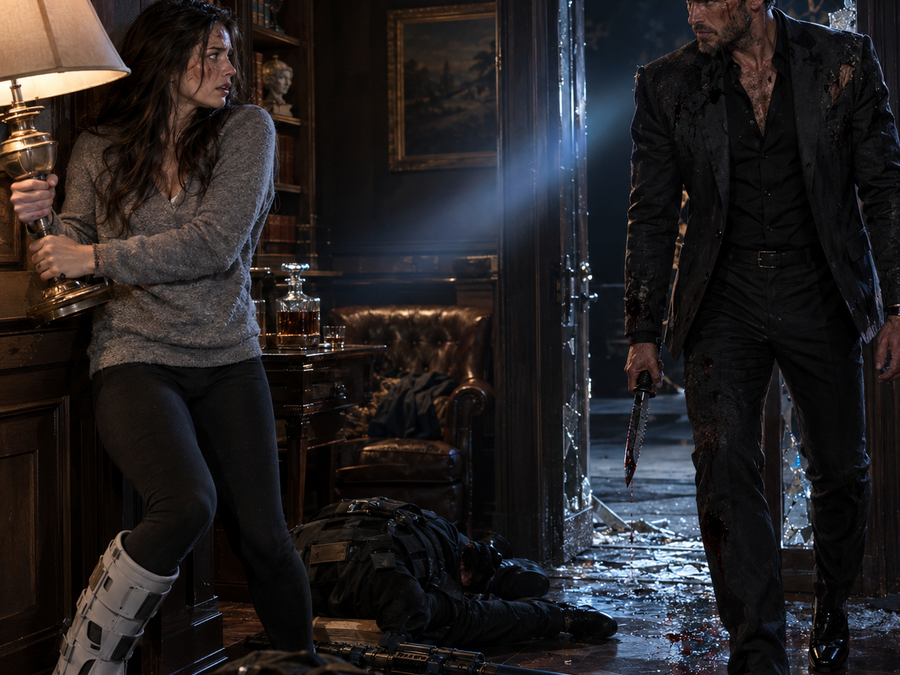
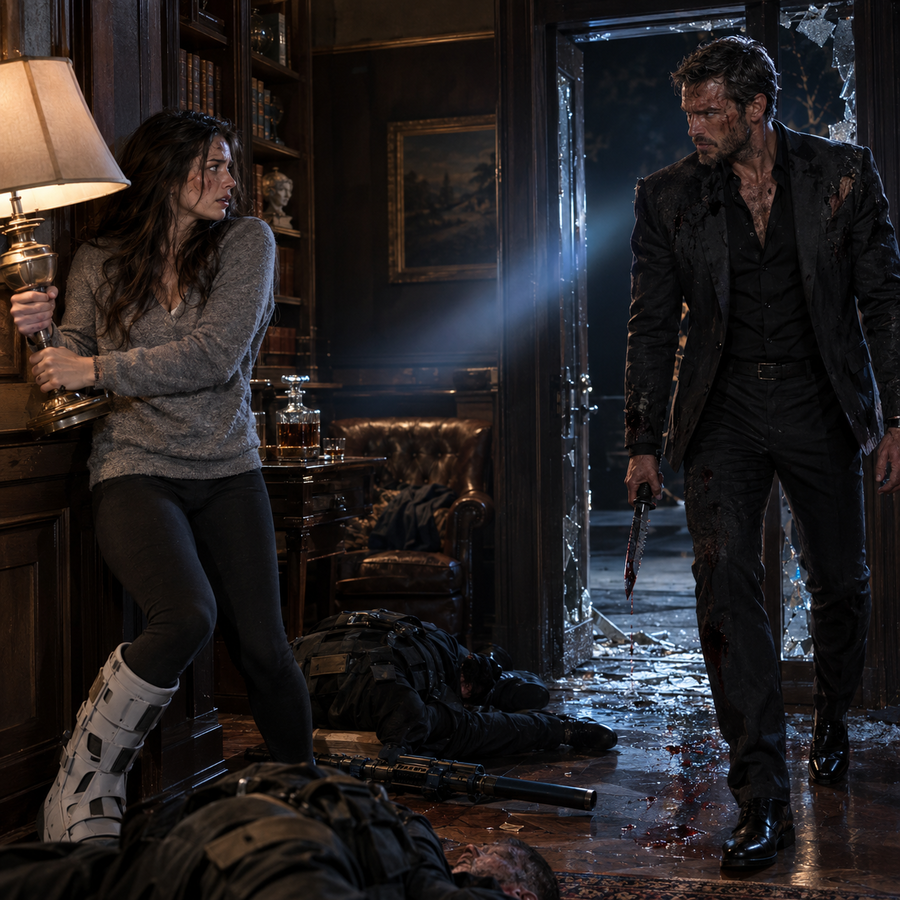
“Check behind the desk,” the first man ordered, sweeping his rifle toward the window. Tessa wasn’t behind the desk. She was standing pressed against the wall directly beside the doorframe. As the second man stepped over the ruined door, the beam of his light sweeping past her legs, she swung the heavy brass lamp with every ounce of strength in her upper body.
The brass base connected with the side of the man’s head with a sickening, hollow crack. He didn’t scream. He dropped instantly, his rifle clattering against the floorboards, his body folding like a discarded suit. The first man whipped around, the blinding beam of his tactical light hitting Tessa right in the eyes. She froze, the lamp slipping from her sweat-slicked hands. The man raised his weapon, the black muzzle leveling at her chest.
“Don’t move, you stupid—” Tessa braced herself. She closed her eyes. A shadow separated itself from the darkness of the hallway outside the study. The man didn’t even have time to pull the trigger. Declan stepped into the doorway, moving with a speed that defied his massive frame. He didn’t use a gun. He stepped inside the man’s guard, grabbed the barrel of the suppressed rifle, and violently wrenched it upward.
The weapon discharged into the ceiling, showering plaster. In the same fluid motion, Declan drove a heavy serrated combat knife deep into the space just beneath the man’s tactical vest, angling upward into the ribs. The man gasped, a wet, ragged sound. Declan twisted the blade once, brutally, and pulled it free. The man collapsed, hitting the floor with a heavy thud, blood pooling rapidly on the antique rug.
Declan stood over him, his chest heaving, the knife dripping onto the floorboards. His suit was torn, his face smeared with grease and blood. He looked like a demon dragged up from the concrete foundation of the city. He turned to Tessa. She was pressed flat against the wall, staring at the two bodies on the floor, her breath coming in short, panicked gasps.
He closed the distance between them in two strides. He grabbed her shoulders, his grip tight enough to bruise. “Are you hit?” he demanded, his voice a gravelly roar. “No,” Tessa choked out. “No, I’m okay.” He looked at the man she had hit with the lamp, then down at the heavy brass object on the floor. A grim, terrifying smile touched the corners of his mouth. “Good girl,” he breathed.
A burst of automatic gunfire erupted from the ground floor, shattering the momentary quiet. “Carter is holding the kitchen,” Declan said, his tone instantly shifting back to cold tactical precision. “Hayes is dead at the front door. There are three more outside pushing the perimeter. We have to go.” “Go where?” Tessa asked. The reality of the violence finally catching up to her.
“They have the house surrounded. Not underneath.” Declan grabbed her arm and pulled her toward the hallway. “Keep weight off that boot. Move fast.” They scrambled down the back staircase, avoiding the main foyer where the gunfire was concentrated. The smell of cordite and copper was thick in the air, burning the back of Tessa’s throat.
Declan led her into the basement. It was a concrete cavern filled with heating units and water tanks. He moved to a heavy steel grate set into the floor in the far corner. He shoved his knife into his belt, grabbed the iron handle, and hauled upward. The grate groaned, protesting on rusted hinges before swinging open to reveal a dark, narrow utility tunnel.
“Old prohibition runner route,” Declan explained, ushering her toward the hole. “It connects to the municipal sewer line two blocks east. It’s tight. It smells like death. And you are going to ruin your clothes. Get in.” Tessa looked down into the black abyss. Then she looked back at the stairs leading up to the house where the sound of shouting and gunfire was growing louder. She didn’t hesitate. She sat on the edge, swung her booted leg down, and dropped into the dark.
Declan followed a second later, pulling the heavy iron grate shut behind them. The metal clanged with a finality that echoed through the concrete pipe, sealing them in the dark. For the next hour, they crawled. The tunnel was barely four feet high. Tessa had to drag her injured leg behind her, the heavy walking boot scraping loudly against the damp concrete.
The air was foul, thick with the stench of stagnant water and rotting leaves. Declan moved ahead of her, the small beam of a pen light clamped in his teeth, guiding the way. He didn’t speak. He just kept moving, setting a punishing pace. Every muscle in Tessa’s body screamed. The raw, terrifying adrenaline that had fueled her in the study was burning off, leaving behind a cold, shivering exhaustion.
But she didn’t complain. She matched his pace, crawling through the filth, driven by a primal urge to survive. Finally, the concrete gave way to a larger, brick-lined storm drain. Declan stood up, spitting the pen light into his hand. “We’re clear,” he rasped. He leaned against the curved brick wall, his head tipped back, dragging in ragged breaths of the foul air.
Tessa collapsed onto the damp floor of the tunnel, pulling her knees to her chest. She was covered in mud and grease. Her hands were raw, but she was alive. Declan looked down at her. He pulled his burner phone from his pocket. It had no signal underground, but he checked the screen anyway, a nervous habit. “They burned the house down,” he said quietly. It wasn’t a guess. It was a certainty. “Moran’s people don’t leave structures standing.”
“What about Carter?” Tessa asked, her voice cracking. “Carter knew the risks when he took my money,” Declan replied, his voice devoid of emotion. It was a cold, brutal assessment. It was the reality of the world she had accidentally stepped into.
Declan walked over to her. He extended a dirt-caked hand. Tessa looked at it for a long moment. She had spent the last three years shrinking away from violence, terrified of the men who wielded it. But looking at the blood on Declan’s knuckles, the dirt on his face, she realized something profound. The violence outside the tunnel was chaotic, senseless, and cruel. The violence Declan used was a shield. A brutal, bloody shield, but a shield nonetheless.
She reached up and took his hand. He pulled her to her feet, his grip solid and unwavering.
Two days later, the air smelled like expensive gin and ozone. They sat in a penthouse suite fifty floors above the harbor. The quiet was heavy. The grime of the sewer was gone, scrubbed away and replaced by pressed suits and silk. Tessa’s heavy walking boot rested on a pristine glass coffee table. Next to it sat a thick, unmarked manila envelope.
Declan stood by the floor-to-ceiling window. He watched the ferries carve gray lines into the dark, churning water below. “It’s done,” he said. He didn’t turn around to look at her. “Moran is currently rotting in the trunk of a submerged Lincoln. His lieutenants folded before dawn. The supply lines are clear.”
He walked over to the table and tapped the envelope with one bruised knuckle. “Inside is a new passport, a birth certificate, a deed to a house in Oregon under the name Sarah Jenkins. There’s an offshore account routing number with half a million clean dollars. Untraceable.” Tessa stared at the brown paper. “You’re paying me off.”
“I’m severing a liability,” Declan corrected, his voice dropping into that familiar flat register. “You were collateral damage in a dispute that wasn’t yours. You survived the tunnel. You earned a clean break.” “And if I take it?” “You go to Oregon. You open a business. You never look over your shoulder because absolutely no one will be looking for you. You forget the brownstone. You forget me.”
He recited the instructions like a legal disclaimer. But his jaw was locked tight. The muscle feathered rapidly under his skin. He was an expert at cutting ties, but this one was actively resisting the blade. Tessa leaned forward. For three years, she had prayed for an escape hatch. Brent had trapped her in a small, suffocating box of fear and apologies. Now, a man who dealt in extortion, violence, and murder was handing her the keys to absolute, unquestionable freedom. All she had to do was pick up the paper.
She looked at the envelope. She looked at Declan. He was a monster. But he was the monster who had shielded her in the dark. He was the man who had treated her broken bones not as a weakness to be exploited, but as a temporary structural failure to be repaired. She picked up the envelope. It was heavy with the promise of a quiet, lonely life.
Deliberately, she tore it in half. The sharp rip echoed loudly in the silent room. She tore it again, dropping the shredded remains of Sarah Jenkins onto the glass. Declan finally froze. The dead-eyed calm fractured completely. “What are you doing?” “I don’t want to be Sarah Jenkins,” Tessa said.
She stood up, planting her weight firmly on the walking boot. She didn’t flinch. “Sarah ran away to hide. I’m done hiding.” “Tessa.” His voice was a low, dangerous rumble. “This isn’t a game. It ends in blood. There is no second envelope if you change your mind.” “I know how structures fail, Declan,” she said, stepping into his space. “You need someone to tell you when the load-bearing walls are cracking. Someone who isn’t on the payroll.”
He stared at her, the last of his professional armor shattering. He reached out, his large, calloused hand gripping the back of her neck, fingers tangling in her hair. He didn’t ask again. He pulled her in, his mouth crashing against hers. It was rough, desperate, and entirely consuming. It tasted of scotch, gunpowder, and survival.
She had sent a text into the dark, pleading for help. She got a war instead. And looking out over the city they were about to own, she knew she wasn’t leaving.
