Part 2: “I’m not going to kill you. And in this city, that’s a declaration of love.”
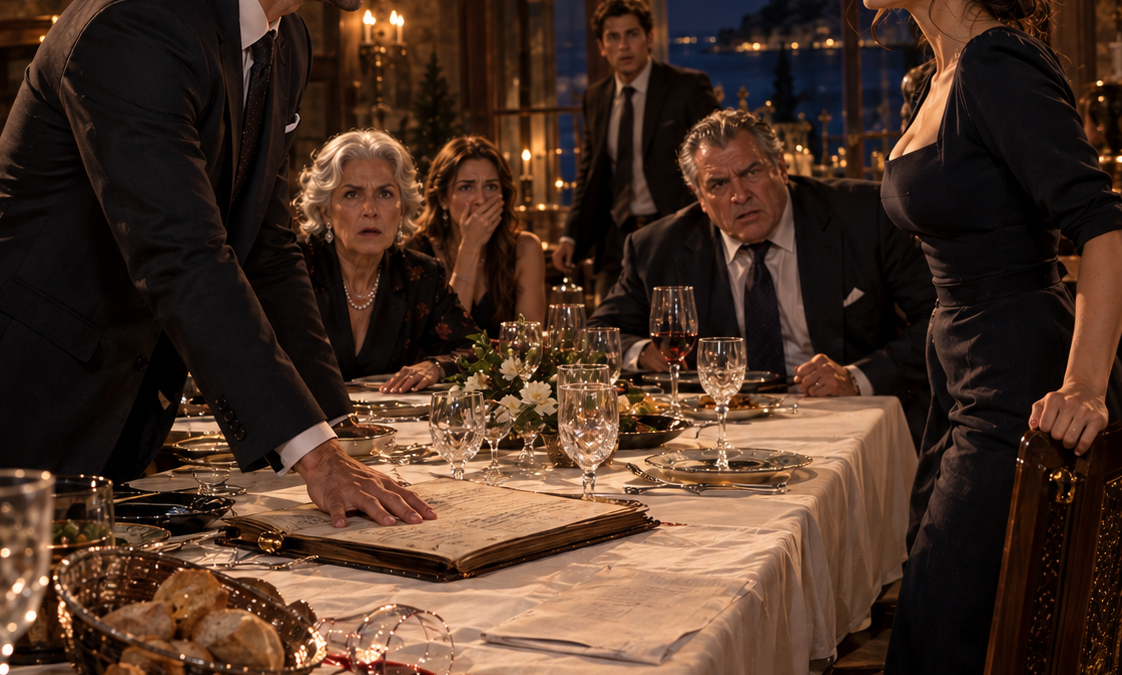
CHAPTER 7: The Code That No One Else Could Read
The breakthrough came on a Tuesday, at four in the morning, when Elena was too tired to sleep and too wired to stop working.
She’d pulled the original certification papers for every compromised batch — the four she’d identified in Genoa, plus three more she’d found in the Arcuri archives. She’d laid them out side by side on the oak table, along with the corresponding production logs, and she’d been staring at them for hours.
The batch numbers were legitimate. The production logs matched. But the certification papers — the documents that accompanied each shipment across the border — had been altered. Not the batch number itself, but the suffix.
AR-2749-03. The -03 was the lot number. But on the certification papers, it had been changed to -04.
The difference was invisible unless you knew the coding system. And the coding system was something only two people had ever understood.
Matteo. And his father.
She was still staring at the papers when the door opened and Matteo walked in.
He looked like he hadn’t slept either. His shirt was wrinkled, his hair disheveled, and there was a fresh cut on his knuckle — the kind of wound you got from hitting something hard.
“You’re up early,” he said.
“I’m up late.” She gestured at the papers. “Look at this.”
He walked to the table, leaned over her shoulder, and studied the documents. His proximity was distracting — the warmth of him, the smell of cedar and smoke. She forced herself to focus.
“The suffix,” she said. “Someone changed the lot numbers. Not on the manifest — on the certification papers. The lot number on the papers doesn’t match the lot number on the containers.”
Matteo straightened. His face had gone very still.
“That’s not possible,” he said.
“It’s right there.”
“No — I mean, it’s not possible because the certification papers are generated automatically. The system pulls the lot number from the production log. If someone changed the papers, they’d have to change the log too.”
“Or they’d have to know how to override the system.”
They looked at each other.
“Who has override access?” Elena asked.
“Only me. And—” He stopped.
“Your father.”
“Yes.”
“Your father is dead.”
“Yes.”
The silence stretched between them. Outside, the first light of dawn was beginning to creep over the valley.
“There’s something else,” Elena said quietly. “The lot number on the certification papers — the altered one. It follows a pattern. -04, -05, -06, -07. It’s not random. It’s a sequence.”
Matteo stared at her. “What sequence?”
“I don’t know yet. But I’ve seen it before.” She pulled out her phone, scrolled through her photos, and found a picture of an old case file — something she’d photographed years ago, during her first posting in Rome. “There was a customs investigation in 2015. A counterfeiting ring operating out of Naples. They used a similar coding system — lot numbers that didn’t match the manifests. The case was closed without charges because the analyst couldn’t crack the code.”
“Who was the analyst?”
“My mentor. A man named Salvatore Ricci.” She looked up. “He died two years ago. Heart attack. But before he died, he told me there was one case he never solved. One case that kept him up at night.”
She slid the phone across the table.
Matteo picked it up. Looked at the photo. His face went pale.
“What?” Elena said.
He didn’t answer. He was staring at the screen — at the case file, at the names, at the dates.
“This case,” he said slowly. “This investigation. It was into the Battaglias.”
“Yes.”
“And the analyst — Salvatore Ricci.”
“Yes.”
He set the phone down. His hand was shaking.
“Matteo. What is it?”
He looked at her, and for the first time since she’d met him, he looked genuinely afraid.
“My father didn’t design the coding system alone,” he said. “He had help. From a man he trusted. A man who understood numbers, patterns, the way information could be hidden in plain sight.”
“Who?”
“Salvatore Ricci.”
The room spun.
“Your father worked with my mentor?”
“Worked with. Was betrayed by. It’s the same thing, in the end.” He stood up, walked to the window, and stood with his back to her. “The counterfeiting ring in Naples — the one Ricci investigated. It wasn’t the Battaglias. It was my father. And Ricci knew. He figured it out. But he never filed the report.”
“Why not?”
“Because my father made him a deal. He gave Ricci something — information, leverage, I don’t know the details — and in exchange, Ricci buried the case. He resigned from customs enforcement a year later. Took a teaching position. Lived out the rest of his life with the guilt.”
Elena felt like the floor had dropped out from under her.
“You’re telling me my mentor was corrupt.”
“I’m telling you he was human. And he made a choice that haunted him until the day he died.” Matteo turned to face her. “That’s why I recognized your name when I saw your credentials. Ricci talked about you. He said you were the best analyst he’d ever trained. He said you had a gift for patterns.”
“He never told me about any of this.”
“No. He wouldn’t have. He was ashamed.” Matteo walked back to the table, sat down, and met her eyes. “Your mentor and my father were partners in a crime they both regretted. And now someone is using their code — the code they created together — to destroy my family.”
Elena’s mind was racing. “The sequence. -04, -05, -06, -07. It’s not random. It’s a countdown.”
“To what?”
“I don’t know yet. But if someone is using Ricci’s code, they’re not just trying to damage your reputation. They’re sending a message.”
Matteo was silent for a long moment. Then he said, “There’s something I haven’t told you.”
“There’s a lot you haven’t told me.”
“This is different.” He reached across the table and took her hand — a deliberate gesture, not an accident. His fingers were warm, calloused, and they held hers with a certainty that made her pulse jump. “The code isn’t just a coding system. It’s a ledger. A record of every illegal shipment my family has ever made. The counterfeits, the bribes, the payoffs. Everything.”
Elena stared at him. “You have a ledger.”
“My father kept it. He was paranoid — he wanted leverage, in case the family ever turned on him. He hid it before he died. I’ve been looking for it for four years.”
“And the person sending the tips—”
“Is looking for it too. And they’re using you to find it.”
The dawn light was stronger now, filling the room with pale gold. Elena looked down at their joined hands, then up at his face.
“Why are you telling me this?” she asked.
“Because I need you to understand what’s at stake.” His voice was low, urgent. “This isn’t just about counterfeit oil. This is about the future of my family. If that ledger falls into the wrong hands, everything my father built — everything I’ve spent my life protecting — will be destroyed. And the people who destroy it won’t stop with the business. They’ll come for my mother. My sister. Everyone I love.”
“And what about me?”
He was quiet for a beat.
“You’re already in it,” he said. “You’ve been in it since the first text. The question is whether you’re going to run, or whether you’re going to help me find the ledger before someone else does.”
Elena pulled her hand back. She stood up, walked to the window, and looked out at the valley — the olive groves, the winding roads, the distant shimmer of the sea.
She thought about Salvatore Ricci. The man who’d trained her, mentored her, told her she had a gift. The man who’d died with a secret he’d never shared.
She thought about the texts. The batch numbers. The precision.
And she thought about Matteo Arcuri — a man she’d been sent to investigate, a man who’d admitted his family was criminal, a man who was asking her to choose sides in a war she didn’t understand.
“I’m not going to run,” she said finally. “But I’m not going to help you hide evidence either. If I find the ledger, I’m going to read it. And if what’s in it is as bad as you say, I’m going to have to make a decision about what to do with it.”
Matteo nodded slowly. “I wouldn’t expect anything less.”
“Then we have a problem.”
“We have several.” He stood, walked to her, and stopped close enough that she could feel the heat of him. “But we’ll solve them one at a time.”
He reached up and brushed a strand of hair from her face — a gesture so gentle it made her chest ache.
“Get some sleep,” he said. “Tomorrow, we start looking for the ledger.”
He walked out. Elena stood at the window, watching the sun rise over the valley, and tried to remember the last time she’d felt this terrified and this alive at the same time.
She couldn’t.
CHAPTER 8: The Olive Grove
They found the first clue three days later, in the most ordinary place imaginable.
Matteo had taken her to the original Arcuri grove — forty hectares of ancient trees on the western slope of the hill, planted by his grandfather in the 1950s. The trees were gnarled and silver-leafed, their trunks thick with decades of growth, and the ground beneath them was soft with fallen olives.
“This is where it started,” Matteo said. “My father used to bring me here when I was a boy. He said the trees were the only honest thing in the world.”
“Why honest?”
“Because they don’t lie. If a tree is sick, it shows. If it’s healthy, it bears fruit. No pretense. No politics.” He walked between the rows, his hand brushing the bark of each trunk as he passed. “He wanted to be like them. He failed.”
Elena followed him in silence. The morning was cool and clear, the light slanting through the leaves in long golden bars. She could understand why someone would love this place — the peace of it, the simplicity.
“Your father’s study,” she said. “You said you searched it.”
“Twice. Three times. I took apart the furniture, pulled up the floorboards, checked every book on every shelf. Nothing.”
“What about the grove?”
He stopped walking. Turned to look at her.
“What about it?”
“Your father was a farmer. He designed the coding system, but he was also a man who worked with his hands. Maybe he hid the ledger somewhere more… practical.”
Matteo was quiet for a moment. Then he said, “The old irrigation shed. At the far end of the grove. I haven’t been inside it since he died.”
They walked there together, through the rows of ancient trees. The shed was small — a stone structure with a wooden door and a corrugated roof — and it looked like it hadn’t been opened in years.
Matteo pulled the door open. Inside, the air was cool and dry, smelling of dust and old wood. There were tools on the walls — pruning shears, a hand saw, coils of irrigation tubing. A workbench in the corner. A single window, grimy with age.
“Nothing,” Matteo said.
Elena stepped inside. She ran her fingers along the workbench, the walls, the window frame. Then she looked down at the floor.
The stones were uneven. One of them — near the center of the room — was slightly raised.
“Here,” she said.
Matteo knelt, pulled out a pocketknife, and pried at the stone. It lifted easily, revealing a hollow space beneath.
Inside was a metal box. And inside the box was a ledger — leather-bound, worn at the edges, filled with his father’s handwriting.
Matteo pulled it out. His hands were shaking.
“This is it,” he said. “This is what they’re looking for.”
Elena knelt beside him. “Open it.”
He did.
The first page was a list of dates and amounts — payments, shipments, names. The second page was more of the same. By the third page, Elena had stopped reading. She didn’t need to. The pattern was clear.
This was a record of every crime the Arcuri family had committed for forty years. Bribes to customs officials. Counterfeit shipments to every major port in Europe. Payoffs to politicians, police, judges. Murder, even — three names on a separate page, with dates and locations.
“It’s worse than I thought,” Matteo said quietly.
“You knew.”
“I suspected. There’s a difference.”
Elena stood up. She walked to the window, looked out at the grove, and tried to steady her breathing.
“What are you going to do with it?” she asked.
“I don’t know yet.”
“You could destroy it. Burn it. No one would ever know.”
“I could.”
“But you won’t.”
He looked up at her. His face was pale, drawn, older than it had been when she’d first met him.
“No,” he said. “I won’t. Because whoever is sending those tips — whoever is using my father’s code — they know this ledger exists. They’re not going to stop until they find it. And if I destroy it, they’ll come after my family. My mother. My sister.”
“Then what?”
He stood, tucked the ledger under his arm, and walked to her.
“I’m going to give it to you,” he said.
Elena blinked. “What?”
“I’m going to give you the ledger. You’re the auditor. You’re the one with the authority to investigate. If you take this to your supervisor—”
“Ferraro would bury it. He’s already told me to drop the case.”
“Then take it to someone else. The prosecutor’s office. The national anti-mafia commission. Someone who can actually do something with it.”
“And destroy your family in the process.”
“Yes.” His voice was steady. “If that’s what it takes.”
Elena stared at him. “Why?”
“Because I’m tired of running,” he said. “I’ve spent my whole life protecting a lie. My father’s lie. I told myself I was doing it for the family, for the business, for the people who depend on us. But the truth is, I was doing it for myself. Because I was afraid of what would happen if I stopped.”
“And now?”
“Now I’m more afraid of what happens if I don’t.” He held out the ledger. “Take it.”
Elena reached for it. Her fingers brushed the leather cover — warm from his hands — and she felt the weight of it, the history, the lives it had destroyed.
“I need time,” she said. “To read it. To understand what’s in it. To figure out what to do.”
“Take all the time you need.”
“And I need you to answer one question.”
“Anything.”
She looked up at him. “The anonymous texts. The batch numbers. The tips. Was it you?”
He didn’t answer immediately. His eyes searched hers — looking for something, she didn’t know what.
“No,” he said finally. “It wasn’t me.”
“Do you know who it was?”
“I have a theory.”
“Tell me.”
He stepped closer. His hand came up to cup her face — gentle, deliberate, like he was asking permission.
“I think it was my father,” he said. “I think he left something behind. A contingency. A way to expose the truth if the family ever went too far. And I think whoever is sending those texts found it.”
“Your father is dead.”
“Yes.”
“Then who—”
“I don’t know.” His thumb traced her cheekbone. “But we’re going to find out. Together.”
He kissed her.
It was soft at first — a question, not a demand. But when she didn’t pull away, it deepened. His hand slid into her hair, tilting her head back, and she felt the whole length of him against her, warm and solid and alive.
She kissed him back. She couldn’t help it. She’d been fighting this since the first night on the terrace, and she was tired of fighting.
When they finally broke apart, they were both breathing hard. The ledger lay on the ground between them, forgotten.
“That was a mistake,” Elena said.
“Probably.”
“We can’t do it again.”
“No.”
He kissed her again.
CHAPTER 9: The Fifth Tip
The fifth text arrived at 2:13 a.m. on a Thursday, and it wasn’t like the others.
They know you have the ledger. Get out of the villa. Now.
Elena was awake when it came — she’d been lying in the dark, replaying the kiss, trying to convince herself it hadn’t happened. She read the message twice, then threw off the covers and grabbed her phone.
She called Matteo. He answered on the first ring.
“Did you get it?” she asked.
“Yes.”
“Where are you?”
“Hallway. Outside your door.”
She opened the door. He was standing there in sweatpants and a T-shirt, phone in hand, looking like he’d been running.
“We need to go,” he said. “Now.”
“Where?”
“The city. There’s a safe house. My father kept it for emergencies.”
“What about your mother? Your sister?”
“Already moving. I called them five minutes ago.” He took her arm. “We have maybe twenty minutes before whoever sent that text makes their move.”
They ran. Down the back stairs, through the kitchen, out the service entrance. Matteo’s car was parked in the shadows — not the sedan she’d seen before, but a small, nondescript hatchback that looked like it belonged to a gardener.
He drove fast, taking the back roads down the hill, his eyes flicking to the rearview mirror every few seconds.
“Who sent that text?” Elena asked.
“I don’t know. But they knew about the ledger. They knew we found it. That means someone’s watching us.”
“Someone in your household.”
“Or someone who’s bugged the villa. Or someone who’s been following us.” He took a sharp turn, and Elena grabbed the door handle. “It doesn’t matter. What matters is getting you somewhere safe.”
“What about you?”
“I’m going to draw them off. Find out who’s behind this.”
“That’s insane.”
“Probably.” He glanced at her. “But you’re the one with the ledger. You’re the one who can actually do something with it. I’m just—”
“You’re just what?”
He didn’t answer. They drove in silence for a few minutes, the city lights growing closer.
“There’s something I need to tell you,” he said finally.
“More secrets?”
“One more.” He pulled the car to a stop in a narrow alley, killed the engine, and turned to face her. “The ledger — the one we found. It’s not the only one.”
Elena stared at him. “What?”
“My father kept two ledgers. The one we found is the public one — the record of crimes he wanted people to know about. Leverage. Insurance. But there’s another one. A private one. The one that lists the people who helped him. The ones who are still alive.”
“Who?”
“The head of the anti-mafia commission. Two judges. A cardinal. And—” He stopped.
“And?”
“And your mentor. Salvatore Ricci.”
Elena felt the blood drain from her face. “No.”
“He wasn’t just corrupt. He was complicit. He helped my father cover up three murders. He took money. He took favors. And he spent the rest of his life trying to make up for it.”
“You’re lying.”
“I’m not.” He reached into his jacket and pulled out a folded piece of paper — old, yellowed, covered in handwriting she recognized. “This is a letter he wrote to my father. Six months before he died. He talks about you. He says you’re the only good thing he ever did. He says he hopes you never find out the truth about him.”
Elena took the letter. Her hands were shaking.
She read it. Twice.
Then she folded it, put it in her pocket, and looked at Matteo.
“Why are you telling me this?”
“Because you need to know what you’re walking into. If you take that ledger to the authorities, you’re not just exposing my family. You’re exposing everyone in it. Including the man who trained you. Including people who are still in power. Including people who will kill to keep their secrets.”
“And you think I should destroy it.”
“I think you should make an informed choice.” He reached over and took her hand. “I’m not going to tell you what to do. I’m just going to tell you the truth. For once in my life, I’m going to tell the truth.”
Elena looked at their joined hands. Then at his face — tired, honest, afraid.
“I need to think,” she said.
“I know.”
“I need to be alone.”
“I know.”
He let go of her hand. She opened the car door, stepped out into the alley, and walked away without looking back.
She didn’t see him watch her go. She didn’t see him sit in the car for ten minutes after she left, staring at the empty street.
She didn’t see him pull out his phone and type a message to an unlisted number.
She knows. Stage two.
The reply came immediately.
Understood. Move to phase three.
Matteo Arcuri deleted the messages, started the car, and drove away.
Shall I continue with Act 3?
CHAPTER 10: The Man Behind the Curtain
Elena walked for two hours.
The streets of Palermo were quiet at that hour — the markets shuttered, the cafés dark, the only movement the occasional stray cat slinking between parked cars. She walked without direction, the ledger heavy in her bag, Matteo’s letter burning in her pocket.
Salvatore Ricci. Corrupt. Complicit. A murderer by proxy.
She’d trusted him. She’d loved him, in the way a student loves a mentor. And he’d been everything she’d spent her career fighting against.
She stopped at a small piazza, sat on the edge of a dry fountain, and pulled out her phone.
Three missed calls from Matteo. Two from Ferraro. One from a number she didn’t recognize.
She called the unknown number.
“Ms. Vitale.” The voice was female, crisp, unfamiliar. “My name is Giulia Battaglia. I think we need to talk.”
Elena went very still. “Battaglia.”
“Yes. I know what you’re thinking — rival family, sworn enemy, all of that. But I’m not calling about the feud. I’m calling because someone sent me a very interesting document this morning. A ledger. Or part of one.”
“Who sent it?”
“I don’t know. It came through an anonymous drop. But it lists names, Ms. Vitale. Names of people who’ve been helping the Arcuris for decades. Including your mentor. Including several members of my own family.” A pause. “I’m not your enemy. I’m just someone who wants the truth. Same as you.”
Elena closed her eyes. “Where do you want to meet?”
The Battaglia estate was smaller than the Arcuri compound, but no less fortified. Giulia Battaglia met her at the gate — a tall woman in her fifties, silver-haired, with the kind of sharp, assessing gaze that made Elena feel like she was being weighed and measured.
“You look like hell,” Giulia said.
“I’ve had a long night.”
“I imagine.” She led Elena through a courtyard, into a study lined with books and maps. “Coffee?”
“No.”
“Wine?”
“No.”
“Sit, then.” Giulia gestured to a chair. “You have the ledger.”
“I have *a* ledger. I don’t know if it’s the one you’re talking about.”
She pulled it out, set it on the table between them. Giulia didn’t reach for it. She just looked at Elena with an expression that was almost sympathetic.
“You know what’s in there,” Giulia said.
“I know what Matteo told me is in there. I haven’t read the whole thing.”
“Then read it. But first, let me tell you what I know.” She leaned back. “Twenty years ago, my father and Matteo’s father were partners. Not rivals — partners. They ran the counterfeit operation together. The olive oil, the bribes, the shipping routes. It was a joint venture.”
Elena stared at her. “That’s not what Matteo told me.”
“Matteo doesn’t know. Or he does, and he’s lying. Either way, the truth is that the Arcuri and Battaglia families built their fortunes together. Then something happened. A betrayal. My father wanted out. He wanted to go legitimate. Matteo’s father wouldn’t let him. There was a fight. My father died.”
“How?”
“Car accident. At least, that’s what the police said. But I was sixteen, and I knew my father’s car. Someone had tampered with the brakes.” Giulia’s voice was flat, controlled. “I’ve spent thirty years trying to prove it. And now, finally, I have proof.”
She pulled out her phone, scrolled to a document, and turned the screen toward Elena.
It was a page from the ledger. The same handwriting. The same dates. But this page listed something Elena hadn’t seen before — a transaction dated the night Giulia’s father died.
Payment to M. Arcuri. For services rendered.
“Services,” Giulia said. “That’s how they wrote it. Murder as a line item.”
Elena’s hands were cold. “Why are you showing me this?”
“Because you’re the auditor. You have the authority to investigate. And because I think you’re the only person in this city who actually wants the truth, not just leverage.”
“And what do you want?”
“Justice. For my father. For all the people the Arcuris have destroyed.” Giulia leaned forward. “I’m not asking you to trust me. I’m asking you to do your job.”
Elena looked at the ledger. At Giulia’s face. At the phone screen with its damning evidence.
“I need to read the rest of the ledger first,” she said. “All of it. Before I decide anything.”
Giulia nodded. “Take your time. I’ll have a room prepared.”
Elena read for six hours.
By the time she finished, she understood everything. The counterfeit operation. The bribes. The murders — three of them, not one. The way the Arcuri family had built an empire on corruption, and the way Salvatore Ricci had helped them do it.
And she understood something else: Matteo had lied to her.
Not about everything. The ledger was real. The crimes were real. But he’d told her he didn’t know who was sending the texts. He’d told her he had a theory it was his father. He’d told her he wanted to expose the truth.
But the texts had been too precise. Too targeted. Whoever was sending them knew exactly which batches to flag, exactly when to warn her. They had access to the production logs, the certification papers, the shipping schedules.
They had access to everything.
She pulled out her phone, scrolled back through the messages, and looked at the timestamps. The first text had arrived three weeks before she’d even been assigned to the Arcuri case. Before she’d ever set foot in Palermo.
Someone had been watching her for a long time.
She thought about Matteo’s eyes. The way he’d looked at her on the terrace. The way he’d kissed her in the grove.
I’m not going to tell you what to do. I’m just going to tell you the truth.
But he hadn’t told her the truth. He’d told her a version of it — enough to keep her close, enough to make her trust him, but not enough to actually understand what she was walking into.
She stood up, grabbed the ledger, and walked out of the room.
Giulia was waiting in the hallway.
“Where are you going?”
“To get answers.”
 [Tap here for the Next Part ]

