Part 2: “You’re making a mistake.” / “Maybe. But it’s mine to make.
PART 5 — THE CAVALRY
The evidentiary hearing was held in the same courtroom, but this time it was packed.
Word had gotten out. The case had made the local news, then the state news, then a brief mention on a national veterans’ blog. People had started paying attention. Veterans from all over the county had shown up to support us. Some of them had been Kessler’s victims. Some of them just wanted to be there.
I walked in with Elena and Tom and Priya and Danny. The back rows were full of people I’d never met — old men with unit hats and young men with prosthetic limbs and women in service dog vests and families with children who sat quietly and held their parents’ hands. They didn’t cheer when we walked in. They just watched. Their eyes said everything.
I sat at the plaintiffs’ table. My foot was still in a boot, but I’d left the crutches at home. I didn’t want to look weak. Not today.
Kessler’s lawyers were already there. Harrison was back, looking even more polished than before. Next to him sat a man I hadn’t seen before — older, silver-haired, with a face that belonged on a magazine cover. Randall Kessler. He looked exactly like the voice on the phone. Smooth. Cultured. Confident.
He didn’t look at me. He looked at the crowd. He looked at the cameras. He looked at the judge’s bench. He looked everywhere except at the people he’d hurt.
Judge Ramirez rapped her gavel.
“Alright. This is the evidentiary hearing in the matter of Mercer et al. versus Copperline Property Solutions et al. Ms. Vasquez, you may proceed.”
Elena stood up. She laid out the case: the notices, the shell companies, the emails, the pattern. She called witnesses — veterans who’d been evicted, veterans who’d been threatened, experts who testified about Kessler’s business practices. She was calm, methodical, relentless. Every time Harrison objected, Judge Ramirez overruled him. Every time Kessler’s lawyers tried to muddy the waters, Elena brought it back to the facts.
Then it was Harrison’s turn.
He stood up. Smoothed his tie. Smiled at the judge.
“Your Honor, the defense maintains that these are private landlord-tenant matters. My client has the right to manage his properties as he sees fit. The plaintiffs are asking the court to interfere with legitimate business practices based on speculation and emotion.”
He called Kessler to the stand.
Kessler walked up to the witness box like he owned the room. He sat down. Crossed his legs. Folded his hands. Smiled.
“Mr. Kessler,” Harrison said, “can you tell the court what you do for a living?”
“I’m a real estate developer. I buy distressed properties, renovate them, and sell them. I’ve been doing this for over twenty years.”
“And during that time, have you ever targeted veterans specifically?”
“Never. I don’t even know who my tenants are. I buy properties. If there are tenants living there, that’s a matter for the property management companies to handle.”
“So you had no knowledge of the eviction notices sent to the plaintiffs?”
“None. I was as surprised as anyone when I heard about this.”
Elena stood up for cross-examination.
“Mr. Kessler, are you familiar with an email sent from your account on March 12th of last year?”
“I send a lot of emails, Ms. Vasquez. I can’t remember every one.”
“Let me refresh your memory. The email was sent to your associate, David Chen, and it reads, and I quote: ‘These veteran targets are perfect. High value, low resistance. Let’s focus on the disabled ones first. They’re easier to push out.'”
Kessler’s smile faltered. Just for a second.
“I don’t recall sending that.”
“The email was recovered from your company’s server. It has your email address, your signature, and a timestamp. Are you saying it’s a forgery?”
“I’m saying I don’t recall it.”
“Mr. Kessler, are you aware that your company has evicted at least sixty-three veterans in the past three years?”
“I’m not aware of any such thing.”
“Are you aware that your company has a policy of targeting disabled veterans because they’re considered ‘low resistance’?”
“I’m not aware of any such policy.”
“Are you aware that one of your eviction notices was served to a hundred-percent-disabled veteran two days after he returned home from surgery?”
Kessler didn’t answer.
“Mr. Kessler?”
“I’m aware that some tenants have received notices. I don’t control the day-to-day operations of the property management companies.”
“But you control the LLCs that own them.”
“I’m a businessman. I own a lot of things.”
“Including Copperline Property Solutions?”
“I have an interest in that company.”
“And Lone Star Asset Group?”
“I have an interest in that one too.”
“And Alamo Ridge Holdings?”
“Yes.”
“And Hill Country Property Partners?”
“Yes.”
“So when you say you don’t know who your tenants are, you’re saying you don’t know who’s living in the properties owned by your companies?”
“I don’t involve myself in those details.”
“But you sent an email calling them ‘high value targets.'”
“I don’t recall that email.”
“You don’t recall a lot of things, Mr. Kessler.”
“I have a lot of things to remember.”
Elena paused. She looked at the judge. Then she looked at Kessler.
“Mr. Kessler, are you aware that there are veterans in this courtroom right now who were evicted from their homes because of your company’s practices?”
Kessler didn’t answer.
“Are you aware that some of them are homeless because of you?”
“I don’t—”
“Are you aware that one of them, a man named Raymond Foster, spent three weeks sleeping in his car after your company pushed him out of the house he’d lived in for forty years?”
Kessler’s face was pale. His hands were gripping the edge of the witness box.
“I don’t control—”
“Are you aware, Mr. Kessler, that the men and women you targeted are not ‘low resistance profiles’? That they are veterans of the United States military who served their country and who deserve better than to be treated as obstacles to your profit margin?”
Harrison stood up. “Objection. Badgering the witness.”
Judge Ramirez looked at him.
“Overruled.”
She turned to Kessler.
“Mr. Kessler, you may step down.”
Kessler stood up. He looked shaken. He looked at the crowd in the back of the courtroom, and for the first time, he seemed to see them. The old men with unit hats. The young men with prosthetic limbs. The women with service dog vests. The families.
He looked at them, and they looked back.
And then something happened that I will never forget.
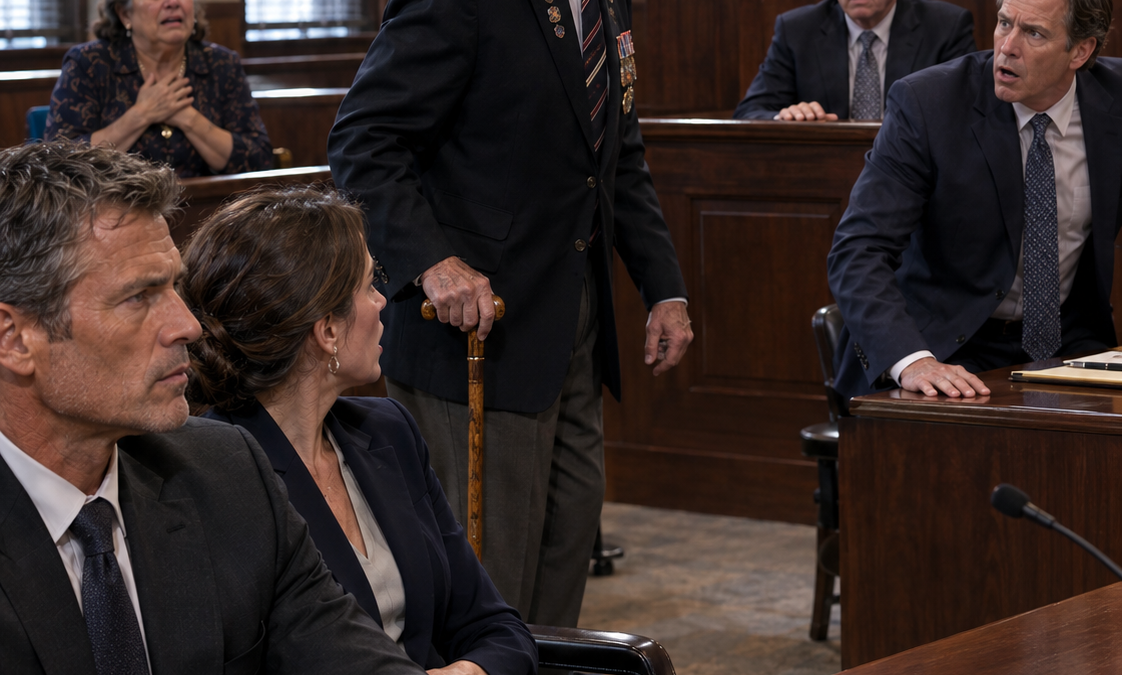
A man in the back row stood up.
He was old — seventies, maybe eighties — with a face like leather and a hat that said 5th Special Forces Group. He stood up slowly, using a cane, and he looked at Kessler with an expression I recognized. It was the expression of a man who had seen worse things than Randall Kessler and who was not impressed.
“Mr. Kessler,” he said. His voice was quiet, but it carried. “My name is William Hart. I’m a retired command sergeant major. I served thirty years in Special Forces. I’m also one of the veterans your company tried to evict.”
Kessler stared at him.
“I’m not here to yell at you. I’m not here to threaten you. I’m just here to tell you something.”
He paused.
“You looked at us and saw weakness. You saw disability. You saw fixed incomes. You saw people who couldn’t fight back. But what you didn’t see — what you couldn’t see — is that we’re not alone. We never were.”
He turned and gestured to the crowd.
“These people behind me? They’re not just veterans. They’re a network. We served together. We fought together. We bled together. And when one of us is in trouble, we show up.”
He looked back at Kessler.
“You tried to push us out. But you picked the wrong neighborhood. You picked the wrong people. And now you’re going to find out what happens when you mess with the wrong family.”
He sat down.
The courtroom was silent.
Judge Ramirez looked at the crowd. Then she looked at Kessler. Then she looked at the lawyers.
“I’ve heard enough,” she said. “I’m going to take this under advisement. But I want to say something before we adjourn.”
She took off her glasses.
“I’ve been on the bench for eighteen years. I’ve seen a lot of cases. But I’ve never seen anything quite like this. A group of veterans targeted by a developer who thought they were easy prey. A community that came together to fight back. And a network of support that I think surprised everyone.”
She put her glasses back on.
“My ruling will be issued within the week. Court is adjourned.”
She rapped her gavel.
The crowd erupted.
Not in a wild way. Not in a chaotic way. In a steady, rolling way, like a wave building and breaking. People stood up. People hugged each other. People cried. William Hart, the command sergeant major, shook my hand and said, “You did good, son.” Mrs. Delgado hugged me and didn’t let go for a long time.
But the moment I remember most is when I looked over at Kessler.
He was still standing near the witness box, his face pale, his hands shaking. His lawyers were talking to him in low, urgent voices. He wasn’t listening. He was looking at the crowd. He was looking at the veterans. He was looking at the network that had just revealed itself.
And I think, for the first time, he understood what he was up against.
He turned and walked out of the courtroom without looking back.
PART 6 — THE WAIT
The week after the hearing was the longest week of my life.
I couldn’t sleep. I couldn’t eat. I couldn’t sit still. I kept going over everything in my head — every question Elena had asked, every answer Kessler had given, every detail that might make a difference. I kept thinking about the judge’s face, trying to read her expression, trying to figure out which way she was leaning.
But I couldn’t. Judges are hard to read. That’s the point.
I spent most of the week at the VDLF office, helping Priya organize the final evidence, helping Tom prepare for the next phase, helping Danny coordinate with the veterans who had come forward. It was good to be busy. It kept my mind off the waiting.
But the waiting was still there. Always there.
On the third day, I got a phone call from an unknown number.
I almost didn’t answer. But something made me pick up.
“Mr. Mercer.”
I recognized the voice.
“Mr. Kessler.”
“I need to talk to you.”
“We’re talking.”
“In person. Not on the phone.”
“Why would I want to do that?”
“Because I have information you might find useful. Information about the other properties. The ones you haven’t found yet.”
I didn’t say anything.
“There are more,” he said. “More veterans. More properties. More notices. I can give you names. Addresses. Everything.”
“Why would you do that?”
“Because I want to make a deal.”
“What kind of deal?”
“I’ll cooperate with the investigation. I’ll provide evidence. I’ll testify if I have to. In exchange, I want immunity.”
“Immunity from what?”
“From prosecution. From civil suits. From anything the AG might throw at me.”
I thought about that. About the veterans who’d been evicted. About the ones who were still homeless. About Raymond Foster sleeping in his car. About Mrs. Delgado’s tree.
And I thought about what it would mean to let Randall Kessler walk away.
“I can’t make that deal,” I said.
“You can talk to the lawyers. You can talk to the AG. You can make it happen.”
“I can’t make that deal,” I said again. “And I wouldn’t if I could.”
There was a long pause.
“You’re making a mistake.”
“Maybe. But it’s mine to make.”
“You think you’re going to win? You think a judge is going to rule against a man who’s been doing business in this state for twenty years?”
“I think the truth matters. And I think people like you always underestimate people like me.”
Another pause. Longer this time.
“We’ll see,” he said. And he hung up.
I told Elena about the call. She listened carefully, then nodded.
“He’s scared.”
“You think?”
“I know. He’s offering to sell out his own operation. That’s not something a confident man does.”
“Or he’s trying to buy time.”
“Maybe. But either way, it means we’re getting to him.”
I hoped she was right.
On the fifth day, I went to see Raymond Foster.
He was still living in his house — the eviction had been stayed by the restraining order — but he was nervous. He’d been nervous since the day I met him. He was seventy-eight years old, alone, and facing the possibility of losing everything he had.
“How are you holding up?” I asked.
“I’ve been better.”
He made coffee. We sat in his living room. There were photographs on the walls — his wife, his children, his grandchildren. A flag folded into a triangle on the mantel. A shadow box with his medals.
“I was in Quang Tri,” he said. “1968. Tet Offensive. I was with the 1st Cavalry. We lost a lot of good men that year.”
“I know.”
“You ever lose anyone?”
“Yes.”
“It doesn’t get easier, does it?”
“No. It doesn’t.”
He was quiet for a moment.
“I think about them sometimes. The men I served with. I wonder what they’d think of me now. An old man in a little house, about to lose everything.”
“They’d think you’re a survivor,” I said. “They’d think you’re still fighting.”
He looked at me.
“You think so?”
“I know so.”
He nodded slowly.
“Thank you,” he said. “I needed to hear that.”
On the seventh day, the judge issued her ruling.
I was at the VDLF office when Elena got the call. She listened for a minute, her face unreadable. Then she hung up and looked at us.
“We won.”
The room erupted.
“What did she say?” Tom asked.
“She found in favor of the plaintiffs on all counts. The eviction notices were retaliatory and fraudulent. Kessler’s companies are ordered to cease all eviction proceedings immediately. And she’s referring the case to the Attorney General’s office for criminal investigation.”
“What does that mean?” Danny asked.
“It means Kessler is in serious trouble. Fraud. Predatory business practices. Possibly racketeering. The AG’s office has been looking for a case like this for years.”
I sat down. My legs felt weak.
We’d won.
We’d actually won.
The next few weeks were a blur.
The AG’s office launched a full investigation. Kessler’s companies were raided. His computers were seized. His associates were subpoenaed. The story made national news — a developer targeting disabled veterans, a network of shell companies, a community that fought back.
Kessler was arrested three weeks later. He was charged with fraud, racketeering, and violating the Fair Housing Act. His lawyers tried to negotiate a plea deal, but the AG’s office refused. They wanted a trial. They wanted a public reckoning.
The veterans who’d been evicted got their homes back. The ones who’d already left got settlements. The ones who’d been homeless got help finding new places to live.
Raymond Foster stayed in his house. He sent me a thank-you note, handwritten, in shaky cursive. It said, “You gave me back my life. I’ll never forget it.”
Mrs. Delgado planted a new tree in her front yard. She invited me to the planting. I went. I brought a shovel. We dug the hole together, her and me, and we put the sapling in the ground and covered the roots with dirt.
“It’s a live oak,” she said. “They live for hundreds of years.”
“Like memories,” I said.
She smiled. “Like memories.”
I moved out of the house on Cypress Street six months later.
Not because I had to. Because I wanted to. I’d found a small place in San Antonio, closer to the VDLF office, closer to the people I’d come to think of as family. I still visited Cypress Street sometimes. I still drove by Mrs. Delgado’s house and saw the tree growing in her front yard. I still waved at the neighbors.
But I didn’t live there anymore. That chapter was over.
The new chapter was just beginning.
PART 7 — THE NETWORK
The trial of Randall Kessler began on a Monday morning in October, nine months after the eviction notice was taped to my door.
I sat in the front row of the courtroom, next to Elena and Tom and Danny and Priya and Mrs. Delgado and Raymond Foster and William Hart and a dozen other veterans who had come to witness the reckoning. The room was packed. Cameras were set up in the back. Reporters scribbled in notebooks. The atmosphere was electric.
Kessler sat at the defense table, flanked by a new team of lawyers. He looked older than he had in the first hearing. Thinner. Tired. The confidence was gone. In its place was something I hadn’t seen before: fear.
The prosecutor was a woman named Sarah Chen. She was small and sharp and relentless. She laid out the case with the precision of a surgeon: the shell companies, the fraudulent notices, the emails, the pattern. She called witness after witness — veterans who’d been evicted, experts who’d analyzed Kessler’s business practices, investigators who’d traced the money.
Then she called me.
I walked up to the witness box. I was wearing a suit. My foot was finally out of the boot. I sat down and looked at the prosecutor.
“Mr. Mercer, can you tell the court what happened on the morning of February 12th?”
“I woke up. I made coffee. I went to the door to get the newspaper. There was a notice taped to the door.”
“What did the notice say?”
“It said I had thirty days to vacate. It cited lease violations. It didn’t specify what those violations were.”
“How did you feel when you read that notice?”
“I felt confused. Then I felt angry. Then I felt something else.”
“What was that?”
“I felt like I was being pushed. Like someone was trying to make me leave. And I didn’t know why.”
“Did you call the number on the notice?”
“Yes.”
“What happened?”
“A man named Dale Whitcomb answered. He told me the owner had decided not to renew my lease. I asked who the owner was. He refused to tell me.”
“Did you eventually learn who the owner was?”
“Yes. It was Randall Kessler. The defendant.”
“Did you have any contact with Mr. Kessler directly?”
“Yes. He called me a few weeks before the evidentiary hearing. He offered me money to drop the case.”
“What did you say?”
“I said no.”
“Why?”
“Because it wasn’t about the money. It was about the principle. It was about the other veterans. It was about the fact that someone had looked at us and seen weakness. And I wasn’t going to let that stand.”
Sarah Chen paused. She looked at the jury.
“Mr. Mercer, you served in the United States Army for twenty-two years. Is that correct?”
“Yes.”
“Fourteen of those years were in Special Forces?”
“Yes.”
“What does that mean, exactly?”
“It means I was part of a team. A small, highly trained unit that operated in difficult environments. It means I learned to stay calm under pressure. It means I learned to assess a situation and find a way through it. It means I learned that the mission comes first, and the team comes second, and the individual comes last.”
“And how did those skills help you in this situation?”
“They helped me stay calm when I wanted to panic. They helped me see the pattern when others might have missed it. They helped me organize the other veterans and build a case. And they helped me remember that I wasn’t alone.”
“Thank you, Mr. Mercer. No further questions.”
The defense attorney stood up for cross-examination. He was a new one — a man named Peterson, with a gray beard and a slow, drawling way of speaking that was meant to put witnesses at ease.
“Mr. Mercer, you said you felt ‘pushed.’ Can you explain what you meant by that?”
“I meant that someone was trying to force me out of my home. Someone was using legal threats to scare me into leaving.”
“But you didn’t leave, did you?”
“No.”
“In fact, you stayed. You fought. You organized. You turned this into a national case.”
“Yes.”
“Some might say you were looking for a fight. That you saw an opportunity to make a name for yourself.”
“I wasn’t looking for a fight. I was looking for justice.”
“Justice for who?”
“For the veterans who couldn’t fight for themselves. For the ones who were evicted. For the ones who were homeless. For the ones who died alone because they had nowhere else to go.”
Peterson paused. He looked at the jury. He looked at Kessler. He looked back at me.
“No further questions.”
The trial lasted three weeks.
In the end, the jury found Kessler guilty on all counts. Fraud. Racketeering. Violating the Fair Housing Act. The judge sentenced him to twelve years in federal prison and ordered him to pay restitution to every veteran he’d evicted.
The day the verdict came down, I stood outside the courthouse with the other veterans. The sun was shining. The cameras were rolling. Mrs. Delgado was crying. Raymond Foster was smiling. William Hart was shaking hands with everyone he could reach.
And I stood there, leaning on my cane, and I thought about what it meant.
It meant that a man who had preyed on the weak had been brought low by the strong. It meant that a network of veterans — men and women who had served their country and been discarded by it — had come together and fought back. It meant that the truth had won.
It meant that we were not alone.
We never had been.
The aftermath was strange.
The story went viral. I was interviewed by CNN and NPR and the local news. I was asked to speak at veteran events and community meetings. I was even invited to the White House for a ceremony honoring veterans who had fought against predatory lending practices.
I didn’t go to the White House. I didn’t want to. I didn’t want to be a symbol. I just wanted to go home.
But I did give a speech at a veteran event in San Antonio. It was a small thing, held in a community center, with maybe a hundred people in the audience. I stood at the podium and looked out at the faces — old and young, men and women, every branch of service — and I said what I had to say.
“I didn’t do this alone,” I said. “I couldn’t have. I’m just one man. But I’m part of a network. A network of veterans who served together, who fought together, who bled together. And when one of us is in trouble, we show up.”
I paused.
“That’s what happened here. We showed up. We stood together. We fought back. And we won.”
I looked at the crowd.
“So if you’re out there, and you’re feeling alone, and you’re feeling like no one cares — remember this. You’re not alone. You never were. And if you need us, we’ll be there.”
I stepped back from the podium.
The room erupted.
PART 8 — THE QUIET
The year after the trial was the quietest year of my life.
I moved into a small apartment on the north side of San Antonio, close to the VDLF office. I got a dog — a rescue mutt named Charlie who slept at the foot of my bed and barked at the mailman and made me laugh for the first time in years. I went to physical therapy twice a week. I learned to walk without a cane. I started cooking for myself again. I planted tomatoes on my balcony.
I didn’t disappear. I stayed involved with the VDLF. I helped other veterans who were facing eviction or foreclosure or fraud. I spoke at events. I mentored younger veterans who were struggling with the transition to civilian life. I stayed connected to the network.
But I also learned to be still.
That was the hard part. For twenty-two years, I’d been in motion. Always training. Always deploying. Always preparing for the next mission. When I retired, I didn’t know how to stop. I filled my days with tasks and projects and obligations. I kept moving because I was afraid of what would happen if I stopped.
But after the trial, after the victory, after the reckoning — I didn’t have anything to fight. I didn’t have a mission. I just had my life.
So I learned to live it.
I took Charlie for long walks in the mornings. I read books. I watched old movies. I sat on my balcony and looked at the sky and didn’t do anything at all.
It was strange. It was uncomfortable. But it was good.
One afternoon, I got a visit from William Hart.
He knocked on my door, cane in hand, hat on his head. I invited him in. We sat on the balcony and drank sweet tea and watched the sun go down.
“You’ve been quiet lately,” he said.
“I’ve been resting.”
“Good. You earned it.”
“I don’t know about that.”
“You do. You fought a war, son. A different kind of war, but a war. And you won.”
“I didn’t do it alone.”
“No. But you led. That’s what matters.”
We sat in silence for a while.
“You know what I remember most about Vietnam?” he said.
“What?”
“The quiet. After the firefights. After the noise. There was always a moment of quiet. And in that quiet, you could hear yourself think. You could hear what mattered.”
He looked at me.
“That’s what this is. The quiet. It’s not the end. It’s just the space between battles.”
I thought about that.
“What if I don’t want another battle?”
“Then you don’t have to fight one. But if one comes — and it will — you’ll be ready.”
He stood up. Grabbed his cane.
“You’re a good man, Jake Mercer. Don’t forget it.”
He walked out. I watched him go.
The next morning, I got a phone call from Elena.
“Jake, I need your help.”
“What’s going on?”
“There’s a new case. A group of veterans in El Paso. They’re being evicted from their apartments by a landlord who’s trying to sell the building. Same pattern as Kessler. Different players.”
I was quiet for a moment.
“You want me to go to El Paso?”
“I want you to talk to them. Tell them your story. Let them know they’re not alone.”
I looked at Charlie. He was asleep on the couch. He opened one eye and looked at me.
“I’ll go.”
“Thank you, Jake.”
“When do I leave?”
“Monday.”
“Okay.”
I hung up. Walked to the window. Looked out at the street. The sun was shining. The sky was blue.
I felt something I hadn’t felt in a long time.
Purpose.
I drove to El Paso on a Monday morning. It was a long drive — eight hours, most of it through flat, empty country. I stopped for gas and coffee and kept going. Charlie slept in the passenger seat.
I got to the hotel in the early evening. Checked in. Took Charlie for a walk. Ate dinner at a diner down the street. Then I went back to my room and looked at the file Elena had given me.
The veterans in El Paso were mostly older. Vietnam-era, mostly. Some of them had been living in the same apartments for decades. The landlord was a man named Victor Salazar, who owned a string of properties across West Texas. He’d been buying up buildings for years, raising rents, pushing out tenants who couldn’t afford the increases.
The veterans were organized. They’d been working with a local legal aid group. They’d filed complaints with the city. They’d held protests. But nothing had worked. Salazar had connections. He had lawyers. He had money.
They needed someone who understood what they were going through. Someone who’d been there. Someone who could tell them they weren’t alone.
I was that someone.
The next morning, I met with the veterans at a community center on the south side of El Paso. There were about twenty of them, men and women, old and young. They sat in a circle and listened as I told my story.
I told them about the notice taped to my door. About the surgery. About the phone calls. About the shell companies. About the network of veterans who had come together to fight back.
I told them about Mrs. Delgado and her tree. About Raymond Foster and his forty years in the same house. About William Hart and his speech in the courtroom. About the moment when Kessler realized he wasn’t fighting one man — he was fighting a family.
When I finished, the room was quiet.
Then an old man in the back raised his hand.
“Mr. Mercer, what if we can’t win? What if Salazar’s too powerful?”
I looked at him.
“Then we lose,” I said. “But we lose together. And that’s better than winning alone.”
He nodded slowly.
“What do we do first?”
I smiled.
“We start by talking to each other. We start by making a list. We start by doing what veterans have always done — we take care of our own.”
The room came alive.
People started talking. Sharing stories. Making plans. I stood in the corner and watched them, and I felt something I hadn’t felt in a long time.
Hope.
I stayed in El Paso for a week. I helped the veterans organize. I talked to lawyers. I knocked on doors. I did what I’d done on Cypress Street — I listened, I documented, I fought.
It was hard. It was exhausting. My foot ached every night. My head ached every morning. But it was worth it.
By the end of the week, the veterans had filed a class-action lawsuit against Salazar. They had a lawyer. They had a plan. They had each other.
And they had me.
The last night in El Paso, I sat on the roof of the community center and looked at the city lights. Charlie sat next to me. The air was cool. The stars were out.
I thought about the journey that had brought me here. The eviction notice. The surgery. The fear. The anger. The fight.
I thought about the men and women I’d met along the way. The ones who had stood with me. The ones who had believed in me. The ones who had taught me that I wasn’t alone.
I thought about the fact that I’d spent twenty-two years in the Army, and the most important mission of my life had come after I retired.
I thought about the fact that I was still fighting. Still serving. Still part of a team.
And I thought about the fact that I wouldn’t have it any other way.
PART 9 — THE FAMILY
The El Paso case took six months to resolve.
It didn’t go to trial. Salazar settled. The veterans got to keep their apartments. They got rent reductions. They got repairs. They got a landlord who was forced to treat them like human beings.
I went back to El Paso for the announcement. The veterans threw a party. There was food and music and dancing. An old woman in a wheelchair grabbed my hand and said, “Thank you for coming. Thank you for helping us.”
I didn’t know what to say.
So I just said, “You helped yourselves. I just showed you how.”
The VDLF grew after that. The case had drawn attention. Donations poured in. New lawyers joined. New offices opened. Elena became the executive director. Tom became the chief investigator. Priya became the research director. Danny became the director of outreach.
And me?
I became something else. Something I hadn’t expected.
I became a mentor.
Not officially. Not with a title or a business card. But veterans started coming to me. Young ones, mostly — men and women who’d served in Iraq and Afghanistan and who were struggling with the transition to civilian life. They’d heard my story. They wanted to know how I’d done it. How I’d stayed calm. How I’d fought back. How I’d found purpose after the military.
I didn’t have easy answers. I didn’t have a formula. But I had experience. I had time. I had a willingness to listen.
So I listened.
I met with a young Marine named Luis who’d lost his leg in Afghanistan and was drinking too much and didn’t know why. I sat with him in a coffee shop for three hours and listened to his story. I didn’t tell him what to do. I just let him talk. At the end, he said, “No one’s ever listened to me like that.”
I met with a young soldier named Keisha who’d been sexually assaulted by a superior and who was afraid to report it. I told her about the network. About the people who would support her. About the fact that she wasn’t alone. She reported it. The man was court-martialed.
I met with a young sailor named Marcus who was living in his car and didn’t know where to turn. I helped him get into a VA housing program. I helped him find a job. I helped him get back on his feet.
I didn’t do any of this alone. I did it with the network. With the VDLF. With the other veterans who had become my family.
But I did it. And it mattered.
One evening, I was sitting on my balcony with Charlie when my phone rang.
I looked at the screen. The number had a 910 area code. Fayetteville, North Carolina.
I answered.
“Mercer.”
“Jake? Is that you?”
I recognized the voice. It was older than I remembered, raspier, but I recognized it.
“Tommy?”
“Jake Mercer. I’ll be damned.”
Tommy Callahan had been my team sergeant in 7th Group, back in the day. He’d retired a few years before me and moved to North Carolina. We’d lost touch. I hadn’t talked to him in almost ten years.
“How’d you find me?”
“Saw your name in the news. Read about the trial. Figured I’d give you a call.”
“How are you, Tommy?”
“Not bad for an old man. You?”
“Not bad for an old man.”
He laughed. It sounded like gravel.
“I heard what you did. The veterans. The evictions. The whole thing.”
“It wasn’t just me.”
“I know. But you led. That’s what matters.”
I didn’t say anything.
“Jake, I’ve been thinking.”
“About what?”
“About the old days. About the team. About how we all scattered after we retired. We don’t talk anymore. We don’t see each other. It’s like we forgot who we were.”
He paused.
“I want to change that.”
“What do you mean?”
“I want to organize a reunion. A get-together. All the old guys. Everyone we can find.”
“That’s a lot of people.”
“I know. But I think it’s time. I think we need each other.”
I thought about William Hart. About the network of veterans who had come together to fight Kessler. About the fact that we were stronger together than we were apart.
“I think you’re right,” I said.
“Good. I’ll start making calls. You do the same.”
“I will.”
“And Jake?”
“Yeah?”
“I’m proud of you. We all are.”
I didn’t know what to say. So I just said, “Thanks, Tommy.”
We hung up.
I sat on the balcony for a long time after that, looking at the stars, thinking about the past. The men I’d served with. The missions we’d run. The ones we’d lost. The ones who were still here.
I thought about the fact that we were scattered across the country, living our lives, carrying our memories. And I thought about the fact that we didn’t have to be alone.
I picked up my phone and started scrolling through my contacts.
I had calls to make.
PART 10 — THE REUNION
The reunion was held at a lodge in the Hill Country, west of Austin, on a weekend in April.
Tommy Callahan had done most of the organizing. He’d tracked down twenty-three of the original thirty members of our team. Seven had passed away. The rest were scattered across the country — Texas, North Carolina, Florida, Colorado, California, even one guy who’d retired to Costa Rica.
Twenty-three men showed up.
We were older now. Grayer. Some of us walked with canes. Some of us had hearing aids. Some of us had scars that were visible and some that weren’t. But we were there. We were together.
The first night, we sat around a fire pit and told stories. Some of them were funny. Some of them were sad. Some of them were the kind of stories you only tell when you’re with people who understand.
We talked about the old days. The training. The deployments. The missions that went right and the ones that went wrong. We talked about the men we’d lost. We talked about the men we’d saved.
We talked about what it meant to serve. What it meant to be part of something bigger than ourselves. What it meant to be a team.
Tommy raised his glass.
“To absent friends,” he said.
We all raised our glasses.
“To absent friends.”
The second night, Tommy pulled me aside.
“I’ve been thinking about what you did,” he said. “The veterans. The legal fund. The whole thing.”
“It wasn’t just me.”
“I know. But you were the spark. You were the one who refused to back down.”
I didn’t say anything.
“I want to help.”
“Help how?”
“I’ve got connections. Guys all over the country. Veterans who are struggling. Veterans who need help. I want to connect them to your network. To the VDLF.”
“That’s a good idea.”
“I’ve already talked to some of the guys. They’re interested. They want to be part of something.”
I looked at him.
“You’re talking about building a national network.”
“I’m talking about building a family.”
I thought about that. About what it would mean. About the veterans in El Paso. About the ones on Cypress Street. About all the ones I hadn’t met yet.
“That’s a big idea.”
“It’s a necessary idea. There are veterans all over this country who are being preyed on. Landlords. Lenders. Scammers. They don’t know where to turn. They don’t know they’re not alone.”
He paused.
“We can be the ones who tell them.”
I looked at the fire. At the men gathered around it. At the stars overhead.
“Let’s do it,” I said.
The network grew.
It started small. Tommy connected us to veterans in North Carolina. I connected us to veterans in Texas. Others connected us to veterans in their states. We built a database. We built a hotline. We built a system for connecting veterans in crisis with legal help, housing help, mental health help.
We called it the Hometown Network. It was a reference to Kessler’s Operation Hometown — a way of taking something ugly and turning it into something good.
The VDLF partnered with us. Other veteran organizations joined. We got grants. We got volunteers. We got media coverage.
But the most important thing we got was trust.
Veterans trusted us because we were veterans. We understood what they’d been through. We understood the transition. We understood the struggle.
And we understood that no one should have to face it alone.
One year after the reunion, I got a letter.
It was from a veteran named Samuel Ortiz. He was in his sixties, a former Marine, living in a small town in New Mexico. He’d been targeted by a predatory lender who was trying to foreclose on his house. He’d heard about the Hometown Network through a friend. He’d called the hotline. He’d gotten help.
The letter was short.
“Mr. Mercer,” it said. “I don’t know you. But I want to thank you. I was about to lose everything. I was about to give up. But someone told me about you and the network and the other veterans who are fighting back. And I realized I wasn’t alone. I’m still in my house. I’m still fighting. And I’m not going to stop. Thank you.”
I read the letter three times.
Then I folded it up and put it in my pocket.
I walked outside. Charlie was waiting for me. The sun was setting. The sky was orange and pink.
I thought about the eviction notice taped to my door. About the surgery. About the fear. About the anger.
I thought about the courtroom. About the veterans who had shown up. About William Hart’s speech. About the moment Kessler realized he was fighting a family.
I thought about the network. About the Hometown Network. About all the veterans who were fighting back. About all the ones who would fight back.
I thought about the fact that I was fifty-six years old. That I’d been retired for nine years. That I’d fought in wars and survived. That I’d been pushed and threatened and underestimated.
And I thought about the fact that I was still here. Still fighting. Still serving.
Still part of a team.
I looked at Charlie.
“Come on, boy,” I said. “Let’s go home.”
We walked back inside.
The door closed behind us.
The story wasn’t over. But this chapter was.
PART 11 — THE DOOR
Three years later, I stood in the front yard of a small house on Cypress Street.
It wasn’t my house. It was Mrs. Delgado’s. She’d invited me over for dinner — she did that every few months, and I always said yes. Charlie was with me, sniffing around the base of the live oak tree she’d planted after the trial. It had grown tall. Almost as tall as the fence.
“You should sit down,” she called from the porch. “You’re not a young man anymore.”
“I’m not old either.”
“You’re old enough.”
I laughed. I walked up the steps. I sat in the chair next to her. She handed me a glass of sweet tea.
“How’s the network?” she asked.
“Busy. We’ve got cases in eight states now.”
“That many?”
“That many.”
She shook her head.
“I never thought it would go this far. When I got that notice, I thought I was going to lose everything. And now—”
She looked at the tree.
“Now I have a tree. And a yard. And a home.”
“You always had a home, Mrs. Delgado.”
“I had a house. Now I have a home. There’s a difference.”
I thought about that. About the difference between a house and a home. About the difference between a place you live and a place you belong.
She was right. There was a difference.
We ate dinner on the porch. Chicken and rice and beans and tortillas. She talked about her grandchildren. About the new baby. About the garden she was planning for the spring.
I listened. I ate. I laughed.
When the sun went down, she lit a candle on the table. The flame flickered in the breeze.
“You know what I remember most?” she said.
“What?”
“The day you knocked on my door. After you got your notice. You were on crutches. You could barely walk. But you came anyway. You came to check on me.”
“I remember.”
“I thought you were going to tell me to give up. To leave. To find somewhere else to go. But you didn’t. You told me to stay. You told me to fight.”
“I remember.”
“You gave me hope. That’s what you gave me. Hope.”
I didn’t know what to say.
So I just said, “You gave me hope too.”
She smiled.
“We gave each other hope. That’s what neighbors do.”
I drove home that night with the windows down and the radio off. The road was dark. The stars were out. Charlie slept in the passenger seat.
I thought about the journey. About the eviction notice. About the surgery. About the fear. About the anger. About the fight.
I thought about the people I’d met. Mrs. Delgado. Raymond Foster. William Hart. Elena. Tom. Priya. Danny. Marcus. Tommy. All the veterans who had stood with me. All the ones who had believed in me.
I thought about the fact that I’d started alone and ended surrounded. That I’d started afraid and ended strong. That I’d started as one man and ended as part of a family.
I thought about the fact that I’d spent twenty-two years in the Army, and the most important mission of my life had come after I retired.
I pulled into my driveway. Turned off the engine. Sat in the dark for a moment.
Then I went inside, locked the door, and went to bed.
Tomorrow was another day.
Another mission.
Another chance to serve.
I closed my eyes.
And I slept.
