“I didn’t die on that table alone so you could decide I wasn’t worth the truth.”
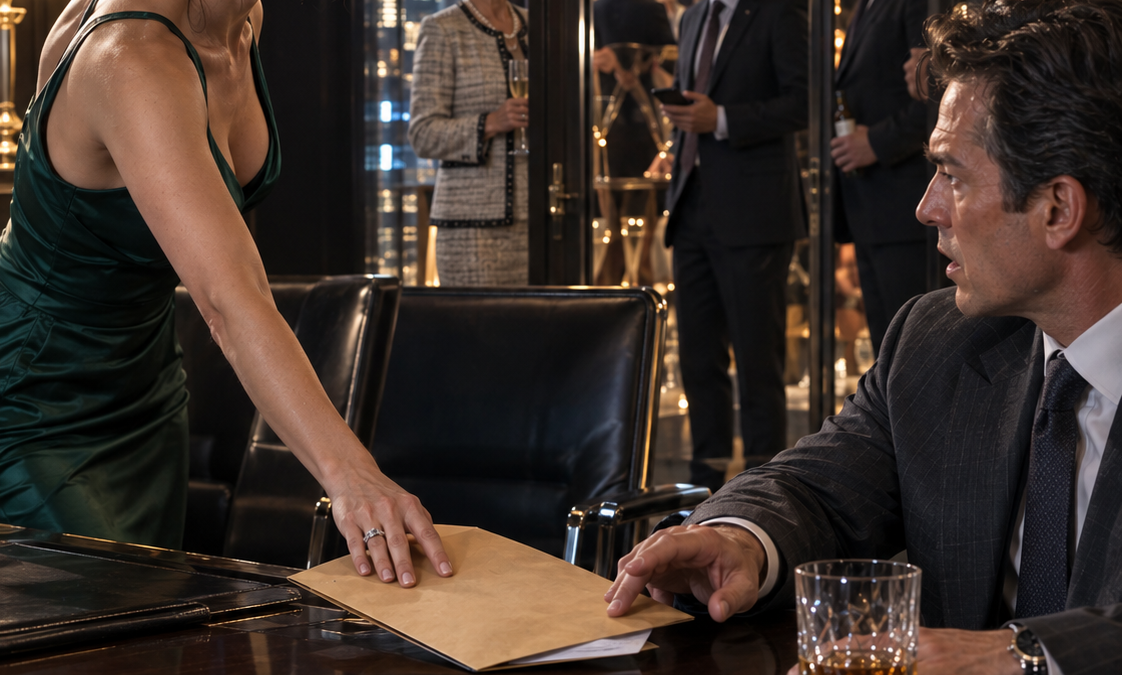
“I didn’t die on that table alone so you could decide I wasn’t worth the truth.”
She filed for divorce at his retirement party. She didn’t expect to become CEO of his company — or to give him a second chance.
The retirement party was everything Marcus Harrington hated about civilian life — too many people, too much noise, and a bar tab that would’ve funded a small battalion for a month.
He stood at the edge of the rooftop terrace at the Peninsula, Chicago’s skyline glittering behind him like a wall of lit matchsticks. His former SEAL team had flown in from Coronado, Virginia Beach, and Little Creek — men he’d bled with, men who’d carried him when he couldn’t walk, men who still called him “Hondo” because of a stupid bet in BUD/S that involved a Hawaiian shirt and a goat. They were drinking his whiskey, telling stories that got louder with each round, and pretending they weren’t all looking at the woman who’d just walked in wearing a dress that cost more than their first cars.
Elena.
His wife of six years, who’d been sleeping in the guest room for the past four months, who’d stopped answering his calls after the third week of his deployment to the Gulf, who’d looked at him across the kitchen island three days ago like he was a stranger who’d wandered into her house.
She moved through the crowd like she owned it. And technically, she did. Harrington Industries held the mortgage on half the buildings visible from this terrace, and Elena — as the company’s former general counsel, before she’d walked away two years ago — had negotiated most of those deals herself. The board still whispered about her. Some with admiration. Most with fear.
Marcus watched her stop to speak with his mother, Margaret Harrington, who was holding court near the bar in a Chanel suit and a smile that could curdle milk. Margaret touched Elena’s arm — a gesture that looked affectionate to anyone who didn’t know better. Marcus knew better. His mother’s fingers were pressing into Elena’s forearm like she was checking for a pulse.
“Your wife looks like she’s about to commit a felony,” said Jake Torres, his former XO, now a security consultant in Austin. Jake handed him a fresh glass of Macallan 18. “You two still fighting?”
“We’re not fighting,” Marcus said. “We’re negotiating.”
“Same thing in my house.” Jake clinked his glass against Marcus’s. “She’s been here twenty minutes and hasn’t come over. That’s not negotiating. That’s a war crime.”
Marcus didn’t answer. He was watching Elena’s face as she extracted herself from Margaret’s grip. There was something in her expression tonight — a tightness around her mouth, a stillness in her hands — that he’d seen only twice before. Once, when she’d been preparing to resign from Harrington Industries. And once, three years ago, when she’d told him she was pregnant and then, two weeks later, told him she wasn’t anymore.
The memory landed like a punch to the sternum. He pushed it down.
“Marcus.” Elena’s voice cut through the noise. She’d crossed the terrace without him noticing. Up close, he could see the faint lines around her eyes that hadn’t been there a year ago. She’d stopped dyeing her hair — the gray at her temples was new. He liked it. He’d never told her.
“Elena.”
“I need to speak with you. Privately.”
“Can it wait? I’m—”
“No.”
The single syllable landed between them like a dropped plate. Jake took a step back, muttering something about needing another drink.
Marcus studied her. She was holding her purse — a black leather thing he’d bought her for their anniversary two years ago — with both hands, gripping the strap like a lifeline. He’d never seen her nervous. Not when she’d argued before the Illinois Supreme Court. Not when she’d faced down a hostile board vote. Not when she’d told him, in the flat clinical voice of someone reading a medical chart, that she’d lost the baby.
“Five minutes,” he said.
She led him away from the party, through the glass doors and into the private conference room the hotel had set aside for the event. The room smelled like lemon polish and old money. A single lamp burned on the long mahogany table. Elena didn’t sit. She set her purse on the table, opened it, and pulled out a manila envelope.
Marcus felt the temperature in the room drop.
“What is that?”
“Sit down.”
“I don’t—”
“Marcus. Sit. Down.”
He sat. Not because she’d asked. Because his legs had stopped working.
Elena slid the envelope across the table. It was thick — at least twenty pages. His name was printed on the front in her neat, careful handwriting. The same handwriting that had written the notes she used to leave in his briefcase before his trips. Come home safe. I’ll be here. — E.
“Open it,” she said.
He didn’t. He looked at her instead. Really looked. The dress was emerald green — his favorite color on her, though he’d never told her that either. Her hands were steady now. Her eyes met his without flinching.
“What is this?”
“Divorce papers.”
The words landed like a sniper round. Marcus didn’t move. Didn’t blink. His training kicked in — a cold, dispassionate voice in the back of his skull cataloging the threat, calculating angles, assessing damage.
“You’re serving me at my retirement party.”
“I’m serving you at the only event I knew you’d attend without canceling.”
“Elena—”
“I’ve signed everything. The house on Astor is yours. The apartment in New York is mine. I’m not asking for alimony. I’m not asking for a settlement. I want nothing from you except my name back.”
“Your name.”
“Vasquez. I want my name back.”
Marcus picked up the envelope. It felt heavier than paper. He didn’t open it. He set it back on the table and folded his hands over it like he was trying to keep it from growing legs and running away.
“Why now?”
“Because you’re finally done. Because you’re not deploying again. Because there’s no excuse left for either of us.” She paused. “Because I found the emails.”
The words didn’t compute at first. Then they did — slow, like cold water seeping through a crack in a dam.
“Emails.”
“Between you and Dr. Reyes. The prenatal specialist. The one you paid to tell me the baby wasn’t yours.”
Marcus felt the floor tilt.
“I didn’t—”
“Don’t.” Her voice cracked — just once, a hairline fracture in the marble calm. “Don’t you dare lie to me in the same room where you accepted the flag for your father’s funeral. Not here.”
He stood up. The chair scraped back against the hardwood. “Elena, listen to me—”
“I’ve listened for six years. I’ve listened to your mother tell me I wasn’t good enough for this family. I’ve listened to your colleagues call me a diversity hire behind my back. I’ve listened to you tell me you loved me while you were planning a future that didn’t include me.”
“That’s not—”
“I found the emails, Marcus. All of them. The ones where you told Dr. Reyes to lie to me about the paternity test. The ones where you told her the timing was ‘inconvenient.’ The ones where you asked her to recommend a ‘termination’ because you couldn’t handle a child right then — not with the merger, not with the board, not with your mother breathing down your neck.”
He felt something tear loose in his chest.
“The pregnancy was ectopic,” he said, his voice low and rough. “You almost died.”
“I did die.” Elena’s eyes were wet now, but her voice didn’t waver. “I died on that table while you were in a board meeting. I died alone because you told the doctor not to call you until after the vote. And then I found out you’d told her to lie to me about whether the baby could have been yours. You wanted me to think I’d lost something that was never mine to begin with.”
“That’s not what happened.”
“Then what happened, Marcus? Tell me. Because I’ve spent four months trying to find another explanation, and I can’t.”
He opened his mouth. Closed it. The truth was a grenade with the pin already pulled. He could throw it, but it would detonate either way.
I told Dr. Reyes to lie because I was afraid you’d leave me if you knew the truth. Because the merger was falling apart. Because my mother was threatening to expose the offshore accounts. Because I was being investigated by the SEC and I couldn’t afford a scandal. Because I was a coward.
Because I loved you too much to lose you.
None of it was enough. He knew that even as the words formed in his throat. There was no version of this story where he came out the hero. He’d made the choice. He’d signed the order. He’d let her believe a lie for three years because the truth would have cost him everything.
Everything except her. And now he’d lost her anyway.
“The party’s still going,” Elena said. She picked up her purse. “I didn’t want to do this in public. I didn’t want to humiliate you in front of your team. That’s the only mercy I have left to give you.”
“Elena—”
“Goodbye, Marcus.”
She walked to the door. He didn’t stop her. He couldn’t. His legs were rooted to the floor, his mind a blank white static. She paused with her hand on the doorknob.
“The courier will pick up your signed copies tomorrow by noon. If they’re not ready, my attorney will file with the court on Monday. I’d prefer to keep this quiet. But I won’t wait forever.”
She opened the door. The noise of the party flooded in — laughter, clinking glasses, someone telling a story about a helicopter crash in Fallujah. Elena stepped through it like a ghost passing through a wall.
The door closed behind her.
Marcus stood alone in the conference room for a long time. Then he opened the envelope, pulled out the papers, and read every word.
When he finished, he called his attorney.
Then he called his mother.
Then he poured himself a drink and stared at the skyline until the lights blurred and the city looked like a photograph someone had left out in the rain.
Chapter 2: The Name on the Door
Elena made it to the elevator before she started shaking.
She pressed the button for the lobby, leaned against the mirrored wall, and closed her eyes. The doors slid shut. The car began its descent. Somewhere between the 42nd and 38th floors, the tears came — hot, silent, and furious. She wiped them away with the back of her hand before the doors opened.
The lobby was marble and gold and indifferent. A bellhop in a navy uniform nodded at her as she crossed to the revolving door. She didn’t nod back. The night air hit her like a slap, cold and bracing, and she walked three blocks before she realized she’d left her coat upstairs.
She didn’t go back.
Her apartment was in River North — a two-bedroom on the 18th floor of a building that Harrington Industries didn’t own, which had been the point. She’d bought it six months ago, quietly, with money from an account Marcus didn’t know about. The account held the remnants of her inheritance from her grandmother — $340,000 that she’d never touched because it felt like blood money. Her grandmother had earned it cleaning houses for the families Elena now dined with. Using it to leave her husband felt like a kind of justice.
She let herself in, locked the door, and stood in the dark for a full minute before turning on the lights. The apartment was sparse — a couch, a coffee table, a kitchen with nothing in the fridge but yogurt and wine. She’d been living here part-time for four months, ever since she’d found the first email.
The emails.
She’d discovered them by accident. Marcus had left his laptop open on the kitchen island — a breach of protocol so out of character that she’d almost ignored it. But the screen was bright, the subject line was “RE: Vasquez-Harrington — Confidential,” and her name had caught her eye like a hook.
She’d read them all. The exchange with Dr. Reyes. The instructions. The cold, clinical language of a man orchestrating a lie. Recommend termination. Patient is not emotionally stable. Timing is inconvenient.
She’d sat at that island for three hours, reading and re-reading, until the words blurred and her hands went numb. Then she’d closed the laptop, walked upstairs, and slept in the guest room for the first time in their marriage.
Marcus had come home three days later. He’d asked her what was wrong. She’d said nothing. She’d wanted to see how long he could look at her without confessing.
Four months. He’d lasted four months.
The divorce papers had been ready for six weeks. She’d been waiting for the right moment — the right combination of public and private, devastating and dignified. His retirement party had been perfect. All his men. All his family. All the people who thought they knew him.
She’d wanted him to feel the ground disappear.
Now she sat on her couch, still in the emerald dress, and opened her laptop. There was an email from her attorney, two from work, and one from a name she didn’t recognize — L. Harrington.
Margaret.
Elena opened it.
Elena. I heard about tonight. I’m not surprised. You were never right for this family, and I told Marcus that from the beginning. But I want you to know — the board meeting next week is going to be very interesting. I’ve been speaking with some of our investors. They have concerns about Marcus’s leadership. Perhaps it’s time for a change. You always were the smart one. I’m sure you’ll land on your feet. — Margaret
Elena read it twice. Then she deleted it.
She knew what Margaret was doing. The old woman had been waiting for this moment — the fracture in Marcus’s marriage, the crack in his armor. She’d never approved of Elena. Never forgiven her for being the daughter of a schoolteacher and a union organizer, never mind that Elena had graduated top of her class at Northwestern Law, never mind that she’d saved Harrington Industries from a hostile takeover three years ago by working eighteen-hour days for six months straight.
Margaret wanted the company. She’d always wanted it. And with Marcus vulnerable, she’d make her move.
Elena closed her laptop. She poured a glass of wine, drank half of it standing at the kitchen counter, and then went to bed.
She didn’t sleep.
At 2:47 a.m., her phone buzzed. A text from an unknown number.
I know what you did. — M
She stared at the screen for a long time. Then she typed back.
Which part? The divorce or the part where I found out you lied about our dead baby?
No response.
She put the phone face-down on the nightstand and closed her eyes.
Chapter 3: The Man Who Didn’t Sign
Marcus didn’t sign the papers.
He read them again the next morning, sitting in the kitchen of the Astor Street house — the house Elena had loved, the house she’d decorated with flea-market finds and auction-house treasures, the house that now felt like a museum exhibit of a life that no longer existed. The papers were straightforward. No alimony. No settlement. She wanted nothing.
That was the problem.
If she’d asked for money, he could have negotiated. If she’d demanded the house, he could have fought. But she was asking for nothing — which meant she was asking for everything. She wanted out. She wanted her name back. She wanted to erase him from her life like a stain.
He couldn’t let that happen.
Not because he deserved her. He knew he didn’t. But because there was something else — something she didn’t know yet. Something that would make the divorce a catastrophe not just for him but for her.
The merger.
Harrington Industries had been in talks with Vanguard Logistics for six months. It was the biggest deal of Marcus’s career — a $2.3 billion acquisition that would triple the company’s shipping capacity and make them the dominant player in the Midwest. The deal was contingent on one thing: Marcus’s marriage.
Vanguard’s CEO, Arthur Chen, was old-school. He believed in family. He’d made it clear during the initial negotiations that he didn’t do business with men who couldn’t keep their own houses in order. His exact words: “I’ve seen too many deals fall apart because a man’s personal life was a mess. If you can’t manage your marriage, how can I trust you to manage my company?”
Marcus had laughed it off at the time. He’d told Chen that his marriage was solid. He’d brought Elena to the dinners, let her charm Chen’s wife with stories about her pro bono work, watched her navigate the conversation with the same precision she’d once used in courtrooms.
Chen had been impressed. He’d said so. “Your wife is your best asset,” he’d told Marcus. “Don’t screw it up.”
If the divorce became public, the merger would collapse. Two billion dollars, gone. Thousands of jobs, at risk. The board would revolt. Margaret would have her opening.
And Elena would be caught in the crossfire.
Marcus set the papers down and called his attorney.
“Don’t file anything,” he said. “I need time.”
“Marcus, she’s given you a deadline—”
“I’ll handle it.”
He hung up and stared at the wall. Then he called Elena.
She didn’t answer.
He called again. Nothing.
He texted: We need to talk. Not about the divorce. About the merger. Vanguard will walk if this becomes public. You know what that means for the company.
Three minutes passed. Then:
The company is not my problem anymore.
He typed: It’s not about the company. It’s about the people who work there. 12,000 employees. Half of them in Chicago. If Vanguard walks, we lose the deal, the stock tanks, and the first thing the board does is cut payroll. You know this.
Another pause. Longer this time.
What do you want, Marcus?
He wanted to say: I want you to come home. I want to undo every stupid decision I’ve made. I want to go back to the night you told me you were pregnant and be the man you deserved instead of the coward I was.
He typed: Six months. Stay married for six months. Let me close the merger. Then I’ll sign whatever you want. I’ll give you the house, the apartment, the money — everything. Just give me six months.
The reply came fast.
You think I’m for sale?
No. I think you’re the only person who can save this deal. Chen trusts you. His wife likes you. If you show up at the next dinner, if we play happy family for a few more months, the merger goes through. After that, you’re free. I’ll never bother you again.
Silence.
Then: I want something in writing. A post-nuptial agreement. If you so much as look at another woman, if your mother so much as breathes in my direction, the deal is off and I walk. And I want a seat at the table. Literal. I want to be in the room when you negotiate with Chen. I want to see the numbers. I want to know what I’m propping up.
Marcus stared at the screen.
She was negotiating. Of course she was. She’d been the best attorney he’d ever met — sharper than anyone on his legal team, more ruthless than his CFO, more strategic than his own mother. He’d forgotten that, somewhere along the way. He’d let her become the wife in the background instead of the partner she’d been.
He typed: Done. I’ll have the papers drawn up tonight.
Her reply: I’ll have my attorney review them. Don’t call me again until they’re ready.
That was it. No goodbye. No emoji. Nothing.
Marcus set the phone down and poured himself a drink. It was 10 a.m. He didn’t care.
He had six months.
He had no idea if it would be enough.
Chapter 4: The Dinner Party
The Vanguard dinner was at Chen’s penthouse in the Gold Coast — a sprawling duplex with floor-to-ceiling windows and a view of the lake that made Marcus’s own house look like a starter home. Elena arrived separately, in a navy dress he’d never seen before, her hair pulled back in a sleek knot that showed off the gray at her temples. She looked like a stranger. She looked like the woman he’d married.
Chen greeted her with a kiss on the cheek. “Elena! I was afraid you wouldn’t come. Marcus said you’d been under the weather.”
“I’m feeling much better,” Elena said. Her smile was flawless. “Thank you for asking.”
Marcus watched her work the room. She moved from Chen to his wife, Lila, to the CFO and his husband, to the general counsel and his daughter. She asked questions that made people feel interesting. She laughed at jokes that weren’t funny. She was, in every way, the perfect corporate wife.
It was a performance. He knew it. She knew it. But no one else did.
They sat through a four-course dinner that tasted like cardboard to Marcus. Elena sat beside him, her hand resting on the tablecloth inches from his. She didn’t touch him. She didn’t look at him. But she laughed at his jokes, nodded at his stories, and once — when Chen asked about their plans for the summer — she said, “Marcus has been talking about Greece. He’s always wanted to see the islands.”
Marcus almost choked on his wine.
He’d never said that. He’d never mentioned Greece. But Elena had remembered — from a conversation years ago, before the miscarriage, before the lies — that he’d once dreamed of sailing the Aegean. She’d remembered. And she was using it as a prop.
After dinner, Chen pulled Marcus aside.
“Your wife is remarkable,” he said. “You’re a lucky man.”
“I know.”
“I mean it. I’ve seen a lot of marriages in this business. Most of them are performances. Yours isn’t. I can tell.”
Marcus forced a smile. “We’ve had our challenges.”
“Haven’t we all.” Chen clapped him on the shoulder. “The merger is a go. I’ll have my team send over the paperwork tomorrow. Congratulations, Marcus. You’ve earned it.”
Marcus should have felt relief. Instead, he felt hollow.
He found Elena by the window, staring out at the lake. The city lights reflected off the water like shattered glass. She didn’t turn when he approached.
“We did it,” he said. “The merger is on.”
“I know.”
“Thank you.”
She turned then. Her eyes were cold, but there was something else beneath the cold — something tired, something sad.
“I didn’t do it for you,” she said. “I did it for the people who work for you. The ones who don’t have a choice.”
“I know.”
“Do you? Because I’m not sure you’ve ever understood what it means to not have a choice. You’ve spent your whole life choosing, Marcus. Choosing to lie. Choosing to hide. Choosing to let me believe something that wasn’t true.”
He wanted to defend himself. He wanted to explain. But the truth was a grenade, and he’d already pulled the pin.
“I’m sorry,” he said.
“I know.” She turned back to the window. “That doesn’t change anything.”
They stood in silence for a long time. Then she said, “I’ll see you at the next dinner. Don’t call me before then.”
She walked away. He watched her go.
Chapter 5: The Betrayal in the Details
The first crack appeared two weeks later, in a boardroom on the 40th floor of Harrington Tower.
Marcus was reviewing the merger paperwork when his CFO, David Kim, slid a folder across the table.
“We have a problem.”
Marcus opened the folder. Inside was a financial report — a detailed analysis of Vanguard’s holdings, subsidiaries, and liabilities. It was the kind of document that took weeks to compile. David had been working on it in secret.
“What am I looking at?”
“Vanguard’s numbers don’t add up. They’ve been inflating their revenue projections for the past three years. The merger is built on a lie.”
Marcus felt the blood drain from his face. “How do you know?”
“Because I had a source on the inside. A woman named Sarah Chen.”
“Chen. As in—”
“Arthur Chen’s daughter. She’s been estranged from her father for years. She reached out to me last month. She said she couldn’t let the deal go through without someone knowing the truth.”
Marcus stared at the numbers. The merger — the deal he’d staked everything on — was a house of cards. If it collapsed, Harrington Industries would lose billions. The board would demand his resignation. His mother would finally get what she wanted.
“Why didn’t you tell me sooner?”
“I wasn’t sure if I could trust her. But I’ve verified the numbers. It’s real, Marcus. We’re about to buy a company that’s bleeding money and hiding it.”
Marcus stood up. He walked to the window and stared at the city below. The buildings looked small from up here. Everything looked small.
“There’s something else,” David said.
“What?”
“Sarah Chen isn’t just Arthur’s daughter. She’s also your wife’s former law school roommate.”
Marcus turned. “What?”
“Elena and Sarah were roommates at Northwestern. They stayed close after graduation. Sarah’s the one who introduced Elena to the Vanguard deal in the first place.”
Marcus felt the floor tilt.
“Elena knew?”
“I don’t know. But if she did, she didn’t tell us.”
Marcus grabbed his phone. He called Elena. She answered on the third ring.
“Marcus. What—”
“Did you know?”
A pause. “Know what?”
“About Vanguard. About Chen’s daughter. About the inflated numbers. Did you know?”
Silence. Then: “Yes.”
Marcus felt something crack inside him. “You knew the deal was a fraud and you didn’t tell me?”
“I didn’t know for sure until last week. Sarah called me. She told me what she’d found.”
“And you didn’t think to mention it?”
“I was trying to figure out what to do.” Her voice was tight. “I was trying to protect you.”
“Protect me? You let me walk into a boardroom and present a fraudulent deal to my own company. You sat beside me at Chen’s dinner and smiled while I shook his hand.”
“I was trying to find a way to stop the merger without destroying the company. I was trying to—”
“You were trying to punish me.” The words came out raw, jagged. “You wanted to watch me fail. You wanted to see me humiliated in front of the board, just like I humiliated you.”
“That’s not—”
“Don’t lie to me, Elena. Not about this.”
The line went dead.
Marcus stared at the phone. Then he threw it across the room.
It hit the wall and shattered.
Elena didn’t call back.
Marcus didn’t expect her to. He’d accused her of something she hadn’t done — or at least, something she hadn’t fully done. He knew that even as the words left his mouth. But the accusation had felt good. It had felt like control, and control was the only thing he had left.
He spent the next three days in the office, sleeping on the leather couch in his corner suite, ignoring the calls from his mother, his attorney, and David Kim. He didn’t eat. He didn’t shower. He stared at the numbers on his screen until they blurred into meaningless shapes.
On the fourth day, Elena walked into his office.
She didn’t knock. She didn’t announce herself. She just opened the door, crossed the room, and dropped a folder on his desk.
“Sarah Chen’s statement,” she said. “Notarized. She’s willing to testify that her father knowingly falsified Vanguard’s financial reports. She’s also willing to provide documentation of every illegal transaction the company has made in the past five years.”
Marcus looked up. Elena was wearing jeans and a gray sweater. Her hair was loose. She looked tired — more tired than he’d ever seen her.
“Why?”
“Because I’m not the villain in this story, Marcus. I never was.” She sat down across from him. “I found out about the fraud three weeks ago. I called Sarah. I convinced her to go on the record. I’ve been working with a team of forensic accountants to build a case that will stand up in court.”
“You’ve been working against me.”
“I’ve been working to save you.” She leaned forward. “If the merger goes through and the fraud is exposed later, you’ll be personally liable. You’ll lose everything — the company, your reputation, your freedom. The SEC will come after you. The board will throw you to the wolves. Your mother will dance on your grave.”
Marcus stared at her. “Why do you care?”
“I don’t.” The words were flat. “But I’m not a monster. And despite everything, I don’t want to see you destroyed. I want to see you held accountable. There’s a difference.”
She stood up. “The board meeting is in two days. You can present Sarah’s evidence and cancel the merger. Or you can go down with the ship. It’s your choice.”
She walked to the door.
“Elena.”
She stopped.
“The baby,” he said. His voice was hoarse. “The ectopic pregnancy. I need you to know — I didn’t plan that. I didn’t want you to lose it. I was scared. The merger was falling apart, my mother was threatening to expose the offshore accounts, and I was terrified of losing you. So I told Dr. Reyes to lie. I told her to tell you the baby might not have been mine. I thought if you believed the pregnancy was a mistake, you wouldn’t grieve. You wouldn’t leave. You’d stay with me.”
She turned. Her face was unreadable.
“I was a coward,” he said. “I was a liar. I was every terrible thing you think I am. But I never stopped loving you. Not for a single day.”
The silence stretched between them like a wire pulled too tight.
“I know,” Elena said. “That’s what makes it worse.”
She left.
Chapter 6: The Boardroom
The board meeting was scheduled for 9 a.m. in the main conference room on the 40th floor. Marcus arrived at 7, alone, carrying a leather briefcase that contained Sarah Chen’s statement, the forensic accountant’s report, and a single sheet of paper that he’d spent the whole night writing.
He sat in the dark conference room and waited.
The board members filed in one by one — David Kim, looking nervous; Arthur Vance, the lead independent director, looking suspicious; his mother, Margaret, looking like a cat who’d found a bowl of cream.
Margaret sat at the opposite end of the table. She’d been circulating rumors about his leadership for weeks. He knew what she was planning. She was going to call for a vote of no confidence. She was going to take his company.
“Gentlemen,” Marcus said. “I have an announcement.”
He opened the briefcase and slid the folders across the table.
“Vanguard Logistics has been falsifying its financial reports for the past three years. The merger we’ve been negotiating is built on fraud. I have notarized testimony from Sarah Chen, Arthur Chen’s daughter, confirming her father’s illegal activities. I have documentation from a forensic accounting team verifying the numbers. And I have a recommendation.”
He paused.
“We cancel the merger. Effective immediately.”
The room erupted.
Vance wanted to know how this had happened. Kim wanted to know who else knew. Margaret wanted to know what it would cost the company.
“The cost of canceling the merger is estimated at $200 million,” Marcus said. “The cost of going through with it is the destruction of everything we’ve built over the past sixty years. I know which one I choose.”
“You’ll lose your position,” Margaret said. Her voice was silk. “The board will demand your resignation.”
“Then they’ll have it.” Marcus stood up. “But before I go, I want to make one thing clear. The person who brought me this information — the person who saved this company from a catastrophic mistake — is my wife. Elena Vasquez. She could have let me fail. She had every right to. Instead, she chose to save the people who work here. The people who don’t have a choice.”
He walked to the door.
“I’m resigning as CEO. Effective immediately. The board can elect a new leader at its next meeting.”
He opened the door. Elena was standing in the hallway, leaning against the wall. She’d been listening.
“You didn’t have to do that,” she said.
“Yes, I did.”
He walked past her. She followed.
“Marcus—”
He stopped. Turned. Looked at her.
“I signed the divorce papers,” he said. “This morning. My attorney has them.”
Elena stared at him. “What?”
“You were right. Six months was too long. You shouldn’t have to wait for your life to start.”
He reached into his pocket and pulled out a small velvet box. He opened it. Inside was a ring — not a wedding ring, but something older. His grandmother’s ring, a simple band of gold with a single diamond. She’d given it to him when he’d graduated from BUD/S. She’d told him to give it to the woman who made him want to be better.
“I didn’t give you this when we got married because I was afraid,” he said. “I was afraid you’d leave. I was afraid you’d stop loving me. I was afraid of everything except being honest with you.”
He closed the box and pressed it into her hand.
“You don’t have to take it. You don’t have to forgive me. But I need you to know — I see you, Elena. I see everything you’ve done. Everything you gave up. Everything I took from you. And I’m sorry.”
He let go of her hand and walked away.
Chapter 7: The Second Letter
Elena stood in the hallway for a long time after Marcus left. The velvet box was warm in her palm. The boardroom behind her was in chaos — voices raised, chairs scraping, someone yelling about liability.
She walked to the elevator and pressed the button for the lobby.
She didn’t open the box. Not in the elevator. Not in the cab. Not when she got home. She set it on her kitchen counter and stared at it like it was a bomb.
The divorce papers came the next day, via courier. She read them on her couch, still wearing her coat. Marcus had signed everything. He’d given her the house, the apartment, the full financial settlement — far more than she’d asked for. He’d also attached a handwritten note.
E —
The bottom line is this: I’ve spent my whole life trying to control things so I wouldn’t get hurt. I controlled the company. I controlled the narrative. I tried to control you. I know now that control isn’t the same as love, and safety isn’t the same as trust.
You were the only person I never had to control. You chose me. Out of everyone in the world, you chose me. And I repaid you by making sure you’d never have a reason to leave.
I’m not going to ask you to come back. I’m going to spend the rest of my life trying to become the man who deserved you. If you ever want to talk, I’ll be here. If you never want to see me again, I’ll understand.
I love you. That’s the only thing that was ever true.
— Marcus
Elena read the letter three times. Then she folded it, slid it back into the envelope, and put it in a drawer.
She didn’t cry. She’d done enough crying.
She picked up the velvet box. Opened it. The ring was simple, elegant, old. His grandmother’s.
She put it on her finger. Then she took it off.
Then she put it back on.
 [Tap here for the Next Part ]

