“She’s not the victim she claims to be. She’s a predator, and she’s been circling this family for years, waiting for the right moment to strike.”
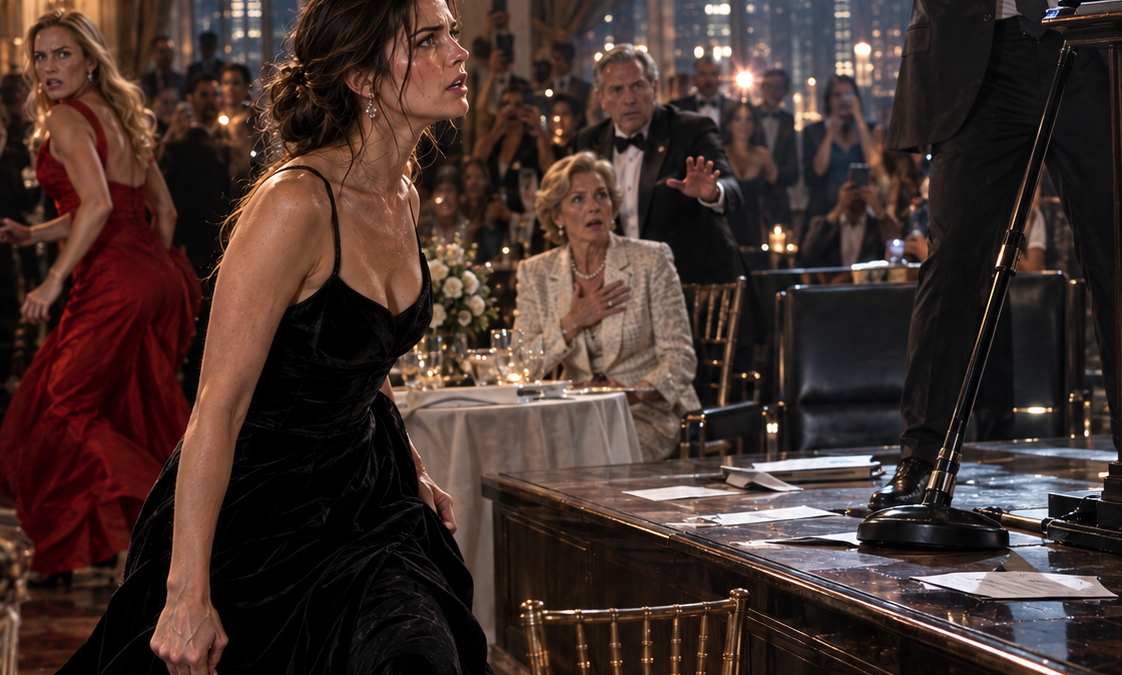
“She’s not the victim she claims to be. She’s a predator, and she’s been circling this family for years, waiting for the right moment to strike.”
She married him to save her family. She never planned to stay—until she discovered the one secret that could destroy them all.
The first thing I noticed was the shoes.
Not the woman wearing them—not yet—but the shoes themselves, red-soled, patent leather, placed neatly side by side on the marble floor of my husband’s private study like they belonged there. Like they’d been there a hundred times before.
I was holding a tray of coffee. Two cups, black, no sugar, because Adrian had been in back-to-back meetings since six a.m. and I still remembered how he took it, even after eleven months of sleeping in separate wings of a house that had more bedrooms than I could name.
The door to his study was supposed to be locked. It was always locked. I’d learned that the first week of our marriage, when I’d tried to bring him dinner and found the handle wouldn’t turn.
But today it was open. Just a crack. Just enough.
“—can’t keep stalling, Adrian. The fund closes in six weeks.”
Her voice was low, intimate, the kind of voice that didn’t need to be loud to fill a room. I stopped walking. My heels made no sound on the Persian runner, which was the only reason I heard what came next.
“I’m not stalling.” Adrian’s voice, clipped, controlled—the voice he used in boardrooms when he was calculating something. “There are complications.”
“Complications.” A soft laugh. “Is that what we’re calling your wife now?”
The tray tilted in my hands. Coffee sloshed over the rim, hot against my fingers, and I didn’t feel it.
“Victoria.” His tone was a warning. The kind of warning that made grown men in his company go pale.
But she laughed again. “Oh, don’t get protective. It’s cute. Really. The way you keep her tucked away up here like a doll in a display case. But dolls don’t sign NDAs, darling. And this one—” a pause, “—this one’s been asking questions.”
My blood went cold.
“I’ll handle it,” Adrian said.
“Will you? Because I’ve been handling things for you since before you ever met her, and I’m telling you—she’s a liability. She found the White Oak account. She just hasn’t realized what she found yet.”
The name meant nothing to me. White Oak. I turned it over in my mind, searching for context, finding only blankness.
There was a sound—movement, maybe. Then Victoria spoke again, softer now, almost gentle. “I know you think you owe her something. But you don’t. You owe me. You owe us. And if she keeps digging, if she goes to the SEC or the press or anyone with even a shred of curiosity—”
“She won’t.”
“You can’t promise that.”
“Watch me.”
I should have walked away. I should have turned around, gone back to the kitchen, pretended I hadn’t heard anything. But I’d spent eleven months in this house being told what I should do, what I shouldn’t ask, what I didn’t need to know. Eleven months of smiling at charity galas while Adrian’s mother introduced me as “the new Mrs. Blackwood” like I was a piece of furniture she was still deciding whether to keep.
So instead of walking away, I pushed the door open.
They were standing close—too close, the kind of proximity that had nothing to do with business and everything to do with history. She was tall, blonde, dressed in a cream-colored suit that probably cost more than my entire wardrobe. Thirty-five, maybe. Sharp cheekbones, sharper eyes.
And she was wearing my husband’s watch. The Rolex his father had given him on his twenty-first birthday. The one he never let out of his sight.
Adrian saw me first. Something flickered across his face—surprise, then something harder, then nothing at all. The mask sliding into place.
“Elena.” He didn’t move away from her. Didn’t step back. “I thought you were at the foundation.”
“I brought you coffee.” I held up the tray like evidence. My hands were steady. I don’t know how. “I didn’t realize you had company.”
Victoria turned, slow and deliberate, and smiled. It was a beautiful smile. It was also the smile of a woman who had never once been told no.
“You must be Elena.” She extended her hand. “I’ve heard so much about you.”
I didn’t take it. “From whom?”
That smile widened, just a fraction. “Around.”
“Victoria.” Adrian’s voice again, that edge of warning. But she ignored him completely, her eyes fixed on me with an intensity that made my skin prickle.
“You know, I’ve been trying to get Adrian to bring you to dinner for months. But he’s so protective.” She tilted her head. “Or maybe he’s just embarrassed. I can never tell.”
“Victoria.” Harder now.
She laughed—that same light, careless sound—and finally stepped back. “Fine, fine. I know when I’m not wanted.” She gathered her bag from the desk, a sleek black thing I didn’t recognize. “But think about what I said, Adrian. Six weeks.”
She brushed past me on her way out. Close enough that I could smell her perfume—something floral, expensive, familiar in a way that made my stomach turn. And just before she reached the door, she paused.
“Oh, and Elena?” She looked back over her shoulder. “That foundation you run. The one for at-risk youth. It’s lovely work.” A pause. “I’d hate to see anything happen to it.”
Then she was gone, heels clicking down the hallway, and I was left standing in my husband’s study with a tray of cold coffee and the slow, sick realization that I had just walked into something I didn’t understand.
Adrian moved first.
“That was nothing.” He was already reaching for his phone, already dismissing me. “A business associate. Nothing you need to worry about.”
“Her shoes are in your study.”
He glanced at the red-soled heels still sitting by his desk. Something crossed his face—irritation, maybe. “She leaves them. The floors damage them.”
“She leaves them,” I repeated. “How often does she visit that she has a designated spot for her shoes?”
“Elena—”
“Who is she?”
“My sister.”
The word landed like a slap. I blinked at him. “You don’t have a sister.”
“I don’t have a sister you know about.” He finally looked at me—really looked, the way he did in those rare moments when the mask slipped and I saw the man I’d married underneath. “It’s complicated.”
“Complicated.” I set the tray down on the edge of his desk because my hands weren’t steady anymore. “She’s wearing your father’s watch. The one you said you’d never—”
“I gave it to her.” The words came out flat. “For her thirtieth birthday. It’s not what you think.”
“You don’t know what I think.”
“I know you’re standing there calculating how quickly you can pack a bag.” He moved toward me, and I stepped back. He stopped. Something flickered in his eyes—hurt, maybe, or something like it. “Elena. Listen to me. Victoria is my half-sister. Same father, different mother. She was born six years before me, before my parents married. My mother—” his jaw tightened, “—my mother made sure she was erased from the family records. Paid off. Sent away. Victoria grew up thinking her father wanted nothing to do with her.”
“And now?”
“Now she’s back. And she has… leverage.”
“What kind of leverage?”
He didn’t answer. Which was an answer in itself.
“The White Oak account,” I said slowly. “She mentioned it. What is it?”
“Nothing you need to concern yourself with.”
“Adrian, I’m your wife.”
“You’re my wife,” he agreed, and there was something strange in his voice—something almost like regret. “Which is exactly why I need you to stay out of this.”
I stared at him. Eleven months of marriage, and this was the first time he’d looked at me like I was a problem to be managed rather than a person he’d chosen. Eleven months of separate bedrooms, of careful distance, of a wedding that had felt more like a business merger than a beginning. And now, when I finally had a reason to demand answers, he was shutting me out.
“The foundation,” I said. “She threatened it.”
“She was making a point.”
“She was threatening me.”
“Elena.” He stepped closer, and this time I didn’t move back. “I will handle Victoria. I will handle everything. But you need to trust me.”
“Trust you.” I laughed, and it came out bitter. “I’ve been trusting you for eleven months. I’ve been living in your house, attending your events, smiling at your mother while she looks at me like I’m a stain on the family name. And in all that time, you’ve never once told me the truth about anything.”
His expression didn’t change, but something in his posture shifted—a subtle tension, like a predator assessing a threat. “What do you want me to say?”
“I want you to tell me why your half-sister, who you’ve apparently been hiding from me, is wearing your father’s watch and threatening my foundation. I want you to tell me what White Oak is. I want you to tell me—” my voice broke, just a little, “—why you married me.”
The silence stretched. Long enough that I could hear the clock ticking on his desk, a heavy antique thing that had belonged to his grandfather. Long enough that I could feel the weight of everything I’d been ignoring for eleven months pressing down on me.
“You want the truth?” His voice was quiet. Dangerous. “The truth is that I married you because I needed someone the world would believe. Someone with a clean reputation. Someone no one would suspect.”
“Suspect of what?”
“Of being connected to me.”
The words didn’t make sense. They circled in my head, looking for somewhere to land, finding nothing. “I don’t understand.”
“I know.” He reached out, and this time I let him touch my face—just his fingertips against my cheek, light as a breath. “And I’m sorry. I never meant to put you in danger.”
“Danger from what? Adrian—”
“Victoria is not just my sister.” He dropped his hand. His eyes met mine, and I saw something I’d never seen before: fear. “She’s also the woman who laundered two hundred million dollars through my family’s company. And if anyone finds out—including you—everyone connected to me goes down.”
The floor tilted. Or maybe that was just my world, rearranging itself around a truth I’d never imagined.
“I need you to forget this conversation,” he said. “I need you to go back to the foundation, do your work, smile at my mother, and pretend you don’t know anything. For your sake. For my sake. For everyone’s sake.”
“And if I don’t?”
“I can’t protect you if you don’t.”
The threat hung in the air between us, soft and terrible. I looked at my husband—this man I’d married for reasons I was only beginning to understand—and I realized I had a choice.
I could do what he asked. Go back to my carefully constructed life, pretend I hadn’t heard anything, let myself be managed and protected and lied to. Or I could find out what White Oak really was, why Victoria was back, and what my husband was so afraid of.
I picked up the tray.
“I’ll take the coffee back to the kitchen,” I said. “And I’ll think about what you said.”
Something in his expression shifted—relief, maybe, or something that looked like it. “Thank you.”
I nodded. And then I walked out of his study, down the long hallway, past the portraits of Blackwood men who had all looked like Adrian did now—controlled, powerful, hiding something.
But I didn’t go to the kitchen.
Instead, I went to my own room, closed the door, and opened my laptop. It took less than five minutes to find the first article about White Oak.
A hedge fund. $2.3 billion in assets. Founded eight years ago by a woman named Victoria Hale.
And according to the filings, one of its primary investors was Blackwood Capital.
The company my husband ran.
The company that, in six weeks, would close its doors to new investors—a standard move before quarterly audits.
Except the article I was reading was from eighteen months ago. And Blackwood Capital had pulled its investment three months later.
I stared at the screen, my heart pounding. Then I opened a new tab and started searching for everything I could find about Victoria Hale.
It was going to be a long night.
CHAPTER 2: The Man Who Bought My Silence
The house was quiet at 2 a.m. in a way that made the walls feel like they were listening.
I’d been sitting in my room for hours, laptop open, reading everything I could find. Victoria Hale had a clean digital footprint—almost too clean. A LinkedIn profile, a few mentions in business journals, a paper trail that led in perfectly respectable circles. But there were gaps. Years where she seemed to have fallen off the face of the earth, followed by sudden reappearances with more money and more connections.
She’d started White Oak Capital in 2015. Before that, she’d worked at three different hedge funds in London. Before that, nothing.
Nothing at all before the age of twenty-two.
It was like she’d materialized fully formed, a woman with a past that didn’t exist and a future that seemed to expand every year.
I was still staring at my screen when I heard the footsteps in the hallway.
Adrian didn’t knock. He never knocked—he owned the house, after all, and I was just the woman he’d installed in the east wing. He pushed the door open and stood in the doorway, backlit by the hallway lights, his face unreadable.
“You’re still awake.”
“So are you.”
He walked in. Didn’t ask permission. Just crossed the room and sat in the chair by the window, the one I’d never seen him use. He was wearing a t-shirt and sweatpants, which somehow made him look more dangerous than the suits—more real, more human. The mask was off.
“I need to tell you something,” he said. “And I need you to listen without interrupting.”
I closed my laptop. “I’m listening.”
“Victoria came to me three months before we met. She’d tracked down the adoption records, the payments my mother made to her mother, everything. She knew who she was, and she wanted what she thought she was owed.”
“What did she want?”
“Money. Position. Access.” He laughed, humorless. “She wanted to be part of the family. My mother refused. Told her she’d never be a Blackwood, that she was a mistake no one wanted to acknowledge. So Victoria went to my father.”
“And?”
“He agreed to meet her. He gave her the watch—the one she was wearing today. He told her he was sorry. He told her he’d always wondered about her, always wanted to know if she was all right.” Adrian’s voice was tight. “And then he told her that he couldn’t acknowledge her publicly, because it would destroy my mother’s reputation, and my mother’s reputation was worth more to him than a daughter he’d never met.”
I felt something twist in my chest. Not for Victoria—not exactly—but for the girl she’d been. Erased from her own family, paid off, dismissed.
“So she decided to take something else,” Adrian continued. “Something worth more than a name.”
“The laundering.”
“The laundering.” He nodded. “She built White Oak with money from my father—hush money, a one-time payment. But she was smart. She used it to start something legitimate, on the surface. Hedge fund. Tech investments. And then she started moving money through it. My father’s money. My money. Money from every Blackwood account she could access.”
“Why?”
“Because she wanted to control us. Because she wanted to make us complicit in something we couldn’t walk away from.” He leaned forward, elbows on his knees. “And because she knew that if she went down, she’d take the entire Blackwood empire with her.”
I took a breath. Let it out slowly. “Why are you telling me this now?”
“Because she’s right about one thing.” He met my eyes. “You’re a liability. You’re smart, you’re observant, and you don’t trust me. If you start digging—and I know you already have—you’ll find things that could hurt all of us.”
“Is that a threat?”
“No.” He shook his head. “It’s a warning. And an offer.”
“What offer?”
“I’ll give you answers. Real ones. Not the polished version, not the company line—the truth. But only if you let me protect you. Only if you stop investigating on your own and let me handle this.”
“And what do I get in return?”
“You get to be part of this family. Not as the wife I keep tucked away—” he winced, just slightly, “—but as a partner. Someone who knows what’s happening. Someone I trust.”
“You trust me?”
“I want to.” He said it simply, without embellishment. “I want to trust you, Elena. I want to tell you everything. But you have to give me a reason.”
The room felt smaller than it had a moment ago. The distance between us—the distance I’d maintained for eleven months—seemed to shrink, and I was suddenly aware of every detail of him: the tired lines around his eyes, the way his t-shirt was wrinkled from sleeping in a chair, the fact that he’d come to me in the middle of the night because he couldn’t sleep either.
“I’m not going to pretend this is normal,” I said. “You bought me. That’s what happened. Your mother picked me out of a lineup of potential wives, and you paid my father’s debts, and now I live in your house and attend your events and pretend we’re a couple. I know what this is.”
“It’s not—”
“Let me finish.” I held up a hand. “I’m not saying this to hurt you. I’m saying it because I need you to understand that I’m not stupid. I’ve known what this marriage is from the beginning. A transaction. A way for you to look normal while you cleaned up whatever mess your father left behind. A way for me to save my family from bankruptcy.”
His expression flickered. “That’s what you think?”
“That’s what I know.”
“It wasn’t a transaction.” He stood up, moving toward me. “The money for your father—that wasn’t payment. That was me doing what I could to help someone who didn’t deserve it because I knew his daughter didn’t deserve to suffer for his mistakes.”
“Then why did you propose?”
“Because you were the only person in that entire room who looked at me like I was a human being instead of a threat.” He stopped in front of me. “Because you didn’t flinch when I told you my name. Because you asked what I wanted, not what I could give you.”
“That’s romantic,” I said. “But it doesn’t change anything.”
“Maybe not.” He reached down, took my hand. His fingers were warm, calloused—not the hands of a man who’d been born to wealth and never worked for anything. “But it’s the truth. I don’t expect you to trust me, Elena. I haven’t earned it. But I’m asking you to let me try.”
“And in the meantime?”
“In the meantime, we need to figure out what Victoria is planning. The six weeks she mentioned—that’s the timeline. Something happens at the end of it, and I need to know what before she forces my hand.”
“She said she wants what she’s owed.”
“She wants more than that.” His grip tightened on my hand. “She wants to destroy my mother. And she wants to destroy me. And if we don’t stop her—” he paused, “—she’ll destroy you too.”
The words hung in the air between us. I thought about the foundation, the work I’d poured my heart into, the kids who depended on me. I thought about my sister, who was still recovering from the accident that had nearly destroyed our family. I thought about everything I’d built since marrying Adrian—small, fragile things—and how easily it could all be taken away.
“I won’t let her touch the foundation,” I said.
“Then help me stop her.”
I looked at my husband—really looked, the way I hadn’t let myself look since our wedding night. He was tired. He was scared. And underneath all of it, underneath the power and the control and the carefully constructed façade, he was just a man. A man who’d made mistakes. A man who was trying to fix them.
“Fine,” I said. “I’ll play by your rules. For now.”
He exhaled. “Thank you.”
“But I need something from you.”
“What?”
“The truth. All of it. No more secrets, no more lies. If I’m going to be your partner, I need to know what I’m walking into.”
He nodded. “Deal.”
“No—” I pulled my hand free, “—don’t agree too fast. You don’t know what I’m asking.”
“I know.” He met my eyes. “You’re asking for everything. And I’m saying yes.”
I stared at him. And for the first time since our wedding day, I felt something other than resignation when I looked at my husband. Something more complicated. Something more dangerous.
“I need to tell you something,” I said. “Something I haven’t told anyone.”
“What?”
“There’s a file. In my father’s study, when I was cleaning out the house after the bankruptcy—I found a file with your father’s name on it. And Victoria’s.”
Adrian went still. “What kind of file?”
“I don’t know. I couldn’t open it. It was sealed. But I kept it.” I swallowed. “I don’t know why. Something told me it might matter.”
“Where is it now?”
“In a safe deposit box at First National. I put it there the week before we got married.”
He stared at me for a long moment. Then he laughed—a low, surprised sound. “You’ve been hiding evidence from me this whole time?”
“I didn’t know it was evidence. I just knew it was important.” I lifted my chin. “And I wasn’t going to hand it over to a man I’d just met. I don’t make decisions that fast.”
“No,” he said, still laughing, “you don’t. That’s what makes you different.”
“What do you mean?”
“Everyone else falls in line the moment they meet a Blackwood.” He shook his head. “You didn’t. You still haven’t. And I’m starting to think that’s the only reason this is going to work.”
I didn’t have an answer for that. So I just stood there, in the middle of the night, with my husband laughing softly in the dark, and let myself feel—for the first time in eleven months—like maybe I wasn’t as alone as I’d thought.
CHAPTER 3: His Mother Has Opinions
The next morning, I woke to the smell of coffee and the sound of my mother-in-law’s voice.
“—absolutely unacceptable, Adrian. The gala is in three weeks, and the seating chart is a disaster. Half the board is refusing to sit next to the Whitmores, and you know how Meredith Whitmore gets when she’s slighted. I spent six months positioning this.”
I pulled on a robe and walked to the kitchen, following the sound of inevitable disaster.
Constance Blackwood was standing in the middle of the room, dressed in a cream Chanel suit at 8 a.m., holding a tablet like it was a weapon. She was seventy-two, elegant, and terrifying in a way that had nothing to do with her stature and everything to do with the sheer force of her will.
“Elena.” She didn’t look up. “Lovely of you to join us. There’s a scheduling issue with the foundation’s Christmas benefit. I’ve moved it to the fifteenth.”
“The fifteenth?” I reached for a mug. “That’s the same day as the pediatric cancer gala. I already committed to attending.”
“Which I’m sure they’ll understand. The Blackwood Foundation takes precedence.”
“I am the Blackwood Foundation.” I poured coffee, took a sip. “I’m the one who runs it. I’m the one who approves every grant, every partnership, every event. And I’ve already RSVP’d.”
Constance finally looked up. Her eyes were the same color as Adrian’s—that cold, clear blue—but where his could soften, hers never did.
“You’re the figurehead,” she said. “We both know that. The real work is done by the staff I hired.”
“Then you won’t mind if I delegate the Christmas benefit to them while I attend the gala I already committed to.”
The room went quiet. Adrian was sitting at the island, coffee in hand, watching us like a man watching a tennis match—except with slightly more fear. He’d told me once that his mother had never lost an argument. I was starting to understand why.
“You’re being difficult,” Constance said.
“I’m being consistent.” I leaned against the counter. “You asked me to take over the foundation six months ago. You said you wanted fresh ideas, new energy. I’ve doubled our donor base and tripled our reach. If you want to make scheduling decisions, that’s fine—but you’ll need to find a new face for the foundation. Mine comes with opinions.”
Constance’s lips thinned. “I see.”
“Good.” I smiled. “I’m glad we understand each other.”
Adrian made a sound that might have been a cough. When I glanced at him, he was looking at me with an expression I couldn’t read—something between amusement and awe.
“Well.” Constance set her tablet down. “Since you’re so invested in the foundation’s independence, perhaps you’ll be interested in the audit that came across my desk yesterday. Apparently, one of your new partnerships has raised some flags.”
I kept my face neutral. “Which partnership?”
“The one with Harbor House. The youth shelter in the South End.” She picked up her tablet, tapped something. “Their financials are a mess. I’ve been told there are irregularities going back years.”
Harbor House. I’d been working with them for months. They were the heart of my mission—the reason I’d wanted to run the foundation in the first place. A shelter for kids who’d fallen through the cracks, run by a woman who’d been one of those kids herself.
“What kind of irregularities?”
“Missing funds. Unaccounted donations. The usual.” She smiled, thin and cold. “I’m sure it’s nothing you can’t explain. But perhaps you’ll want to look into it before the board meeting next week.”
She swept out of the room, leaving her tablet behind on the counter. I stared at the screen—still open to a spreadsheet, still full of numbers I didn’t understand.
“She’s lying,” Adrian said quietly.
“What?”
“Look at her face. She’s hiding something.”
I turned. He was standing now, closer than he’d been before, his eyes on the doorway where his mother had disappeared.
“You saw her expression?”
“I saw the way she smiled.” His voice was grim. “That’s her ‘I have a secret’ smile. She’s up to something.”
“Maybe she’s just being Constance.” I picked up the tablet. “She hates that I run the foundation. She hates that I have any power at all. This is probably just—”
“Elena.” He took the tablet from my hands, set it down. “My mother doesn’t make idle threats. If she’s bringing up an audit, it’s because she’s already talked to someone. She’s already made moves. She’s trying to warn you.”
“Warn me about what?”
“That she can take things away.” He met my eyes. “She’s been doing it my whole life. She took away my father—not physically, but she made him choose between her and us. She took away my sister. She took away every person I’ve ever cared about, one by one, until I learned not to care.”
“Is that why you married me?” I asked. “Because you thought she couldn’t take me away?”
He was quiet for a moment. Then: “I married you because you were the first person who looked at me like I was worth knowing. Not worth having—worth knowing. I didn’t think my mother could take that away. I didn’t think anyone could.”
I didn’t know what to say to that. So I just stood there, in the kitchen of a house I’d never wanted, looking at a man I was only just beginning to understand.
“I need to go,” he said. “I have a meeting with the board in an hour. Victoria’s lawyers have been making noise about some kind of disclosure.”
“Disclosure of what?”
“Of our relationship. She wants to go public as my sister. She thinks it gives her leverage.”
“Does it?”
“That depends.” He grabbed his jacket from the back of a chair. “It gives her sympathy. The abandoned daughter, cast out by the cruel Blackwood family. It makes me the villain.”
“And if you don’t let her go public?”
“She goes to the SEC instead. Claims the entire family’s been hiding her existence as part of a money-laundering scheme.”
I felt cold. “Are you?”
“Am I what?”
“Laundering money. Are you part of what she’s doing?”
He stopped. Turned. Looked at me with those clear blue eyes that could be so cold and so warm at the same time.
“No,” he said. “But my father was. For years. And I didn’t find out until after he died.”
“Adrian—”
“I have to go.” He pulled on his jacket. “We’ll talk tonight. I’ll tell you everything. But right now, I need to stop my sister from destroying my family’s name before I figure out how to destroy her first.”
He walked out before I could respond. I stood in the kitchen for a long time after, listening to the house settle around me.
The tablet was still on the counter, still open to Harbor House’s financials. I picked it up, scrolled through the numbers, and felt my stomach drop.
Constance wasn’t lying about the irregularities. The accounts were a mess—donations that didn’t match, expenses that made no sense, money flowing in directions that weren’t documented. But something else was there too, something I only caught because I’d spent the last three months learning every detail of those books.
The same name appeared in every irregular transaction. The same name, in every unexplained transfer.
Victoria Hale.
I stared at the screen, my heart pounding. Then I picked up my phone and called the only person I could trust.
“Lena?” My sister’s voice was groggy. “It’s eight in the morning.”
“Are you at the office?”
“Where else would I be? Some of us have real jobs.”
“Can you pull everything you have on a company called White Oak Capital? And a woman named Victoria Hale?”
There was a pause. “Why?”
“Because I think my mother-in-law just handed me the first piece of evidence I need to destroy my husband’s half-sister.”
Another pause. “Elena. What exactly have you gotten yourself into?”
I looked out the window at the sprawling estate, the manicured lawns, the life I’d never wanted.
“I’m not sure,” I said. “But I’m going to find out.”
CHAPTER 4: The Sister Who Wasn’t Supposed to Exist
Three days later, I met Victoria Hale in a coffee shop on the other side of the city.
She was already there when I arrived—sitting in the corner, nursing a black coffee, looking like she owned the place. Which, I was beginning to understand, was her default setting. To own things. To take them. To make you believe she’d always had them.
“Elena.” She smiled as I slid into the booth across from her. “I was wondering when you’d reach out.”
“How did you know I would?”
“Because you’re curious.” She tilted her head. “And because you’re smart enough to realize you’re in over your head.”
I didn’t answer that. Just studied her—the same cream suit, the same careful poise, the same red-soled shoes. Everything about her was calculated. Everything was a performance.
“You threatened my foundation,” I said.
“I warned you about your foundation. There’s a difference.”
“Constance Blackwood is trying to destroy it. The audit, the missing funds—that’s her doing, isn’t it? She’s using you.”
Victoria’s smile didn’t waver. “Your mother-in-law and I have an understanding. She stays out of my way, and I stay out of hers.”
“She’s not my mother-in-law. Not really.”
“Oh, but she is.” Victoria leaned forward. “That’s the thing about marriage, Elena. It ties you to people you never wanted to know. It makes you part of families that would rather see you disappear than acknowledge your existence.”
I felt the words like a slap. Because she wasn’t just talking about me. She was talking about herself.
“You were the one who told Constance about Harbor House,” I said. “You gave her the information. You set this up.”
“I gave her ammunition. She chose to use it.”
“Why?”
“Because I wanted to meet you.” Victoria leaned back. “I wanted to see what kind of woman my brother married. And I have to say—” she smiled, “—I’m impressed. You’re not what I expected.”
“What did you expect?”
“Someone easily managed. Someone who’d take the money and the house and the nice life and never ask questions.” Her smile sharpened. “But you’re not that, are you? You’re a fighter. Like me.”
“I’m nothing like you.”
“You’re exactly like me.” She took a sip of coffee. “We’re both women who married into the Blackwood family and got burned. We’re both fighting for something that shouldn’t be this hard to hold onto. The only difference is—” she set her cup down, “—I was born into this. You chose it.”
“I didn’t choose anything.”
“Didn’t you?” She raised an eyebrow. “You married Adrian for the money. You can dress it up all you want, call it saving your family, but at the end of the day, you were bought. And the only question that matters is: what are you going to do about it?”
I stared at her. The coffee was getting cold. The shop was getting louder. And somewhere in the back of my mind, a door was opening—a door I’d been trying to keep closed for eleven months.
“What do you want from me?” I asked.
“I want you to understand the truth.” Victoria leaned forward. “Adrian is not the man you think he is. He’s not a victim. He’s not innocent. He knew about the money. He knew about the laundering. He let it happen, and then he let me take the fall.”
“That’s not what he told me.”
“Of course it isn’t.” She laughed. “Adrian has spent his entire life learning how to make people believe him. He’s a Blackwood. That’s what they do. They make you trust them, and then they destroy you.”
“You’re lying.”
“I’m the only person telling you the truth.” She reached across the table, touched my hand. Her fingers were cold. “I have proof, Elena. Documents. Transactions. Everything that shows what Adrian did. I was going to take it to the SEC—that’s what the six weeks was about. I was giving him one last chance to make it right.”
“Make it right how?”
“He was supposed to transfer me the shares I’m owed. The ones my father promised me before he died. But Adrian refused.” Her grip tightened. “He said I wasn’t a real Blackwood. He said I didn’t deserve anything. Just like his mother said. Just like everyone’s always said.”
I pulled my hand away. “Why are you telling me this?”
“Because you’re his wife.” Victoria’s voice was soft. “You have access to his accounts, his records, his secrets. You can help me get what I’m owed. And in return—” she smiled, “—I can help you get out.”
“Out of what?”
“Out of a marriage that was never real. Out of a family that will never accept you. Out of a life that you never chose.” She leaned back. “I know you’re not happy, Elena. I know you’ve been living in that house like a ghost, watching everyone else live. I’m offering you a way to be free.”
The offer hung in the air between us. I thought about my room in the east wing, the separate beds, the careful distance. I thought about Constance’s cold eyes and Adrian’s hidden truths. I thought about the foundation, the one thing I’d built that was truly mine.
“I need to think about it,” I said.
“Of course.” Victoria stood. “Take your time. But not too long. The SEC doesn’t wait forever.”
She left a card on the table. Just her name and a phone number. No title, no company. Just Victoria.
I sat there for a long time after she left, staring at the card. Then I picked it up, tucked it into my pocket, and walked out into the cold.
CHAPTER 5: The Man Behind the Mask
Adrian was waiting for me when I got home.
Not in the study this time. Not in the kitchen. In my room—the one place I’d thought was mine—sitting on the edge of my bed like he’d been there for hours.
“I need to tell you something,” he said.
“So do I.”
“You first.”
I took a breath. Reached into my pocket. Pulled out Victoria’s card.
“I met with her today.”
His face went pale. “Elena—”
“She told me you knew about the laundering. She told me you let her take the fall. She told me you refused to give her the shares your father promised her.”
“I know what she told you.” He stood up. “And she’s lying.”
“How do I know that?”
“Because I have proof.” He reached into his jacket and pulled out a folder—thick, worn, like it had been handled a hundred times. “This is everything. Every transaction, every communication, every document. It shows what really happened.”
“What really happened?”
“My father was the one laundering money. Not me. Not Victoria. My father.” He opened the folder, spread the papers across the bed. “He set up the whole thing—the shell companies, the offshore accounts, everything. And when he died, he left it to me to clean up.”
“Then why is Victoria involved?”
“Because she found out.” His voice was tight. “She found out about the money and the accounts and the whole operation. And instead of going to the authorities, she decided to take it. She started moving funds, hiding assets, setting up her own version of the scheme. She’s been doing it for years.”
“She said you knew.”
“I knew.” He nodded. “I’ve known for three years. But I didn’t know how to stop her without exposing my father—without exposing the entire family. So I let her think she was in control. I let her think she had leverage. I’ve been trying to clean up the mess, quietly, before anyone found out.”
“The six weeks.”
“The SEC audit.” He met my eyes. “I’ve been working with a team of forensic accountants to unwind every transaction she made. To show that the money was stolen, not laundered. To prove that Victoria was acting alone.”
“And the shares?”
“There are no shares.” His voice was flat. “My father never promised her anything. She made it up. She’s trying to take what isn’t hers, and she’s using you to do it.”
I looked at the papers spread across my bed. Real evidence. Real documentation. It was everything Victoria said she had, but it told the opposite story.
“Why should I believe you?” I asked.
“Because I’ve never lied to you.” He stepped closer. “I’ve kept things from you—I won’t deny that. But I’ve never lied. And I’m telling you now, Elena: Victoria is dangerous. She’s not the victim she claims to be. She’s a predator, and she’s been circling this family for years, waiting for the right moment to strike.”
“She said you were the one who was dangerous.”
“She’s not wrong.” He met my eyes. “I am dangerous. I’ve done things I’m not proud of. I’ve hurt people. I’ve made choices that cost lives. But I’ve never—never—hurt you.”
I wanted to believe him. God, I wanted to believe him. But I’d spent eleven months being careful, being distant, protecting myself from exactly this kind of moment.
“How do I know you’re not just a better liar than she is?”
He was quiet for a long moment. Then he did something I didn’t expect.
He sat down on the bed. Pulled off his watch—the one he always wore, the one his father had given him—and set it on the nightstand.
“This was my father’s,” he said. “He gave it to me when I was twenty-one. Told me it was the only thing of his I should ever trust.”
“Why are you telling me this?”
“Because I want you to understand something.” He looked up at me. “My father was a liar. A cheat. A man who destroyed everyone who ever loved him. I spent my entire childhood learning how to be like him—how to hide, how to manipulate, how to control. And I succeeded.” His voice cracked, just slightly. “I became exactly what he was.”
“But?”
“But then I met you.” He stood up. “And for the first time in my life, I wanted to be something else. I wanted to be a man who deserved to be looked at the way you looked at me on our wedding day. A man who could actually love someone without destroying them.”
I didn’t know what to say. So I just stood there, watching him, feeling everything I’d been holding back for eleven months pressing against the walls I’d built.
“I know you don’t trust me,” he said. “I know you have every reason not to. But if you can find it in yourself to give me one more chance—one real chance—I’ll spend the rest of my life proving that I’m not the man you think I am.”
“And if you are?”
“Then you can walk away. You can take the foundation, take everything, and never look at me again.” He met my eyes. “But if I’m not—if I’m actually the man you married—then I need you to stand beside me. Because I can’t do this alone.”
The room was quiet. The clock ticked. And somewhere in the distance, I heard the front door open—Constance, probably, returning from one of her charity meetings.
“I need to think,” I said.
“I know.”
“Give me tonight.”
“Take as long as you need.”
He turned to go—and then stopped. Turned back. Looked at me with those clear blue eyes that had always seemed so cold, and now seemed so desperate.
“I never should have kept you in the east wing,” he said. “I never should have kept you at arm’s length. I was trying to protect you—from Victoria, from my mother, from everything—but all I did was make you feel like a stranger.”
“You did make me feel like a stranger.”
“I know.” He stepped closer. Reached out, tentative, like he was asking permission. “But I don’t want to anymore.”
His hand touched my cheek. Warm. Calloused. Real.
“Adrian—”
“Say yes,” he said. “Not to everything. Not to me forever. Just to tonight.”
I closed my eyes. Thought about Victoria’s cold offer. Thought about Constance’s cold eyes. Thought about the cold, empty room I’d been living in for eleven months.
And then I thought about the way Adrian had looked at me in the kitchen when I’d stood up to his mother. The way he’d laughed, surprised and delighted, like I’d done something he’d never expected.
“Yes,” I said. “Tonight.”
He kissed me then—slow, searching, like he was learning something he’d been waiting years to know. And for the first time since our wedding night, I let myself kiss him back.
CHAPTER 6: The Wife Who Finally Stayed
The morning after the first night I actually slept in Adrian’s bed—not my separate room, not the careful distance we’d maintained for eleven months—I woke to find him already dressed, standing by the window with his phone pressed to his ear.
“No,” he was saying, his voice tight. “Push it back another week. I don’t care what they say—we’re not ready.”
He turned at the sound of my moving, and something in his expression softened. Just for a moment. Then the mask slid back into place, and he was the CEO again, the heir, the man who never let anyone see him sweat.
“I have to go,” he said into the phone. “We’ll talk at the office.”
He hung up, crossed to the bed, and dropped a kiss on my forehead like he’d been doing it for years. Like it was the most natural thing in the world.
“Stay,” I said.
It came out before I could stop it. Stay. A single word, the first real request I’d made of him since our wedding.
He stopped. Looked at me with an expression I couldn’t read.
“I have a meeting—”
“Cancel it.”
“Elena—”
“One morning.” I sat up, pulled the sheet around me. “Give me one morning where you’re not the CEO. Where you’re just… you.”
He was quiet for a moment. Then he laughed—that surprised, delighted laugh I’d heard in the kitchen three days ago.
“You’re going to be a problem,” he said.
“I know.”
He sat back down on the edge of the bed. Pulled off his jacket. Then his shoes.
“Fine,” he said. “One morning.”
We spent it in bed. Not the way you’re thinking—or not just that. We talked. Really talked, for the first time since we met.
I told him about my father’s gambling, the debts that had nearly destroyed our family. I told him about my sister, who’d been in a car accident the year before and was still learning to walk without a cane. I told him about the foundation, and Harbor House, and how running it had given me a purpose I’d never known I needed.
He told me about his childhood—about the cold house, the absent father, the mother who criticized everything he did. He told me about his father’s death, and the mess he’d left behind, and the three years he’d spent trying to clean it up without anyone knowing.
“I used to think I could control everything,” he said. “That if I was careful enough, smart enough, I could fix everything before anyone noticed it was broken. But I can’t. I can’t fix my mother. I can’t fix Victoria. I can’t fix what my father did.”
“You can’t fix everything,” I said. “But you can try to do better.”
“I’m trying.” He looked at me. “For you.”
The morning slipped away. One hour. Two. And by the time he finally left, I felt more married than I had in eleven months.
 [Tap here for the Next Part ]

