At 2 AM, His Secretary Called From the Hospital—The Mafia Boss Arrived Without a Word
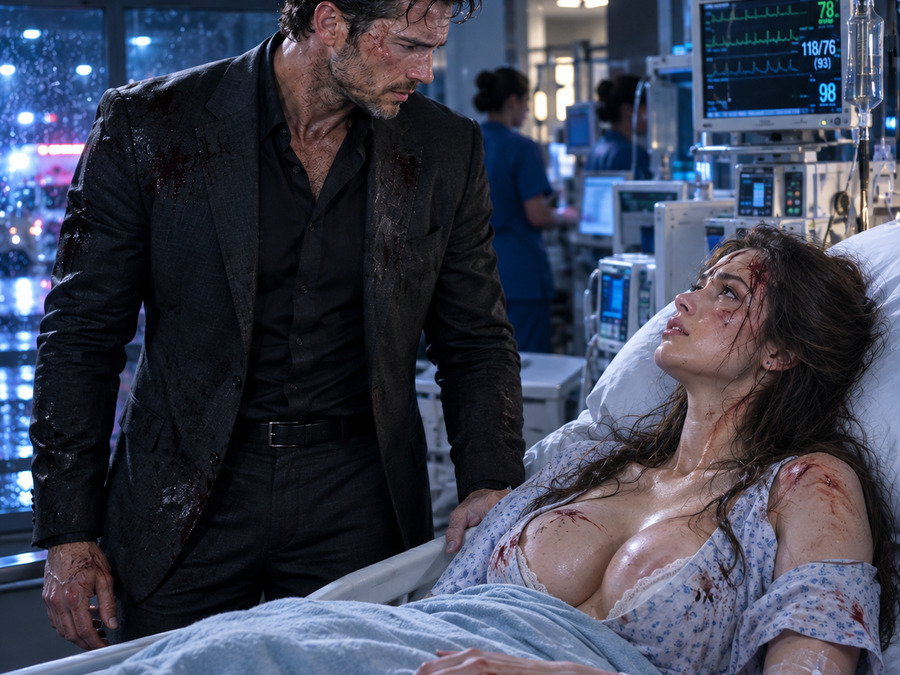
At 2 AM, His Secretary Called From the Hospital—The Mafia Boss Arrived Without a Word

The phone rings at 2:04 a.m. For a man like Dominic Gallo, a ringing phone at that hour usually means someone is dead or someone needs to be.
But the voice on the other end isn’t a capo or a cleaner. It’s a triage nurse. His secretary, Clara, is in the ER. She didn’t call her parents. She didn’t call a boyfriend. She had them call him.
Dominic doesn’t ask questions. He doesn’t say a word. He just grabs his keys. The digital clock on the dashboard of the Audi glowed a harsh red. 2:08 a.m.
Dominic drove with a singular, terrifying focus. He didn’t speed in a way that drew attention. He glided through the rain-slicked streets of the city like a shark cutting through dark water.
The windshield wipers beat a steady, frantic rhythm, clearing away the heavy downpour that had been drowning the city since Tuesday. He hadn’t spoken since hanging up the phone. There was nothing to say.
Clara Hayes. She was 28. She drank her coffee black, typed 90 words a minute, and had a habit of biting the inside of her cheek when the men in Dominic’s boardroom got too loud.
She didn’t flinch when men with broken knuckles came into the office. She just handed them a tissue so they wouldn’t bleed on the leather chairs. She was a civilian. An employee. A ghost who kept his life running with terrifying efficiency.
And she was in St. Jude’s emergency room. Dominic pulled into the red zone directly in front of the emergency doors. He threw the car in park, killed the engine, and left the keys in the ignition. If they towed it, he’d buy a new one tomorrow.
The sliding doors parted with a mechanical sigh. The smell hit him first. Industrial bleach, stale coffee, and the sharp metallic tang of dried blood.
The ER was a circus of misery. A drunk bleeding from a scalp wound was yelling at a security guard. A mother rocked a feverish toddler in a plastic chair. Dominic walked past them all.
He wore a dark wool overcoat over a tailored charcoal suit, no tie. He didn’t belong here, and the room seemed to know it. The ambient noise dialed down just a fraction as he approached the front desk.
The nurse behind the plexiglass didn’t look up immediately. She was typing furiously. “Name and date of birth.” “Clara Hayes,” Dominic said. His voice was gravel and low thunder. It wasn’t a request.
The nurse stopped typing. She looked up, took in the expensive coat, the cold, flat deadness in his dark eyes, and the rigid set of his jaw. She swallowed hard. “Are you family?” “I’m the one they called.”
She checked her screen. “B4. Through those doors. Take a left. The doctor is with her now.” Dominic pushed through the double doors. The clinical hum of monitors and the squeak of rubber-soled shoes on linoleum replaced the chaotic noise of the waiting room.
He counted the bays. One. Two. Three. Four. The curtain was pulled back halfway. Dominic stopped.
She looked small. That was the first thing that registered. Clara was normally a force of nature in beige pencil skirts and crisp white blouses, moving through his office with a clipboard like a shield.
Now she was swallowed up by a faded hospital gown. The left side of her face was a canvas of purple and blue, swelling shut around her eye. A stark white bandage covered her forehead, stark against her pale skin. Her left arm was immobilized in a sling.
A young doctor with exhausted eyes was shining a pen light into her good eye. “Pupils are responsive,” the doctor muttered, mostly to himself. “You have a mild concussion, Ms. Hayes. A fractured clavicle. Three broken ribs. The laceration on your forehead took 12 stitches.”
Clara stared at the ceiling tiles. “Will I be able to type by Monday?” Her voice was a rasp, dry, pain-filled. “You won’t be working for at least two weeks,” the doctor said, sounding annoyed.
“That’s unacceptable,” Clara whispered. “Quarterly reports are due.” Dominic stepped fully into the bay. “The reports can wait.”
Clara turned her head. A sharp intake of breath hissed through her teeth as the movement pulled at her broken ribs. Her good eye widened slightly. “Mr. Gallo.”
“Clara.” The doctor looked between them. “And you are her employer,” Dominic said. He didn’t look at the doctor. His eyes stayed on Clara. He took in the dried blood in her mousy brown hair, the stark white of her knuckles clutching the thin hospital blanket.
“Right, well, employer,” the doctor sighed. “She needs rest. The police are waiting in the hall to take her statement. It was a nasty hit and run.”
Dominic’s gaze finally snapped to the doctor. The temperature in the small bay seemed to plummet ten degrees. “Hit and run,” he repeated.
“Pushed her sedan right off the embankment on Route 9,” the doctor said, oblivious to the sudden lethal tension radiating from the man in the wool coat. “Car rolled twice. She’s lucky to be alive. I’ll send the officers in.” The doctor slipped out.
Silence descended on bay four, save for the rhythmic beep of the heart monitor. Dominic stepped closer to the bed. He didn’t reach for her. He didn’t offer a platitude. He just stood there, a solid, immovable shadow.
“You’re wet,” Clara said finally. Dominic looked down at his coat. The rain was beading on the wool. “It’s raining.” “You came. You had them call me.”
Clara looked away, swallowing dryly. “My emergency contact sheet. I didn’t update it after my mother died last year. You were the only other number they could find in my phone under favorites.”
A humiliated, painful smile touched the unbruised corner of her mouth. “Apparently, my phone thinks my boss is my best friend.” “I am not your friend, Clara.” “I know.”
He reached into his pocket and pulled out a silver flask. He unscrewed the cap and poured a small measure of water from the plastic bedside pitcher into a cup, then added a drop from the flask. He handed it to her. “Drink.”
She took it with her good hand. Her fingers brushed his. Hers were ice cold. His were burning. “What happened on Route Nine?” he asked softly.
Clara took a small sip. She coughed, grimacing as her ribs protested. “I was driving home late. I stayed to finish the payroll audits. A black SUV came up fast behind me. No headlights.”
Dominic’s jaw tightened. “Did you see the plates?” “No plates. Or they were covered.” Clara handed the cup back to him. He took it, setting it on the rolling tray.
“They bumped my bumper first. I thought it was a drunk driver. I tried to pull over to let them pass. Then they swerved into my lane and slammed into my side. The car spun. I went over the guardrail.”
She recounted it with the same detached efficiency she used to brief him on his stock portfolios, but her hands were shaking. Two uniformed police officers walked into the bay.
They looked young, tired, and thoroughly uninterested. “Clara Hayes?” the older of the two asked, clicking a pen. “Yes.” “We need to get a statement about the accident.” The cop glanced at Dominic. “Sir, we’re going to need you to step outside.”
Dominic didn’t move. He didn’t even shift his weight. He just turned his head slowly and looked at the officer. “I am staying.”
The younger cop puffed out his chest. “Sir, it’s police procedure. Family only. And even then, we prefer to speak to the victim alone.”
Dominic reached into his breast pocket. Both cops instinctively twitched toward their belts. Dominic slowly pulled out a leather wallet, flipped it open, and handed a small embossed card to the older officer.
The cop looked at it. His expression shifted from irritation to pale realization. He recognized this name. Every cop in the city recognized the name. Gallo wasn’t just a businessman. He was the gravity that held the city’s underworld in orbit.
“Mr. Gallo,” the older cop said, his tone instantly losing its edge. “I didn’t realize—” “My secretary is heavily medicated and in pain,” Dominic said. His voice was smooth, completely devoid of the anger churning in his gut. It made him sound far more dangerous.
“You will ask your questions quickly. You will not badger her. And tomorrow morning, you will forward a copy of the traffic camera footage from Route 9 directly to my office. Are we clear?”
“The traffic cams are department property, sir—” “Are we clear, officer?” The older cop swallowed. “Crystal.”
They took a statement in three minutes. It was useless. Black SUV, no plates, dark tinted windows. A phantom.
The cops left, clearly eager to be out of Dominic’s presence. Once they were gone, Dominic pulled up a cheap plastic chair. It groaned under his weight. He sat down, leaning his forearms on his knees, his hands clasped loosely together.
The posture brought him closer to her eye level. He looked at her ruined face, the black and blue skin, the stitches. A black SUV. No headlights. A targeted strike.
Nobody targeted a secretary who lived in a one-bedroom apartment and watched baking shows on the weekends. They targeted the people connected to the throne. Someone was sending a message.
Someone had looked at Dominic Gallo’s empire, bypassed his heavily armed capos, bypassed his fortified warehouses, and found the one civilian who stood by his side eight hours a day. They had tried to kill her just to see if Dominic would flinch.
He wasn’t flinching. He was detonating. “It wasn’t an accident,” Clara said softly into the quiet of the room. “She was smart.” “Too smart. That’s why I hired her.”
“Was it the Rossi family? Because I caught that discrepancy in the shipping manifest last week.” “I don’t know yet.” “If it was,” she said, her voice dropping to a harsh whisper, “I want my medical bills billed to them directly. With interest.”
A harsh, brief sound escaped Dominic. It might have been a laugh in another life. “You’re bleeding on a hospital gurney and you’re worried about accounting.”
“Mr. Gallo, I bought that sedan brand new three months ago. It had leather seats.” Dominic reached out. It was a rare breaking of his own rules. He didn’t touch people. Touch implied intimacy, and intimacy was a vulnerability he couldn’t afford.
But he reached out and gently brushed a stray, blood-crusted strand of hair away from her uninjured eye. “I’ll buy you a new car,” he said.
“I don’t want a car from you,” she fired back, though she leaned a millimeter into his touch before catching herself. “It’s a conflict of interest. Taxable gift.” “Clara, what—” “Shut up.”
She closed her mouth. The pain medication was starting to drag her down. Dominic watched her fight it. Her good eye kept drooping, snapping open with sheer willpower.
“Go to sleep,” he ordered quietly. “Can’t. Vulnerable.” She slurred the word slightly. “Don’t like hospitals. Smells like bleach and dying.”
“Nobody is going to touch you here.” “You can’t stay.” She looked at his expensive suit. “You have the waterfront meeting at 8:00 a.m. The union guys respect punctuality. If you miss it, they’ll think you’re weak.”
“Let them think what they want.” He stood up. He walked to the edge of the curtain, pulling out his cell phone. He dialed a number he rarely used. The burner phone in the pocket of a man named Leo, who lived in a basement and didn’t exist on any government database.
“Yeah.” Leo’s voice was gravelly, thick with sleep. “Route 9,” Dominic said, keeping his voice so low it was barely a vibration in the air. “Between midnight and 1:00 a.m., a black SUV ran a silver sedan off the road. Find the SUV. Find the driver.”
“And when I find them, boss?” “You don’t touch them. You tell me where they are. I want this one myself.” “Understood.”
Dominic hung up. He slid the phone back into his pocket and turned around. Clara was watching him. The haze of the drugs hadn’t entirely clouded her sharp mind. She knew who he was. She had always known.
She managed his schedule. She knew when blocks of time were blocked out for waste management consulting or logistics restructuring. Euphemisms for violence and extortion.
She had always maintained a professional distance, wrapping herself in denial and spreadsheets. But tonight, the violence had crossed the threshold. It had broken her bones and bruised her face.
“You’re going to kill them,” she stated. It wasn’t a question. Dominic walked back to the chair. He sat down heavily. “Yes.” “Because they hurt me.” “Because they touched what is mine.”
He corrected smoothly, his voice devoid of romantic inflection. It was a statement of territorial fact. Clara frowned. A tiny wince following the movement of her facial muscles.
“I am not your property, Mr. Gallo. I am a W-2 employee.” “You are under my protection. They violated that.” “I don’t want someone dead because of me.”
“They won’t be dead because of you. They’ll be dead because they made a mistake.” She stared at him. The clinical lighting cast deep shadows under his cheekbones, making him look older, harder, entirely unforgiving.
He was a monster. The city whispered about him. His rivals bled because of him. But right now, sitting in a cheap plastic chair, ruining his thousand-dollar coat with hospital grime, he was the only thing making her feel safe.
“Dominic,” she whispered. It was the first time in three years she had used his first name. His eyes snapped to hers. “What?” “My coat was in the back seat. The camel hair one. I think—I think it’s ruined.”
A tear finally escaped, sliding down her bruised cheek. It wasn’t about the coat. It was the shock, the trauma, the sheer exhaustion of the last two hours finally breaking through the dam of her professional detachment.
Dominic felt something tight and unfamiliar snap in his chest. A heavy, dark weight settled in his ribs. He leaned forward, bracing his elbows on the bed, bringing his face close to hers.
“I’ll buy you a new coat,” he said, his voice dropping to a rough, quiet rumble. “I’ll buy you a new car. I’ll burn the city down to keep you warm, Clara. Just close your eyes.”
She looked at him for a long moment, the unspoken weight of his words hanging in the sterile air. The boundary between boss and secretary was gone, incinerated in the wreckage on Route 9.
She finally let her eyes close. “Okay. But I want a corner office when I get back.” “Done.”
Dominic sat back in the chair. He didn’t move for the rest of the night. He watched her chest rise and fall. He listened to the rain hammer against the hospital windows. And in the cold, quiet hours of the morning, Dominic Gallo plotted a massacre.
Monday morning arrived with the subtlety of a hammer strike. The Gallo Holdings executive suite was normally a temple of quiet efficiency, a testament to the iron grip Dominic maintained on his legitimate businesses and the illicit ones buried beneath them. Today, the air felt thin.
Dominic stepped out of the private elevator at exactly 7:45 a.m. The heavy glass doors whispered shut behind him. He didn’t look toward the mahogany desk positioned directly outside his office doors. He didn’t need to. The absence radiated from it like cold from an open freezer.
There was a woman sitting there. A temp. Her name badge read Jessica. She looked up as Dominic approached, her eyes wide, a nervous smile plastered on her face. She held a ceramic mug. “Good morning, Mr. Gallo. I have your coffee.”
“Leave it,” Dominic said. He didn’t break stride. He didn’t look at her. He walked into his office, shucked his suit jacket, and draped it over the back of his chair. He sat down.
His desk was immaculate, but the daily briefing folder was crooked. Clara always aligned it perfectly with the edge of the leather desk pad. Dominic reached out, his blunt fingers adjusting the manila folder by a quarter of an inch. He opened it.
The print was too small. The margins were wrong. He pressed the intercom button. “Jessica.” A beat of static. “Yes, Mr. Gallo.” “Who typed this summary?” “I did, sir. The agency said you preferred a condensed format.”
“The agency doesn’t run my company,” Dominic said. His voice was flat, dead. “Get Victor in here now.” He released the button.
He didn’t drink the coffee. He knew without tasting it that it wouldn’t be right. Clara sourced the beans from a small roaster in the North End. She knew exactly how long to let the French press steep.
It was a minor detail, a trivial thing, but Dominic lived his life entirely in the details. A missed detail meant an audit, an indictment, or a bullet.
Victor pushed through the heavy oak doors two minutes later. Victor was built like a cinder block, a man who had survived 20 years in the Gallo family by speaking rarely and acting decisively. He took the chair opposite Dominic’s desk.
“The temp looks like she’s going to cry,” Victor noted. “Fire her,” Dominic said, reading a quarterly earnings report without absorbing a single number. “Get someone else.”
“She’s the third one since Thursday, Dom. Nobody can do what Clara does. Not on short notice.” Dominic finally looked up. His eyes were dark, hollowed out by three nights of terrible, fractured sleep.
He had spent his evenings sitting in a plastic chair in a hospital room, watching a heart monitor, waiting for a woman who wasn’t his family, wasn’t his lover, to simply breathe without pain.
“What did Leo find?” Dominic asked, seamlessly shifting from corporate irritation to street-level violence. “He found the SUV,” Victor said, his voice dropping an octave. The corporate veneer vanished.
“It was dumped in a chop shop in the Lower East Side. A place run by an old mechanic named S. The front quarter panel is caved in. Traces of silver paint on the bumper. Matches Clara’s sedan.”
Dominic closed the folder. The soft thack of the cardboard was the loudest sound in the room. “And the plates were stripped, but Leo pulled the VIN off the engine block. It’s registered to a shell company, one we track back to the Moretti outfit.”
The Morettis. A rival syndicate that had been encroaching on Dominic’s shipping routes for six months. They were sloppy, loud. They thought violence was a megaphone.
“A Moretti crew went after a civilian,” Dominic said. The logic didn’t track. The Morettis were stupid, but breaking the unspoken rule of targeting non-combatant employees was a death sentence. It invited federal scrutiny. It invited a bloodbath.
“That’s the thing,” Victor said slowly. “Leo put a guy on S. Pressed him hard. S says the guy who dropped the car off wasn’t Moretti muscle. It was one of ours.”
The silence in the office turned sharp. Toxic. “Who?” Dominic asked. “S only knows him as Tommy. Low-level soldier. Works collections for Paulie’s crew.”
Paulie. One of Dominic’s top capos. A man who sat at his dinner table. A man who earned millions under the Gallo flag.
Dominic stood up. He walked to the floor-to-ceiling window overlooking the city skyline. The glass was cold against his knuckles.
Someone inside his house had taken money from the Morettis. Someone inside his house had sent a heavy piece of steel tearing into the side of Clara’s car, shattering her ribs, fracturing her collarbone, leaving her bleeding on the asphalt.
“Bring the car around,” Dominic said to the glass. “Where are we going?” Victor asked, standing up. “To grab Tommy.” “No,” Dominic said. He turned around. “I have to visit St. Jude’s.”
Thirty minutes later, Dominic was walking down the sterile, linoleum-tiled hallway of the orthopedic ward. The smell of bleach and institutional food made his stomach tighten. He hated this place. He hated that she was in it.
He pushed open the door to room 312. Clara was sitting up in bed, propped against three thin pillows. Her arm was still locked in a sling. The bruising on her face had shifted from a vivid purple to an ugly, sickly yellow-green.
The stitches on her forehead were stark black threads against her pale skin, and she was holding a tablet in her good hand, aggressively tapping the screen with her thumb. She didn’t look up when the door opened.
“I told you, Jessica, the invoices from the Long Beach dock need to be routed through the Cayman account before they hit the ledger. If you put them in the primary server, we trigger an SEC red flag.”
“Jessica is fired,” Dominic said. Clara jumped, wincing as the sudden movement pulled at her ribs. The tablet slipped, and she caught it awkwardly against her good thigh. She looked at him.
He was wearing a charcoal suit, immaculately tailored, a dark tie knotted perfectly at his throat. He looked like money and violence poured into a human mold.
“You can’t keep firing the temps, Mr. Gallo,” Clara said, exasperated. “The agency will blacklist us.” “I don’t care about the agency.”
Dominic walked over to the bed. He reached out and smoothly slid the tablet out of her hand. He pressed the power button, turning the screen black, and set it on the bedside table out of her reach.
“Hey,” she protested. “I was in the middle of a wire transfer.” “You are on medical leave.” “I am bored,” Clara fired back. Her voice was raspy, but the fire was back in her eyes. “There is only so much daytime television a person can watch before their brain turns to liquid. The nurse keeps offering me Jell-O. I hate Jell-O.”
Dominic pulled up the visitor’s chair. It was slightly more comfortable than the ER chair, but not by much. He sat down, unbuttoning his suit jacket.
“The doctor said you need to keep your blood pressure down.” “My blood pressure spikes when I know the quarterly audits are being handled by a 22-year-old who doesn’t know the difference between a shell corporation and a taco shell.”
Dominic almost smiled. It was a microscopic shift in the muscles around his mouth, but Clara caught it. She blinked, momentarily thrown off balance.
“I found the car,” Dominic said quietly. The corporate banter vanished instantly. The temperature in the room dropped. Clara pulled the thin hospital blanket up a little higher, a defensive gesture.
“The police—” “No. Not the police.” She looked at her lap. Her good hand picked at a loose thread on the blanket. “What happens now?”
“Now,” Dominic said, leaning forward slightly, “I clean my house.” He watched her process that information. She didn’t ask for details. She never did. It was the firewall she had built between her job and his reality.
But the firewall was gone now. She was a casualty in a war she hadn’t signed up for. “When are they releasing you?” he asked, changing the subject.
“Tomorrow morning,” Clara said. “The doctor wanted to keep me until Wednesday, but I threatened to walk out. My clavicle isn’t going to heal any faster in this bed than it will in my own.” “Good.”
Dominic stood up. He rebuttoned his jacket. “I’ll pick you up at 9:00.” Clara frowned. “That’s not necessary. I can call a cab.” “I said I will pick you up at 9:00.”
The tone brokered absolutely zero argument. It was the voice that moved millions of dollars and ended lives. Clara met his stare. She didn’t flinch.
“Fine. 9:00 a.m. But bring real coffee. If I have to drink one more cup of this hospital sludge, I’m going to sue you for workplace negligence.” “Black, no sugar,” Dominic said. “You do pay attention.” “I pay attention to everything that matters, Clara.”
He turned and walked out of the room, leaving the words hanging in the sterile air behind him. The rain had returned, a cold, miserable drizzle that coated the city in a thin layer of grime.
The chop shop was located at the end of a dead-end street in the industrial district. A crumbling brick facade, corrugated metal roll-up doors, and a yard filled with rusting carcasses. It smelled of ozone, old motor oil, and wet dog.
Dominic’s black town car idled at the curb. Victor sat in the driver’s seat. In the back, Dominic sat completely still. “Leo is inside,” Victor said, checking the rearview mirror. “He’s got the old man secured. Tommy hasn’t shown up yet.”
“He will,” Dominic said softly. “People like Tommy always return to the scene of their crimes. They get nervous. They want to make sure the evidence is gone.”
They waited in silence for 40 minutes. The only sound was the rhythmic hum of the engine and the wipers pushing water off the glass. At 6:15 p.m., a beat-up Honda Civic turned down the alley. It moved slowly, hesitantly. It parked two blocks down.
A man got out. Mid-20s, tracksuit, cheap sneakers, shoulders hunched against the rain. He kept looking over his shoulder as he walked toward the garage. “That’s him,” Victor grunted.
Dominic opened his door. The damp air hit his face. He didn’t rush. He walked down the cracked pavement with the deliberate, heavy stride of a predator that knows the prey has nowhere to run. Victor fell in step half a pace behind him, an immovable wall of muscle.
Tommy reached the side door of the garage. He knocked twice, paused, knocked once. The door opened a crack, then swung wide. Tommy stepped inside. Dominic caught the door before it closed.
He stepped into the dim, cavernous space. The air was thick with the smell of acetylene. In the center of the room sat a black SUV. The front right quarter panel was crushed. The headlight assembly was missing.
Leo was standing near a tool bench. An older man, S, was sitting on a stool, nursing a bloody lip, looking terrified. Tommy stood by the SUV, freezing as he saw Dominic walk through the door.
The color drained from the young man’s face so fast it looked like a physical blow. He knew exactly who had just walked in. “Mr. Gallo,” Tommy stammered. His eyes darted to the exits. Victor stepped in front of the door, crossing his arms.
“Tommy,” Dominic said. His voice was conversational. Relaxed. It was the most terrifying sound in the world. Dominic walked slowly around the SUV. He trailed a gloved hand along the dented metal of the hood. He stopped at the point of impact, the place where this machine had transferred its violent kinetic energy into Clara’s car, into her bones.
“You hit her hard,” Dominic observed, looking at the bent steel. “I—I don’t know what you’re talking about, boss,” Tommy lied, his voice cracking.
Dominic didn’t look at him. “You hit a silver sedan on Route 9. Pushed it off the embankment.” “I swear to God, Mr. Gallo, I was just driving. The roads were slick. It was an accident.”
Dominic turned. He closed the distance between himself and Tommy in three rapid, explosive strides. There was no warning, no grand monologue. Dominic’s right hand shot out, grabbing Tommy by the throat, slamming him backward into the side of the SUV.
The impact rattled the windows. Tommy gagged, his hands clawing at Dominic’s iron grip, his feet scrambling for purchase on the greasy concrete floor. “An accident,” Dominic whispered. His face was inches from Tommy’s. The cold deadness in Dominic’s eyes had been replaced by a raging, white-hot inferno.
“You turned off your headlights. You rammed her. You left her to bleed to death in the rain.” “Please,” Tommy choked out. Dominic applied a fraction more pressure. “Who paid you?” “Nobody. It was a mistake.”
Dominic reached into his coat with his free hand. He pulled out a heavy, snub-nosed revolver. He didn’t point it at Tommy’s head. He pointed it down, pressing the barrel directly against Tommy’s left kneecap.
“I am going to ask you one more time,” Dominic said. His voice was a calm, steady rhythm against the panicked rasp of Tommy’s breathing. “Who paid you to hit my secretary?”
Tommy looked at the gun. He looked at Dominic’s eyes. He saw his own death written there. “Paulie,” Tommy sobbed, the word tearing out of his crushed throat. “It was Paulie.”
He said the Morettis offered him a seat at their table if he delivered the docks. But he needed a distraction, something to pull Dominic away from the waterfront transition this week. So he targeted a civilian.
“He said she was just a secretary. He said you’d spend a few days dealing with HR and the cops, and he could move the shipments without you breathing down his neck.”
Dominic stared at the sweating, weeping man pinned against the car. Just a secretary. Paulie had fundamentally misunderstood the board. He had looked at the chess pieces and thought Clara was a pawn. He hadn’t realized she was the king’s only vulnerability.
Dominic lowered the gun. He released Tommy’s throat. Tommy collapsed to the concrete floor, hacking and gasping for air, clutching his neck. Dominic looked at Victor. “Put him in the trunk,” Dominic ordered. “Take him to the warehouse by the river. Keep him breathing.”
Victor nodded, stepping forward and hauling the gasping Tommy up by his collar. Dominic turned to walk out. He paused by the tool bench, looking at the trembling mechanic, S. “Crush the SUV,” Dominic told him. “Melt it down to slag. If I ever see a piece of this metal again, I will put you inside the crusher with it.”
“Yes, Mr. Gallo. Yes, sir,” S babbled. Dominic walked back out into the rain. The cold air felt good against his skin. The puzzle was solved. The traitor was named. Now he just had to keep Clara alive while he burned his own empire to the ground.
Tuesday morning, 9:15 a.m. sharp. Clara stood in the lobby of St. Jude’s. She was wearing sweatpants she had asked a nurse to buy from the hospital gift shop, and her ruined camel hair coat draped awkwardly over her good shoulder. She felt weak, shaky, and deeply humiliated by her lack of independence.
A black SUV pulled up to the curb. It wasn’t the town car. It was armored. Victor got out of the driver’s side and opened the rear door. Dominic was sitting inside.
Clara hesitated, clutching a plastic bag containing her discharge papers and a bottle of painkillers. She awkwardly climbed in, wincing as she slid across the leather seat. The door shut with a heavy, vault-like thud.
Dominic handed her a paper cup. “Black, no sugar.” She took it, cradling it in her good hand. The heat seeped through the cardboard, warming her freezing fingers. She took a sip. It was perfect. “Thank you.”
Dominic tapped the glass partition. The SUV pulled away from the curb. “My apartment is on Fourth and Elm,” Clara said, leaning her head back against the leather headrest. She closed her eyes, exhausted by the simple act of walking to the car. “Can we stop at a pharmacy? I need to fill this prescription.”
“Victor has already picked up your medication,” Dominic said. Clara opened her eyes. She looked at him. “How did he get my prescription?” “I am your emergency contact. I authorized it.”
She frowned, the movement pulling at the stitches on her forehead. “Fine. Then just Fourth and Elm.” The SUV turned left. Elm Street was in the opposite direction. “Victor, you missed the turn,” Clara called out.
The driver didn’t respond. The SUV merged onto the highway. Clara turned to Dominic, her pulse spiking. The corporate mask slipped, revealing the raw, frightened woman beneath. “Where are we going?”
“You are not going back to your apartment, Clara.” “What? Why? My cat is there. My clothes are there.” “Your neighbor has the cat. Victor packed three bags of your clothes this morning. They are in the trunk.”
Clara stared at him. Genuine shock overriding the pain in her ribs. “You broke into my apartment.” “I used the spare key you keep hidden under the fake rock in the hallway planter. It’s a terrible hiding spot, by the way.”
Dominic’s voice remained impossibly calm. “Your apartment is a ground-floor walk-up with a standard deadbolt and fire escape access. It is entirely unsecure.”
“Unsecure from what?” A voice rose. “The police said it was a hit and run.” Dominic looked at her. He didn’t say anything for a long moment. He let the silence stretch until the reality of his world began to seep through the floorboards of her denial.
“It wasn’t a hit and run, Clara.” She swallowed hard, a grip on the coffee cup tightened. “You told me you found the car.” “I did. And I found the man driving it. And I found the man who paid him to drive it.”
Dominic kept his gaze locked on hers. “There is an internal dispute within my organization. A capo named Paulie wants my chair. He used you to create a distraction.”
Clara felt the blood drain from her face. The nausea that had been hovering since the accident crashed over her. She was a spreadsheet manager. She drafted emails. She scheduled lunches.
“They tried to kill me,” she whispered. “To distract you.” “Yes.” She looked away, staring blankly out the tinted window at the passing city. The rain was starting again.
“So what now? You fire him?” “I don’t have an HR department for this.” “Paulie has men. He has guns.” “For the next 48 hours, this city is going to be very dangerous. Which is why you are not going to a ground-floor apartment.”
“Where are you taking me?” “My penthouse.” Clara whipped her head back around, instantly regretting the fast movement. She hissed through her teeth, clutching her ribs. “Absolutely not. I am not moving in with my boss.”
“You are moving into a building with private elevator access, bulletproof glass, and a four-man security detail in the lobby.” Dominic leaned closer. The faint scent of sandalwood and something sharper, metallic, reached her. “This is not a negotiation, Clara. You are a target until Paulie is in the ground. You will stay where I can see you.”
She wanted to argue. She wanted to demand he pull the car over. She wanted to quit. But her collarbone throbbed, her head spun, and she remembered the terrifying crunch of metal tearing through her car. She remembered the dark SUV disappearing into the night, leaving her to bleed.
She slumped back against the seat, defeated. “Fine. But I want my own bedroom.” “You’ll have the East Wing,” Dominic said smoothly.
Twenty minutes later, they arrived at a luxury high-rise in the financial district. They bypassed the lobby, driving directly into a subterranean private garage. An elevator took them straight to the penthouse.
The doors opened into a sprawling minimalist space of glass, steel, and dark wood. It was immaculately clean, profoundly expensive, and utterly devoid of warmth. It looked exactly like the inside of Dominic Gallo’s mind.
Clara stood awkwardly in the foyer, a cheap hospital sweatpants ensemble a stark contrast to the imported Italian marble floors. Dominic took her ruined coat. He handed it to Victor, who disappeared down a hallway with her luggage.
“The kitchen is stocked,” Dominic said, gesturing to the massive open-plan living area. “There is a private chef on call, but I assumed you wouldn’t want strangers around. I had soup brought up from the bistro downstairs.”
Clara looked at him. The feared mob boss. The man who had likely tortured someone to get answers last night. He was standing in his foyer offering her soup. The cognitive dissonance was dizzying.
“Thank you,” she managed to say. Dominic led her to the kitchen island. A ceramic bowl sat on a heating pad. Chicken noodle. Not the canned stuff. Real broth, thick cuts of vegetables.
He pulled out a stool for her. She sat down heavily. Her left arm was utterly useless. She picked up the spoon with her right hand. Her hand was shaking.
She tried to scoop the broth, but the tremor spilled it back into the bowl. She tried again. Spilled again. Frustration, hot and bitter, welled up in her throat. A tear leaked out of her good eye, tracking down her bruised cheek. She dropped the spoon. It clattered against the ceramic bowl.
“I can’t even eat,” she whispered, the sheer vulnerability breaking her. Dominic stood on the opposite side of the island. He watched her break. He didn’t offer a platitude.
He walked around the marble counter. He pulled up a second stool, sitting directly beside her. He picked up the spoon. Clara froze. She looked at his hands. Large, calloused, dangerous hands. Hands that ended lives.
He dipped the spoon into the broth. He brought it up, blowing gently on it to cool it down. Then he held it to her lips. Clara stared into his dark, fathomless eyes. The air between them thickened, heavy with an intimacy that felt far more dangerous than the men with guns roaming the city.
She opened her mouth. She took the soup. Dominic didn’t say a word. He just dipped the spoon again. In the quiet of the penthouse, high above the violent streets, the monster fed the ghost. And Clara realized with a terrifying jolt of clarity that she wasn’t just afraid of the men trying to kill her. She was entirely terrified of the man keeping her alive.
The East Wing of the penthouse was a sprawling suite of soundproof glass, gray silk sheets, and oppressive silence. Clara spent Wednesday trapped inside it. Her broken ribs throbbed with a dull, rhythmic ache that synced perfectly with her heartbeat.
The painkillers made her mind fuzzy, wrapping her thoughts in thick cotton, so she stopped taking them at noon. She preferred the pain. Pain was sharp. Pain was a data point she could manage.
By 3:00, she was pacing the length of the bedroom, clutching her immobilized left arm against her chest. She hated feeling useless. She hated being a liability. In Dominic Gallo’s world, liabilities were eventually cut loose. Or buried.
Victor knocked on the door frame once before entering. He carried a sleek black laptop under one massive arm and a terrified-looking orange tabby cat under the other. “Barnaby,” Clara breathed, dropping to her knees on the plush rug.
The sudden movement sent a spike of white-hot agony through her collarbone, but she gritted her teeth. Victor set the cat down. Barnaby immediately bolted under the king-sized bed.
“I brought your secure terminal,” Victor said, setting the laptop on the glass desk near the window. “Boss said you’re not allowed to work. He also said you’d probably try to pick the lock on the office door if I didn’t bring this to you.”
“He knows me well,” Clara muttered, using her good arm to pull herself up from the floor. “Yeah, he does.” Victor lingered for a fraction of a second. The big enforcer looked entirely out of place among the silk and glass.
“Don’t push yourself, Clara. The boss—his head isn’t entirely in the game right now. He’s worried about you.” Clara stopped. She looked at Victor, searching his flat, scarred face for a punchline. There wasn’t one.
“Dominic Gallo doesn’t worry, Victor. He calculates.” “Usually,” Victor agreed. “But yesterday he fed you soup with a spoon. If you don’t think that means the world has tilted on its axis, you haven’t been paying attention.”
Victor turned and left. Clara walked to the desk. She opened the laptop. The glow of the screen illuminated the yellowing bruises on her face. She logged into the Gallo Holdings secure mainframe.
She bypassed the legitimate shipping manifests and the real estate portfolios. She dug deeper, tunneling into the encrypted ledgers she normally only touched once a quarter to sanitize for the offshore accounts.
If Paulie was staging a coup, he needed capital. You couldn’t bribe dock workers, buy illegal firearms, and flip loyal capos with promises alone. You needed liquid cash.
She typed with one hand. It was agonizingly slow, but her mind was racing ahead of her fingers. She checked the standard slush funds. Untouched. She checked the construction union payrolls. Normal.
She spent four hours hunting the ghost in the machine. At 7:30 p.m., the bedroom door opened. Clara didn’t look up from the screen. She recognized the heavy, deliberate cadence of his footsteps on the hardwood.
Dominic walked over and stood behind her chair. He had changed into dark denim, a black t-shirt, and a tactical Kevlar vest strapped tight across his chest. He smelled of gun oil and cold rain. The corporate veneer was entirely gone. He was dressed for a massacre.
“I told Victor you weren’t supposed to work,” Dominic said. His voice was a low rumble, vibrating in the quiet room. “I’m not working for Gallo Holdings right now,” Clara said, her right hand flying across the trackpad. “I’m working for me. My ribs hurt. My car is destroyed. And I want the man responsible to bleed.”
Dominic paused. The sheer venom in her clinical tone caught him off guard. A dark, terrifying smirk touched the corner of his mouth. “I’m handling Paulie tonight.” “Not without this, you aren’t,” Clara said.
She hit the enter key. A series of offshore bank statements populated the screen. “Paulie didn’t use the standard shell companies. He’s stupid, but he’s not suicidal. He routed the money through a dummy logistics firm out of Newark. $3 million moved in increments of under $10,000 to avoid federal flagging.”
Dominic leaned over her shoulder, bracing his hands on the edge of the desk. His chest brushed against her good shoulder. He stared at the numbers. “Where did the money go?”
“A holding account for a private security firm down at the naval shipyards.” Clara pointed at the screen. “Warehouse 44. He’s not waiting for you to find him, Dominic. He used the money to hire outside muscle. Ex-military contractors. They’re heavily armed, and they’re waiting for you at the warehouse.”
The air in the room grew heavy, stifling. If Dominic had walked into Warehouse 44 blind, expecting Paulie’s usual street-level thugs, he and Victor would have been cut to ribbons by military-grade hardware.
Dominic stared at the screen for a long, silent minute. Then he looked down at her. Clara looked up. Their faces were inches apart. She could see the faint gold flecks in his dark eyes. She could feel the heat radiating from him.
“You found this with one hand,” Dominic murmured. “I’m very good at my job.” He reached out, his knuckles brushed against her uninjured cheek, a feather-light touch that sent a jolt of electricity straight down her spine.
“You just saved my life, Clara.” “Then we’re even for the soup.” Dominic’s jaw tightened. “We are nowhere near even. Lock the door when I leave. Do not open it for anyone except me or Victor.”
“Dominic.” He stopped at the door, looking back over his shoulder. “Don’t miss,” she said. He didn’t smile. He just walked out, the door clicking shut with terrifying finality.
The naval shipyards were a graveyard of rusted shipping containers and towering steel cranes that looked like skeletal fingers reaching into the black, rain-swept sky. Warehouse 44 sat at the edge of the water. It was dark, silent, and massive.
Dominic’s armored SUV parked three blocks away, hidden in the shadow of an abandoned dry dock. Rain hammered against the reinforced roof. Inside, Victor was checking the magazine of a matte black submachine gun. In the passenger seat, Leo was screwing a sound suppressor onto a tactical pistol.
“Three exits,” Leo said, looking at a digital blueprint on a tablet. “Front roll-up door, side personnel door, and a loading bay in the back facing the water. Thermal imaging shows at least 12 bodies inside, spread out. Tactical positions.”
“Contractors,” Victor grunted, racking the bolt of his weapon. “They know what they’re doing. This isn’t a street fight, boss. It’s an ambush.”
Dominic sat in the back seat. He wasn’t looking at the tablet. He was looking at his phone. The screen was dark, but his thumb traced the edge of the casing. He was thinking about a woman sitting in his penthouse, tapping on a keyboard with one hand.
She didn’t belong in this world of blood and cold steel, yet she had just outmaneuvered a dozen hired killers with a spreadsheet. “We don’t go in,” Dominic said quietly.
Victor turned around. “We don’t? We just let Paulie sit there? Paulie paid them $3 million to kill me.” “Paulie paid them $3 million to kill me,” Dominic said, finally looking up. His eyes were devoid of any human warmth. They were the eyes of an apex predator. “But he hasn’t paid them the back half of the contract yet.”
“Clara found the holding account. The money is sitting in a digital escrow.” Dominic handed the tablet to Leo. “You have the routing numbers Clara pulled. Burn it.”
Leo grinned, a sharp, feral expression. He plugged a decryption key into the tablet. “Wiping the holding account. Routing the remaining $3 million into a crypto tumbler. It’s gone, boss. Disappeared into the ether.”
Dominic checked his watch. 11:42 p.m. “Give it 10 minutes,” Dominic said.
Inside Warehouse 44, Paulie paced the catwalk overlooking the main floor. He was sweating despite the chill in the air. He chewed aggressively on an unlit cigar. Below him, 12 men in dark tactical gear stood at various checkpoints. They held suppressed rifles and moved with lethal, quiet efficiency.
The leader of the contractors, a heavily scarred man named Vance, walked up the metal stairs to the catwalk. His phone was in his hand. He looked angry.
“We have a problem,” Vance said, his voice flat. “The only problem is Gallo hasn’t shown up yet,” Paulie snapped. “He’s weak. He’s probably sitting in a hospital holding his secretary’s hand.”
“No,” Vance said, stepping closer. “The problem is my encrypted account just zeroed out. The escrow bounced. You don’t have the money.”
Paulie froze. The cigar fell from his mouth, bouncing off the metal grating. “That’s impossible. I deposited it yesterday.” “The bank—” “I don’t care about the bank,” Vance interrupted, raising a hand.
The 12 men on the floor below simultaneously raised their rifles. The laser sights painted Paulie’s chest with a dozen red dots. “We work on a 50% up-front, 50% secure hold basis. Your secure hold just vanished. We don’t fight Dominic Gallo for free.”
“Wait, wait.” Paulie backed up against the railing, his hands raised. “I can get it. Give me a day. I own the docks. I can get you 10 million.”
Vance shook his head slowly. “Dominic Gallo owns the docks. You’re just a dead man borrowing his air.”
The heavy metal roll-up door at the front of the warehouse began to grind upward. The screech of unlubricated metal echoed in the cavernous space. Vance signaled his men. They lowered their weapons from Paulie and aimed at the rising door.
The door stopped halfway up. Rain lashed at the concrete floor. A single figure walked under the door. Dominic Gallo didn’t have his gun drawn. He walked into the kill box with his hands hanging loosely at his sides.
He stopped 10 feet inside the door. He looked up at the catwalk. Vance kept his rifle aimed directly at Dominic’s chest.
“Mr. Gallo, your contract is void,” Dominic said. His voice carried effortlessly over the sound of the rain. “The man who hired you is broke. If you pull that trigger, you start a war with my family that you will not survive. You have a transport chopper fueled on the roof of the adjacent building. Leave now, and I let you walk to it.”
Vance was a mercenary. He calculated risk versus reward. The reward had just vanished from his bank account. The risk was currently standing in front of him, radiating the kind of quiet, absolute confidence that only comes from a man who has already won.
Vance lowered his rifle. He tapped his earpiece. “Stand down. We’re leaving.” “You can’t do this,” Paulie screamed, drawing a gold-plated pistol from his waistband. “Shoot him. I order you to shoot him.”
Before Paulie could aim, Vance drove the butt of his rifle hard into Paulie’s stomach. Paulie folded in half, gasping, dropping the pistol.
The contractors moved like ghosts, backing out of the warehouse through the loading bay doors. Within 30 seconds, the warehouse was empty, save for Dominic on the ground floor and Paulie wheezing on the catwalk.
Dominic began to climb the metal stairs. Each footstep rang out like a judge’s gavel. Paulie scrambled backward, clutching his ribs. “Dom. Dom, please. It was business. It was just business. The Morettis made me an offer.”
Dominic reached the top of the stairs. He looked down at the man who had eaten at his table. “Business is stealing a shipment,” Dominic said softly. “Business is skimming off the top.”
Dominic drew the heavy revolver from his holster. He cocked the hammer. The metallic click was deafening. “You put my secretary in the hospital,” Dominic said. “That wasn’t business. That was personal.”
Paulie raised his hands, tears streaming down his face. “She’s just a girl, Dom. Why do you care? She’s just a nobody.” “She,” Dominic said, leveling the barrel directly at Paulie’s forehead, “is mine.”
He pulled the trigger. The gunshot echoed through the empty warehouse, a thunderclap of finality. Paulie fell backward, hitting the grating, and lay still. Dominic didn’t look at the body. He decocked the gun, slid it back into his holster, and walked back down the stairs. The war was over. He needed to get home.
It was 2:15 a.m. when the private elevator opened into the penthouse. Dominic stepped out. The adrenaline was draining from his system, leaving behind a heavy, bone-deep exhaustion. The Kevlar vest felt like it weighed a hundred pounds. His knuckles ached. There was a fine mist of blood on the cuff of his right sleeve.
The penthouse was entirely dark, save for the ambient city light spilling through the floor-to-ceiling windows. He walked towards the kitchen to pour a drink. He stopped.
Clara was sitting on one of the bar stools at the kitchen island. She hadn’t gone back to bed. The laptop was closed. She was wearing one of his oversized black t-shirts. Victor must have pulled it from his dresser. It hung loosely over her injured frame.
Her hair was messy, the bandages stark against her pale skin. She was awake. She was waiting for him. Dominic stood perfectly still. In all his years, no one had ever waited up for him after a night of violence.
Women in his past had either turned a blind eye or demanded not to know. Clara looked at him. She took in the tactical gear. She saw the blood on his cuff. She didn’t flinch. She didn’t look away. She just stared at the monster in her kitchen, completely unafraid.
“Is it done?” she asked. Her voice was quiet, raspy, grounding him in reality. “It’s done. Paulie is gone. The contractors walked away.”
Dominic stripped off the Kevlar vest, dropping it onto the marble floor with a heavy thud. He walked over to the sink, turned on the cold water, and scrubbed his hands with harsh, violent motions. He wanted to wash the smell of gunpowder and copper off his skin before he got any closer to her.
He dried his hands on a towel and leaned against the counter, looking at her across the island. “You should be asleep,” he said.
“I couldn’t sleep.” She shifted awkwardly on the stool. “I kept thinking about the quarterly projections.” A short, breathless laugh escaped Dominic’s chest. It was the truest sound he had made in a decade. “The quarterly projections?”
“They’re a mess, Dominic.” “I don’t care about the quarterly projections, Clara.” He walked around the island. He stopped directly in front of her. He was standing in her space, towering over her, pulling all the oxygen from the room.
She looked up at him. The bruising on her face was ugly, brutal evidence of the life he lived. But he had never seen anything more beautiful. She had survived his world. She had navigated his darkness and handed him the torch.
“You can’t come back to the office,” Dominic said, his voice dropping to a low, rough whisper. Clara’s good eye widened slightly. A flash of genuine hurt crossed her face before she masked it.
“You’re firing me after I found the Cayman accounts?” “I am not firing you. I am telling you that you can no longer be my secretary.”
He reached out, his large, warm hand gently cupping her uninjured jaw. His thumb brushed over her cheekbone. “A secretary sits outside my door. A secretary is a civilian. I can’t protect a civilian.”
Clara’s breath hitched. She leaned into his touch, her eyes fluttering shut for a fraction of a second before opening to meet his intense gaze. “Then what am I, Dominic?”
“You are my partner,” he stated. The words an oath sworn in the dark. “You run the logistics. You find the leaks. You stand beside me, not behind a desk. And you never—ever—let anyone make you bleed again.”
Clara swallowed hard. The corporate boundaries, the W-2 forms, the HR policies—they all burned away, leaving only the raw, undeniable truth of what they had become to each other over the last four days.
“A partnership implies equal standing,” Clara whispered, her heart hammering against her broken ribs. “That means I get to tell you when you’re being an idiot.”
“You already do.” “It means my medical bills are fully covered.” “I bought the hospital yesterday, Clara. It’s yours.” She stared at him, trying to find a joke in his eyes. There wasn’t one. He was dead serious. He had bought St. Jude’s.
Clara let out a shaky breath. She raised her good right hand and placed it flat against his chest, right over his heart. She could feel it beating. Steady. Strong. Terrifying.
“I want the corner office,” she said quietly. Dominic stepped closer, closing the final inch between them. He leaned down, his lips brushing against her temple, right below the edge of her bandage.
“You can have the whole damn building.” Outside, the rain finally stopped. The city of steel and glass gleamed under the street lights, completely unaware that its underworld had just been violently restructured.
In the quiet of the penthouse, the mafia boss held the woman who possessed the keys to his empire, knowing that the most dangerous thing in his life wasn’t his enemies anymore. It was her. And he wouldn’t have it any other way.
