The Roof Collapsed — A Poor Waitress Risked Everything to Save the Mafia Boss’s Mother
The Roof Collapsed — A Poor Waitress Risked Everything to Save the Mafia Boss’s Mother
She didn’t ask permission.
She didn’t think twice.
Elena Brooks dropped a full tray of champagne glasses, $600 of crystal shattering across the marble floor of the most exclusive gala in New York, grabbed a 73-year-old woman she had never spoken to in her life, and ran. 3 seconds later, 2,000 lb of iron and glass came down from 40 ft and erased the table where that woman had been sitting. The music stopped.
The screaming started.
And somewhere in the smoke and the ringing silence that followed, a man in a black suit who was feared by half of this city pushed through the wreckage with one name on his lips, his mother’s name.
Elena Brooks had been on her feet for 11 hours when the ceiling decided to kill someone.
She didn’t know that yet.
Not at 7:00. Not when she was still on the cross town bus from Queens with her uniform folded in her lap and her eyes closed against the window, trying to store up whatever quiet she could before the shift started.
The bus smelled like other people’s food and the particular exhaustion of a Tuesday evening, and Elena sat in it with her hands loose in her lap and thought about nothing, which was the only luxury she could still afford.
Her phone buzzed. She looked at it.
A text from nurse Pollson at the dialysis center. Your mother did well today.
She asked me to tell you not to worry. Elena stared at that text for a long moment.
Then she put her phone in her pocket and looked back out the window at the city going dark around her and she thought, “Don’t worry.”
Right? Her mother had been on diialysis for 14 months. The bills came every 30 days in envelopes that Elena had stopped opening directly.
She left them on the kitchen counter for 48 hours first, like something that needed to cool down before you could touch it. The number inside was always larger than the month before.
The payment plan she’d negotiated with the hospital’s billing department required her to make a minimum payment every 2 weeks just to keep the account from going to collections.
And making that payment required working every shift she could get, which meant she hadn’t had a full day off in 3 months, which meant she was sitting on a cross town bus on a Tuesday night with her uniform in her lap, heading to a gala at the Grand Bell Vista Hotel for people who spent more on a single bottle of wine than Elena made in a week.
She wasn’t bitter about it.
She had tried bitterness for a while in the early months and found it too expensive.
Bitterness required energy she didn’t have.
What she had instead was a kind of clear, practical focus, a narrowing of the world to the things that could be controlled and the things that couldn’t, and a commitment to spending her attention only on the former.
The bus stopped. Elena stood up, straightened her uniform, and went to work.
The Grand Bella Vista Hotel occupied the entire block between 54th and 55th on Park Avenue, and it had been there long enough that New York had grown up around it the way a tree grows around a fence post gradually, irreversibly, until the two were no longer separable. It had been built in 1,887 by a railroad magnate whose name nobody remembered anymore, expanded in 9,924, renovated twice in the 70s, and declared a protected landmark in 1991 in the particular way that New York declared things landmarks, acknowledging their historical significance while doing as little as possible to maintain it. Elena had worked events here for 3 years.
She knew the building’s rhythms the way you knew the rhythms of a person you’d lived with long enough.
The way the service elevator groaned on the way up, but ran smooth on the way down. The way the ventilation in the east wing made a sound-like breathing when the heat kicked on.
The way the marble floors in the main corridor had a slightly uneven section near the coat check that you had to remember to step over or the tray would shift. She knew the building, which was why when she arrived at 4:30 in the afternoon for setup, the first thing she did without thinking about it.
The way you didn’t think about checking both ways before crossing a street was look up.
The Grand Bell Vista’s central atrium was the hotel’s most famous feature.
A glass ceiling 40 feet overhead, constructed in 1924 in 47 individual panels of leaded crystal set into an iron lattice that arched across the space like the rib cage of some enormous creature. It was beautiful in the way that very old things were beautiful, not because it was perfect, but because it had survived long enough to accumulate a kind of dignity.
Elena looked at it, noted the way the late afternoon light came through the western panels, noted the shadows in the iron work, moved on. Nothing wrong. Not yet, Brooks.
Marco Vitelli materialized out of the service corridor with a clipboard in one hand and the particular expression he wore when he was already three problems deep into an evening that hadn’t started yet.
Marco was the floor supervisor for events at the Bella Vista, a compact, efficient man in his 50s who had been managing gallas and charity dinners for long enough that his default emotional register was controlled irritation. He was good at his job.
He was not particularly good at being kind, but Elena had long since decided that wasn’t required of him.
“You’re late,” he said.
By 4 minutes, Elena said the bus. The bus is not my problem. He handed her a tray check sheet without looking at her.
You’re on champagne service tonight.
East quadrant center tables. Stay visible but not intrusive.
And Brooks, he stopped, lowered his voice in the way he did when he was about to say something. He wanted to be able to deny having said these are Romano people tonight.
You understand what that means? Elena understood. It means stay invisible.
She said it means stay more invisible than usual. Marco said it means if something goes wrong, your job is to make it go less wrong as quietly as possible.
and then pretend it didn’t happen.
It means if Adrienne Romano asks you for something, you get it for him immediately and you do not look him in the eye while you’re doing it.
You understand? Yes, Elena said.
Good. He looked at her for a moment longer, assessing something. You look tired.
I’m fine.
I need you to be more than fine tonight.
I’ll be more than fine, Elena said.
Can I get my tray? The gala opened at 6:00.
By 6:15, the ballroom was filling with a particular breed of New York wealth that attended events like this. Not the new money, which was louder and less certain of itself, but the old money, the inherited money, the money that had been sitting in the same families long enough that it had started to feel like personality rather than circumstance.
politicians and their wives, real estate developers and their lawyers, doctors and judges, and the men who ran the foundations that gave grants to other foundations, and the Romano family. Elena first saw Margaret Romano at 6:47. She was already seated at the center table, the table directly beneath the grand atrium, the best table in the room, the table that said, without a word being spoken, that the person sitting at it was the reason the event existed.
Margaret Romano was 73 years old and had the posture of a woman who had been told her whole life to stand up straight and had eventually internalized it as a matter of personal pride rather than obedience. She wore a burgundy dress and a single strand of pearls that caught the light every time she moved.
and she was talking to the woman beside her with her whole body leaning forward, gesturing, laughing with her head thrown back in a way that made everyone around her lean in slightly as though warmth were a gravitational force. Elena watched her for about 4 seconds while refilling a tray near the service station.
“She’s happy,” Elena thought with a vague distant sadness that she didn’t examine too closely.
“She’s genuinely happy to be here.”
Then she picked up her tray and went back to work. The next hour passed the way. Hours passed at events like this in a rhythm of trays and glasses and brief practiced interactions with guests who looked through her rather than at her, which was fine, which was the job, which was what Marco meant by invisible.
Elena
was good at invisible. She moved through the crowd with the efficiency of someone who had learned to read the room the way her father had taught her to read buildings, not the surface of it, but the structure underneath.
She saw which tables were running low before they knew it themselves. She saw the woman near the east wall who had had three glasses and was starting to speak too loudly, and she quietly redirected her service to that table and began offering water without being asked.
She saw the young senator from the second table arguing quietly but intensely with his aid near the coat check, and she gave them a wide birth. She saw things.
That was what she did. Which was why at 7:47 when she crossed the center of the ballroom with a fresh tray of champagne, she looked up purely reflexively, purely out of habit.
The way her father’s voice still said, “Always look up in the back of her head.”
20 years after he’d first said it to her, and she stopped walking.
The tray went still in her hands. Her eyes went to the northeast quadrant of the glass ceiling. third panel from the center.
The iron strut that connected that panel to the main loadbearing arch had a gap in it. Not a shadow, not a trick of the light.
A gap, a separation between the strut and the arch fitting that should not have existed, that could not have been there last month or last week. Because if it had been there last week, someone would have noticed it.
Someone would have said something. Someone would have minus.
Someone would have said something. The thought landed in her chest like cold water.
She stood in the middle of the ballroom and looked at that gap and understood with the absolute clarity of her father’s daughter two things simultaneously.
One, the ceiling was going to fall, not might fall, not was at risk of falling. Was going to fall tonight, possibly in the next few minutes, certainly before the end of the evening.
To the woman directly underneath it was Margaret Romano. Excuse me. The security guard was a broad man in his 40s with the particular stillness of someone who spent a lot of time standing in rooms and had learned to make himself feel important by making other people feel small.
Elena had her hand on his sleeve before he’d registered her approach.
And he turned with an expression that moved quickly through surprise and settled on dismissal.
Ma’am the ceiling,” Elena said.
And she kept her voice low and her face completely calm because she had learned a long time ago that the fastest way to be dismissed was to sound panicked. Northeast panel third from center. The support strut is separating from the arch fitting.
You need to clear the center tables right now. The guard looked at her.
Then he looked up. Then he looked back at her.
Ma’am, he said in the slow, careful voice of a man explaining something obvious to someone who clearly didn’t understand it.
This ceiling has been here for a hundred years. A 100red years of stress and deferred maintenance. Elena said the strut is pulling away from the arch.
I can see the gap from here. That section is going to come down.
And that woman, she gestured toward Margaret’s table, is sitting directly underneath it.
That woman, the guard said, and his voice dropped slightly, is Mrs.Romano.
And I am not going to walk up to Mrs.Romano’s table and tell her the ceiling is going to fall because a waitress thinks she sees something.
Then don’t tell her anything,” Elena said, and she could feel the urgency rising in her chest now, pressing against the calm she was trying to maintain.
“Just get her to move.
Tell her there’s been a change in the seating arrangement.
Tell her anything, but move her now.”
The guard looked at her for one more second.
Then he said, “Get back to your station.”
And turned away. 3 seconds.
Elena stood there with her tray and counted them.
One, she thought about the job, about the bills on the kitchen counter, about the minimum payment due in six days, about Marco’s face if she caused a scene at an event full of Romano people.
Two, she thought about the gap in the iron strut, about the way the structure had shifted even in the 30 seconds she’d been watching it.
About her father’s voice, 17 years gone, saying, “Structures lie.
Ellie, they look solid until the second they’re not.
And by the time you can see that they’re not, it’s already almost too late.
Three. She looked at Margaret Romano. The old woman was laughing at something, head thrown back, completely alive and completely unaware, sitting at the most beautiful table in the room, directly underneath 40 ft of iron and glass that was 3 minutes, maybe two, maybe one, from letting go.
Elena set the tray down on the nearest surface. The woman in the green gown sitting closest to her looked up startled.
“What are you?”
“I need you to stand up and move away from this table,” Elena said with a calm that surprised her.
“Right now, please take whoever is with you.”
“Excuse me, who do you?”
But Elena was already moving. She cut through the crowd at an angle, keeping her eyes on the ceiling, watching the gap, watching it. And she could see it differently now from the center of the room.
could see the way the light coming through the northeast panel had changed subtly as the gap widened. Could see the iron lattice around that strut beginning almost imperceptibly to bow.
Brooks Marco’s voice from somewhere behind her, sharp and certain.
Brooks, what are you doing? Get back to your station.
She didn’t stop.
A cluster of men in tuxedos stepped back as she pushed through them. One of them making a sound of irritation. One of them reaching out to touch her arm.
She pulled away without looking, kept moving, kept her eyes on Margaret Romano, who was now 15 ft away, 10 ft 8.
Brooks, Marco’s voice again louder with an edge to it that meant real consequences.
That meant she was spending something she couldn’t afford to spend.
Stop right now. I am not kidding. 5 ft.
Elena put her hand on Margaret Romano<unk’s arm.
The old woman turned, dark eyes, sharp, completely alert. Not the eyes of someone who frightened easily.
Ma’am, Elena said, and she heard her own voice come out level and clear and utterly certain.
My name is Elena.
I’m a waitress, and I need you to stand up and walk with me right now.
Away from this table, please. Margaret Romano looked at her hand on her arm, looked at her face.
Something moved through those dark eyes, not fear, not confusion, something more like recognition, as though she were identifying a specific type of person she’d encountered before and had particular feelings about.
Why? Margaret asked.
The support structure in the ceiling above us is failing, Elena said. I have maybe 60 seconds, please.
The woman beside Margaret Younger, expensively dressed, the personal assistant, or the daughter-in-law, Elena couldn’t tell, said sharply, “What?
Who is this person? Mark Elena.
Margaret Romano<unk’s voice was quiet and absolutely firm.
That’s your name.
Yes, ma’am.
Show me, Margaret said.
There’s no time to show me, she said again.
Point. Elena pointed.
Margaret Romano looked up. She looked for exactly 4 seconds.
Then she put both hands on the table and pushed herself to her feet with the decisive movement of a woman who had made faster decisions than this in harder circumstances.
And she said to the woman beside her, “Get up, Carla.
Right now, don’t take anything.”
“Margaret, what my now?”
said Margaret Romano. The personal assistant Carla stood up.
The man on Margaret’s other side who had been deep in conversation with the guest beside him looked up in confusion.
“What’s happening?”
“Get away from the table,” Margaret said.
“Tell everyone at this table to stand up and walk toward the north wall, Margaret.”
That’s The sound stopped him.
It stopped everyone.
It came from above, a low, resonant groan that wasn’t loud so much as total.
A sound that seemed to come from the bling itself rather than from any specific point. The sound of something that had been holding on for a very long time.
Finally, fatally reconsidering that choice, the conversations nearest them faltered. People looked up.
“Run,” Elena said.
She had Margaret’s arm and she was already moving not toward the exits, not toward the doors.
There wasn’t time for the doors.
Just toward the nearest pillar, the massive marble column 15 ft to the north that rose from the floor to the ceiling like something a reasonable universe would have thought to build the rest of the hotel around. Margaret Romano did not hesitate. She moved.
For a 73-year-old woman, she moved extraordinarily fast. Behind them, Elena heard Carla cry out a short involuntary sound of fear rather than pain. And the man from the table say something sharp and confused.
and Marco’s voice, which had been following her across the ballroom, suddenly go very quiet.
Then the first piece fell. A single iron strut four feet long, maybe 30 lb, dropped from 40 ft up with a sound like a gunshot. It hit the center of the table.
The champagne tower, six tears of crystal glasses that Elena had helped arrange at 5:00 that afternoon, went sideways in what seemed like slow motion. The woman in the green gown screamed and then the whole northeast quadrant of the ceiling let go. There was a moment, a fraction of a second, a sliver of time too thin to have a name between the first piece falling and everything falling.
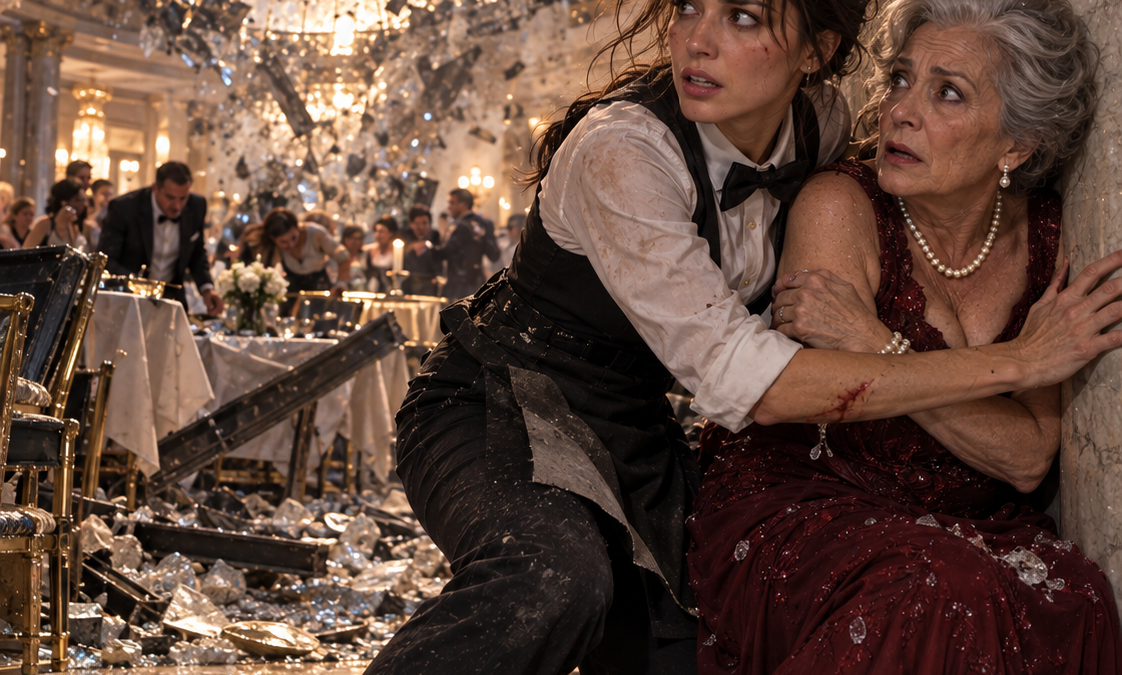
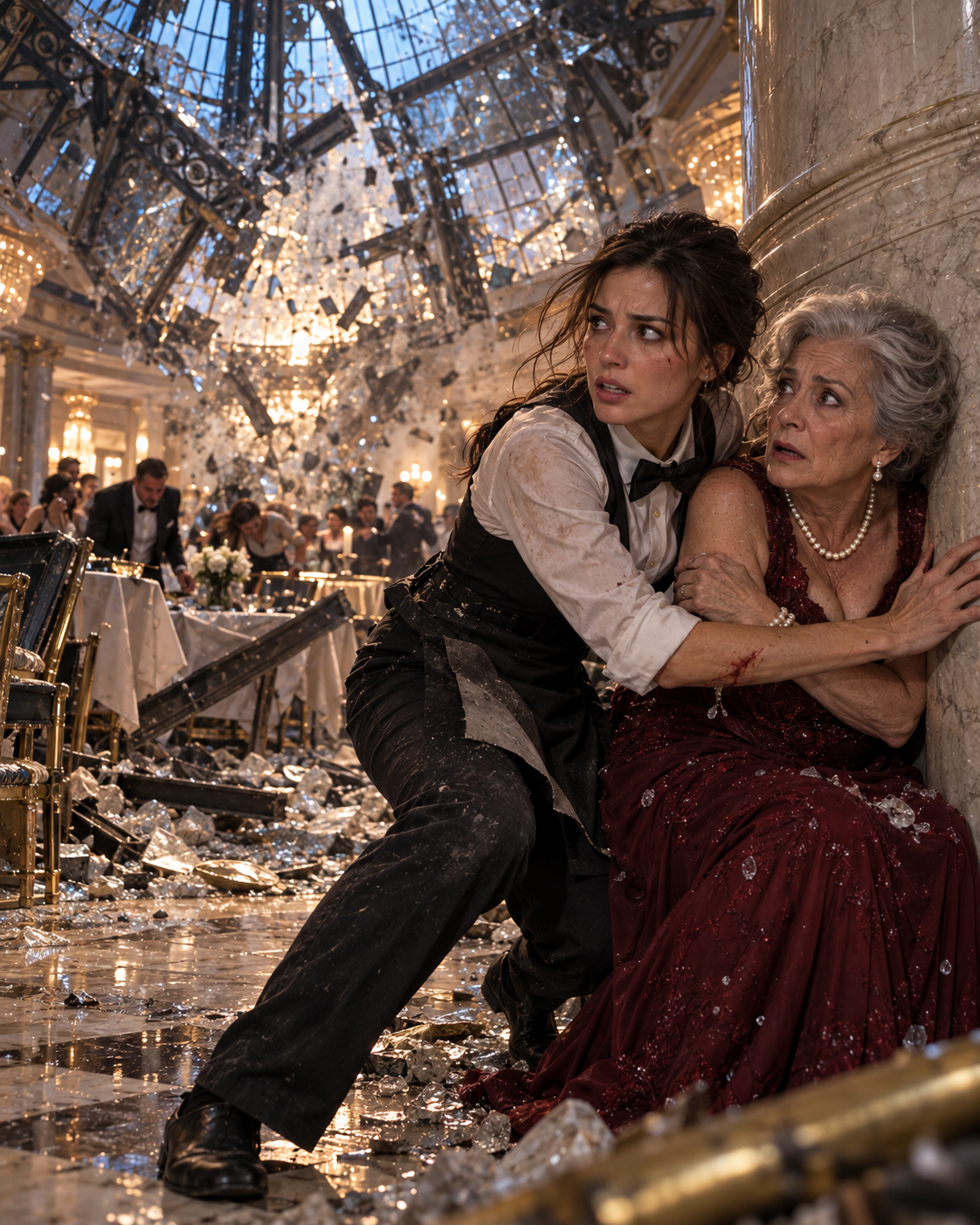
And in that moment, Elena pushed Margaret Romano behind the pillar and put herself between the old woman and the room, her arms up, her head down, her whole body making itself into the smallest possible shape. The sound that came next was not like anything Elena had a word for.
It was not an explosion exactly. It was was more like a sentence being completed, like something that had been gathering its breath for years finally saying what it meant. Four tons of Victorian iron work and a century of leaded glass descended from 40 ft in approximately 2 seconds, and the sound it made was the sound of a world rearranging itself around a correction that had been delayed too long.
The pressure wave hit Elena’s back like a hand.
Then the glass everywhere, a blizzard of it. A rainfall of crystal and iron fragments that went on for what seemed like much longer than 2 seconds, much longer than the physics should have allowed.
Then silence. A silence so complete and so sudden after the noise that it felt like a separate event, like a second disaster following immediately on the heels of the first. Elena lifted her head.
Her ears were ringing. Her palms were on the floor and they were wet.
atard. She registered that distantly, noted it the way you noted facts that would need to be processed. Later, when the immediate situation had been assessed, she turned.
Margaret Romano was sitting upright against the base of the pillar with her back straight and her pearls broken, several of them scattered across the floor beside her, catching the light from the emergency fixtures that had come on when the power flickered, and she was holding both of her own hands in her lap with the careful attention of someone who had just been reminded that hands were something worth keeping. There was a cut above her left eyebrow, already welling, her eyes were open, Mrs.Romano, Elena said, and her voice came out horarsser than she expected. Are you hurt?
Can you hear me? Margaret Romano looked at her.
For a moment, she didn’t speak.
And Elena felt a spike of real fear head injury, the silence after impact. But then the old woman said in a voice that was entirely steady, entirely herself.
Those were my grandmother’s pearls.
Elena stared at her. She brought them from Sicily.
Margaret continued conversationally as though they were having coffee through customs in 1931. My grandmother was a very stubborn woman.
Mrs.Romano, Elena put her hand on the old woman’s arm.
I need you to tell me if you’re hurt.
I’m not hurt, Margaret said.
Then precisely, “Are you hurt?”
Elena checked. Her palms were bleeding from the glass dust on the floor.
Her knee was scraped. Her uniform was white with ceiling dust and something that was probably champagne, but nothing felt broken in the deep alarming way that meant real damage.
Nothing screamed at her. For in I her own body, the way damaged things screamed.
“I’m okay,” she said.
“Good,” said Margaret Romano.
And then, for just a moment, just a hairline fracture in the composure, her eyes went bright, and her breath came out in a long, slow, shaking exhale that she clearly hadn’t intended anyone to hear.
Good, she said again softer to no one in particular. Elena looked at the center of the ballroom. The table where Margaret Romano had been sitting 30 seconds ago was invisible.
Buried under the largest section of fallen lattice, a mass of iron beams and crystal debris that rose 3 ft from the floor and covered a radius of 20 ft with no indication that anything had existed underneath it. She understood with a very quiet and very complete certainty that Margaret Romano would not have survived.
Nobody at that table would have survived. The chaos that followed was the particular chaos of a disaster among people who were not accustomed to disasters. People who had money and connections and the general expectation of safety, suddenly confronted with the fact that iron and glass did not respect any of those things, and that the ceiling above them had just proven it.
screaming at first, then crying. Then the slower, stranger sounds of people helping each other. Voices calling out names.
The scuff of expensive shoes stepping over debris. The sound of someone issuing orders in the controlled way of someone who had decided practically that someone needed to.
The strings, the quartet that had been playing near the east wall were apparently intact because Elena could hear a woman’s voice from that direction saying repeatedly, “I’m all right.
I’m all right.
Don’t worry about me.
With the specific insistence of someone who was worried about themselves, but more worried about the perception of worrying. Alena stayed with Margaret.
She didn’t make a decision to do this.
She simply didn’t leave.
The way you didn’t leave a thing you’d started until it was finished.
And helping Margaret Romano feel safe in the aftermath of nearly dying felt like something she’d started 30 seconds before the ceiling fell and hadn’t finished yet.
She helped her to her feet, kept a hand at her elbow, guided her around the edge of the nearest debris field toward the north wall, where a crowd of shaken but largely unheard guests had gathered, and where someone with a medical kit hotel staff, bless them, was already moving through the group.
“Your head needs attention,” Elena told Margaret, gesturing at the cut.
“I’m aware,” Margaret said.
“I’ve had worse.
I believe you,” Elena said.
Something passed across Margaret’s face, the beginning of a smile.
Maybe though the circumstances made it complicated. You believed the ceiling was going to fall.
Margaret said, “Yes, when you came to my table, you already knew.
I’d been watching it for about 2 minutes.”
Elena said, “From the time I noticed the gap until the time I reached you, I had maybe 4 minutes, I think.
Maybe a little less.”
” Margaret said, “Give or take.”
And the security guard you spoke to before you came to me. Elena looked at her.
You heard that?
I didn’t hear it, Margaret said.
I saw it. I was watching you from across the room. A pause.
I saw him turn away from you. Elena was quiet. And then you came to me anyway, Margaret said.
Yes. You knew what would happen if you were wrong, Margaret said.
It wasn’t quite a question.
I knew, Elena said. Margaret Romano looked at her for a long, steady moment with those dark assessing eyes.
What’s your name?
She asked. Elena Brooks. Elena Brooks?
Margaret repeated as though filing it somewhere important. How long have you worked here?
3 years. Do you have family?
The question landed sideways unexpected. Somehow more intimate than any of the others.
Elena took a breath.
My mother, she’s sick.
That’s she stopped.
That’s why I work nights.
Margaret Romano looked at her for another moment.
Then she reached out and put her hand over Elena’s.
The hand that was bleeding. the hand that had pushed her behind a pillar four minutes ago and held it with a firmness that had nothing sentimental in it.
That was simply the grip of one person telling another that they had been seen.
She didn’t say anything.
She didn’t need to.
Adrien Romano arrived at 11 minutes 8. Elena knew it was him before she saw his face.
Before anyone said his name, she knew from the way the room changed, from the way even the grief and the chaos seemed to rearrange itself around a new gravitational center.
from the way the security personnel near the north entrance didn’t just stiffen, but seemed to become more fully themselves, more intentionally present, as though his arrival made being present more consequential.
He came through the
entrance with four men around him, and he moved through the disaster the way water moved through rock, not loudly, not with force, but with the absolute assurance of something that had been in motion for a long time, and was not going to stop.
He was taller than Elena had imagined with dark hair going silver at the temples and a face that had learned somewhere in its life to keep whatever it felt in a room the face couldn’t access.
He scanned the crowd. She watched his eyes move systematic, rapid, the eyes of someone who had assessed dangerous situations before and knew how to do it efficiently. They moved over the debris, over the guests, over the staff, over the emergency responders who had just arrived and were beginning to work through the room.
And then they found Margaret.
In the fraction of a second between seeing her and reaching her, something crossed Adrien Romano’s face that Elena would think about for a long time afterward, something that had nothing to do with power or control, or the particular version of himself he presented to the city he ran.
It was something much older than any of that. Something that looked for just that moment like the face of a son who had not been sure what he would find. He covered the distance in seconds.
Mama, he said just the one word. Quiet.
And Margaret Romano opened her arms and her son went into them. And Elena looked away because some things were not for witnesses. And she understood that instinctively.
And she found something near the window to look at until the moment passed. She was pressing a folded cocktail napkin against her palm when she heard footsteps approach and stop. She turned.
Adrienne Romano was standing two feet away from her. He was not. She noticed looking at her.
The way most people at events like this looked at her the way that passed through her without stopping. The way that made her feel like a piece of the furniture, functional and interchangeable. He was looking at her the way someone looked at a thing they were trying to understand with full attention with something that was working.
You moved her, he said. Yes.
Elena said, “The security team is telling me they tried to stop you.”
One of them did, Elena said before the ceiling fell. I told him the northeast strut was separating from the arch fitting and he needed to clear the center tables.
He told me to get back to work.
The look that moved through Adrien Romano<unk’s eyes at that was brief and almost entirely internal, but Elena caught it, and instead he said, “You walked across a full ballroom and physically removed my mother from a table that was about to be buried under.”
He paused.
“What are we looking at structurally?”
“Do you know?”
“It was not the question she had expected.”
“The northeast quadrant,” Elena said, shifting slightly, falling into the clarity that technical language always gave her.
approximately 47 panels in the original lattice.
From what I could see before it came down, the primary failure was at the connection between the third trod and the main arch fitting the collar joint was completely separated which would have put the full weight of that quadrant on the secondary bracings and those weren’t rated for that load.
When the third strut went, the bracings went and the whole quadrant followed. Silence.
You know a lot about structural engineering for a waitress.
Adrienne Romano said it wasn’t quite an insult.
It wasn’t quite not an insult.
My father was a maintenance worker. Elena said evenly.
He taught me to look at buildings the way other people’s fathers taught them to look at cars.
I never had the money to finish my architecture degree, but I know what a failing connection looks like. Adrienne Romano held her gaze for a moment.
What do you need? He asked.
Elena blinked.
I’m sorry.
You saved my mother’s life, he said in a tone that was entirely level, entirely direct.
I intend to address that. What do you need?
She thought about the bills on the kitchen counter.
She thought about nurse Pollson’s text, don’t worry.
She thought about the security guard who had told her to get back to work. She thought about what kind of person she was, the kind who took the money and went home, or the kind her father had raised. I need to know, Elena said quietly.
who signed off on the last structural inspection of this building.
The stillness that came over Adrienne Romano’s face was different from the controlled stillness she’d watched him maintain since he walked in.
It was something more like surprise, genuine surprise from someone who was not often surprised.
That’s an unusual thing to need.
He said, “This ceiling didn’t just fall.”