“Come On, Your Turn.” The CEO’s Bodyguard Mocked a Single Dad—Unaware He Was a Navy SEAL Legend
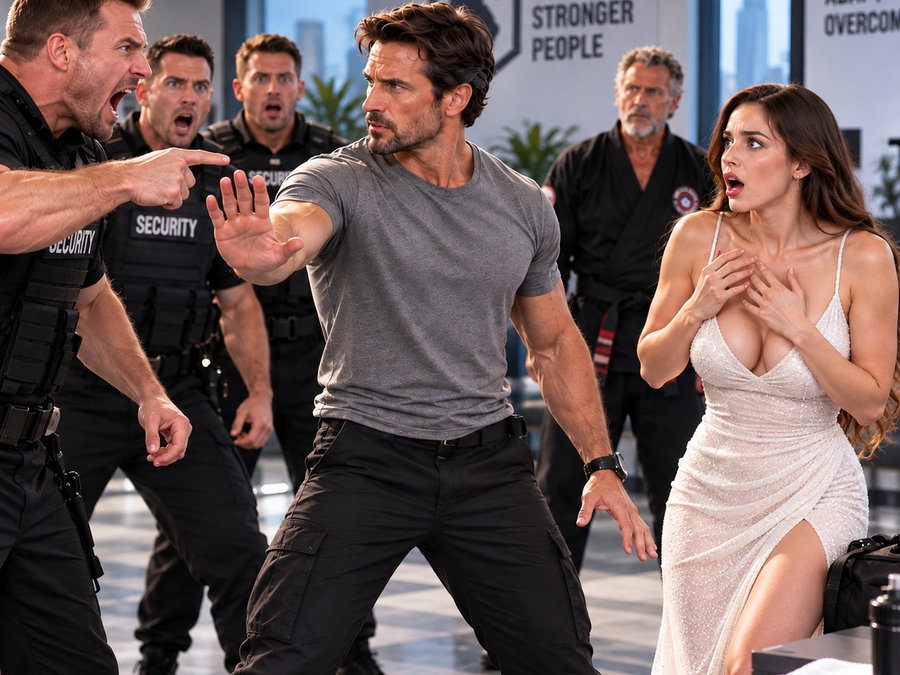
“Come On, Your Turn.”The CEO’s Bodyguard Mocked a Single Dad—Unaware He Was a Navy SEAL Legend
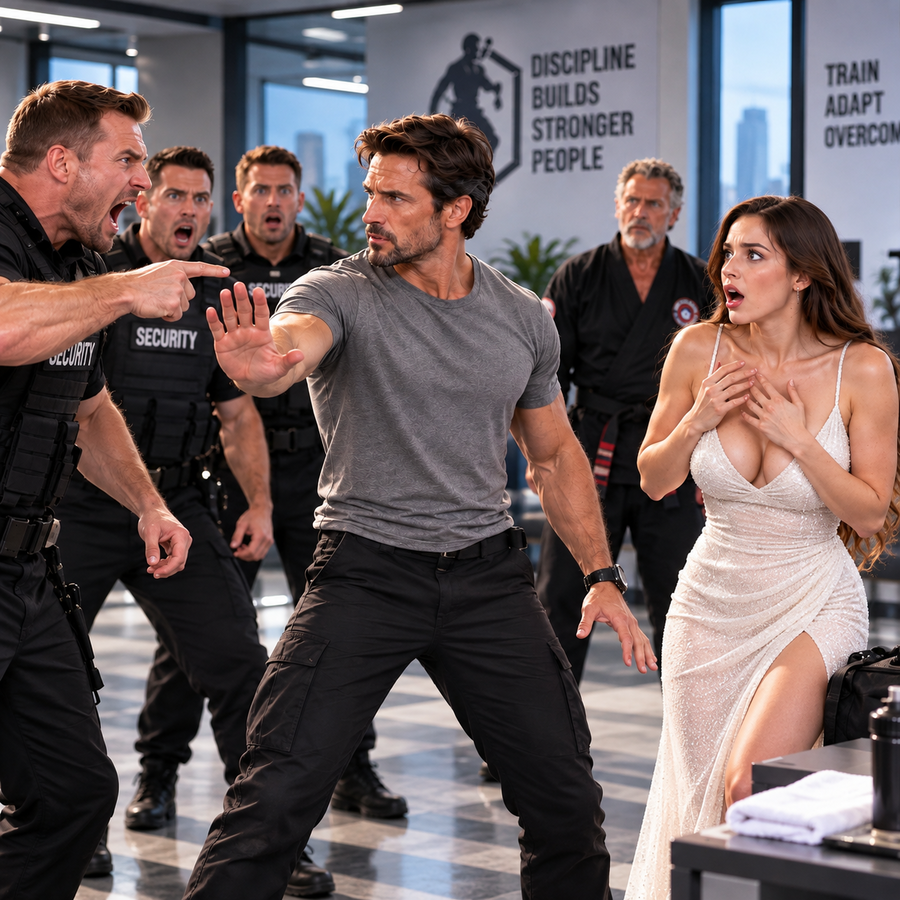
Grant Voss had the kind of smile that felt like a warning.
He stood at the center of the training floor with his arms loose at his sides and he tossed the padded training knife across the room like a man throwing scraps to an animal.
It landed at Ethan Cole’s feet with a flat slap against the polished concrete.
Half the security team was already laughing.
Come on, Grant said.
Your turn.
Since you clearly know how this works.
Ethan didn’t look at the knife.
He looked at his 10-year-old son standing near the back wall.
Noah wasn’t laughing.
Then the emergency exit on the east side gave a sound Ethan recognized from the worst night of his life.
The soft mechanical click of a magnetic lock releasing 3 seconds before it should.
Ethan didn’t explain.
He didn’t ask permission.
He was already moving toward Clare Whitmore when the lights went out and the first impact hit the door.
Grant stopped smiling.
The morning Ethan Cole’s life changed for the second time began the same way most of his mornings began with burnt toast and an argument he was already losing.
Dad, Dad, the edges are black.
The edges are fine.
They’re not fine.
They’re carbon.
Ethan flipped the toast onto a plate anyway and slid it across the kitchen counter toward Noah
who looked at it the way a scientist examines a failed experiment.
The boy had his mother’s eyes.
that same particular quality of patience.
That wasn’t patience at all, but a very quiet form of judgment.
You want eggs instead?
We don’t have time for eggs.
You said that.
Then eat the toast.
The edges.
Our character, Ethan said.
Eat the character.
Noah picked up the toast
pulled a piece off from the center where it wasn’t burned
and ate it without comment.
That was another thing he’d inherited.
The ability to register a point without making a speech about it.
Ethan had spent six years watching that particular expression develop on his son’s face
and every time he saw it
he felt something equal parts tender and unsettling
like looking at a map of a place he used to know.
He poured coffee into a thermos
checked the time
and grabbed his jacket off the back of the chair.
The jacket had a small tear in the left elbow that he kept meaning to sew up.
He hadn’t gotten around to it in 8 months.
“You’re going to the harbor today,” Noah said.
It wasn’t a question.
Propulsion control on a demonstration vessel shouldn’t take more than half the day.
And then Saturday games wouldn’t miss it.
Noah considered this with the same measured evaluation he’d applied to the toast.
You said that last week.
Last week the main bearing failed at noon.
That’s not on me.
The bearing just decided to fail at noon.
Bearings are unreliable.
People are unreliable.
This is a life lesson.
You’re teaching me to make excuses using machinery.
Ethan almost smiled.
He was careful about that
not because he didn’t want to smile
but because when he did
Noah watched him with a look of such concentrated attention that it made him feel seen in a way he wasn’t always prepared for.
His son was 10 years old and already had the unsettling habit of noticing the things Ethan preferred to keep quiet.
He drove Noah to schools
waited until the boy disappeared through the front doors
and then sat in the truck for a moment longer than necessary.
This was a habit, too.
He wasn’t sure when it had started.
Some mornings he simply needed the 10 seconds between dropping Noah off and pulling out of the lot.
A small pause to reestablish that everything was where he’d left it.
He pulled onto the highway and drove toward the harbor.
The repair job had come through a maritime leasing company he’d worked with for 2 years.
A steady
unglamorous stream of navigation equipment
propulsion systems
and weather sealing on working vessels.
the kind of work that paid predictably and left his hands dirty and didn’t require him to think about anything except the problem in front of him.
He liked that about it.
He had spent years in environments where the cost of a wrong decision was measured in lives.
Fixing marine engines was not that.
A failed repair meant a delayed schedule and a frustrated client.
Nobody died.
Nobody’s family got a phone call.
That simplicity was not an accident.
He had arranged it deliberately.
The harbor was busy when he arrived.
a working waterway on the south side of Seattle’s industrial waterfront
active with container logistics and commercial shipping and the occasional recreational vessel that had wandered for somewhere at Forsizen.
It they technically wasn’t supposed to be.
Ethan parked unloaded his toolbox and found the vessel he was looking for at Pier 7
a 60oot demonstration craft leased by a company called Whitmore Systems for what the paperwork described as a maritime communications trial.
He didn’t know anything about Whitmore Systems.
He hadn’t looked it up.
He rarely did.
He was halfway through the engine compartment inspection when he heard the vehicles.
Three of them moving in a formation he clocked without meaning to lead vehicle.
Principal trail security conscious spacing consistent with a protection detail.
He kept his attention on the propulsion housing and registered the movement in his peripheral vision the way other people register weather automatically without effort.
It was the kind of awareness that had never actually shut off
no matter how many years he’d spent pretending otherwise.
The woman who got out of the center vehicle was younger than he’d expected.
Early 30s, maybe.
She moved with the brisk efficiency of someone who hadn’t stopped being busy since she woke up a phone already in one hand
talking to the man beside her
scanning the dock as she walked.
She wore a plain dark jacket and no visible jewelry
which told him she’d learned at some point that looking expensive in working environments created friction she didn’t need.
The man beside her was not plain at all.
Grant Voss was built for the impression he made.
Mid-40s
shoulders that suggested a gym he visited religiously
wearing tactical clothing that was cleaner than any fieldwork had ever made it.
He walked the dock with the proprietary ease of a man who had decided in advance that any space he entered belonged to him.
Ethan watched him direct two of his people to positions near the gang plank without looking at either of them directly.
The gesture of someone who expected compliance as a baseline condition.
Professional, practiced, and utterly predictable.
That was the word that surfaced in Ethan’s mind before he’d consciously decided to form an opinion.
Predictable.
The vehicle positions hadn’t changed from when the group had apparently visited the previous day based on the faint oil marks near the peer edge that matched the tire contact points.
The two officers near the gang plank were the same, too.
He could tell by their positioning habits
the way the one on the left favored his right hip when he stood still.
Same faces, same spots, same intervals.
It was a good operation, organized, alert, clearly drilled.
It was also a pattern
which meant anyone paying attention could work around it.
Ethan went back to the propulsion housing.
He had been working for 20 minutes when he noticed the service corridor.
It ran along the eastern building face of the Piers maintenance facility
a utility access passage marked with a laminated card that said authorized personnel and a lock that had been propped open
apparently by someone who’d needed both
hands to carry something through and hadn’t bothered to close it.
The corridor wasn’t visible from either of the guard positions.
It was also the most direct route between the public dock road and the pier itself.
He said nothing about it for another 10 minutes.
Then one of the younger security officers walked past him while doing a sweep of the dock and Ethan straightened up and said quietly
“Service corridor on the east walls been propped open for at least half an hour.
” The officer stopped
looked where Ethan indicated
looked back at him
“Who are you?”
“Manic, here for the propulsion repair.”
The officer hesitated, then said, “I’ll pass it along.”
and kept moving.
He didn’t pass it along.
Or if he did
the information traveled up the chain and died somewhere because nobody closed the corridor and nobody adjusted the guard positions.
And Grant Voss continued his methodical walkthrough of the dock without his route changing by a single step.
Ethan watched this happen.
He watched it with the flat neutral attention of a man who had long ago stopped being surprised by the gap between how capable people thought they were and how capable they actually were.
He wasn’t angry.
He wasn’t contemptuous.
He was simply making an accurate measurement.
He had put his head back in the engine compartment when Grant Voss appeared beside him.
You the mechanic?
Ethan didn’t look up immediately.
He finished the connection he was receding and then straightened.
Yes.
You said something to my officer about the service corridor.
I mentioned it was propped open.
And you knew to mention that because minus because it’s propped open
Ethan said.
Grant studied him for a moment.
The way he did it
that particular quality of appraisal was something Ethan recognized.
It was the look of a man calibrating whether he was being challenged and by whom and whether that person was worth the energy of a real response.
He apparently decided not.
I appreciate the input
Grant said
and his tone carried the specific weight of a man who did not appreciate input.
But we have protocols for exactly that kind of situation.
My people handle it.
Your people were told about it 20 minutes ago.
A beat of silence.
Something shifted in Grant’s expression.
Not quite anger yet, but its immediate neighbor.
I said, “We handle it.
” Ethan nodded once and went back to the engine.
That should have been the end of it.
would have been if Clare Whitmore hadn’t been standing close enough to hear the exchange.
She had finished her call and had been reviewing something on a tablet and she looked up at exactly the wrong moment or the right one
depending on how you measured it.
She met Ethan’s eyes for a fraction of a second.
There was nothing warm in the look
just the quick assessing quality of someone filing away a data point they hadn’t asked for.
Then she turned back to Grant and said
“Make sure someone gets that corridor
please.”
Not a suggestion, not quite an order.
Something in between that left Grant with no comfortable response except a very small nod.
Ethan noticed she walked away before Grant could answer.
He kept working.
The morning moved forward in the ordinary way of working Morning’s diesel smell and metal sounds and Zenen
the rhythmic argument between machinery and the person trying to fix it.
He was running a diagnostic on the shaft coupling when he heard Noah’s voice.
He heard it before he understood what he was hearing.
just the boy’s particular register.
Not afraid
not hurt
just uncertain in the way of a 10-year-old who has wandered somewhere and isn’t sure whether he’s in trouble for it.
Ethan was on his feet and out of the engine compartment before he’d consciously processed what he was responding to.
Noah had found the pier.
He’d been dropped off at the harbor by Marcus retired senior chief Marcus Hail
an old friend who sometimes drove Noah from school on afternoon jobs because the school had let out early for a professional development day that Ethan had apparently misread the date on.
Noah had found his way down through the public dock entrance looking for Ethan
and he was standing now at the near end of Pier 7
studying the demonstration vessel with the same focused attention he gave everything interesting.
The maintenance cart was already moving.
It was a large electric utility cart battery operated used for moving equipment along the dock and it had been parked on a slight grade at the top of the pier access ramp.
Someone hadn’t set the brake or had set it improperly.
The cart was heavy and it was moving downhill with the slow inevitable logic of gravity.
And between it and the water there were two children.
Noah and a girl of about the same age who had wandered down from the public dock with a lunch bag and a general lack of awareness that a dock was not a good place to stand still.
Ethan didn’t run.
Running meant noise and panic and unpredictable movement.
He moved fast
directly
and without hesitation
and he covered the distance between himself and the cart in a way that would have looked to anyone watching
like something that didn’t belong in the category of ordinary human movement.
He intercepted the cart with his left shoulder
not stopping it
but redirecting it
using its own momentum to angle it left toward a concrete barrier at the pier’s edge
and simultaneously moved his right arm to guide both children out of its path without shoving either of them
which would have sent them toward the dock
edge.
The cart struck the barrier and stopped.
The whole thing took about 4 seconds.
Noah stared at him.
The girl stared at him.
Ethan checked Noah’s arms
checked the girl’s face
verified neither had been struck or fallen
and then straightened up.
His left shoulder was already sore.
He’d hit the cart harder than was strictly elegant.
“You okay?”
he said to Noah.
Noah said
“Yeah
” in the tone of a person who was absolutely processing something and had decided to defer it.
The girl picked up her lunch bag from where she’d dropped it and walked away at speed
apparently deciding that the safest response to what had just happened was to pretend she hadn’t been there.
Ethan let her go.
It was only when he turned around that he noticed Clare Whitmore standing 20 ft away.
She had seen all of it.
That was obvious.
But it wasn’t the rescue she was looking at.
She was looking at what Ethan did after.
Because after he confirmed Noah was unheard and the girl was gone
before he checked his own shoulder
before he said anything else
he did something that wasn’t parent behavior and wasn’t bystander behavior.
His eyes went up.
Rooftop of the maintenance building
rooftop of the adjacent warehouse
the elevated service gantry over the peer access.
A complete methodical scan
a full check of every elevated position within line of sight.
The whole scan took about 3 seconds.
Clare Whitmore watched every second of it.
Ethan caught her watching and felt the thing he always felt when someone saw him doing that
a flat
brief discomfort
the internal equivalent of a door closing.
He looked away first.
He turned back to Noah
said something low about what exactly the boy was doing on the pier without calling first
and put his arm around his son’s shoulders
and they walked back toward the vessel.
He didn’t look at Clare again.
She didn’t stop looking at him.
Grant Voss
who had arrived on the dock about 30 seconds after the cart incident
had positioned himself near Clare and was now saying something about documentation and incident reports.
Clare said yes without turning her head.
She was still watching Ethan and Noah walk away.
Something about the man with the boat engine and the scraped shoulder and the sun he was steering away from the dock with one arm was arranging itself in her head in a way she hadn’t expected.
She wasn’t sure yet what it meant.
She just knew that the scantho’s 3 seconds of methodical elevation check before he’d even looked at his own arm was not the reflex of a marine mechanic.
She filed it away and went back to her meeting.
The afternoon passed without incident.
Ethan finished the propulsion repair
wrote up a clean diagnostic report
and drove to pick up Noah from Marcus’ house.
Marcus Hail was 65 years old and had the specific physical quality of a man who had spent decades making himself comfortable with being uncomfortable.
He made coffee that was too strong for most people and kept a small wood shop in his garage and volunteered twice a week at a veteran’s transition office downtown.
He’d known Ethan for 11 years
which meant he knew most of the things Ethan didn’t discuss.
“How’d the harbor job go?”
Marcus asked, handing Ethan a mug of the murderous coffee.
“Fine.
Which company was it?”
“Witmore Systems.”
Marcus was quiet for a moment in a way that was not empty.
“The communications platform people.
That’s the one.
Security situation over there has been tense.
Marcus said, “I heard something about threat messages.”
I heard the same thing
Ethan said
which was true in the sense that you couldn’t spend a morning at that dock without picking up the tension in the way the security team moved.
They’ve got Grant Voss running protection.
I met him and professional, Ethan said.
Predictable.
Marcus looked at him over the rim of his own mug.
He had the patience of a man who had learned to tell the difference between someone who had nothing more to say and someone who was deciding not to say more.
He drank his coffee and didn’t push.
Noah came out of the kitchen carrying two cookies on a paper towel and gave one to Ethan with the off-hand generosity of a kid who hadn’t yet learned to be strategic about food sharing.
Ethan ate it in two bites and didn’t deserve it.
They drove home.
Dinner was soup from a can heated in a pot
which Ethan told himself was not a moral failure.
supplemented by bread that was one day from going stale
which he told himself was practical.
Noah ate it without commentary
which was either acceptance or the quiet accumulation of evidence for a future argument.
With that kid you never entirely knew.
After dinner
Noah was at the kitchen table doing something with a broken model boat
not building it.
Exactly.
More like interrogating its structural failures when he said without looking up.
You looked at the roof.