“So… You’re Still a VlRGlN?” The Mafia Boss Said After Taking His Enemy’s Wife
“So… You’re Still a VlRGlN?” The Mafia Boss Said After Taking His Enemy’s Wife
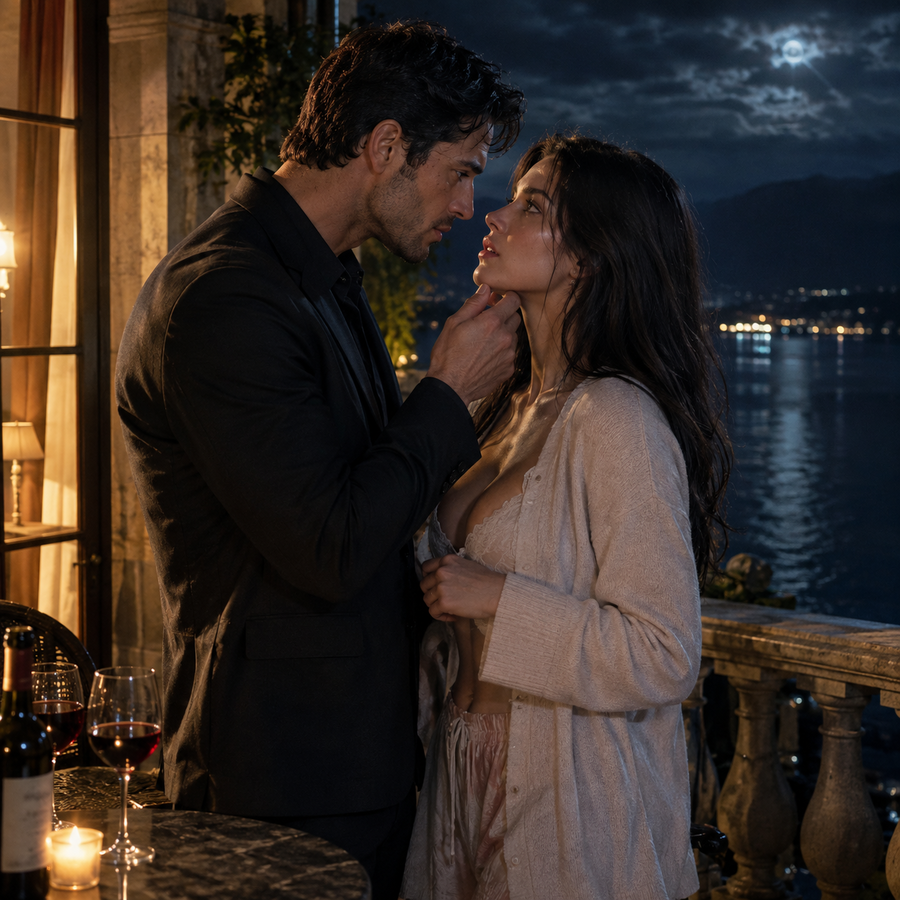
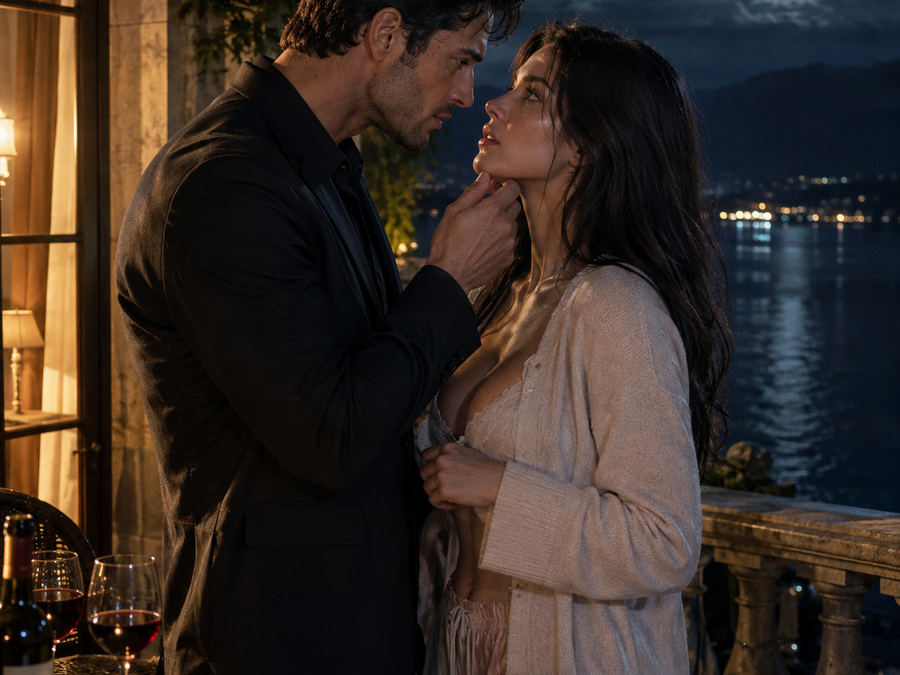
He stole me during my own wedding. Amid shattering glass and muffled screams, Aleandro Mancini reached out and tore me from the altar as if my fate were already his. Now in the shadows of his lakeside mansion, he leaned over me like a warm, inescapable shadow. His lips drifted slowly down my neck, tracing silent trails of fire, slow enough to feel like music and damnation at once. I shouldn’t crave the touch of the man who kidnapped me on my wedding day. But he was good, dangerously good. Then he stopped, lifted his face, dark eyes cutting into mine, and asked in a low, rough voice, “Are you still a virgin?” I’d guarded that secret like a sin, and the instant the truth left my lips, everything would shatter or turn eternal.
Chapter 1. The worst day of my life.
The veil sat crooked and it had been crooked for the better part of 20 minutes. I’d noticed and done nothing because somewhere along the way the energy required to fix it had drained out of me entirely. So I stayed there in the little anti-chamber of St. Patrick’s, studying my reflection in a heavy gilded mirror, the sort of mirror that seems to form quiet judgments about everyone who stands before it, and turning over a thought I couldn’t shake. That I was minutes from marrying a man who was essentially a stranger, and the thing occupying most of my attention was a strip of tulle tilted a few degrees to the left.
“You’ve got the face of someone walking to the gallows,” said Petra. My cousin materialized behind me in the glass, bouquet in hand, wearing the expression of a woman who had never once in her life considered holding something back. Twenty-five, dark hair clipped at the jaw, gifted with a talent for voicing exactly the wrong thing at exactly the wrong second. “White chrysanthemums. I’m serious, Julia. Half of Europe lays these on graves. Who in their right mind picked these? The groom did. Of course he did.” She dropped the bouquet onto the armchair like it had insulted her personally. “That’s a sign. A whole collection of signs. A press release from the universe.” Honestly, she nudged open the door to the side corridor. Went quiet for a beat, then reported back. “That priest is sweating like the building’s on fire. Either he’s terrified or he’s been drinking. Could go either way.” Petra, I’m only observing. She eased the door shut and turned to me.
And I recognized the look, the one she wore right before she said something I’d rather not hear. “While we’re observing things, you’ve clocked that Dario Dragna never actually looks at you when he speaks. He aims for a spot just past your ear. Like you’re some background detail in a painting he’s appraising.” I didn’t reply. She was right. And saying so out loud would make it true in a way I wasn’t ready to deal with yet. “There’s still the back door.” Her tone had shifted. This wasn’t a joke anymore. “Cars parked around the corner. I’ll feed this dress out the window after you and we vanish and abandon my father with nowhere to turn. Your father is the reason you’re standing here, Julia.”
I was aware of that. The trouble is that understanding a thing and acting on it are two completely different skills, and I’d never had much of the second one. I looked past the mirror through the narrow window facing the church’s flank. Chicago in October has its own particular light, gold and cold and hurried, like the sun knows winter is bearing down and means to take everything. Cars were still rolling up outside, delivering 200 near strangers dressed for a wedding I’d consented to, only to clear a debt I’d never incurred.
My father, Lenny Voss, had gone under two years back, not discreetly, magnificently, with court filings, seized property, and a startling number of acquaintances who abruptly forgot how phones worked. Dario Dragna, 38, Sicilian, rich in the way that never comes with a tidy origin story, had purchased the debt. Then he’d purchased the remedy, which was me. My father called it an opportunity. I’d told myself it was a choice, mostly because it was the only one I had left. “Hand me the bouquet,” I said. Petra passed it over with the gravity of a second presenting a dueling pistol. I took the chrysanthemums, set the veil straight in the glass, and pulled in one long breath, the useless kind that fixes nothing but pretends it controls, and promised myself it would pass. That all of it would pass.
The organ swelled. The ceremony unfolded exactly as I’d braced for, drawn out, rigid, surreal as something glimpsed through a fever. Daario waited at the altar, looking like a man pleased with a recent acquisition. Hair combed flat, suit cut to the millimeter, eyes that had never once struck me as warm, not even in the rare event of a smile. I came up the aisle on my father’s arm, staring straight ahead at nothing, because meeting anyone’s eyes meant remembering that 200 witnesses were watching me finalize the sale of myself against another man’s ledger. The priest started in on the Latin. Daario’s gaze found me, or found that spot beside my head, just as Petra had said, and only then did I admit she’d been right. I lifted my eyes instead to the stained glass over the altar. St. George, lance raised, the dragon crushed beneath him. Something about marrying under a portrait of battle struck me as bleakly funny, given that I couldn’t have named the thing I was supposed to be fighting. “Do you take Daario Dragna as your lawful husband?”
That was the precise instant the windows in the main doors blew inward. It was a single hard crack, not a rolling noise, but one sharp burst that shoved a tremor through the air of the nave. Guests jolted upright. A scream, two more reports from outside, not within the church, but close enough to leave no question about what they were. The priest retreated a step. Daario’s hand came up in a signal, and four of his men peeled out of the crowd carrying weapons that had no business inside a Catholic church on a Saturday afternoon. I should have moved, dropped flat, bolted the other way, done whatever people do when instinct outruns thought. Instead, I just stood there, chrysanthemum still in my grip, veil still a skew, eyes fixed on the entrance.
It swung open without urgency. No violence to it. None of the force of a man breaking in. Just the unhurried ease of someone who knows the door will open because he’s already decided it will. The man who stepped through was somewhere in his early 30s. Dark hair, black suit, no tie, and his expression resisted easy labeling. Not anger, not arrogance, not quite coldness either. The look of someone who’d arrived to close out a piece of business and was simply working down the list. He came up the center aisle as though the 200 panicking guests and Daario’s four armed men were nothing more than scenery. He halted a few paces shy of the altar. His eyes settled on Daario for two long seconds. Seconds that stretched well past their literal length with an indifference so total it landed like a blow. Then they moved to me. He held out his hand. “Let’s go.” Low, meant for me alone. It wasn’t a request and it wasn’t a command in the usual sense. Nothing loud or forceful about it. It was a foregone conclusion. As if the only thing left undecided was how long I’d take to catch up to what he already knew.
I turned to Daario. He hadn’t moved. The intruder’s men ringed him. Guns trained on his captains. Every exit sealed off with a precision that spoke of planning. What sat on his face wasn’t fear. It was something I’d never caught there before. Humiliation. The specific humiliation of a man undone in front of everyone obligated to respect him and powerless to answer for it. That was when I understood. Daario stood frozen, not for lack of choices, but because any move would cost him more than he was prepared to surrender. In that moment, I looked back at the open hand in front of me, and I set mine in it. Behind me, Petra shouted my name, not the cry of someone calling for rescue. It was her own particular brand of distress, equal parts genuine alarm and outrage that the situation had slipped past her control.
I turned just far enough to see one of the stranger’s men steering her toward the side door. No roughness, no raised weapon, only the certainty of a man who isn’t asking. “Julia,” I looked at her once. Only once. The man at my side never broke stride. In the car, a black SUV, windows tinted, leather seats, the interior so quiet it felt sealed off from the world. I realized I was still clutching the chrysanthemums. I let them fall onto the seat beside me as though they’d done something to deserve it. The man on my left glanced at the bouquet, then at me and said nothing. The driver pulled into traffic. Chicago streamed past the glass under that unchanged October light. Gold, cold, entirely unbothered by the fact that I’d just been carried off from my own altar.
“What’s your name?” I asked. “Aleandro Mancini.” I let it settle. Aleandro Mancini. It meant absolutely nothing to me, which probably summed up how little I understood about the world I’d just been dropped into. I rolled my eyes. The entire cosmos had arranged for me to end up in an armored SUV beside a mobster whose name I hadn’t possessed until 10 seconds ago. “Is there Wi-Fi at the mansion?” He turned slowly, very slowly, with the look of a man recalibrating something behind his eyes. Not anger, not quite surprise, but the focused attention you give an object that has just behaved in a way it shouldn’t. As though I were a sum that had returned the wrong answer, and he was working out whether the fault lay in the formula or the numbers. “There is,” he said after a moment. “Great.” I went back to the window.
The mansion stood on the edge of Lake Michigan, far enough out that the city arrived only as a faint echo. It was large the way old money things are large, not showy, just inevitable. Size reading less as ambition and more as the natural residue of everything that had piled up there across decades. Alessandro walked me to a room on the second floor, generous with a window onto the water, sheets that plainly hadn’t come off any supermarket shelf, and a bathroom bigger than my old living room. He hung back at the threshold while I drifted in and took stock, and then he spoke. “You’re not a prisoner here.” I turned. “The door stays unlocked.” Same flat tone, the one that seemed to be his voice at rest, “but the grounds are secured. Leave without telling anyone, and my men will have you before you reach the gate.” “That’s the textbook definition of a prisoner.” “It’s the definition of someone protected,” he said. Expression unmoved. “Those aren’t the same thing.”
I wanted to push back. Wanted to point out how conveniently the line gets drawn by whoever owns the dictionary, but he was already gone. Unlocked door behind him, just as promised, not another word. And I was alone with a crooked veil in a wedding dress that had never reached the end of the ceremony it was built for. I considered leaving. Truly considered it. Measured the distance to the gate. Weighed the odds of flagging a car on the road past the wall. Calculated how long before I could reach Petra and ask her to come. Then I thought of Daario Dragna, frozen at the altar, that cold and dangerous shame stamped across his face, humbled before 200 guests, before allies, rivals, captains, a man with money and muscle and armed men reduced to standing still while his bride was led out on an enemy’s arm. A man like that I knew without needing any schooling in this world would never let it stand.
Sel, Alessandro’s right hand, 30 or so, his face fixed in a neutrality I still couldn’t read, pushed the bedroom door open without knocking. In any other circumstance I’d have filed it under rude. Here it was just one more entry on a growing list of things that ran by different rules. “There’s something you should see.” He led me downstairs to a room lined with monitors each feeding live footage from the perimeter cameras. The grounds, the gate, the street beyond the wall. Two black cars were making slow loops of the block, unhurried. The pace of things that don’t need to rush because they’re only waiting for the right moment to stop. “Dragna’s,” Sel said, with the detachment of a man reading off a weather report. I studied the cars on the screen, the block, the wall holding the line between them and the place I now stood.
I thought of Daario at the altar. I thought of walking out that gate by myself in a wedding dress onto a Chicago street where two of Dragna’s cars were circling. And I understood with the unwelcome clarity that surfaces the instant you can no longer lie to yourself. That choosing to stay had nothing to do with feeling. It was simply the only call anyone hoping to stay alive could make for now.
Chapter 2. Prisoner in luxury.
The rules of the place were written down nowhere, which meant the only way to learn them was by process of elimination. I went about it methodically those first few days. Wake, coffee, a slow circuit through whatever rooms would have me. Sitting room, library, balcony, the side garden, and I mapped the boundaries of the permitted by noting where no one bothered to stop me. Nobody trailed me down the corridors. Nobody pulled books out of my hands. Nobody dictated where to sit, when to eat, whom to speak to. The house ran on a quiet, efficient logic that took me 3 days to crack. There were no bars because bars would have been redundant. The perimeter handled that out there somewhere. In here, the freedom was genuine, just hemmed in by geography.
Sale surfaced every morning with a tray of coffee, bread, and fruit, wrapped twice, and let himself in before I could answer, a habit I’d elected to read as efficiency rather than rudeness. He’d set the tray down, offer a good morning miss, in the flat tone of a man who had run every conceivable life scenario, and concluded that none of them warranted a visible reaction. And go every morning, no variation, like a weather system. Alisandro turned up at meals, not all of them. Some, which I worked out fast, was considerably worse than all of them, because all of them I could have braced for. As it stood, I never knew whether he’d be at the table when I came down. And the unsettling part was discovering that I’d begun to keep track.
The fifth meal was where the war of words actually started. I came down for lunch expecting nothing, and found him already seated, a folded newspaper beside his plate, and a coffee that was plainly not his first of the day. I took the far side of the table, distant enough that it shouldn’t have read as deliberate, though it was, and picked up the menu Sle had left out. “Sleep well?” Aleandro asked, eyes still on the paper. “Define well?” He looked up slowly, like a man finishing his sentence first. “Four uninterrupted hours. No jolting awake. That usually clears the bar.” “Then, yes,” I said. “By that standard, I’ve slept well most of my adult life.” The nights before weddings, I didn’t want included. The paper dropped a single cm. Not two, one, just enough to lift his eyes above the fold. There was something in the look I still hadn’t pinned down exactly. Not quite curiosity, not quite amusement, but something in the gap between the two that he clearly didn’t hand out to just anyone.
“Didn’t want,” he repeated. “You think I wanted to marry Dario Dragna?” “I think,” he said, folding the paper with care and laying it beside his plate. “That you had every chance to slip out the back before that ceremony began. And you stayed.” I held his gaze a beat. That was maddeningly accurate. “There were circumstances,” I said. “There always are.” He lifted his cup. “The only question is which circumstances you decide to honor.” I let it go because any answer I had would have confirmed his point, and giving Aleandro Mancini the satisfaction of being right on a Monday morning struck me as a poor precedent. For however long this forced cohabitation was going to run. He knew I’d quit the field. I knew he knew. And he drank his coffee with the ease of a man entirely at home in silence, which I was beginning to see was an enormous advantage in any conversation. I’d need to work on that.
Petra’s voice note landed Thursday at 11 in the morning, 4 minutes and 32 seconds long. I was in the library when the phone buzzed. Aleandro had handed the device back on day two without comment, a gesture I read as faith in the perimeter rather than generosity, and I got my earbuds in before pressing play because the thumbnail already had Petra’s face mid expression and I knew this was going to require privacy. “Julia, Julia, are you alive? I went to the police. They said there’s no kidnapping report on file. So I went to a different precinct and got the exact same answer, which obviously means somebody paid somebody. So then I went to a pause, the sound of deliberate breathing. Okay, calm. I’m calm. So your mother called. I told her you were fine. And she asked whether you’d actually gotten married before vanishing. I said, ‘Not exactly.’ She went quiet for 10 full seconds and then hung up, which is honestly the most reasonable thing she’s done in years. Your father. Another pause, a longer one. Your father’s fine physically, as in upright, breathing, no visible damage. So, Julia, I need to know you’re okay. Not okay like I’m not bleeding. Okay. Like, okay. Can you send something, a word, an emoji? Literally anything that a pause. Are you okay? Because if you are, and you need to be, I need everything. Details. Was he hot? Because from the angle I caught at the side door, he looked hot. Julia, text me now.”
I lay there staring at the library ceiling for a moment after it ended. There was something deeply steadying about the fact that Petra, amid a scenario featuring gunfire, an abduction, and a collapsed wedding, had organically circled back to the question of her abductor’s looks. I texted, “I’m fine. Details soon. He’s hot.” Which makes everything more complicated. She fired back inside 40 seconds with a 2-minute voice note I decided to save for later.
It was a Tuesday afternoon, nearly 2 weeks in, when I found my camera bag. It was in the bedroom, propped against the wall by the closet, exactly where someone had set it down with deliberate care. I’d had it on my wedding day because I’d come straight from a job. I’d shot a corporate function the night before and hadn’t had time to swing by the apartment, and in the chaos of the sacry, I’d left it standing in a corner and forgotten it entirely. I picked it up and checked the contents on reflex. Both cameras, the lenses, the memory cards, the charger, all accounted for. I zipped it shut and exhaled. There’s something about the tools of your trade that normalizes any room, however strange, and carried the bag out to the balcony. Photographing the lake became a habit over those days. It was the one thing I did that felt entirely mine, untouched by any film of that place laid over the top. What I didn’t notice was that the outer side pocket had been opened and closed before I ever got to it.
Fen Caruso arrived at the mansion that same afternoon. I watched him from the garden. A man in his mid-40s, hair going gray, suit a dark charcoal, moving with the particular walk of someone who had never once shown up anywhere unannounced. I didn’t yet know who he was, but sail met him at the door with the wordless familiarity of a man who needs neither name nor reason, which in this world counted as an introduction in itself. Fen Caruso, I’d learn, was Alessandro’s counselor, the man who appeared once the decisions had already been reached, and only execution remained. The two of them vanished into the house without ceremony. What caught my attention wasn’t the arrival. It was how long Fen stayed. 2 hours. I counted without meaning to because I was on the balcony when he went in and still on the balcony when he came out. Same composure as before, same unhurried stride. But there was something altered in the way Alisandro drifted into the garden a few minutes later, planting himself near the stone ballastrade, gazing out at the lake with his hands in his pockets and a tightness across his shoulders that hadn’t been there that morning. I didn’t ask. It was none of my business. Or so I told myself. I just watched him longer than I should have.
That same night was when the window happened. I was on the second floor trying to capture the lake in the light that lingers after sundown. That specific blue gray of a Chicago October that takes patience to get right. I worked the aperture, shifted the angle, stepped back two paces, came forward one, locked into the kind of focus that makes the rest of the room dissolve. Then I registered that I wasn’t alone. There’d been no sound, no footsteps, nothing audible. It was the presence that reached me first, the warmth of someone too close, or a stir in the air, or some sense I hadn’t known I possessed until that instant. I turned, shoulders up, braced for something that turned out not to be necessary. Aleandro stood less than a meter off, looking at the camera screen I still held at chest height. He’d announced nothing, asked for nothing. He simply occupied the space with that silent ease of a man used to entering rooms without permission. Not aggressively, but with the settled certainty of someone who had never needed to announce himself to be felt.
I should have said something, stepped back, or produced some sarcastic line that reset the proper distance between the abducted and the abductor. Instead, I stayed rooted while he studied the images on the screen, the lake, the horizon riding just below center, the glint of light off the window pane left inside the frame instead of cropped away. The silence ran on longer than it had any right to. “You see what most people miss,” he said low. It wasn’t quite a compliment wasn’t quite analysis. It was an observation, the kind that escapes a person before he’s decided whether to say it, as though he’d thought it at some earlier point, and the words had found their own way out. I had no idea what to do with that. No idea what to do with the tone, the closeness, the fact that he’d been watching my photographs in silence long enough to form a view. I looked at him for a second and he was looking back with that attention that wasn’t quite curiosity and wasn’t quite interest but was something I didn’t feel ready to name. He left before either of us had to find out what came after. I lowered the camera and stared at the lake for a good while. Thinking there was something acutely inconvenient about sharing a house with a man who could knock me off balance in eight words and then walk out before I had the chance to write myself.
The next morning, Alessandro came to breakfast wearing the look of a man who’d settled something during the night. He didn’t say it, but there was a change in how he looked at me when I came into the room. Less calculated, more attentive, as if I’d graduated from variable to problem. And he was still deciding what the difference required of him. I didn’t know what had shifted. I only knew that it had.
Chapter 3. The danger of getting too close.
Aleandro summoned me to the office on a Monday morning at the start of the fourth week. It wasn’t Sale who came for me. It was him. Two knocks on the bedroom door. And when I opened it, he was leaning into the frame with the posture I’d already learned to read as I have something to say. And I’ve mapped every way of saying it before walking over here. Not tension, precision. The line between the two I’d come to understand over those weeks was one of his signatures. “When you have a moment,” he said, “I have several. I’m a prisoner.” One corner of his mouth shifted. “Almost. Office. 5 minutes.”
The office sat on the first floor. At the end of a hallway I still hadn’t fully explored. The room read like a direct extension of the man who used it. Dark ordered. Not a single object that lacked a purpose. Shelves swallowing an entire wall. A heavy oak desk. Two chairs on the far side. No photographs. No decorative touches that gave away anything past the essential. I sat. He stayed standing. A power move I clocked and decided not to name. “There’s something inside your camera bag you need to know about,” he said. I looked at him. “The external drive you used at that corporate function,” Alisandre went on in the neutral tone that didn’t make things lighter, only more inevitable. “The automatic backup you photographed more than a business meeting that night.”
He opened the laptop on the desk and angled the screen toward me. I recognized the location at once. The port warehouse, the harsh industrial lighting, the long tables stacked with documents, the crates lined up in the background. I’d shot it believing it was exactly what I’d been hired to shoot. Executives in a meeting, the kind of formal corporate record some companies keep as visual minutes. I’d done the job, left, run the backup in the car before I got home. Then the screen advanced to the next frame. Without realizing it, I’d caught the moment someone pried open one of the crates in the background. At the resolution the telephoto lens delivered, even at distance, the contents were legible with a clarity that turned my stomach. Rifles, tactical vests bearing markings that weren’t civilian, pistols nested in black foam, and ringing the table. Faces I’d recorded without knowing whose they were until Alessandro swiped to the next image. And there was Daario Dragna in profile. Two men I didn’t recognize beside him and two more I did because I’d seen them in newspaper photos. Federal senators, men who delivered prime time speeches about cracking down on organized crime.
I stared at the screen for a span of time I couldn’t measure. “I didn’t know,” I said at last. It was obvious, but it needed saying. “I know,” Aleandro said. “I was hired to photograph a business meeting. They sent the address, gave me the time. I went, shot what was there to shoot, and left.” I heard my own voice and realized I was arranging the facts aloud, less for him than for myself, trying to force the pieces into an order that made sense. “I had this with me the whole time and didn’t even know it.” “And you went to the wedding straight from work,” Alessandro said without stopping at home. The understanding arrived slowly and with wait. The bag in the sacry, the drive inside the bag, Daario Dragna at the altar, 30 m from the evidence that could bury him with no idea it was there. I hadn’t had any idea either. “What does this mean?” I asked, and the question was far larger than its words. Aleandro closed the laptop. “It means you accidentally photographed enough to put Daario Dragna, two Dragna captains, and two federal senators away for illegal arms trafficking.” He laid it out slowly without drama, the way a man reads off coordinates. “And it means that as long as this drive exists with your name on it, even if you have no clue what’s stored there, you’re a problem the Dragnas have to deal with.” The silence that followed had texture. “That’s why you’re still keeping me here,” I said. Not an accusation, a conclusion. “Partly,” he answered, and there was something in that. Partly I wasn’t sure I wanted to look at more closely.
The next day, S took me to my apartment. The idea had been mine. I needed clothes, gear, things that were mine and that still existed in a place that had gone on existing while my entire life relocated over the past few weeks. Aleandro had cleared it with one condition. Sel went too, and Sel set the route, not me. I’d agreed, because it was reasonable, and because reasonable had become my new yard stick for every decision given the surroundings. The apartment was exactly as I’d left it. Cameras on the charger, plants gone slightly dry, the coffee cup from the morning of the wedding still sitting in the sink because I’d rushed out and it had quietly become a time capsule. I grabbed what I needed fast since sail had said we had 30 minutes and the tone he used setting deadlines didn’t open the floor to negotiation.
On the way back, maybe 15 minutes from the mansion, the car stopped at a light and two vehicles boxed the SUV in from both sides at once. S reacted before I’d even processed what was happening. Punched through the light, swung onto a side street, fired off rapid Italian into his phone. I twisted toward the rear window and saw the two cars straining to match us, then watched one of them clip a parked vehicle and lose speed. The second hung on for two more blocks before it gave up. The SUV pulled into a sealed garage sale opened with a code. He cut the engine, sat silent for exactly 3 seconds, and then said, “Are you all right, miss?” I was physically not a scratch, but there was something that wasn’t quite fear and wasn’t quite adrenaline. The gut level understanding lodged in the body before it ever reached thought. That this world was real. That the guns were real. That the men in those cars had a real objective and I was part of it. “They were draggas,” I said, not a question. “Yes,” Sel said. “How did they know I’d left?” Sel didn’t answer right away. And that 2-cond pause said more than any answer could have.
Back at the mansion, Aleandro was at the entrance when we arrived. No visible urgency to him. There never was. But there was that quality of concentrated attention I’d learned to separate from his neutral state. He looked at me first, then at Sel. Sel gave an almost invisible tilt of his head, and the two traded three low phrases in Italian before Alessandro brought his eyes back to me. “You’re all right,” he said. Also not a question but different from sails. A verification the kind of person runs when the answer matters more than the phrasing. “I am,” I said. He nodded. Then he turned to Sel with the expression I’d already learned to recognize as the opening of something that wasn’t going to be simple. I knew in that moment that the question of how the Dragnus had learned of my departure already had an answer and that the answer lived inside this house.
The name was Petrov. I found that out that night, not because anyone told me outright, but because the mansion has a specific acoustics when something serious is in motion. Footsteps change their cadence, doors shut with more care than usual, and the silence takes on a different density, compressed like air before a storm. Petro was the mansion’s security assessor, a man around 40, blonde hair, cropped short, whom I’d seen a handful of times in the corridors without anyone ever formally introducing him. There was something in the way he read rooms before he read people that I’d noticed without knowing what to call it. Sail had joined two dots. Petrov was present when the camera bag turned up and he’d placed a call to a dragna number a few hours before the strike on the car. Aleandro confronted him in the meeting room with the proof in hand. I wasn’t there, but Aleandro’s voice carried down the hall, low and even, without a single rise to it, which was more chilling than any shouting could have been. Petro tried to bargain. I caught a fragment. “I can be useful. I know things that.” And then Aleandro’s silence, which lasted exactly long enough to make plain that the negotiation had ended before it began. When Sail came out of the room a few minutes later wearing the look of a man handed a task he won’t comment on, I pictured Aleandro looking at Petro. The way one looks at something small and inconvenient. No anger, no theater, just the indifference of a man who has already decided and is waiting for the execution to catch up to the decision. Sel handled the problem. I didn’t ask how. I heard a door close downstairs, a heavy door, with that final sound of something that won’t be opening again, and concluded there were questions I didn’t need to ask in order to understand the answers.
Aleandro came out to the balcony where I was. Later, once the mansion had settled back into the silence that was its baseline, but that night carried a different layer. He was without his jacket, his composure not entirely assembled, and there was something in that detail, a shirt sleeve rolled slightly back, an expression a degree less calibrated than usual, that made his presence more real than I was accustomed to handling. He stopped by the ballastrade, looking out at the garden. I watched him a moment before I spoke. “Did you know this was going to happen?” Aleandro turned. He held my eyes for a second and I saw for the first time since I’d known him the moment a man finds himself without an elegant answer. Ready, not quite hesitation. The interval of someone weighing his words not to manipulate, but because he’s being exact about something that matters. “I knew they’d react,” he said finally. “I didn’t calculate it would be this fast. It was a mistake.” He was owning a mistake. To me, out loud, with the same precision he brought to everything, neither minimizing nor inflating it, just setting the fact where it belonged. For a second, I didn’t know what to do with that. And then I understood he didn’t either, that there was something in the way he looked at me after saying it that suggested the admission had cost more than it appeared to, that he felt the weight of the moment exactly as much as I did. “It’s all right,” I said after a while. “No one got hurt.” He didn’t reply, but something eased slightly in his shoulders. So slightly, I almost certainly wouldn’t have caught it a week earlier.
After that night, something shifted in the way he moved through the space we shared. Not abruptly. Aleandro Mancini did nothing abruptly. Everything about him was measured, gradual, with that timing that looked natural, but that I was starting to suspect wasn’t. He began turning up at moments I didn’t expect him, not always to talk, sometimes only to be near, with that presence that filled a room in a way I felt before I saw it. One afternoon, I found a glass of wine on the library table beside the book I’d left open the night before. No note, no explanation. Sel, when I passed him in the hall, wore the expression of a man who had most definitely not said any glass of wine anywhere. Another time, Alessandro lowered himself onto the living room sofa while I was reading. Not the far end, where seats were open, but the same sofa at a distance that wasn’t close enough to be declared yet close enough that I felt his warmth and lost the thread of the paragraph in front of me. He stayed 20 minutes with a book of his own before getting up and leaving without a word.
And then one night when the wind off the lake was beating at the windows and I’d lingered on the balcony past any reasonable hour simply because sleep wouldn’t come, he appeared beside me with a glass in his hand and stayed quiet a long while before saying without looking at me. “Mateo loved this view.” A pause. “My younger brother, he used to say the lake at night looked like a sleeping animal.” I said nothing. I knew for reasons I couldn’t quite put into words that saying anything would be the wrong move. That the sentence had surfaced by some route that bypassed the control he applied to everything, and that any response from me might send it retreating back to wherever it had come from. So, I stayed silent, and he stayed silent beside me, and the lake below stayed quiet like an animal, exactly as Mateo had said. Only later, back in my room, did I register that Alessandro had noticed I’d kept that, had seen it in the way he looked at me as I finally went in, a fraction of a second longer than necessary with that silent scrutiny he reserved for things that didn’t behave as expected. I was becoming dangerously close to one of those things.
Fen Caruso came back to the mansion at the end of the week. This time, I was in the living room when he arrived, and this time, Aleandro made no effort to wall off the conversation. Fen came in, greeted us with that nod of a man who doesn’t hand out formalities for free, took the chair facing the two of us, and said in his usual low voice, “The senators in the photos have been contacted by the dragness. A pause. They’re going to try to make the drive vanish before it reaches anyone who can use it. We’ve got 48 hours to get it to the federal prosecutor or this material is gone for good.” The silence that came after was unlike any of the silences that House had held before. It was the kind that runs ahead of decisions with no way back. Aleandro looked at me. I looked at him. And I understood that the next 48 hours were going to change a great deal more than the Dragnus’ situation.
Chapter 4. The 48-hour window.
The operation got underway that same night. I wasn’t read into the details and hadn’t expected to be. What I knew was enough to grasp the stakes. The drive had to reach the federal prosecutor before the dragness erased it, and it had to arrive in a way that left no trail back to anyone. Fen Caruso had a contact inside the public prosecutor’s office, someone who took in evidence without identifying the source, without asking questions, without generating any record that could be followed. That was how the Mancini family had worked for years. They never surfaced, but things got handled. I pieced this together, sitting in the library, listening to the mansion shift quietly around me, footsteps changing tempo, low voices that cut off whenever I crossed the hall, sail moving in and out with the look of a man working through the stages of a plan, and with no spare bandwidth for any other expression.
Aleandro didn’t sleep that night. I knew because the office lights were burning when I passed the hallway at 2:00 in the morning, unable to settle, and still burning when I passed again at 4:00. I didn’t go in, but I lingered at the door a second longer than I needed to before moving on. I went to the library. I stayed there with my phone in hand, waiting on news I had no idea how would reach me, and it reached me at 6:40 the next morning on a Chicago news site in a headline with no drama and no by line. Sicilian businessman detained over suspected arms trafficking and bribery of public officials. Daario Dragna arrested. I stared at the screen a long while, waiting to feel something more complicated than what I felt. Relief maybe, or some leftover fear, or the cold satisfaction of watching a threat removed. What surfaced was simpler than any of those. The sense that something had closed. And right behind it, the realization that I was still here, that the reason I’d ended up at this mansion had evaporated, and I was still sitting in Aleandro Mancini’s library at 6:40 in the morning, in no hurry at all to go. I closed the site, set the phone on the table, and looked down the dark hallway toward the office where the light was still on.
Lenny Voss showed up two days later. My father, 55, hair going gray, wearing the permanent expression of a man perpetually on the verge of pitching a deal, arrived at the mansion gate on a Wednesday afternoon with the confidence of someone certain the board had tilted his way. With Daario in custody, the debt that had produced the wedding had lost its holder. Lenny’s logic, I’d work out afterward, was simple. No debt, no groom, no reason for his daughter to remain there. Time to turn up, salvage the situation, and see what could be renegotiated with the man holding her. I was on the stairs when I heard my father’s voice in the entryway. I didn’t go down right away. I froze midway up the steps, out of sight of anyone below, and listened. Alisandre received him in the entrance hall. Not the office, not the main sitting room, the entrance, which was, I’d learned, a statement about exactly how long the conversation would run. Lenny talked for maybe 2 minutes. I couldn’t make out the words, but the tone was the one I’d known since childhood. The tone of a proposal, of negotiation, of a man who arrives with arguments loaded and expects room to deploy them.
Aleandro answered in three sentences. I didn’t catch the content. His voice was too low to bridge the distance, but I heard the silence that followed, lasting precisely as long as it takes a man to understand the conversation had ended before it began. I heard the door open. I heard my father leave. I came down the last steps and walked into the entrance hall. Aleandro stood with his back to the closed door, his composure intact as ever. He looked at me as I entered. “What did you tell him?” I asked. “I told him the debt was settled,” Aleandro said in the direct tone he used when nothing needed elaborating. “That he had nothing to negotiate here and that you’re not anyone’s property.” A 1second pause, “mine included.” I stared at him. There was something in those three sentences, the order of them, the precision, and above all, the last one, that I couldn’t process on the spot, because Alessandro Mancini had carried me off the altar of a man who treated me as an acquisition, had kept me in a mansion for nearly 2 months, had governed every variable around me the whole time, and had just told my father I wasn’t anyone’s property, his included. “Why did you say that?” I asked low. Aleandro held my gaze a second. “Because it’s true,” he said, and he left before I could find any answer to it.
I went back to the stairs, climbed the first three steps, and then stopped because my legs weren’t cooperating. I stood there, hand on the railing, thinking how deeply inconvenient it was to be in love with a mobster who had just defended your autonomy to your own father, while technically still keeping you in a house ringed with armed security. The irony was considerable. With the Dragna threat resolved, the mood of the mansion changed. Not abruptly. Nothing about Alessandro Mancini ever was. But the difference was real. The urgency had drained out. No more closed door meetings with Fen at all hours. No more Sel moving through the house with a mission in progress face. No more of that background tension I’d absorbed without noticing until I felt its absence. What was left behind was harder to name. Two adults who’d come to this place for reasons that no longer existed. And neither one moving to end whatever this had become.
I thought about leaving. Every day in the morning, I thought about it. The apartment was there. Petra was there. My life was there in whatever shape it was in, waiting to be picked back up. Nothing kept me in that mansion anymore except something I refused to look at directly because looking at it directly meant making a decision. And then Alisandro would appear at breakfast with the folded newspaper and the cup of coffee and the dry irony that took 3 seconds to register. And I’d stay one more day.
It was a November night, nearly 3 weeks after Daario’s arrest, that the seduction reached its peak. I couldn’t sleep. I’d tried for an hour, given up, and laying there staring at the ceiling of a bedroom that no longer felt entirely foreign, which was itself information about how far I’d sunk into the place. I got up, pulled a cardigan over my pajamas, and went out to the second floor balcony simply because I needed air. Alisandre was on the balcony below. I could see him from where I stood, his outline against the dark of the garden, a glass in his hand, watching the lake with that stillness he carried even alone. Without quite knowing why, I went down. The lower balcony was larger, with a direct line to the water. November’s cold was a different animal from October’s, drier, more solid, without autumn’s damp.
Aleandro heard me arrive. He always heard, but didn’t turn at once. He kept his eyes on the lake one more second before he looked at me. He said nothing. Neither did I. Then Sel appeared. He came through the side door with two plates in hand. Something hot carrying that smell of Italian cooking I’d learned to associate with the mansion’s coldest nights. Set them on the stone table by the ballastrade with his usual silent efficiency and withdrew wearing the expression of a man who had most definitely not arranged anything, planned anything, or formed any opinion whatsoever about what was unfolding. Alessandro looked at the plates. Looked at me. “He does this,” I said. “He does,” Aleandro confirmed in a tone that brushed against humor without quite arriving. We sat. There was a bottle of wine on the table. I hadn’t noticed before, but there it was, already open, as if Sel had anticipated that, too. Alessandro filled both glasses without asking, and I let it pass, because saying anything would have fractured the silence that had settled between us, and that oddly I didn’t want fractured.
We ate and drank inside that quiet that was no longer uncomfortable, the kind that forms between two people who’ve stopped needing to pack the space between them with words. The cold deepened while we ate, and at some point, I folded my arms over the cardigan, not having been clever enough to bring anything warmer. I didn’t catch the moment Alisandre’s jacket landed on my shoulders. It wasn’t announced, wasn’t asked. It was cold, he must have noticed, and the jacket was simply there, heavy and warm, carrying that scent of him I could have picked out with my eyes shut by then. I looked at him. He was watching the lake as if he’d done nothing worth remarking on. I said nothing. We stayed like that a while. The lake below, the cold around us, the jacket on my shoulders, and that presence beside me that had become both the most familiar and the most unsettling thing in my day at once. Aleandro shifted slightly in his chair toward me. He didn’t stand, didn’t make any dramatic change of position, just turned enough that the distance between us became something other than what it had been a moment before. Then he leaned in slowly, unhurried, with the deliberation he brought to everything, and raised his hand, drawing a finger along my chin in a light, exact touch that lasted under 3 seconds, but that I felt in every nerve in my body. When he spoke, his voice came low, with that timing of his for things that knew precisely where to land. “Are you still going to tell me you want to leave?” The garden went still. The cold went still. I went still. And the silence that followed, the silence in which I didn’t answer, didn’t look away, didn’t pull back, was a clearer answer than anything I could have put into words. He knew it. I knew. He knew.
I rose slowly, the jacket still on my shoulders, and went inside without looking back. Not because I wanted to leave, but because one more minute on that balcony, and I wouldn’t have been able to make it up the stairs. I climbed the steps, entered my room, shut the door, not locking it, only shutting it, and stood in the dark a moment, Alessandro’s jacket still around my shoulders, and my heart running at a rhythm that had nothing to do with the effort of stairs. Downstairs on the balcony, he stayed, but we both knew the night wasn’t over.
Chapter 5. The night that changed everything.
I knew he would come to my room, not because he’d said so. Not because there was any spoken agreement between us. Nothing was ever left implicit with Aleandro Mancini. Everything about him was deliberate and exact, but I knew because I’d climbed those stairs with his jacket still on my shoulders. Hadn’t given it back, and neither of us had pretended that was an accident. I sat on the edge of the bed for a while, didn’t lie down, left every light off except the lamp on the nightstand, which threw a small circle of yellow and surrendered the rest of the room to shadow. The mansion murmured around me. Wind off the lake against the glass. The particular hush of a large house after dark. Footsteps in the hall that I recognized before they stopped outside my door. Two knocks. I stood, crossed to the door, opened it. Aleandro was on the other side, the glass still in his hand, empty now, wearing the expression I’d spent two months learning to read with a precision that unsettled me. It wasn’t the dawn’s face. It wasn’t the face of the man who weighed every move before making it. It was the face of someone who had already weighed everything and decided that tonight he was finished weighing.
Neither of us feigned surprise. He came in, it began slowly. That was simply his way. He set the glass on the nightstand with the deliberate quiet of a man who wants nothing to break what was forming in the air between us, then turned and looked at me. For a long moment, he only looked with that silent attention I’d felt since the first day, the kind that missed nothing and asked for nothing in return. Then he took a single step toward me and stopped close enough that I could feel his warmth, far enough that the space left between us was mine across or not. It was the same question he’d put to me on the balcony. “Are you still going to tell me you want to leave?” asked now in the language of distance. I crossed it.
He lifted a hand to my face, his palm warm against my cheek, and said my name. “Julia.” Just that as if he needed to confirm I was there, present and choosing. “I’m here,” I said, and he kissed me. It wasn’t the kiss I’d imagined, and I had imagined it more times over the past weeks than I’d have admitted. There was no urgency to it. No rush. It was slow and certain and deep with the quality of something being done the only way it was meant to be done. One of his hands stayed at my face. The other found my waist, resting rather than gripping. A light pressure that somehow weighed more than force would have. What came after, I keep for myself. It’s enough to say the room narrowed to the two of us, that his patience was its own kind of intensity, and that for the first time I felt how completely I could undo the composure nothing else in his life ever seemed to touch. And then at a certain point, something in me went still. He felt it instantly, the slight tension, the breath that caught in a different way, the hesitation of someone about to step over a line they had never crossed.
He drew back, controlled and unhurried as ever, lifting himself just enough to see my face. “Julia,” he murmured, his voice low and rough. “Is this your first time?” The room seemed to shrink around us. I could have lied. The temptation flickered past, but those eyes would have caught it before the word left my mouth, so I didn’t. I gave a small nod, my cheeks burning, my gaze lowered. I didn’t need to say it. He understood. There was no shock in him, no disappointment, no awkward retreat. He simply looked at me for a long second, taking it in. Then he eased back just enough to put a breath of space between us without leaving. Still warm, still there. “It’s all right,” he said. Steady, not a single crack in it. “This doesn’t change what I want from you. It only changes how it happens.” “What do you mean?” I whispered. He brought his face close to mine. His eyes locked on mine with an intensity I felt even lying down. “It means that when it happens, it’ll be because you chose it. Because you looked me in the eye and told me without a trace of doubt that you wanted it.” His voice dropped lower. Waited with promise. “I can wait. And when the time comes, it will be because you couldn’t wait any longer. And you’ll never forget who was first.” There was a small, dangerous smile in it, full of control. And I was left with no words at all. My whole body alive with something far deeper than shock. A man who could have kept going had chosen to stop. Not for any lack of wanting. I’d felt exactly how much he wanted me. He stopped because I mattered more than the impulse of the moment. And that restraint, that deliberate choice, was the most disarming thing that had ever happened to me.
We stayed together that night with nothing more happening. After he stopped, after that quiet, honest exchange, something between us shifted in a way that was subtle and complete at once. He didn’t push, didn’t try to pick up what had been interrupted. He only drew me closer with a gentleness that sat oddly against the desire still plain in him, pulled the covers over us both, and settled onto his side with his arm around my shoulders, calm and sure, I curled against him, my head on his chest. His shirt was warm, and I could feel his heart, still a little quick, gradually slowing. His fingers traced lazy, idle lines across my back. No pressure, no expectation. There was no need to fill the silence. We lay there close and real with only our breathing and the far-off sound of the lake, the soft slap of water at the shore, the December wind whispering at the windows. It was a different kind of silence, welcoming, almost sacred. At some point, I stopped thinking so hard and simply let myself be there. The warmth of him, the familiar scent of his skin threaded with the cold night air, the way he held me as though I were both precious and breakable. All of it closed around me like a cocoon.
And it was exactly there, my head on Aleandro Manchini’s chest, his breath rising and falling beneath my cheek, that the truth arrived with a clarity I couldn’t argue with. I was in love with this man. It didn’t come gradually, assembled piece by piece. It was a door swinging suddenly open onto something that had been there a long time, only waiting to be seen. The certainty took up residence in my chest all at once, warm and undeniable. Maybe it had begun on the balcony of this house. When he looked at me and I felt truly seen for the first time, maybe it had taken hold the day he faced down my father and said in that calm, even voice that I belong to no one. Maybe it had deepened the night he mentioned Mateo almost in passing and noticed without my saying a word that I’d kept those words and left that space untouched. Or maybe I’d loved him from much further back from the moment I put my hand in his at the altar, not even knowing who he was, and felt all the same that something that mattered had just started.
The part that undid me was understanding that the certainty hadn’t come from the desire that had nearly swept us under minutes earlier. It came from what happened after he stopped, from the way he’d chosen to respect me, from the patience of his waiting, from the care with which he held me now without frustration or demand. A man who could have continued, who plainly wanted me, had set my comfort and my choice above his own wanting. I fell asleep with that settled in my chest, not as a weight, not as something to fear, but as something that had finally found its place, his heartbeat steady beneath my cheek. And for the first time in longer than I could remember, I felt entirely safe, wanted, and though neither of us had said the word, loved. And I knew beyond any doubt what that meant for every choice still ahead of me.
I woke before he did. December light came through the window with that cold level quality of Chicago winter mornings. No warmth in it, but a sharpness that made everything precise. Aleandro slept beside me, eyes closed, breathing even, and there was something in that single moment. The composure gone, no calculation, no control, none of the exactness he applied to everything that made him more human than I’d seen him in all those weeks. I watched him for a span of time I couldn’t measure. I thought about everything that had happened since that October Saturday when I walked into a church with a crooked veil, not wanting to be there. Daario Dragna frozen at the altar. The SUV, the Wi-Fi, the sparring over meals, the hard drive and the attack on the car and Petrov and the 48 hours and my father turned away in three sentences and the jacket on my shoulders that I never caught arriving. I thought about Mateo, named in a single passing sentence on a cold night, and the way Allesandro had stayed silent beside me, asking nothing for it, and I decided, not out of fear, not because I had nowhere to go. I did. The apartment was there, Petra was there, my life was there, waiting, not for lack of options. I decided because I wanted to. Because something in this place, in this morning, in this man sleeping beside me, looking effortlessly human for the first and only time, was worth more than anything I’d left behind. I was staying.
I stayed there looking at him a while longer. Not because anything was left to decide, but because there was something in that exact moment, in that man asleep with his guard fully down for what was probably the only time that I wanted to hold on to before he woke and the composure slid back into place. Asleep, he looked like a version of himself that only existed when no one was watching. Shoulders loose, jaw without its usual tension. There was a small scar above his left eyebrow I hadn’t noticed before. The kind you only catch when you’re close enough to see what a person doesn’t mean to show. I didn’t ask where it came from. It wasn’t a morning for questions. I rose carefully without a sound and went to wash my face. I studied myself in the mirror for a second. Hair a mess. The look of someone who’d slept little but slept well. The cardigan still somehow on me. Something was different in the face looking back. And it took a moment to name it. The look of someone who’d made a decision and wasn’t sorry. That, I was learning, was rarer than it ought to be.
That afternoon, I went down to the garden with my camera. It was one of those December days when the lake turned the color of lead, heavy, solid, with the texture of something holding things inside. I spent a while photographing the waterline, working the frame, letting the focus do what it always did, shrink the world to something I could manage through a lens. That was when I saw Aleandro in the garden. He stood near the stone ballastrade on the far side, phone to his ear, his back to the house. Se was two steps behind him, on his feet, in the posture I’d learned to read as a state of alert. Not someone waiting for an order, but someone who’d already absorbed bad news and was waiting for the boss to process it. I stopped shooting. There was something in the set of Aleandro’s shoulders I’d never seen. Not the tension of a man solving a problem. Something else deeper and quieter. The tension of a man who has just learned there’s a problem with no solution yet. He spoke too low for me to catch anything, and the call lasted under a minute. When he hung up, he stood a second looking at the line where the gray water met the gray sky with an expression I couldn’t name because I’d never seen it on him. Not fear, not anger, the weight of someone handed news that changes the whole board, calculating in silence the size of what’s coming. Sile said something low. Alessandro nodded once briefly. Then he went into the mansion without looking up, without looking at the lake, without looking at me. I stayed frozen in the garden, camera in hand, staring at the space where he’d been a second earlier. With that feeling I couldn’t name, but recognized all the same. The feeling of something taking shape on the horizon before you can make out what it is.
The dragness had fallen. The threat was over. We were together or whatever together meant in that world, in that house, between those two people. Everything had been resolved. So why did that expression match none of it? I looked again at the heavy gray lake. Its still dark water. I remembered Mateo’s words, dropped almost carelessly. It looks like a sleeping animal. Sleeping animals rarely stay asleep forever. I pressed the camera to my chest, the cold metal against my skin. The wind came up harder, setting the dry leaves dancing around my feet. For a moment, the garden seemed quieter than it had any right to be, and for the first time since I’d arrived, I felt it plainly. Something was forming on the horizon. Something dark, something that didn’t have a name yet, but had already begun moving toward us.
Lena here, that wraps up book one, and I’ve already finished book two. You can get access to it for a really small fee. I’d chosen to stay, not because I had to, because I wanted to. I never imagined I’d end up falling in love with the man who stole me from my own altar in front of 200 guests without even asking permission. Aleandro Mancini was dangerous, controlled, and elegant in a way that made resisting him a full-time job. And for 2 weeks, I thought the worst was over. Then the envelope arrived. A photograph of me sleeping taken from outside the mansion by someone who got in without being seen. Someone wanted me silenced and he knew it before I did. The question was, would he save me? And was what he felt real enough to survive the price.

