“Don’t let him tell you war stories. This one sat behind a computer his whole career.”
“My uncle called me a desk jockey in front of two hundred people. He said it loud. He said it smiling. He said it like it was a joke everyone was in on.”
They thought he was a quiet man with a boring job → They learned he was a decorated Navy SEAL whose commanding officer was standing ten feet away.
He said it loud. He said it smiling. He said it like it was a joke everyone was in on.
“Don’t let him tell you war stories,” he said. “This one sat behind a computer his whole career. Safe and sound.”
The room laughed. Not all of it. But enough.
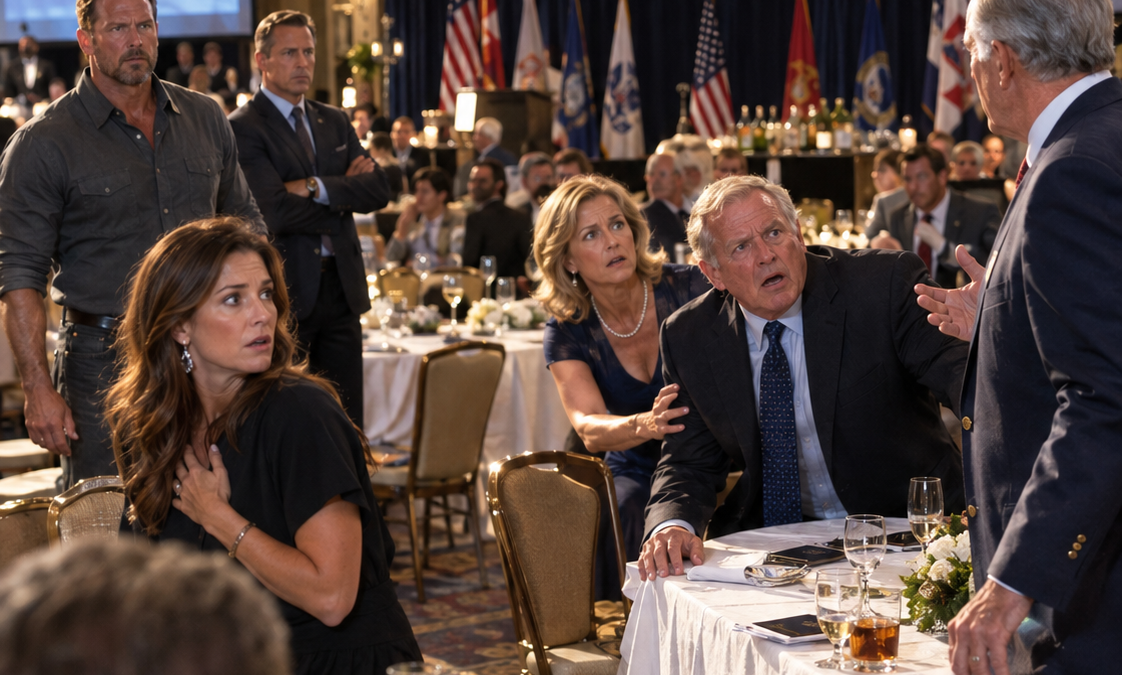
I was standing by the dessert table with a paper cup of bad coffee when it happened. The hotel ballroom was full of veterans. Old ones. Young ones. Families. Flags on the walls. A banner that read “ANNUAL VETERANS REUNION — DISTRICT 7.” White tablecloths. Folded programs. A color guard that had already presented the colors and marched off.
What my uncle didn’t know was that the man standing ten feet behind him, nursing a ginger ale by the drink station, had signed the orders that sent me into three countries I still couldn’t name out loud.
My name is Daniel Reeve. I was forty-six years old when my uncle tried to erase my life in a single sentence. I spent fourteen years as a Navy SEAL, eight of them at Team Six. I did things I don’t talk about. I lost people I still dream about. And I built a quiet life afterward that my family mistook for a small one.
That night, I was about to find out how wrong they were.
The reunion was my aunt’s idea. She’d married into the family forty years ago and never quite accepted that the Reeves weren’t a military dynasty. My uncle Carl was the closest thing we had. He did four years in the Army in the late seventies. Never deployed. Never saw a firefight. But he wore the hat. He went to the reunions. He told the stories.
He told them well.
I’ll give him that.
Carl was sixty-eight then. Broad in the shoulders, thick through the middle, with a voice that carried across any room he entered. He’d been a foreman at a paper mill for thirty years. He coached Little League. He ran the local VFW chapter for a decade. In our family, he was the veteran. The one who served. The one who sacrificed.
I never corrected him. That wasn’t my way.
I came home from my last deployment in 2019. I was thirty-nine. My knees were shot. My back had a disc that clicked when I turned too fast. I had a TBI from a training accident that gave me headaches when the weather changed. I didn’t talk about any of it.
I took a job as a security consultant for a logistics firm in Norfolk. It paid well. It was quiet. I worked from an office with a window that looked out at a parking lot. I drove a twelve-year-old pickup. I went to my niece’s soccer games. I helped my sister move twice. I was the guy who showed up with a toolbox and left without saying much.
That’s what they saw.
A quiet man with a boring job.
Carl saw something else. He saw a nephew who never went anywhere, never did anything, never had a story worth telling. He saw a man who didn’t drink at family gatherings, who didn’t slap backs or swap tales, who didn’t fit the mold of what a veteran was supposed to be.
He decided that meant I hadn’t really served.
The reunion was in Virginia Beach. My aunt booked a block of rooms at a hotel near the oceanfront. Fifty-two members of our extended family showed up. Some I hadn’t seen in years. Some I hadn’t seen since I was a kid.
I almost didn’t go.
My sister Sarah called me three weeks before. “You should come,” she said. “Mom would have wanted you there.”
Our mother died in 2017. She was the one who kept the family together. After she passed, the reunions got smaller. This was the first one in four years. Aunt Linda wanted to make it count.
I said yes because my mother would have wanted it. Not because I expected anything good to come from it.
The first night was a mixer in the hotel lobby. People hugged. People caught up. I stood near the fireplace and answered the same questions I always answered.
What are you doing now? Security consulting.
Where do you live? Virginia Beach.
Any kids? No.
Wife? No.
The conversation would die. People would drift. I didn’t mind. I’d spent enough years in rooms where silence was survival. Small talk never bothered me.
Carl found me around nine o’clock. He had a beer in his hand and a grin that didn’t reach his eyes.
“Daniel,” he said. “Still hiding out in that office?”
I smiled. “Something like that.”
“You know, I was talking to your cousin Michael. He’s a contractor now. Makes good money. Travels all over.”
“Good for him.”
“You ever think about doing something more? You’re still young. Forty-six. You could do something real.”
I took a sip of my water. “I’m fine, Carl.”
He clapped me on the shoulder. Hard. “Sure you are.”
He walked away. I watched him go. The room was warm. The fire crackled. Someone laughed near the bar.
I stayed for another hour. Then I went upstairs and called my old teammate, Marcus Webb.
“You still coming tomorrow?” I asked.
“Yeah. Got my ticket.”
“You don’t have to.”
“I know.”
The reunion was supposed to be a family thing. But Marcus had been with me through two deployments. He’d held my arm while a medic stitched a gash on my forehead. He’d carried a piece of me home that I couldn’t carry myself. He wasn’t blood. He was closer.
I’d asked him to come because I knew Carl would be there. And I knew what Carl would do.
Marcus just said, “I’ll be there.”
The second night was the dinner. That’s where it happened.
Two hundred people in the ballroom. Veterans from every branch. Families. Speakers at the podium. A slideshow of old photos on the big screens.
I sat at a table near the back with Sarah and her husband. Marcus was supposed to meet me there. He was running late.
Carl was at the head table. He’d been asked to give a speech. Of course he had. He’d been planning it for weeks.
He stood up after the main course. The room quieted.
“Thank you all for coming,” he said. “I look around this room and I see service. I see sacrifice. I see men and women who gave something to this country.”
He paused. The room applauded.
“I served in the Army. 1976 to 1980. I never saw combat. I’ll be honest about that. But I served. And I’m proud of that.”
More applause.
“Now, some of us served in different ways. Some of us did the hard jobs. The dangerous jobs. And some of us…” He laughed. “Some of us found a nice safe desk and let the real warriors do the fighting.”
A few people laughed. I didn’t.
“Take my nephew Daniel over there.”
He pointed. Every head in the room turned.
I felt the weight of two hundred eyes. My neck tightened. I didn’t move.
“Daniel’s a good kid. But don’t let him tell you war stories. This one sat behind a computer his whole career. Safe and sound. Never heard a shot fired in anger.”
The room laughed again. Louder this time.
Sarah put her hand on my arm. I stayed still.
What Carl didn’t know was that the man at the drink station had gone very quiet. He had put down his glass. He was looking at Carl with an expression that would have made a smarter man stop talking.
Admiral James Vance had been my commanding officer for three years. He’d signed my promotion to Senior Chief. He’d signed the orders that sent me on missions Carl couldn’t imagine. He’d stood at attention while I received a Silver Star in a ceremony that was never reported in any newspaper.
He was seventy years old then. Tall. Gray. Unassuming in a navy blazer and a plain tie. Nobody in that room knew who he was except me.
And he was walking toward the head table.
I didn’t know he was there.
I hadn’t seen him when I walked in. I hadn’t seen him during dinner. I hadn’t seen him while Carl was talking.
But I saw him now.
He moved through the crowd slowly. People parted without knowing why. There was something about him. A stillness. A weight.
He stopped in front of the head table. He looked up at Carl.
“That’s an interesting story,” he said.
Carl blinked. “Excuse me?”
“I said it’s an interesting story. The one about your nephew.”
Carl’s smile faltered. “Just a joke. Family stuff.”
“I understand.” The admiral’s voice was calm. Flat. “I just thought you might want to know the rest of it.”
The room had gone completely silent.
Admiral Vance turned to face the crowd. He didn’t raise his voice. He didn’t need to.
“My name is James Vance. I served in the United States Navy for thirty-eight years. For the last three of those years, I was the commanding officer of a SEAL Team detachment.”
He let that land.
“Daniel Reeve served under my command. He was a Senior Chief Petty Officer. He completed eleven combat deployments. He was awarded the Silver Star, two Bronze Stars with valor, and a Purple Heart. His service record is classified. But I can tell you this.”
He looked back at Carl.
“He didn’t sit behind a desk.”
The silence stretched.
“I signed his orders. I read his after-action reports. I attended his award ceremonies. I can tell you he was in places you’ve never heard of, doing things you’ll never know about. And he never once asked for credit.”
Carl’s face had gone white. His mouth opened. Nothing came out.
Admiral Vance turned back to the room. “I’m not here to embarrass anyone. I’m here because I was in town for a conference and I saw the reunion on the hotel schedule. I thought I’d stop by and pay my respects to a man I served with.”
He looked at me.
“Senior Chief.”
I stood up. My legs felt steady. My hands were calm.
“Admiral.”
“Thank you for your service.”
The room didn’t applaud. Not at first. They were too stunned. Then someone near the front started clapping. Then someone else. Then the whole room.
It went on for a long time.
Carl sat down. He didn’t say anything. He didn’t look at me.
I nodded at him once. Then I walked out.
Sarah found me in the lobby. Her eyes were wet.
“Why didn’t you tell me?” she asked.
“You never asked.”
“I’m your sister.”
I looked at her. “You never asked.”
She hugged me. I let her.
“I’m sorry,” she said.
“You didn’t do anything.”
“I should have.”
I didn’t answer. The lobby was quiet. The ocean was somewhere beyond the windows. I could smell salt in the air.
My phone buzzed. Marcus.
“Where are you?”
“Lobby.”
“Coming.”
I sat down on a bench near the door. Sarah sat next to me. Neither of us spoke.
Three minutes later, Marcus walked in. He was in a suit. He looked like he’d run the whole way.
“You okay?” he asked.
“I’m fine.”
“You don’t look fine.”
“I’m fine.”
He sat down on the other side of me. Nobody said anything for a while.
Then Marcus said, “That was Admiral Vance, wasn’t it.”
“Yeah.”
“Did you know he was going to be here?”
“No.”
“Damn.”
“Yeah.”
We sat in the lobby for another hour. Sarah went back to the ballroom eventually. Marcus stayed.
At some point, my uncle walked past us. He didn’t look at me. He didn’t say anything. He just walked. His shoulders were lower than I’d ever seen them.
I didn’t feel anything.
That’s what surprised me.
I thought I’d feel triumphant. I thought I’d feel vindicated. Instead I just felt tired. The kind of tired that comes after a long mission. The kind where you know you did what you had to do and you’re ready to sleep.
Marcus said, “You want to get a drink?”
“No.”
“What do you want to do?”
“Go home.”
“Okay.”
I drove home that night. Ninety minutes on I-64. The radio was off. The windows were down. The air was cool.
I got to my apartment around midnight. I walked in. I locked the door. I stood in the dark for a long time.
Then I went to bed.
The next morning, my phone was full of messages.
Cousins. Aunts. People I hadn’t spoken to in years.
All of them asking the same thing.
“Why didn’t you tell us?”
I didn’t answer any of them.
Sarah called around nine. She wanted to know if I was okay. I told her I was.
“Carl left early,” she said. “He didn’t say goodbye to anyone.”
“Okay.”
“He’s been telling everyone he didn’t know. He said he thought you were just a computer guy.”
“He never asked.”
“I know.”
We talked for a few more minutes. Then I hung up.
I made coffee. I sat on my balcony. I watched the street.
It was over. But it wasn’t.
I knew that. I’d been through enough debriefs to know that the moment the truth comes out isn’t the end. It’s just the beginning.
Carl would have to live with what he’d done. The family would have to live with what they’d learned. And I would have to live with the fact that the quiet life I’d built wasn’t as invisible as I thought.
The sun was warm on my face. The coffee was good. For the first time in a long time, I felt like I could breathe.
But I knew it wasn’t finished.
Not yet.
PART 2 — THE MORNING AFTER
The messages kept coming.
I put the phone face-down on the kitchen counter and let it buzz. It buzzed for an hour. Then it stopped. Then it started again.
I made a second pot of coffee. I stood at the window. The parking lot was empty except for my truck and a blue sedan that belonged to the guy in 3B. He left for work at seven every morning. It was ten-thirty. He was already gone.
I thought about my mother.
She died in a hospital in Richmond. Lung cancer. She was seventy-one. I was on the other side of the world when she got the diagnosis. I couldn’t get back for three weeks. By the time I did, she was already in hospice.
She knew what I did. Not the details. Never the details. But she knew enough.
She never told anyone.
I sat with her for six days. I held her hand. I read to her from a book she liked — something about birds. She drifted in and out. On the fourth day, she opened her eyes and looked at me.
“You never told them,” she said.
“No.”
“Why?”
I didn’t have an answer. Not one I could put into words.
She squeezed my hand. “You’re a good man, Daniel. Better than they know.”
She died two days later. I was in the room. I was alone with her. I called Sarah first. Then I called Carl.
He said, “I’m sorry for your loss.”
That was it. That was all he said.
At the funeral, he gave a speech. He talked about her kindness. Her patience. Her love of family. He didn’t mention me.
I didn’t expect him to.
Sarah came over that afternoon.
She brought sandwiches from a deli near her office. Turkey and Swiss on rye. She knew I didn’t cook when I was in my head.
We sat on the balcony. The ocean was five miles away. You couldn’t see it, but you could smell it when the wind was right.
“How are you really?” she asked.
“I’m fine.”
“You keep saying that.”
“Because it’s true.”
She looked at me. “You know, I spent my whole life thinking you were just… quiet. That you didn’t have much going on. That you were just existing.”
“I was.”
“That’s not what I mean.”
I took a bite of my sandwich. It was good. Sarah always picked good places.
“I didn’t hide it,” I said. “I just didn’t talk about it.”
“Why not?”
“Because it’s not something you talk about.”
She was quiet for a minute. Then she said, “Carl called me last night.”
“What did he say?”
“He said he didn’t know. He said he thought you were a computer guy. He said he was just joking.”
“Okay.”
“He wants you to call him.”
“I’m not going to.”
“I know.”
She stayed for another hour. We talked about her kids. Her job. The usual things. She didn’t bring up the reunion again.
When she left, I cleaned the kitchen. I did the dishes. I wiped down the counters. I took out the trash. Small tasks. Things I could control.
Then I sat on the couch and stared at the wall.
The first phone call I actually answered was from Marcus.
“Hey,” he said.
“Hey.”
“You okay?”
“I’m fine.”
“You keep saying that.”
I almost laughed. “Sarah said the same thing.”
“Sarah’s smart.”
“Yeah.”
He paused. “Listen. I talked to some of the guys. They heard about what happened.”
“How?”
“Vance. He mentioned it to a couple of people. Word travels.”
“Great.”
“It’s not bad. People are just… they want to know if you’re okay.”
I rubbed my eyes. “I’m okay.”
“You want to come out? Get some dinner? A few of us are meeting at that place in Norfolk. The one with the wings.”
“Not tonight.”
“Tomorrow?”
I thought about it. “Yeah. Tomorrow.”
“Good.”
We hung up. I looked at the phone. The messages were still there. I scrolled through them.
Aunt Linda: “Daniel, I’m so sorry. I had no idea.”
Cousin Michael: “Dude, why didn’t you say anything? That’s insane.”
Uncle Carl: “Call me.”
I deleted Carl’s message. I didn’t delete the others. I didn’t answer them either.
I didn’t sleep well that night.
I never sleep well after a mission. Even the small ones. The ones that don’t matter. My body doesn’t know the difference between a real threat and a memory. It just knows the adrenaline is gone and the world is too quiet.
I got up at three. I made tea. I sat in the dark and listened to the refrigerator hum.
I thought about the day I got the Silver Star.
It was a private ceremony. Small room on a base I can’t name. Six people in the room. Admiral Vance was there. My team was there. A photographer took one picture. I never saw it.
The citation was two paragraphs long. It described a night in a country I can’t name. A compound. A hostage. A firefight that lasted forty minutes. I did what I was trained to do.
I didn’t feel like a hero. I felt like a man who did his job.
That’s what I tried to explain to my mother once. She didn’t understand. She wanted to. But she couldn’t.
“It’s not about being brave,” I told her. “It’s about being prepared. You train. You react. You do the thing you were trained to do.”
She nodded. She didn’t get it. But she tried.
That was enough.
The next day, I went to work.
My office was small. A desk. A computer. Two chairs. A filing cabinet. The window looked out at the parking lot. Same blue sedan. Same spot. The guy in 3B was predictable.
I answered emails. I reviewed a security assessment. I ate a sandwich at my desk. Normal things. Things I could control.
At two o’clock, my boss knocked on the door. Richard was sixty-two. Bald. Glasses. A former Marine who never deployed. He was a good guy. Quiet. He didn’t ask about my past.
“Got a minute?” he asked.
“Sure.”
He sat down in the chair across from my desk. He folded his hands.
“Heard about the reunion,” he said.
“Word travels.”
“It does.”
I waited.
“I’m not going to ask questions,” he said. “I just want you to know that if you need anything — time off, whatever — you can take it.”
“I’m fine.”
“I know you are.”
He stood up. He walked to the door. Then he stopped.
“For what it’s worth,” he said, “I always knew you were more than a desk guy.”
He left.
I sat there for a minute. Then I went back to my emails.
That night, I met Marcus and three other guys at the wing place.
It was loud. TVs on every wall. Sports. News. The kind of place where nobody asked questions.
Marcus was there. So was Pete. So was Dave. So was a guy I’d never met — a young former Ranger named Kevin who worked with Marcus at a security firm.
They didn’t bring up the reunion. Not at first. We talked about football. About the wings. About the new guy Kevin was dating. Normal things.
Then Pete said, “So. Your uncle.”
I put down my beer. “What about him?”
“Heard he called you a desk jockey.”
“He did.”
“Damn.”
“Yeah.”
Marcus said, “We don’t have to talk about it.”
“It’s fine.”
Pete shook his head. “I don’t get it. Why would he say that? Why would anyone say that?”
“He didn’t know.”
“How could he not know?”
I shrugged. “He never asked.”
Kevin, the young Ranger, said, “My family’s the same way. They think I was a cook in the Army.”
We all laughed. It was the first time I’d laughed in days.
“You were a cook?” Dave asked.
“No. I was a Ranger. But that’s what they tell people.”
“Same,” Pete said. “My mom thinks I was a mechanic.”
“You were a mechanic,” Marcus said.
“I was a SEAL who could fix a truck.”
We laughed again.
For the next two hours, we didn’t talk about the reunion. We talked about everything else. Old missions. New jobs. The guys we’d lost. The lives we’d built.
It was good. It was normal. It was what I needed.
When I got home, I felt better. Not fixed. But better.
The next week, Carl showed up at my apartment.
I was coming back from a run. Five miles. Slow. My knees hurt but I didn’t care. I rounded the corner and saw his truck in the parking lot. He was standing by my door.
He looked older than he had at the reunion. Smaller. His shoulders were slumped. He wasn’t wearing his hat.
“Daniel,” he said.
“Carl.”
“I need to talk to you.”
I walked past him. I unlocked the door. I went inside. He followed.
The apartment was small. Two bedrooms. One bath. A kitchen with a table that only had two chairs. He stood in the living room and looked around.
“You live here?” he asked.
“Yeah.”
“It’s… nice.”
“It’s fine.”
I went to the kitchen. I poured myself a glass of water. I didn’t offer him one.
“What do you want, Carl?”
He sat down on the couch. He looked at his hands. He didn’t say anything for a long time.
“I didn’t know,” he finally said.
“You keep saying that.”
“Because it’s true.”
I leaned against the counter. “You never asked.”
“I know.”
“You never asked me anything. Not once. Not in twenty years.”
He looked up. His eyes were red. “I was jealous.”
That stopped me.
“What?”
“I was jealous. You were everything I wanted to be. You were the real thing. And I was just… I was just a guy who wore the hat.”
I didn’t say anything.
“I did four years. Stateside. Never deployed. Never saw anything. And I spent the rest of my life pretending I did. Telling stories. Wearing the uniform to parades. Acting like I was a warrior.”
He wiped his eyes.
“Then you came along. You actually did it. You actually served. And you never talked about it. You never bragged. You never made me feel small. And I hated you for it.”
I set my glass down. “You hated me?”
“I hated that you were better than me. I hated that you didn’t need to prove it. I hated that everyone respected you without you saying a word.”
He stood up. He walked toward the door. Then he stopped.
“I’m sorry, Daniel. I know that doesn’t fix anything. But I’m sorry.”
He opened the door. He walked out.
I stood in the kitchen for a long time. The water in my glass was warm. The apartment was quiet.
I didn’t feel angry. I didn’t feel sad. I just felt tired.
The next morning, I got a call from Admiral Vance.
“Senior Chief,” he said.
“Admiral.”
“I hope I didn’t overstep the other night.”
“You didn’t.”
“Good. I wasn’t planning to say anything. But when I heard him… I couldn’t let it stand.”
“I appreciate it.”
He paused. “How are you doing?”
“I’m fine.”
“You keep saying that.”
I laughed. “You sound like my sister.”
“She sounds like a smart woman.”
“She is.”
He paused again. “I’m in town for a few more days. If you want to get lunch, I’d be honored.”
“I’d like that.”
We made plans for Thursday. I hung up. I looked at the phone.
Something had shifted. I didn’t know what it was yet. But something had shifted.
PART 3 — THE ADMIRAL’S TABLE
Thursday came faster than I expected.
I drove to a restaurant near the oceanfront. Small place. White tablecloths. A view of the water. The kind of place where the waiters knew the regulars by name.
Admiral Vance was already there when I walked in. He was sitting at a table by the window. He stood when he saw me.
“Senior Chief.”
“Admiral.”
We shook hands. His grip was still strong. His eyes were still sharp.
“Sit down,” he said. “I already ordered coffee.”
I sat. The waiter brought a menu. I didn’t open it.
“How have you been?” he asked.
“Good. Working. The usual.”
“Still at the logistics firm?”
“Yes.”
“Good. They treat you well?”
“They treat me fine.”
He nodded. He took a sip of his coffee.
“I read your file last week,” he said. “First time in years. I wanted to make sure I had the details right.”
“You didn’t have to do that.”
“I know.”
The waiter came back. We ordered. I got the fish. He got the steak.
“I’ve been thinking about what happened at that reunion,” he said.
“So have I.”
“Your uncle. He’s not a bad man. He’s just a small one.”
I didn’t say anything.
“I’ve met a lot of men like him. They serve their four years. They never deploy. They spend the rest of their lives trying to prove they were something they weren’t. It eats at them.”
“He admitted it. He came to my apartment.”
Vance raised an eyebrow. “Did he?”
“Yes.”
“What did he say?”
“He said he was jealous. He said he hated that I was better than him.”
The admiral nodded slowly. “That’s more self-awareness than most of them have.”
“Maybe.”
“He’s still your uncle.”
I looked out the window. A container ship was moving across the horizon. Slow. Steady. The kind of thing that made you feel small.
“He’s been my uncle my whole life,” I said. “But he’s never been family.”
Vance didn’t argue.
We ate. The fish was good. The coffee was better.
“Can I ask you something?” I said.
“Of course.”
“Why did you come to the reunion? You said you were in town for a conference. But that’s not the whole story.”
He set down his fork. He looked at me the way he used to look at me in briefings. Calm. Measuring.
“No,” he said. “It’s not.”
“Then why?”
He was quiet for a moment.
“I heard about it through a mutual friend. Someone in the community. They mentioned that a SEAL was going to be at a family reunion in Virginia Beach. That his uncle was a VFW guy. That there might be trouble.”
“Trouble?”
“Not the kind you’re thinking. Social trouble. The kind where a man gets his service dismissed by people who don’t know any better.”
I leaned back in my chair. “You came to protect me.”
“I came to make sure the record was accurate.”
“That’s a fancy way of saying it.”
He smiled. It was the first time I’d seen him smile in years.
“I’ve watched you for a long time, Daniel. I’ve watched you come home and disappear. I’ve watched you take a job that doesn’t use half your skills. I’ve watched you go quiet.”
“I’m not quiet.”
“You’re the quietest man I know.”
I didn’t argue.
“I didn’t come to the reunion to embarrass your uncle. I came because I know what it costs to serve in silence. And I know what it costs when people decide your silence means you have nothing to say.”
I looked at the table. The white cloth. The silverware. The glass of water.
“Thank you,” I said.
“You don’t have to thank me.”
“I do.”
He nodded. He picked up his fork. We finished our meal.
After lunch, we walked along the boardwalk.
The sun was out. The ocean was calm. A few people were jogging. A few were fishing. A few were just sitting on benches, watching the water.
“I want to ask you something else,” Vance said.
“Okay.”
“Have you thought about what you’re going to do next?”
“What do you mean?”
“With your life. Your career. You’re forty-six. You’ve got twenty years ahead of you. Maybe more. Are you going to spend them in an office?”
I watched a seagull land on the railing. It looked at us. It looked at the water. It flew away.
“I don’t know,” I said.
“You could do more.”
“I’m not sure I want to.”
He stopped walking. He turned to face me.
“When you were on my team, you were the best operator I ever had. You had instincts I couldn’t teach. You had calm I couldn’t train. You had a way of seeing things before they happened.”
“I was lucky.”
“No. You were good.”
I looked at the water.
“There’s a program,” he said. “At a federal agency. They’re looking for people with your background. Not for combat. For training. For planning. For leadership.”
“What agency?”
He told me. It was one I knew well. One I’d worked with before.
“They need someone who understands the operators. Someone who’s been there. Someone who can teach the next generation without breaking them.”
“I’m not a teacher.”
“You’ve been teaching your whole career. You just didn’t call it that.”
I thought about it. The office. The parking lot. The blue sedan. The emails.
“I’ll think about it.”
“That’s all I ask.”
We walked a little further. Then he checked his watch.
“I need to get back. My wife’s expecting me.”
“Of course.”
He shook my hand. Then he held it for a moment longer.
“You’re not invisible, Daniel. You never were. You just didn’t look in the right places.”
He walked away. I stood on the boardwalk for a long time.
That night, Sarah called.
“Mom’s birthday is next week,” she said.
“I know.”
“We’re doing a dinner. At my place. Just the immediate family.”
“Carl?”
“He’s not invited.”
I was quiet.
“I talked to everyone,” she said. “Aunt Linda, Michael, the cousins. Everyone agrees. He crossed a line.”
“He’s still family.”
“He’s your uncle. But he’s not welcome in my house.”
I didn’t know what to say. Sarah had always been the peacemaker. The one who smoothed things over. This wasn’t like her.
“You don’t have to do that,” I said.
“I know I don’t have to. I want to.”
“Why?”
She paused. “Because I watched him humiliate you in front of two hundred people. And I watched you not fight back. And I realized I’ve been watching you not fight back your whole life.”
“That’s not true.”
“It is true. You never defend yourself. You never explain. You just take it and move on.”
“It’s not worth the energy.”
“That’s what you say. But I think it’s just what you tell yourself.”
I didn’t answer.
“Come to dinner,” she said. “Please.”
“I’ll be there.”
“Good.”
We hung up. I sat on the couch. The apartment was quiet. The refrigerator hummed.
I thought about what she said. About not fighting back. About taking it and moving on.
She was right.
I’d spent my whole life not fighting back. Not because I was weak. Because I’d learned early that the fight wasn’t worth it. That the people who mattered would see you eventually. That the truth would come out.
But sometimes it didn’t. Sometimes you had to push.
I didn’t know if I was ready to push. But I was starting to think about it.
The next morning, I got an email from an unknown address.
Subject: Reunion
I opened it.
It was from a woman named Patricia Holloway. I didn’t recognize the name at first. Then I read the message.
“Dear Mr. Reeve,
I was at the reunion last week. I’m a friend of your aunt Linda. I was sitting at the table near the back. I saw what your uncle did. I saw what Admiral Vance said. I wanted you to know that I was married to a SEAL for thirty-two years. He passed away in 2016. He never talked about his service either. I understood.
I also wanted you to know that there were other people in that room who knew who you were. Not many. But some. We were all watching. We were all proud.
You don’t have to respond to this. I just wanted you to know.
Sincerely,
Patricia Holloway”
I read it twice. Then I closed my laptop.
I didn’t know what to do with that. Kindness from strangers was harder to accept than cruelty from family. Cruelty I understood. Kindness I didn’t.
I made coffee. I went to work. I did my job.
But something was different. Something had cracked open.
I just didn’t know what was going to come out.
Two days later, I got another call.
This one was from a number I didn’t recognize. I almost didn’t answer. But something made me pick up.
“Daniel Reeve?”
“Yes.”
“This is Captain Michael Torres. I’m with the Navy Personnel Command. I’m calling about your uncle, Carl Reeve.”
My stomach tightened.
“What about him?”
“He listed you as his emergency contact. He was in an accident this morning. He’s at Sentara Norfolk General. He’s asking for you.”
I stood in my kitchen. The coffee was cold. The sun was coming through the window.
“What kind of accident?”
“A car accident. He’s stable. But he’s asking for you.”
I didn’t say anything for a moment.
“Mr. Reeve?”
“I’m here.”
“Will you come?”
I looked at the clock. Ten-fifteen. I had nowhere to be.
“I’ll be there.”
PART 4 — HOSPITAL CORRIDORS
The drive to Norfolk General took forty minutes.
I didn’t speed. I didn’t rush. I drove the speed limit like I always did. Old habits. The kind that kept you alive.
The hospital was busy. Fluorescent lights. Linoleum floors. The smell of antiseptic and bad coffee. I asked at the desk. A tired woman with reading glasses pointed me to the third floor.
Carl was in a room at the end of the hall. The door was open. I stood in the doorway for a moment before I went in.
He was awake. His left arm was in a cast. His face was bruised. His right leg was elevated. He looked smaller than he had in my apartment.
“Daniel,” he said.
I didn’t move.
“You came.”
“You asked.”
He nodded. He looked at the ceiling. The room was quiet except for the beeping of the monitors.
“They said you’re my emergency contact,” I said.
“You’re the only one I could think of.”
“What about Linda?”
He didn’t answer. His jaw tightened.
“She left me,” he said.
“When?”
“Two weeks ago. After the reunion. She said she couldn’t look at me anymore. She said she’d been married to a stranger for forty years.”
I sat down in the chair by the bed. It was plastic. Uncomfortable.
“I’m sorry,” I said.
“Are you?”
The question hung in the air.
“I don’t know,” I said. “Maybe not.”
He nodded again. His eyes were wet. He didn’t try to hide it.
“I was a coward,” he said. “My whole life. I was a coward.”
I didn’t say anything.
“I joined the Army because my father did. I did four years because that’s what you did. I never deployed because I was scared. I never asked to. I never volunteered.”
He looked at me.
“You volunteered. Didn’t you?”
“Every time.”
“I know. I know that now.”
He closed his eyes. A nurse came in. She checked his vitals. She left without saying a word.
“Sarah’s not inviting me to the birthday dinner,” he said.
“No.”
“I don’t blame her.”
We sat in silence for a while. Then he said, “Did you ever kill anyone?”
The question was blunt. Unthinking. The kind of question people asked when they didn’t know better.
I looked at him.
“That’s not something I talk about.”
“I know. I’m sorry. I shouldn’t have—”
“It’s fine.”
“I just… I want to understand. I want to know what it was really like.”
I leaned back in the chair. The plastic creaked.
“It was hot,” I said. “It was loud. It was confusing. And it never leaves you.”
He waited.
“I did what I was trained to do. I did what I had to do. I don’t think about it as good or bad. I think about it as necessary.”
“And the people you lost?”
“They’re still with me.”
He looked away. His hand shook on the blanket.
“I’m sorry,” he said again.
“I know.”
I stayed for an hour. Then I left.
The hallway was long and white. I walked slowly. My boots were loud on the floor.
At the elevator, I ran into a man in a Navy uniform. He was older. Gray hair. A captain’s insignia on his collar.
“Mr. Reeve?”
“Yes.”
“I’m Captain Torres. I called you.”
We shook hands.
“Your uncle is going to be fine,” he said. “The injuries are minor. He should be discharged in a couple of days.”
“Good.”
“He’s been talking about you. To the nurses. To me.”
“What’s he saying?”
“He’s telling everyone what you did. He’s telling everyone he was wrong.”
I didn’t know what to do with that.
“He’s a changed man,” Torres said.
“Maybe.”
“Does that matter to you?”
I thought about it.
“It’s not about whether he’s changed,” I said. “It’s about whether he ever knew me at all.”
Torres nodded. “I understand.”
He didn’t. But I appreciated the effort.
That night, I went to Sarah’s house.
It was a small place in Chesapeake. Three bedrooms. A fenced yard. A dog that barked at everything.
Her kids were already in bed. Her husband, Tom, was in the kitchen. She met me at the door.
“You look tired,” she said.
“I am.”
We sat in the living room. She brought me a beer. I didn’t drink it.
“Carl called me,” she said.
“He’s in the hospital.”
“I know. He told me.”
“He wants you to forgive him.”
“I know.”
“Are you going to?”
I looked at the bottle in my hand.
“I don’t know.”
She sat back in her chair. The dog put its head on her lap.
“He’s not a bad man, Daniel.”
“I know.”
“He’s just small.”
“Admiral Vance said the same thing.”
“He’s right.”
I set the beer down. “I spent my whole life not caring what he thought. Now everyone wants me to care. They want me to forgive him. To make it better. To say it’s okay.”
She didn’t say anything.
“It’s not okay.”
“I know.”
“He humiliated me in front of two hundred people.”
“I know.”
“And now I’m supposed to feel sorry for him because he broke his arm and his wife left him?”
“You’re not supposed to feel anything. You’re allowed to feel whatever you feel.”
I stood up. I walked to the window. The yard was dark. The dog was still watching me.
“I don’t know what I feel.”
“That’s okay.”
I turned around. She was looking at me the way she used to when we were kids. The way she looked at me when I came home from school with a black eye and wouldn’t tell her what happened.
“You always did that,” she said.
“Did what?”
“Hide the hurt. Pretend it didn’t matter.”
“It didn’t.”
“It did. You just didn’t let anyone see.”
I sat back down. I picked up the beer. I took a drink.
“You’re a good sister,” I said.
“I know.”
We both laughed. The first real laugh I’d had in days.
The birthday dinner was on Sunday.
It was my mother’s birthday. She would have been seventy-six.
Sarah cooked. My cousins came. Aunt Linda came. She wasn’t Carl’s wife anymore, not officially, but she was still family. She hugged me for a long time when she walked in.
“I’m sorry,” she said.
“You didn’t do anything.”
“I should have known. I should have asked.”
“Everyone keeps saying that.”
“I mean it.”
I looked at her. She was sixty-five. Tired. Sad. She’d been with Carl for forty years. She’d walked away. That took something.
“I know you do,” I said.
We sat down to eat. There were twelve of us. Sarah’s family. My cousins. My aunt. A few others.
They asked me questions. Real ones this time.
Where did you serve? How long? What was it like?
I didn’t give them details. I couldn’t. But I gave them more than I’d ever given before.
“I was in the Navy,” I said. “I was a SEAL. I did things I can’t talk about. I served with men I’ll never forget. And I came home.”
That was enough.
They didn’t push. They didn’t ask for stories. They just nodded. They passed the potatoes. They talked about other things.
It was normal. It was good.
After dinner, I helped Sarah with the dishes.
“You handled that well,” she said.
“I just told the truth.”
“That’s all anyone wanted.”
“Is it?”
She handed me a plate. I dried it. I put it away.
“They didn’t want the details,” she said. “They just wanted to know you trusted them enough to share something.”
I thought about that.
“I never thought about it that way.”
“I know.”
She handed me another plate.
“Mom would have been proud,” she said.
“I hope so.”
“She would have.”
I put the plate away. The kitchen was warm. The house was full of voices.
For the first time in a long time, I felt like I was home.
The next week, I called Admiral Vance.
“I’ve been thinking about what you said,” I said.
“About the program?”
“Yeah.”
“And?”
“I want to know more.”
He was quiet for a moment.
“I’ll make some calls,” he said. “You’re not going to have trouble getting in.”
“I’m not looking for special treatment.”
“I know. But you’re going to get it anyway. People remember.”
“People remember what?”
“The things you did. The things you didn’t say. The way you carried yourself.”
I didn’t know what to say to that.
“Thank you,” I said.
“Don’t thank me. Just do the job.”
“I will.”
We hung up. I stood in my kitchen. The sun was setting. The apartment was quiet.
Something was changing. I could feel it.
For years, I’d lived in the shadow of my own silence. I’d let people assume I was small. I’d let them think I was invisible.
That was over.
I didn’t know what came next. But I was ready to find out.
 [Tap here for the Next Part ]