“I did something,” I said
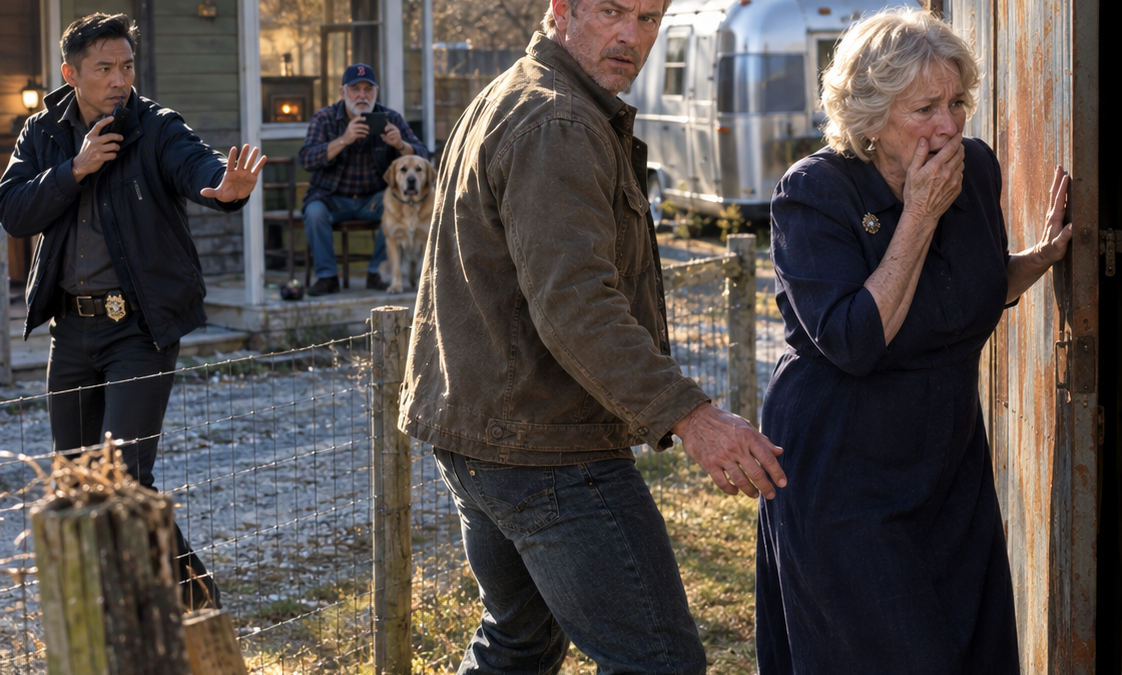
“Dustin Pike pulled a knife on me over a fence post. He was thirty-four years old and he had been drinking since noon. I could smell it from eight feet away.”
They thought the quiet old welder would pack his truck and leave town by Sunday — instead, his daughter watched him stand at a Fort Campbell podium while his brother and sister-in-law sat in the third row and finally saw who he was.
He was thirty-four years old and he had been drinking since noon. I could smell it from eight feet away. Corn whiskey and cigarettes and the particular sour sweat of a man who has already decided he is going to win.
“It’s a fence,” he said. “You’re gonna fix it, or I’m gonna fix you.”
The blade was a cheap gas-station folder with a four-inch serrated edge. He held it low and pointed it at my belt buckle, the way he’d seen it done in movies.
What he didn’t know was that better men than Dustin Pike had pointed better knives at me in worse places, and not one of them had gotten to keep it.
My name is Calvin Draeger. I was fifty-eight years old that afternoon. For twenty-four years I served in the United States Army, most of it in Special Forces — the Green Berets — as an 18B weapons sergeant, then as a team sergeant on an Operational Detachment-Alpha, Fifth Special Forces Group. Six deployments. A drawer at home with a Silver Star in it that I have never once shown to a neighbor.
That’s the short version. The long version has a lot of names in it, and most of those names I don’t say out loud.
Dustin took a step toward me.
“Old man,” he said. “I’m talking to you.”
I kept my hands where he could see them. That’s a habit. It’s also a courtesy. It tells the other man you’re not going to do anything he hasn’t agreed to yet.
“I hear you,” I said.
“You hear me? You hear me?” He waved the knife in a small circle. “Then why’d you break my fence?”
I didn’t break his fence.
The fence in question was eighty feet of four-by-four cedar with wire mesh running along the property line between the cottage I rented and the Pike family’s back lot. It was put up in 1987. I know the year because I looked it up at the county assessor’s office, which is a thing I do, because I’ve learned over the years that people lie more often than paperwork does.
Nine days before Dustin pulled the knife, a post at the corner had rotted through at the ground line and leaned over into my tomato beds. I called Mrs. Pike. I called her twice more that week. I wrote it down on the calendar in my shop. Then I propped the post with a scrap of pressure-treated two-by-four so it wouldn’t fall on the water line, and I left it alone.
Dustin’s dog got out through the gap. That was the whole crime.
He didn’t want to hear that.
“That fence cost me money,” he said.
“It cost your mother money,” I said. “In 1987. She told me.”
His face changed. Not much. Just a tightening around the eyes. I’ve seen that look on men in three countries. It means the conversation has stopped being about the fence.
“You calling my mother a liar?”
“I’m telling you what she told me.”
He came another step. We were six feet apart now. The knife was still low, still pointed at my middle. His knuckles were white on the handle, which is a tell. A man who knows how to use a knife doesn’t grip it like a hammer.
I have three rules I made for myself when I took the uniform off for the last time.
Rule one: never raise my voice. Nothing good has ever come from a loud man.
Rule two: never touch anybody first.
Rule three: if I have to move, move once, and be done.
I was still on rule one.
“Dustin,” I said. “Put the knife in your pocket and go inside. We’ll talk about the fence tomorrow when you’re sober.”
“Don’t tell me what to do on my own property.”
“It’s not your property. It’s your mother’s.”
That was the wrong thing to say. I knew it before the words were all the way out of my mouth. Some men have one soft spot, and you only find it by accident, and once you find it you should walk the other way.
Dustin Pike’s soft spot was that he had never owned anything.
He came at me.
I want to be clear about the next part, because there were four people watching and three of them told it wrong later.
He came at me with the knife low and inside. He was aiming for my stomach. He wasn’t trying to scare me anymore. His eyes had gone flat and his mouth had gone slack and he’d stopped blinking.
I turned my left hip back and let the blade pass. I caught his wrist with my left hand — thumb on the back of his hand, fingers wrapped under, which is the way you hold a wrist if you want the hand to open. My right hand came up and pressed flat against the back of his elbow and I turned him.
It wasn’t a strike. That’s the important part. I didn’t hit him. I didn’t throw him. I turned him, the way you’d turn a door handle.
His arm went where arms go when you turn them that way. His shoulder rotated. His grip failed. The knife dropped out of his hand and hit the grass, point down, and stuck there.
I stepped back and put my hands down at my sides.
That’s it. That’s the whole thing.
From the moment he lunged to the moment the knife was in the dirt was about three seconds. Maybe less.
Dustin stood there with his arm still half-turned in the air, looking at the knife, looking at his hand, looking at me. He had no idea what had just happened. None. You could see it on his face like a man who’d walked into a glass door.
“What the—” he said.
“Go inside,” I said.
“Did you—” He looked at his own hand again. He flexed his fingers. “Did you hit me?”
“No.”
“You did something.”
“I did something,” I said.
He backed up two steps. Not because he’d decided to. His body decided for him. His feet moved before his brain caught up, which is the oldest instinct there is.
I picked up the knife. I folded it. I held it out to him, handle first.
“Take it,” I said. “And don’t take it out of your pocket again.”
He didn’t take it. He just stood there.
A screen door banged across the street. Marisol Vega from 114 had come out onto her porch with her phone in her hand. Her son Diego, who was eleven and who I’d been teaching to weld on Saturdays, was behind her with his mouth open.
Dustin saw them. That mattered to him. He cared about being seen.
“You’re done,” he said to me. “You hear me? You’re done in this town.”
He turned and walked back toward his mother’s house, and he didn’t look back, and he left the knife in my hand.
I put the knife on the porch rail and sat down in my chair and breathed for a minute.
Not because I was scared. I want to be honest about that part too. I wasn’t scared. I was angry, and I was tired, and there was a small cold thing in the middle of my chest that I recognized.
That thing is the reason I did twenty-four years.
It’s the thing that shows up when someone decides you’re nothing, and you know that if they knew who you were they’d never have said it, and you also know you can never tell them.
I sat on that porch for a while.
The cottage I rented from Ruthanne Pike was eight hundred square feet with a tin roof and a wood stove that didn’t draw right and a kitchen window that looked out on her peonies. Six hundred dollars a month, cash, handshake, no lease. She’d offered it to me four years ago when I moved back to Harlow Bend and she’d said, “You look like a man who’ll pay on time,” and I’d said, “Yes, ma’am,” and that had been the whole arrangement.
I’d fixed the gutters. I’d rebuilt the steps. I’d re-hung the porch light and replaced the water heater at my own cost and never said a word about it, because that’s what you do when you live somewhere.
I didn’t know anybody in Harlow Bend when I came here. That was the point.
I’d grown up two hours east of here, in a town called Ash Grove, and I’d left when I was eighteen, and I’d come back to Virginia four years ago because there was nowhere else I wanted to be and no one I particularly wanted to see.
My brother Nolan still lived on the family place in Ash Grove. He had the house, the forty acres, the barn, the equipment. When our mother died, the will left everything to be divided, and Nolan and his wife Patricia had handled the estate, and somehow by the time the dust settled the only thing I got was a phone call telling me not to bother coming to the funeral.
That’s a whole other story. This isn’t that one.
What matters is that Nolan and Patricia and the whole rest of the family had spent thirty years telling each other that Calvin was the one who went off and wasted his life playing soldier, and that if he’d stayed home and worked like a man, he might have something to show for it.
My daughter Erin lives in Denver. She’s thirty-one. She calls me every other Sunday. She believes most of what her aunt Patricia told her growing up. I’ve never once corrected her, because correcting her would mean explaining, and explaining is a thing I’ve never been good at and never wanted to do.
So I came to Harlow Bend to be nobody.
I run a small fabrication shop on Route 11. Draeger Welding & Fabrication. Fourteen customers, mostly farmers and one quarry. I fix tractor buckets and gate hinges and trailer frames. I make decent money. I go to the diner on Tuesday mornings and I sit at the counter and I read the paper and Wanda behind the register says good morning and I say good morning back. That’s my whole life here.
It’s a good life. It’s the first good life I’ve had.
And Dustin Pike had just told me I was done in this town.
Mrs. Pike came out at six-fifteen that evening.
She was seventy-one years old with white hair pulled back in a clip and reading glasses on a chain and hands that had done fifty years of nursing work. She stood at the bottom of my porch steps with her arms crossed.
“Calvin,” she said.
“Ruthanne.”
“Did you put hands on my son?”
“I did not.”
“Because he said you put hands on him.”
I looked at her for a long moment. I’ve been lied about in a lot of places. You get used to it the way you get used to weather.
“Ruthanne,” I said, “he came at me with a knife.”
She didn’t say anything. Her mouth moved a little, like she was chewing on it.
“Where’s the knife now?” she said.
I reached behind the chair and picked it up off the rail and held it out to her. She looked at it, and she didn’t take it, and something went across her face that I couldn’t read.
“He wouldn’t,” she said.
“He did.”
“You don’t know him like I do.”
That’s the thing. That’s the sentence that ends every conversation in America. You don’t know him like I do.
“I’ve known him four years,” I said. “I’ve never seen him sober past two in the afternoon. I’ve seen him put his fist through your garage door. I’ve seen you sweep it up.”
Her face closed.
“That’s my son,” she said.
“Yes, ma’am. I know.”
“You don’t get to talk about him.”
“No, ma’am.”
She stood there a while longer. Then she turned and walked back across the yard toward the main house, and she stopped halfway and said one more thing without turning around.
“You should fix that fence,” she said. “Before somebody gets hurt.”
I watched her go inside. The light came on in her kitchen. She stood at the sink for a long time with her back to the window.
I sat on the porch until it got dark.
Dustin left at eight. I heard his truck — a straight-piped Silverado with a cracked tailgate — start up and back out and go down Beech Street with the engine barking.
He was gone two hours.
At ten-forty, the truck came back. But it didn’t come back alone.
I was in the kitchen when I heard it. Two engines, then three. I put my coffee down and went to the window.
Dustin’s Silverado pulled into the Pike driveway and parked sideways, blocking the whole lot. Behind it came a black Jeep with the doors off. Behind that came a Ford F-250 with a flatbed and a headache rack and a set of KC lights across the top.
Four men got out of the three vehicles.
I knew two of them by face from the diner. The third one I didn’t know at all — he was heavy, mid-forties, with a shaved head and a sun-cooked neck and a way of standing that says he’s used to being the biggest thing in any room.
The fourth was Dustin.
They didn’t come to my door. That’s not how it works. They stood in the driveway in a loose half circle and they talked and they laughed and one of them pointed at my cottage and they all looked at it for a while.
Then the heavy one walked up onto Mrs. Pike’s porch and knocked on her door, and she opened it, and he leaned down and said something to her, and she nodded, and he went inside.
I stood at my kitchen window and watched all of it.
I’ve been watched. I’ve been watched by men who intended to kill me. I know how it feels when the watching has weight behind it.
I also know that the first move in a situation like that is not to move.
So I didn’t.
I did three things that night. I turned off the kitchen light so I could see out and they couldn’t see in. I took my phone out and took four photographs through the window glass — the three vehicles, the plates, the men. And I opened the bottom drawer of the sideboard and took out the little green canvas bag I keep in the back, and I set it on the kitchen table, and I unzipped it, and I looked at what was inside.
It wasn’t a weapon. I want to be clear about that. I don’t keep weapons in the house. That’s a rule I’ve kept for twenty-two years.
It was a stack of papers and a small black notebook and a photograph.
The photograph was eight men in beards and no uniforms standing in front of a mud wall somewhere in the mountains, with a sky behind them the color of a nickel. I’m the third from the left. I have my arm around a thin young man with a bandage on his head and a smile that takes up half his face.
On the back of the photograph, in ballpoint, is a date and three letters: F.N.
I looked at it for a while.
Then I put it back in the bag and zipped the bag and put the bag back in the drawer.
The men stayed in Mrs. Pike’s house until two in the morning. I heard the back door open and close. I heard a truck start and idle and stop. I heard the heavy one’s laugh carry across the yard, twice.
At two-forty, the black Jeep and the flatbed F-250 left. Dustin’s Silverado stayed.
I lay down on the couch with my boots on and I didn’t sleep. I’ve done that before. I can do it for three days if I have to.
At four in the morning, my phone lit up on the coffee table.
Unknown number. I looked at it for four rings. Then I picked it up.
“Cal Draeger,” said a voice I hadn’t heard in twelve years.
I sat up.
“Who’s this,” I said.
“You know who this is.”
I did.
“Ruby,” I said.
“Ruby,” he said. “Yeah. Ruby.” A long breath on the line, like a man who’d just set down something heavy. “Listen, brother. I’m gonna ask you something and I need you to tell me the truth.”
“Go ahead.”
“Is there a reason three different people from three different agencies have spent the last six weeks running your name through a database in Roanoke?”
I didn’t answer right away.
Outside my window, in the dark, Dustin Pike’s Silverado sat in the driveway with the driver’s door hanging open and the dome light on.
“Cal,” Ruby said. “You still there?”
“I’m here,” I said.
“Say something.”
I looked at the open truck door. I looked at Mrs. Pike’s dark kitchen window. I looked at the black shapes of the trees past the fence line, and the rotted post still propped with a scrap of two-by-four, and the gap where the dog got out.
“Ruby,” I said, “I think I got a problem I didn’t start.”
“Say the word,” he said.
“Not yet.”
“Say the word, Cal.”
“Not yet,” I said. “But keep your phone on.”
PART 2 — HARLOW BEND
Ruby Alcazar and I go back to 1999.
He was my team sergeant on ODA 3121 for six years and my friend for twenty-six. He’s a Puerto Rican kid from the South Bronx who grew up in a building with a broken elevator, and he enlisted at seventeen to get out of it, and he ended up as a Command Sergeant Major with three Bronze Stars and a Purple Heart and a limp he doesn’t talk about.
When he retired he moved to North Carolina and started a thing called the Rowan County Veterans Outreach Center, which is a folding table in a strip mall next to a vape shop, and which has, over eleven years, gotten somewhere north of four hundred men and women off the street and into care.
He calls me every three months. I answer maybe half the time. That’s not because I don’t love him. It’s because he always asks how I’m doing, and I never know what to say.
That night he called me at four in the morning, and he was awake, and he had been awake. That’s a thing about Ruby. He never sleeps past four. Twenty-six years and I’ve never once caught him in bed after 0400.
What he told me on that call, in his flat, clipped way, was this:
Six weeks earlier, the Virginia State Police had executed a search warrant on a property outside Carrick County, about forty miles east of me. They’d been working it for eight months. What they pulled out of it was a distribution operation — meth, mostly, with a fentanyl problem that had killed eleven people in three counties since January.
The warrant named nine people. Eight of them were low-level.
The ninth was a man named Tulley Marsh.
Tulley Marsh was fifty-one years old and he ran a “logging and land clearing” business out of a shed on Route 608, and he had been arrested twice in his life and convicted zero times, and he was — according to the state police — the man who moved everything from the Shenandoah Valley down to the Carolina line.
Ruby knew all of this because Ruby knew everybody. He’d done a stint on a state drug task force as a civilian liaison after he retired. He still had coffee with a captain in Roanoke twice a year.
And here was the part that made him call me.
“Tulley Marsh’s nephew,” Ruby said, “is a kid named Dustin Pike.”
I sat there with the phone against my ear and looked at the Silverado in the driveway.
“Say that again,” I said.
“Dustin Pike. Thirty-four. Runs a hauling business out of his mother’s address on Beech Street in Harlow Bend. Does clean-out jobs, scrap metal, estate liquidations. And he’s the guy who drives for his uncle when his uncle needs something moved that he doesn’t want a logger driving.”
“That’s a small town,” I said.
“That’s a small town,” Ruby said. “And six weeks ago, when they served that warrant, one of the guys they picked up flipped. Gave them everything. Names. Addresses. And he mentioned that Tulley had a nephew in Harlow Bend who was holding something for him.”
“What kind of something.”
“He didn’t know. He just said ‘something.'”
I looked at the open truck door. I looked at the rotted fence post.
“Ruby,” I said. “My landlady’s son is Tulley Marsh’s nephew.”
Silence.
“How long you been living there?” Ruby said.
“Four years.”
“Four years, and he just now shows up?”
“He showed up today,” I said. “With a knife.”
“Did he—”
“He didn’t touch me.”
Another silence. Longer this time.
“Cal,” Ruby said. “Listen to me very carefully.”
“Go ahead.”
“If this kid is holding something for Tulley Marsh, and if the state police know it, then there are about four different ways this goes bad for you and none of them are about a fence.”
“I know.”
“I don’t think you do. I think you’ve been sitting in a cottage in the woods for four years pretending you’re a retired welder, and now there’s a drug crew next door and they know your face.”
“They don’t know my face,” I said. “They know the old guy in the cottage.”
“Cal.”
“They don’t know my face, Ruby.”
He was quiet. I could hear him breathing. Ruby’s got a thing he does when he’s angry — he goes very still on the phone. It’s worse than yelling.
“Say the word,” he said.
“Not yet.”
“Say the word.”
“I’ll call you,” I said, and hung up.
Here’s what I knew by Tuesday morning.
I knew Dustin Pike was in trouble with his uncle. That’s what the heavy man on the porch had been about. I’d watched them through the window, and the body language was clear even at fifty yards: the heavy man had done the talking, Mrs. Pike had nodded along, and when Dustin came out of the house he’d had his hands in his pockets and his chin down.
You don’t do that with your uncle’s friend. You do that with your uncle’s friend when your uncle is unhappy.
I knew something was in that house.
And I knew something else, which is the part that got under my skin.
I’d been living next door to Ruthanne Pike for four years. I’d fixed her gutters. I’d driven her to her cardiologist appointment in Brenner when her car wouldn’t start. I’d sat with her on her porch on Memorial Day two years ago and listened to her talk about her husband, Wayne, who’d been a Marine in Korea and who’d been dead since 1998, and whose folded flag sat in a triangular case on her mantel under a photograph of a twenty-year-old kid in dress blues.
She’d told me that whole story. She’d cried a little.
And on Monday night, she had let four men into her house and sat there while they talked about whatever they were talking about, and on Tuesday morning she came out to her mailbox, saw me, and looked at the ground.
I was already at the shop by six. The shop is a forty-by-sixty steel building on Route 11 with a rolling door and a wood stove and a coffee maker that’s older than my daughter. I’ve got a welding table, a plasma cutter, a press brake, a mill, and a shelf of hand tools my father left me. It’s the only thing he ever gave me that I kept.
I opened the door and turned on the lights and stood there.
And then I did what I’ve always done when things get strange. I made a list.
That’s a habit from a long time ago. In the teams, we called it an OPORD — an operations order. You don’t do anything until you’ve written it down. Terrain. Enemy. Assets. Timeline. Contingencies.
I got a legal pad out of the desk drawer and I sat down and I wrote:
Terrain: Harlow Bend, pop. 1,100. One main road. One deputy, Brenner County Sheriff’s Office — a man named Kelty who is fifty-six and who I’ve spoken to twice, both times about a stray dog. Nearest state police barracks: forty minutes.
Enemy: Tulley Marsh (uncle). Dustin Pike (nephew, resident). Unknown number of associates. Heavy man in his forties, shaved head, unaccounted for. Possibly armed. Possibly with product stored on the Pike property.
Assets: Me. Ruby Alcazar (NC). Marisol Vega (neighbor, 114 Beech — saw the knife, has it on video). Diego Vega (11, my Saturday student). Wanda Pruitt (county assessor’s office). One cell phone. One legal pad. One drawer in my kitchen.
I stopped at that line.
Then I crossed it out and wrote:
Assets: One drawer in my kitchen.
I looked at that for a long time.
Marisol Vega came over Tuesday at lunch.
She brought a covered dish, which is a thing she does, and which I have learned to accept because refusing it insults her. It was arroz con pollo. It was excellent. I’ve never told her that her cooking is the best thing that has happened to me in four years, because that’s not a thing a man like me says out loud.
She sat on the porch steps and I sat in the chair and we ate.
“I got it on video,” she said.
“I know.”
“He came at you with the knife, and you just—” She made a small gesture with her hand, a turn of the wrist. “Like that. And he dropped it.”
“Yes.”
“How did you do that?”
I thought about it. I thought about what to say.
“I was in the Army,” I said.
“For how long?”
“A while.”
She looked at me. Marisol Vega is forty-two and she runs the deli counter at the Food Lion in Brenner and she raised Diego alone since he was three and she notices things.
“A while,” she repeated.
“Yes, ma’am.”
“Mr. Draeger, I have watched you for four years. You fix everybody’s things. You don’t talk. You don’t drink. You go to church on Christmas and Easter and I’m pretty sure that’s it. And when a man came at you with a knife, you didn’t even flinch.” She set her fork down. “That’s not ‘a while’ in the Army.”
I didn’t say anything.
“Diego thinks you’re a spy,” she said.
I laughed. It was the first time I’d laughed in a week.
“I’m not a spy.”
“What are you, then?”
I looked out at the fence. The rotted post. The gap where the dog got out.
“I’m a welder,” I said.
She shook her head and picked her fork back up and we ate the rest of the meal in silence, and when she left she said one thing at the bottom of the steps.
“If he comes back,” she said, “call me first. Before the police. I want it on video.”
“I will.”
“I mean it. I’ve got a nephew in Roanoke who’s a paralegal and he says a video is worth more than ten witnesses.”
“Thank you, Marisol.”
She nodded and walked home.
That night, at nine-forty, somebody cut the brake line on my truck.
I found it Wednesday morning.
I was standing at the truck with a coffee in my hand, and I crouched down to check the rear tire because it had looked low, and I saw the line.
A clean cut. About an inch of it gone. Brake fluid pooled on the gravel under the rear axle, and it had already soaked in, which meant it had been done hours ago, in the dark, after nine-forty and before the dew.
That’s not a prank.
A cut brake line doesn’t kill you backing out of a driveway. It kills you at fifty miles an hour on Route 11 when you go to stop for the grain truck at the crossroads.
Somebody wanted me to die on the road between my house and the shop and for it to look like an old man with a bad truck.
I stood there for a minute and looked at it.
I want to be honest about what I felt. I wasn’t scared. I’ve been shot at. I’ve been in a vehicle that hit an IED. I’ve had a man point a rifle at my chest at nine hundred meters and I’ve had one point one at my face at four feet, and I’ve learned that fear is a thing you can put in a box and set on a shelf and deal with later.
What I felt was something closer to grief.
Because I’d spent four years here. Four years of nobody. Four years of being the quiet old man in the cottage who fixes your gate. And in nine days, Dustin Pike had taken that and cut it in half.
I didn’t call the police. Not yet.
I called Ruby.
“Brake line,” I said.
“Jesus.”
“I found it this morning.”
“You call anybody?”
“Not yet.”
“Cal.”
“Ruby. If I call the sheriff today, then what? Kelty comes out, writes a report, asks Dustin if he did it, Dustin says no, and then Dustin knows I called. And I’m still living next door.”
“You’re living next door to a drug operation.”
“I’m aware.”
“So what are you going to do?”
I looked at my truck. I looked at the cottage. I looked at the fence.
“I’m going to fix my brake line,” I said. “And then I’m going to go to work.”
“You’re going to go to work.”
“Yes.”
“That’s your plan.”
“That’s part of my plan.”
Ruby was quiet for a second.
“Cal,” he said. “How many guys from the team are within two hundred miles of you right now?”
“I don’t know.”
“I do,” he said. “Harlan’s in Bristol. Boudreaux’s in Winchester. Doc Amaya’s in Charlottesville. Metz is in Norfolk. And I’m in Rowan County with a truck and a full tank of gas.”
“Ruby.”
“Say the word.”
“Not yet.”
“You keep saying that.”
“Because it’s not yet.”
“Then tell me when.”
I looked at the fence.
“When I know what’s in that house,” I said.
I fixed the brake line at the shop that morning. It took me forty minutes and cost me thirty-eight dollars in parts. I bled the lines and tested the pedal and drove around the lot twice.
Then I drove to the county assessor’s office in Brenner.
Wanda Pruitt has worked at that counter since 1988. She has short gray hair and glasses on a beaded chain and a laugh you can hear through a closed door, and she has helped me three times — once with the fence, once with the property line, once when I was trying to find out whether the Pike parcel had ever been subdivided.
“Calvin,” she said. “What brings you in?”
“Mrs. Pike’s property,” I said. “Lot 14 and the back parcel.”
“What about it?”
“I need to know who owns the back parcel.”
She typed for a minute. Then she stopped typing.
“Well,” she said. “That’s interesting.”
“What is.”
“Lot 14’s been Pike since 1971. But the back parcel — the four acres behind the cottage, the ones with the shed on them — that was transferred.”
“When?”
“Eight years ago.” She scrolled. “Quitclaim deed. From Ruthanne Pike to Dustin Pike. Filed August 14th.”
“Quitclaim,” I said.
“Mm-hm. No money changed hands. No survey. No title search. Just a signature and a notary.”
I stood there at the counter for a moment.
“Can I get a copy of that deed?” I said.
“It’s public record.” She looked at me over her glasses. “You can get a copy of anything you want, Calvin. But I’ll tell you the same thing I tell everybody: a quitclaim deed transfers whatever interest the grantor has. If the grantor didn’t have clear title, the grantee doesn’t get clear title.”
“Meaning what?”
“Meaning if Ruthanne Pike didn’t properly own that parcel when she signed it over, Dustin Pike doesn’t own it either.”
I looked at the screen.
“Who would know if she owned it?”
“The title company. The bank. A lawyer.” She shrugged. “Or the county, if there was ever a lien.”
“Was there ever a lien?”
She typed again. Then she stopped.
“Calvin,” she said, “there’s a lien on the back parcel from 2009. Unpaid. It’s from the estate of Wayne Pike.”
I didn’t say anything.
“Wayne Pike died in 1998,” Wanda said. “His estate was never fully closed. And that lien has been sitting on that parcel for seventeen years.”
I stood there with my hand on the counter.
“Can I get a copy of that too?” I said.
“Of course you can.”
She printed both documents and handed them to me and I folded them and put them in my jacket pocket, and as I was walking out she said, “Calvin.”
I turned.
“Be careful with Dustin,” she said. “His mother’s a good woman. He’s not.”
“Yes, ma’am,” I said.
I walked out to the truck with the papers in my pocket and I sat in the driver’s seat and I didn’t start the engine.
Because I had just learned two things.
One: the back parcel — the four acres with the shed — did not legally belong to Dustin Pike, and probably didn’t legally belong to Ruthanne Pike either, and that meant whatever Tulley Marsh was storing back there was sitting on property with a seventeen-year-old lien on it, which is a thing that shows up in any title search a state police investigator would run.
Two: Dustin Pike had forged his mother’s signature on a quitclaim deed eight years ago and filed it with the county.
Or he hadn’t forged it. Or she’d signed it and not understood it. That part I didn’t know yet.
But I knew which one it was.
I’ve known a lot of Dustin Pikes. I’ve known them in three countries. I’ve known them as village elders and as district police chiefs and as interpreters and as the guy who sells you the diesel. And they all have one thing in common.
They take the shortcut.
And the shortcut always, always leaves a piece of paper behind.
I started the truck and drove back to Route 11 and opened the shop and turned on the lights.
And for the first time in four years, I did something I hadn’t done since I took the uniform off.
I unlocked the bottom drawer of my desk, and I took out the black notebook, and I opened it to a blank page, and I started writing everything down.
Names. Dates. Addresses. Times.
I wrote for two hours.
And at the bottom of the fourth page I wrote a phone number I hadn’t dialed in twelve years, next to three letters.
F.N.
I looked at it for a long time.
Then I closed the notebook and put it back in the drawer and locked the drawer and went out to the welding table, because a man named Otis Renfro was coming at two to pick up a hay spear and I had three inches of bead left to run.
At four-fifteen, Dustin Pike walked into my shop.
PART 3 — THE SHOP
Dustin Pike walked into my shop at four-fifteen on a Wednesday afternoon with his hands in his pockets and his eyes everywhere.
He looked at the welder. He looked at the plasma cutter. He looked at the shelf of hand tools. He looked at the hay spear on the table and the bead I’d just run, still warm.
“Nice setup,” he said.
“Thank you.”
“Must’ve cost something.”
I didn’t answer that.
He walked a slow circle around the welding table. He was sober this time. That was worse, not better. Sober men are more careful. Sober men think about what they’re doing.
“Mom said you were in the Army,” he said.
“I was.”
“How long?”
“Twenty-four years.”
He whistled. “Twenty-four years. What’d you do, cook?”
“Logistics,” I said.
That’s the answer I give. I’ve been giving it for twenty-two years. It’s true in the way that a river is true when you call it water. It’s not a lie and it’s not an answer.
“Logistics,” Dustin said. “So you were a truck driver.”
“Something like that.”
He stopped on the other side of the table and put his hands on it and leaned forward. His knuckles went white on the steel. He had a scab on his right hand, fresh, from where he’d put his fist through something. Probably a wall. Probably his mother’s wall.
“You know what I do?” he said.
“I don’t.”
“I haul. Clean-outs, scrap, estate stuff. I got a truck and a trailer and I work six days a week.”
“That’s good work.”
“It’s my uncle’s work, mostly.”
“Your uncle.”
“Tulley. Tulley Marsh. You probably know him.”
“I don’t.”
“He’s a big deal around here.” Dustin smiled. It didn’t reach his eyes. “He’s got land. He’s got guys. He’s got friends in Richmond.”
“That’s good to have.”
“It’s very good to have.”
He straightened up and took his hands off the table and walked toward the rolling door and looked out at Route 11, where the light was going orange. A grain truck went by. Then nothing.
“You fixed your truck,” he said.
“I did.”
“Funny.”
“What’s funny.”
“That it needed fixing.”
I didn’t answer.
Dustin turned around. His face was different now. Sober, careful, and somewhere underneath it a low hum of something I recognized. Not anger. Not yet. Fear. And fear in a man like Dustin Pike always comes out as anger eventually, because that’s the only place he knows to put it.
“I’m gonna say something,” he said, “and I want you to hear it.”
“I’m listening.”
“There’s been people coming around. Asking questions. About me, about my uncle, about the property.”
“What people?”
“I don’t know. That’s the point.” He took a step toward me. “But I know when something changes. And something changed around here nine days ago. When you broke my fence.”
“I didn’t break your fence.”
“I don’t care about the fence.”
“Then what do you care about?”
He stood there. The light from the open door was behind him and his face was in shadow and I could see his jaw working.
“I want you out,” he said.
“Out of the cottage.”
“Out of the cottage. Out of Harlow Bend. I want you gone by Sunday.”
I looked at him for a long moment.
“That cottage is your mother’s,” I said. “She rents it to me. I’ve paid every month for four years. I’ve never missed one. She’s never asked me to leave.”
“My mother’s getting old.”
“Yes, she is.”
“She doesn’t need a tenant anymore. She needs somebody to help her, and I’m the one who’s here.”
“You live in her house and you don’t have a job that pays on the books.”
His face went still.
I went on, in the same tone I’d have used to tell him the price of a gate hinge.
“I know that because I looked. I don’t have anything against you, Dustin. But I know that you get money from your uncle, and I know the money doesn’t come through a payroll, and I know that your truck is registered to your mother’s address and insured under her name, and I know that you cut the brake line on my truck Monday night between nine-forty and six in the morning and that a forensic guy could look at the cut and tell you which side of the truck you stood on.”
Dustin’s mouth opened.
“You—”
“I don’t have proof. I’m not saying I do. I’m saying I know.” I put the hay spear down on the table and set the angle grinder next to it. “And I’m saying that if you want me gone, you can tell your mother, and she can ask me, and I’ll go. That’s the arrangement we made and I’ll honor it. But you don’t get to make it for her. And you don’t get to cut my brakes. And you don’t get to walk into my shop and tell me I’m done in a town I have never once caused a problem in.”
The shop was quiet.
The wood stove ticked. A fly worked at the window. Route 11 was empty.
Dustin Pike stood in the door of my shop and looked at me and I watched him decide something. I’ve watched a lot of men decide things. You can see the pivot. The shoulders come down, or the chin comes up, or the hands come out of the pockets.
His hands came out of the pockets.
“You think you’re tough,” he said.
“No, I don’t.”
“I saw what you did Monday. That thing with my arm. I don’t know what that was but I saw it.”
“I know you did.”
“That was some karate shit.”
“It was something I learned a long time ago.”
“So you’re a tough old man. Fine. But you’re one old man.” He spread his hands. “I got people, Draeger. I got a lot of people. And I don’t gotta do anything. I don’t gotta touch you. I don’t gotta come near you. All I gotta do is say the word to one guy, and one guy tells another guy, and one night your shop burns down while you’re asleep in that cottage, and the fire department in this county takes thirty minutes to get here, and you know what they find?”
I didn’t say anything.
“Nothing,” Dustin said. “They find nothing. Because there’s nothing to find. There’s a lot of empty buildings on this road.”
He let that sit.
Then he said, “Sunday,” and turned around and walked out the door and across the lot to his truck and drove off.
I stood there for a while.
Then I picked up the hay spear and finished the bead.
Ruby called at seven.
“Talk to me,” he said.
“Dustin came to the shop.”
“What’d he want?”
“He wants me out of town by Sunday.”
“How’d he say it?”
“He described how my building is going to burn down.”
Ruby didn’t say anything for a second.
“Cal,” he said.
“I know.”
“That’s arson. That’s a threat of arson. That’s a felony.”
“Yes.”
“Did you record it?”
“No.”
“Why not?”
“Because he’d have seen me reach for my phone.”
Ruby let out a long breath.
“You’re not the same guy you were when you got out, are you,” he said.
I didn’t answer.
“Cal, listen to me. I’ve been patient. I’ve been respecting your thing. But I’ve got a state police captain in Roanoke who owes me a favor, and I’ve got a name — Tulley Marsh — that is already in the system, and I’ve got a guy whose nephew just threatened to burn down a building in front of an eyewitness. That’s a lot of pieces, and I could put them on somebody’s desk tonight.”
“Not yet.”
“Cal—”
“Ruby. It’s not yet.” I sat down in the chair by the door and looked out at the dark yard. “The state police are already working this. They’re already running my name. If I call your captain now, the first thing anybody asks is who the hell is Calvin Draeger and why is he the one making the call. Then the next thing they do is pull my file.”
Silence.
“You don’t want them to pull your file,” Ruby said.
“I don’t want them to pull my file.”
“Why?”
“You know why.”
Ruby was quiet for a long time. Long enough that I could hear him thinking. Ruby Alcazar is not a stupid man. He is the least stupid man I have ever known.
“You never told them,” he said. “You never told the family.”
“I never told the family.”
“You never told your daughter.”
“I never told Erin.”
“Cal—”
“Ruby, I’ve known you twenty-six years and I love you like a brother and I’m telling you it’s not the time.”
“It’s not the time,” he repeated. Flat. Not a question.
“It’s not the time.”
“Then what are you going to do?”
“I’m going to find out what’s in that shed,” I said.
“That’s not a plan. That’s a suicide note.”
“Ruby.”
“I’m serious. You’re fifty-eight years old. You’re living next door to a drug crew. You’ve got one truck with a brake line they already cut, one cottage with a wood stove, and one neighbor with a phone. And you want to go poke around the shed?”
“I don’t want to.”
“Then don’t.”
“Ruby,” I said, “the shed is on my side of the fence.”
He was quiet.
“What?” he said.
“The back parcel. Four acres. The shed is on the property line. Half of it is on the parcel that Ruthanne quitclaimed to Dustin in 2009, and half of it is on the parcel that’s still held by Wayne Pike’s estate with an open lien.” I looked at the legal pad on the kitchen table. “There’s a strip about eleven feet wide running along the back of the shed that technically belongs to the estate of a man who died in 1998 and whose estate was never closed.”
Ruby breathed out.
“You went to the assessor’s office,” he said.
“I went to the assessor’s office.”
“Holy shit.”
“I’m a welder,” I said. “I know where things are.”
Ruby laughed. It was a short, hard laugh.
“So what’s in the eleven feet?” he said.
“I don’t know. But if a man wanted to store something he didn’t want on his own property and didn’t want on his nephew’s property, an eleven-foot strip of dead man’s land with a lien on it would be a reasonable place.”
“A judge would eat that up.”
“A judge would eat it up.”
“Cal.”
“Yes.”
“You’re not going to break into that shed.”
“No.”
“You’re not going to break into that shed.”
“Ruby,” I said, “I spent twenty-four years in Special Forces. I am fifty-eight years old, I have a bad knee, and I am not about to commit a burglary in a small town where the sheriff and I are on a first-name basis. I’m going to walk over there in the daylight with a camera, stand on the eleven feet of dead man’s land, and photograph what I can see through the gap in the shed door from the outside. That’s it. That’s all.”
Ruby was quiet.
“You’ve got a legal right to stand on that strip,” he said.
“Wanda Pruitt says I do.”
“Wanda Pruitt is the county assessor.”
“Wanda Pruitt is the county assessor.”
Ruby laughed again. Longer this time.
“You’re not a welder,” he said.
“I’m a welder who reads.”
“Cal.”
“I’ll call you if anything changes.”
“You call me if anything changes and I swear to God I’ll drive up there myself.”
“You will not.”
“I will. I’ll bring Boudreaux. He’s bored.”
I hung up.
Thursday morning I called Erin.
She answered on the second ring. It was eleven in Denver, so she was at work, and I could hear her keyboard in the background.
“Dad. Hey. It’s not Sunday.”
“I know.”
“Everything okay?”
“Everything’s fine.”
“Okay.” Her keyboard stopped. “So why are you calling on a Thursday?”
I stood at the kitchen window with the phone at my ear and looked out at the fence.
“I wanted to hear your voice,” I said.
She didn’t say anything for a second.
“Dad.”
“Mm.”
“You’re lying.”
“I’m not lying.”
“You’re being weird.”
“I’m being your father.”
“That’s the same thing.” She was smiling. I could hear it. “What’s going on?”
“Nothing’s going on. I had a rough week at the shop. I wanted to hear your voice.”
“Okay.” She didn’t believe me. She never does. Erin has her mother’s ear for things I don’t say. “Are you eating?”
“Yes.”
“Are you sleeping?”
“Mostly.”
“Are you drinking?”
“Never.”
“Are you going to church?”
“Christmas and Easter.”
“That’s not what I asked.”
“That’s the answer.”
She laughed. Then her voice changed.
“Dad. Aunt Patricia called me last week.”
I stood very still.
“What’d she want?”
“She wanted to know if I’d heard from you.”
“Why?”
“She said you never came to Grandma’s funeral and she was wondering if you were okay.”
“Mm.”
“She said Uncle Nolan’s been asking about you too.”
“That’s a first.”
“That’s what I said.” Erin’s voice got softer. “Dad, what happened with them? You never told me. I’ve asked you like fifty times.”
I looked at the fence. The rotted post. The gap where the dog got out.
“Your grandmother left the estate to be divided,” I said. “Nolan and Patricia handled it. There was a lot of confusion. By the time it was over, there wasn’t much left. That’s all.”
“That’s not all.”
“That’s all I’m going to say.”
“Dad—”
“Erin.”
“Okay. Okay. I hear you.” She breathed out. “I just— I wish you’d talk to me. About anything. About the Army. About when I was a kid. About why you never—” She stopped.
“Why I never what.”
“Nothing.”
“Erin.”
“Forget it. It’s fine.”
“It’s not fine.”
“I don’t want to do this on a Thursday.”
I stood there with the phone against my ear and I could feel the words sitting in my chest, all of them, twenty-two years’ worth, stacked up like rounds on a belt.
“I’ll tell you,” I said. “Someday.”
“Someday.”
“Someday.”
“Okay, Dad.” She didn’t believe me. That was fair. “I love you.”
“I love you too.”
“Talk Sunday?”
“Sunday.”
I hung up and stood at the window for a long time.
Then I put on my jacket and my boots and I took the camera out of the drawer and I walked out the back door and across the yard and through the gap in the fence.
The shed was forty feet behind the cottage on the back parcel. It was a rusted-out metal building about the size of a two-car garage, with a sliding door on the front that hadn’t moved in years and a corrugated roof that sagged in the middle.
The property line, according to the survey Wanda had printed for me, ran along the west wall of the shed and cut through about eleven feet of it.
I stood on the eleven feet.
From where I stood I could see the gap between the door and the frame — a two-inch slit where the door didn’t close all the way. Above it was a broken vent screen. Below it was a concrete slab that had buckled with roots.
I took the camera out and raised it.
And then I heard something I did not expect.
A voice. Inside the shed.
Low. Two voices. One of them was Dustin’s. The other was heavier, slower, the same voice I’d heard in the driveway Monday night.
I lowered the camera.
I did not move. That’s a habit. When you’re close to something you shouldn’t be close to, you don’t run, because running makes noise. You go still and you listen and you wait.
The voices went on for about three minutes.
I heard three words clearly.
“Sunday,” Dustin said. “He’s gone Sunday.”
And the other voice said something I couldn’t make out, and Dustin said, “No, I’ll do it myself.”
Then the sliding door rattled and I turned and walked back through the gap in the fence at a normal pace and went in the kitchen door and shut it behind me and stood with my back against it.
I stood there for a full minute with my eyes closed.
Then I walked to the sideboard and opened the bottom drawer and took out the little green canvas bag and set it on the table and unzipped it and took out the photograph.
Eight men in beards and no uniforms, standing in front of a mud wall somewhere in the mountains, with a sky behind them the color of a nickel.
Third from the left. Me. Twenty-nine years old, beard down to my chest, arm around a thin young man with a bandage on his head and a smile that took up half his face.
On the back, in ballpoint, a date and three letters.
F.N.
I sat down at the table and I put the photograph in front of me and I looked at it.
Then I picked up my phone and I dialed a number I hadn’t dialed in twelve years.
It rang four times.
“Hello?”
“Is this Frank Ngo?” I said.
A long pause on the line. Then:
“Who’s asking?”
“My name is Calvin Draeger.”
Another pause. Longer this time. Long enough that I thought he might have hung up.
Then a sound I hadn’t heard in twelve years — Frank Ngo’s laugh. High and sudden and a little bit cracked, the way a man laughs when he can’t believe what he’s hearing.
“Sergeant Draeger,” he said. “You son of a bitch.”
“Frank.”
“I’ve been looking for you for eleven years.”
“I know.”
“You don’t write, you don’t call, you don’t answer your phone—”
“I know.”
“You saved my life, you miserable bastard.”
I looked at the photograph.
“I didn’t call to talk about that,” I said.
“Then what’d you call for?”
I looked out the kitchen window. The shed was dark. The fence post leaned in the grass.
“Frank,” I said, “what do you do now?”
“I’m a special agent with the Virginia State Police,” he said. “Organized crime division. Roanoke field office.”
I closed my eyes.
“Frank,” I said, “I need to talk to you.”
 [Tap here for the Next Part ]


