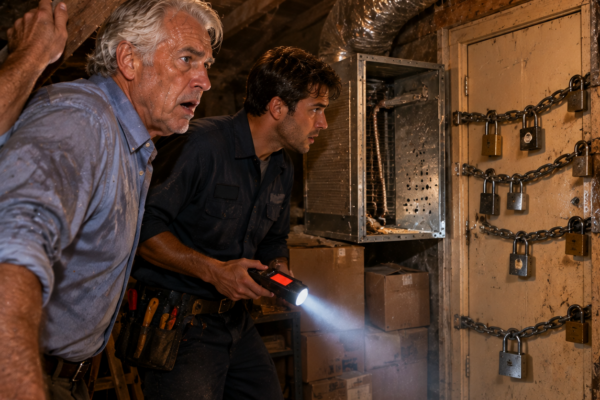
“She’ll be hurt. You know how she gets.”
“The email arrived on a Tuesday. I was sitting in my truck outside the hardware store when my phone buzzed. The screen said ‘Lorraine Whitfield’ and I almost didn’t open it.”
They thought skipping the brunch to attend a child’s piano recital was an embarrassment to the family → it became the moment the entire Navy finally showed up to honor the man they’d spent forty years underestimating.
I was sitting in my truck outside the hardware store when my phone buzzed. The screen said “Lorraine Whitfield” and I almost didn’t open it. My mother-in-law had that effect on me. Forty years of marriage to her daughter, and the woman still looked at me like I was a stray dog that had followed Eleanor home.
I opened it anyway.
Robert — Wanted to give you a heads up. We’ve booked the Valley Country Club for the 14th. The whole family is flying in. It’s going to be a beautiful celebration of your twenty years of service. Lorraine.
I read it three times.
Twenty years of service. She made it sound like I’d been a mailman.
What Lorraine didn’t know—what none of them knew—was that I hadn’t told anyone the whole truth about those twenty years. Not my wife. Not my children. Not the in-laws who’d spent four decades treating me like a disappointment their daughter settled for.
My name is Robert Hale. I was fifty-eight years old when my mother-in-law tried to schedule my retirement party on top of my daughter’s first piano recital.
I’m a former Navy SEAL. SEAL Team Six, specifically. Twenty years of service, eight of them classified. I retired as a Master Chief Petty Officer, though most days I still felt like the kid from Bakersfield who’d enlisted to get out of a bad situation.
But that’s not what Lorraine saw when she looked at me.
She saw the man who’d married her daughter against her wishes. The man who’d spent too much time deployed and not enough time climbing the corporate ladder. The man who drove a fifteen-year-old truck and lived in a modest house and never once mentioned what he’d actually done for a living.
I put the phone down and stared at the hardware store’s front window. A display of lawnmowers. A sign that said “Spring Sale.”
My daughter Marcy was twelve years old. She’d been taking piano lessons for eight months. Her recital was scheduled for the 14th at two o’clock in the afternoon. She’d been practicing the same piece for six weeks—a simplified arrangement of “Clair de Lune” that she played with more heart than precision.
She’d asked me to be there. Not her mother. Not her grandmother. Me.
“Daddy, you have to come. You have to.”
I’d promised her I would.
Now Lorraine was telling me the whole family was flying in for a party I hadn’t asked for, on a day I’d already claimed.
I called my wife.
Eleanor picked up on the third ring. “Did you get Mother’s email?”
“I got it.”
“Isn’t it wonderful? She’s been planning this for months. She wanted it to be a surprise, but she said you deserved to know ahead of time so you could—”
“Ellie. The fourteenth is Marcy’s recital.”
Silence.
“I know,” she said finally. “I know. But Mother said the country club only had that date available. And your retirement is a big deal. Twenty years, Robert. The whole family wants to celebrate you.”
“The whole family didn’t want to celebrate me for the last twenty years. Why now?”
“That’s not fair.”
It was fair. It was the fairest thing I’d said in years. But I didn’t push it. I never pushed it with Eleanor. That was part of the problem.
“Marcy’s recital is at two,” I said. “What time is the party?”
“Six. It’s a dinner.”
“Then I can do both.”
Another silence. Longer this time.
“The thing is,” Eleanor said, “Mother scheduled a brunch at eleven. And then there’s the family photos at one. And she wants everyone to get ready together at the club. It’s a whole day thing.”
“Marcy’s recital is at two.”
“I know.”
“So I’ll skip the brunch and the photos and go to the recital, then meet everyone at six.”
“Robert—”
“What?”
“She’ll be hurt. You know how she gets.”
I knew exactly how Lorraine Whitfield got. She got quiet and cold and made everyone around her feel like they’d ruined her day. She’d been doing it for forty years, and it worked every time.
But this wasn’t about Lorraine.
This was about a twelve-year-old girl who’d been practicing “Clair de Lune” for six weeks, who’d told me in a whisper that she was scared she’d mess up, who’d asked me—just me—to be there.
“I’ll figure it out,” I said.
I hung up before Eleanor could respond.
The brunch was at the Valley Country Club. White tablecloths. Crystal chandeliers. A view of the golf course through floor-to-ceiling windows.
I’d been there twice before. Once for Lorraine’s seventieth birthday, once for my brother-in-law’s promotion party. Both times I’d stood in the corner and watched the Whitfields perform their particular brand of upper-middle-class theater.
They were good at it. They’d had practice.
Lorraine’s father had been a surgeon. Her mother had been a homemaker with a trust fund. They’d raised their children to believe that appearances mattered more than anything, that money was the measure of a man, and that anyone who didn’t fit their mold was somehow less.
I’d never fit their mold.
I’d grown up in a two-bedroom house with a father who drank and a mother who worked two jobs. I’d enlisted at eighteen because I didn’t have money for college and didn’t want to spend my life stocking shelves at the local grocery store.
The Navy had given me a direction. The SEALs had given me a purpose. And the twenty years that followed had given me experiences I couldn’t talk about at dinner parties.
So I didn’t talk about them.
I let the Whitfields think what they wanted. That I’d been a glorified mechanic. That I’d spent my career on a ship somewhere, doing something unimportant. That their daughter had married beneath her.
It was easier that way. It was also, I was starting to realize, a mistake.
The day of the recital arrived hot and bright. August in Virginia. The kind of heat that made the air feel thick.
I woke up early. I always woke up early. Forty years of military discipline didn’t just disappear because you stopped wearing a uniform.
I made coffee. I sat on the back porch and watched the sun come up over the trees.
My phone buzzed at seven. Lorraine.
Don’t forget — brunch at eleven sharp. Wear the navy blazer. The one Eleanor bought you for Christmas.
I didn’t respond.
At eight, Eleanor came downstairs. She was already dressed—a pale blue sundress and heels. Her hair was done. Her makeup was perfect.
She looked at me sitting there in my old T-shirt and jeans.
“You’re not dressed.”
“I’m not going to the brunch.”
“Robert—”
“I’m going to Marcy’s recital. Then I’ll meet you at the club for dinner.”
She stood in the kitchen doorway and stared at me. There was something in her eyes I couldn’t quite read. Frustration, maybe. Or disappointment.
“She’s going to be furious.”
“Probably.”
“You’re going to ruin the whole day.”
“I’m not ruining anything. I’m going to my daughter’s piano recital. That’s not ruining.”
“It’s a conflict. You’re creating a conflict.”
“No. Your mother created a conflict when she scheduled my retirement party on the same day as her granddaughter’s recital.”
Eleanor’s jaw tightened. “She didn’t know.”
“She knew. Marcy told her two weeks ago. I heard her.”
Silence.
“You heard her?”
“I was standing right there. Marcy told Lorraine about the recital, and Lorraine said, ‘Oh, how nice, sweetheart,’ and then changed the subject to the party.”
Eleanor looked away. She knew. She’d probably known the whole time.
“I have to go,” she said. “I told Mother I’d help set up.”
“Okay.”
She walked toward the door. Then she stopped.
“Robert.”
“Yeah.”
“You’re going to regret this.”
She left before I could respond.
The recital was at a community center on the other side of town. A small auditorium with folding chairs and a piano that had seen better days.
I got there early. I always got there early. Old habits.
I sat in the back and watched the other parents file in. Mothers with cameras. Fathers with video recorders. Grandparents with flowers.
I was the only one there alone.
At two o’clock, the lights dimmed and a woman in a floral dress walked onto the stage. She welcomed everyone, thanked the parents, talked about the importance of music education.
Then the children started playing.
They were nervous. They stumbled. They forgot notes and started over. They were twelve years old, and they were trying, and that was enough.
Marcy was the seventh performer.
She walked onto the stage in a dress I’d bought her for her birthday. Navy blue. Her hair was pulled back. She looked small and serious and absolutely terrified.
She found me in the crowd. I nodded.
She sat down at the piano. She placed her hands on the keys. She took a breath.
And then she played.
It wasn’t perfect. She missed a note in the second measure. She hesitated before the bridge. Her tempo wavered.
But there was something in the way she played. Something honest. Something brave.
When she finished, I stood up and clapped. The rest of the audience joined in. Marcy’s face turned red, but she was smiling.
She found me again as she walked off the stage.
I gave her a thumbs up.
After the recital, I took Marcy out for ice cream. We sat in a booth at a shop near the community center and talked about nothing in particular.
She was happy. That was what mattered.
“Dad,” she said, somewhere between her second and third scoop of chocolate chip.
“Yeah.”
“Grandma Lorraine called me last night.”
I set down my spoon. “She did?”
“She said she was sorry I couldn’t come to your party. She said it was a shame the recital was the same day.”
My jaw tightened. “What did you say?”
“I said it was okay. I said you were coming to my recital.”
“And what did she say?”
Marcy shrugged. “She said, ‘Well, that’s nice, dear.’ Then she asked if I wanted to see the pictures from the party.”
I didn’t say anything. I didn’t trust myself to say anything.
“She’s not very nice, is she, Dad?”
I looked at my daughter. Twelve years old, and she already saw what it had taken me decades to accept.
“She’s complicated,” I said.
“That’s what Mom says about everyone she doesn’t like.”
I laughed. I couldn’t help it.
“Yeah,” I said. “I guess that’s true.”
I got to the country club at six.
The parking lot was full. I found a spot in the back and walked toward the entrance. I was wearing the navy blazer Eleanor had bought me. I’d ironed it myself.
Lorraine was waiting in the lobby.
She was dressed in a cream-colored suit with pearls. Her hair was perfectly coiffed. She looked at me the way she always looked at me—like I was a stain on an otherwise clean carpet.
“Robert. You made it.”
“I said I would.”
“How was the recital?”
“It was good. Marcy played well.”
“That’s nice.” She said it the way you’d say “that’s nice” about a neighbor’s new fence. “Everyone’s already seated. We saved you a spot at the head table.”
“Okay.”
She led me into the dining room. It was decorated with balloons and banners. A large sign read “CONGRATULATIONS ROBERT — 20 YEARS OF SERVICE.”
I looked at that sign and felt something twist in my chest.
Twenty years of service. That’s what they thought it was. Two decades of showing up to a job and collecting a paycheck. Nothing more.
The room was full of Whitfields. Eleanor’s brothers. Their wives. Their children. A few cousins I’d met once or twice. They all turned to look at me when I walked in.
Polite smiles. Half-hearted waves.
I sat down at the head table and waited for the show to begin.
Dinner was uneventful.
I ate roast chicken and made small talk with Eleanor’s brother, Phillip, who spent most of the meal talking about his recent promotion at the bank. His wife, Carla, told me about their daughter’s acceptance to a private school. Lorraine held court at the other end of the table, laughing at jokes and dispensing opinions on everything from politics to the proper way to fold a napkin.
No one asked me a single question about my career.
No one asked what I’d done during those twenty years. No one asked where I’d been deployed or what my job had entailed. No one asked about the things I couldn’t talk about even if they had.
They just assumed. And their assumptions were small.
After dinner, Phillip stood up and tapped his glass.
“Everyone, if I could have your attention.”
The room quieted.
“We’re here tonight to celebrate my brother-in-law, Robert Hale. Twenty years of military service. That’s a long time. That’s dedication.”
A few people nodded.
“Robert’s been part of this family for forty years now. He’s been a steady presence. A good husband to my sister. A good father to their children.”
More nods.
“He’s never been one to brag. Never been one to talk about his accomplishments. But tonight, we want to honor him. We want to say thank you for your service.”
He raised his glass. “To Robert.”
“To Robert,” the room echoed.
I sat there and felt nothing.
After the toast, people started to mingle. I found a corner near the bar and stayed there, nursing a glass of water.
That’s when I saw him.
A tall man in a dark suit. Gray hair. A face that looked vaguely familiar. He was standing near the entrance, talking to one of the waiters.
He looked at me.
I looked at him.
Then he walked over.
“Robert Hale?”
“Yes.”
“I thought that was you.” He extended his hand. “Admiral James Crawford.”
I shook his hand. His grip was firm.
“I’m sorry to interrupt. I was here for a retirement dinner for one of my old colleagues. Then I saw your name on the sign.”
He gestured toward the banner.
“Twenty years of service. That’s impressive.”
“Thank you.”
“I don’t want to intrude, but I have to ask. Were you Team Six?”
I hesitated.
“Yes.”
Something changed in his face. A flicker of recognition. Of respect.
“I thought so. I read your file once. A long time ago.”
He looked at me for a long moment. Then he said something I didn’t expect.
“You saved a lot of lives, Master Chief. A lot of lives.”
I didn’t know what to say.
“I won’t keep you,” he said. “I just wanted to shake your hand.”
He shook it again. Then he walked away.
I stood there with my water and my navy blazer and watched him go.
The party lasted until ten.
I said my goodbyes, made my rounds, played the part of the grateful honoree. Lorraine gave me a stiff hug and told me she was glad I could make it. Eleanor kissed my cheek and said she’d see me at home.
I drove back to the house alone.
The lights were off when I got there. I sat in the driveway for a few minutes, staring at the dark windows.
Then I checked my phone.
A voicemail from a number I didn’t recognize.
I pressed play.
“Master Chief Hale, this is Commander Sarah Okonkwo. I’m with Naval Special Warfare Command. I’m calling because someone here just saw something at your retirement party. A video. A photo. I’m not sure. But I think you need to know that people are starting to ask questions. People who matter. Please call me back when you can.”
The message ended.
I sat there in the dark and thought about Admiral Crawford.
What I didn’t know then was that he wasn’t just some random retiree at the country club. He was a member. And he’d been sitting two tables over when I walked in.
He’d seen the whole thing.
And he’d decided, for reasons I still don’t fully understand, to make a phone call.
PART 2 — THE VOICEMAIL
I didn’t call Commander Okonkwo back that night.
I sat in the driveway until midnight, listening to the cicadas and thinking about what Admiral Crawford had said. You saved a lot of lives, Master Chief. A lot of lives.
I hadn’t thought about those lives in years. Not the specific ones. Not the faces. That was a door I’d learned to keep closed.
I went inside at twelve-fifteen. Eleanor was already asleep. I stood in the bathroom and looked at myself in the mirror. Fifty-eight years old. Gray hair. Lines around my eyes that hadn’t been there ten years ago.
I didn’t look like a hero. I looked like a man who’d spent too many years carrying things nobody could see.
I went to bed.
The next morning, Eleanor was already in the kitchen when I came downstairs. She was sitting at the table with a cup of coffee and her phone.
She didn’t look up when I walked in.
“Morning,” I said.
“Morning.”
I poured myself a cup of coffee. The silence was thick.
“Phillip called me last night,” she said.
“Yeah?”
“He said he saw you talking to some man in a suit. He said the man looked important.”
I sat down across from her. “He was an admiral.”
Eleanor looked up. “What?”
“Admiral Crawford. He was at the club for a different event. He recognized my name.”
“An admiral. Recognized your name.”
“Yes.”
She set her phone down. “Robert, what is going on?”
“Nothing’s going on. He just came over to say hello.”
“Why would an admiral come over to say hello to you?”
I looked at her. Forty years of marriage, and she still didn’t understand.
“Because I was in the Navy, Ellie. Admirals know Navy people.”
“You were a mechanic.”
I didn’t correct her. I’d never corrected her. That was part of the problem.
“I was in the Navy,” I said again. “That’s all.”
She stared at me for a long moment. Then she shook her head and picked up her phone.
“Mother wants us to come over for lunch. She wants to talk about the party. She said she felt like you were distant.”
“I wasn’t distant.”
“You barely talked to anyone.”
“I talked to everyone I was supposed to talk to.”
“That’s not the same thing.”
I didn’t argue. I never argued with Eleanor. That was the other part of the problem.
I went for a run that morning.
I ran five miles along the trail near our house. It was hot and humid, and by the time I finished, my shirt was soaked through. But the run cleared my head. It always did.
When I got back, I checked my phone. Two more voicemails from Commander Okonkwo. One from a number in Virginia Beach. One from a number with a 619 area code—San Diego.
I called the commander back first.
She answered on the second ring. “Master Chief Hale. Thank you for calling me back.”
“Commander.”
“I’m sorry to bother you on a weekend. But something’s come up, and I thought you should be aware.”
“What’s that?”
“Admiral Crawford called the command on Friday night. He said he’d run into you at a retirement dinner. He said he was concerned.”
“Concerned about what?”
“About the way your service was being represented. He said the event felt more like a roast than a tribute. He said the family didn’t seem to know who you were.”
I didn’t say anything.
“Master Chief, I’ve been at NSW Command for six years. I’ve seen a lot of retirement parties. But I’ve never seen an admiral call the command because he was worried about a SEAL’s family not knowing what he did.”
“That’s Crawford,” I said. “He’s always been—”
“He’s not the only one asking questions.”
I stopped.
“What do you mean?”
“Someone posted a photo from the party on social media. One of your relatives, I think. The photo shows you standing next to the banner. ’20 YEARS OF SERVICE.’ And someone tagged it with your full name.”
“So?”
“So people started looking. And when people look up a Master Chief named Robert Hale with twenty years of service, they find things.”
I sat down on the back porch steps.
“What kind of things?”
“Your service record is classified. That’s normal for SEALs. But there are citations. Awards. Recommendations. And there’s one document that isn’t classified.”
“What document?”
“A letter of commendation from the Secretary of Defense. It’s public record. It was published in the Federal Register seven years ago.”
I remembered the letter. I’d never told anyone about it. I’d never even read it all the way through. It was easier not to.
“Someone found it,” I said.
“Someone found it,” she confirmed. “And they posted it in the comments.”
I spent the rest of the morning trying to figure out who had posted the photo.
It didn’t take long. Phillip’s wife, Carla, had posted it on her Facebook page. Caption: “So proud of my brother-in-law Robert! 20 years of service! #military #retirement #family.”
She’d tagged me. She’d tagged Eleanor. She’d tagged the country club.
And someone in the comments had asked the obvious question: “What did he do for twenty years?”
The answer had come from a man named Douglas Renfro. I’d never heard of him. But he’d posted a link to the Federal Register and written three words: “Read this. Thank him.”
I clicked the link.
The letter was long. Formal. Filled with language I barely recognized as describing my own life.
For extraordinary heroism and unwavering dedication to duty during a classified operation in the Kandahar Province, Afghanistan, Master Chief Petty Officer Robert J. Hale displayed exceptional courage and leadership under enemy fire. His actions resulted in the rescue of seventeen American service members and the neutralization of a high-value target without civilian casualties. Master Chief Hale’s conduct reflects the highest traditions of the United States Navy and the Naval Special Warfare community.
I closed the link.
Seventeen service members. I’d never counted. I’d never let myself count.
I sat there on the porch and stared at the trees until Eleanor came outside.
“Robert? Mother’s waiting. We need to leave.”
I didn’t move.
“Robert, did you hear me?”
“I heard you.”
“What’s wrong?”
I looked at her. My wife of forty years. The woman I’d married when I was nineteen and she was eighteen. The woman who’d waited through deployments she couldn’t know about, who’d raised two children mostly alone, who’d built a life around me while never once asking what I did.
“Ellie,” I said. “What do you think I did in the Navy?”
She blinked. “What do you mean?”
“I mean, what do you think I did? For twenty years. What did you think I was doing?”
She crossed her arms. “You were in the Navy. You had a job. You fixed things.”
“I fixed things.”
“Yes.”
“Where did you get that idea?”
“You told me. When we first met. You said you were a mechanic.”
“I said I was in the Navy. You assumed the rest.”
She stared at me.
“Robert, what are you saying?”
“I’m not saying anything. I’m just asking what you thought.”
She didn’t answer. She just stood there, arms crossed, waiting for me to say something that made sense.
I stood up.
“We should go to your mother’s,” I said.
Lunch at Lorraine’s was tense.
She’d made a salad and a quiche and set the table with her good china. Phillip and Carla were there. So was Eleanor’s older brother, Mark, and his wife, Diane.
Everyone was polite. Everyone was waiting.
I ate my quiche and made small talk about the weather and the drive over.
Lorraine watched me the whole time.
Finally, over dessert, she set down her fork and said, “Robert, I want to talk about last night.”
“Okay.”
“I felt like you were… distant. Like you didn’t want to be there.”
“I was there.”
“Yes, but you weren’t there. You know what I mean.”
I set down my fork too. “What do you want me to say, Lorraine?”
“I want you to tell me what’s going on. You’ve been different lately. Ever since the party.”
“I haven’t been different.”
“You have. Eleanor says you’ve been quiet. Distant. She’s worried about you.”
I looked at Eleanor. She was staring at her plate.
“I’m not different,” I said. “I’m the same person I’ve always been.”
“Then why did an admiral come to your party?”
The table went quiet.
“Phillip told me,” Lorraine said. “He said a man in a suit came over and talked to you. He said the man called you ‘Master Chief.’ And he said the man looked at you like you were… important.”
I didn’t say anything.
“Well?” Lorraine pressed. “What did he want?”
“He wanted to say hello.”
“Admirals don’t just say hello.”
This one does, I thought. But I didn’t say it.
“Robert,” Lorraine said, and her voice had that edge now, the one she used when she was about to say something cutting, “I’ve known you for forty years. I’ve never once heard you talk about your military career. Not once. You’ve never worn a uniform to a family event. You’ve never told us where you were deployed or what you did. And now a man in a suit comes to your retirement party and calls you ‘Master Chief’ like you’re some kind of—”
She stopped.
“Some kind of what?” I asked.
She didn’t answer.
“Say it, Lorraine.”
“I don’t know what to say. That’s the problem. I don’t know who you are.”
The room was silent.
I looked at the faces around the table. Phillip, who’d always treated me like a handyman. Carla, who’d posted my retirement photo for likes. Mark, who’d never asked me a single question about my life. Diane, who looked uncomfortable and tried to hide it.
And Eleanor. My wife. Who’d spent forty years assuming I was something small because I’d never corrected her.
“I’m the same person I’ve always been,” I said again. “You just never asked.”
I pushed back from the table.
“Robert,” Eleanor said. “Where are you going?”
“I need some air.”
I walked outside and sat in my truck.
My phone buzzed. Commander Okonkwo again.
I answered.
“Master Chief, I’m sorry to keep bothering you.”
“It’s fine.”
“I wanted to let you know that the photo and the letter are spreading. Someone from the command saw it. Someone from your old team.”
I closed my eyes.
“Who?”
“I can’t say. But I can tell you that there are people who want to honor you. Properly. Not with a country club dinner. With something real.”
“I don’t want to be honored.”
“I know. That’s why you deserve it.”
I didn’t respond.
“Master Chief, there’s going to be a ceremony. At the Naval Special Warfare Command in Virginia Beach. It’s been in the works for months. A belated retirement ceremony. For you and three others.”
“I didn’t ask for that.”
“No. But someone did. Admiral Crawford. He put in the request six weeks ago. Before the party. Before any of this.”
I stared at the dashboard.
“He requested it?”
“He did. He said he’d been trying to find you for years. He said the Navy owed you something they’d never given you.”
I didn’t know what to say.
“The ceremony is scheduled for September 20th. I’m calling to ask if you’ll come.”
I sat there in the truck, outside my mother-in-law’s house, and thought about all the years I’d spent hiding. All the things I’d never said. All the assumptions I’d let people make because it was easier than explaining.
“Master Chief?”
“I’ll be there,” I said.
I went back inside.
The table had cleared. Lorraine was in the kitchen. Phillip and Mark were in the living room. Eleanor was standing by the window.
She looked at me when I walked in.
“Who was that on the phone?”
I walked over to her. I reached into my pocket and pulled out my phone. I pulled up the Federal Register link. I handed it to her.
“Read that,” I said.
She took the phone. She looked at the screen.
“What is this?”
“Just read it.”
She read.
I watched her face. Confusion at first. Then disbelief. Then something else. Something I couldn’t quite name.
When she finished, she looked up at me. Her eyes were wet.
“Robert—”
“I’m not who you thought I was,” I said. “I never was.”
She opened her mouth. Then closed it.
“I have to go,” I said.
“Where?”
“Home. I need to think.”
She didn’t try to stop me.
I drove home alone.
The house was quiet when I got there. I sat in the kitchen and made a cup of coffee. Then I went online and looked up the ceremony.
There it was. On the Naval Special Warfare Command website. A public announcement.
The Naval Special Warfare Command will host a belated retirement ceremony for Master Chief Petty Officer Robert J. Hale and three other SEALs on September 20th. The ceremony will recognize their extraordinary service and sacrifice.
Four names. Mine was third.
I stared at the screen for a long time.
Then I checked my email.
There was a message from Lorraine.
Robert — I don’t know what’s happening. Eleanor told me to read something. I don’t understand. Call me.
I closed the email.
Then I checked Facebook.
Carla’s post had two hundred comments. People I’d never met were calling me a hero. People I’d known for years were asking why I’d never said anything.
I closed the browser.
My phone buzzed. A text from Eleanor.
I’m sorry. I didn’t know. I should have known. Please call me.
I didn’t call.
I sat there in my quiet kitchen and thought about the ceremony. About the men I’d served with. About the lives I’d saved and the ones I hadn’t.
And I thought about Marcy. Twelve years old. Playing “Clair de Lune” on a piano that had seen better days.
She’d known. Somehow, she’d known.
That was the only thing that mattered.
My phone buzzed again. This time it was a text from a number I didn’t recognize.
Master Chief Hale. This is Captain Alan Reyes. I was your CO from 2003 to 2006. I’m the one who requested the ceremony. We need to talk. Call me.
I looked at the number.
Then I called it.
PART 3 — THE CAPTAIN
Captain Alan Reyes answered on the first ring.
“Master Chief. Thank you for calling.”
“Captain.”
“I’ve been trying to reach you for two months. Your number was unlisted. I had to go through Admiral Crawford.”
“I didn’t know anyone was looking.”
“That’s the problem, Robert. Nobody ever knows where you are. You’ve been off the grid since you retired.”
I sat down at the kitchen table. “I’ve been living my life.”
“I know. That’s what worries me.”
He had a voice like gravel and authority. I remembered it well. He’d been my commanding officer during the worst years of the war. He’d sent me on missions he couldn’t talk about and waited for me to come back. Most of the time, I did.
“I heard about the ceremony,” I said.
“You’re damn right you did. September 20th. Virginia Beach. You’re going to be there.”
It wasn’t a question.
“I said I would.”
“Good. Because there are three other men who are going to be standing next to you, and they’ve been asking about you for years.”
“Who?”
“Tom Delgado. Marcus Webb. And Danny Kwan.”
I closed my eyes.
Tom Delgado. My swim buddy from BUD/S. We’d been through hell together more times than I could count. I hadn’t spoken to him in fifteen years.
Marcus Webb. My point man on more missions than I could remember. He’d taken a bullet for me once. I’d carried him three miles through hostile territory to get him to an extraction point.
Danny Kwan. The youngest SEAL on my team. I’d watched him grow from a scared kid into one of the best operators I’d ever served with.
“Are they coming?”
“They’re already here. They’ve been at Little Creek for a week, waiting.”
“Waiting for what?”
“For you to answer your phone.”
I didn’t say anything.
“Robert, I’m going to be honest with you. I’ve been watching this from a distance. I saw the photo from your party. I saw the comments. I saw the way your family looked at you like you were some kind of janitor who’d somehow gotten a medal.”
I gripped the phone tighter.
“Your mother-in-law scheduled your retirement party on the same day as your daughter’s recital.”
I didn’t ask how he knew.
“She did.”
“And you went to the recital instead.”
“I did.”
There was a long pause.
“That’s why we’re doing this, Robert. Not because of the medal. Not because of the citations. Because of that. Because you’re still the same man you always were.”
I didn’t know what to say.
“The ceremony is at 1400. Dress uniform. I’ll send you the details.”
“I don’t have a dress uniform anymore.”
“Then I’ll have one made. What’s your size?”
I told him.
“I’ll have it delivered by Friday. Don’t be late.”
He hung up.
The next few days were strange.
Eleanor came home that night and tried to talk to me. She sat on the edge of the bed while I was reading and asked me to explain.
“Explain what?”
“Everything. The letter. The ceremony. Why you never told me.”
I set down my book.
“What do you want to know?”
“Were you really a SEAL?”
“Yes.”
“For how long?”
“Twenty years.”
“Why didn’t you tell me?”
I looked at her. Forty years of marriage, and she still didn’t understand.
“I did tell you. The first time we met, I told you I was in the Navy. I told you I was stationed in Coronado. You asked what I did, and I said I couldn’t talk about it. You said that was fine. You never asked again.”
She stared at me.
“I thought you were a mechanic.”
“Why?”
“Because you fixed the sink. When we first moved in. You fixed the sink and you said it was the same kind of work you did in the Navy.”
I almost laughed.
“Ellie, I was making a joke. I was a SEAL. I fixed problems. Sometimes that meant plumbing. Sometimes it meant things I can’t talk about.”
She was quiet for a long time.
“I feel like I don’t know you.”
I reached over and took her hand.
“You know me. You just don’t know that part of me. There’s a difference.”
She didn’t say anything.
“Go to sleep,” I said. “We’ll talk more tomorrow.”
She lay down. I turned off the light.
But I didn’t sleep.
The next morning, Marcy came into the kitchen while I was making coffee.
“Dad?”
“Morning, sweetheart.”
“Mom said you were in the Navy.”
“I was.”
“She said you were a SEAL. Like in the movies.”
I poured her a glass of orange juice.
“Not like in the movies. But yes.”
She sat down at the table and looked at me. She had that expression she got when she was thinking hard about something. Her brow furrowed. Her lips pressed together.
“Did you kill people?”
I set down the coffee pot.
“That’s a complicated question.”
“Did you?”
I sat down across from her.
“Yes. Sometimes. When I had to. To protect people.”
She nodded slowly.
“Were you scared?”
“Sometimes.”
“What did you do when you were scared?”
“I did my job anyway.”
She thought about that.
“Grandma Lorraine is scared of you now.”
I looked at her.
“What do you mean?”
“She called Mom last night. She said she didn’t know who you were. She said she felt like she’d been living next to a stranger.”
“And what did Mom say?”
“Mom said she felt the same way.”
I didn’t say anything.
“Dad?”
“Yeah.”
“I’m not scared of you.”
I reached across the table and took her hand.
“I know, sweetheart.”
“I’m proud of you. Even if you were just a mechanic. But I’m extra proud now.”
I squeezed her hand.
“Thanks, Marcy.”
She smiled and drank her orange juice.
The dress uniform arrived on Friday.
I opened the box and laid it out on the bed. Navy blue. Gold buttons. Ribbons I hadn’t worn in years.
There was a note tucked into the collar.
Master Chief — Wear this like you mean it. — Captain Reyes
I hung it in the closet.
That afternoon, Eleanor came home early. She found me in the bedroom, staring at the uniform.
“Robert?”
“Yeah.”
“Is that—”
“It’s for the ceremony.”
She walked over and stood next to me. She reached out and touched the sleeve.
“There are so many ribbons.”
“There are a lot of things I never told you about.”
She turned to face me.
“Tell me now.”
I looked at her.
“You really want to know?”
“I need to know.”
So I told her.
I told her about BUD/S. About the cold water and the sand and the men who quit and the men who didn’t. I told her about my first deployment. About the missions I couldn’t describe in detail but could describe in feeling. The fear. The focus. The way the world narrowed to a single point and everything else fell away.
I told her about Tom Delgado. About the time we got separated from our team in the mountains and spent three days evading enemy patrols. About the way he’d carried me when I couldn’t walk.
I told her about Marcus Webb. About the bullet he took for me. About the blood and the screaming and the way I’d held his hand and told him he was going to be okay.
I told her about Danny Kwan. About the kid who’d joined my team at twenty-two and grown into a man I’d trust with my life.
I told her about the mission that had earned me the letter in the Federal Register. About the seventeen men we’d pulled out of a compound that was supposed to be empty. About the firefight that lasted four hours. About the three men I couldn’t save.
When I finished, Eleanor was crying.
“I didn’t know,” she said. “I didn’t know any of that.”
“I know.”
“Why didn’t you tell me?”
“Because you didn’t ask. And because I couldn’t. Some of it was classified. Some of it was just… too much.”
She wiped her eyes.
“I’m sorry.”
“For what?”
“For all of it. For letting my mother treat you like that. For not asking. For assuming.”
I pulled her into a hug.
“It’s okay.”
“It’s not okay.”
I held her for a long time.
Then she said something I didn’t expect.
“I want to go to the ceremony.”
I pulled back and looked at her.
“You do?”
“I want to see it. I want to see you in that uniform. I want to know that part of you.”
I nodded.
“Okay.”
The family found out about the ceremony on Monday.
Carla saw it on the Naval Special Warfare Command website. She posted it on Facebook before she called Eleanor.
So proud of my brother-in-law Robert! Belated retirement ceremony at Naval Special Warfare Command on September 20th! #hero #SEAL #family
The comments flooded in.
Some people congratulated me. Some people asked questions. Some people said things like, “I always knew there was more to Robert than met the eye.”
Lorraine called Eleanor that afternoon.
“What is this ceremony?”
“It’s a belated retirement ceremony. The Navy is honoring him.”
“Why?”
“Because he’s a SEAL, Mother. Because he did things we never knew about.”
There was a long silence.
“I don’t understand.”
“I know. Neither do I. But I’m going.”
“Eleanor—”
“I’m going, Mother. And you should come too.”
“Why would I come?”
“Because you owe him that much.”
Lorraine hung up.
The week before the ceremony, I got a call from Tom Delgado.
“Robert?”
“Tom.”
“It’s been a long time.”
“It has.”
“I’m at Little Creek. I’ve been waiting for you.”
“I know. Captain Reyes told me.”
“Are you coming?”
“I’ll be there.”
“You better be. I’ve got a lot to say to you.”
“Like what?”
“Like why you disappeared for fifteen years. Like why you never called. Like why I had to find out from a Facebook post that you were retiring.”
I didn’t say anything.
“I’m not mad,” Tom said. “I’m just… I don’t know. I’m just glad you’re alive.”
“I’m alive.”
“Good. That’s all I needed to hear.”
He hung up.
The day before the ceremony, I got a letter.
It was from Lorraine. Handwritten. On her personal stationery.
Robert — I don’t know what to say. I’ve spent forty years thinking of you as someone who didn’t quite fit. Someone who wasn’t quite enough. And now I find out that you’re a hero. That you saved lives. That you did things I can’t even imagine. I don’t know how to process that. I don’t know how to apologize. But I want you to know that I’m going to be there tomorrow. I’m going to watch. And I’m going to try to understand. — Lorraine
I folded the letter and put it in my pocket.
That night, I couldn’t sleep.
I sat on the back porch and watched the stars. The air was cool. September in Virginia. The leaves were starting to turn.
My phone buzzed. A text from an unknown number.
Master Chief Hale. This is Marcus Webb. I’m alive because of you. I’m going to be at the ceremony tomorrow. I’m going to shake your hand. And then I’m going to tell you what that means to me.
I stared at the message for a long time.
Then I typed back.
I’ll see you there.
I put the phone down and looked up at the sky.
Tomorrow, everything would change.
PART 4 — THE CEREMONY
The Naval Special Warfare Command sits on a stretch of Virginia Beach that smells like salt and diesel. I’d been there a hundred times. It had never felt like this.
I arrived at noon. The parking lot was full of trucks and sedans and a few motorcycles. I sat in my truck for a minute, watching the flag snap in the wind.
Then I got out.
The uniform fit perfectly. Dress blues. Gold buttons. The ribbons I’d earned over twenty years, pinned in rows across my chest. I hadn’t worn it in six years. It felt like putting on someone else’s skin.
I walked toward the building. A young sailor at the door saluted me.
“Master Chief Hale?”
“Yes.”
“Right this way, sir. Everyone’s waiting.”
The ceremony was held in a large auditorium. Flags on the stage. A podium. Rows of chairs filled with people in uniform and people in civilian clothes.
I stood in the back and looked at the crowd. There were more people than I expected. SEALs I’d served with. Officers I’d reported to. A few faces I didn’t recognize.
Captain Reyes found me first.
“Robert.”
“Captain.”
He extended his hand. I shook it.
“You look good.”
“I feel like I’m wearing a costume.”
He laughed. “You’ll get used to it. Come on. They’re waiting for you.”
He led me to the front row. Three chairs were reserved. Two of them were already occupied.
Tom Delgado stood up when he saw me.
He was older. Grayer. But his eyes were the same. Sharp. Alert. The eyes of a man who’d spent his life watching for threats.
“Robert.”
“Tom.”
He pulled me into a hug. It was awkward and brief, the way men like us hugged. But it meant something.
“I can’t believe you’re here,” he said.
“I can’t believe you’re here.”
“I told you I would be.”
“I know.”
He stepped back and looked at me.
“You look good, brother. You look like you.”
I didn’t know what to say.
Marcus Webb was next. He stood up slowly. He walked with a slight limp. The bullet he’d taken for me had never fully healed.
“Master Chief.”
“Marcus.”
He saluted me. I saluted back.
Then he said something I didn’t expect.
“I’ve been waiting twenty years to thank you.”
“You don’t have to—”
“I do. I’ve been waiting twenty years to thank you for carrying me three miles through enemy territory. For not leaving me behind. For saving my life.”
I looked at him. At the limp. At the scars I couldn’t see.
“You would have done the same for me.”
“That’s not the point.”
He hugged me too. Longer than Tom had.
Danny Kwan was last. He was in his forties now. Still young. Still sharp. He’d stayed in the Navy and made Captain.
“Master Chief.”
“Captain Kwan.”
He smiled. “You don’t have to call me that.”
“I do. You earned it.”
He shook his head.
“You’re the reason I made it. You know that, right? You’re the reason I didn’t quit after my first deployment. You’re the reason I stayed.”
I didn’t say anything.
“I was twenty-two years old. I was scared. I wanted to go home. And you sat me down and told me that fear was normal. That everyone felt it. That the only thing that mattered was what you did with it.”
I remembered that conversation. I’d almost forgotten it. It was just something I said. Something I said to a scared kid who needed to hear it.
“I don’t remember what I said,” I lied.
Danny laughed. “You’re a bad liar, Master Chief.”
The ceremony started at two.
Captain Reyes stood at the podium. He looked out at the crowd.
“Ladies and gentlemen, we’re here today to honor four men. Four SEALs who gave twenty years of their lives to this country. Four men who did things that most people will never know about. Four men who deserve more recognition than they’ll ever receive.”
He looked at me.
“We’re here to correct that.”
The room was quiet.
“Master Chief Robert Hale. Would you please come forward?”
I stood up. My legs felt heavy. I walked to the stage. The room was watching.
I stood next to Captain Reyes. He turned to face me.
“Master Chief Hale, your service record is classified. Most of what you did, we can’t talk about. But some of it, we can.”
He read from a document I’d never seen.
“On March 12, 2008, during Operation—” He paused. “During a classified operation in Helmand Province, Master Chief Hale led a team of six SEALs into a compound that was believed to be empty. It was not empty. It was occupied by thirty-seven enemy fighters.”
The room was silent.
“Master Chief Hale’s team was outnumbered six to one. They were pinned down for four hours. Three of his men were wounded. One was critically injured. Master Chief Hale carried that man—Marcus Webb—three miles through enemy territory to an extraction point. He then returned to the compound to retrieve two more wounded men.”
I felt the room shift.
“By the end of the operation, Master Chief Hale had personally neutralized twelve enemy fighters, rescued seventeen American service members, and secured a high-value target without civilian casualties. For his actions, he was awarded the Navy Cross.”
Captain Reyes held up a medal.
“Master Chief Hale, it is my honor to present this to you today. Not because you need it. But because you earned it.”
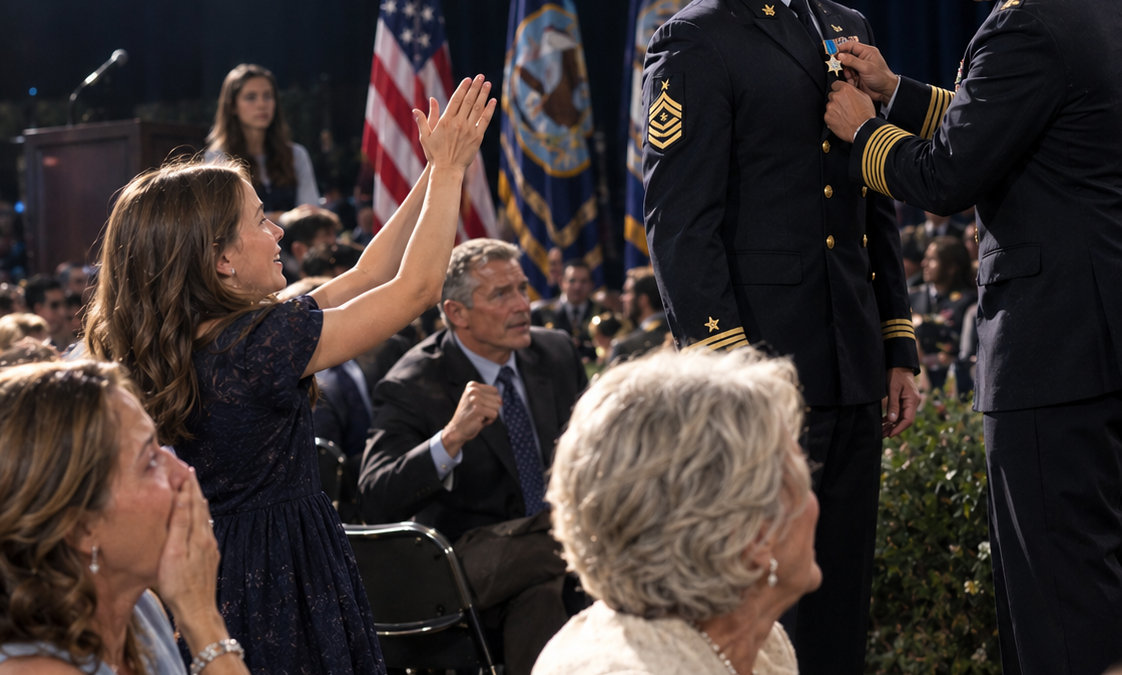
He pinned the medal to my uniform.
The room stood up.
I don’t remember much of what happened after that.
There were more words. More medals. Tom, Marcus, and Danny received their own honors. I stood on the stage and shook hands and nodded at people I didn’t recognize.
Then it was over.
I walked off the stage and into the lobby. Eleanor was there. She was crying.
“Robert.”
“Ellie.”
She hugged me. She held on tight.
“I’m sorry,” she said. “I’m so sorry.”
“For what?”
“For everything. For not knowing. For not asking. For letting you carry all of that alone.”
I held her.
“It’s okay.”
“It’s not okay. But I’m going to make it okay. I’m going to try.”
I pulled back and looked at her.
“That’s all I ever wanted.”
Marcy was next. She ran up to me and hugged me around the waist.
“Dad!”
“Hey, sweetheart.”
“You were amazing. You are amazing. I can’t believe you did all that.”
I knelt down so I was at her level.
“I did it a long time ago.”
“But you still did it. You saved people. You’re a hero.”
I looked at her. Twelve years old. Eyes bright. Proud.
“I’m your dad,” I said. “That’s all I ever wanted to be.”
She hugged me again.
Lorraine was standing near the door.
She looked smaller than I remembered. Older. She was wearing a navy dress and pearls. Her hands were clasped in front of her.
“Robert.”
“Lorraine.”
She looked at me. At the uniform. At the medal.
“I didn’t know.”
“I know.”
“I didn’t want to know. That’s the truth. I didn’t want to know because if I knew, I would have to respect you. And I didn’t want to respect you.”
I didn’t say anything.
“I was wrong. About everything. About you. About the way I treated you. About the way I let my family treat you.”
She paused.
“I don’t expect you to forgive me.”
“I don’t know if I can.”
She nodded. “That’s fair.”
She turned to go.
“Lorraine.”
She stopped.
“I don’t forgive you. Not yet. But I’m willing to try.”
She looked at me. Her eyes were wet.
“Thank you.”
The reception was in a tent outside the building.
There were tables of food and drinks. People were talking and laughing. Tom Delgado found me near the bar.
“That was something,” he said.
“It was.”
“I didn’t know you got the Navy Cross.”
“I didn’t either. Not for sure. They didn’t tell me at the time.”
He looked at me.
“They should have told you.”
“I know.”
“You should have been at a ceremony like this fifteen years ago.”
“I know.”
He shook his head.
“You’re still doing it. Still carrying it alone. Still not letting anyone in.”
I looked at him.
“What do you want me to say, Tom?”
“I want you to say you’re going to stop. I want you to say you’re going to let people in. I want you to say you’re not going to disappear again.”
I didn’t answer.
“Robert—”
“I hear you.”
“That’s not the same thing.”
“I know.”
He sighed.
“Same old Robert.”
“Same old Robert.”
He laughed. “Yeah. I guess that’s why we love you.”
I walked outside and stood by the water.
The sun was setting. The sky was orange and pink. The waves were calm.
I thought about the men I’d served with. The ones who were still alive. The ones who weren’t. The ones who’d come home and the ones who hadn’t.
I thought about the seventeen men I’d saved. I didn’t know their names. I never would. But they were alive somewhere. They had families. Children. Lives.
I thought about the three I couldn’t save.
My phone buzzed. A text from an unknown number.
Master Chief Hale. My name is David Chen. I was one of the seventeen. I’m alive because of you. I’ve been trying to find you for years. I want to thank you in person. Please call me.
I stared at the message.
Then I saved the number.
I looked out at the water.
One of the seventeen.
I’d never known their names. I’d never let myself learn them. It was easier that way.
But now one of them was reaching out. And I couldn’t ignore it.
I called the number.
 [Tap here for the Next Part ]