“He’s not our son. Our son would never—he’s just some vagrant.”
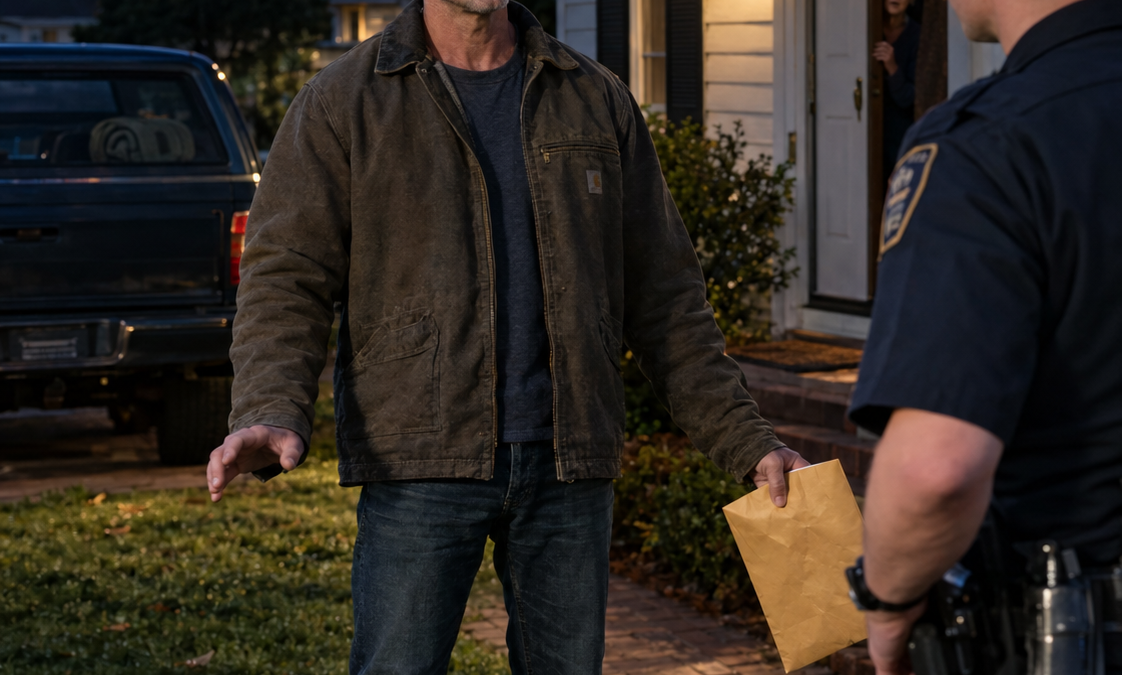
“The police car pulled up to my parents’ house at 7:42 on a Tuesday evening. I know the time because I was standing on their front lawn when the cruiser’s headlights swept across me. I had been standing there for eleven minutes.”
They thought their son was lost and homeless → They watched him receive the Navy and Marine Corps Medal in front of hundreds, with a general calling him one of the best Marines he’d ever known.
I know the time because I was standing on their front lawn when the cruiser’s headlights swept across me. I had been standing there for eleven minutes. Long enough for the porch light to flick on. Long enough for the curtain in the front window to twitch. Long enough for my mother to pick up the phone and dial three numbers she had known by heart since I was a child.
I didn’t move when the car stopped. I didn’t raise my hands. I just stood there in my worn Carhartt jacket and my three-year-old boots, holding a manila envelope, waiting.
What they didn’t know was that the man they were reporting as a suspicious vagrant had founded the largest veteran housing organization in the Pacific Northwest.
What they didn’t know was that I had donated my entire military pension — every month, for the past four years — to keep that organization running.
What they didn’t know was that I had been sleeping in my truck by choice, not by circumstance, because every dollar I saved on rent was another bed for a veteran who had nothing.
My name is Daniel Marcus Cole. I was forty-three years old when my parents called 911 on me.
I spent twelve years in Marine Corps Force Recon, attached to MARSOC for the last four of those years. Three deployments to Afghanistan. Two to Iraq. One to places I still can’t name. I came home in 2019 with a titanium rod in my left femur, a Purple Heart I never told my family about, and a promise I made to a dying friend in a dusty compound outside Kandahar.
That promise was the reason I was standing on my parents’ lawn in the dark, waiting for the police to arrive.
The officer who stepped out of the cruiser was young. Maybe twenty-six. He had that careful walk of someone who had been trained to approach unknown situations with measured caution. His hand rested near his holster, not on it.
“Sir,” he called out. “Can you tell me what you’re doing here?”
I kept my hands visible. Old habit.
“I’m waiting for my parents to let me in,” I said. “They live here.”
The officer glanced at the house. The porch light was on. The curtains were drawn tight.
“They called in a report of a suspicious person on their property.”
“I know.”
“They said they don’t recognize you.”
I let out a breath. The cold air made it visible.
“They do recognize me,” I said. “They just don’t want to.”
The officer’s name tag said T. Alvarez. He looked at me for a long moment, taking in the worn jacket, the boots that had seen better days, the truck parked at the curb with a camper shell and a bedroll visible through the rear window.
“You homeless, sir?”
“No.”
“You got ID?”
I reached slowly into my jacket pocket and pulled out my wallet. Handed him my driver’s license. He looked at it, then at me, then back at the license.
“Daniel Cole,” he read. “Address in Tacoma.”
“That’s my mailing address. I have a PO box there.”
“You don’t live at the address?”
“I live where I’m needed.”
He handed the license back. His expression had shifted. Not quite suspicion anymore. Something closer to confusion.
“Sir, I’m going to need you to wait here while I talk to the homeowners. Can you do that for me?”
“Yes, sir.”
I stayed where I was. Watched him walk up the brick path to the front door. Watched the door open a crack. Heard my mother’s voice, tight and high-pitched, the way it got when she was upset.
“He’s not our son,” she said. “Our son would never — he’s just some vagrant. He’s been loitering out there for an hour.”
I closed my eyes. Breathed in through my nose, out through my mouth. The way I’d been taught in a tent in Helmand Province by a corpsman who was trying to keep me from bleeding out.
Four count in. Four count hold. Four count out.
The officer’s voice was calm. Professional.
“Ma’am, he has identification. He says he’s your son. Daniel Cole.”
Silence.
“That’s not possible,” my father said. His voice came from deeper in the house. “Daniel has a job. Daniel has a life. He would have called. He wouldn’t just show up like — like this.”
“Sir, I’m just telling you what his ID says. He’s not causing any trouble. He’s just standing on your lawn.”
“Then make him leave.”
The door closed. The officer stood there for a moment, then turned and walked back down the path.
“I’m sorry, sir,” he said. “They’re not going to let you in.”
“I know.”
“You want me to give you a ride somewhere?”
“No, thank you. I have my truck.”
He hesitated. Looked at the truck, then back at me.
“You sure you’re not homeless?”
I almost smiled.
“I’m sure.”
He nodded slowly. Got back in his cruiser. Sat there for a minute, typing something into his computer, then pulled away. The red and blue lights disappeared around the corner.
I stood on the lawn for another few minutes. The porch light was still on. The curtains were still drawn.
I had come here to tell them the truth. I had come here to explain the last four years. I had come here with a manila envelope full of news clippings and photographs and a letter from a colonel at Camp Pendleton that was supposed to explain everything.
I got back in my truck. Started the engine. Pulled away from the curb.
The manila envelope sat on the passenger seat beside me. I didn’t open it.
I drove to the VA clinic in Lakewood, where I had a cot in the back room that the night staff let me use when I was in town. It wasn’t much. But it was more than my parents had given me.
I need to back up.
You need to understand how I got here. How a decorated Marine ended up standing on his parents’ lawn while they called the police on him. How a man who had led twelve-man teams through hostile territory became a stranger to the people who raised him.
My parents are not bad people. I want to say that clearly.
They are people who value things. The right car. The right neighborhood. The right friends. The right son.
I was never the right son.
My older brother, Michael, was the right son. Michael went to Stanford. Michael got an MBA. Michael married a woman named Claire who had perfect teeth and a trust fund. Michael drove a BMW and lived in a house in Bellevue that had four bedrooms and a view of the lake.
Michael never served. Michael never wanted to.
I was the wrong son. I was the son who enlisted instead of going to college. The son who chose camo over a suit. The son who came home from war with something broken behind his eyes and never quite put it back the way it was.
My parents loved me. I believe that. But they loved the idea of me less.
The first time I noticed it was at Michael’s wedding in 2012. I had just come back from my second deployment. I was still in that phase where everything felt too loud and too close. I stood in a corner during the reception, nursing a club soda, watching Michael and Claire dance.
My mother came over to me.
“Daniel, you should go talk to your uncle. He’s in finance. He could help you get a job.”
“I have a job, Mom.”
“You have a — you’re in the military. That’s not a career. That’s a — ” She waved her hand. “A detour.”
I didn’t say anything. I had learned by then that arguing with my mother was like arguing with a wall. She couldn’t see me. She could only see the version of me she had constructed in her head, the one who was supposed to be like Michael, who was supposed to be successful and presentable and normal.
I wasn’t normal. I knew that.
The things I had seen. The things I had done. The people I had lost.
Normal was a language I had forgotten how to speak.
The years passed. I kept serving. I kept deploying. I stopped coming home for holidays because every visit ended the same way — with my mother looking at me like I was a stranger, with my father asking when I was going to “get serious about my life.”
I met Sarah in 2014. She was a nurse at a base hospital in Germany. She had short hair and a laugh that made the room feel warmer. She didn’t ask about my deployments. She didn’t ask about the missions. She just sat with me in the quiet and didn’t expect anything I couldn’t give.
We got married in a courthouse in Virginia Beach. My parents didn’t come. They said they couldn’t get away. Michael sent a card.
Sarah got pregnant in 2016. A girl. We named her Emma.
I was in Iraq when Emma was born. I saw her for the first time on a video call, her tiny face scrunched up and red, Sarah’s tired smile behind her.
“I’ll be home soon,” I said.
“You’d better be,” Sarah said.
I came home in 2017. I held my daughter for the first time and felt something crack open in my chest. Something I had thought was dead.
I was wrong.
Emma was two when the diagnosis came. A heart condition. Congenital. Rare. Expensive.
The Marine Corps gave me what it could. But what it could wasn’t enough. Sarah and I spent every penny we had. We mortgaged our future. We borrowed from banks and friends and family.
My parents loaned us five thousand dollars. They made sure to tell everyone about it.
Michael loaned us nothing. He said he and Claire were “tight” that year. They had just bought a vacation home in Scottsdale.
Emma died in 2018. She was two years and four months old.
Sarah left six months later. Not because she didn’t love me. Because she couldn’t stand to look at me anymore. Because every time she saw my face, she saw Emma’s face. Because grief was a language we had both learned too well and neither of us could speak it anymore.
The divorce was quick. Painless. We had nothing left to divide.
I went back to the Corps because I didn’t know what else to do. Because the structure was the only thing holding me together. Because the silence of the desert was better than the silence of an empty house.
I deployed again in 2019. Afghanistan. A compound outside Kandahar. A twelve-man team and a mission that I still can’t talk about.
That’s where I met Marcus.
Marcus Webb. Sergeant First Class. Army Special Forces. Green Beret. He had been attached to our team for a joint operation. He had a wife back home in Oregon and three kids he hadn’t seen in seven months.
He took a round in the chest on the third day.
I held his hand in the dust while the corpsman worked. He looked up at me with eyes that were already starting to go glassy.
“Promise me something,” he said.
“Anything.”
“There’s a place. In Portland. For vets who got nowhere to go. I volunteered there before I deployed. They need help. They need — ” He coughed. Blood on his lips. “They need someone who gets it.”
I told him I would help. I told him I would do whatever he needed.
He died before I could finish the sentence.
I came home with a flag that didn’t belong to me and a promise that did.
The organization was called Shelter Six. I founded it in 2020 with fifteen thousand dollars of my own money and a rented warehouse on the outskirts of Portland.
The mission was simple. Find homeless veterans. Give them a place to sleep. Give them a path back.
I did it because of Marcus. I did it because of Emma. I did it because I had learned that the only way to survive grief was to turn it into something that helped someone else.
The first year was hard. I worked sixteen-hour days. I drove around the city at night, looking for the ones who were invisible. The ones sleeping under bridges. The ones standing on corners with cardboard signs.
I brought them blankets. I brought them food. I brought them a card with the address of the warehouse and a promise that they would be safe there.
Most of them didn’t believe me. Most of them had heard promises before.
But some did. And those some turned into dozens. And those dozens turned into hundreds.
By 2023, Shelter Six had three facilities. We had sixty beds. We had job training programs, mental health counseling, a partnership with the VA that I had personally negotiated over eighteen months of frustrating bureaucracy.
We had saved lives.
I had saved lives.
But the money was always tight. Always. Government grants came and went. Donations fluctuated. The rent on the warehouses alone was eighteen thousand a month.
So I made a choice.
I moved out of my apartment. I started sleeping in my truck. I redirected my entire military pension — $4,200 a month — into the organization’s operating budget.
I didn’t tell my parents. I didn’t tell anyone. It wasn’t a sacrifice. It was a decision. The money wasn’t doing anything for me. It was doing something for people who needed it.
I ate what the volunteers ate. I showered at the shelter. I wore the same jacket for three years.
I wasn’t homeless. I had a home. I had sixty homes. They just happened to be filled with veterans who needed them more than I did.
My parents didn’t know any of that.
They knew their son had left the Marines in 2020. They knew he had moved to Portland. They knew he had “some kind of nonprofit” that they never asked about.
They had seen the articles in the local paper. The feature in the Oregonian. The profile on the evening news. But they had never read them. Never watched them. Never called to ask.
I had sent them the articles. I had sent them emails. I had sent them invitations to the fundraising galas and the open houses and the ribbon-cuttings.
They never came.
They never even responded.
I told myself it didn’t matter. I told myself I had built something that didn’t need their approval. I told myself I had found a family among the broken and the lost, and that family was enough.
I was lying.
The truth was that every time I sent another email into the silence, something inside me broke a little more. Every unanswered invitation was a reminder that I was still the wrong son. Still the disappointment. Still the one who couldn’t get it right.
So when I finally decided to tell them the truth, it was because I couldn’t keep lying to myself.
The military ceremony was scheduled for May 15. The Marine Corps was giving me an award — the Navy and Marine Corps Medal, the highest non-combat honor for heroism. It was for what I had done in Afghanistan. For running into a burning vehicle to pull out two wounded Marines while under fire.
I hadn’t told anyone about it. I hadn’t told my parents. I hadn’t told the board of Shelter Six. I had just received the notification and put it in a drawer and tried to forget about it.
But the ceremony was going to be public. There was going to be a general. There was going to be press. There was going to be a reception afterward at the Marine Corps League hall in Tacoma.
And I wanted my parents to be there.
Not for the award. I didn’t care about the award.
I wanted them to see me. Just once. I wanted them to see what I had become.
So I had driven to their house on that Tuesday evening in April. I had brought the manila envelope with all the documentation. I had planned to sit at their kitchen table and explain everything.
Instead, I stood on their lawn while they called 911.
The night after the police came, I sat in the back room of the VA clinic in Lakewood and stared at the wall.
The cot was hard. The fluorescent light buzzed. I could hear the night nurse, a woman named Patricia, moving around in the hallway.
I should have been sleeping. I hadn’t slept in three days. But every time I closed my eyes, I saw my mother’s face through the crack in the door. The fear. The disgust.
He’s not our son.
I knew she meant it. That was the worst part. She wasn’t lying to protect herself. She genuinely didn’t recognize me. She had constructed a version of me in her mind — successful, presentable, normal — and the man standing on her lawn didn’t fit that version.
So he couldn’t be her son.
My phone buzzed. A text from my brother.
“Heard Mom and Dad had some homeless guy on their lawn last night. You should call them. They’re pretty shaken up.”
I stared at the message for a long time.
Then I typed back: “I’ll call them.”
I didn’t call them.
The next morning, I drove to the shelter.
The warehouse was busy. Volunteers were moving through the main room, serving breakfast to a line of men and women who had come in from the cold. The smell of coffee and eggs and industrial cleaner filled the air.
A man named Reggie was sitting at a table near the front, nursing a cup of coffee. Reggie had been at Shelter Six for eight months. He had been a Marine in the first Gulf War. He had lost his wife to cancer and his job to the recession and his home to the bank. He had been living under a bridge on I-5 when one of my outreach teams found him.
He looked up when I walked in.
“Cole,” he said. “You look like hell.”
“Rough night.”
“Sit down. You want coffee?”
I sat. He poured me a cup from a thermos on the table. It was terrible coffee. Bitter and weak. But it was warm.
“What happened?” he asked.
I told him. The whole thing. The drive to Tacoma. The porch. The police. The door closing in my face.
Reggie listened without saying anything. He had that quality — the ability to just listen. It was one of the reasons he had become a leader at the shelter. One of the reasons other veterans trusted him.
When I finished, he was quiet for a long moment.
“You know what your problem is?” he said.
“Tell me.”
“You still care what they think.”
I didn’t say anything.
“You built this whole thing.” He gestured at the room around us. “You saved all these people. You did it without them. You don’t need their approval.”
“I know.”
“Then why are you still trying to get it?”
I didn’t have an answer.
I went back to work. There was too much to do to sit around feeling sorry for myself. A new group of veterans was arriving from a shelter in Seattle that had closed. We needed to find beds for them, paperwork, food.
I spent the day moving cots. Filling out forms. Making phone calls.
At three in the afternoon, Patricia called from the VA clinic.
“Daniel, there’s someone here to see you.”
“Who?”
“A man in a uniform. He says he’s from the Marine Corps.”
My stomach tightened.
“Tell him I’ll be right there.”
The man waiting for me in the VA clinic lobby was a lieutenant colonel named James Hardwick. He was tall and lean, with gray at his temples and a firm handshake.
“Mr. Cole,” he said. “I’m sorry to show up unannounced. I tried calling, but your phone went straight to voicemail.”
“I’ve been busy.”
“I understand.” He gestured at a pair of chairs. “Can we sit?”
We sat.
“I’m here about the ceremony,” he said. “The Navy and Marine Corps Medal presentation.”
“I know about the ceremony.”
“The commandant wants to make sure you’re still planning to attend.”
I looked at him. “The commandant?”
“The commandant of the Marine Corps. General Morrison. He’s going to be there personally.”
I didn’t say anything.
“Mr. Cole, what you did in Afghanistan — running into that vehicle, pulling those men out — it’s the kind of thing that doesn’t get forgotten. The general wants to honor you properly. He wants to make sure your family is there. Your friends. The people who matter to you.”
I thought about my parents. The closed door. The police car.
“I don’t know if anyone will be there,” I said.
Hardwick studied me for a moment.
“The general also mentioned something else,” he said. “He’s aware of your work here. Shelter Six. He wants to recognize that too. At the ceremony.”
I looked up.
“He wants to present a check. From the Marine Corps Foundation. For the shelter.”
“How much?”
“Two hundred and fifty thousand dollars.”
I felt something shift in my chest. Something that had been tight for a long time.
“That’s — that’s a lot.”
“It’s what you deserve.” Hardwick leaned forward. “Mr. Cole, the general knows your story. He knows about your daughter. He knows about your friend. He knows what you’ve been doing out here with your own money and your own time. He wants the world to know too.”
I didn’t know what to say.
“The ceremony is in two weeks,” Hardwick said. “I need to know if you’ll be there.”
“I’ll be there.”
“Good.” He stood up. “And Mr. Cole — one more thing.”
“What?”
“Invite your parents. Whatever’s happened between you — invite them. Let them see.”
I nodded.
I didn’t tell him I had already tried.
PART 2 — THE WAREHOUSE
Two days after Hardwick’s visit, my brother called.
I was in the shelter’s office, going through a stack of intake forms, when my phone lit up with Michael’s name. I hadn’t talked to him in eight months. The last time had been Christmas. He had called to tell me about his promotion at work. I had listened for twenty minutes without saying much.
I picked up on the third ring.
“Daniel.”
“Michael.”
“Hey.” A pause. “I’ve been trying to reach you. Mom and Dad are pretty upset about what happened.”
“What happened?”
“The homeless guy. On their lawn. Dad said he looked like he was on drugs. Mom’s been having trouble sleeping.”
I set down the pen. Leaned back in my chair.
“That was me, Michael.”
Silence.
“What?”
“That was me on their lawn. I drove down to see them. They called the police.”
Another pause. Longer this time.
“Why would you — ” He stopped. Started again. “Why would you just show up like that? Why didn’t you call?”
“I did call. Three times that week. They didn’t answer.”
“They probably didn’t recognize the number.”
“They knew the number. I’ve had the same phone for six years.”
Michael was quiet. I could hear him breathing. In the background, I heard Claire’s voice, asking who it was.
“Look,” he said finally. “I don’t know what’s going on with you. But you can’t just — you can’t just show up at their house looking like that. It scares them.”
“Looking like what?”
“Like — ” He hesitated. “Like you’re not doing well.”
I looked down at my jacket. The one I’d been wearing for three years. The one with the frayed cuffs and the faded patches.
“I’m doing fine, Michael.”
“Are you? Because from where I’m standing, it looks like you’re — ”
“Like I’m what?”
“Like you’re not okay. Like you need help.”
I closed my eyes. Counted to four. Opened them.
“I don’t need help. I need my family to see me.”
“What does that even mean?”
“It means I’m tired of being invisible.”
He didn’t have an answer for that. We sat in silence for a long moment. Then Claire’s voice again, louder this time, saying something I couldn’t make out.
“I have to go,” Michael said. “But Daniel — call Mom. Apologize. Fix this.”
“I didn’t do anything wrong.”
“Just call her.”
He hung up.
I sat there for a long time, staring at the wall. The office was small and cluttered. Files stacked on every surface. A whiteboard covered in schedules and phone numbers. A photograph of Emma on my desk, her tiny face frozen in a smile.
I picked up the photo. Traced the outline of her cheek.
“I’m trying,” I said. “I’m trying.”
The next week was chaos. The new group from Seattle arrived — twelve veterans, men and women who had been sleeping in a church basement for a month. We found beds for all of them. It took three days of constant work, moving furniture, sorting donations, coordinating with the VA for medical screenings.
I didn’t think about my parents. I didn’t have time.
But at night, when I lay on my cot in the back room, the thoughts came anyway. The look on my mother’s face. The sound of the door closing. The way Michael had said fix this like I was the one who had broken something.
I called my mother on Thursday.
It rang six times before she picked up.
“Hello?”
“Mom. It’s Daniel.”
Silence.
“Mom?”
“I know who it is.”
More silence. I could hear the television in the background. Some kind of morning show.
“I wanted to apologize,” I said. “For showing up like that. I should have called first.”
“You should have.”
“I know.”
“You scared your father. He’s been having chest pains.”
“I’m sorry.”
“Sorry isn’t — ” She stopped. Breathed. “What’s happening to you, Daniel? Why are you living like this?”
“I’m not living like anything. I have a job. I have a place to stay.”
“Your brother said you’re sleeping in your truck.”
I closed my eyes.
“Michael doesn’t know what he’s talking about.”
“Then tell me. Tell me what’s going on.”
I wanted to. I wanted to tell her everything. The shelter. The promise to Marcus. The choice I had made to live simply so that others could live at all.
But I knew it wouldn’t matter. She wouldn’t hear it. She would only hear the parts that confirmed what she already believed — that her son was lost, that he had failed, that he was not the person she had raised him to be.
“There’s a ceremony,” I said instead. “In two weeks. The Marine Corps is giving me an award. I’d like you and Dad to come.”
“A ceremony?”
“Yes.”
“For what?”
“For something I did overseas.”
She was quiet for a moment.
“Are you in trouble?”
“No, Mom. I’m not in trouble.”
“Then why are they giving you an award?”
“Because they think I did something good.”
Another silence. I could hear her thinking. Trying to fit this into the story she had constructed.
“Where is it?”
“Tacoma. The Marine Corps League hall. May 15th. There’s a reception afterward.”
“I don’t know if we can make it.”
“It’s two weeks away.”
“Your father has his golf league.”
“Mom.”
“I’ll talk to him.”
“Please.”
“I said I’ll talk to him.”
She hung up.
I stared at the phone in my hand. The call had lasted four minutes. It had felt like four hours.
The days passed slowly. I threw myself into work. There was always more to do. The shelter was growing faster than I could manage. We needed a new facility. We needed more staff. We needed money.
The $250,000 from the Marine Corps Foundation would help. It would cover six months of operating expenses. It would give us breathing room.
But it wouldn’t solve the underlying problem. The problem was that there were always more veterans. Always more men and women who had come home from war and found that home didn’t want them back. Always more Reggies, sleeping under bridges, forgotten.
I started doing outreach again. I hadn’t done it in months. Too busy with administration. But there was something about walking the streets at night, looking for the ones who had fallen through the cracks, that grounded me.
I found a woman on Tuesday. Under the I-5 overpass on Lombard. She was huddled in a sleeping bag that had seen better days. A cardboard sign leaned against her shopping cart. VETERAN. ANYTHING HELPS.
I crouched down beside her. She was awake. Eyes open. Watching me.
“Ma’am. My name is Daniel. I run a shelter in Portland. We have beds. Food. A place to sleep.”
She looked at me for a long time. Her face was weathered. Older than it probably was. Her hair was gray and tangled.
“I’m not going to a shelter.”
“Why not?”
“Bad experiences.”
“I understand. But this one’s different. It’s run by veterans. For veterans.”
She laughed. It was a bitter sound.
“I’ve heard that before.”
I sat down on the concrete beside her. Not too close. Just close enough.
“What’s your name?”
“Does it matter?”
“It does to me.”
She studied me. Something in her eyes shifted.
“Ruth.”
“Ruth. I’m Daniel. I was in the Marines. Force Recon. Two deployments to Iraq, three to Afghanistan. I lost my daughter three years ago. I sleep in my truck so that other veterans don’t have to sleep on the street. I’m not here to hurt you. I’m here because I’ve been where you are.”
She was quiet for a long moment.
“You sleep in your truck?”
“Yes.”
“Why?”
“Because I don’t need a house. I need to know that the people I’m trying to help are okay.”
She looked at me. Really looked at me. The way few people did.
“You’re serious.”
“I am.”
She let out a breath. Something in her shoulders loosened.
“Okay,” she said. “Okay.”
I helped her up. Walked her to the shelter’s van. Drove her to the warehouse. Got her a bed, a meal, a clean set of clothes.
She slept for fourteen hours.
When she woke up, she asked if she could help in the kitchen.
I told her yes.
The ceremony was eight days away when my father called.
I was in the warehouse, helping unload a truck of donated furniture, when my phone buzzed. I didn’t recognize the number. But I answered anyway.
“Daniel.”
It was my father’s voice. Gruff. Familiar.
“Dad.”
“Your mother said you called.”
“I did.”
“She said you want us to come to some ceremony.”
“Yes.”
“What kind of ceremony?”
“It’s an award. From the Marine Corps.”
“What for?”
I set down the box I was carrying. Moved outside, where it was quieter.
“For something I did in Afghanistan. Pulling two Marines out of a burning vehicle.”
Silence.
“You did that?”
“Yes.”
“When?”
“2019. My last deployment.”
He was quiet. I could hear him breathing. The way he did when he was thinking.
“Why didn’t you tell us?”
“I tried. I sent emails. I sent articles. I invited you to events.”
“We don’t — ” He stopped. Started again. “Your mother doesn’t check the email much.”
“I know.”
“I’m not — ” Another pause. “I’m not good at this, Daniel.”
“Neither am I.”
We stood in silence. The sun was setting behind the warehouse. Orange light spilled across the parking lot.
“Your mother wants to come,” he said finally. “She won’t say it. But she does.”
“And you?”
“I’ll come if she comes.”
“That’s not an answer.”
“I know.”
Another silence.
“There’s something I need to tell you,” I said. “About what I’ve been doing. What I’ve been building.”
“Your mother said you have some kind of nonprofit.”
“Yes.”
“For veterans?”
“Yes.”
“That’s — ” He stopped again. “That’s good, Daniel. That’s real good.”
I felt something crack in my chest. Something I had been holding tight for years.
“Thanks, Dad.”
“Don’t thank me. I didn’t do anything.”
“You’re talking to me. That’s something.”
He didn’t say anything. But he didn’t hang up either.
“May 15th,” I said. “7 PM. Marine Corps League hall in Tacoma. I’ll send you the address.”
“We’ll be there.”
“You promise?”
“I promise.”
He hung up.
I stood in the parking lot for a long time. The sun finished setting. The sky went dark.
I didn’t know if he meant it. I didn’t know if they would actually come.
But for the first time in years, I felt something I had almost forgotten.
Hope.
The day before the ceremony, I got a call from General Morrison’s aide.
“Mr. Cole. The general wanted me to confirm the details for tomorrow.”
“Go ahead.”
“The ceremony starts at 7 PM. The general will present the medal at 7:30. There will be a brief speech. Then the check presentation. You’ll have a chance to say a few words if you’d like.”
“I’d like that.”
“Good. The press will be there. Local news. The Oregonian. A reporter from the Marine Corps Times.”
“I understand.”
“One more thing. The general wanted me to ask — is your family coming?”
I paused.
“I think so.”
“You think so?”
“They said they would.”
“Good. The general was hoping they would be there. He wants to meet them.”
“He does?”
“He does. He said — ” The aide cleared his throat. “He said he wants to tell them what kind of man they raised.”
I didn’t know what to say.
“Thank you,” I said finally.
“See you tomorrow, Mr. Cole.”
That night, I couldn’t sleep.
I lay on my cot, staring at the ceiling, running through the day ahead. The ceremony. The medal. The check. The speech.
My parents would be there. Michael and Claire would be there. They had RSVP’d. My mother had called the Marine Corps League hall to confirm the address.
I didn’t know what they were expecting. I didn’t know what they thought they were coming to see.
But I knew what they were going to get.
They were going to see their son. Not the version they had constructed in their heads. Not the disappointment. Not the failure.
The real one.
The one who had served. The one who had fought. The one who had built something from nothing.
The one who had kept a promise to a dying friend.
I closed my eyes.
Tomorrow, they would see.
PART 3 — THE HALL
The Marine Corps League hall in Tacoma sat on a side street off Sixth Avenue, a low brick building with a flagpole out front and a parking lot that held maybe forty cars.
I got there at 5:30. Two hours early.
The hall was already busy. A team of volunteers was setting up chairs, arranging tables, hanging banners. A large American flag dominated the back wall. Below it, a podium with a microphone.
I stood in the doorway and watched.
A woman named Carol, who ran the league’s events, spotted me and hurried over. She was in her sixties, with short gray hair and a no-nonsense manner.
“Daniel. You’re early.”
“I wanted to help.”
“You’re the guest of honor. You’re not supposed to help.”
“I’m not good at sitting still.”
She smiled. “I remember. Come on. I’ll show you where you’ll be sitting.”
She led me to the front row. A single chair, slightly apart from the others. A name card on the seat.
Mr. Daniel Cole.
“Your family will be in the third row,” she said. “We saved six seats. Your parents, your brother, his wife, and two others.”
“Two others?”
“Your mother said she might bring her sister. And your brother’s wife’s mother.”
I nodded. I didn’t know Claire’s mother was coming. I had met her once, at the wedding. She had spent the entire evening talking about her son’s law practice.
“That’s fine,” I said.
“Are you nervous?”
I looked at her.
“No,” I said. “I’m not nervous.”
The next hour passed slowly. I walked the perimeter of the hall, checking the exits. Old habit. I couldn’t help it. Every room I entered, I mapped the exits, the sightlines, the potential threats.
The hall had four exits. Two in front, two in back. The windows were reinforced. The parking lot was well-lit. It was as safe as any place could be.
I stepped outside at 6:15. The sun was starting to set. The sky was streaked with orange and pink.
A car pulled into the lot. A black BMW. Michael’s car.
I watched it park. Watched the doors open. Michael got out first, wearing a suit. Claire followed, in a dress that probably cost more than my monthly pension. Then my mother, in a navy blue pantsuit. Then my father, in a sports coat that looked new.
They stood in the parking lot for a moment, looking at the hall. Looking at the flag. Looking at the sign above the door.
MARINE CORPS LEAGUE — TACOMA DETACHMENT
My mother said something to my father. He shrugged. They started walking toward the entrance.
I stayed where I was.
My mother saw me first. She stopped. Her face did something complicated. Surprise. Confusion. Something that might have been relief.
“Daniel.”
“Mom.”
She looked me up and down. I was wearing my dress blues. The uniform I hadn’t worn in four years. It still fit. Barely.
“You’re in uniform.”
“I am.”
“You look — ” She stopped. “You look different.”
“I look the same. You just haven’t seen me like this.”
My father stepped forward. He extended his hand. I shook it.
“Son.”
“Dad.”
We stood there, the four of us, in the parking lot of the Marine Corps League hall. The silence stretched.
Michael broke it.
“So this is where it’s happening.”
“Yes.”
“Nice building.”
“It’s not about the building.”
He looked at me. Something flickered in his eyes. Irritation, maybe. Or guilt.
“Look, Daniel — about what I said on the phone — ”
“It’s fine.”
“It’s not fine. I shouldn’t have — ”
“Michael.” I held up a hand. “It’s fine. You’re here. That’s what matters.”
He nodded. Didn’t say anything else.
Claire stepped forward. She gave me a hug that lasted exactly one second. Her perfume was overwhelming.
“Congratulations, Daniel.”
“Thank you.”
She looked at the hall. At the flag. At the people starting to arrive.
“I didn’t know you were — I didn’t know any of this.”
“Most people don’t.”
My mother was still looking at me. Her expression had shifted. Something had replaced the confusion. Something softer.
“Daniel, I — ”
“Mom. Let’s go inside. There’s a lot I need to tell you.”
We sat in the third row. My parents on either side of me, Michael and Claire behind. The hall filled quickly. Veterans in wheelchairs. Veterans with canes. Veterans with that look in their eyes that only other veterans recognized.
Carol came over to me. “The general is here. He wants to meet you before the ceremony.”
I stood up. “Excuse me.”
I followed her to a side room. General Morrison was there, along with Lieutenant Colonel Hardwick and two aides. The general was a big man, broad-shouldered, with silver hair and a face that had seen decades of sun and wind.
“Mr. Cole.” He extended his hand. “I’ve heard a lot about you.”
“General.”
“You don’t look like a man who ran into a burning vehicle.”
“I don’t feel like one either, sir.”
He laughed. It was a warm sound.
“I read your file. Force Recon. MARSOC. Three deployments to Afghanistan, two to Iraq. Purple Heart. Bronze Star. And now this.” He gestured at the medal box on the table. “You’ve had quite a career.”
“Thank you, sir.”
“And then you came home and built a shelter for homeless veterans. With your own money. Your own time.”
“It’s what needed to be done.”
“It’s what most people wouldn’t do.” He studied me. “Your family is here?”
“Yes, sir.”
“Good. I want to meet them.”
“With respect, sir — ”
“I know.” He held up a hand. “I know it’s complicated. But I want to meet them anyway. I want to tell them what kind of man they raised.”
I didn’t say anything.
“Are you ready?”
“Yes, sir.”
The ceremony started at 7 PM.
Carol welcomed everyone. Said a few words about the League, about the Marines who had served, about the importance of honoring those who had gone above and beyond.
Then she introduced General Morrison.
He walked to the podium. The room stood. He waved them down.
“At ease,” he said. “Sit down. This isn’t a parade.”
Laughter. The room settled.
“I’m here tonight to present the Navy and Marine Corps Medal to a man who has spent his entire adult life serving others. First in uniform. Then out of it.”
He looked at me.
“Daniel Cole grew up in Tacoma. He enlisted in the Marine Corps at eighteen. He served twelve years. He deployed five times. He was wounded in action. He was decorated for valor. He was, by every measure, an exemplary Marine.”
The room was quiet.
“But that’s not why we’re here tonight. We’re here because of what happened after.”
He paused.
“In 2019, during a joint operation in Afghanistan, Sergeant Cole was part of a team that came under heavy fire. A vehicle was hit. Two Marines were trapped inside. The vehicle was burning. The ammunition inside was cooking off.”
I stared at the floor.
“Sergeant Cole didn’t hesitate. He ran into the vehicle. Pulled both Marines out. Sustained burns to his arms and hands. Refused medical treatment until the other wounded were evacuated.”
The room was silent.
“That’s why he’s receiving this medal. But that’s not the whole story.”
He looked at me again.
“After Sergeant Cole left the Marine Corps, he founded an organization called Shelter Six. It provides housing, job training, and mental health services to homeless veterans in Portland and the surrounding areas. He funded it with his own pension. He lived in his truck so that more veterans could have beds. He built something extraordinary out of nothing but will and sacrifice.”
I heard my mother inhale sharply.
“Tonight, I’m proud to present Sergeant Daniel Cole with the Navy and Marine Corps Medal. And I’m proud to announce that the Marine Corps Foundation is donating two hundred and fifty thousand dollars to Shelter Six.”
The room erupted.
I stood up. Walked to the podium. Shook the general’s hand. Let him put the medal around my neck.
The applause was deafening.
I looked out at the crowd. At the veterans who had come to support me. At Reggie, sitting in the back row, nodding. At Patricia, from the VA clinic.
And at my parents.
My mother was crying. My father was staring at me with an expression I had never seen before. Michael’s face was pale. Claire’s mouth was slightly open.
General Morrison leaned in.
“Would you like to say a few words?”
I nodded.
I stood at the podium. The room went quiet.
“I want to thank General Morrison for those kind words. And I want to thank all of you for being here tonight.”
I paused.
“Most of you know me. You’ve seen me in the shelter. You’ve seen me on the streets. You’ve seen me in this uniform.”
I looked at my parents.
“But some of you don’t know me. Some of you haven’t seen me in years. Some of you have wondered what happened to me. Why I disappeared. Why I stopped coming home.”
My mother’s face was wet with tears.
“I want to tell you a story. It’s the story of why I do what I do.”
I took a breath.
“Five years ago, I was deployed to Afghanistan. I was part of a team that was working with a group of Army Special Forces. One of them was a man named Marcus Webb.”
I saw Reggie nod.
“Marcus was from Oregon. He had a wife and three kids. He had been in the Army for fifteen years. He was the kind of soldier who made everyone around him better.”
I paused.
“On the third day of our mission, Marcus was hit. He didn’t make it. I was with him when he died. He asked me to promise him something. He asked me to help the veterans who had nowhere to go. The ones who had come home from war and found that home didn’t want them back.”
My voice didn’t waver. I had practiced this. Not the words, but the calm. The way my father had taught me, long before I ever enlisted. Keep it together, Daniel. People are watching.
“I kept that promise. I founded Shelter Six. I gave it everything I had. And I’ve spent the last four years trying to make sure that no veteran has to sleep on the street if I can help it.”
I looked at my parents.
“I know I haven’t been the son you expected. I know I haven’t been the brother you wanted. I know I’ve disappointed you.”
My mother shook her head. Opened her mouth. I held up a hand.
“But I want you to know that I’m not sorry. I’m not sorry for the life I’ve chosen. I’m not sorry for the sacrifices I’ve made. I’m not sorry for the man I’ve become.”
I looked at the crowd.
“I’m proud of what I’ve built. And I’m proud of the people I’ve helped. And I’m proud to be a Marine.”
I stepped back from the podium.
The room exploded in applause.
After the ceremony, there was a reception.
Tables of food. Drinks. People crowded around me, shaking my hand, thanking me for my service. I smiled. I nodded. I said the right things.
But I was watching my parents.
They were standing near the back of the room, talking to General Morrison. I couldn’t hear what they were saying. But I could see the looks on their faces.
My mother was listening. Really listening. The way she never had before.
My father was nodding. Slowly. Deliberately.
Michael was standing apart from them, nursing a drink, looking uncomfortable. Claire was talking to someone from the League, her smile fixed and bright.
I made my way through the crowd.
“Mom. Dad.”
They turned. My mother’s eyes were red. My father’s jaw was tight.
“Daniel,” my mother said. “We need to talk.”
We found a quiet corner. A small room off the main hall, used for storage. Boxes of old uniforms. Folded flags. Photographs of Marines who had come before.
My father closed the door.
“Daniel,” he said. “We owe you an apology.”
I didn’t say anything.
“We didn’t know,” my mother said. “We didn’t — you never told us.”
“I tried.”
“I know. I know you tried.” She wiped her eyes. “I just — I didn’t listen. I didn’t want to hear it. I had this idea in my head of who you were supposed to be. And when you weren’t that, I — I just stopped seeing you.”
I nodded.
“That’s not an excuse,” she said. “I know it’s not. But it’s the truth.”
My father stepped forward.
“I’m not good with words, Daniel. Never have been. Your mother’s the talker.” He paused. “But I want you to know that I’m proud of you. I’ve always been proud of you. I just didn’t know how to say it.”
I felt something loosen in my chest. Something that had been tight for a long time.
“Dad.”
“You’re a good man. You’re a better man than I ever was. And I’m sorry we didn’t see it sooner.”
I didn’t say anything. I just stood there. Letting the words land.
My mother reached out. Touched my arm.
“Can you forgive us?”
I looked at her. At my father. At the years of silence and misunderstanding and hurt.
“I don’t know,” I said honestly. “But I’m willing to try.”
We stood in the storage room for a while. Talking. Actually talking. The way we hadn’t talked in years.
I told them about Emma. About Sarah. About the divorce. About the promise to Marcus.
They listened. They didn’t interrupt. They didn’t try to fix anything.
They just listened.
When we finally walked back into the reception, the room was starting to empty. People were saying their goodbyes.
General Morrison came over.
“Mr. and Mrs. Cole,” he said. “You raised an extraordinary son.”
My mother’s eyes filled again.
“Thank you, General.”
“I mean it. I’ve seen a lot of Marines in my career. Your son is one of the best.”
He shook my father’s hand. Then mine.
“I’ll be in touch, Daniel. We need to talk about how the Corps can support Shelter Six long-term.”
“Thank you, sir.”
He left.
I turned to my parents.
“There’s something I want to show you.”
I drove them to Portland the next morning.
The shelter was busy. Breakfast was being served. Volunteers were moving through the room. The smell of coffee and eggs filled the air.
I led my parents through the front door.
Reggie was at his usual table. He looked up when we walked in.
“Cole. You brought company.”
“Reggie, these are my parents. Mom, Dad, this is Reggie. He’s a Marine. First Gulf War.”
Reggie stood up. Shook my father’s hand.
“Your son saved my life,” he said. “I was living under a bridge when his team found me. I hadn’t had a real meal in three weeks. I hadn’t talked to anyone in longer than that.”
My mother’s eyes were wide.
“He gave me a bed. A purpose. A reason to keep going.”
Reggie looked at me.
“He’s a good man. You should be proud.”
My father didn’t say anything. He just nodded. But I saw his jaw tighten. Saw him swallow.
I showed them the rest of the shelter. The dormitories. The kitchen. The counseling rooms. The job training center.
I showed them the photo of Emma on my desk.
My mother picked it up. Held it for a long time.
“She was beautiful.”
“She was.”
“I’m sorry we never met her.”
“You could have. You just didn’t come.”
She flinched. But she didn’t argue.
“I know,” she said. “I know.”
They left that afternoon.
My mother hugged me. Held on longer than she had in years.
“Come home for Thanksgiving,” she said. “Please.”
“I don’t know if I can.”
“Please.”
I looked at my father. He was standing by the car, watching us.
“I’ll try,” I said.
“That’s all I ask.”
They drove away. I stood in the parking lot of the shelter, watching the car disappear down the street.
Reggie came up beside me.
“So.”
“So.”
“That went better than I expected.”
“Me too.”
“You think they’ll actually change?”
I thought about it. About my mother’s tears. About my father’s tight jaw. About the way they had listened.
“I don’t know,” I said. “But I’m willing to find out.”
 [Tap here for the Next Part ]


