“Military families. Poor as dirt and twice as proud. Can’t even afford a jersey for their kid.”
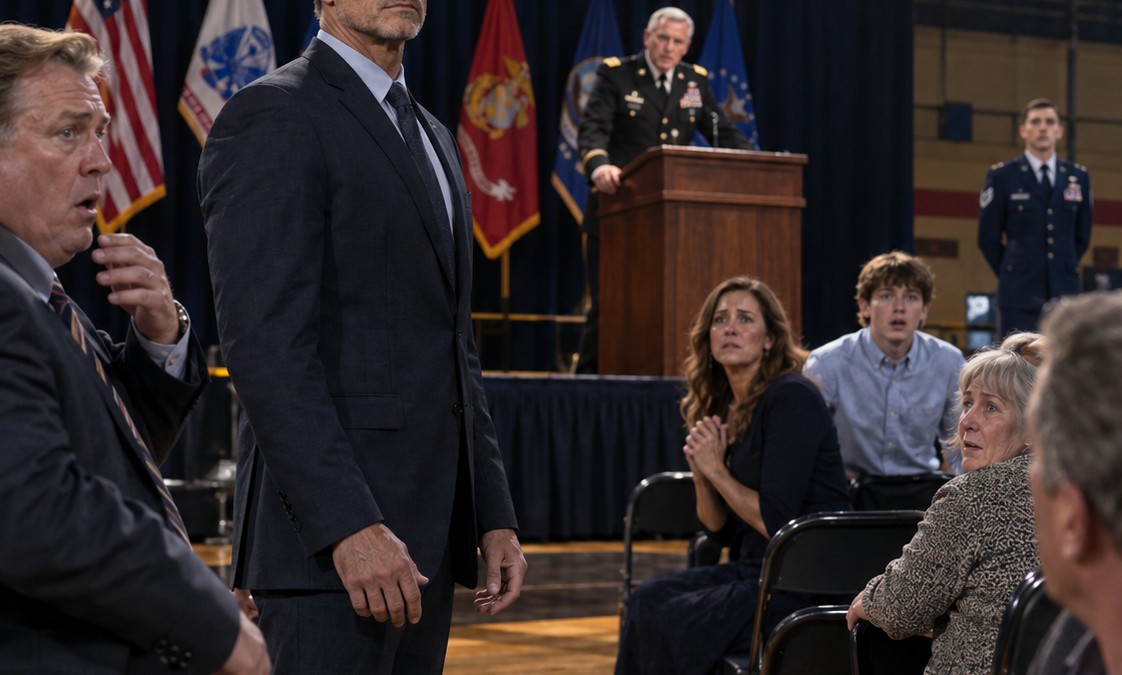
“The coach said it loud enough for the whole gym to hear. ‘These military families think we owe them something. News flash — we don’t. Poor as dirt and twice as proud. Can’t even afford a jersey for their kid.’ He was talking about my nephew. He was talking about my sister. He was talking about me.”
They thought the quiet uncle who sat in the back row was nobody → they found out he was a decorated Pararescueman whose anonymous donations had been paying for their kids’ equipment for years.
“These military families think we owe them something. News flash — we don’t. Poor as dirt and twice as proud. Can’t even afford a jersey for their kid.”
He was talking about my nephew. He was talking about my sister. He was talking about me.
What he didn’t know was that I had been paying for half the jerseys in that gym for three years.
My name is Daniel Kessler. I was forty-six years old when I walked into Westbrook High School’s athletic booster meeting and heard a man I’d known for six years call my family trash in front of two hundred people.
I was a Pararescueman. PJ. Air Force Special Tactics. Twenty-two years in uniform, most of it classified, all of it real. I’d pulled pilots out of burning wreckage in places I’m still not allowed to name. I’d jumped into freezing ocean at night to reach a downed airman who’d been treading water for six hours. I’d held a man’s artery closed with my fingers for forty minutes in a helicopter over hostile territory so he could see his daughter’s fourth birthday.
But in that gymnasium, in the town where my sister lived, I was just the quiet uncle who came to games and sat in the back row.
Nobody asked what I did. Nobody cared.
Until they did.
The meeting started at seven. I got there at six forty-five because my nephew Marcus liked to warm up before the booster sessions started. He was fourteen. Third-string quarterback. Small for his age, fast, smart. He’d been playing since he was eight, and he loved it more than anything.
I’d been coming to these meetings for three years. Ever since my sister Rachel’s husband left. Ever since she needed help.
The gym smelled like floor wax and old sweat. Folding chairs in rows. A podium at the front with the school crest. A projector screen showing the athletic budget for the year.
I sat in the back. Same seat every time. Third row from the wall, aisle side. Clear sight lines to all exits. Old habit.
Marcus was on the court, throwing passes to another kid. He saw me and waved. I nodded.
His coach was Doug Harrington. Forty-something, paunchy, loud. He’d been coaching at Westbrook for twelve years. Won three district championships. His brother-in-law was the athletic director. His cousin was on the school board.
He walked past me on his way to the podium. Didn’t look at me. He never did.
I watched him take the microphone. Watched him adjust his polo shirt. Watched him look out at the crowd of parents, boosters, teachers.
“Alright, folks. Let’s get started.”
The usual stuff first. Budget updates. Fundraising goals. The new scoreboard they wanted to install. Numbers I already knew because I’d seen the financials. Because I’d been quietly funding things for years.
Then came the scholarships.
Harrington’s voice changed. Got warmer. Slicker.
“We’ve got a great program this year. Twenty-two kids on varsity, and thanks to some generous donors, we’re able to cover equipment costs for eight of them.”
Polite applause.
“Now, I know some folks in this community think athletics should be self-funded. That if you can’t afford the gear, maybe your kid shouldn’t be on the field.”
He paused. Let it sit.
“I disagree. Every kid deserves a chance.”
More applause. He was good at this.
“But here’s the thing.”
He leaned into the microphone.
“Some of these families — and I’m gonna be honest with you — they don’t appreciate what they’re getting. They think it’s owed to them. They think because they served, or their daddy served, or their uncle served, that the world owes them a living.”
The gym got quiet.
I felt my jaw tighten. Just slightly. I kept my hands flat on my thighs.
“We got a family like that right here. Won’t name names. But they’re the kind that shows up to every meeting, never contributes a dime, and expects their kid to get the same treatment as everyone else.”
He shook his head.
“Military families. Poor as dirt and twice as proud. Can’t even afford a jersey for their kid, but they’ll stand there and lecture you about sacrifice.”
I heard someone laugh. Low. Behind me.
My nephew was still on the court. He hadn’t heard. Thank God.
I stayed in my seat.
This is what I want you to understand about who I am and how I was trained. For twenty-two years, I operated in environments where the wrong move, the wrong word, the wrong breath could get people killed. I learned to sit in the middle of chaos and keep my heart rate under sixty. I learned to take a hit, assess the damage, and wait for the right moment.
So when Doug Harrington stood on that stage and called my family poor trash, I didn’t stand up. I didn’t yell. I didn’t do anything that would have made the moment about me.
I sat there. I watched. I catalogued.
And I made a decision.
I met my sister Rachel at the exit after the meeting. She’d been sitting up front, volunteering for the snack table. She hadn’t heard Harrington’s comments. She was smiling, tired, holding a tray of leftover cookies.
“How was it?”
“Same as usual.”
“You look tense.”
“I’m fine.”
That’s what I said. I’m fine. Two words I’d used a thousand times in places where fine meant the opposite.
We walked out to the parking lot together. Marcus was already in the car, headphones on, drumming on his thighs.
Rachel looked at me sideways.
“You sure you’re okay?”
“Long day.”
“Marcus has a game Friday. You coming?”
“I’ll be there.”
She hugged me. I let her.
My sister Rachel was forty-one years old. She worked two jobs — mornings at a diner, afternoons at a daycare. She’d married a man who left her three years ago with nothing but debt and a kid who barely remembered him. She’d been doing her best ever since.
She didn’t know I’d been covering her rent for a year. She didn’t know I’d paid for Marcus’s cleats, his helmet, his physicals. She didn’t know that the “generous donors” Harrington mentioned at every meeting were mostly me.
She just thought I was a good uncle who showed up to games.
I was fine with that.
Until Doug Harrington opened his mouth.
I drove home that night thinking about a lot of things. About the burning wreckage in Kandahar where I’d pulled two pilots out. About the night jump over the Pacific. About the men I’d lost.
And about a high school football coach who thought service was something poor people did.
My phone rang at 9:47 p.m.
I was sitting in my garage, which sounds dramatic but isn’t. I just liked the quiet. A workbench, a few tools, a chair. No decorations. No pictures of the teams I’d been on, no medals, no citations. All that was in a storage unit in Colorado Springs, where I’d left it after my last deployment.
The phone vibrated on the bench. I picked it up.
“Kessler.”
“Chief. It’s Tom Bracken.”
Master Sergeant Tom Bracken. Retired. My old team lead from the 24th Special Tactics Squadron. The man who’d taught me how to keep a man alive with nothing but an IV bag and a prayer.
“Tom. What’s up.”
“Got a call from the Pentagon. They want to do a thing.”
“What kind of thing.”
“A ceremony. Recognition. Some of the old crew. They’re putting together something for the twenty-year anniversary of the Kandahar rescue.”
I was quiet.
“Dan?”
“I’m here.”
“They want you there. They want to present you with something. I don’t know the details yet, but it’s coming down from the top. General Halstead’s office.”
General Marcus Halstead. Commander of Air Force Special Operations Command. A man I’d once pulled out of a helicopter that had been hit by an RPG. He’d written me a letter after that. I still had it somewhere.
“Dan? You still there?”
“Yeah.”
“You going to do it?”
I thought about the gym. About the parents who’d laughed. About my nephew on the court, throwing passes to a kid who’d never know his uncle had once carried a dying man on his shoulders for three miles.
“When is it?”
“Three weeks. They want to do it at the school. Westbrook High.”
I froze.
“Why there?”
“Because that’s where the community is. Because they want to honor you in front of the people who know you. Because some colonel in the public affairs office thinks it’ll play well. I don’t know. But they asked me to ask you.”
I stared at the wall of my garage. A single nail. A hammer hanging from it.
“Dan?”
“I’ll think about it.”
“Don’t think too long. They need to start planning.”
“I’ll call you tomorrow.”
I hung up.
For a long time, I sat there in the dark. The garage was cold. I could hear a dog barking in the distance. Somewhere in the neighborhood, a car door slammed.
Three weeks.
In three weeks, a general could walk into that gym and tell two hundred people who I was.
Or I could say no. I could let Doug Harrington keep talking. I could keep sitting in the back row. I could keep being the quiet uncle who paid for everything and got credit for nothing.
That was the smart play. That was the trained play. Keep your head down, keep your mouth shut, protect the mission.
But there was another part of me. A part I’d spent twenty-two years learning to control. A part that remembered what it felt like to stand in front of a crowd and be told I wasn’t enough.
I’d heard it before. In high school, from my father. In the military, from men who didn’t think I deserved my beret. In civilian life, from a thousand people who saw a quiet man and assumed he was a broken one.
I’d never answered them. That wasn’t my job.
But Rachel. Marcus. They didn’t deserve this.
I picked up my phone. Called Tom back.
“Tell them yes.”
“You sure?”
“Tell them yes.”
I hung up.
The next morning, I got up at 5:00 a.m. like I always did. Ran four miles in the dark. Came home. Showered. Made coffee.
Then I opened my laptop and started doing what I do best.
Research. Planning. Quiet, careful movement.
Doug Harrington wanted to make this about class. About money. About who deserved what.
Fine.
I’d spent twenty-two years learning how to reach people nobody else could reach. How to get into places nobody else could get into. How to solve problems that seemed impossible.
I could handle a football coach.
But first I needed to understand something.
Why was Doug Harrington so angry at poor families?
Why did he care so much about who paid for jerseys?
And why did his brother-in-law, the athletic director, keep signing off on a budget that didn’t add up?
I’d noticed the discrepancies months ago. The fundraising numbers didn’t match the spending. The scholarship fund was smaller than it should have been. Somebody was skimming. I didn’t know who. I didn’t know why.
But I was going to find out.
That’s the thing about being a PJ. You don’t just extract people from bad situations. You figure out how the situation went bad in the first place. You map the terrain. You identify the threats. You find the path.
Doug Harrington was a threat.
And he was standing between me and my family.
I made three calls that morning.
The first was to an old friend named Carla Reyes. She’d been an intelligence analyst for AFSOC, now worked for a defense contractor in D.C. She owed me a favor. Several, actually.
“Carla. It’s Dan Kessler.”
“Dan. What do you need?”
“I need you to look into someone. Quiet. No paper trail.”
“Name?”
“Doug Harrington. Westbrook High School. Football coach. I want to know about his finances, his family, his connections.”
“You think he’s dirty?”
“I think he’s stupid. But I want to know who’s holding his leash.”
“Give me a week.”
“Thanks.”
The second call was to a lawyer named Ben Okonkwo. He’d been a JAG officer in the Air Force before going private. He specialized in school district law. I’d helped his son get into the Air Force Academy two years ago.
“Ben. Dan Kessler.”
“Dan. How’s the civilian life?”
“Quiet. Listen, I need a favor.”
“Name it.”
“I need to know how a school district’s athletic budget works. Specifically, I need to know who has access to the scholarship funds and how they’re allocated.”
“You think someone’s stealing?”
“I think someone’s playing games. I just don’t know what kind yet.”
“Send me what you have. I’ll take a look.”
The third call was the hardest.
I called my sister.
“Rachel. It’s Dan.”
“Hey. Everything okay?”
“Yeah. Listen, I need to ask you something.”
“Okay.”
“Has Marcus ever been treated differently? By his coaches? By the other parents?”
She was quiet for a moment.
“Why are you asking?”
“Just something I noticed.”
She sighed.
“Some of the moms don’t talk to me. Some of the dads look at me funny. I don’t know. I thought it was just me being paranoid.”
“What about Coach Harrington?”
“He’s… I don’t know. He’s not mean to Marcus. But he’s not exactly nice either.”
“Has he ever said anything about money? About the scholarships?”
“Not to me. Why?”
“Just checking.”
“Dan. What’s going on?”
“Nothing. I’m just trying to understand something.”
“You’re being weird.”
“I know. I’ll see you Friday.”
I hung up.
I sat in my kitchen, drinking cold coffee, staring at the wall.
Three weeks.
Three weeks until General Halstead walked into that gym.
Three weeks until Doug Harrington found out who he’d been insulting.
I smiled. Just a little.
It was time to go to work.
The next few days were routine. I went to my job — I worked as a security consultant for a defense contractor, mostly remote, mostly boring, exactly what I wanted. I ran in the mornings. I ate dinner alone.
But underneath the routine, I was moving.
Carla called on day three.
“I’ve got something.”
“Go.”
“Doug Harrington. Forty-seven. Married to Angela Harrington, née Morrison. Two kids. House in the Westbrook Hills, zillow says it’s worth about six hundred grand. He makes maybe seventy thousand a year as a teacher and coach.”
“So how’d he afford the house?”
“His wife’s family. Old money. Her father was a real estate developer. Died five years ago, left her a trust fund.”
“That doesn’t make him dirty.”
“No. But here’s the thing. The athletic department’s budget has a line item called ‘equipment and supplies’ that’s been growing for three years. Last year it was ninety thousand dollars. That’s high for a school this size.”
“Who approves it?”
“The athletic director. His brother-in-law, Mark Morrison.”
“Let me guess. Morrison signs off on the budget, Harrington spends the money, and nobody audits anything.”
“Bingo. And here’s the kicker. The school board approved a scholarship fund two years ago to help low-income families cover equipment costs. That fund was supposed to be replenished by private donations.”
“Supposed to be.”
“Right. But according to the public records, donations to that fund have been declining. And yet the fund keeps paying out.”
“Where’s the money coming from?”
“That’s what I can’t figure out. Somebody’s been covering the gap. Somebody who doesn’t want their name on it.”
I smiled.
“Thanks, Carla.”
“You gonna tell me what this is about?”
“Maybe. Not yet.”
“Be careful, Dan.”
“Always.”
I hung up.
So the scholarship fund was being supplemented by an anonymous donor. That donor was me. I’d set up a private foundation three years ago — a shell company, technically, but legal — that funneled money to the school district designated for “athletic scholarship support.” No name attached. Just a P.O. box in Denver and a bank account.
I’d done it because Rachel couldn’t afford Marcus’s gear, and I didn’t want her to feel like a charity case. I’d done it because I knew what it was like to grow up poor and be told you didn’t belong.
I’d done it because I could.
But now I was learning that the money wasn’t going where it was supposed to. The scholarship fund was paying out to families who needed it — but the equipment budget was growing at the same time, and somebody was pocketing the difference.
Doug Harrington was a liar and a thief.
He just didn’t know I knew.
Ben Okonkwo called on day five.
“Dan. I’ve got something interesting.”
“Tell me.”
“The Westbrook athletic department operates under a special provision. It’s called a ‘student activity fund.’ It’s technically overseen by the school board, but in practice, the athletic director has complete discretion over how it’s spent.”
“So Morrison can do whatever he wants.”
“As long as he submits an annual report. Which he does. But the report is just a summary. No line-item detail. No receipts.”
“So he could be stealing and nobody would know.”
“Potentially. But here’s the thing. The school board has to approve the fund every year. And there’s a provision in the district’s bylaws that says any fund over fifty thousand dollars requires an independent audit.”
“Has there been an audit?”
“Not in three years.”
“Why not?”
“Because the board voted to waive it. Every year. On the recommendation of the athletic director.”
“Let me guess. Morrison recommends the waiver, the board approves it, and nobody asks questions.”
“Exactly.”
“So who’s on the board?”
“Seven members. Four of them have kids who play sports. Two of them are personal friends of Mark Morrison. One of them is Doug Harrington’s cousin.”
“Of course.”
“The seventh member is a woman named Patricia Vance. Retired teacher. No kids. She’s been on the board for fifteen years. She votes against the waiver every year.”
“Does she know something?”
“She’s suspicious. But she’s never had proof.”
I leaned back in my chair.
“Ben, I need you to do something for me.”
“What?”
“I need you to request an audit. On behalf of a concerned citizen. Anonymous.”
“Dan, that could trigger a formal investigation.”
“I know.”
“You could be opening a can of worms.”
“I know.”
“Are you sure you want to do this?”
I thought about Marcus. About Rachel. About the way Harrington had looked at me when he said “poor as dirt.”
“Yeah. I’m sure.”
“I’ll file the request tomorrow.”
“Thanks, Ben.”
I hung up.
The game was Friday night.
Westbrook High vs. Northside Prep. Rivalry game. Big crowd.
I got there early, like always. Sat in the back. Watched Marcus warm up.
He was nervous. I could tell. His passes were a little off, his footwork a little slow.
I walked down to the sideline.
“Hey.”
He looked up. “Uncle Dan.”
“You okay?”
“Yeah. Just… big game.”
“You’ve played big games before.”
“Not like this. There’s scouts here. From State.”
I nodded.
“Listen to me. You’re not playing for them. You’re playing for you. For your mom. For the kid you were when you first picked up a ball.”
He smiled. “That’s corny.”
“I know. But it’s true.”
He laughed. “Thanks.”
“Go get ’em.”
He ran back onto the field.
I walked back to my seat.
Doug Harrington was standing near the bench, clipboard in hand. He saw me. Looked away.
The game started.
Marcus didn’t play the first quarter. He was third-string. That was expected.
Second quarter, the starter threw an interception. Harrington pulled him.
Backup went in. Three plays, three incompletions.
Harrington looked at his clipboard. Looked at Marcus. Frowned.
“Kessler! Get in there.”
Marcus ran onto the field.
I watched him take the snap. Watched him scan the defense. Watched him throw a perfect pass to the tight end for a fifteen-yard gain.
The crowd cheered.
I didn’t.
I just watched.
Marcus played the rest of the game. Threw for two hundred yards. One touchdown. No interceptions.
Westbrook won, 24-17.
After the game, I waited by the locker room. Marcus came out, grinning.
“Uncle Dan! Did you see?”
“I saw.”
“I played good, right?”
“You played great.”
He hugged me. I let him.
Harrington walked by. Didn’t say anything.
I watched him go.
That night, I got another call from Tom Bracken.
“Dan. The ceremony’s confirmed. Three weeks from Saturday. Westbrook High gym. General Halstead’s office is handling the details. They’re inviting local officials, veterans groups, the whole thing.”
“Okay.”
“You sure you’re up for this?”
“I’m sure.”
“Dan… you know this is gonna be a big deal, right? They’re not just doing a small thing. They’re doing a full presentation. Color guard, national anthem, the works.”
“I figured.”
“You ready for that?”
I thought about the gym. About the parents who’d laughed. About Doug Harrington standing at the podium, calling my family trash.
“Yeah. I’m ready.”
I hung up.
Three weeks.
It was time to get ready.
PART 2 — THE PAPER TRAIL
Three weeks out, I started with the money.
Not because money was the point. Money was never the point. But money was the thread, and if you pull a thread long enough, the whole sweater comes apart.
I’d learned that in the desert. Not in the way you’d think. I wasn’t running financial ops. I was pulling pilots out of burning metal. But the principle was the same. Every bad situation has a root. Find the root, understand it, and you can control the situation.
The root here was the Westbrook Athletic Department.
I’d been giving money to that department for three years. Quietly. Anonymously. Through a foundation that existed on paper in Colorado and a bank account that had one signatory — me.
I’d set it up through a lawyer in Denver who specialized in charitable giving. I’d told him I wanted to support youth sports in a specific district. I’d told him I wanted no name, no recognition, no press.
He’d asked why.
I’d told him the truth. Because kids shouldn’t have to know their parents can’t afford cleats.
He’d nodded and filed the paperwork.
That was three years ago. In that time, I’d sent just over one hundred and forty thousand dollars to Westbrook High School’s athletic scholarship fund. Enough to cover equipment, fees, physicals, and travel for dozens of kids. Enough to make sure Marcus and his teammates never had to sit out because of money.
I’d never told Rachel. I’d never told anyone.
But now I was starting to wonder where the money actually went.
The first thing I did was pull the public records.
School district budgets are public in Colorado. Athletic department spending is public. Scholarship fund allocations are public. All of it was online, buried in PDFs and spreadsheets, but there if you knew where to look.
I knew where to look.
I spent a weekend cross-referencing.
The scholarship fund reported receiving seventy-eight thousand dollars in donations over three years. I’d sent one hundred and forty thousand. That was a gap of sixty-two thousand dollars.
The equipment budget had grown by forty-five thousand in the same period. New helmets. New pads. New uniforms. All legitimate expenses — except when I checked the vendor invoices, the numbers didn’t match the retail prices.
A set of twenty varsity helmets from the school’s official supplier cost about twelve thousand dollars. The budget reported eighteen thousand.
The difference — six thousand dollars — was unaccounted for.
I found seven line items like that. Helmets. Shoulder pads. Game jerseys. Practice jerseys. A blocking sled. A tackling dummy. A new scoreboard controller.
Total discrepancy: forty-eight thousand dollars.
Almost exactly the amount that was missing from the scholarship fund.
Somebody was taking money from the donations and hiding it in the equipment budget. Somebody who had access to both.
Mark Morrison. The athletic director. Doug Harrington’s brother-in-law.
Or maybe both of them.
I sat in my kitchen on Saturday morning, coffee cold, spreadsheets open, and I felt something I hadn’t felt in years.
The cold calm before a mission.
I knew what I was looking at. I’d seen it before. Not in a school district, but in a village in Afghanistan where a local official was skimming reconstruction funds. The pattern was the same. Overcharge one budget. Underfund another. Keep the difference. Make sure the people who suffer are the ones who can’t complain.
Doug Harrington had stood in that gym and called my family poor trash. But he was the one stealing from poor families. Taking money meant for kids who couldn’t afford equipment and using it to pad his brother-in-law’s slush fund.
I didn’t know yet if Harrington was personally benefiting. He might just be the front man. The loud one. The distraction.
But I was going to find out.
I called Ben Okonkwo on Monday.
“Ben. It’s Dan.”
“Hey. I filed that audit request.”
“Already?”
“Told you I’d move fast. It’s submitted. Anonymous. Cites ‘irregularities in the athletic department’s financial reporting.’ The board has thirty days to respond.”
“Good.”
“But Dan — I looked at some of the public records myself. You were right. Something’s off. The scholarship fund and the equipment budget don’t reconcile. If the board doesn’t act on this, I can escalate to the state auditor’s office.”
“Let’s see what happens first.”
“You know this could get messy.”
“I know.”
“You’re not going to tell me why you’re doing this, are you?”
“Not yet.”
“Fine. But if this goes where I think it’s going, you’re going to need more than an audit.”
“I know.”
I hung up.
The thing about being a PJ is that you learn to see the whole board. Not just the piece you’re moving. Not just the piece you’re trying to take. The whole board. Every piece. Every possible move. Every consequence.
I’d been thinking about Doug Harrington. About his brother-in-law. About the school board. About the money.
But I’d also been thinking about Rachel.
My sister didn’t know I was doing any of this. She thought I was just a retired guy with a boring job who liked football. She didn’t know about the foundation. She didn’t know about the audit. She didn’t know that in two and a half weeks, a four-star general was going to walk into her son’s high school gym and tell two hundred people that her brother was a hero.
I wanted to keep it that way. As long as possible.
But I also knew that when the truth came out — and it would — Rachel would be caught in the middle. She’d have to choose sides. She’d have to face the parents who’d whispered about her. She’d have to deal with the coach who’d insulted her family.
I didn’t want to put her through that.
But I also knew I didn’t have a choice.
Doug Harrington had made this public. He’d stood in that gym and made my family a target. He’d laughed at Rachel behind her back. He’d looked at Marcus like he was a charity case.
That wasn’t going to stand.
I drove to Rachel’s house on Tuesday evening.
She lived in a small rental on the east side of town. Two bedrooms, one bathroom, a kitchen that hadn’t been updated since the eighties. The lawn was patchy. The fence was leaning. But she kept it clean. She kept it proud.
Marcus was at practice. Rachel was making dinner.
“Dan. You didn’t have to come.”
“I wanted to.”
She smiled. Tired. Always tired.
“Sit down. I made chili.”
I sat at the small kitchen table. She put a bowl in front of me. I ate.
“How’s work?” she asked.
“Fine. Same as always.”
“You look tired.”
“I’m fine.”
She sat across from me. Looked at me for a long moment.
“Dan. What’s going on?”
“What do you mean?”
“You’ve been… different. The last few weeks. Since the booster meeting. Something’s going on.”
I set down my spoon.
“Rachel. Has Marcus ever told you about Coach Harrington?”
“What do you mean?”
“Has he ever said anything about how Harrington treats him?”
She frowned.
“Not really. Marcus doesn’t complain. You know how he is.”
“I know.”
“Why are you asking?”
I looked at her. My sister. Forty-one years old. Two jobs. A son she loved more than anything. A life that hadn’t gone the way she’d planned.
“There’s something I need to tell you.”
She tensed. “Is it Marcus? Is he okay?”
“He’s fine. It’s not about him.”
“Then what?”
I took a breath.
“The scholarship money. The donations to the athletic fund. The reason Marcus has gear and uniforms and physicals paid for.”
She stared at me.
“That’s from a donor. The school said —”
“It’s from me, Rachel.”
Silence.
“What?”
“I’ve been funding it. For three years. Anonymously. I set up a foundation. It sends money to the school district. The district uses it to cover costs for kids who can’t afford them.”
She didn’t move.
“Why didn’t you tell me?”
“Because you would have tried to pay me back. Because you would have felt like a charity case. Because I didn’t want you to feel that way.”
“Dan…”
“I didn’t do it for credit. I did it because Marcus deserves to play. Because you deserve to not worry about whether he can afford cleats. Because that’s what family does.”
She was crying. Quietly. She wiped her eyes with the back of her hand.
“I don’t know what to say.”
“You don’t have to say anything.”
“I do. I do. I — thank you. I don’t — I can’t —”
“Rachel. Stop.”
She stopped.
“There’s more.”
She looked at me.
“The money isn’t going where it’s supposed to. Somebody’s been skimming. Taking money from the scholarship fund and hiding it in the equipment budget.”
Her face changed. Hardened.
“Who?”
“I don’t know yet. I have my suspicions.”
“Harrington?”
“Maybe. Maybe his brother-in-law. Maybe both.”
She stood up. Paced the kitchen.
“That son of a bitch. That — he stood up there and called us poor trash and he’s been stealing from us?”
“We don’t know that yet.”
“Don’t tell me we don’t know. You know. I can see it on your face.”
I didn’t answer.
She stopped pacing. Looked at me.
“What are you going to do?”
“I’m going to find out the truth. And then I’m going to make sure it comes out. In public.”
“Dan. You can’t —”
“I can.”
“He’s the coach. His brother-in-law runs the athletic department. His cousin’s on the school board. You can’t fight that.”
I stood up.
“I’ve fought worse.”
She stared at me.
“Dan. What did you do? In the Air Force? What did you actually do?”
I looked at her.
“I was a Pararescueman. PJ. Air Force Special Tactics.”
“I know that. But what does that mean? What did you actually do?”
I was quiet for a moment.
“I jumped out of planes. I went into places nobody else wanted to go. I pulled people out of situations nobody else could survive.”
She sat back down. Slowly.
“Like what?”
“I can’t tell you most of it. It’s classified. But I can tell you I’ve been in burning buildings. I’ve been in freezing water. I’ve been shot at. I’ve held men’s lives in my hands.”
She was pale.
“And now you’re going to take on a football coach?”
I smiled. Just a little.
“I’ve handled worse.”
She didn’t laugh.
“Dan. I’m serious. If you do this — if you go after Harrington — people are going to come after you. People in this town. Parents. Boosters. The school board.”
“I know.”
“And you’re okay with that?”
I thought about the gym. About the laughter. About my nephew on the court, throwing passes, not knowing his uncle was being called trash.
“I’m not okay with any of this. But I’m not going to let it stand.”
She looked at me for a long time.
“You’re not just a security consultant, are you?”
“No.”
“What are you?”
I sat back down.
“I’m a retired Chief Master Sergeant. I spent twenty-two years in Air Force Special Operations. I’ve been awarded the Air Force Cross, the Silver Star, and three Purple Hearts. I’ve saved lives in places you’ve never heard of. And in two and a half weeks, a four-star general is coming to Westbrook High School to present me with a medal in front of the entire community.”
Rachel stared at me.
“A general?”
“Yes.”
“Coming here?”
“Yes.”
“Why?”
“Because twenty years ago, I pulled a man out of a helicopter that had been hit by an RPG. That man is now the commander of Air Force Special Operations Command. He wants to honor me. In public. At the school.”
She was silent for a long time.
“Does Harrington know?”
“No. Nobody knows. Except you. And a few people at the Pentagon.”
She looked at me. Her eyes were wet.
“Dan. When this comes out —”
“I know.”
“He’s going to look like a fool.”
“He’s going to look like what he is.”
She nodded slowly.
“Good.”
I stayed for another hour. We talked. About Marcus. About the games. About the future. She asked me questions about my service — careful questions, respectful questions. I answered what I could.
When I left, she hugged me.
“Thank you,” she said.
“For what?”
“For everything. For the money. For Marcus. For being you.”
I didn’t know what to say.
So I just nodded.
And drove home.
The next morning, I got a call from Carla.
“Dan. I’ve got something else.”
“Go.”
“Mark Morrison. The athletic director. He’s got a boat. A forty-foot cabin cruiser. Bought it three years ago. Cash.”
“How much?”
“Two hundred thousand dollars.”
“Where’d he get the money?”
“Good question. His salary is ninety-five thousand a year. His wife doesn’t work. They’ve got two kids in private school. And a mortgage on a house in the Hills.”
“So he’s living beyond his means.”
“Way beyond. And here’s the thing. The boat is registered to a shell company. Same shell company that owns a rental property he’s been collecting income on for two years.”
“Let me guess. The shell company is registered to a P.O. box.”
“Yep. Same P.O. box as the scholarship fund.”
I felt a cold knot in my stomach.
“Wait. What?”
“The scholarship fund. The one you’ve been donating to. It’s registered to a P.O. box in Denver.”
“I know. I set it up.”
“But the shell company that owns Morrison’s boat and rental property? Same P.O. box. Same address. Same everything.”
I was quiet.
“Dan? You still there?”
“Yeah.”
“That means someone in the school district has access to your foundation’s paperwork. Someone who knows how it works. Someone who’s been using it as cover.”
“Morrison.”
“Or Harrington. Or both.”
I sat down. My hands were steady. They always were.
“Can you find out who has signing authority on the shell company?”
“I can try. It might take a few days.”
“Do it.”
“Dan. This is bigger than a football coach skimming money. This is organized. This is somebody who knows how to hide money.”
“I know.”
“You need to be careful.”
“I will.”
I hung up.
The P.O. box. The shell company. The boat. The rental property. The scholarship fund.
It all connected. Somebody had been using my money — my anonymous donations — to build a personal empire. And they’d been doing it for years.
Doug Harrington was the face. The loud one. The one who stood in gyms and called families trash.
But Mark Morrison was the brain. The one who knew how to move money. The one who knew how to hide it.
And somewhere in the middle, there was a connection I hadn’t found yet.
I spent the rest of the day digging.
Public records. Property records. Business registrations. Tax filings. Anything I could find.
By evening, I had a picture.
Mark Morrison had incorporated a shell company five years ago. The company owned a boat, a rental property, and a small storage facility. All purchased with cash. All registered to the same P.O. box in Denver.
That P.O. box was the same one I’d used for my foundation.
Someone had copied my paperwork. Someone had used my foundation’s address to create a cover for their own shell company. Someone who knew how my foundation worked.
I’d never told anyone about the foundation. Not Rachel. Not my lawyer. Not anyone in Westbrook.
Except the school district. When I’d set up the donations, I’d had to file paperwork with the district’s business office. Standard procedure. The paperwork included the foundation’s name, address, and purpose.
Anyone in that office could have seen it. Anyone in that office could have copied it.
And Mark Morrison, as athletic director, had regular access to the business office.
I called Ben.
“Ben. It’s Dan.”
“Hey. What’s up?”
“I need you to do something else.”
“Name it.”
“I need you to file a formal complaint with the state auditor’s office. Not just a request for an audit. A complaint. Alleging fraud.”
“Dan. That’s a big step.”
“I know.”
“You have evidence?”
“I have enough.”
“Send me what you’ve got.”
I sent him everything. The spreadsheets. The invoices. The shell company. The boat. The rental property. The P.O. box.
He called me back an hour later.
“Dan. This is serious.”
“I know.”
“If this is true — if Morrison and Harrington have been using your foundation as cover — this is felony fraud. This is jail time.”
“I know.”
“Who else knows about this?”
“Just you. And Carla.”
“Carla?”
“An old friend. She’s been helping me research.”
“Dan. You need to be careful. If these people find out you’re investigating them —”
“They won’t.”
“You don’t know that.”
“I know how to be quiet.”
He was silent for a moment.
“Okay. I’ll file the complaint. But Dan — you need to understand what you’re starting. This isn’t just a football coach. This is a network. This is people with connections.”
“I’ve faced worse.”
“I hope you’re right.”
I hung up.
The next two weeks passed slowly.
I went to work. I ran in the mornings. I ate dinner alone. I went to Marcus’s games. I sat in the back row. I watched Doug Harrington pace the sidelines, screaming at refs, screaming at players, screaming at anyone who got in his way.
He didn’t know.
He didn’t know that a state auditor was reviewing his brother-in-law’s finances. He didn’t know that an intelligence analyst was tracing his family’s shell companies. He didn’t know that a four-star general was scheduled to walk into his gym in ten days.
He didn’t know anything.
And that was the point.
Ten days out, I got a call from Tom Bracken.
“Dan. The ceremony’s confirmed. General Halstead’s office sent over the details. They want you there at 5:00 p.m. for a pre-ceremony briefing. The event starts at 6:00. It’ll be in the gym. They’re expecting a big crowd.”
“Big crowd?”
“Local officials. Veterans groups. The school board. The mayor. The press.”
“The press?”
“Public affairs is handling it. They want coverage. They want people to know what you did.”
I was quiet.
“Dan? You still there?”
“Yeah.”
“You okay?”
“I’m fine.”
“You don’t sound fine.”
“I’m fine.”
“You’re a terrible liar, Chief.”
I almost smiled.
“I’ll be there.”
I hung up.
Ten days.
Ten days until the truth came out.
I called Rachel.
“Hey. It’s Dan.”
“Hey. Everything okay?”
“Yeah. Listen. I need you to do something for me.”
“Okay.”
“The school’s having an assembly in ten days. Saturday. 6:00 p.m. In the gym. I need you and Marcus to be there.”
“What kind of assembly?”
“Just trust me. Be there.”
“Dan. What’s going on?”
“You’ll see.”
“Dan —”
“Rachel. Please.”
She sighed.
“Okay. We’ll be there.”
“Thank you.”
I hung up.
Ten days.
The countdown was on.
 [Tap here for the Next Part ]


