“Single Dad Was Stood Up—Until an Older Billionaire Asked, ‘Would You Date Me’” (Part 1)
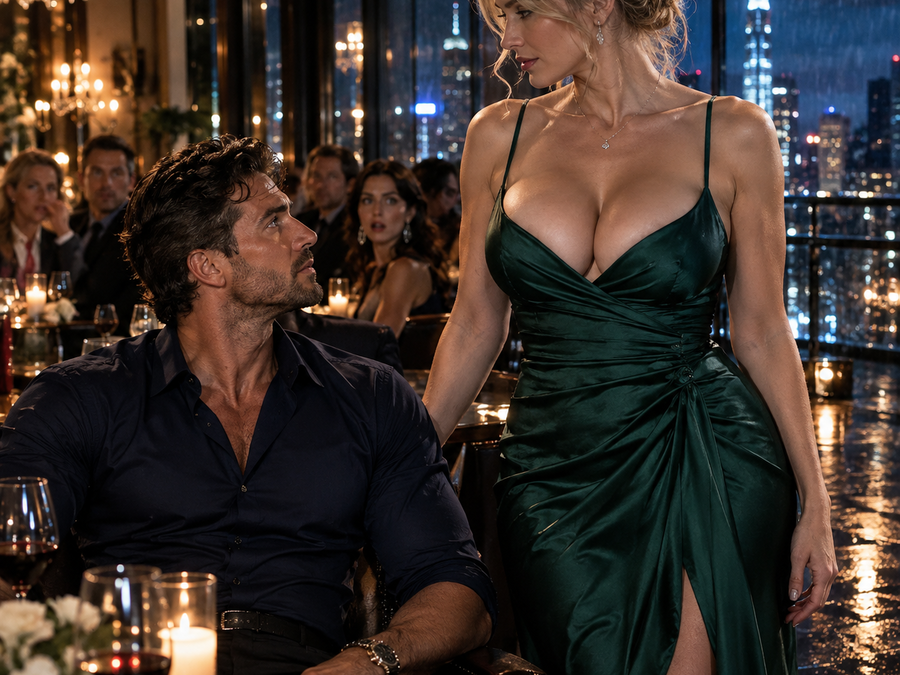
“Single Dad Was Stood Up—Until an Older Billionaire Asked, ‘Would You Date Me’” (Part 1)

PART 1
He sat alone for 40 minutes in one of the most expensive restaurants in the city. A tired single father in a suit that didn’t quite fit, watching the door, checking his phone, pretending not to notice the pity in the waiter’s eyes. His date was never coming. But then the empty chair moved, and the woman who sat down across from him was worth more than most small countries. She was 50. She was a billionaire, and she had just decided that the most interesting man in the room wasn’t at her table. He was sitting at his alone.
The reservation had been for 7:30. By 8:10, Evan Callaway had stopped looking at the door. Not because he’d given up, not exactly, but because there was only so many times a man could glance at the entrance of a restaurant before the gesture stopped meaning anything and started just being sad. The maître d’ had already given him one of those looks. Careful, neutral, the professional kind of pity that expensive establishments trained their staff to deliver without anyone admitting it was pity at all.
Evan turned his water glass in a slow circle on the white tablecloth. The ice had mostly melted. He hadn’t ordered anything. Hadn’t wanted to order anything really because ordering felt like a declaration I’m staying. And some part of him was still leaving the question open. Maybe traffic. Maybe her phone had died. Maybe there was a completely reasonable explanation that would arrive any minute and make this whole miserable evening turn into one of those stories couples told at dinner parties years later, laughing about it.
He wasn’t a fool. He knew she wasn’t coming. He just hadn’t quite talked himself into standing up yet. The restaurant was called Arden. His sister Dana had suggested it—suggested was generous. She’d basically staged an intervention three weeks ago in his kitchen while Milo sat in the next room watching cartoons at full volume. “You need to try, Evan. You can’t just disappear into your own apartment for the rest of your life.” She’d made the reservation herself. She’d even described the woman—Caroline, a graphic designer, recently divorced, no kids, funny in texts, pretty in her profile photo. Dana had been so pleased with herself.
Evan had spent 20 minutes that evening trying to get a juice stain off his tie. He hadn’t managed it completely. The tie now sat slightly crooked across his chest, the knot too thick, because he’d retied it four times in the car and still hadn’t gotten it right. And there was a faint pale ghost of dried apple juice about three inches from the bottom that was only visible if the light caught it from the right angle.
He’d worn the tie anyway. He didn’t own that many. The suit itself was fine. He’d bought it three years ago for a colleague’s wedding. It was the kind of suit that was designed to look acceptable in a photograph and unremarkable in person. And it did both of those things without complaint. It did not look like the suits the men around him were wearing. Those suits had a kind of weight to them, a presence. His suit was present the way furniture in a waiting room was present. None of that had mattered when he’d left the apartment. It mattered now.
At 8:15, the waiter, a young guy named Thomas, according to his name tag, who had perfected the art of approaching a solitary diner with maximum gentleness, came over for the third time. “Can I bring you anything while you wait? Sparkling water, perhaps, or something from the bar?” Evan looked up. “I think I’m—” He stopped, started over. “I’m going to go ahead and get the check.” Thomas nodded as though this was a completely ordinary thing to say and not a quiet little surrender. “Of course.” Evan reached for his coat on the back of the chair.
That was when the chair across from him moved. Not violently, not dramatically, just moved, scraped back from the table in a slow, deliberate arc, and then someone sat down in it, and Evan looked up from his coat with the expression of a man who had genuinely not predicted this particular development, which was the honest truth. The woman across from him was somewhere around 50. She wore a charcoal gray suit that probably cost more than a month of Evan’s rent, and her dark hair was pulled back in a way that suggested it had started the evening in a very precise arrangement, and was now, at this hour, slightly less precise, which somehow made her look more formidable rather than less.
She set a glass of wine on the table with the ease of someone who had always occupied exactly whatever space she chose to occupy. She studied him for a moment. Evan studied her back. “Your date abandoned you,” she said. Her voice was even, not unkind, but not particularly cushioned either. “I’ve been watching you wait for 40 minutes.” “That’s—” Evan wasn’t sure how to finish that sentence. Embarrassing felt accurate. Correct. Also felt accurate. “Yeah.” “I just walked out of a corporate dinner.” She didn’t offer this as a confidence or a vulnerability. It was just information. Stated plainly. “Six people at that table and every single one of them was performing. By dessert, I wanted to pour my wine into a plant and leave. So I did.” “The wine or the dinner.” Her mouth moved—almost a smile. “The dinner. I’m drinking the wine.”
Thomas had appeared again with the supernatural timing of good wait staff, and he looked between the two of them with an expression he was working very hard to keep professional. “Shall I—” Evan looked at the woman across from him, realizing he had no idea what she wanted. He also had no idea who she was. She seemed like someone he should probably know in the vague way that a person could seem important without the reason being immediately clear. “Sparkling water,” she said. “And I’ll look at the menu.” Thomas left. Evan put his coat back on the chair. “I don’t actually know why you sat down,” he said. “Because the alternative was going home at 8:15 on a Thursday, and that seemed like losing.” She picked up the menu, glanced at it briefly, set it back down. “Why should they ruin the rest of our night? Both of us.” “They’re not exactly—I mean, you chose to leave your dinner.” “I did.” She looked at him directly. She had the kind of eye contact that didn’t feel aggressive, but also didn’t give ground. “Your situation was less voluntary.”
Evan laughed. He hadn’t meant to—it came out because it was true and because there was something absurd about having this conversation at all in this restaurant on this particular evening. “That’s a polite way to say it.” “I’m told I’m occasionally polite.” “Only occasionally.” “I don’t like to overpromise.” Her name was Helena. She offered the last name Whitmore, the way people offered a last name when they were used to it meaning something, though she said it without any visible expectation that it would land with significance. It didn’t for Evan. He caught it, filed it somewhere, and extended his own hand across the table. “Evan Callaway.” “Evan.” She shook his hand once, firmly, released it. “What do you do, Evan?” “Architecture. Junior level. I work for a firm downtown. Commercial design, mostly. A lot of office interiors.” “Do you like it?” He considered the question. Most people asked it expecting yes and moved on. “Parts of it. The problem-solving parts. Not the parts where you spend six weeks on a concept and the client decides in a 40-minute meeting that they want everything beige.” “Beige,” she repeated. “It happens more than you’d think.” “I believe you. What else?” He looked at her. “What else?” “What else do you do? Architecture can’t be the whole sentence.”
This was a strange question for a first conversation with a stranger who had sat down uninvited at his table in a restaurant where he’d just been stood up. He would think about that later, the directness of it. The way she asked things like she actually wanted to know the answers and wasn’t just building toward a point about herself. “I have a son. He’s six. His name is Milo. Single father since he was two.” Something shifted very slightly in her expression. She was quiet for a moment. Not an uncomfortable quiet, more like she was taking the information seriously rather than rushing to respond to it. “That’s a lot to carry.” “It’s—” he shrugged, which wasn’t really an answer, but he wasn’t sure what the answer was. “It’s fine.” Sounded like a lie. “It’s the hardest thing I’ve ever done.” Sounded like a complaint, and he didn’t feel like complaining about Milo to a stranger. “It’s my life. I don’t really think about it as carrying anymore. Just the shape of things.” Helena looked at him steadily. “That’s a good answer.” “Is it better than the ones I usually get?” Evan wasn’t sure what that meant. He let it go.
Thomas came back with the sparkling water and took their orders. Evan ordered something modest—the soup, the salmon, the second cheapest thing on the menu with the careful internal calculation that he’d been doing since he’d looked at the menu prices online that afternoon and done a quiet private reckoning that he’d never admit to anyone. Helena ordered without looking at the menu again. They talked through the first course. It wasn’t the way Evan had expected the evening to go—sitting across from a woman he hadn’t planned to meet. Talking about architecture and child-rearing and whether the city’s new transit development made any practical sense. They both agreed it didn’t, though for different reasons.
Helena argued infrastructure from a position of someone who had clearly spent time in enough cities to have actual comparative data. Evan argued it from the position of someone who took the subway every morning and knew exactly which platforms flooded when it rained. She listened when he talked, not nodding and waiting, but actually listening. It made him slightly self-conscious once he noticed it, which made him talk differently, more carefully. And then when he caught himself being more careful, less carefully again. “You went quiet,” she observed. “I was thinking about something.” “What?” He debated whether to say it, then said it. “You listen like you’re actually paying attention.” “I am.” “Most people listen like they’re waiting for their turn.” Helena tilted her head slightly. “Most people in my world listen like they’re building a case.” “That sounds exhausting.” “It is.” She said it without self-pity, just as a statement of fact. “You stop noticing after a while. Then you’re at dinner and someone starts talking about a juice stain on his tie.”
Evan looked down at his tie. “And you realize,” she continued, “that you haven’t heard anyone say anything unrehearsed in longer than you can remember.” It was quiet for a moment. “It’s apple juice,” he said. “My son. This afternoon, before the babysitter arrived. I tried to get it out.” “I know. You keep touching it.” He hadn’t realized he’d been doing that. He moved his hand away from the tie. “How much does a babysitter cost?” Helena asked. Tonight, it was a strange question. Not rude, just direct in a way that cut through a layer of the evening that Evan hadn’t planned to discuss. “Why?” “I’m curious about the actual arithmetic of your life.” He looked at her for a second. “$50. She charges 15 an hour. So, every hour we sit here costs you $15 plus the meal.” “Yeah.” Helena said nothing for a moment. Then, “Then we should probably make it worth the money.”
Evan laughed again—the second time that evening, which was already more than he’d expected when he’d left the apartment, and something in the conversation loosened after that. The way things loosened when both people stopped being careful at exactly the same time. He told her about Milo’s obsession with dinosaurs. Not just the common ones, the T-Rex, the Triceratops, the ones on lunchboxes, but the obscure ones. Milo could tell you the difference between a Carnotaurus and a Ceratosaurus at six years old and would correct anyone who got it wrong, including his kindergarten teacher, which had led to a parent-teacher conference that Evan still wasn’t entirely sure had been resolved in anyone’s favor. Helena’s mouth curved—a real smile this time, not the careful almost-one from before. “He sounds formidable.” “He’s terrifying,” Evan said, and meant it as a compliment.
She told him briefly and without much detail about the company she ran, an investment firm, large. He gathered large in the way that her tone shifted slightly when she said it, the careful neutrality of someone describing something that other people tended to react to. He nodded and asked, “What kind of investments?” And she seemed mildly surprised that this was his follow-up question. “Infrastructure primarily. Some tech. Real estate development.” “Any architecture firms?” “A few. Nothing residential.” “Pity,” he said it without thinking. “That’s where the interesting problems are.” She looked at him. “Why interesting?” “Because residential design is about how people actually live. Commercial design is about how people project that they work.” He paused. “Sorry. That’s probably not—” “No,” she said. “Keep going.” He did.
He talked about a project he’d been pushing at the firm—affordable family housing with actual attention paid to light and communal space instead of just cubic footage efficiency. His bosses hadn’t been enthusiastic. The margins weren’t there. “They said—” Evan thought the margins weren’t the point, which was exactly the kind of thinking that kept him at junior level, according to his bosses. He said all of this and then stopped and looked across the table and noticed that Helena Whitmore was watching him with the same focused attention she’d been giving him all evening. And it occurred to him suddenly and rather forcefully that he had no idea who she actually was.
He’d caught the name. He’d caught investment firm and large. He hadn’t connected them to anything specific because he wasn’t someone who tracked that world. He knew buildings. He knew Milo’s school schedule and the transit map and which grocery store had the best prices on the specific brand of frozen waffles that Milo ate every morning without variation. He didn’t know who Helena Whitmore was, and she, it seemed, understood this perfectly. By the time the check arrived, they’d been at the table for nearly two hours. Thomas brought the bill without being asked because Thomas was good at his job. Evan reached for it out of reflex, checked the total, and kept his face very still. Helena moved the check toward herself. “You don’t have to,” he started. “I know I don’t have to.” She glanced at the amount, set her card on the folder without blinking at a number that Evan’s face had needed a full second to process. “You can argue with me if you’d like, but you’re paying a babysitter by the hour.”
He wanted to argue. He understood that arguing would be the right thing to do, the dignified thing, the thing that a man with any pride would do. He also understood that the number on that check was going to take him three weeks to recover from if he put it on his card tonight. He didn’t argue. “Thank you,” he said instead. She looked up. “You mean it?” “Yes.” Something in her expression shifted barely, just at the edges, like she’d been waiting to see whether he’d perform gratitude or feel it. And she’d gotten her answer, and it had surprised her a little. “You’re welcome,” she said.
They gathered their coats. The restaurant had thinned out around them. The couples and business dinners winding down. The evening tilting toward late. Evan helped Helena with her coat without thinking about it, just because he was closer to it, and she let him, which also seemed to require a small internal adjustment on her part. “I should find my driver,” she said. Evan nodded. They walked toward the door and the maître d’ said goodnight with a particular warmth that establishments reserved for people who had significantly above average and they stepped out into the city air, which was cold and sharp and immediate in the way that nighttime cities were—all noise and light and distance.
Evan looked at this woman who had sat down across from him and turned a completely wrecked evening into something he couldn’t quite name yet. He still didn’t know who she was. He thought for a half second about asking for her number. Then he thought about Milo at home, probably already asleep, and the babysitter checking her watch, and the $15 per hour ticking quietly in the background of everything. “This was—” he started. “Unexpected,” she said. “That’s the word.” She almost smiled again. “Good night, Evan.” “Good night, Helena.” Her car was waiting at the curb, a long dark thing with a driver who stepped out before she’d reached the sidewalk. She moved toward it without looking back. Evan watched until the car merged into traffic and disappeared, then stood there another moment in the cold, alone on the sidewalk outside the most expensive restaurant he’d ever eaten in without actually paying for the meal.
He reached into his pocket, pulled out his phone, called the babysitter to let her know he was on his way. And the whole ride home on the subway in the cold, he couldn’t figure out who Helena Whitmore was, but he couldn’t stop thinking about the way she’d listened. Like what he said actually mattered. Like she hadn’t decided the answer before he’d finished the sentence. He’d forgotten what that felt like. He hadn’t realized until tonight how much he’d missed it.
He didn’t look her up that night. That was the first thing. He got home, paid the babysitter, a college junior named Priya, who lived two floors up, and had the particular gift of being both reliable and unbothered by Milo’s habit of conducting full-volume dinosaur lectures at unpredictable hours, and then stood in his kitchen for a while, eating the leftover half of a sandwich he’d made that afternoon and didn’t remember leaving in the fridge. The apartment was quiet, the way apartments got quiet when a six-year-old was asleep in the next room, which was a specific and particular quiet that still felt slightly unreal to Evan after four years of it. Not empty, just held.
He thought about looking her up. He didn’t. It wasn’t principle exactly. It was more that the evening had felt like something complete in itself—a strange, accidental thing that had happened and that he wasn’t ready to dismantle with information. If he searched her name and found out she was exactly as significant as her car and her suit and the way the restaurant staff had moved around her suggested, then the whole thing would rearrange itself in his memory into something different. A story about a powerful woman who’d briefly entertained herself with a regular person. He’d had enough of that feeling for one night. So he finished the sandwich, checked on Milo sleeping on his back with one arm flung over the edge of the bed, small plastic Ankylosaurus tucked under his chin, which was a new thing, and went to bed. He didn’t sleep particularly well.
In the morning, Milo wanted waffles, which was not a surprise, and wanted to know why Evan looked tired, which was also not a surprise because Milo had the observational instincts of a small, relentless detective and had been this way since approximately age four. “I didn’t sleep great,” Evan said. “Was it the date?” Milo asked entirely without tact. Because tact was not yet in his repertoire. Evan looked at his son. “Dana told you about the date.” “She said you were going on a date and you looked scared.” “I wasn’t scared.” “You look scared sometimes when you think I’m not looking.” Evan put a waffle in the toaster and didn’t say anything to that because there wasn’t a good answer that was also honest and also appropriate for a six-year-old at 7:00 in the morning.
“Was she nice?” Milo asked. “The date didn’t really—” Evan stopped. “It’s complicated.” Milo considered this. “Did she not like dinosaurs?” “I don’t know. We didn’t get to that.” “That’s bad,” Milo said with complete seriousness. “That’s—that’s an important thing to know about a person.” Evan had to agree that it was probably important. He dropped Milo at school, went to work, sat through a two-hour meeting about a commercial lobby redesign in which a client said the word dynamic 14 times in reference to a floor plan that was by any objective measure a rectangle. He drew small, careful boxes in the margin of his notepad while the meeting ran long. He thought periodically about Franklin’s Diner, which was three blocks from his office.
That was what Helena had said the night before. “Take me somewhere ordinary.” She’d said it standing outside Arden while her driver waited at the curb and Evan had been so off-balance from the whole evening that he’d answered honestly, “I know a diner.” She’d said, “Perfect.” He’d assumed she was being polite. She had not been being polite. He found out exactly how not polite she’d been two days later because that was how long it took for him to look her up. He’d caved on a Tuesday afternoon, sitting at his desk with a half-eaten granola bar and a search engine and the specific kind of curiosity that had finally worn through his resistance.
Helena Whitmore, 50 years old, founder and CEO of Whitmore Capital Group, a private investment firm with holdings across infrastructure, commercial real estate, technology, and several other sectors that took Evan a few minutes to fully absorb. The firm managed assets somewhere in the range of figures that required him to count the zeros twice to make sure he was reading correctly. There were photographs—formal ones, mostly board meetings, industry conferences, a magazine profile from three years ago with a headline about women who had reshaped the financial landscape. She looked the same in the photographs as she had across the table from him. Composed, direct, completely at ease with being the most significant person in the room.
He sat with that for a while. He’d had soup and salmon with her. He’d told her about Milo’s kindergarten teacher standoff over dinosaur taxonomy. He’d complained about his boss’s preferring margins over design integrity. She’d listened to all of it with the same focused attention, and he hadn’t known. He genuinely hadn’t known, and she’d understood that and hadn’t corrected it. He thought about that for the rest of the afternoon. He thought about it on the subway home. By the time he was making dinner, he’d decided that the most sensible course of action was to forget the whole thing. Not cruelly, just realistically. Helena Whitmore did not need anything from his particular corner of the world, and he had a grocery budget and a school schedule and a son who needed an Ankylosaurus replaced because the tail had finally snapped off, and that was his life, and it was enough.
He’d almost completely talked himself into this when his phone buzzed with an unknown number. “The diner you mentioned. Franklin’s. I looked it up. Is it as good as the fries suggest, or are you one of those people who oversells local places to seem relatable?” He read it twice. He typed back, “Who is this?” A pause. Then: “Helena.” Another pause, slightly longer. Then: “You didn’t look me up.” It wasn’t a question. He thought about how she would know that. He thought about the fact that he’d only looked her up today. And she’d apparently been waiting to see whether he would. And now she knew he hadn’t done it immediately. “I looked you up today,” he wrote back. And he thought about what to say. He typed several things and deleted them. Eventually, he wrote, “The zeros were alarming.” Three dots appeared, disappeared, appeared again. Then: “They alarm most people.” “They didn’t seem to alarm you.” “I’ve had 20 years to get used to them.”
Evan sat in his kitchen, phone in hand, aware that this was the moment where the sensible thing and the actual thing were two completely different things. He typed, “The fries are genuinely good. Not overselling.” Her response came back in under a minute. “Friday.” He wrote, “That’s not a question.” “No,” she agreed. “It isn’t.” He looked at the ceiling for a moment, then he texted Priya about Friday.
Franklin’s Diner existed in that particular category of New York establishment that had survived 60 years of neighborhood change through sheer stubbornness and the loyalty of regulars who would follow it through a flood. It occupied a corner slot on a side street that most people in the neighborhood walked past without registering, unless they already knew it was there, at which point it became the only thing they could see. The booths were red vinyl, cracked along the seams in patterns that had been cracking since roughly 1987. The lighting was the specific amber of places that had never updated their fixtures. The menu was laminated and slightly sticky and had photographs of approximately 40 different items, most of which involved eggs in some configuration.
Evan got there first on Friday and took the booth in the back corner, which had the best sight lines to the door and also a slight lean to the table that you had to account for when setting down a mug if you didn’t want it to drift. Helena came in at 7 exactly. She was wearing different clothes than the charcoal suit—dark jeans, a cream-colored top, a coat that was still clearly expensive, but less formally so. Her hair was down. She looked around the diner the way someone looked around a place they’d been curious about, taking it in without performing the taking in. And then she found him in the back and crossed the restaurant with the same directness she’d crossed the dining room at Arden four days ago. Slid into the booth. “Okay,” she said, looking around again. “I understand the fries. The whole thing.” She picked up the menu, looked at the photographs. “This is someone’s actual favorite place.” “It was my father’s,” Evan said. “He used to bring me here when I was a kid. After he moved out, we’d come here on Sundays.”
Helena looked at him. He hadn’t planned to say that. It had come out because the diner had a way of loosening things, which was probably why his father had chosen it. Neutral ground, a place where things felt smaller in a useful way. “I bring Milo here,” he added. “He orders chocolate milk and takes the pickles off his burger and lines them up on the edge of the plate. And I used to try to get him to eat them, and now I’ve given up. So we just sit there with this little line of pickles in the corner.” Helena’s mouth moved. “How many pickles?” “Three usually. Sometimes four if he’s feeling ambitious.”
Martha, the woman who’d been working weekend and Friday evenings at Franklin’s for as long as Evan had been coming, appeared at the table with two mugs and the coffee pot already in hand. She looked at Helena the way she looked at most people Evan brought to the diner, which was with a careful and comprehensive appraisal delivered over roughly three seconds. “Coffee?” Martha asked. “Please,” Helena said. Martha poured without further comment and disappeared. Helena wrapped both hands around the mug and looked at the coffee with an expression that suggested she was accustomed to a very different quality of coffee and had decided actively not to hold this against it. She took a sip. “It’s terrible,” she said. “It’s famously terrible.” “I’ve had coffee in 40 countries. This is comfortably in the bottom five.” “That’s actually impressive,” Evan said. “I think they’ve been using the same beans since the Clinton administration.”
She laughed. It was a different laugh than the careful, controlled expression she’d deployed at Arden—shorter, more genuine, slightly surprised by itself. She looked briefly younger when she laughed. And then the expression settled back and she was 50 again, which was fine because 50 suited her in the way that some people wore their age, like a fact they’d made peace with. They ordered. Helena ordered the fries as promised and a burger, which she’d studied on the laminated menu with the same focus Evan had seen her apply to everything else. He ordered the same. Martha brought them their food without ceremony, set the plates down like she was completing a transaction rather than providing a service, which was exactly right for the diner.
Helena looked at the plate in front of her. “These are enormous,” she said. “Yeah.” She picked up a fry, ate it, considered. “Okay,” she said. “I was wrong to doubt you. The fries don’t lie.” “No.” She ate another one. “What does Milo order here?” And they were back in it—the same way they’d been at Arden. Talking. Actually talking in the way that Evan had forgotten was possible with someone he’d only just met. He told her about Milo’s current phase, which involved both dinosaurs and an intense interest in whether the moon was actually on fire, which it was not. But Milo had a friend at school who had stated this with great confidence, and Milo was keeping the question open, pending further evidence.
Helena found this genuinely funny and didn’t pretend otherwise. She told him things, too. Not the things from the magazine profile—those were already public, available to anyone with a search engine—but the other things. That she had grown up in a two-bedroom apartment in Baltimore with her mother and an older brother. And that her mother had worked double shifts at a hospital administration desk and had still somehow made dinner most nights, and that watching her mother do that had taught Helena more about resource management than any MBA program. That she’d started the firm at 31 with a combination of savings, a small loan, and a level of confidence she now recognized as partially delusional in the best possible way. That she hadn’t taken a vacation in four years. Not because she couldn’t, but because she’d stopped being able to locate the version of herself that would have enjoyed one.
“What would you do?” Evan asked. “If you took one.” “I have no idea,” she said it plainly. “That’s the problem.” “You could start with bad coffee and good fries.” She looked at him across the table. “I appear to be doing that.” The diner filled up around them—the Friday evening crowd. A mix of regulars and younger people who’d found the place on some neighborhood app. A family with two kids in the booth near the front who were conducting some negotiation about dessert that was getting progressively louder. Helena noticed the family without making a thing of it. She watched them the way she watched most things, with attention she didn’t advertise. “You ever wish it was different?” She asked. “What?” “Being alone? Doing it alone?” Evan looked at his coffee mug. The question was direct enough that it deserved a direct answer, and he thought about giving her a measured one, the kind he gave people who asked about Milo’s mother with the careful, interested faces of people who mostly wanted a story. He decided against it. “Every day,” he said. “Some days more than others. But if you’re asking whether I wish I hadn’t had Milo, I’m not asking that.” “No.” “Yeah, I know.” He set the mug down. “It’s just—it’s hard to separate. He’s the reason I’m doing it alone, and he’s also the reason it’s worth doing. Those two things live in the same place.”
She was quiet for a moment. “That’s honest.” “You asked an honest question.” “Most people don’t answer honestly.” “I’m not most people.” “No,” she said. “You’re not.” There was a moment after that where neither of them said anything, and the diner noise filled the space—the family negotiation at the front table, Martha calling something through the window to the kitchen, scrape of a chair nearby. It wasn’t uncomfortable. It was the kind of quiet that settled between two people who had temporarily run out of words and were fine with it. Then Helena reached across the table and stole one of his fries. He looked at her. “You have more than me,” she said without any apology in it. “I do not have more than you. Count them.” He didn’t count them. She ate the fry with complete composure. He pushed the plate toward the middle of the table. They split the fries. Martha came by and refilled the coffee without being asked.
They talked about the city’s development projects, which Evan had opinions about from an architectural standpoint, and Helena had opinions about from an investment standpoint, and their opinions overlapped in some places and disagreed sharply in others, and disagreeing with her was, Evan found, not uncomfortable. She didn’t take it personally. She didn’t back down unless she actually thought he was right. And when she did think he was right, she said so directly without making a production of conceding. It was, he thought, the clearest conversation he’d had with another adult in a long time that wasn’t about Milo’s school or his firm’s billing cycles or Dana’s ongoing efforts to reorganize his life. At 9:15, he checked his phone—not anxiously, just a reflex. Priya was fine. Milo had gone to bed at 8:30 without incident, which Priya had texted with two exclamation points because it was unusual enough to warrant them. Helena watched him check the phone. “He’s okay,” she asked. “Yeah, he’s asleep.” “What time does he wake up?” “6:30. On good days. If he’s excited about something.” “What’s he excited about this weekend?” Evan thought about it. “There’s a thing at the Natural History Museum. Dinosaur exhibit. I told him we’d go Saturday.” Helena looked at him. “You’re tired,” she said. Not as an accusation, just as an observation. “I’m fine.” “You’ve been awake since 6:30. You worked all day. You’re having coffee that’s roughly the quality of hot ditch water.” “I made a choice,” he said. She studied him. Then she said carefully. “Can I ask you something?” “You’ve been asking me things all night.” “This one’s different.” A pause. “When did you last do something just because you wanted to? Not for Milo. Not for the firm. Just for yourself.” He opened his mouth. Nothing came out immediately. “Don’t say tonight,” she added. “You came here tonight partially because you were curious and partially because you felt like you owed me the benefit of the doubt.” “That’s very specific.” “Am I wrong?” He thought about it. “No.”
So when the honest answer was that he couldn’t remember. He’d been through long enough stretches of grocery budgets and school pickups and late nights reworking plans that the clients rejected anyway, that the question itself felt slightly theoretical, like being asked to describe a color he’d seen once years ago in different light. “I don’t know,” he said. Helena didn’t push it, didn’t offer a solution or a reframe. She just nodded once, like that was an answer she’d been expecting and had decided to sit with rather than fix. That was the thing about her, Evan was starting to understand. She didn’t try to fix things she hadn’t been asked to fix. She just paid attention.
They stayed until Martha started wiping down the tables around them with the pointed efficiency of a woman who was not going to say we’re closing, but was very clearly thinking it. Evan left a tip that was generous relative to his budget, which he did every time he came here because his father had taught him that, and it had stuck. Helena noticed—she noticed most things—but didn’t comment. Outside, the city was doing what it did on Friday nights, which was being loud and bright and indifferent to individuals in the way that cities were indifferent. That enormous collective hum of everyone having their own evening simultaneously. Her car was at the curb. He’d expected that. He hadn’t expected her to pause on the sidewalk.
“I want to ask you something else,” she said. “Another one.” “Last one tonight.” She looked at him steadily. “Why haven’t you asked me anything about the money?” He thought about the question. “What would I ask?” “Most people want to know how it works. What it’s like. Whether it changes things.” She said it without defensiveness, just documentation. “They get curious in a particular way.” “I’m curious about other things.” “Like what?” “Like why you walked out of your dinner on Tuesday and sat down at a stranger’s table.” He looked at her. “The money seems like the least interesting thing about you.” She was quiet for a moment. The car idled at the curb. A cab went by. “Nobody’s said that to me in a long time,” she said. “Said what?” “That.” She didn’t specify further. She didn’t need to. Evan looked at her for a moment. “I’ll say it again whenever it applies.” She looked at him with an expression he couldn’t quite read—not guarded, not open. Something in the middle that suggested she was working something out internally, and wasn’t sure of the answer yet. Then she moved toward the car. “Saturday,” she said without turning around. “What about Saturday?” She paused with her hand on the door. “You said the Natural History Museum. What time?” He blinked. “Helena, I’m—” “I’m asking what time.” She turned slightly. “I haven’t been to the Natural History Museum in 15 years. I used to like the blue whale.” Milo, will he—” She stopped. “He’s going to have opinions.” “I assumed.” “He’s going to tell you everything that’s wrong about the dinosaur exhibits.” “I look forward to it.”
Evan stood on the sidewalk and tried to find the part of this that was a bad idea. He could identify several components that should theoretically constitute a bad idea. Couldn’t locate the feeling of it being one. “10:00,” he said. She nodded once, got in the car, he watched it go. Then he stood there another moment in the Friday night noise. Hands in his coat pockets, thinking about a 50-year-old billionaire who hadn’t been to the Natural History Museum in 15 years and missed the blue whale. And his six-year-old son, who would absolutely, without question, tell her everything that was wrong with the fossil labeling methodology in the main hall. He pulled out his phone, texted Priya to let her know he was on his way. Then he typed a message to Dana. “The date stood me up.” Three seconds later, “I know. I’m so sorry. She texted me and excused that.” “It’s fine,” he wrote back. “Something else happened.” A longer pause. Then: “Evan, what did you do?” He put the phone in his pocket and walked toward the subway. He didn’t answer her until the next morning, because some things deserve to be thought about first, and some things deserve to be kept close for a little while before they got handed to other people’s reactions. He’d forgotten that feeling, too. The feeling of something that was just his, at least for one more night.
Milo didn’t know who Helena was. That was the thing Evan kept coming back to on Saturday morning while he was making waffles. And Milo was sitting at the kitchen table with a dinosaur encyclopedia the size of a small brick, cross-referencing something with the focused intensity that six-year-olds applied exclusively to things they cared about deeply. Milo didn’t know who Helena Whitmore was. He didn’t know about Whitmore Capital Group or the asset figures or the magazine profile or the car that materialized at curbs before she’d finished walking toward them. He didn’t have any of that information and it wouldn’t have meant anything to him if he did. Milo was going to evaluate Helena Whitmore entirely on her own merits as he understood merits, which meant she would be assessed on whether she was interesting and whether she was honest and whether she knew anything about dinosaurs. Evan suspected she was going to fail the last one spectacularly.
He told Milo over waffles that someone was meeting them at the museum. A friend, a woman named Helena who Evan had met recently. He’d kept it simple because simple was the right register for a six-year-old on a Saturday morning and also because he didn’t entirely know what else to say. Milo had processed this information while eating his second waffle and then asked without looking up from it. “Does she know about dinosaurs?” “I don’t know,” Evan said. “Does she seem like someone who would?” Evan thought about Helena in the diner booth eating fries with the composed focus of someone who applied genuine attention to everything they did. “I honestly can’t tell.” Milo considered this. “We’ll find out,” he said with the tone of someone who had handled uncertainties before and emerged fine.
They took the subway uptown, which Milo loved because the express trains made a sound between stations that he had decided at age four was the train thinking, and he had never fully revised this position. He sat next to Evan with the Ankylosaurus in his jacket pocket—the new one ordered online three days after the tail snapped off the old one. Slightly different shade of green, but otherwise acceptable—and watched the tunnel go by. “What’s her last name?” Milo asked. “Whitmore.” “Helena Whitmore?” He tried it out. “That sounds like a person in a movie.” “She’s not in a movie.” “I know. I’m just saying.” He looked back at the tunnel. “Is she nice?” “I think so.” “Yeah.” “You think so?” “She’s—” Evan paused. “She’s honest. Sometimes more honest than you expect.” Milo seemed to find this acceptable. He didn’t ask anything else.
Helena was waiting at the museum steps when they arrived, which Evan had not expected. He’d half anticipated the car pulling up at 5:10 with an apologetic explanation about traffic, but she was already there, standing near the top of the steps in a coat that was slightly more casual than the Arden charcoal suit, and considerably more casual than anything the magazine profile had photographed her in. She was looking at something on her phone and she looked up when she heard them on the steps and she did something that Evan would think about later. She put the phone in her pocket before they reached her. Not mid-sentence, not after finishing whatever she was reading. She just put it away and gave them her attention.
Milo looked up at her from approximately three feet below eye level. Helena looked down at him. “You’re Milo,” she said. “You’re Helena Whitmore,” Milo said. “That sounds like a person in a movie.” “It does a little,” she agreed. “Dad said you’re honest.” Helena glanced at Evan very briefly with an expression that suggested she found this characterization both accurate and slightly amusing. “Your dad’s generous,” she said. “He said sometimes more honest than you expect.” “Also accurate.” Milo appeared to have completed his initial assessment. He turned toward the museum doors. “The Titanosaur is inside,” he said. “It doesn’t fit, so they have to put part of its neck in the hallway. 72 feet long.” “I know,” Helena said. Milo stopped, turned back. This was apparently significant. “You know about the Titanosaur? Patagotitan mayorum? Covered in Argentina. They cast the bones because the originals are too fragile to display.” She said it evenly without showing off, just as information she happened to have. “I read about it when they installed the exhibit.” Milo stared at her for a moment with the expression of someone radically revising an initial estimate. Then he turned and walked through the doors and his pace had quickened. Evan looked at Helena. “I did some reading last night,” she said. “How much reading?” “Enough.”
They went inside. The Natural History Museum on a Saturday morning was its own specific kind of organized chaos. School groups moving in coordinated clusters. Families with strollers that took up the width of the hallway, small children running in the peripheral vision of parents who were managing the particular exhaustion of trying to make a cultural experience feel fun. Evan knew the museum well enough to navigate it efficiently, which was the only way to navigate it. He knew which elevators were faster, which bathrooms had the shorter lines, which angles of the whale room Milo liked best. Milo went directly to the fourth floor, which was where the dinosaurs were. Because for Milo, the museum had exactly one floor that mattered, and the rest were context.
He walked Helena through the hall of Saurischian dinosaurs with the focus of someone who had prepared for this. He corrected two of the exhibit labels, not loudly, not for performance, just as factual amendments he felt should be noted. He explained at length the difference between an Allosaurus and a Ceratosaurus and why people got them confused, which they shouldn’t, because the differences were obvious if you looked at the skull structure. Helena listened, not in the patient waiting-for-the-child-to-finish way that adults often listen to children. She actually listened, and when she asked a question, it was a real question. “What makes the Carnotaurus different from the others in this family?” she asked in front of the relevant display case. Milo looked up at her with an expression that was three parts suspicion and one part excitement, which was the expression he wore whenever he thought someone might actually be interested. “The horns,” he said. “And the arms are even smaller than T. Rex. Almost vestigial.” “Vestigial is a big word.” “I know what it means.” “I didn’t say you didn’t.”
