“He thought I was a supply clerk. He was about to find out exactly how wrong he was.”
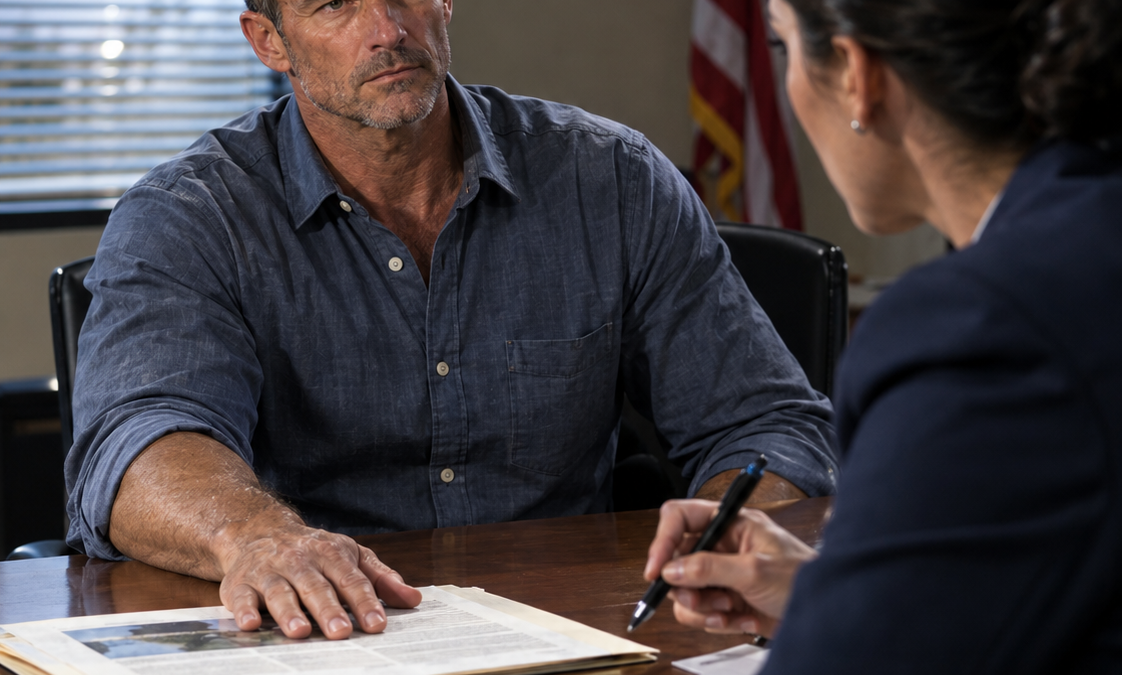
“My father-in-law asked me to pass the salt. Then he asked me to commit a federal crime. That’s not how he phrased it, of course.”
They thought the quiet veteran who married into the family was beneath them → They watched him stand on a Marine Corps base while the Commandant thanked him for his service.
Then he asked me to commit a federal crime.
That’s not how he phrased it, of course. Richard Calloway never phrased anything directly. He was a man who had spent forty years in defense contracting, and in that world, you learned to say everything without saying anything. He could make a bribe sound like a favor and a threat sound like a compliment.
What he didn’t know was that I had spent twelve years learning to hear exactly what people like him were actually saying.
My name is Daniel Mercer. I was forty-four years old when my father-in-law tried to use me to obstruct a federal investigation. I was a former Marine Corps Force Recon operator, and I had spent the better part of two decades doing things I still couldn’t talk about. The man across the table from me saw a quiet, weathered contractor who had married his daughter and settled into a boring civilian life.
He saw what I let him see.
The Calloway estate sat on eleven acres of manicured Virginia horse country, about forty minutes outside D.C. The main house was a colonial revival monstrosity with white columns and black shutters and a driveway long enough to land a helicopter. Richard had bought it in 2003, right after Calloway Defense Systems landed its first major Pentagon contract. The house was his monument to himself.
We were in the formal dining room. Crystal chandelier. Mahogany table that could seat sixteen. Portrait of Richard’s grandfather over the fireplace — some banker from Richmond who had lost everything in the Depression and never let anyone forget it. Richard liked to say he had rebuilt the family fortune from nothing.
What he didn’t say was that he had rebuilt it by cutting corners on equipment that soldiers wore into combat.
My wife, Sarah, sat to my right. She was Richard’s only daughter, and she had spent her whole life trying to earn his approval and failing. She had married me against his wishes — I was enlisted, I had no family money, I had spent most of our early years deployed to places she couldn’t know about. Richard had made it clear that I was a disappointment.
Sarah had made it clear that she didn’t care.
That was twelve years ago. We had two kids now — Tyler, ten, and Emma, seven. We lived in a modest house in Fredericksburg, about an hour south of her parents. I worked as a security consultant for a private firm. It paid well enough. It was boring. That was the point.
Sarah’s mother, Eleanor, sat at the far end of the table, nursing a glass of white wine and watching her husband with the tired patience of a woman who had learned to read his moods decades ago. She was the only Calloway who had ever treated me like a human being.
And then there was Marcus.
Marcus Calloway was Sarah’s younger brother by three years. He was the golden child — the one who had gone to Yale, the one who had taken over the family business, the one who had never spent a day in uniform and never missed an opportunity to remind everyone that he had “real responsibilities.” He was forty-one years old, and he still dressed like he was trying to impress a fraternity brother. Tonight it was a navy blazer and an open-collared shirt that probably cost more than my first car.
Marcus sat across from me. He hadn’t stopped smiling since I walked in.
“So, Danny,” he said, leaning back in his chair. “Still doing the security thing?”
I let the nickname slide. Marcus had been calling me Danny for twelve years, ever since he figured out it annoyed me.
“Still doing it,” I said.
“Must be nice. Low stress. Regular hours.”
“It has its moments.”
Sarah’s hand found mine under the table. She knew what Marcus was doing. She had watched him do it at every family dinner since we got married.
Richard cleared his throat. The signal.
“Actually, Daniel,” he said, “I was hoping we could talk. Man to man.”
The table went quiet. Eleanor set down her wine glass. Marcus’s smile widened.
“Of course,” I said.
“After dinner. My study.”
I nodded. I took a bite of the roast lamb. It was excellent, as always. The Calloways employed a chef who had trained in Lyon.
Under the table, Sarah squeezed my hand harder.
The study was Richard’s inner sanctum. Leather chairs. A desk the size of a small boat. Shelves lined with books he had never read and photographs of himself with people who mattered. A framed picture of him shaking hands with a senator. Another of him at a charity gala, arm around his wife, smile wide and fake.
He closed the door behind us. Gestured to a chair.
“Drink?”
“No, thank you.”
He poured himself two fingers of Scotch anyway. Sat down behind the desk. Studied me the way a man studies a contract he’s about to sign — looking for loopholes.
“You’ve been with Sarah for twelve years now,” he said.
“Thirteen in June.”
“Thirteen. Right.” He took a sip. “I’ll be honest with you, Daniel. I wasn’t happy when she married you. You know that.”
“I know.”
“You had no money. No prospects. You were… what was it? Military?”
“Marine Corps.”
“Right. Marines.” He said it the way someone might say “janitorial staff.” “But you’ve proven yourself. You’ve been a good husband. A good father. You’ve stayed out of trouble.”
I waited.
“The thing is,” he continued, “I’m in a bit of a situation. And I think you might be able to help.”
“What kind of situation?”
He leaned forward. Set down his glass. Folded his hands on the desk.
“There’s an investigation,” he said. “Federal. Into some of our contracts. It’s routine — these things happen in defense work. But some overzealous prosecutor has gotten it into their head that there’s something improper about how we handled a few procurement deals.”
“Improper how?”
“Nothing criminal. Just… paperwork issues. Technicalities. But you know how these things can snowball.”
I knew exactly how these things could snowball. I had seen it happen. I had been part of it.
“The investigators,” Richard said, “they’re from a joint task force. Navy CID, Defense Criminal Investigative Service, and some others. They’ve been interviewing our people. Subpoenaing documents.”
“That sounds serious.”
“It’s manageable. If we handle it correctly.” He paused. “The lead investigator — a woman named Captain Alvarez — she’s been asking about a specific component. The M-47 targeting module.”
I kept my face still. My heart rate stayed steady. The training never really leaves you.
“What about it?”
“There was a batch that had some… quality control issues. We caught it. We fixed it. But the paperwork trail is messy, and she’s trying to make something of it.”
“Quality control issues.”
“Minor ones.”
“How minor?”
Richard’s jaw tightened. He didn’t like being questioned. He was used to people nodding along.
“A few units malfunctioned in testing. No one was hurt. We issued a recall, replaced the affected units, and moved on.”
No one was hurt.
That was a lie.
I knew it was a lie because I had been there. Not at his company — I had never worked for Calloway Defense Systems. But I had been on the other end of that equipment. I had worn it. I had trusted it.
And I had watched it fail.
But Richard didn’t know that. Richard didn’t know anything about what I had actually done in the Marine Corps. He thought I had been a logistician. A supply clerk. Something boring and safe that he could dismiss.
That was the story I had let Sarah tell him. She didn’t know the truth either — not all of it. She knew I had been in Force Recon. She knew I had deployed. She didn’t know the details. She had never asked, and I had never volunteered.
Some things you don’t talk about. Some things you can’t.
“The investigation,” Richard said, “is going to conclude in a few weeks. There’s a hearing. I need to make sure the right narrative gets out there.”
“What does that have to do with me?”
“I need someone to talk to the investigators. Someone they’ll trust. Someone with a military background.”
“You want me to talk to them.”
“I want you to… provide context. Explain how these things work. How a minor QC issue can look bigger than it is. You were in the service. You understand the procurement process.”
“I was a supply clerk,” I said. The lie tasted like copper.
“Exactly. You can speak their language. Make them understand that this is a misunderstanding.”
I looked at him for a long moment. The leather chair creaked as I shifted my weight.
“You want me to lie to federal investigators.”
Richard’s expression flickered. Just for a second.
“I want you to tell the truth,” he said. “The truth is that Calloway Defense Systems makes the best equipment in the world. Sometimes things go wrong. We fix them. That’s the story.”
“That’s not the truth.”
“Daniel—”
“There was a recall on the M-47. What year?”
He hesitated. “2019.”
“And the units that malfunctioned — where were they deployed?”
“I don’t see how that’s relevant.”
“Because I was in Afghanistan in 2019. And I knew men who were using M-47s.”
Richard went very still.
“That’s a coincidence,” he said.
“Is it?”
“Daniel, I don’t think you understand the position you’re in. I’m not asking you to do anything illegal. I’m asking you to help your family.”
“By obstructing a federal investigation.”
“By providing context.” His voice hardened. “You married into this family. You have a responsibility to protect it. Sarah, the kids — they depend on this company. On me. If this investigation goes the wrong way, everything we’ve built could fall apart.”
“Everything you’ve built.”
“Our family’s legacy. Your children’s inheritance.”
I stood up.
“I’ll think about it,” I said.
Richard’s eyes narrowed. “That’s not an answer.”
“It’s the only one you’re getting tonight.”
I walked to the door. My hand was on the knob when he spoke again.
“Daniel.”
I turned.
“You should know,” he said quietly, “that I’ve been very generous with you and Sarah. The down payment on your house. The kids’ school tuition. The money we’ve given you over the years.”
“Is that a threat?”
“It’s a reminder. Of what’s at stake.”
I held his gaze for three seconds. Then I opened the door and walked out.
Sarah was waiting in the hallway.
Her face was pale. She had been crying.
“What did he say?” she asked.
“Nothing good.”
She followed me out to the car. The kids were already in the back seat, half-asleep after a long evening of being paraded around for grandparents who barely acknowledged them.
We drove home in silence. The highway stretched ahead, dark and empty. Sarah stared out the window.
Finally, she spoke.
“He asked you to help with the investigation.”
“Yes.”
“And you said you’d think about it.”
“I said I’d think about it.”
She turned to look at me. “What are you going to do?”
I didn’t answer right away. I thought about the men I had served with. The ones who had come home in flag-draped coffins. The ones who had come home missing pieces of themselves. The ones who were still over there, still fighting, still trusting the equipment they were given.
I thought about a specific night in Afghanistan. February 2019. A mission in Helmand Province. We were supposed to have air support. We were supposed to have working targeting modules.
What we got was a malfunction that cost us two hours and almost cost us a team.
One of those men — Sergeant First Class Michael Torres — had lost his leg because of that malfunction. He was in a VA hospital in San Antonio now, learning to walk on a prosthetic. His wife had left him. His kids barely recognized him.
And Richard Calloway wanted me to help him cover it up.
“I’m going to do the right thing,” I said.
Sarah nodded slowly. “Good.”
She reached over and took my hand.
Whatever came next, we would face it together.
I didn’t know then how much it would cost us.
The next morning, I made a phone call.
Not to Richard. Not to Sarah. To a number I hadn’t dialed in four years.
It rang three times before a gruff voice answered.
“Mercer. That you?”
“It’s me.”
“I’ll be damned. Thought you were dead.”
“Not yet.”
“What do you need?”
I hesitated. Once I said it out loud, there was no going back.
“I need to talk to someone at DCIS. About a case they’re working.”
There was a long pause.
“What kind of case?”
“Defense contractor fraud. Bad equipment. Soldiers hurt.”
Another pause. Then: “You sure you want to open that door?”
“I’m sure.”
“Alright. I’ll make a call.”
He hung up. I stood in my kitchen, listening to the coffee maker gurgle, watching the sun rise over the trees.
Three hours later, my phone rang again.
The caller ID said “UNKNOWN.”
I answered.
“Mr. Mercer? This is Captain Elena Alvarez, Defense Criminal Investigative Service. I understand you have information about Calloway Defense Systems.”
“I do.”
“Can you come in today?”
I looked at the clock. It was 9:47 AM.
“I can be there by noon.”
“Good. Ask for me at the front desk.”
She hung up.
I put the phone down and stood there for a moment, feeling the weight of what I had just done.
Richard Calloway was going to destroy me for this. He had the money, the connections, the lawyers. He had spent his whole life building a fortress of influence that no one could breach.
But he didn’t know who I was.
He didn’t know what I had done. He didn’t know where I had been. He didn’t know the men I had served with, the things I had seen, the skills I had learned in the dark places of the world.
He thought I was a supply clerk.
He was about to find out exactly how wrong he was.
PART 2 — THE CAPTAIN
The DCIS headquarters was a nondescript building in Alexandria. Beige walls. Fluorescent lights. The kind of place that was designed to be forgotten. I had been in buildings like this before, in other countries, for other reasons. The details were different. The feel was the same.
I checked in at the front desk. The security guard looked at my ID, made a call, and waved me through.
Captain Elena Alvarez was waiting in a conference room on the third floor. She was in her late forties, with short black hair and sharp eyes that missed nothing. She wore a plain navy suit and no jewelry. She had the bearing of someone who had spent years in uniform and never quite left it behind.
“Mr. Mercer,” she said, extending her hand. “Thanks for coming in.”
“Thanks for seeing me.”
We sat down across from each other. A digital recorder sat on the table between us. She didn’t turn it on yet.
“Before we start,” she said, “I want to make sure you understand what you’re doing here. You’re about to provide information that could be used in a federal investigation. If that information implicates family members, there could be consequences. Personal consequences.”
“I understand.”
“Your father-in-law is Richard Calloway. CEO of Calloway Defense Systems.”
“Yes.”
“And you’re here to talk about the M-47 targeting module investigation.”
“Yes.”
She studied me for a moment. Then she reached over and turned on the recorder.
“Tell me what you know.”
I took a breath.
“In February 2019, I was deployed to Helmand Province, Afghanistan. I was part of a Marine Corps Force Recon team attached to a joint special operations task force. We were running nightly missions against Taliban positions in the Helmand River Valley.”
Alvarez’s expression didn’t change, but something in her eyes shifted. She knew what Force Recon meant. She knew what kind of missions those were.
“We had been issued M-47 targeting modules for our night operations. The modules were manufactured by Calloway Defense Systems. They were supposed to be top of the line. They weren’t.”
“What happened?”
“On the night of February 14, 2019, my team was inserted into a village outside Sangin. We were supposed to call in precision air strikes on three confirmed enemy positions. The M-47 on our lead observer’s rifle malfunctioned. The targeting data was corrupted. The coordinates we sent were off by 400 meters.”
Alvarez’s pen stopped moving.
“The strike hit a compound that we believed to be empty. It wasn’t. There were civilians inside. A family. Two children were killed. Three others were wounded.”
The room was very quiet.
“We didn’t know the module was faulty. We thought it was operator error. We thought we had made a mistake. It wasn’t until months later, after we rotated back to the States, that we learned there had been a recall. Calloway Defense Systems had identified the defect in January 2019 — before our deployment. They knew the modules were unreliable. They shipped them anyway.”
“Why?”
“Because they had a contract deadline. Because recalling the units would have cost them money. Because they decided that the risk was acceptable.”
“And you can prove this?”
“I can prove what happened on the ground. I have after-action reports. I have witness statements from my team. I have the serial numbers of the modules we were issued.”
“Do you have documentation linking those serial numbers to the defect?”
“I have something better.”
I reached into my jacket and pulled out a folded piece of paper. It was old, creased, worn at the edges. I had carried it with me for four years.
“This is a copy of an internal memo from Calloway Defense Systems. It was sent on January 3, 2019, from the quality control director to the VP of operations. It identifies the defect in the M-47 module and recommends a full recall of all units manufactured between November 2018 and January 2019.”
Alvarez took the paper carefully. She read it twice.
“How did you get this?”
“I have a friend. Someone I served with. He went to work for Calloway after he got out. He found this in the files and made a copy. He gave it to me for safekeeping.”
“Where is he now?”
“His name is David Chen. He left Calloway in 2020. He’s living in Oregon. He’s been waiting for someone to ask him about this for four years.”
Alvarez set the paper down. She looked at me with something that might have been respect.
“You’ve been sitting on this for four years.”
“Yes.”
“Why come forward now?”
“Because my father-in-law asked me to help him obstruct your investigation. He wanted me to talk to you, to convince you that this was all a misunderstanding. He thought I was some supply clerk who didn’t know any better.”
“And instead, you came to me.”
“I came to you.”
She leaned back in her chair. For the first time, she smiled — just a little.
“Mr. Mercer, I’ve been working this case for eight months. I knew there was a paper trail somewhere, but I couldn’t find it. Every time we got close, someone on the inside made sure the documents disappeared.” She tapped the memo. “This is the missing piece.”
“I’m glad I could help.”
“You understand what this means. If this goes to trial, your father-in-law could face federal charges. Your wife’s family could be destroyed.”
“I understand.”
“And you’re okay with that?”
I thought about Michael Torres. I thought about the two children who died in that compound. I thought about the look on their mother’s face when she realized what had happened.
“I’m not okay with any of it,” I said. “But I’m not going to let it keep happening. Richard Calloway knew his equipment was faulty. He knew soldiers were using it. He knew people could die. He decided that was acceptable. I can’t make that choice for him, but I can make sure he answers for it.”
Alvarez nodded slowly.
“I’m going to need you to give a formal statement. Sworn. On the record.”
“I expected that.”
“And I’m going to need to talk to David Chen.”
“I can give you his number.”
“Good.” She stood up. “One more thing.”
“Yes?”
“Your military record. What unit were you with?”
“Second Force Recon Battalion. Attached to MARSOC for most of my deployments.”
“Iraq?”
“Three tours. Afghanistan, two. Plus some other places I can’t talk about.”
She looked at me for a long moment.
“You’re not what I expected.”
“What did you expect?”
“I don’t know. A supply clerk?”
I smiled. “That’s what everyone expects.”
The deposition took three hours. I told them everything. The mission. The malfunction. The aftermath. The cover-up. The memo. The four years of silence.
When I was done, Alvarez shook my hand.
“We’ll be in touch,” she said. “This is going to move fast.”
“How fast?”
“I’m filing for a formal hearing in two weeks. Your father-in-law is going to be subpoenaed. So is Chen. So are you.”
“Understood.”
I walked out of the building into the bright Virginia afternoon. My phone had six missed calls. Three from Sarah. Two from an unknown number. One from Richard.
I called Sarah first.
“Where have you been?” she asked. Her voice was tight. “I’ve been worried.”
“I was talking to the investigators.”
Silence.
“You did it,” she said finally.
“I did it.”
“They’re going to arrest him.”
“They’re going to charge him. Maybe. It depends on what the hearing finds.”
“Daniel…” Her voice cracked. “My father is going to know it was you.”
“Yes.”
“He’s going to destroy us.”
“He’s going to try.”
Another silence. Then: “I’m proud of you.”
That hit me harder than I expected.
“I love you,” I said.
“I love you too. Come home.”
“I’m on my way.”
Richard Calloway called me that night.
I answered on the third ring.
“Daniel.” His voice was ice. “I just received a call from my attorney. He says the DCIS is preparing formal charges. He says they have a memo. He says someone gave it to them.”
“That sounds serious.”
“Don’t play games with me. I know it was you.”
“You don’t know that.”
“I know you went to see them. I had you followed.”
Of course he did.
“Then you know I told them the truth.”
“The truth.” He laughed — a cold, humorless sound. “You think you know the truth? You were a supply clerk. You spent your entire military career pushing paper. What could you possibly know about what we do?”
I didn’t answer.
“You’ve made a serious mistake,” Richard said. “I’ve spent forty years building this company. I’ve spent forty years protecting this family. And you — you come in here with your sanctimonious attitude and your nothing career and you think you can destroy me?”
“I’m not trying to destroy you. I’m trying to tell the truth.”
“The truth is whatever I say it is. That’s how the world works.”
“Not anymore.”
He was silent for a moment. When he spoke again, his voice was different. Almost reasonable.
“Daniel. Think about Sarah. Think about the kids. If this goes to trial, everything they have — everything they’ve ever known — will be gone. The house. The schools. The security. They’ll be pariahs. And it will be your fault.”
“I’m not the one who cut corners on equipment that killed people.”
“You don’t know that.”
“I was there.”
“What?”
“I was there, Richard. In Afghanistan. In 2019. I was using the M-47 modules your company shipped. I saw what happened when they failed.”
Silence.
“You were a supply clerk.”
“I was a Force Recon operator. I spent twelve years in Marine Corps Special Operations. I’ve been shot at more times than you’ve been to dinner parties. I’ve watched men die because of equipment that your company knew was faulty. So don’t tell me what I don’t know.”
The silence stretched. I could hear him breathing.
“I didn’t know,” he said finally. “About the modules. I didn’t know.”
“Maybe not about the specific defect. But you knew there were problems. You knew the quality control was cutting corners. You knew the company was prioritizing profit over safety. You may not have pulled the trigger, but you knew the gun was loaded.”
“I can’t go to prison.”
“You should have thought of that before.”
“Daniel. Please. For Sarah’s sake.”
“Sarah knows. She’s known since I told her what I was going to do.”
“She’ll leave you.”
“She won’t.”
“She should.”
“Maybe. But she won’t.”
Another long silence. Then: “You’ll regret this.”
“I’ve regretted a lot of things in my life. This isn’t one of them.”
I hung up.
Sarah was waiting in the living room when I came downstairs the next morning. She had coffee made and a suitcase by the door.
“What’s that?” I asked.
“I thought we might want to get away for a few days. Take the kids somewhere. Until the storm passes.”
I looked at the suitcase. It was packed carefully, the way she always packed. Practical. Efficient.
“That’s a good idea.”
She came over and put her arms around me.
“I heard what you said to him. On the phone last night.”
“You were listening?”
“The door was open. I couldn’t help it.” She pulled back and looked at me. “You really were a Force Recon operator?”
“I really was.”
“Why didn’t you tell me?”
“I couldn’t. Not then. There were things I couldn’t talk about. Things I still can’t talk about. And after a while, it just seemed easier to let your family believe what they wanted to believe.”
“Even if it meant they looked down on you?”
“I didn’t marry them. I married you.”
She leaned her forehead against mine.
“I wish I had known.”
“Now you do.”
She was quiet for a minute. Then she said, “My father is going to come after us. He’s going to try to take the kids. He’s going to try to cut us off. He’s going to do everything he can to make us pay.”
“He can try.”
“I’m scared, Daniel.”
“I know. So am I.”
We stood there for a while, holding each other in the quiet morning light. The kids were still asleep upstairs. The coffee was getting cold.
Finally, Sarah pulled back.
“What do we do now?”
“We live our lives. We tell the truth. We trust that the system will work.”
“And if it doesn’t?”
“Then we keep fighting. That’s what I was trained to do.”
She nodded slowly.
“Okay,” she said. “Okay.”
PART 3 — THE GOLDEN CHILD
Three days later, Marcus Calloway showed up at my office.
I was working out of a small consulting firm in downtown Fredericksburg — three rooms above a coffee shop, the kind of place where you could hear the espresso machine running all day. My office had a window overlooking the street, a desk, two chairs, and a filing cabinet that was mostly empty. I liked it. It was quiet. It was boring. That was the point.
Marcus didn’t knock. He just walked in and stood in the doorway with his arms crossed.
“Hello, Danny.”
“Marcus.”
“You’ve really done it this time.”
“I’ve really done what?”
“Don’t play dumb. You know what you’ve done.”
I leaned back in my chair. Marcus was wearing a gray suit that probably cost four thousand dollars. He had the kind of flush in his face that came from a lifetime of good meals and no consequences.
“Sit down,” I said.
“I’m not staying.”
“Then say what you came to say and leave.”
He stepped into the office and closed the door behind him. He didn’t sit.
“You went to the feds. You gave them that memo. You told them about the M-47.”
“Yes.”
“Why?”
“Because it’s the truth.”
“The truth.” He laughed. “The truth is that you’re a jealous, bitter man who couldn’t stand the fact that his in-laws were more successful than him. The truth is that you’ve been nursing a grudge for twelve years because Dad didn’t think you were good enough for Sarah. The truth is that you just destroyed a family because you couldn’t handle your own insecurity.”
“That’s not the truth.”
“Then what is?”
I stood up. Marcus took a step back. Just a small one, but I noticed it.
“The truth,” I said, “is that your father’s company shipped faulty equipment to soldiers in combat. Those soldiers used that equipment. People died. I was there. I saw it.”
“You’re lying.”
“I don’t lie.”
“You were a supply clerk. You spent your whole career in an office. You never saw combat.”
“You don’t know anything about my career.”
“I know what Sarah told us. I know what you told us.”
“Sarah didn’t know. She still doesn’t know everything. And what I told you was a lie — a lie I let stand because it was easier than explaining the truth.”
Marcus’s face twisted.
“So you admit it. You lied to us. For years. And now you want us to believe that you’re some kind of hero?”
“I’m not a hero. I’m just someone who was in the wrong place at the wrong time with the wrong equipment. And I’m not going to let that happen to anyone else.”
“You’re going to destroy my family.”
“Your father is going to destroy your family. He did that when he decided that profit was more important than people’s lives.”
“My father built that company. He built everything we have. And you — you’re just a parasite who married into it.”
I walked around the desk. Marcus backed up until he hit the door.
“Go home, Marcus. Tell your father I’m sorry it came to this. But I’m not going to change my mind.”
“You’ll regret this.”
“Everyone keeps telling me that.”
He stared at me for a long moment. Then he yanked open the door and stormed out.
The hearing was held in a federal courtroom in Alexandria. It was a preliminary proceeding — not a trial, exactly, but a formal review of the evidence. The kind of hearing where a judge decides whether there’s enough to proceed to criminal charges.
I arrived early. The courtroom was almost empty. A few lawyers in dark suits. A court reporter. Two security guards. And a woman I didn’t recognize, sitting alone in the back row.
I took a seat near the front. Alvarez was already there, going over papers with a colleague.
“Mr. Mercer,” she said. “You’re early.”
“I like to be early.”
“Good. We’ll be starting in about twenty minutes.”
I nodded. I sat down and waited.
The Calloways arrived at ten minutes before the hour. Richard, Eleanor, Marcus, and two lawyers I didn’t recognize. Richard looked older than he had at dinner. His face was gray. His suit hung loose on his frame.
He didn’t look at me.
Sarah came in a few minutes later. She sat down beside me and took my hand.
“You okay?” she asked.
“I’m okay.”
“You sure?”
I looked at Richard. He was staring straight ahead, jaw set.
“I’m sure.”
The judge entered. Everyone stood. The hearing began.
The first hour was procedural. Motions, objections, legal arguments. I didn’t understand most of it. I didn’t need to.
Then Alvarez called me to the stand.
I walked up and took the oath. I sat down and looked out at the courtroom. Richard was watching me now. His eyes were cold.
“Please state your name for the record,” Alvarez said.
“Daniel Mercer.”
“Your current occupation?”
“I’m a security consultant.”
“And your former occupation?”
“I was a Marine Corps Force Recon operator. Twelve years of service.”
Richard’s expression flickered. Just for a second.
“Can you describe the events of February 14, 2019?”
I took a breath. Then I told the story. The mission. The malfunction. The air strike. The civilians. The aftermath.
When I finished, the courtroom was silent.
“Thank you, Mr. Mercer,” Alvarez said. “I have no further questions.”
The defense attorney stood up. He was a tall man with gray hair and a sympathetic smile. The kind of lawyer who had spent decades defending wealthy clients.
“Mr. Mercer,” he said, “you testified that you were a Force Recon operator. Is that correct?”
“Yes.”
“And you spent twelve years in the Marine Corps?”
“Yes.”
“Yet you told your in-laws that you were a supply clerk.”
“Yes.”
“Why?”
“Because I couldn’t talk about my actual service. There were operational security concerns. And after a while, it was easier to let them believe what they wanted to believe.”
“Easier for whom?”
“For everyone.”
The attorney smiled. “So you lied to your family for twelve years. And now you expect us to believe everything you’ve told us today?”
“I expect you to believe what I’ve testified to. Under oath. With corroborating evidence.”
“Corroborating evidence that comes from a man who worked for my client’s company and was fired for cause.”
“David Chen wasn’t fired. He resigned.”
“He resigned after being accused of theft.”
“He resigned because he found a memo that proved his employer was breaking the law, and he couldn’t stand to be part of it anymore.”
The attorney’s smile faltered.
“Mr. Mercer, isn’t it true that you hold a grudge against my client? That you’ve resented him for years because he didn’t approve of your marriage to his daughter?”
“No.”
“Isn’t it true that you’ve been looking for a way to hurt him?”
“No.”
“Isn’t it true that this entire testimony is motivated by personal animosity?”
“No.”
“Then why did you come forward now? After four years of silence?”
I leaned forward. I looked at Richard. He was staring at the table now, unwilling to meet my eyes.
“Because my father-in-law asked me to obstruct a federal investigation. He wanted me to lie to Captain Alvarez. He thought I was a supply clerk who didn’t know any better. He thought he could use me.”
“And that made you angry?”
“No. It made me decide. I had been silent for four years. I had been carrying this — the memory of what happened — for four years. And when he asked me to help him cover it up, I knew I couldn’t stay silent anymore.”
The attorney stared at me. Then he looked at the judge.
“No further questions.”
The hearing lasted two more days. David Chen testified by video from Oregon. He confirmed the memo. He confirmed the company’s knowledge of the defect. He confirmed the decision to ship the modules anyway.
Other witnesses followed. Former employees. Industry experts. Family members of the soldiers who had been killed in the air strike.
Richard sat through all of it. He didn’t say a word.
On the third day, Marcus was called to the stand.
He walked up looking confident. He had put on a good suit and a serious expression. He was going to defend his father. He was going to explain that this was all a misunderstanding.
It didn’t go that way.
“Mr. Calloway,” Alvarez said, “you’re the current CEO of Calloway Defense Systems, is that correct?”
“That’s correct.”
“And you were aware of the M-47 module defect in 2019?”
“I was aware that there were quality control issues. Yes.”
“Did you take any action to address those issues?”
“We implemented new procedures.”
“Before or after the modules were shipped?”
There was a pause.
“I’m not sure I remember the exact timeline.”
“Let me refresh your memory. The memo from January 3, 2019 recommends a full recall. The modules were shipped on January 15. The recall was not implemented until March. Is that correct?”
Marcus’s face went pale.
“I don’t recall those exact dates.”
“Would you like to see the documents?”
“No. No, that’s… that’s not necessary.”
“So you were aware of the defect. You were aware that the modules were being shipped. And you took no action to stop it.”
“We were evaluating the situation.”
“People died, Mr. Calloway.”
The courtroom was silent.
“I have no further questions,” Alvarez said.
The judge ruled that there was sufficient evidence to proceed to trial. The trial was set for six months later.
Richard Calloway was indicted on eleven counts of fraud, obstruction, and criminal negligence. Marcus was indicted on four.
They were arrested the same day.
I watched them walked out of the courtroom in handcuffs. Richard looked older than I had ever seen him. Marcus looked like a child who had just been told that the world wasn’t fair.
Sarah was crying. Eleanor was standing alone by the door, her face blank.
I walked up to her.
“Eleanor.”
She looked at me. For a long moment, she didn’t say anything.
“You told the truth,” she said finally.
“I did.”
“My husband lied to me. For years. He told me the company was clean. He told me the investigation was nothing.”
“I’m sorry.”
She nodded slowly.
“I believe you,” she said. “And I believe what you said about the equipment. About the soldiers.”
“Thank you.”
“I don’t know what happens now. I don’t know what’s going to happen to Richard. Or Marcus. Or any of us.”
“I don’t know either.”
She reached out and took my hand. Her grip was surprisingly strong.
“You did the right thing,” she said. “Even if it doesn’t feel like it.”
“It doesn’t feel like anything.”
“That’s how you know it’s real.”
 [Tap here for the Next Part ]


