“He didn’t love her. He just lived in her house.”
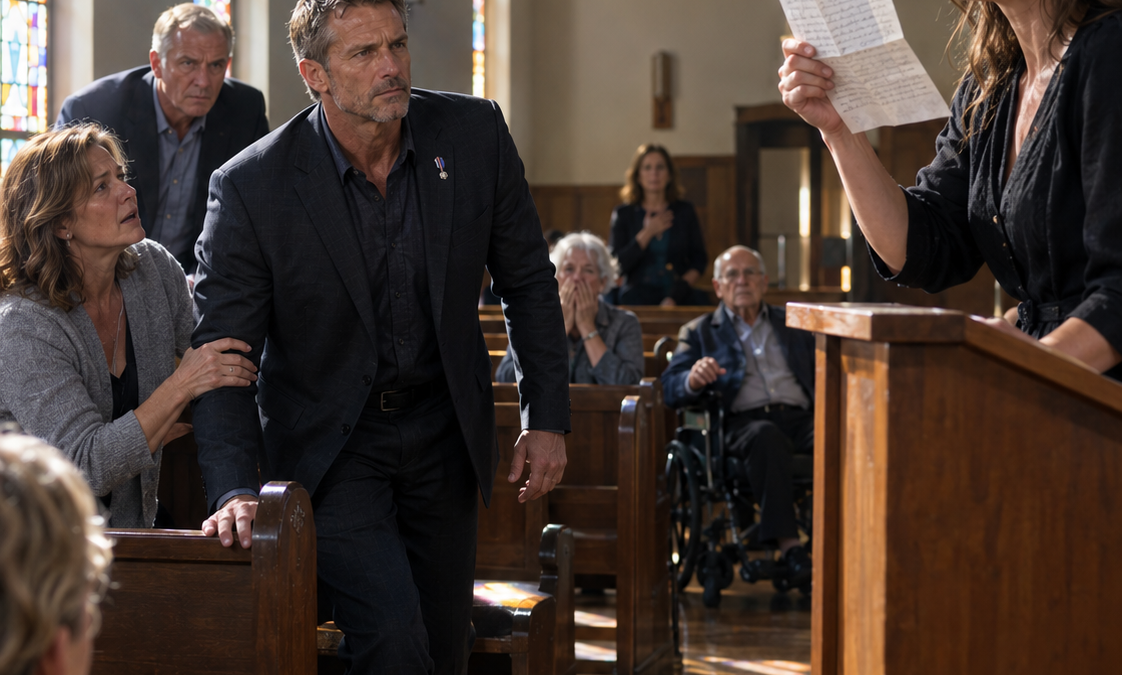
“My stepdaughter told four hundred people I never loved her mother. She said it at the funeral. In front of the whole church. In front of my wife’s sisters, her cousins, her book club, the neighbors, and a row of men I’d served with who’d driven eleven hours to be there.”
They thought the quiet man in the front pew had nothing to say — then a shoe box full of twenty-five years of unsent love letters was read aloud to a church, and a grandchild was given his name.
She said it at the funeral. In front of the whole church. In front of my wife’s sisters, her cousins, her book club, the neighbors, and a row of men I’d served with who’d driven eleven hours to be there.
I was sitting in the front pew. Same spot I’d sat for the viewing the night before. Same spot I’d sat in for her mother’s funeral, and her father’s before that.
Katie stood at the podium in a black dress, holding a folded sheet of paper she never looked at once.
“My mom deserved someone who was there,” she said. Her voice didn’t shake. That was the thing I noticed. It didn’t shake at all.
“He was always gone. Always deployed. Always somewhere else. And when he was home, he was… quiet. He never told her he loved her. Not once that I ever heard.”
She looked down at me. Four hundred people followed her eyes.
“He didn’t love her. He just lived in her house.”
Silence.
The kind of silence that has weight to it. That presses down on your chest like deep water.
I said nothing.
What they didn’t know — what Katie didn’t know, what nobody in that church knew — was that I had written her mother a letter every single time I left. Thirty-one deployments. Thirty-one letters. And I had never mailed a single one of them.
My name is Daniel Reyes. I was fifty-six years old when my wife, Elena, died of pancreatic cancer, eleven weeks after the diagnosis. Before that, before the quiet man in the front pew, I spent twenty-two years as an Air Force Pararescueman. PJ. The ones who jump out of helicopters into the ocean to pull pilots out of burning cockpits. The ones who go into mountains after climbers and into floods after families and into places nobody else wants to go.
I was a Chief Master Sergeant when I retired. I had a Silver Star. I had a Purple Heart. I had a knee that clicked when it rained and a shoulder that had been rebuilt twice.
None of that mattered in that church.
What mattered was that I had never been good at saying things out loud.
Elena knew that. She married me anyway.
We met in 1998 at a diner outside Kirtland Air Force Base in Albuquerque. I was twenty-eight. She was a nurse, thirty-one, with a seven-year-old daughter and a laugh you could hear across a parking lot. She asked me what I did. I told her I was in the Air Force. She asked what kind of work.
“Rescue,” I said.
“Like firemen?”
“Something like that.”
She found out the truth three months later from a newspaper article. A fishing boat had gone down off the coast of Oregon. A PJ team had jumped in at night, in twenty-foot seas, and pulled four men out of the water. My name was in the third paragraph.
She brought the paper to dinner and set it on the table between us.
“You told me you were a fireman,” she said.
“I told you I did rescue.”
She looked at me for a long time. Then she laughed.
“You’re not going to talk about it, are you.”
“No.”
“Ever?”
“Probably not.”
She married me anyway.
Katie was seven when I came into her life. She was a good kid. Smart. Sharp. She had her mother’s laugh and her father’s stubbornness — Elena’s first husband, a man named Rick who’d left when Katie was three and called twice a year after that. I never tried to replace him. I just tried to be there when I was there.
Which wasn’t enough. I know that now. I think I knew it then.
A PJ’s life is not a family life. You’re on alert. You’re gone. You’re in the water or on the mountain and your phone doesn’t work and your family doesn’t know where you are. You come home after three weeks and your stepdaughter has lost a tooth and learned to ride a bike and had a fight with her best friend, and you weren’t there for any of it.
I missed her ninth birthday. I missed her twelfth. I missed her high school graduation because I was in the Hindu Kush pulling a British medic off a cliff.
I was there for the important things. I told myself that. I showed up when I could. I fixed her car when it broke down. I walked her down the aisle when she got married. I held her hand when her mother got the diagnosis.
But I wasn’t there enough. And I never said the words.
That’s the part Katie couldn’t forgive.
The church was hot. October in Virginia, but the heat hadn’t broken yet. The air conditioning couldn’t keep up with four hundred bodies.
Katie kept talking.
“She used to wait up for him. Every deployment. She’d sit in the kitchen with a cup of tea and the phone on the table, and she’d wait for him to call. Sometimes he’d call at two in the morning. Sometimes he wouldn’t call at all.”
She folded the paper in half. Then in half again.
“She told me once she thought he loved her. She said, ‘Katie, some men just can’t say it.’ But I don’t think that’s true. I think some men just don’t feel it. And I think my mother spent twenty-five years hoping he would, and he never did.”
She stepped back from the podium.
The pastor stood up. He said a few words. I don’t remember them.
I remember the sound of the pew creaking when I stood. I remember the way the light came through the stained glass and fell across the coffin. I remember the smell of the lilies Elena’s sister had picked out because they were Elena’s favorite.
And I remember the eyes.
Every single person in that church looked at me like I was a stranger.
I drove home alone.
The house was a split-level in Fairfax, Virginia, bought in 2004 with a VA loan and a down payment Elena’s mother had left her. Three bedrooms. A deck out back with a grill I’d never gotten the hang of. A kitchen with a tile backsplash Elena had picked out and a refrigerator covered in magnets from places I’d been and she’d never seen.
I sat in the driveway for twenty minutes before I went inside.
The house still smelled like her. That’s the thing nobody tells you. It’s been three days and the house still smells like her. Not her perfume — she’d stopped wearing perfume the last month. Just her. The way she smelled. The way the air smelled when she was in a room.
I made a cup of coffee. I didn’t drink it. I just held it.
I thought about what Katie said.
He didn’t love her. He just lived in her house.
I thought about all the ways that was true.
And I thought about all the ways it wasn’t.
When I couldn’t sleep that night, I went up to the attic.
Not for any reason. I just needed to move. The house was too quiet. I’d spent twenty-two years learning to be comfortable in silence — in the dark, in the cold, in places where making noise could kill you — but this silence was different. This silence was loud.
The attic was full of boxes. Christmas decorations. Old clothes. Photo albums Elena had put together over the years. A box of Katie’s childhood art projects. A box of my old uniforms.
I pulled that one down.
O.D. green flight suits. Tan boots. A helmet bag. A stack of t-shirts with unit logos on them.
And underneath all of it, a wooden box.
It was a shoe box, actually. An old one. From a pair of boots I’d bought at the exchange in 2001. But I’d wrapped it in duct tape and labeled it in Sharpie.
E. — NOT TO BE OPENED.
I sat down on the floor with that box in my lap and didn’t move for a long time.
Elena had asked me about it once. Years ago. She’d found it in the closet and asked what was inside.
“Nothing,” I said.
“Nothing doesn’t get duct tape.”
I told her it was old paperwork. She didn’t believe me. But she didn’t push. That was Elena. She never pushed.
I opened the box.
Inside were thirty-one envelopes.
Thirty-one.
One for every time I left.
I wrote the first one in 1998, two months after we met. I was on a C-130 over the Atlantic, headed to a staging base in Germany for a training rotation. I hadn’t even told her I loved her yet. But I wrote it down.
Elena — I don’t know how to say this out loud. I’m not built that way. But if something happens to me out here, I want you to know. You’re the best thing that ever happened to me. I love you. — Danny
I never sent it.
I wrote the second one a year later, when I was on a deployment to the Balkans. Then another. Then another. Every time I left, I wrote a letter. I told her things I couldn’t say to her face.
I told her about the men I’d lost. The ones I couldn’t save. I told her about the nightmares. I told her about the fear — not the fear of dying, but the fear of coming home different. Of coming home and not being the man she married.
I told her about Katie. How much I loved her. How scared I was of screwing it up. How I knew I wasn’t her father and never would be, but how I wanted to be something to her anyway.
I told her about the letters themselves. How I wrote them and never sent them. How I knew that was cowardly. How I was going to send them one day, when I was braver.
I never got braver.
I kept writing them anyway.
Thirty-one letters. Some short. Some long. Some written in the back of a C-130 with a pen I had to hold with two hands because the plane was shaking. Some written in a tent in Afghanistan, with a headlamp and a MRE for a desk. Some written in a hospital in Germany, with my arm in a sling and morphine making the words come out crooked.
They were all there. Every one.
I sat in the attic until the sun came up.
I read every letter. Some of them I hadn’t read since I wrote them. Some of them I didn’t remember writing at all.
There was one from 2003, after a mission in Afghanistan that I still don’t talk about. Four men went in. Three came out.
Elena — I lost a man today. His name was Tommy. He was twenty-four. He had a fiancée named Sarah and a dog named Bo. I was the one who had to tell her. I sat in her kitchen and I told her, and she didn’t cry. She just looked at me like I was the one who killed him. And I don’t know if she was wrong. I was the team lead. I made the call. I’m the reason he’s dead. I don’t know how to come home from that. I don’t know how to be the man you think I am. But I’m trying. I’m trying so hard.
I didn’t send that one either.
I never sent any of them.
The sun came through the attic window around seven. I heard a car in the driveway.
I didn’t move.
I heard the front door open. Footsteps in the kitchen. A voice calling my name.
“Dan? You up here?”
It was Katie.
I looked down at the box in my lap. At the thirty-one envelopes. At twenty-five years of things I never said.
She was already on the stairs.
PART 2 — THE ATTIC
Katie’s head appeared at the top of the stairs.
She was still in the black dress from the funeral. Her mascara had run and she hadn’t fixed it. She looked like she hadn’t slept either.
She stopped when she saw me on the floor.
“What are you doing up here?”
I closed the box.
“Nothing.”
She looked at the box. At the duct tape. At my face.
“That’s the box Mom asked you about.”
“Yeah.”
“What’s in it?”
“Nothing.”
She came up the last few steps anyway. The attic floor creaked under her weight. She stood there in the doorway, arms crossed, looking down at me like I was a suspect.
“I need to talk to you,” she said.
“Okay.”
“About the house.”
I stood up. My knee popped. I didn’t wince. Twenty years of not wincing had made it automatic.
“What about the house?”
“I want to sell it.”
I looked at her.
“Your mother’s been dead three days.”
“I know how long it’s been.” Her voice was flat. “I’m the one who was there.”
I was there too, I thought. But I didn’t say it.
“I was there every day,” I said.
“You were there at the end.”
“I was there the whole time.”
She laughed. It wasn’t a real laugh. It was the kind of sound people make when they’re trying not to cry.
“Three weeks, Dan. You were there for three weeks. She was sick for eleven. Where were you for the first eight?”
I didn’t answer.
I knew the answer. I knew it because I’d lived it. The first eight weeks of Elena’s illness, I was in and out of the house like a ghost. Not because I didn’t want to be there. Because I couldn’t be.
I’d spent twenty-two years training myself to stay calm in emergencies. To keep my face still. To not feel anything until the job was done. It’s what kept you alive. It’s what kept the people you were rescuing alive.
But Elena’s cancer wasn’t a mission. There was no extraction. No rescue. No endgame. It was just a slow, terrible decline, and I didn’t have the tools for it.
So I did what I always did. I disappeared into tasks. I drove her to appointments. I picked up prescriptions. I talked to doctors. I cooked meals she couldn’t eat.
But I couldn’t sit with her.
I couldn’t hold her hand for hours and watch her fade.
Katie could. Katie sat with her every single day. Katie held her hand and read to her and fed her ice chips and cried with her.
I couldn’t do that. And she hated me for it.
“The first eight weeks,” I said, “I was getting her into the trial at Johns Hopkins. The immunotherapy. The one that gave her three extra months.”
She looked at me.
“You never told me that.”
“You never asked.”
She flinched. Just slightly. Like I’d hit her.
“Don’t do that,” she said. “Don’t make this about me.”
“I’m not making it about you.”
“You are. You always do. You make everything about what you did and what you sacrificed and how hard it was for you.”
I looked at her.
“I’ve never said a word about what I sacrificed.”
“That’s the problem.” She stepped closer. “You never say anything. You never told Mom you loved her. You never told me you loved her. You just — you just sat there. Like a stone. For twenty-five years. And now she’s dead and you’re up here in the attic with your box of nothing, and I’m supposed to what? Pretend everything was fine?”
I looked down at the box.
“It wasn’t fine,” I said.
“No. It wasn’t.”
She turned and walked down the stairs.
I heard the front door slam.
I stood there for a long time.
Then I sat back down and opened the box again.
Katie was wrong about a lot of things. But she was right about one thing.
I never told Elena I loved her.
Not out loud. Not in words she could hear.
That’s not true. I said it on our wedding day. I said it when she was diagnosed. I said it in the last hour, when she was unconscious and I was holding her hand and the machines were beeping and I knew she couldn’t hear me.
But I didn’t say it the way she needed me to say it. I didn’t say it over coffee in the morning. I didn’t say it when she got her hair cut. I didn’t say it when she was laughing at something on TV.
I said it in my head. A thousand times a day. I just couldn’t get it out.
That’s the thing about men like me. We’re trained to suppress. To compartmentalize. To put the emotion in a box and seal it shut and never open it again. It’s not that we don’t feel it. It’s that we can’t show it. The training is too deep. The scars are too old.
But I wrote it down.
Every time I left. Every time I was scared. Every time I was in the back of a C-130 at thirty thousand feet and I thought, this might be the one.
I wrote it down.
And I never sent it.
The next morning, I was in the kitchen when the doorbell rang.
It was Elena’s sister, Maria. She was two years older than Elena and had never liked me much. She was a schoolteacher in Richmond, and she had a way of looking at me like I was a problem she hadn’t figured out yet.
“Daniel,” she said.
“Maria.”
She stepped inside without being invited.
“We need to talk about the estate.”
I poured her a cup of coffee. She didn’t drink it.
“The house,” she said. “Katie wants to sell it. I think she’s right.”
“Elena left it to me.”
“She left it to you because she didn’t think you’d fight about it.”
I sat down across from her.
“I’m not going to fight about it.”
“Then what are you going to do?”
“I don’t know yet.”
Maria looked at me with that look she’d been giving me for twenty-five years. The one that said my sister could have done better.
“She was lonely, you know,” she said. “The whole time. She was lonely.”
“I know.”
“Do you? Do you really know? Because I don’t think you do. I think you were gone so much you never saw what it did to her.”
I looked at my coffee.
“She never told me.”
“She never told you because she knew you couldn’t handle it. She knew if she told you she was lonely, you’d just disappear more. It was easier for her to pretend everything was fine.”
I set my cup down.
“Did she tell you that?”
“She didn’t have to. I’m her sister. I knew her.”
I looked at Maria. At her face. At the way she was sitting — arms crossed, jaw set, chin up. The same posture Katie had used in the attic.
“I loved her,” I said.
She didn’t flinch. But she didn’t soften either.
“I know you did,” she said. “That’s what makes it worse.”
“What?”
“That you loved her and still couldn’t show it. That’s what makes it so hard to forgive.”
She stood up.
“The funeral was hard,” she said. “What Katie said. People are talking.”
“I know.”
“Are you going to say anything? To any of them?”
“No.”
She shook her head.
“Of course you’re not.”
She walked to the door. She stopped with her hand on the knob.
“You know what your problem is, Daniel?”
I didn’t answer.
“You’re a hero. I know that. Everyone knows that. You saved lives. You did things most people can’t even imagine. But you never let anyone see the cost. You never let anyone carry it with you. And now Elena’s gone, and Katie thinks you never loved her, and I don’t know how to fix that.”
She opened the door.
“But I do know this. Whatever’s in that box up in your attic — whatever you’re hiding — you better figure out if it’s worth keeping to yourself. Because you’re running out of time to tell the truth.”
She closed the door behind her.
I sat in the kitchen for a long time.
That afternoon, I drove to the cemetery.
Elena’s grave was still fresh. The grass hadn’t grown over the dirt yet. The headstone was temporary — a metal marker with a plastic card that had her name and dates. The permanent one was being carved. It would take six weeks.
I stood there with my hands in my pockets.
Maria was right, I thought. You’re running out of time.
But it wasn’t about time. It was about courage. The thing I’d spent my whole life training for. The thing I’d always had when it mattered.
I’d jumped out of helicopters into the ocean at night. I’d run into buildings on fire. I’d held a man’s hand while he died and told him it was going to be okay when I knew it wasn’t.
But I couldn’t send a letter to my wife.
I couldn’t tell my stepdaughter the truth.
I stood there for an hour.
Then I drove home.
That night, I sat at the kitchen table with the box in front of me.
I opened it again.
Thirty-one envelopes. All of them still sealed. All of them still waiting.
I picked one up. It was from 2007. A deployment to Iraq. I’d been gone six months. Elena had sent me a care package with a photo of her and Katie at the beach. Katie was nineteen. She was smiling. Elena was smiling too.
I remembered writing this letter. I remembered sitting in a tent in Anbar province with the photo in my hand and a pen in the other.
Elena — I got the photo. Katie looks so grown up. I can’t believe she’s in college. I can’t believe I missed it. I keep thinking about all the things I’ve missed. All the birthdays and the recitals and the parent-teacher conferences. I know you tell me it’s okay. I know you tell me I’m doing important work. But I don’t know if that’s true anymore. I don’t know if any of it is worth missing this.
I love you. I love Katie. I love the life we have even though I’m not there for most of it. I’m going to come home. I’m going to retire. I’m going to be there for everything.
I just have to survive this one first.
I read that letter three times.
Then I folded it and put it back in the envelope.
I looked at the box. At all the letters I’d written and never sent.
And I made a decision.
I wasn’t going to hide them anymore. Not because I wanted forgiveness. Not because I wanted to prove Katie wrong. But because Elena deserved to have them. Even if she wasn’t there to read them.
I picked up my phone and called the one person I knew would understand.
“Jim,” I said. “It’s Dan.”
Jim Halstead was a retired PJ. He’d been my team lead for twelve years. He’d saved my life twice. I’d saved his once. He lived in Colorado now, in a cabin outside Colorado Springs, and he answered on the second ring.
“Dan. I heard about Elena. I’m sorry.”
“Thanks.”
“You okay?”
“No.”
“Figured.”
I paused.
“I need a favor.”
“Name it.”
“I need you to come to Virginia. I need you to help me do something.”
“Okay. What?”
I looked at the box.
“I need to tell a story. And I need someone who was there to help me tell it.”
He was quiet for a moment.
“The funeral,” he said. “I heard what Katie said.”
“Who told you?”
“Everybody told me. The whole team knows. Half of them wanted to drive up there and — ” He stopped. “You know.”
“Yeah.”
“You want me to come set the record straight?”
“No. I don’t want you to set the record straight. I want you to help me tell the truth. There’s a difference.”
He was quiet again.
“What’s the truth?”
I looked at the box.
“I’ll tell you when you get here.”
PART 3 — THE BROTHERHOOD
Jim Halstead arrived two days later.
He pulled into my driveway in a silver pickup with Colorado plates and a dent in the rear bumper. He got out slowly — he was sixty-two now, with a hip replacement and a bad back and a wife who’d made him promise to stop jumping out of planes.
He looked at the house.
“Still here,” he said.
“Still here.”
He walked up the steps and shook my hand. His grip was still strong. His face was still the same — weathered, sun-scarred, with eyes that didn’t miss anything.
“You look like hell,” he said.
“Feel worse.”
“Good. That means you’re still alive.”
He came inside. He looked around the kitchen. At the magnets on the fridge. At the tile backsplash. At the photograph of Elena on the counter.
He stopped in front of it.
“She was a good woman,” he said.
“She was.”
“You loved her.”
“Still do.”
He nodded. He didn’t say anything else about it. He didn’t have to.
We sat at the kitchen table. I told him everything. The funeral. Katie’s eulogy. Maria’s visit. The box.
He listened without interrupting. That was Jim. He’d learned to listen before he learned to talk. It was a PJ thing. You couldn’t rescue anyone if you didn’t know what they needed.
When I finished, he looked at the box on the table.
“Thirty-one letters,” he said.
“Thirty-one.”
“You never sent them.”
“Never.”
He was quiet for a moment.
“Why not?”
I looked at the box.
“I was afraid.”
“Afraid of what?”
“That she’d read them and realize how broken I was.”
He looked at me.
“Dan. I’ve known you for thirty years. You’re the least broken man I’ve ever met.”
“You didn’t see me after Tommy.”
He didn’t answer.
We both knew what I meant. Tommy Nakamura. The man I’d lost in Afghanistan. The one I’d written about in the letter. The one whose death I’d been carrying for twenty years.
“I saw you after Tommy,” Jim said quietly. “I saw you carry his coffin. I saw you tell his mother. I saw you go back out two weeks later and save four more men.”
“That doesn’t mean I wasn’t broken.”
“No. It means you were broken and you did it anyway.”
He looked at the box.
“These letters aren’t evidence of a broken man. They’re evidence of a man who loved his wife enough to keep trying even when he couldn’t say it out loud.”
I didn’t answer.
He picked up one of the envelopes. Looked at the date. 1999.
“Can I read one?”
I nodded.
He opened it carefully. Read it slowly. When he finished, he set it down on the table and looked at me.
“I never knew you wrote these,” he said.
“No one did.”
“Why don’t you show them to Katie?”
“I don’t know if she’d read them.”
“She might.”
“She might not.”
He looked at me.
“You’re not doing this for her, are you.”
“No.”
“Then what are you doing it for?”
I looked at the photo of Elena on the counter.
“I’m doing it for Elena. She deserves to know. Even if she’s not here.”
He nodded slowly.
“Okay,” he said. “What do you need from me?”
Jim stayed for four days.
We didn’t do much. We talked. We drank coffee. We went for walks around the neighborhood. He helped me clean out the garage, which hadn’t been cleaned in twenty-five years.
It was good to have him there. Not because he solved anything. Just because he was there. That was the thing about the teams. You didn’t have to talk. You didn’t have to explain. You just had to be present. And that was enough.
On the third day, we drove to the cemetery.
Jim stood at the grave for a long time. He didn’t say anything. He just stood there with his hands behind his back, looking at the metal marker with Elena’s name on it.
“I was there when he met her,” he said finally. “Did you know that?”
“No.”
“Kirtland. 1998. I was with him when he saw her across the diner. He didn’t say anything. He just stopped walking. Like he’d hit a wall.”
I looked at him.
“He told me later he knew right then. That she was the one. He said he’d never felt anything like it before.”
“I didn’t know that.”
“He wouldn’t have told you. He wouldn’t have told anyone. But I was there. I saw his face.”
He turned and looked at me.
“He loved her more than anything in the world. He just didn’t have the words.”
I didn’t say anything.
Jim reached into his pocket and pulled out a small stone. He placed it on the marker.
“I do this for every man I lose,” he said. “Jewish tradition. My grandmother was Jewish. I don’t know if it means anything. But it helps.”
We stood there in silence.
That night, Katie called.
I was in the kitchen. Jim was in the guest room. The phone buzzed and I looked at the screen and saw her name.
I answered.
“Hey.”
“Hey.” Her voice was flat. “I need to come by tomorrow. I need to get some of Mom’s things.”
“Okay.”
“Like her jewelry. Her photographs. The stuff that belonged to her family.”
“Okay.”
“And I need to talk to you about the house.”
“Okay.”
She paused.
“Is someone staying with you?”
“Jim. An old friend.”
“One of your military friends.”
“Yes.”
She was quiet for a moment.
“I don’t want to meet him.”
“He’s not going to be here. He’s leaving tomorrow.”
“Good.”
Another pause.
“I’ll be there at ten.”
“Okay.”
She hung up.
I set the phone down on the table.
Jim came out of the guest room.
“Katie?” he asked.
“Yeah.”
“She coming tomorrow?”
“Yeah.”
He looked at me.
“You want me to stay?”
“No. It’s fine.”
“You sure?”
I looked at him.
“She’s my stepdaughter, Jim. She’s not going to hurt me.”
He didn’t answer. But his face said something I didn’t want to hear.
Katie arrived at ten the next morning.
She was wearing jeans and a t-shirt. Her hair was pulled back. She looked tired. She looked like her mother.
“Hey,” she said.
“Hey.”
She walked past me into the house without stopping. She went straight to the stairs. She knew where everything was. She’d grown up in this house.
I followed her up.
Elena’s bedroom was at the end of the hall. It had a window that looked out on the backyard, and a bed that was still made with the sheets Elena had put on it three months ago. I hadn’t changed them. I couldn’t.
Katie went to the jewelry box on the dresser. She opened it and started pulling things out. Necklaces. Earrings. A bracelet her grandmother had given her.
“I want the photos too,” she said. “The old ones. From when I was a kid.”
“They’re in the closet. Top shelf. The blue album.”
She nodded. She pulled a chair over and reached up. She found the album and pulled it down.
She sat on the bed and opened it.
I stood in the doorway and watched her.
She flipped through the pages slowly. Photos of her as a baby. Photos of Elena holding her. Photos of her first day of school, her first bike, her first dance.
Then she stopped.
There was a photo of the three of us. A trip to the beach in 2005. Katie was seventeen. She was standing between me and Elena, and we were all smiling. Elena had her arm around my waist. I had my arm around Katie’s shoulders.
“I remember this,” she said.
“Me too.”
She looked at the photo for a long time.
“You were happy,” she said.
“I was.”
She looked up at me.
“Were you?”
I looked at her.
“Yes.”
She looked back at the photo.
“Then why didn’t you ever show it?”
“Show what?”
“That you were happy. That you loved her. That you loved me.”
I didn’t answer.
She closed the album.
“You know what I think?” she said. “I think you were happy. I think you loved her. I think you loved me too. But I think you were so scared of losing us that you never let yourself show it. You kept everything inside because you thought if you let it out, it would disappear.”
She stood up.
“And you know what else I think?”
“What?”
“I think Mom knew that. I think she knew you loved her. I think she knew the whole time.”
She walked past me.
“But I don’t. I don’t know. And you’ve never given me a reason to.”
She went down the stairs.
I stood in the doorway of Elena’s bedroom for a long time.
Then I went to the attic.
I brought down the box.
PART 4 — THE LETTERS
I brought the box down to the kitchen and set it on the table.
I didn’t open it right away. I just sat there and looked at it.
Thirty-one letters. Twenty-five years. Every deployment, every mission, every time I left and every time I was afraid I wouldn’t come back.
I thought about what Katie said.
You never gave me a reason to.
She was right. I’d never given her a reason. I’d never given anyone a reason. I’d spent my whole life keeping the important things locked up in a box, and now the box was the only thing I had left.
I opened it.
I took out the first letter. The one from 1998. The one I’d written two months after we met.
Elena — I don’t know how to say this out loud. I’m not built that way. But if something happens to me out here, I want you to know. You’re the best thing that ever happened to me. I love you. — Danny
I read it three times. Then I set it on the table.
I took out the second letter. 1999. A deployment to the Balkans.
Elena — I’m sitting in a tent in Kosovo and I can’t sleep. I keep thinking about you. About your laugh. About the way you looked at me when you told me you loved me for the first time. I didn’t say it back. I wanted to. I just couldn’t. But I want you to know — I love you. I’ve loved you since the first time I saw you. I’m going to spend the rest of my life trying to be the man you deserve. — Danny
I set it on the table.
The third letter. 2000.
Elena — Katie called me Dad today. Just once. She was leaving for school and she said, “Bye, Dad.” And then she caught herself and looked embarrassed and ran out the door. I didn’t say anything. I didn’t know what to say. But I want you to know — I’ve never been happier. I don’t know if I’ve earned it. I don’t know if I ever will. But I love that girl. I love her like she’s my own. I’m going to try to be the father she deserves. — Danny
I set it on the table.
The fourth. 2001.
Elena — I’m in the Gulf. I can’t tell you where. I can’t tell you what we’re doing. But I can tell you I’m scared. Not for me. For you. For Katie. I keep thinking about what happens if something goes wrong. I keep thinking about you getting the knock on the door. I keep thinking about you having to tell Katie. I don’t want to put you through that. I don’t want to be the reason you cry. — Danny
The fifth. 2002.
Elena — I’m in Afghanistan. I can’t tell you what happened today. I can only tell you I’m okay. I can only tell you I love you. I can only tell you I’m coming home. — Danny
The sixth. 2003.
Elena — I lost a man today. His name was Tommy. He was twenty-four. He had a fiancée named Sarah and a dog named Bo. I was the one who had to tell her. I sat in her kitchen and I told her, and she didn’t cry. She just looked at me like I was the one who killed him. And I don’t know if she was wrong. I was the team lead. I made the call. I’m the reason he’s dead. I don’t know how to come home from that. I don’t know how to be the man you think I am. But I’m trying. I’m trying so hard. — Danny
I set it on the table.
The seventh. 2004.
Elena — We bought a house. I can’t believe we bought a house. I can’t believe you found it and I said yes and now it’s ours. I’m sitting in the kitchen right now, at the table, writing this, and you’re asleep upstairs and Katie’s asleep down the hall and I can hear the refrigerator humming and I’ve never been this happy in my life. This is what I’m fighting for. This is what I’m coming home to. — Danny
The eighth. 2005.
Elena — I’m in the desert again. It’s hot. It’s always hot. I keep thinking about that beach trip last summer. Katie laughing in the waves. You holding my hand. The sun going down. I keep thinking about how I almost didn’t go because I had a training conflict. I’m so glad I went. I’m so glad I was there. I’m going to be there more. I’m going to be there for everything. — Danny
The ninth. 2006.
Elena — Katie’s graduating high school. I’m going to miss it. I’m going to be in the air when she walks across that stage. I already talked to my commander. I tried to get out of it. I tried everything. But I can’t. I’m so sorry. I’m so sorry I’m going to miss it. Tell her I love her. Tell her I’m proud of her. Tell her I’m sorry. — Danny
The tenth. 2007.
Elena — I got the photo. Katie looks so grown up. I can’t believe she’s in college. I can’t believe I missed it. I keep thinking about all the things I’ve missed. All the birthdays and the recitals and the parent-teacher conferences. I know you tell me it’s okay. I know you tell me I’m doing important work. But I don’t know if that’s true anymore. I don’t know if any of it is worth missing this. — Danny
The eleventh. 2008.
Elena — I re-enlisted. I know you didn’t want me to. I know you wanted me to retire. But I couldn’t. Not yet. The teams need me. The guys need me. I can’t walk away while there are still people out there who need to be rescued. I’m sorry. I know that’s selfish. I know you’re disappointed. But I can’t. Not yet. — Danny
The twelfth. 2009.
Elena — I’m in the hospital in Germany. I broke my arm. I’m okay. I’m going to be okay. The doctors say I’ll be back in the air in six weeks. I told them I’d be back in four. They laughed. I wasn’t joking. I need to get home. I need to see you. I need to see Katie. I need to be there. — Danny
The thirteenth. 2010.
Elena — Katie got married. I walked her down the aisle. I almost cried. I didn’t. But I almost did. I kept thinking about the first time I met her. Seven years old. Missing her front teeth. Looking at me like I was an intruder. And now she’s married. And I’m the one who walked her down the aisle. I don’t know if I earned it. But I’m grateful. — Danny
The fourteenth. 2011.
Elena — I’m thinking about retiring. I know I’ve said that before. But this time I mean it. I’m getting older. My knee is shot. My shoulder is shot. I can’t keep doing this forever. I want to come home. I want to be there. I want to wake up next to you every morning and not have to leave. — Danny
The fifteenth. 2012.
Elena — I did it. I put in my papers. I’m retiring. I’m coming home. For good. I’m going to be there for everything. Every birthday. Every holiday. Every morning. I’m going to be the husband you deserve. I’m going to be the father Katie deserves. I’m going to make up for all the years I missed. — Danny
The sixteenth. 2013.
Elena — I’m home. I’m actually home. I woke up this morning and you were next to me and I didn’t have to leave. I just lay there and listened to you breathe. I’ve never been this happy. — Danny
I stopped reading.
I’d read sixteen letters. There were fifteen more. But I couldn’t read any more.
Not because they were sad. Because they were happy.
Every single one of them was a love letter. Every single one of them was proof — proof that I loved Elena. Proof that I loved Katie. Proof that I was there, even when I wasn’t.
I sat at the kitchen table and put my head in my hands.
Twenty-five years. Twenty-five years of writing letters I never sent. Twenty-five years of keeping the most important part of myself locked in a box.
And now Elena was gone.
And Katie thought I never loved her.
The next morning, there was a knock at the door.
I opened it. A man in a suit was standing on the porch.
“Daniel Reyes?”
“Yes.”
He handed me an envelope.
“You’ve been served.”
I opened it.
It was a legal complaint. Katie was suing me for the house.
The papers said I had failed to maintain the property. That I had neglected the estate. That I had no legal right to remain in the home because it had been purchased with funds from Elena’s family.
None of that was true. I knew it wasn’t true. The house had been bought with a VA loan and our joint savings. Elena’s family hadn’t contributed a dime.
But Katie was my stepdaughter. She’d grown up in that house. She’d lost her mother. She was grieving.
And she wanted me out.
I read the papers three times. Then I set them on the kitchen table.
I thought about calling a lawyer. I thought about fighting it. I thought about all the ways I could prove that the house was mine, that I’d paid for it, that I had every right to stay.
But I didn’t call a lawyer.
I sat down at the table and opened the box.
I took out the letters. All thirty-one of them.
And I started to read them. Out loud.
“Elena — I don’t know how to say this out loud. I’m not built that way. But if something happens to me out here, I want you to know. You’re the best thing that ever happened to me. I love you. — Danny.”
I read the second one.
“Elena — I’m sitting in a tent in Kosovo and I can’t sleep. I keep thinking about you. About your laugh. About the way you looked at me when you told me you loved me for the first time. I didn’t say it back. I wanted to. I just couldn’t. But I want you to know — I love you. I’ve loved you since the first time I saw you. — Danny.”
I read the third one.
“Elena — Katie called me Dad today. Just once. She was leaving for school and she said, ‘Bye, Dad.’ And then she caught herself and looked embarrassed and ran out the door. I didn’t say anything. I didn’t know what to say. But I want you to know — I’ve never been happier. — Danny.”
I read all thirty-one letters.
Out loud. In the empty kitchen.
By the time I finished, the sun had gone down.
I sat there in the dark and I thought about what I was going to do.
The next day, I called Jim.
“Dan. What’s going on?”
“I need you to come back.”
“Okay. When?”
“Now.”
He didn’t ask why. He just said he’d be on the next flight.
I called Maria too. She didn’t answer. I left a message.
“Maria. It’s Daniel. I need you to come over. There’s something I need to show you.”
Then I called Katie.
She answered on the third ring.
“What?”
“I need you to come over.”
“I’m not coming over.”
“Katie. Please.”
“I have a lawyer now. You should talk to your lawyer.”
“I don’t have a lawyer.”
She paused.
“Why not?”
“Because I’m not going to fight you for the house.”
She was quiet.
“Then what do you want?”
“I want you to come over. There’s something I need to show you.”
“I don’t want to see anything.”
“Katie. Please.”
Another pause.
“It’s about your mother.”
Silence.
“Katie.”
“I’ll be there at six.”
She hung up.
I set the phone down on the table.
Then I went to the attic and brought down the box.
 [Tap here for the Next Part ]


