The Admiral Asked the Single Dad His Call Sign as a Joke—Then “Iron Widow” Shocked Him
The Admiral Asked the Single Dad His Call Sign as a Joke—Then “Iron Widow” Shocked Him
Admiral Richard Halston
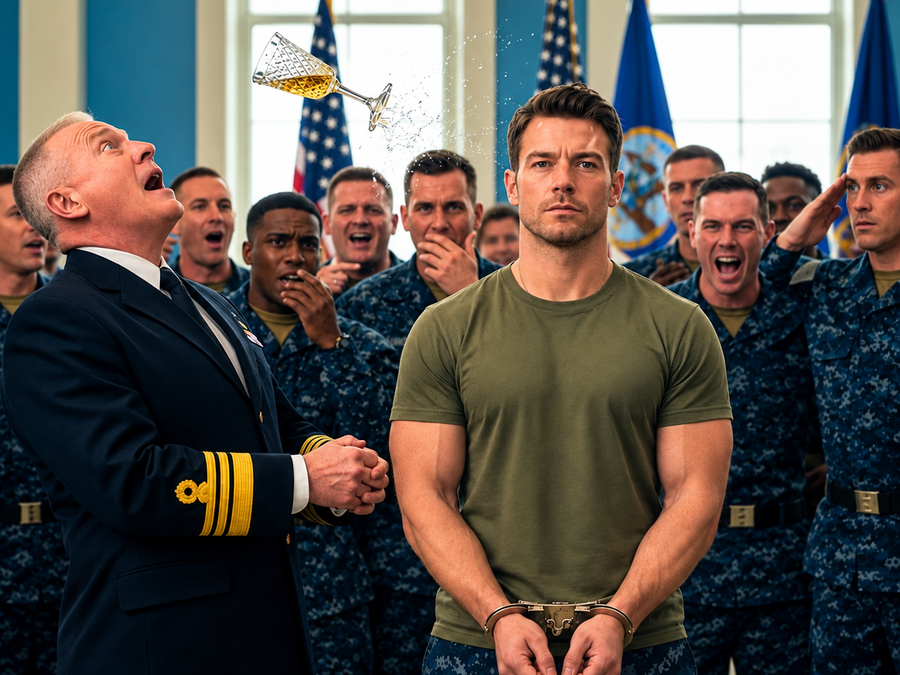
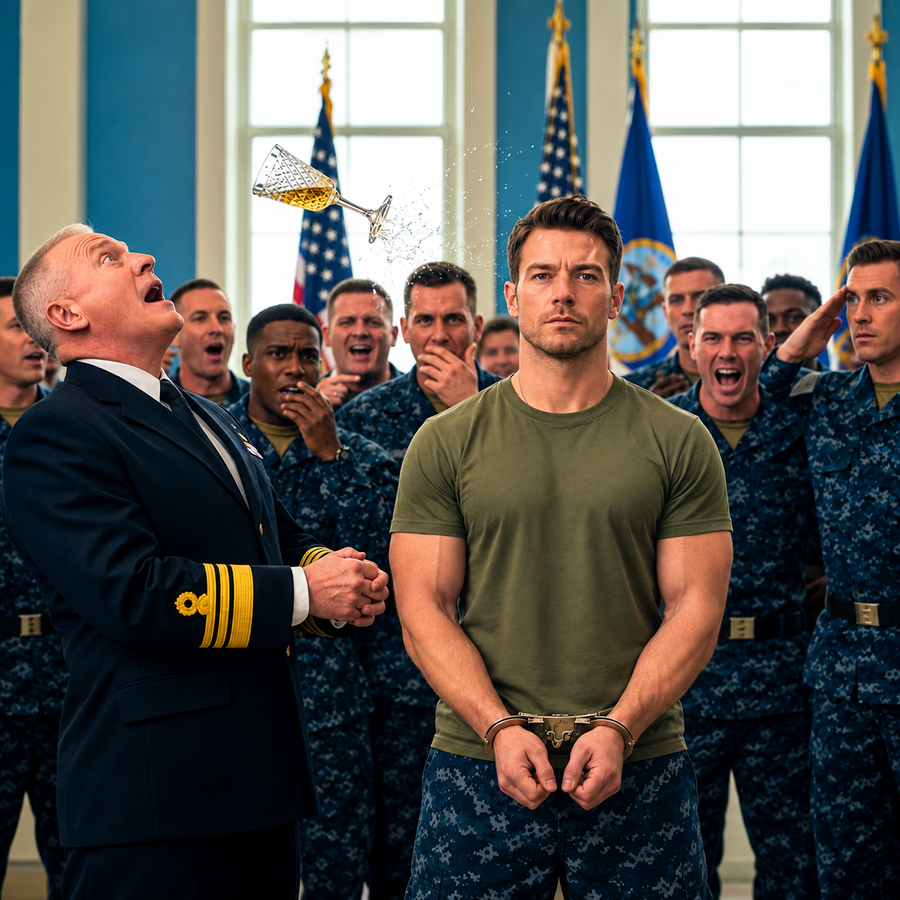
snatched the microphone out of the ceremony coordinator’s hand
stepped forward to the edge of the stage
and pointed directly at Ethan Callaway.
Not gestured, pointed.
Like a man identifying a suspect.
“Stop.
Stop.”
he said.
“Everyone stop.”
The entire Naval Command Hall went silent.
400 officers
decorated commanders
special operations veterans
all of them frozen mid-movement
mid-conversation
mid-breath.
Halston kept his finger aimed at Ethan like a loaded weapon.
“This man
” he said loud and deliberate into the microphone
“is about to receive an official call sign from the United States Navy.
” He paused.
Let the silence stretch.
Then he smiled
and it was the kind of smile that meant something ugly was coming.
“Before that happens
I want him to tell every warrior standing in this room exactly what he has done to earn one.”
Nobody moved.
Nobody breathed.
“Go ahead, Chief Callaway.”
Halston lowered the microphone slightly.
His voice dropped quieter, which somehow made it worse.
“Tell us what a man who packs his little girl’s school lunch every morning has done that justifies standing among these operators.”
Laughter broke out across the room.
Real laughter.
Loud laughter.
And Ethan Callaway stood there and let it happen.
He didn’t flinch, didn’t look down, didn’t move a single muscle in his face.
He waited for the laughter to peak, and then he spoke two words.
Quietly.
Calmly.
The way a man speaks when he has nothing left to prove.
“Iron Widow.”
The laughter stopped like a power line cut.
Admiral Halston’s pointing finger dropped to his side.
Because those two words didn’t just answer the question.
Those two words told every senior officer in that room exactly who was standing in front of them and what Halston had just done to himself.
The first time Ethan Callaway walked into Naval Special Warfare Training Center in Virginia Beach
nobody paid attention to him.
That was exactly how he preferred it.
He carried one bag
medium-sized
no patches on it
no unit insignia
nothing that identified him as anything other than a middle-aged man who had showed up to the wrong building.
He wore a plain gray sweatshirt over his physical training uniform
the kind of sweatshirt you’d find at any base exchange for $12.
His face was clean-shaven.
His eyes were calm in the specific way that only two kinds of men ever manage
men who have never seen anything worth worrying about
or men who have seen so much that worry stopped working on them entirely.
Ethan Callaway was very clearly the second kind.
But nobody knew that yet.
The program he was entering
Advanced Tactical Leadership Selection
formally designated ATLS-7
was not designed for men like him.
Or rather, it wasn’t designed for men who looked like him.
The other candidates were younger
louder
and carried themselves with the barely contained energy of people who needed everyone in the room to understand they were dangerous.
There were 23 of them, ranging from 26 to 34 years old.
Most had recent combat deployments.
Several had decorations that would make a Pentagon staff officer nervous.
One of them
a mountainous SEAL named Derek Roark
had been featured in a military journal profile that described him using words like unstoppable and generational talent.
Ethan was 38.
He had a daughter named Lily
who was 8 years old and currently in the second grade at a public school 20 minutes from his apartment in Norfolk.
She liked horses and strawberry ice cream and a particular television program about a girl who could talk to animals and she had a habit of leaving small crayon drawings of horses in his uniform pockets so he would find them during the day and think of her.
He had three of them in his left breast pocket right now.
He had not told anyone that.
The orientation briefing was held in a building that smelled like industrial cleaning product and bad coffee and it was run by a Master Chief named Gerald Forsythe who had the physical dimensions of a refrigerator and the personality of someone who had given this exact briefing enough times to have stopped pretending it was interesting.
You are here
Master Chief Forsythe said without looking up from his clipboard.
Because someone believes you belong here.
You will spend the next 16 weeks demonstrating whether that someone was correct.
Most of you will not complete the program.
That is not a threat.
It is historical data.
He looked up.
You have questions, save them.
He looked back down.
Callaway.
Ethan raised his hand slightly from the back row.
Forsythe looked at him for exactly 3 seconds.
Then he looked at his clipboard.
Then he looked at Ethan again.
You are the oldest candidate in this program by 4 years.
Yes, Master Chief.
You are aware of that.
Yes, Master Chief.
Any concerns about that?
No, Master Chief.
Forsythe stared at him for another 2 seconds.
He made a small mark on his clipboard.
He moved on.
From the row directly in front of Ethan, a candidate turned around.
He was lean and sharp-featured with the kind of jaw that looked like it had been designed specifically to look good in a military photo.
Lieutenant Marcus Vale.
Team leader designation.
Multiple combat deployments with SEAL Team 8.
The kind of man who entered rooms and immediately calculated how many people in it he could defeat in a physical confrontation.
He studied Ethan the way you study something you’ve identified as irrelevant.
How old are you, Chief?
38.
And you’re doing ATLS 7.
That’s correct.
Why?
Ethan looked at him without particular emotion.
Same reason everyone else is here.
Marcus turned back around.
He didn’t ask another question.
He’d already made his assessment.
In his experience
and it was considerable experience
men like Ethan Callaway didn’t finish programs like this.
They were administrators who had convinced themselves they still belonged in the field.
They were men going through a second adolescence chasing something they’d lost when they got older.
They finished 2 weeks in and returned to their desks with a story about a knee injury.
He had seen it before.
He would see it again.
He forgot about Ethan Callaway by the time the briefing ended.
That night at exactly 22:00 hours
Ethan sat in his quarters and opened his laptop.
The screen showed a video call
and after a moment
a small face appeared
round-cheeked
serious with dark hair pulled into two uneven pigtails that clearly she had done herself because no adult would have allowed them to be that crooked.
Dad.
Hey, bug.
You didn’t call at 8:00.
Training ran long.
I’m sorry.
Lily considered this information with the gravity of someone evaluating a legal defense.
Then she apparently decided it was acceptable because she held up a drawing.
I made you a new one.
It was a horse.
It was purple.
It had what appeared to be wings
which was a recent development in Lily’s artistic interpretation of horses.
Ethan studied it with the same attention he gave to topographical maps.
“That’s a good one,” he said.
“It’s Pegasus.”
“You added a horn.
Pegasus has a horn now.”
“I don’t think that’s” “Dad.”
She gave him a look.
“I decided he has a horn.
It’s my drawing.”
Ethan nodded slowly.
“Fair point.”
She lowered the drawing and looked at him with the particular directness that 8-year-olds have before they learn to be indirect.
“Are the other soldiers nice?”
“They’re fine.”
“Do they know you’re the best one?”
He almost smiled.
“They’ll figure it out.
Mrs. Patterson said I could bring cookies for the class on Friday.”
“Can we make the ones with the sprinkles?”
“I’ll be home Thursday night.
We can make them Thursday.”
“The blue sprinkles, Dad, not the rainbow ones.
” “Blue sprinkles.”
“Promise?”
“Promise.”
She seemed satisfied.
She held the drawing up again.
“I’m going to put this one in your bag when you come home so you have it.”
“I’ll look for it.”
They talked for another 20 minutes about her teacher and a disagreement she’d had with her best friend about something involving a jump rope and a rule that Lily maintained was not an actual rule.
And when they finally said good night and the screen went dark
Ethan sat in the silence of his quarters for a moment.
He reached into his left breast pocket.
He took out three crayon drawings
two horses
one that appeared to be a horse wearing a hat
which was a previous artistic phase.
He lined them up on the desk.
Then he went to sleep.
The first week of ATLS 7 was designed to be brutal and it succeeded.
The training staff ran the candidates through physical assessments
tactical problem sets
psychological evaluations
and sleep deprivation exercises that compressed what would normally be a month of evaluation into five days.
Three candidates withdrew in the first 72 hours.
A fourth was medically evaluated out after a training injury on day four.
Ethan completed every evolution.
Not first
not last
somewhere in the middle
consistent
methodical
unremarkable in a way that seemed almost deliberate.
He ate when there was time to eat.
He slept when there was time to sleep.
During the problem sets, he listened more than he spoke.
During the physical evolutions
he maintained a pace that was efficient without being impressive.
He’s sandbagging, one candidate said.
His name was Torres, a Marine Raider with forearms like bridge cables.
He’s conserving, waiting for something.
Or he’s just slow, another candidate said.
Some guys just run slow.
Torres shook his head.
No. Watch his eyes when they brief an evolution.
Something happens.
Nobody knew what Torres meant yet.
But Torres had been watching.
The tactical problem sets were run in a converted warehouse that the training staff had transformed into a modular environment.
Walls moved rooms
reconfigured obstacles
adjusted between evolutions so that candidates couldn’t rely on pattern recognition from previous iterations.
During the fourth problem set
the candidates were split into four-person teams and given a scenario extract
a simulated downed pilot from a hostile urban environment with limited intelligence
partial communications
and a six-man opposing force staffed by instructors who were frankly enjoying themselves.
Ethan’s team had been deliberately assembled from what the training staff considered the middle tier of candidates.
No stars, no obvious leaders.
The other three men were competent but unremarkable.
A Navy Corpsman named Alvarez
an Army Special Forces Sergeant named Briggs
and a quiet Air Force combat controller named Park
who had not said more than 40 words to anyone in 4 days.
The team leader was supposed to be Briggs by virtue of seniority.
Briggs lasted approximately 3 minutes into the planning phase before looking at Ethan and saying
“Okay
what do you see?”
Ethan looked at the map.
He was quiet for a long moment.
The other three waited.
“They’re expecting us to come from the east,” he said.
“That’s where they’ve positioned the heaviest element.
Standard decision.
We’re not going east.”
“The western approach has two choke points,” Alvarez said.
“Yes, which is why they didn’t put the heavy element there.
They assume we’ll see the choke points and avoid the west.
The choke points are manageable if we move through them at the right time.”
He tapped the map.
“There’s a shift change in the opposing force schedule at the 40-minute mark.
We’ve watched four previous iterations.
Every time the shift change creates a gap here.”
He pointed.
“90 seconds.
That’s our window for the second choke point.”
Briggs stared at the map.
“You timed their shift changes?”
“I timed everything.”
“You’ve been watching since the first iteration?”
“Since the briefing on day one.
” Park
who had said 40 words in 4 days
said
“How did you know they wouldn’t change the schedule?”
Ethan looked at him.
“Because the staff sergeant running the opposing force drinks his coffee at the same time every day
and you can’t run a rotation that disrupts a man’s coffee schedule
or he gets irritable.
I checked.
The schedule hasn’t changed.”
There was a brief silence.
“West approach,” Briggs said.
“You’re running this.”
They completed the evolution in 31 minutes
the fastest time of the day by 11 minutes.
The training staff reviewed the footage afterward.
One of the evaluators
a chief petty officer named Hammond
who had been running ATLS evolutions for 6 years
watched the replay twice.
He walked into the senior evaluator’s office and said, “Calloway.”
The senior evaluator, a commander named Reyes, looked up.
“Problem?”
“No problem.
I just need you to watch something.”
Marcus Vale noticed.
He was not a man who liked being outperformed
but he was
to his credit
a man who was honest with himself
and he was honest enough to recognize what he’d watched Ethan’s team do
and understand that it wasn’t luck.
He cornered Ethan outside the chow hall 2 days later.
“Your team’s evolution on Wednesday
” he said
“that western approach
that was your call.”
“Briggs ran the team.”
“Calloway, I’m not here to argue about credit.
I watched the replay.
The shift change gap you identified that in the planning phase
before the evolution even started.
That means you’d been tracking the opposing force for days.”
Ethan looked at him.
“So, my question,” Marcus said, “is where did you learn to do that?
Because that’s not in any manual I’ve ever read.”
“It’s not a technique,” Ethan said, “it’s just watching.”
“Watching what?”
“Everything.
Everyone.
People repeat themselves.
They have rhythms.
Coffee times break patterns
the way they stand when they’re bored versus when they’re alert.
You watch long enough, you can predict a lot.”
Marcus studied him.
“How long have you been doing that?”
Ethan thought about it.
“Long time.”
Marcus was quiet for a moment.
Then, “Where were you before this assignment?”
Ethan met his eyes.
“Around.
” Something in his tone closed the conversation like a door shutting quietly.
Marcus let it go, but he didn’t stop watching.
3 weeks in
Admiral Richard Halston made his first appearance at the training center.
Halston was not a man who went unnoticed in any room.
He was 61 years old
6’2
with the bearing of someone who had spent four decades arranging himself to be the most important person present.
He had genuine decorations
Bronze Stars
a Meritorious Service Medal service across three conflicts
and he was not without real capability.
But somewhere in the last decade
as his rank increased and his exposure to actual operations decreased
he had developed a secondary identity.
The kind of commander who believed that his assessment of people was so refined and so reliable that he no longer needed evidence to support it.
He had met Ethan Calloway once briefly seven years ago.
He did not remember it.
He arrived at the training center for a scheduled evaluation review and sat in on a tactical briefing where the candidates presented their assessments of a complex multi-environment scenario.
One by one, the candidates laid out their analyses.
Some were polished.
Some were technically impressive.
A few were the kind of planning that looked excellent in a PowerPoint but would collapse in the first five minutes of actual contact.
When it was Ethan’s turn, he stood up without notes.
He talked for 12 minutes.
He didn’t use the slide deck that had been prepared.
He stood at the map board with a dry erase marker and drew
directly narrating as he marked
not the scenario as it had been given
but the scenario as it would actually unfold based on environmental factors
logical enemy decision-making
and two variables that nobody else had mentioned: the weather pattern that would be moving in over the theoretical operational area on day two
and a supply route that was shown on the map as inactive
but which showed trace evidence of recent use in the satellite imagery if you looked at the vehicle track patterns in the
southwest quadrant.
When he finished, the room was quiet.
Admiral Halston leaned back in his chair.
“Chief Calloway
” he said with the measured tone of a man who has decided something but is not ready to show it yet.
“Where did you develop your analytical methodology?”
“Experience, sir.”
“Experience where?”
Ethan looked at him calmly.
“Various assignments, sir.”
Halston’s eyes narrowed.
“That’s a non-answer.”
“Yes, sir.”
A beat of silence.
“You’re 38 years old,” Halston said.
“Yes, sir.”
“You’re the oldest candidate in this program.”
“Yes, sir.”
“You have a daughter, 8 years old.”
Something moved behind Ethan’s eyes
barely perceptible
like a door closing very quietly.
“Yes, sir.”
Halston nodded slowly the way men nod when they’ve already decided and are merely confirming.
“That’s all.”
After the review ended and the candidates had been dismissed
Halston lingered.
Commander Reyes remained with him uncertain what was coming.
“Calloway
” Halston said not looking up from the papers he was leafing through.
“What do you actually know about him?”
“He’s one of our strongest candidates.”
“Tactically, analytically.”
“I didn’t ask for a performance review.
I asked what you know about him.”
Reyes paused.
“His file has some gaps.”
“What kind of gaps?”
“Assignment gaps.”
“3 years with no assignment listed.
Some redacted material.”
Halston set down the papers.
“Pull what you can.”
“Sir, if it’s classified above my clearance.”
“I’m aware of what classified means, Commander.”
He picked up his cover.
“Pull what you can and send it to my office.”
He left.
Reyes stood in the empty briefing room for a long moment.
He pulled the file.
He found the gaps.
He found the redactions.
He found 3 years of service record that showed nothing.
No assignments
no location
no after action records
and then resumed as though those 3 years had never happened.
He sent it to Halston’s office
and he also quietly sent a copy to someone else.
Captain Maya Whittaker arrived at the training center 6 days later.
She was 44 years old and worked in an office inside the Pentagon whose official designation was unremarkable and whose actual function was something considerably more interesting.
She had worked in that office for 11 years and in that time she had developed a very specific set of skills
the most useful of which was the ability to detect when a situation was developing in a direction that was going to cause problems.
She sat in Commander Reyes’ office and read the copy he’d sent her.
Then she looked at him.
“How much does Halston know?”
she said.
“I sent him what I could access, which isn’t much.
But he’s digging.
He’s interested.”
Maya closed the file.
“How is Callaway performing?”
“Exceptionally.”
“Is Halston watching him?”
“Yes.”
========== PART 2 ==========
“With interest or suspicion?”
Reyes thought about it.
“I think he’s decided Callaway is overrated.
He’s watching for the moment it confirms.”
Maya nodded slowly.
“What’s his read on the single father situation?”
Reyes was quiet for a moment.
“He made a comment in the corridor.
Something about divided attention.”
Maya looked at the file again.
“All right.
Ma’am, what’s in those redacted years?”
She stood up.
“Nothing you need to worry about.”
“That’s not an answer.”
“No.” she agreed.
“It isn’t.”
She left.
The maritime extraction exercise happened on day 41.
This was the one that would be talked about afterward
not just within ATLS-7
but in the instructor’s debrief room
and eventually in conversations that would reach much further than anyone had expected.
The scenario was deliberately constructed to be nearly impossible.
Four teams competing in a simultaneous extraction from a maritime environment with limited boats
partial communications
a deteriorating weather window
and an opposing force that had been specifically briefed to make the lead element’s life miserable.
Ethan’s team drew the worst position on the scenario map
the farthest from the objective with the most terrain obstacles between them and the extraction point.
Most candidates looking at the board saw a problem.
Ethan looked at it for 4 minutes without speaking.
Then he turned to his team.
The weather pattern coming in from the northeast
what time does it make landfall?
Alvarez checked his tablet.
The brief said 1400.
The brief is 12 hours old.
Current modeling puts it at 12:20.
He pointed.
That pattern combined with the tidal shift at 11:45 is going to create a current along the southern channel that runs at approximately four knots
probably six at the bend.
Briggs stared at him.
That’s in the opposite direction of the objective.
At the bend, yes.
Before the bend, the current runs toward the secondary landing point.
He traced it.
If we enter the channel at 11:30
we ride the current for 9 minutes
exit at the secondary point before the shift
move overland here.
He traced a route and arrive at the objective from the southeast.
Everyone’s coming from the north and west, Park said.
Yes.
The opposing force is set up for north and west.
Yes.
So we come from southeast and they’re looking the wrong way.
Briggs let out a slow breath.
If the current timing is off, it won’t be off.
But, if it is, it won’t be.
“How do you know?”
Briggs asked.
Ethan looked at him steadily.
“Because I’ve done this before.”
Something in his voice ended the conversation.
They did it.
They entered the channel at 11:28.
The current hit exactly as Ethan had predicted.
They rode it for 11 minutes
2 minutes longer than the model
but well within the window
and exited at the secondary point with 7 minutes to spare before the tidal shift changed everything.
They moved overland through terrain that was objectively miserable
loose shale
a 15° incline
and a wind that was picking up ahead of the weather system.
Ethan set the pace
not fast
exactly correct the pace that covered ground without burning legs that would be needed at the objective.
They reached the objective and completed the extraction 23 minutes before the next fastest team.
The opposing force never saw them coming.
In the instructor debrief room
nobody said anything for almost 30 seconds after they finished reviewing the team’s track on the map board.
Then Chief Hammond said
“He read the weather system off a 12-hour-old briefing.”
“He updated it,” said an evaluator named Kowalski.
“He did his own current modeling.”
“With what?”
“He had a tablet
and apparently the ability to do tidal hydrodynamics in his head.”
“Nobody does tidal hydrodynamics in their head.
” “Callaway does.”
Hammond looked at the track again.
“Where did this man come from?”
Nobody answered, because none of them knew.
Marcus Vale came to Ethan’s quarters that night.
He didn’t knock loudly, just a quiet single knock.
Ethan opened the door.
Marcus stood in the corridor.
He looked
and this was notable because Marcus Vale did not typically look anything other than composed
like a man who had been wrestling with something and had not quite won.
Can I come in?
Ethan stepped back.
Marcus came in.
He sat down without being invited
not rudely
just with the ease of someone operating on instinct.
He looked at the desk.
He saw the crayon drawings lined up there.
Three of them, horses, one with wings and a horn.
He looked at them for a moment.
Your daughter?
Yes.
How old?
Eight.
Marcus nodded.
He looked at the drawings a moment longer.
Then he looked at Ethan.
I owe you an apology, he said.
For what?
First week.
I said something.
You said a lot of things.
I said real operators don’t leave the battlefield to raise kids.
He held Ethan’s gaze.
I was wrong about that
and I was wrong about what I meant when I said it
which was that I didn’t think you belonged here.
Ethan waited.
You belong here, Marcus said.
You probably belong here more than any of us.
And I don’t entirely understand why
because your file doesn’t tell me anything
and you don’t talk about yourself
and everything I can see is just the last 6 weeks.
He paused.
But the channel today, the tidal current, the weather modeling.
No one in this program has the background for that kind of operational instinct.
That’s not something you develop in a classroom.
No, Ethan said.
It’s not.
Where did you develop it?
Ethan was quiet.
Classified.
Some of it.
Marcus nodded.
He looked at the drawings again.
The winged horned horse.
What does she call that one?
Pegasus.
Pegasus doesn’t have a horn.
She decided does.
Can she just decide that it’s her drawing.
A corner of Marcus’s mouth moved, almost a smile.
He stood up.
For what it’s worth
he said
whatever’s in your file
whoever you were before this program
I think the people who sent you here knew exactly what they were doing.
He went to the door, then he stopped.
One question, he said, and you don’t have to answer.
Ethan waited.
The call sign.
What about it?
Every operator here is going to get one at the graduation ceremony.
Halston does it personally.
It’s his thing.
He’s done it for 7 years.
Marcus paused.
He’s already made comments about you.
About your age.
About the family situation.
I think he’s planning to use the ceremony as a He stopped.
I think he’s planning something.
He can plan what he wants, Ethan said.
He’s going to ask you in front of everyone.
He’s going to make it I know.
Marcus looked at him.
And Ethan turned back to the desk.
He picked up the crayon drawing.
The winged horned horse.
He looked at it for a moment.
And when he asks, he said quietly, I’ll answer.
Marcus studied the back of his head.
What’s your call sign, Callaway?
Ethan set the drawing down.
He didn’t turn around.
Iron Widow, he said.
The room was very quiet.
Marcus heard the words.
He felt something he couldn’t have named it exactly
but it moved through him like current through water
something cold and specific and old.
He had heard that designation before.
Not the full context, not the story behind it.
Just the designation itself in a conversation he wasn’t supposed to be part of in a hallway outside a briefing room 7 years ago
spoken in a tone that told him whatever it referred to was not the kind of thing you asked follow-up questions about.
” He looked at the back of Ethan Callaway’s head.
“That’s a classified designation,” he said.
“Yes,” Ethan said.
“Why do you have a classified designation?”
Ethan didn’t answer.
Marcus stood at the door for another moment, then he left.
14 days before the graduation ceremony
Captain Maya Whitaker sat alone in a secure facility in Washington
D.
C.
and opened a file she hadn’t opened in 6 years.
She read it from the first page to the last.
It took her 40 minutes.
When she was finished, she sat back and looked at the ceiling.
She had worked in intelligence for 20 years.
She had reviewed files on men who had done things that most people were not equipped to understand.
She had read after-action reports that had never been and would never be published that described operations conducted in darkness by people whose names would remain unknown in service of outcomes that the people who benefited from them would never learn about.
She had read a lot of files.
This one was different.
Not because of the mission.
The mission itself
Operation Black Harbor
was by the standards of the work she did not unusual in its structure.
What made it different was one thing.
One number.
Six.
Six men extracted.
One operator.
No support.
72 hours behind enemy lines.
Every single one of them home.
She picked up her phone.
She called a secure number.
It rang twice.
“I need to be at Virginia Beach for the ATLS 7 graduation ceremony
” she said.
“And I need to bring a document.”
“Which document?”
She looked at the file.
“The one that explains who Iron Widow is.”
Three days before the ceremony
Admiral Halston called Commander Reyes into his office and told him what he intended to do.
Reyes listened.
When Halston finished, Reyes said, “Sir, I’d recommend against it.”
“Your recommendation is noted.”
“Callaway’s performance record over the last 16 weeks has been” “I’m familiar with his performance record.”
“Then you know that publicly questioning his credentials at the graduation ceremony would be would be what Commander Halston leaned forward.
A reminder to every candidate and officer in that room that exceptional tactical performance during a training program is not the same as a combat record.
That a call sign is not something you assign yourself.
That being a competent training candidate is different from being an operator who has paid the price in actual field conditions.
” He settled back.
“I think that’s a valuable lesson.
And Callaway’s situation
his age
his family circumstances
the gaps in his record that suggest he hasn’t been in real operations in years
makes him the appropriate person to make that point with.”
Reyes looked at him.
“Sir
” he said carefully
“the gaps in his record are a sign of administrative sheltering.
” Halston said, “I’ve seen it before.
Someone protects an officer from field assignments.
Papers stay clean.
Record looks quiet.
Doesn’t mean he’s done anything.”
“Or,” Reyes said, “it means something else entirely.”
Halston looked at him.
“Meaning?”
Reyes held his gaze for a moment.
“Meaning that sometimes a quiet record means the opposite of nothing.
” Halston dismissed him.
Joel, the night before the ceremony, Ethan called Lily at exactly 2100.
She had stayed up late specifically
which her babysitter had allowed
because she was Lily and 7-year-olds who looked at you with that particular expression of focused intention generally got what what wanted.
“Dad,” she said immediately, “is tomorrow the big day?
Tomorrow’s the ceremony.
Are you going to get your name?”
He looked at her.
“What?
Your special name.
Emma’s dad is a firefighter
and he has a special name that the other firefighters call him
like a nickname.
Are you getting one of those?”
He almost smiled.
“Something like that.”
“What is it?”
“You’ll hear it tomorrow.
I’m going to have someone video the ceremony for you.”
She considered this.
“Is it a good name?”
“I think so.”
“Is it something cool?”
He thought about it for a moment.
“It’s something true,” he said.
She seemed to accept this with the seriousness of a person who understands the difference between cool and true.
“Okay,” she said.
“Dad.”
“Yeah, bug.”
“I put a new drawing in your bag.”
She paused importantly.
“It’s Pegasus.
But this time he’s flying really high
higher than anything
and he’s carrying somebody.”
“Carrying who?”
She looked at him through the screen with eight years of complete uncomplicated certainty.
“Us,” she said.
“He’s carrying us.
” Ethan looked at his daughter for a long moment.
“Good,” he said.
“That’s good, bug.”
They they said good night.
He closed the laptop.
He sat in the silence of his quarters one last time.
He reached into the bag beside his bunk.
He found the new drawing.
He unfolded it carefully.
Pegasus
purple-winged and horned
flying above everything
and two small figures on his back.
He folded it again.
He put it in his left breast pocket, and then he went to sleep.
Tomorrow
Admiral Richard Halston was going to ask him a question in front of everyone
and Ethan Callaway was going to answer it.
The laughter died the way fires die when you pull all the oxygen out of the room.
Not gradually, all at once.
400 people and not one of them made a sound.
Admiral Halston stood at the edge of the stage with the microphone still in his hand and his pointing finger now hanging at his side.
And he looked at Ethan Callaway the way a man looks at something he has just realized he fundamentally misidentified.
Not embarrassment yet, not quite.
Something earlier than embarrassment.
The moment just before a man understands he has made a very serious mistake.
Marcus Vale was standing in the third row.
He felt the words hit him the way a concussive wave hits you.
Not the sound of it, but the pressure.
Iron Widow.
He had heard that designation once 7 years ago in a hallway he wasn’t supposed to be in.
Spoken by two men in civilian clothes who stopped talking the instant they noticed him.
He had filed it away the way operators file away things they don’t have clearance to understand.
Classified.
Above his lane.
Forget you heard it.
And he had forgotten it mostly until 30 seconds ago when Ethan Callaway said it quietly into a room full of people and every senior officer over the age of 50 suddenly looked like they’d seen something walk in from the dead.
Colonel James Hartley
who commanded the East Coast Special Operations Coordination Office and who had three decades of service and had heard most things worth hearing
took one step forward from his position along the wall.
Just one step.
Involuntary.
Like his body moved before his brain caught up.
He said nothing.
But his face said everything.
Captain Maya Whitaker
standing near the rear entrance to the hall
reached into the leather folio she was carrying and touched the edge of the document inside it.
She didn’t pull it out yet.
She just touched it.
Like confirmation.
Like grounding herself in the fact that what was happening was real
and that she was prepared for it.
Admiral Halston found his voice first
which was both predictable and unfortunate
because what he said was
“That designation is classified.”
His voice came out steadier than he felt
which he was grateful for
because what he felt was something he hadn’t felt in a very long time
and didn’t have a clean name for.
Ethan looked at him.
“Yes, sir.”
“Then you do not have authorization to speak it in an open ceremony.”
“You asked me what I’d done to earn my call sign, sir.”
Ethan’s voice was exactly the same as it had been every other time he had spoken in the last 16 weeks.
Level, un-rushed.
The voice of a man who does not need volume to be heard.
“I answered your question.”
Something shifted in the room.
Not movement, more like a collective adjustment.
The kind that happens when the people watching a confrontation begin to realize the confrontation is not going the direction they expected.
Halston set the microphone down on the podium, deliberately.
The sound it made was a small flat click that somehow carried to every corner of the hall.
“Chief Calloway
” he said
and now he was not using the microphone
and his voice was lower
and this was somehow worse than the amplified version had been.
“I am going to give you one opportunity to explain what you believe gives you the right to deploy a classified operational designation in front of 400 personnel without authorization.
” Ethan didn’t move.
“Permission to speak freely, sir.”
A beat.
“Granted.”
“I didn’t deploy it,” Ethan said.
“I answered a direct question from a flag officer in front of assembled personnel.
The question was public.
The answer is the same answer regardless of venue.”
He paused.
“You wanted to know what I’d done.
I told you what I’d done.
If the answer creates a problem, the problem started with the question.
Colonel Hartley made a sound.
It was a very small sound, barely audible, almost involuntary.
It might have been a cough.
It was not a cough.
Marcus Vale watched Halston’s face and understood something he hadn’t understood until this exact moment.
The Admiral had walked into this room planning to humiliate Ethan Callaway.
And somewhere in the last 90 seconds
the architecture of that plan had reversed entirely
and Halston was now standing inside a structure that was falling in his direction
and he hadn’t fully grasped it yet.
Halston stared at Ethan for a long moment.
Then he turned to the room.
He was looking for something
an anchor
a familiar face
someone who would give him the read of the situation he needed.
He found Colonel Hartley’s face instead.
And Hartley looked back at him with an expression that said very clearly without words
“Richard
stop.
Stop right now.”
Halston did not stop.
“The designation Iron Widow
” he said
turning back to Ethan
and his voice had gone formal now the way voices go formal when their owners are using formality as a wall
“was associated with a program that was discontinued following a failed operation.
Operation Black Harbor.
The after-action report classified that operation as an unsuccessful intelligence mission resulting in the loss of six operators and one extraction team.
” He folded his hands behind his back.
“There was no successful extraction.
The report is clear.
So
whatever you believe your connection to that designation means
Chief Callaway
I would suggest you consider carefully whether you want to build your call sign on a foundation that upon review does not actually exist.
” The room was very, very quiet.
Ethan looked at the Admiral
and then he looked at Marcus Vale
and Marcus felt the hair on his arm stand up because Ethan was looking at him with recognition.
Not the recognition of a man identifying an acquaintance
but the recognition of something older and specific and weighted
and Marcus felt his stomach drop about 2 in
========== PART 3 ==========
and something very cold moved through him because he suddenly in the space of that single look understood that Ethan Callaway and he had a history that Marcus did not know about and that the
history was real and that whatever Ethan was about to say next was going to break something open that had been sealed for 7 years.
“Sir
” Ethan said
still looking at Marcus
then slowly turning back to Halston.
“The after-action report you’re referencing was the cover report.
Complete silence.
The actual report
” Ethan said
“was filed under a different classification level.
It documents a successful extraction of all six operators over a 72-hour period.
No casualties.
All personnel recovered.”
He paused.
“The cover report exists because the nature of the extraction had to remain classified to protect an ongoing intelligence operation.
The mission was not a failure.
The mission was the most successful special recovery operation conducted in that theater during that period.
The official record says otherwise because the official record was designed to say otherwise.”
Halston’s jaw had tightened.
“You’re describing a classified operation in an open I’m describing the existence of a document
” Ethan said.
“I’m not describing the operation itself.
There is a difference, sir, and with respect, you know there is.”
Captain Maya Whitaker stepped forward from the rear of the room.
Not hurrying
not dramatic
just moving with the purposeful calm of someone who has been waiting for a specific moment and has recognized that the moment has arrived.
The room parted for her.
Not because she outranked most of the people in it
though she did
because something in the way she moved communicated that she was carrying something important
and she intended to put it down in the right place.
She walked to the front of the hall.
She opened the leather folio.
She removed a document single page visible classification markings across the top.
The kind of markings that made two of the colonels standing near the stage physically straighten when they saw them.
She placed it on the podium in front of Admiral Halston.
She stepped back.
Halston looked at her.
He looked at the document.
He did not pick it up immediately.
The room watched him not pick it up for 3 full seconds
which felt like considerably longer.
Then he picked it up.
He read it.
Whatever color had remained in his face left it.
He read it again.
Marcus Vale was watching Halston’s face and had spent enough time in operational environments to read involuntary physical responses
and what he read on Halston’s face right now was not anger and not embarrassment and not defensiveness.
It was something rarer and more complete.
It was the specific expression of a man who has just understood that he was not only wrong
but wrong in a direction that cannot be walked back in front of an audience that cannot be unassembled about a person whose actual record makes everything he said in the last 10 minutes a documented error.
Marcus looked at Ethan.
Ethan was not looking at Halston anymore.
He was looking at the back of the hall
somewhere past the assembled officers
past the ceremony setup
past all of it.
His expression was the same expression it always was.
Level quiet
unreadable to anyone who hadn’t spent 16 weeks watching him closely enough to learn that the stillness wasn’t emptiness.
The stillness was everything compressed down to a surface that didn’t crack.
Marcus thought about the crayon drawings on the desk in Ethan’s quarters.
He thought about the purple horse with the wings and the horn.
He thought this man came here and trained alongside people half his age and let them doubt him and let them mock him and never said a single word about any of this.
For 16 weeks, not one word.
He thought about the night he’d gone to Ethan’s quarters and apologized.
He thought about what Ethan had said.
Some battles don’t happen on the battlefield.
He thought about the specific way Ethan had said it with the weight of a man who was not speaking philosophically.
And something clicked.
Something that had been sitting unassembled in the back of Marcus’s mind for 6 weeks suddenly snapped into place with a finality that made him feel like the floor had shifted 3 in.
He thought I was in Black Harbor.
He thought I was one of the six.
I thought I never saw the face of the operator who came for us.
3 days behind enemy lines.
No support.
No communication.
He appeared at the position we were pinned at on night one and he said very quietly in the dark
“You’re not dying here
not tonight.
Get up.”
And we got up.
And we moved.
And he kept us moving for 72 hours through terrain that should have killed us.
And he brought us home, every single one of us.
And we were debriefed separately and told separately that the identity of the recovery operator was classified and that we were not to discuss the operation with anyone.
And the official record would reflect a different outcome.
And we were to conduct ourselves accordingly.
Marcus had done that.
He had locked it away.
He had followed the instruction.
He had never spoken about it.
Not to anyone.
Not even to himself.
Not really.
Not in the specific factual way that would require him to acknowledge what had actually happened.
He looked at Ethan Calloway.
He looked at the quiet man who had timed the opposing forces coffee breaks and read tidal currents off 12-hour old data and moved his team through a maritime environment using weather patterns.
Nobody else had tracked and arrived at every objective from the direction nobody expected.
He looked at the man who kept purple crayon horses in his left breast pocket
and he knew.
He knew with the absolute physical certainty of a man whose body recognizes something his mind is still catching up to.
He said out loud
without meaning to
not to anyone specifically
just into the air in front of him
“That’s him.
” The man standing next to him
Derek Roark
the physical giant who had been profiled in the military journal and described as a generational talent
turned to look at him.
“What?”
Marcus didn’t answer.
He was already moving forward.
Halston was still holding the document.
He was looking at it with the expression of a man trying to find the exit from a room that doesn’t have one.
Captain Whitaker was standing to his left
not looking at him
which was its own kind of statement.
Colonel Hartley had moved from the wall to a position near the stage
and his face had gone from warning to something more complicated.
Ethan was still standing where he had been standing since the beginning of this.
Still.
Quiet.
Waiting for it to be over
or for whatever came next
with the same patience he brought to everything.
The patience of a man who had learned a long time ago that waiting was not the same as losing.
Marcus came to the front of the room and stopped.
He was 6 ft from Ethan.
He looked at him.
He searched his face the way you search a face when you’re looking for something specific
and you’re terrified both of finding it and not finding it.
Ethan looked back at him.
And in that look
in this specific
quiet
weighted way
Ethan held his gaze
Marcus had his answer.
His voice
when it came
came out rough
not broken
just roughened the way things get when too much is being pushed through a space that wasn’t built to handle that much at once.
“Black Harbor,” he said.
“Night you came to our position alone.
He stopped.
You said we weren’t dying there, not that night.
The room had gone so quiet that the ventilation system was audible.
Ethan looked at Marcus for a long moment
then he said
you had a broken collarbone
right side.
You were splinting it yourself with a piece of equipment webbing.
Marcus’s breath left him.
You weren’t going to say anything about it.
Ethan continued, his voice still that same level quiet thing.
It always was because you didn’t want to slow the team down.
You moved for 72 hours with a broken collarbone
and you never asked for help with it.
Not once.
Marcus couldn’t speak.
“I noticed,” Ethan said simply.
“I redistributed your load without telling you.
I made sure the terrain we covered didn’t require overhead work on your right side.
You never knew.”
The silence in the room had changed quality.
It was no longer the silence of shock.
It was the silence of 200 people witnesses to something they understood was not performance
was not narrative
was not ceremony
was just true.
Marcus put his hand over his mouth.
He was not a man who cried.
He had not cried in years.
He was not crying now, technically, though the distinction felt academic.
“I never knew who came for us,” he said from behind his hand.
“They told us we couldn’t know.”
“No,” Ethan said.
“You couldn’t.”
“Why?”
Marcus lowered his hand.
“Why couldn’t we know?”
Ethan glanced at Captain Whittaker.
Whittaker spoke from her position near the podium
her voice carrying cleanly in the silence.
“Because the operation that preceded Black Harbor
the intelligence failure that put six operators behind enemy lines involved a security breach.
The breach had not been identified at the time of the extraction.
Until the source of the breach was located
the identity of the recovery operator had to remain protected.
If the breach ran deep enough
identifying him would have put him at direct risk.
She paused.
The breach was identified 14 months after Black Harbor.
The investigation and resolution of that breach took an additional 2 years.
Chief Calloway’s record remained classified during that period.
His assignments were suspended.
He was administratively relocated to a non-operational role while the investigation concluded.
Another pause.
The non-operational role he was placed in was primary caregiver for his daughter following the death of his wife during a separate deployment 7 months after Black Harbor.
The room absorbed this.
Halston was still holding the document.
He had not put it down.
He seemed to have forgotten he was holding it.
It was Colonel Hartley who said quietly from near the stage
“His wife was active duty.”
“Warrant Officer Sarah Calloway,” Whitaker said.
“She died in a vehicle accident during a logistics deployment 8 months after Black Harbor.
Their daughter was 6 months old.”
The air in the room changed again.
Different weight this time.
Heavier in a different place.
Marcus looked at Ethan.
He looked at him with the full understanding of what he was seeing now.
Not the quiet training candidate who had been old and unremarkable and easy to dismiss.
But the man underneath that
the actual man
the one who had walked alone into enemy territory to bring six people home and then come back to a daughter who didn’t have a mother and raised her alone through years of administrative
invisibility while a breach investigation played out in offices he wasn’t allowed to enter.
And then when it was done
when the record was cleared
when he could have asked for recognition or reassignment or any of the things a man in his position would have been entitled to ask for
he had shown up at a training program as the oldest candidate in the group and let 23 younger
louder operators doubt him for 16 weeks without saying a single word about any of it.
Why did you come back?
Marcus asked.
Not accusatory, just honest.
Just needing to understand.
After everything, why come back to this?
Ethan was quiet for a moment.
Because my daughter is 8 years old, he said.
And she has a very specific idea of what her father does.
And I didn’t want the thing she was proud of to be something I used to do.
The room was quiet for a long time after that.
Halston finally put the document down.
He set it on the podium very carefully with both hands.
The way you set down something fragile or something heavy.
He looked at it for a moment.
Then he looked at the room.
Then he looked at Ethan.
When he spoke, the formality was gone.
Not replaced by warmth.
Halston was not a man built for warmth in public.
But the formality was gone and what was under it was the plain unadorned voice of a man who had just finished understanding something.
Chief Callaway, he said.
Sir, I owe you an apology.
Ethan looked at him.
I made assumptions, Halston said, about what your record meant.
About what your circumstances meant.
I used this ceremony as a venue for those assumptions and I was wrong to do it.
He straightened.
I was wrong about the assumptions and I was wrong about the venue.
That’s my statement and it’s on the record.
The room impossibly got quieter.
Ethan nodded once.
Small.
The nod of a man who accepts something without making it bigger than it needs to be.
Understood, sir.
Do you, Halston said, because I want to be clear.
I’m not This is not He stopped.
Started again.
I have been in this uniform for 40 years.
I have made calls that I believe were correct.
I have been wrong before
but I do not recall being wrong in this particular way
in this particular setting
about this particular individual.
He looked at the document.
And I want it noted that the record I referenced
the cover report
was the only record available to me at my clearance level.
The actual report.
He looked at Whitaker.
What clearance level is the actual report?
Above yours
sir
Whitaker said with a neutral precision of someone delivering information
not a verdict.
Halston absorbed this.
So, I was working from incomplete information.
Yes, sir.
And the incomplete information was by design.
Yes, sir.
He looked at Ethan again.
You knew that.
Yes, sir.
You knew I was working from the cover report.
Yes, sir.
And you let me He stopped.
Ethan said nothing.
Halston made a sound.
It was a short, contained sound.
Not quite a laugh.
More like the sound of a man who has recognized something ironic at the exact moment when irony is least comfortable.
You let me walk directly into it, he said.
Sir, Ethan said quietly, you asked what I’d done.
I answered.
Whatever happened after that He paused.
You were always going to find out.
I just didn’t choose the timing.
Halston looked at him for a long moment.
Then he picked up the microphone.
He turned back to the assembled room.
He did not look like the same man who had stepped forward 40 minutes ago and pointed at Ethan Callaway like a prosecutor identifying a defendant.
He looked older.
Not diminished, just older.
Like something had been added to him in the last 40 minutes rather than taken away.
I am going to do something
he said into the microphone
that I have not done in 7 years of running these ceremonies.
He stepped down from the stage.
He walked across the floor of the hall.
He stopped in front of Ethan Callaway and he held out his hand.
Not the formal salute of a superior officer
not the performative gesture of a public moment
just a hand offered to another person directly without ceremony.
Ethan looked at it, then he took it.
They shook hands.
The room exhaled.
And then from the third row, Marcus Vale began to clap.
Not politely, not the automatic applause of an audience following a cue.
He clapped like a man releasing something he’d been holding in his chest for seven years hard and sustained and real.
And then Derek Roark
the generational talent
the man who had laughed loudest at Halston’s joke 40 minutes ago
began to clap beside him.
And then the room, all of it, 400 people.
And Ethan Callaway stood in the middle of it with his hands at his sides and his expression unchanged that same level quiet stillness
except for one thing.
In his left breast pocket
behind the fabric of his uniform against his chest
was a crayon drawing of a purple horse with wings and a horn carrying two small figures higher than anything.
He reached up once and touched that pocket.
Just once.
Just for a second.
And then he stood at attention and let the room finish what it had started.
The applause hadn’t fully died when Captain Maya Whitaker pulled Admiral Halston aside.
Not loudly.
Not dramatically.
She simply appeared at his left shoulder and said in a voice pitched low enough that only he could hear it.
“We need to talk, now, before this goes any further.”
Halston looked at her.
His face had the quality of a man who had just survived something and wasn’t yet certain whether surviving it was a good outcome.
“My office,” he said.
“No,” she said.
“Somewhere smaller.”
They found a side room off the main hall
a coordinator’s space
two chairs
a folding table
a coffee maker that had been running too long.
Whittaker closed the door.
She didn’t sit down.
Neither did he.
“How much does the room know?”
Halston asked.
“What they just heard, nothing more.”
“Which is enough.”
“Which is enough.”
She agreed.
Halston looked at the door.
Through it
muffled but audible
the ceremony was resuming voices
movement
the MC working to restore order to an event that had been structurally altered by the last 40 minutes.
“The document you brought,” he said, “the actual after-action report.
Who authorized its release for today?”
Whittaker looked at him steadily.
“I did.”
“On whose authority?”
“Mine.”
He let that sit.
“You anticipated this.”
“I anticipated that you would ask Callaway to justify himself in front of the assembled personnel
” she said.
“Yes.”
“You knew what I was planning.”
“I knew what kind of man you are when you’ve decided something
” she said without cruelty
“just fact.”
“And I knew that if you went down that road today
the outcome would be one of two things.”
“Either Callaway says nothing and leaves this ceremony carrying a humiliation he didn’t earn
or he answers you and the classified designation comes out in an uncontrolled environment.
” She paused.
“I chose controlled.”
Halston was quiet for a moment.
“You used me.”
“I used the situation,” she said, “which you created.”
He looked at the ceiling.
He had the expression of a man doing the kind of internal accounting that doesn’t produce clean numbers.
“The other five,” he said.
“The other operators from Black Harbor.
Where are they now?”
“Active duty, various assignments.”
“Do they know what happened today?”
“They will within the hour.
Word moves fast at this level.
And Callaway’s daughter.
He said it differently than he’d said it during the ceremony.
========== PART 4 ==========
Less like a data point, more like a person.
8 years old.
8 years old, second grade, Norfolk public school system.
Whittaker reached into the folio again and produced a second document
smaller
a single photograph clipped to a half-page summary.
She placed it on the folding table between them.
Halston looked down at it.
The photograph showed a small girl with dark hair in uneven pigtails standing in front of what appeared to be a school building holding a drawing of a purple horse.
She was looking directly at the camera with the specific expression of a child who takes being photographed very seriously.
Halston looked at the photograph for a long time.
“Her mother died 8 months after Black Harbor,” he said.
“Warrant Officer Sarah Callaway, vehicle accident, non-combat deployment.
Lily was 6 months old.
” “So, he came back from an operation that officially didn’t succeed.
Lost his wife 8 months later.
Raised a child alone for 7 years while an investigation played out in offices he couldn’t access.”
Halston paused.
“And then showed up here as the oldest candidate in the program and didn’t say a word to anyone.
” “Correct.”
“Why?”
he said.
And it was a genuine question, not rhetorical, not defensive.
The actual question of a man trying to understand something that didn’t fit his existing framework.
“Why come back at all?
Why this program?
Why now?
Why not take the administrative position?
Take the pension.
Raise his daughter and leave the people who buried his record to manage their own consequences.”
Whittaker picked up the photograph.
She looked at it for a moment.
Then she said
“He told Commander Reyes during his intake interview that his daughter had started asking questions about what he did
about why he was home when other soldiers were deployed
about what his job was.
She set the photograph down.
He said she drew him a picture of a soldier carrying people home.
She said she imagined that was what he did.
And he looked at that drawing and he decided he wanted it to be true again.
Not just something he used to do.
Halston was very still.
“She draws horses,” Whittaker said.
“He carries them in his breast pocket.”
Halston looked at the door again.
Outside it, the ceremony continued.
Inside the room
something was happening to his face that he would not have allowed in a less private space.
A slow incremental rearrangement of a man processing the distance between who he had walked into this building as and who he was going to walk out of it as.
“I need to go back out there,” he said.
“Yes, and I need to finish this ceremony correctly.”
“Yes.”
He picked up the photograph of Lily Callaway and looked at it one more time.
Then he set it down.
“Is she here, the daughter?”
Whittaker’s expression shifted, just slightly.
“She’s in school, but Reyes set up a secure video feed.
She’s watching from her classroom.”
Halston closed his eyes for exactly 2 seconds.
Then he opened them
straightened his uniform jacket
and walked back out the door.
The ceremony had continued in their absence.
Three more call signs had been assigned.
The room had partially resettled into the rhythm of the event
but the energy was different.
You could feel it.
The way you feel the atmospheric pressure change before a weather system arrives.
Everyone in that hall knew that something significant had shifted and none of them were certain where it had settled.
Marcus Vale had not moved back to his row.
He was standing near the left wall slightly apart from the other candidates
and he was doing what Ethan had trained him without knowing it to do watching.
Taking in the room.
Reading the small involuntary signals that most people broadcast without realizing the angle of a body toward a point of interest
the quality of stillness that indicate tension rather than passive waiting.
What he saw was this.
Every senior officer in the room above a certain rank was watching Ethan Callaway with a specific kind of attention.
Not the attention you give a candidate during an evaluation.
Something older than that.
Something closer to the attention you give a landmark when you suddenly understand that it was there before you arrived and will be there after you leave.
Ethan was standing with the other candidates near the right side of the hall.
He was doing nothing unusual.
He was standing.
He was listening to the ceremony continue.
He had the same expression he always had.
But the room had reorganized itself around him in a way that had nothing to do with rank or position.
It was the reorganization that happens naturally unconsciously when a space becomes aware of where its actual center of gravity is.
Marcus thought about that night in Ethan’s quarters.
About sitting on the edge of the chair and looking at the crayon drawings and saying
“Whatever’s in your file.
Whoever you were before this program
the people who sent you here knew exactly what they were doing.”
He had said it meaning to be generous.
He hadn’t understood yet that he was being accurate.
Halston came back through the main doors.
The room noticed.
Attention shifted.
The MC paused in his duties an instinct not a direction.
When an admiral reenters a room with a particular quality of purpose
ceremonies wait.
Halston walked to the front.
He did not go back to the stage.
He stopped on the floor level in front of the podium facing the assembled personnel.
He picked up the the “I’m going to depart from the prepared program
” he said.
Nobody spoke.
“What occurred in this room 40 minutes ago was not planned.
It was not staged.
It was not part of the ceremony structure.”
He looked at the room, not at any one person, at the room.
“I asked Chief Warrant Officer Callaway a question that I framed as a challenge.
I intended it as a challenge.
The question was designed to produce a public moment that I believed would be instructive.”
He paused.
“I was working from an incomplete record
and I was working from assumptions that the incomplete record supported
and I was wrong on both counts.
The silence was total.”
“What I want to say now is not an administrative apology.
I’ve already made that statement privately and on the record.”
He set the microphone down slightly
then picked it up again like a man recalibrating.
“What I want to say is something different.
Something about what this ceremony is supposed to mean
and what I’ve been doing with it for 7 years
and what today showed me about the distance between those two things.
” He looked at Ethan directly now.
“A call sign in this context is not a nickname.
It is not a label.
It is not a reward given to the loudest operator in the room
or the one with the most recent deployment
or the one who looks the most like what people imagine a warrior should look like.”
He held Ethan’s gaze.
“It is a name that tells you who someone is when everything else has been stripped away.
When there is no support
and no communication
and no recognition
and no official record
and no one watching.
Who are you then?
What do you do then?”
He let that sit.
Chief Callaway answered that question 7 years ago in a place where none of us could see him.
He answered it completely.
And then he came home and answered it again alone every day for 8 years in ways that none of us were watching and none of us knew to look for.
He reached into his inner jacket pocket.
He produced a small card, the kind used for official call sign assignments.
He had handwritten something on it.
He walked across the floor.
He stopped in front of Ethan.
He held out the card.
Ethan took it.
He looked at it.
On the card in Halston’s handwriting were two words, Iron Widow.
Below them in smaller text, Halston had written earned, not assigned.
Ethan looked at the card for a moment.
Then he looked up.
“Sir,” he said, just that.
Halston nodded.
He turned back to the room.
He picked up the microphone again.
“The remainder of the ceremony will proceed as scheduled.”
He set the microphone down.
He returned to his position, and that was that.
Or it should have been.
Except that Torres
the Marine Raider with the forearms like bridge cables
who had been watching since the first week of training
and had told another candidate
“Watch his eyes when they brief an evolution.
” “Something happens.”
stepped out of his row, and walked to the front of the room.
He did not ask permission.
He did not look at Halston.
He walked to the front of the room
and he faced the assembled personnel
and he said
“My name is Staff Sergeant Rafael Torres Marsoc.
I’ve been in this program for 16 weeks.
I’ve trained alongside Chief Callaway for 16 weeks.”
He paused.
“I want to say something
and I want to say it here
and I want it on whatever record this ceremony keeps.
Nobody stopped him.
“I was one of the people who underestimated him.”
Torres said.
“Early in the program
I thought I told another candidate that he was conserving
sandbagging
waiting.
” He stopped.
“I was right that he was waiting.
I was completely wrong about why.”
He looked at Ethan.
“I’ve been in special operations for 9 years.
I have worked alongside people who are very good at this.
What I watched Callaway do for 16 weeks
the way he reads environments
the way he reads people
the patience
the precision.
I have seen it one other time.
One operator, one time in 9 years, who operated at that level.
He paused.
I don’t know who that operator was.
I was never told.
But I know what it looks like.
And I know I’m looking at it right now.
He walked back to his row.
The room was quiet for a moment.
Then Park
the quiet Air Force combat controller
who had said 40 words in 4 days
stood up from his seat against the wall.
He didn’t go to the front.
He just stood where he was and said loudly enough to carry what Torres said
“Same.”
And sat back down.
Alvarez stood up.
“Same.”
Sat down.
Briggs stood up.
He was quiet for a moment longer than the others.
Then he said
“He redistributed my load without telling me during a 14-hour evolution because I was favoring my left side.
I didn’t know I was favoring my left side.
I found out 2 days later when the medic told me I had a stress fracture in my right foot that I’d been compensating for.”
He looked at Ethan.
“You knew before I did.”
“You were changing your stride at the heel plant.”
Ethan said.
“About 4% more pressure on the left.
It would have gotten worse over distance.”
Briggs stared at him.
“You noticed a 4% difference in my heel plant.”
“I notice things.”
“Yeah.”
Briggs sat down.
“I know.
It was going to continue.
You could feel the room preparing for it to continue.
The ripple effect of people who had been waiting for a specific permission and had just received it when the ceremony coordinator
a lieutenant commander who had been trying to manage an event that had stopped being an event and started being something else entirely
caught Halston’s eye with a
look that said
‘Sir
the schedule.’
” Halston looked at his watch.
He looked at the room.
He made a decision.
“We’re going to take 15 minutes,” he said into the microphone.
“Reconvene at the top of the hour.”
The room exhaled.
People moved.
Conversations broke out.
Not the polite contained conversations of a formal military ceremony
but the real kind
urgent and low and overlapping
the kind that happen when something significant has occurred and people need to process it in real time.
Marcus moved through the crowd toward Ethan.
He had been trying to get to him since the handshake with Halston and had been intercepted twice
once by Colonel Hartley
who shook Ethan’s hand and said something brief and private that Marcus didn’t catch
and once by a senior chief petty officer
who had apparently served in the same operational theater as Black Harbor and recognized the operational designation from a briefing he’d attended in the aftermath period.
When Marcus finally got through
Ethan was standing slightly apart from the main group in the way he always stood slightly apart from the main group
watching everything.
“Hey,” Marcus said.
“Hey.”
“How are you doing?”
Ethan looked at him.
“You’re the second person to ask me that in the last 10 minutes.”
“What did you tell the first one?”
“That I was fine.
” “Are you?”
Ethan was quiet for a moment.
Then, “I don’t know yet.
Ask me later.”
Marcus nodded.
He stood next to Ethan, also watching the room for a moment.
Then, “The collarbone bone,” he said, “right side, during Black Harbor.”
“What about it?”
“I never got it properly treated.
After we were extracted and debriefed separately
I was told to report to a facility for evaluation
and I did
and they checked everything
and nobody caught the collarbone.
” He paused.
“I found out eight months later when I took an impact during a training exercise and something went wrong that shouldn’t have gone wrong.
The imaging showed an old fracture that had healed incorrectly.
He stopped again.
I had surgery, 6 weeks out.
I told people it was a training injury.
Ethan looked at him.
I just wanted you to know that, Marcus said.
That I carried it for 8 months without knowing.
And that it ended okay.
He paused.
Because of you.
Ethan said nothing for a moment.
Then, how’d the surgery go?
Fine.
Full range of motion.
No lasting issues.
Good.
Yeah.
They stood in silence for a beat.
Then Marcus said, the other five from Black Harbor.
You know where they are.
I know where some of them are.
Have you talked to any of them since?
No. Why not?
Ethan looked at him directly.
Because the operation was classified.
Because their identities were protected.
Because making contact would have created a risk during the investigation period.
And because after the investigation closed, he stopped.
What?
Ethan looked at the room.
At the ongoing conversations
the movement
the particular energy of 400 people processing something unexpected.
Because I didn’t know how to start that conversation, he said quietly.
I still don’t.
Marcus turned to look at him.
He had not expected that answer.
He had expected something operational, something procedural.
Not this.
Not the plain admission of a man who didn’t know how to do something.
I can help with that, Marcus said.
Ethan looked at him.
The other five, I know two of them.
We’ve stayed connected
not about Black Harbor
not about that specifically
but we served together afterward in different contexts.
I know where they are.
He paused.
If you want, I can Not today.
Ethan said.
No, not today.
Maybe not for a while.
Whenever you’re ready.
Ethan nodded.
He looked at the room again.
Something was moving in his expression.
Not much.
Not in the dramatic way of a movie moment.
Just the small specific adjustment of a man who has been holding something at a certain distance for a long time and has just allowed it to move a few inches closer.
It was Captain Whittaker who interrupted them.
She appeared at Ethan’s left elbow with the same purposeful quiet she had used all morning and she said
“There’s a video connection set up in the room off the main corridor.
Secure line.”
She paused.
“Norfolk public school second grade classroom.
They’ve been holding the connection open for 20 minutes.
” Ethan looked at her.
“She’s been watching on a tablet.”
Whittaker said.
“The teacher said she hasn’t moved since it started.”
Ethan was very still for a moment.
Then he said, “Which room?”
Whittaker walked him there.
Marcus started to follow then stopped himself.
This was not his moment.
He understood that instinctively and one of the things Ethan had taught him over 16 weeks without ever intending to was that knowing when to step back was as important as knowing when to step forward.
The room was small.
Folding
table.
Two chairs.
The same coffee maker from before still running too long.
Whittaker pulled up the connection on a laptop and set it on the table and stepped back.
The screen showed a classroom small desks
a whiteboard covered in math
a set of windows letting in morning light.
And in the center of the frame
sitting cross-legged on what appeared to be a chair that was slightly too large for her
was Lily Calloway.
She was 8 years old.
She had dark hair in uneven pigtails that she had clearly done herself.
She was holding a drawing in both hands with the careful grip of someone transporting something important.
And she was looking directly into the camera with the expression of a child who has been waiting and is done waiting and requires answers immediately.
“Dad,” she said.
Ethan sat down in front of the laptop.
“Hey, bug.”
“I saw,” she said.
He looked at her.
“How much?”
“All of it.
Mrs. Patterson let me watch on the tablet.”
She held up the drawing.
“I brought Pegasus.
I brought him so you’d have it.
But it’s here.”
She looked at the drawing, then back at the camera.
“Did you feel it in your pocket?”
Ethan touched his left breast pocket.
“I felt it.”
“Good.”
She lowered the drawing.
She studied him with the focused
undeflectable attention of an 8-year-old who has decided that adult explanations are not going to be sufficient
and she will need to evaluate the primary source directly.
“The man was mean to you,” she said.
“He made a mistake.”
“He was mean,” she said firmly.
She was not interested in diplomatic reframing.
“He was,” Ethan said.
“And then he was honest about it.”
She considered this.
“Is that enough?”
Ethan looked at his daughter through the screen
at the uneven pigtails
at the drawing in her hands
Pegasus purple-winged
horned
carrying two small figures higher than anything.
“Sometimes,” he said, “that’s the best a person can do.
Recognize they were wrong and say it in front of everyone who heard them be wrong.”
Lily thought about this for a long moment with the seriousness of someone reviewing a legal argument.
“Okay,” she said finally.
“But I’m still mad at him.”
“That’s fair.
I’m going to be mad for a while.”
“Also fair.”
“Dad.”
“Yeah, bug.”
“They said your name,” she said.
“In the room.
Everyone heard your name.
The real one.
He was quiet.
Iron Widow, she said.
And the way she said it carefully
========== PART 5 ==========
like something that needed to be handled right
made something in his chest tighten.
What does it mean, the widow part?
He looked at her.
It’s He stopped.
He started again.
You know how sometimes things are named for what they do
like how a flashlight makes light?
Like that.
Iron Widow was named for an operation.
And the operation was named for what it needed to be.
Something that He stopped again.
He looked at his daughter’s face on the screen.
Eight years old, uneven pigtails, watching him with complete attention.
He decided to tell her the truth.
Widows fight alone, he said, after everyone else is gone.
They keep going when there’s no one left to keep going with.
A black widow spider.
When everything falls apart, she is the last one moving.
Iron means it doesn’t break.
He looked at her.
The operation needed someone who would keep moving when there was no one left.
When there was no support
and no one watching
and it would have been easier to stop.
Someone who would carry people home regardless.
Lily looked at him for a long moment.
That’s you, she said.
That was me.
Once.
No, she said.
She shook her head with the absolute certainty of an 8-year-old who is not interested in your past tense.
That’s you.
You do that every day.
You kept going after Mom.
You keep going for me, every day.
She held up the drawing again.
That’s why I drew Pegasus carrying us.
Because that’s what you do.
You carry us.
Ethan looked at his daughter.
He looked at her for a long time.
He did not trust his voice for a moment.
Then he said, “You’re pretty smart for eight.”
“I know,” she said.
“Mrs. Patterson says so, too.”
“She’s right.”
“Are you coming home Thursday?”
“Thursday night.”
“Blue sprinkles.”
“Blue sprinkles.”
“Promise.”
“Promise.”
She held the drawing up one more time.
“I’m going to mail this one, so it’s there when you get home.
” “I’ll look for it.”
“Dad?”
“Yeah.”
“I’m proud of you,” she said simply.
The way children say things when they mean them completely and haven’t yet learned to dress them up or qualify them.
“I was watching and I was proud the whole time, even the scary part.”
Ethan put his hand flat against the screen for a moment.
The way you would touch a window.
“I know, bug,” he said.
“I know.”
They said goodbye.
The screen went dark.
Ethan sat in the small room for exactly 60 seconds.
Then he stood up
straightened his uniform jacket
and touched his left breast pocket once where the drawing was
where it had been all morning
where two small figures rode a purple horse above everything.
He went back out into the hall.
The ceremony was resuming.
The MC was calling for attention.
The remaining call signs were waiting to be assigned.
400 people were finding their positions again
reorganizing into the formal structure of the event.
Ethan returned to his place among the candidates.
Torres has nodded at him.
Park nodded at him.
Briggs made a small gesture
a single raised chin that meant several things at once.
Marcus from across the room caught his eye and held it for a moment.
Just that.
Admiral Halston stepped back to the podium.
He looked at the room.
He looked at Ethan.
He picked up the microphone.
“Let’s finish what we started,” he said.
“And in the left breast pocket of Chief Warrant Officer Ethan Callaway’s uniform against his chest.
A purple horse with wings and a horn carried two small figures higher than anything through a morning that had started as one thing and become something else entirely.
Something that none of them
not Halston
not Marcus
not the 400 assembled personnel
not even Ethan himself had fully prepared for.
But sometimes that was the nature of truth.
It didn’t wait for preparation.
It arrived on its own schedule in its own way and it asked only one thing of the people in the room when it did
that they be honest enough to recognize it.
And in that room on that morning for the first time in a very long time
every person present was.
The ceremony ended at 13:47 hours
not with the clean formal conclusion that had been planned.
The scheduled remarks
the group photograph the reception in the adjacent building with the coffee that was slightly better than the coffee everywhere else.
It ended differently.
It ended the way things end when something real has happened inside a structure built for something formal with people standing in clusters
not moving toward the exits
not quite ready to let go of whatever the morning had
become.
Admiral Halston was the first senior officer to leave.
He did it correctly, no abrupt exit, no visible retreat.
He spoke briefly to Colonel Hartley
shook three hands and walked out with the bearing of a man who had made a decision about how he was going to carry what had happened and was already carrying it.
Hartley watched him go with an expression that was complicated in ways he didn’t try to simplify.
Captain Whittaker stayed.
She found a position near the back wall and watched the room with the practiced attention of someone whose job required her to track
not just what people said
but what happened between the words.
What she was tracking right now was as Ethan Callaway and what she saw was a man who had spent the last 3 hours at the center of something he had not chosen and was now doing what he always did
standing slightly apart
watching
waiting for the room to tell him what it needed from him next.
It told him at 1602 hours in the form of Commander Reyes appearing at his elbow with a phone.
“Secure line.”
Reyes said, “For you.”
Ethan took the phone.
“Callaway.”
A pause on the other end.
Then a voice mail mid-40s by the sound of it
carrying the specific vocal compression of someone who has learned to keep feeling out of their voice in professional contexts and is currently failing at it.
“It’s Diaz.”
The voice said.
Ethan went very still.
“Sergeant First Class Eduardo Diaz.”
The voice said.
“ATLS 4 graduate, currently assigned to Fort Bragg.”
Another pause.
“I was in Black Harbor.”
The room continued around Ethan
conversations
movement
the sound of chairs being rearranged.
He heard none of it.
“I know who you are.”
Ethan said.
“Word got out fast.”
Diaz said, “About the ceremony, about what happened.”
A breath.
“About the designation.”
“Yes.”
“I’ve been sitting here for 40 minutes trying to figure out what to say.
You don’t have to say anything.
I know I don’t.”
Another pause.
“But I’ve been carrying this for 7 years, the not knowing.
Who came for us?
What actually happened?
The official record said we were lost and I knew I knew that wasn’t right.
I had 3 days of direct evidence that it wasn’t right and I couldn’t talk about it
couldn’t ask about it
and the not knowing had a weight to it that I He stopped.
“I just needed to know it was real
that you were real
that someone actually came.
” Ethan looked at the phone in his hand.
He looked at the room.
He looked at nothing.
“I came.”
“Came,” he said.
“It was real.”
A long pause on the other end.
When Diaz spoke again, his voice had changed.
Not broken, changed.
The way something changes when a pressure that has been constant for 7 years is suddenly reduced.
“Thank you,” he said.
Just that.
“You got yourself home,” Ethan said.
“All of you.
I moved you in the right direction.
You got there.”
“That’s not” “That’s the truth,” Ethan said.
“3 days.
Every one of you.
When you had every reason to stop, you didn’t stop.
I showed up.
You did the rest.”
A silence.
“Sergeant Vale is here,” Ethan said.
“He’s been trying to figure out how to reach the others.
” “I know two of them,” Diaz said immediately.
“Chan is at Coronado.
Reyes, different Reyes, not your commander, is at damn neck.
I have contact information.”
“Would you be willing to” “Already drafted the message,” Diaz said.
“Been sitting on it for 40 minutes.
Just needed to know whether to send it.”
Ethan closed his eyes for 1 second.
“Send it.”
“Yeah,” Diaz said.
“Okay.”
A pause.
“Hey, Calloway.”
“Yeah.”
“Your daughter.”
“I heard about her.
About your wife.”
He stopped.
“I’m sorry.
About Sarah.”
Ethan was quiet for a moment.
“She would have thought the whole thing today was too dramatic,” he said.
“She had no patience for ceremony.”
A sound from Diaz that was almost a laugh.
“Sounds right.”
“She was practical,” Ethan said.
“She would have said, ‘You did the thing.
Why does everyone need to know about it?’
” “Is that how you felt after” “For a long time,” Ethan said.
“Then my daughter started drawing pictures of soldiers carrying people home
and I decided the thing needed to be real again
not just past tense.
Diaz was quiet for a moment.
Then, “She sounds like her father.”
Ethan said nothing to that, but something moved in his face.
“Send the message,” he said.
“I’ll be at this number for another 2 hours.”
He handed the phone back to Reyes.
Marcus was waiting 6 ft away.
He had been close enough to hear one side of the conversation
and his face showed the effort of managing what that had done to him.
“Diaz,” Ethan said.
“He called.
He’s reaching out to Chen and Reyes, the other Reyes.”
Marcus nodded.
He looked at Ethan carefully.
“How are you doing?”
“Actually, this time, not fine.”
Ethan looked at him.
“It’s a lot,” he said.
“For one morning.”
“Yeah.”
“I don’t” He stopped, started again.
“I spent 7 years with that operation in a box, sealed, not opened.
You learn how to function around something like that.
You build your life in the space that’s left.”
He looked at the room.
“Today, someone opened the box in front of 400 people.
Was that wrong?”
Ethan considered it.
“No,” he said.
“No, it needed to happen.
I just” He touched his breast pocket without thinking.
“I just didn’t expect it to feel like this.”
“Like what?”
He was quiet for a moment.
“Like something coming back to life that you’d stopped expecting to come back.”
Marcus stood with him in the quiet for a moment.
“Then
the other five
when they get here
and they’ll get here
Diaz won’t stop at a phone call.
What do you want that to look like?”
“I don’t know.
Do you want to control it?”
Ethan looked at him.
“I’ve spent 7 years controlling what nobody could see.
I think I’m done controlling things.
Marcus studied his profile.
That’s a significant thing for a man like you to say.
It’s a significant day.
Torres appeared from the direction of the main hall
moving with the directional certainty of someone who has identified a target and is closing distance.
He stopped in front of Ethan and said without preamble
“There are two reporters outside.
Building security is holding them at the perimeter.
Someone talked.”
Ethan looked at him.
“Who?”
“Unknown.
Could be any of 400 people with a phone.”
Ethan looked at Whitaker
who had appeared at his peripheral vision with the timing of someone who had been tracking this development in real time.
“Handle it.”
Ethan said.
“Already being handled.”
she said.
“The designation is still classified.
No one in that room has authorization to speak publicly about operational details.
The reporters have nothing they can print without violating federal statute.”
She paused.
“But the story is out.
Not the classified details.
The shape of it.
Single father disputed call sign Admiral’s apology classified record.
That part is out.”
Ethan looked at her.
“How long before it moves?”
“It’s already moving.”
she said.
“Social media.
Someone in the room posted a partial video before security could intervene.
No classified material.
No designation.
Just the apology.
Halston’s handshake.
The room clapping.”
Ethan was silent.
“It has 400,000 views.”
she said.
“As of 10 minutes ago.
” The number landed in the room like a stone in water.
The ripple visible in every face around Ethan.
Even the faces of people who spent their professional lives in classified environments and had a trained indifference to public exposure.
Ethan said, “Lily.”
“The school has been notified.”
Whitaker said immediately.
“Security protocols are in place.
She is fine.
She is in her classroom.
She doesn’t know about the video yet.”
Ethan looked at the ceiling for one moment.
Just one.
Then he looked back at Whitaker.
“When she gets home.”
“There will be a security presence at your building.
Discreet.
She won’t be frightened.”
“She will be frightened.”
Ethan said.
“She is eight.
” “Discreet doesn’t matter to an eight-year-old who comes home to find strangers outside her building.”
He paused.
“I need to call her.”
“The school line is available.”
He used it.
The call lasted four minutes.
From Whitaker’s position, she could hear only Ethan’s half of it.
The calm, steady voice that she had been listening to all morning.
The voice that did not change
register
regardless of what was happening around it saying
“Yes
some people are going to know Dad’s name now.
No, no one is going to hurt you.
Yes, I know it’s strange.
No, I’m not in trouble.
Yes, I’ll be home Thursday.
Yes, blue sprinkles.”
He said that last part twice.
When he ended the call, he stood for a moment with the phone in his hand.
Then he handed it back and said, “What do the reporters want specifically?”
“A statement.”
Torres said.
“About the ceremony.
About the classified designation
which they don’t know the details of
just that one exists.
About Halston’s apology.”
“They’re not getting a statement.”
“Correct.
” “But they’re going to write something regardless, with or without you.”
Ethan looked at him.
“So let them write something.”
“They don’t have the classified material.
Whatever they write is incomplete.
Incomplete is fine.”
“Incomplete can be wrong.”
Marcus said.
“People write wrong things.”
Ethan said.
“That’s not new.
And me giving a A doesn’t make it more right.
It just gives them more to work with.
He paused.
I’m not interested in giving anyone more to work with today.
Whitaker was watching him.
You understand
she said carefully
that at a certain number of views
this becomes a story that senior DOD leadership is going to have opinions about.
I understand.
And that some of those opinions will be about you.
About whether the classified designation should have come out the way it did.
About whether Black Harbor’s actual record should have remained sealed.
I understand that, too.
And Ethan looked at her.
And I answered a question I was asked in front of witnesses.
The answer was true.
What happens after a true answer is not my responsibility to manage.
Whitaker looked at him for a long moment.
You know
she said
Halston said something similar to me in the side room about the cover report.
Ethan waited.
He said he was working from incomplete information.
She paused.
And you said just now that incomplete is fine.
But I noticed you both arrived at that position from completely opposite starting points.
Something moved in Ethan’s expression.
Very slight.
He arrived at it from believing an incomplete record, Ethan said.
I arrived at it from living inside one.
She nodded.
Yes, she said.
That’s the difference.
It was 15:31 hours when the first of the others arrived
not in the ceremonial hall.
The formal event was long over.
The setup crew already breaking down chairs and folding the presentation materials.
They arrived in the building’s secondary conference room
which Reyes had quietly commandeered for the afternoon
and they came in ones and twos over the span of 90 minutes
each arrival carrying the specific weight of people who have traveled a significant emotional distance in a very short time.
Chen came first.
Lieutenant Commander David Chen, Naval Special Warfare Coronado.
He was 41 years old
and he walked into the conference room and stopped when he saw Ethan
and he stood in the doorway for 3 full seconds without speaking.
Which was long enough to communicate everything that needed to be communicated before words became necessary.
I thought you were a ghost, he said.
For 7 years
literally
I thought we had been extracted by someone who had died somewhere in that 72 hours
and I would never know who.
Ethan looked at him.
Not dead, no, Chen said.
Clearly not dead.
He crossed the room and extended his hand.
Ethan shook it.
Chen held the grip longer than a standard handshake.
The extra 2 seconds of a man whose body was communicating something his vocabulary wasn’t quite reaching.
Then he let go and stepped back and looked at Ethan’s face with the focused attention of someone trying to reconcile a memory with a present reality.
You were younger, he said, in Black Harbor.
We both were.
You looked He stopped.
I remember thinking when I first saw you in the dark that you were too calm.
Nobody is that calm in that situation.
I thought you must not understand how bad it was.
I understood how bad it was.
I know that now.
Sergeant First Class Edwardo Diaz arrived 20 minutes later.
He was compact and precise in the way of men who have spent years in environments where precision is a survival trait.
He came through the door
saw Ethan
and did something that surprised everyone in the room
including himself.
He laughed.
Not from humor.
The kind of laugh that comes out when something has been held at a certain tension for so long that when the tension releases
the only sound available is laughter.
7 years, he said, still laughing slightly, shaking his head.
“Seven years and you’re standing in a conference room in Virginia Beach like it’s nothing.”
“It’s not nothing,” Ethan said.
“No,” Diaz said, pulling himself together.
“No, it’s not.”
He crossed the room.
He shook Ethan’s hand.
He also shook Marcus’s hand.
They had apparently served in overlapping contexts.
At some point
there was a recognition there
an acknowledgement of a shared professional world.
Then he sat down and looked at Ethan and said
“Okay
tell me what I don’t know.”
“What do you think you don’t know?”
“Why you were alone,” Diaz said.
“That’s the thing that never made sense.
Single operator extraction of six personnel over 72 hours in active hostile territory.
That’s not a mission design.
That’s an improvisation.
Something went wrong before you got to us.”
The room went quiet.
Marcus, who had not heard this part, looked at Ethan.
Chen had gone still.
Ethan looked at Diaz.
Then he looked at the room
at Marcus
at Chen
========== PART 6 ==========
at the door where two more arrivals were expected within the hour.
He made a decision.
“The original extraction team,” he said, “was four operators.
Standard configuration for a six-person recovery at that distance.
They infiltrated 48 hours before I did.”
He paused.
“They were compromised on insertion.
The breach that put your team behind lines also flagged the extraction team’s route.
They were intercepted before they reached the operational area.”
Dead silence.
“Were they?”
Marcus started.
“They got out,” Ethan said.
“Two injuries, non-fatal.
They were extracted before I went in.
By the time their compromise was confirmed
you had been in position for 60 hours and the window for a secondary team insertion was closing.
Command made the decision to send one operator on a modified route that the compromised intelligence didn’t cover.
“One operator,” Diaz said.
“One operator for six people?”
“Yes.”
“Who made that call?”
Chen asked.
Ethan looked at him.
“I did.”
The silence had a different quality now.
“It was your call,” Chen said slowly.
“You volunteered for a single operator extraction of six personnel after the primary team was compromised.
” “The alternative was leaving you in position past the survivability window.”
“Command presented the options.
I presented a route.
They approved it.”
Marcus was looking at him with an expression that had moved through several distinct emotional states in the last 30 seconds and had arrived somewhere that didn’t have a clean name.
“You walked into that alone
” he said
“knowing the primary team had been burned
knowing the intelligence was compromised
knowing the route you were using was untested.”
“I knew what I was walking into, yes.”
“Why?”
Diaz asked.
The same question Halston had asked earlier from a completely different place.
“Operationally, what made you the right person?
What made you the one who goes instead of someone else?”
Ethan was quiet for a moment.
“I knew the terrain,” he said.
“I had worked that operational area on a previous assignment.
The route I proposed used geography that wasn’t in the compromised intelligence package because it wasn’t in any official documentation.
It was information I had from direct observation on a prior mission.”
He paused.
“Nobody else on the available roster had that specific knowledge
so it was me.”
Diaz stared at him.
“You had information nobody else had?”
“Yes.”
“From a prior mission?”
“Yes.
In that specific operational area.”
“Yes.”
Diaz looked at Chen.
Chen looked at Diaz.
Something passed between them.
The wordless communication of people who have shared an experience significant enough to create a private language.
Then Diaz looked back at Ethan and said
“The prior mission
the one where you gained that terrain knowledge
was that also classified?”
A pause.
“Yes.”
Ethan said.
“How many missions in your file are classified?”
Ethan looked at him steadily.
“Enough.”
Diaz made a sound.
Not the laugh from earlier, something quieter.
The sound of a man who has been trying to construct a picture of another person and has just realized that he has been working with about 15% of the available information.
“You know what the strangest part of all of this is?”
he said.
“The strangest part is that you showed up at an advanced training program as the oldest candidate in the room and you didn’t say any of this.
You let a bunch of people half your age doubt you.”
“The training was the training.”
Ethan said.
“My record doesn’t change the evolution.
If I can’t do the work, the file doesn’t matter.”
“But you can do the work.”
“Yes.”
“Obviously.”
“I think so.”
“You timed an opposing force’s coffee breaks.”
Marcus said, “to find a 90-second gap in a shift rotation.”
“It was a reliable gap.”
“On day four.”
Marcus said.
“You had been timing them since day one.”
“Habit.”
Ethan said.
The door opened.
Petty Officer First Class James Kowalski.
Different Kowalski from the evaluator.
A coincidence that had caused minor administrative confusion during the coordination process
came through with the slightly overwhelmed expression of a man who drove 3 hours on 90 minutes notice and is still processing what he drove toward.
He stopped inside the door, looked at Ethan, did not speak for a moment.
Then he said, “You still have the beard.”
Ethan touched his jaw reflexively.
He didn’t have a beard.
“I don’t have a beard.”
“You had one in Black Harbor.”
I’d been in the field for 2 weeks.
“It was” Kowalski seemed to realize this was not the planned opening of the conversation he had imagined during 3 hours of driving.
“Never mind the beard.”
He came the rest of the way into the room.
“Thank you,” he said.
“That’s what I drove 3 hours to say.
Thank you.”
“You drove 3 hours to say two words,” Ethan said.
“They’re good words.”
“They are,” Ethan agreed.
Whittaker came in at 6 Deeks 23.
She stood in the doorway of the conference room and looked at the assembled people.
Ethan
Marcus
Chen
Diaz
Kowalski
Commander Reyes standing near the wall
Torres who had attached himself to the perimeter of the gathering with the quiet tenacity of a man who has decided this is where he belongs right now
and her expression showed something that her professional composure rarely allowed simple
uncomplicated satisfaction.
She had a folder in her hand.
She set it on the table without preamble.
“Two things,” she said.
“First
the remaining two from Black Harbor
Sergeant Harris and Lieutenant Nakamura
are inbound.
Harris is 4 hours out.
Nakamura is catching a flight ETA tomorrow morning.
They asked me to ask you to wait.”
Ethan nodded.
“I’ll be here.
Second
” she opened the folder
“the actual after-action report for Operation Black Harbor
not the cover report
the real one.”
She looked at Ethan.
“I have authorization to share it with the six of you for the first time together in the same room.”
The weight of that landed differently on each person.
On Chen and Diaz
who had lived inside the official fiction of their own mission outcome for 7 years.
On Marcus
who had known something was wrong with the official record without being able to articulate what.
On Kowalski
who had a very particular expression of someone who has been told for years that a thing did not happen and is about to see written confirmation that it did.
On Ethan
who had written the original field report that this document was drawn from
who knew every word in it and who had not seen the compiled final version with his own eyes.
“I haven’t read the final version.”
Ethan said.
Whitaker looked at him.
“No, you weren’t cleared for it.”
“I wrote the source material.”
“Yes.”
“But I wasn’t cleared for the document built from it.
” “No.” A pause.
“You are now.”
Ethan looked at the folder.
He looked at it for a long moment.
Then he picked it up.
He opened it.
He read the first paragraph
which described in the flat
precise language of official military documentation
a single operator extraction mission conducted under specific classified parameters in a specific operational area over a specific 72-hour period with a specific outcome.
Six personnel recovered, zero casualties.
Operator identity protected under classified protocol for duration of active investigation.
And then
at the bottom of the first paragraph in language that official military reports almost never used because official military reports were not designed to make these kinds of statements
mission outcome assessed as exceptional.
Recovery conducted under conditions that precluded any reasonable expectation of success.
All personnel survived due to the judgment
endurance
and operational capability of a single operator functioning without support
communication
or extraction option for the duration.
Ethan read that sentence twice.
He read it the way you read something that was written about you when you weren’t in the room with the specific disorientation of seeing yourself described from the outside.
In language you would never have chosen for yourself by people who were trying to be accurate.
He set the document down.
“72 hours.”
Diaz said quietly.
He had been reading over Ethan’s shoulder.
“It’s It says 72 hours.
I knew it was 3 days, but 72 hours looks different written down.”
“It was what it was.”
Ethan said.
“You slept 4 hours in 72 hours.”
Chen said.
He had found the relevant section.
“The operator maintained operational effectiveness on 4 hours of rest over the duration of the extraction.
” “4 hours, Callaway.”
“I slept when you slept.”
Ethan said.
“Which wasn’t often.”
“We slept more than 4 hours.”
“Not much more.”
Marcus was reading a different section.
He had found the part about the “collarbone.”
He read it.
Then he read it again.
Then he looked up.
“It’s in here.”
he said.
“The load redistribution.
You’re in the report.
” “The report is thorough.
It says” He stopped, read it again.
“It says the operator identified a stress injury in Sergeant Vail on day one and modified the group’s load distribution and movement pattern to reduce stress on the injury site without alerting Vail to the modification in order to preserve team morale and movement pace.
” He set the document down.
“You didn’t tell me.”
Marcus said.
“Because you didn’t want to slow us down.”
“Because if I’d known” “You would have pushed it harder to compensate.”
Ethan said.
“And you would have made it worse.
Better that you didn’t know.”
“That is” Marcus stopped.
“That is the most exhausting way to take care of someone.
” “It worked.”
“It did.”
He looked at Ethan.
“You managed six people for 3 days.
Their physical condition, their morale, their pacing, their injuries, alone.
Without them knowing you were doing it.
That’s what the mission required.
That’s not Marcus looked at the ceiling briefly.
That is not what normal people consider manageable.
I wasn’t being normal, Ethan said.
I was being necessary.
Torres
from his position near the wall
said
That’s what you should have said at the beginning of the ceremony.
Everyone looked at him.
When Halston asked what you’d done
Torres said
You should have said I was being necessary.
A silence.
Then Diaz made the sound again, the not-quite laugh, the release.
And Chen said, He said Iron Widow, which is better.
Iron Widow is better, Kowalski agreed.
Marcus looked at Ethan.
Is that what it means to you, the designation being necessary?
Ethan thought about it.
He thought about Lily’s question from the video call
the widow part she’d asked.
And he thought about what he’d told her.
Widows fight alone, after everyone else is gone.
They keep going when there’s no one left to keep going with.
It means finishing, he said.
Whatever the mission is
however long it takes
regardless of what’s available or not available
you find a way to finish.
Even when finishing means Diaz gestured at the document.
This.
Even then.
And after Diaz said
After Black Harbor
after Sarah
seven years of administrative limbo
single parent
coming back to a training program as the oldest guy in the room.
He looked at Ethan steadily.
Was that also finishing?
Ethan looked at him.
He looked at the document on the table.
He looked at the room
at these men who had been the reason for the mission
who had lived inside the wrong official story for seven years
who had driven hours and caught flights and picked up phones because they needed to close a loop that had been open since a three-day march through enemy territory.
He looked at his left breast pocket.
“Yeah,” he said.
“That was also finishing.”
The room was quiet for a moment.
Then Commander Reyes
who had been standing near the wall for the last two hours and had said almost nothing
said
“Dinner.”
Everybody looked at him.
“It is almost 1700 hours and nobody in this room has eaten since the ceremony breakfast
which was at 0700.
I am commandeering the building’s conference catering and I am getting food and we are going to sit in this room and eat and talk like normal human beings and nobody is going to use any classified designations or read from any official documents and that is my command decision for the evening.”
A pause.
Then Torres said, “What’s the food situation?”
“Whatever they have.”
“Is it better than the chow hall?”
“Anything is better than the chow hall.”
“Then I’m in.”
And that was how it happened.
Not with ceremony
not with formality
not with the architecture of an official event that six men who had been connected by 72 hours of darkness seven years ago finally sat in the same room and knew the whole story and knew each other’s faces and said each other’s names.
The food arrived at 1720.
It was in fact better than the chow hall.
Not by much, but enough.
Ethan sat at the end of the table and ate and listened to the conversations overlap and intersect.
Diaz and Marcus discovering they had a mutual acquaintance at Bragg Chen describing a training exercise that had apparently gone spectacularly wrong in a way that everyone agreed was funny.
In retrospect
Kowalski asking Torres about MARSOC selection with the specific interest of someone filing information away for future use.
Normal.
Human.
Real.
And in his left breast pocket
a purple horse with wings and a horn carried two small figures through the air above everything that had tried to bring them down.
He reached up once and touched the pocket.
Just once.
Just to make sure it was still there.
It was.
Lieutenant Nakamura landed at Norfolk International at 08:47 the following morning.
Marcus was the one who drove to pick him up
which had not been planned
but it happened naturally the way things happened in that conference room the previous evening.
Someone needed to go.
Marcus had keys.
It was settled in two sentences.
He pulled up to the arrivals curb
and Nakamura was already standing there
43 years old
Navy SEAL
Japan-born American
with the bearing of someone who had spent two decades making himself very difficult to surprise
and who was currently visibly surprised.
Not by the car, by the fact that it was Marcus behind the wheel.
He got in.
He looked at Marcus.
He said, “You were there, too.”
Black Harbor, night one, right side of the position.
Nakamura was quiet for a moment.
Then, “You had the radio.”
“The one that didn’t work.”
“You kept trying it anyway.”
“I kept trying it for 6 hours
” Marcus said
“before I accepted that it wasn’t going to work.
I remember thinking” Nakamura stopped.
“I remember thinking that watching you try that radio was the most stubborn thing I’d ever seen
and that it was keeping everyone else from giving up.
Because if you were still trying the radio
the situation couldn’t be completely over.”
Marcus pulled into traffic.
He didn’t say anything for a moment.
Then, “I didn’t know that’s what I was doing.”
“You never do,” Nakamura said.
“That’s usually how it works.”
They drove in silence for 3 minutes.
Then Nakamura said, “Tell me about him.”
Marcus thought about how to answer that.
He thought about the crayon drawings on the desk.
He thought about the title current calculation off a 12-hour-old briefing.
He thought about the collarbone redistribution.
He thought about Ethan standing in the middle of 400 people clapping and touching his breast pocket once
just once
like a man checking that something important was still there.
“He’s quiet,” Marcus said.
“Quieter than anyone you’ve ever met who has done what he’s done.
He doesn’t fill space with himself.
He just watches and processes.
And when he moves
it’s exactly the right movement at exactly the right time.”
He paused.
“And he has an 8-year-old daughter who draws purple horses with wings and horns and puts them in his uniform pockets so he finds them during the day.”
Nakamura turned to look at him.
“I know,” Marcus said.
“I know.”
Sergeant Harris arrived by car 40 minutes later
having driven through the night from a posting in North Carolina with the specific energy of someone who decided at 2200 that sleeping was not a viable option and road miles were a better use of the hours.
He was 39 Army Special Forces and he came through the conference room door carrying two large coffees and a paper bag from a drive-thru which he set on the table without explanation.
“For everyone,” he said.
“I didn’t know what people wanted so I got the thing with the most sugar.”
He looked at Ethan.
He looked at him for a long moment.
Then he set down his own coffee and said, “Day two, the river crossing.
I was going under.”
“The current caught your kit,” Ethan said.
“Weight distribution went wrong.
” “I was going under,” Harris said again.
“And a hand came out of nowhere and grabbed my collar and just held for about 45 seconds while I got my feet under me.”
He paused.
“I never saw your face.
You were upstream, it was dark.
I had water in my eyes.
I just felt the hand.
“You got your feet under you.
” Ethan said.
“I just held the line.”
“You held the line.”
Harris said.
“That’s the whole thing, isn’t it?
You just held the line.”
He sat down.
He picked up his coffee.
He looked at the paper bag.
“I got hash browns.”
he said.
“If anyone wants hash browns.”
Diaz reached for the bag immediately.
And that was how the second morning began.
With bad drive-thru coffee and hash browns.
And eight people in a conference room who had all in one way or another held a line that needed holding.
Ethan watched them.
Harris and Nakamura meeting for the first time since Black Harbor
Diaz and Chen finishing a conversation that had apparently started by text the previous evening and needed a final point resolved in person.
Marcus and Kowalski doing the thing men do when they are processing significant emotion and choose to express it by discussing logistics.
Torres still present
still quiet
still deciding that this was where he needed to be.
Captain Whitaker arrived at 0930.
She came in
assessed the room in approximately 4 seconds and sat down next to Ethan without ceremony.
“There’s something you need to know.”
she said quietly.
He looked at her.
“What?
Halston called this morning at 0630.”
She paused.
“He’s filing a formal request for the Black Harbor record to be reclassified.
Not from classified to public, that’s not his call and he knows it.
But from the cover report being the official record to the actual report being acknowledged within the relevant command structure.
” She looked at him steadily.
“He wants the people in this building
the training command
the operational commanders
the officers who evaluate and promote and make decisions about careers to know the truth.”
Ethan was quiet.
“It’s not nothing.”
she said.
========== PART 7 ==========
“He’s putting his name on a document that essentially says he ran a command on false information and he wants it corrected.
” “Why?
I asked him that,” she said.
“He said” she stopped.
She seemed to be deciding how to deliver the next part.
“He said he had a daughter, 26 years old, Air Force logistics officer.
He said he called her last night and told her what happened at the ceremony.
Not the classified details, just the shape of it.
” Another pause.
“And she said to him, ‘Dad, you know what you have to do.’
” Ethan looked at the table.
“He’s also
” Whitaker continued
“submitting a formal commendation for Black Harbor.
Your name
the actual mission outcome
the operational conditions
for the record.”
Something moved in the room.
Not physical
a shift in the quality of the air
the specific atmospheric change that happens when something that has been owed for a long time is finally being delivered.
Ethan said nothing for a moment.
Then, “That’s his decision to make.”
“It is,” she agreed, “and he made it.”
She paused.
“How do you feel about it?”
Ethan looked across the room.
He looked at Harris
who had crossed a river in the dark 7 years ago and felt a hand grab his collar and hold.
He looked at Nakamura
who had watched a broken radio being tried for 6 hours and taken courage from the stubbornness of it.
He looked at Marcus
who had moved for 3 days on a broken collarbone without knowing his load had been redistributed to protect him.
“I feel like it’s 7 years late,” he said, “and exactly on time.”
Whitaker nodded.
She stood up.
“There’s one more thing.”
He waited.
She reached into the folio.
She produced a single document
not a classified report
not an administrative form
a letter
handwritten.
She set it on the table in front of him.
He looked at it.
He recognized the handwriting immediately.
He had been looking at variations of it since Lily learned to hold a crayon.
She wrote it this morning, Whitaker said, before school.
Her teacher helped her get it to me.
Ethan picked up the letter.
It was written on notebook paper with the careful large print of a child who is working very hard to make her letters right.
It said, “Dear Dad, I watched the whole thing yesterday.
I wasn’t scared except a little at the beginning when the man was mean.
But then you said your name and everyone got quiet and I knew it was going to be okay because that is what happens when you are in the room.
Things get okay.
I am proud of you every day, but yesterday was a special day of being proud.
I drew you a new Pegasus.
This one has armor because you are iron and you should look like it.
I love you.
Come home Thursday.
Blue sprinkles.
Don’t forget.
Love, Lily.
P.
S.
Mrs. Patterson cried a little.
Don’t tell her I said that.”
Ethan read the letter once.
Then he folded it carefully
the way he folded all of them
and put it in his left breast pocket.
Then he sat very still for a moment.
Harris
who had been watching from across the table
said quietly
“You okay?”
Ethan looked up.
“Yeah,” he said.
And for the first time all morning
maybe for the first time since the ceremony
the day before the word came out with the weight of something true rather than something managed.
“Yeah, I’m okay.”
The morning moved.
People came and went from the conference room
Reyes coordinating logistics
Whitaker handling the ongoing external pressure from the video that was still circulating.
Torres finally accepting that he needed to check in with his own unit and stepping out to make calls.
The six men from Black Harbor drifted between conversation and silence in the natural rhythm of people who have shared something that doesn’t require constant articulation.
At Wall 100
Marcus sat down next to Ethan and said
“I’ve been thinking about what comes next for you.”
“Next meaning what?”
“Next meaning after this program, after the graduation.
You’re officially a completed ATLS 7 candidate now.
That means assignment options.”
He paused.
“What do you want?”
Ethan thought about it
really thought about it in the visible way
looking at something that wasn’t in the room
working through it.
“I want to teach,” he said.
Marcus looked at him.
“Teach the program or something like it
the next group of people who come through here.”
He looked at this room.
“The things I know
the terrain reading
the environmental analysis
the pattern recognition
those aren’t natural gifts
they’re learned things.
They took time and exposure and a specific kind of attention that can be developed in someone if someone shows them how.”
He paused.
“I want to show people how.”
“You want to turn 38-year-old quiet men into people who time coffee breaks and read title currents off outdated briefings.
I want to turn whatever age
whatever background into people who actually see what they’re looking at.
” He looked at Marcus directly.
“There were 23 candidates in this program
good people
capable people
but the training they’re getting teaches them to execute.
It doesn’t teach them to observe.
Those are different skills.”
Marcus was quiet for a moment.
Then, “You’d be good at that.”
“I know.”
“That’s not arrogance.
” “No,” Ethan said.
“It’s not.”
Marcus leaned back.
“What does Lily think about a teaching role versus a field role?”
“She doesn’t know the options yet.”
“But she’ll have opinions.”
“She always has opinions, Ethan said.
She has opinions about things she has no information about.
She forms the opinion first and acquires the information second.
Smart kid.
She takes after her mother, Ethan said.
It came out naturally without pain
or not without pain exactly
but with the specific quality of pain that has been carried long enough to become familiar.
Integrated.
Part of the person rather than a wound to the person.
Marcus heard the difference.
He didn’t say anything about it.
He just nodded.
At 1500, Diaz called the room to informal attention.
Not literally
not with any rank authority
just with the specific tonal shift of someone who has decided to say something and wants people to be listening.
I want to say something, he said.
And I want to say it while we’re all here because I don’t know when we’ll all be in the same room again.
The conversation stopped.
Seven people looking at him.
Seven years ago we went behind enemy lines on a mission that went wrong
he said.
The intelligence was bad.
Our extraction team was burned and we were 72 hours from being an official casualty report.
He looked at Ethan.
And then one person showed up
alone
with a route nobody else knew and a patience that I still don’t fully understand and a refusal to let the situation be what it looked like it was going to be.
He paused.
We all came home.
Every one of us.
Our families got to keep us.
Our kids grew up with fathers.
That happened because of the man sitting at the end of this table.
He looked at Ethan steadily.
And I think I speak for all five of us when I say that we spent seven years not being able to say thank you to the right person and we’re saying it now.
Thank you.
It is insufficient and it is all we have and we mean it completely.
The room was quiet.
Nakamura said, “Yes.”
Chen said, “All of it.”
Harris said, “Every word.”
Kowalski didn’t say anything.
He nodded once, the kind of nod that contains a complete sentence.
Marcus
who was not from Black Harbor
but who was in the room
and who had his own 7-year debt to this man
said nothing.
He looked at Ethan.
That was enough.
Ethan looked at the table for a moment.
He looked at the folded letter in his breast pocket
not at it physically
but in the direction of it
like a compass pointing.
Then he looked up.
“The mission worked because you worked,” he said.
“Every one of you.
You were in bad shape and bad terrain and bad conditions
and not one of you stopped.
Not one of you asked me to slow down
to change the road
to take a break that would have cost us the window.
You moved when I said move.
You trusted a face you couldn’t see in the dark.”
He paused.
“I showed up.
You did the rest.
Don’t give me what belongs to you.”
Diaz looked at him.
“We’re giving you what belongs to you,” he said firmly.
“You can do what you want with it after that.”
A beat of silence.
Then Ethan said, “Okay.”
Just that.
“Okay.”
The smallest possible acceptance of a very large thing.
But it was real
and everyone in the room heard that it was real
and that was what mattered.
The twist came at 13:47 in the form of Captain Whitaker’s phone ringing
and her face doing something when she looked at the screen that made every person in the room stop what they were doing.
She answered.
She listened.
She said, “When?”
She listened again.
She said, “Yes, sir.
He’s here.”
She lowered the phone.
“That was the Secretary of the Navy’s office,” she said.
Nobody spoke.
“The video,” she said.
“The partial clip from the ceremony.
It reached the Secretary’s personal attention this morning.
He has reviewed the available information including the portions of Black Harbor’s record that are accessible at his clearance level.
She paused.
He wants to speak with you.
She was looking at Ethan.
Ethan looked at her.
When?
Now, secure line.
His office is holding.
The room had gone completely still.
Six men from Black Harbor one.
Marine Raider and a senior intelligence officer.
All of them processing the specific information that the civilian head of the United States Navy had watched a video clip of a ceremony that wasn’t supposed to be remarkable and had decided it required his direct and immediate attention.
Okay, Ethan said.
He stood up.
He looked at Whitaker.
Private.
The room off the corridor is available.
He went.
The conference room waited.
Four minutes passed, then six, then nine.
Marcus looked at Diaz.
Diaz looked at Chen.
Nobody said anything because nobody had anything useful to say.
At 11 minutes Ethan came back.
He sat down.
He looked at the table for a moment.
Then he said
he’s formally requesting that the Black Harbor record be reclassified.
The actual report as the official record.
My operational history unsealed within the relevant command structure.
He paused.
And he’s asking me to accept a direct appointment to lead a new instructional development program at the training center.
Curriculum design for advanced tactical and environmental analysis.
He looked up.
Starting in 60 days.
The room exhaled.
Torres said, that’s what you wanted.
That’s what I wanted, Ethan agreed.
Did you tell him that?
He told me that, Ethan said.
He’d apparently reviewed my training program evaluations
the Hammond reports.
He paused.
He said the evaluations described my teaching method during peer exercises
as he read it directly among the most effective informal instruction they had observed in 6 years of running the program.
Chen said, “You were teaching people during your own training program.”
“I was answering questions,” Ethan said.
“During the problem sets, people asked how I was seeing things.
I told them.”
“That’s teaching,” Diaz said.
“I know,” Ethan said.
“I know that now.”
The afternoon moved differently after that.
The weight that had been in the room
the accumulated gravity of 7 years and one ceremony and 2 days of reckoning hadn’t left
but it had shifted
redistributed
the way Ethan redistributed loads without telling people
finding the configuration that allowed everyone to keep moving at Lecken 600.
Harris said he needed to start driving back.
He stood up and shook hands around the room with the efficiency of a man who has learned that prolonged goodbyes create their own weight.
When he got to Ethan
he shook his hand and held it for the extra 2 seconds and said
“I’ll be watching the program
what you build.”
“It’ll take time,” Ethan said.
“I know,” Harris said.
“So do good things.”
He left.
Nakamura followed at 16:30.
At the door he stopped and turned back and said
“The radio
that Marcus kept trying.”
He looked at Marcus.
“I never told you that it helped.
I’m telling you now.”
Marcus looked at him.
“Noted,” he said.
“Logged.”
Nakamura almost smiled.
He left.
One by one
the room reduced itself the way gatherings do when the essential thing has been accomplished and the people are ready to carry it forward rather than circle it further.
Chen and Diaz left together exchanging numbers with Marcus and Kowalski
making the specific plans of people who intend to actually follow through
rather than the vague plans of people being polite.
Kowalski lingered longest
asking Ethan three careful questions about the instructional program.
What age range of candidates
what operational backgrounds
what specific skills the curriculum would prioritize
with the focused interest of someone already evaluating whether there was a role in it for himself.
Talk to me in 60 days, Ethan said.
You’ll hear from me in 59, Kowalski said.
Torres was last.
He stood at the door after everyone else had gone and looked at Ethan across the now empty conference room and said
I’m going to ask you something and you can tell me it’s none of my business.
Go ahead.
The nine years I’ve been doing this work
Torres said
I’ve been trying to figure out what the ceiling is for a person.
What the actual upper limit of operational capability looks like in a human being.
He paused.
Is this it?
Are you it?
Ethan looked at him for a long moment.
No, he said.
Torres waited.
I’m not the ceiling, Ethan said.
I’m a data point.
One operator
one mission
one set of conditions that I happen to have the specific combination of experience and information to navigate.
He paused.
The ceiling is higher than me.
It’s always higher.
That’s the whole point of the program I’m building.
To find people who can go where I couldn’t go.
He looked at Torres directly.
You might be one of them.
Torres was quiet for a moment.
That’s a significant thing to say.
It’s a true thing to say.
How do you know?
I watch, Ethan said.
I’ve been watching you for 16 weeks.
You see things.
You just haven’t been taught what to do with what you see yet.
He paused.
Give me 60 days and a curriculum.
Torres looked at him for a long moment.
Then he nodded.
Once.
The way Kowalski had nodded complete sentence, no words required.
He left
and then the room was empty except for Ethan and Whitaker
who was gathering the documents from the table with the calm efficiency of someone who has overseen the conclusion of something significant and understands that the conclusion requires the same care as the beginning.
“How are you?”
she said.
Not the way people ask when they expect fine
the way people ask when they actually want to know.
Ethan considered it honestly.
“I feel like something that was broken for 7 years just got set correctly
” he said.
“And setting it correctly hurt
and it’s going to be sore for a while
but it’s set.
” She nodded.
“Your wife,” she said.
“Sarah.”
She said it carefully
the way you say the name of someone you didn’t know
but have come to understand.
“What would she say about today?”
Ethan looked at the table
at the empty paper bag from Harris’s drive-thru coffee run
at the ring marks from cups that had been set down and picked up and set down again over 12 hours of something that had started as a ceremony and become a reckoning and ended as a meal.
“She would say,” he said slowly, “that it took long enough.”
He paused.
“And then she would ask if Lily had eaten properly while I was gone
and whether I had remembered to put a coat in her bag because the school keeps the classrooms cold.”
Another pause.
“In that order.
Mission outcome second, Lily’s coat first.
” Whitaker looked at him.
Something in her expression had gone soft around the edges in the way that competent people’s expressions go soft when they are briefly privately human.
“She sounds like she was right for you.”
“She was right for everything,” Ethan said.
“She was She made things make sense.
The parts that didn’t make sense without her.
And now, he reached into his breast pocket.
He took out the letters
all of them
the ones he had carried since Lily started writing them
folded and refolded until the creases were soft.
He held them in his hand for a moment, then he put them back.
“And now Lily makes things make sense,” he said.
“Different sense
her kind of sense
which involves purple horses with armor and very firm opinions about sprinkle color.”
He paused.
“It’s enough.
It’s more than enough.”
Whitaker picked up the last of the documents.
“Go home, Calloway.”
“Thursday,” he said.
“It’s Wednesday,” she said.
He looked at her.
“You have one day of program checkout left,” she said.
“Then you’re done.
And then you go home and you make cookies and you start building the thing you came back to build.”
She paused.
“And Chief Calloway.”
“Ma’am.”
“The program you’re building, the instructional curriculum.”
“What are you going to call it?”
“I thought about it.”
He thought about Torres at the door asking what the ceiling looked like.
He thought about Diaz saying, “You held the line.
That’s the whole thing.”
He thought about Lily’s letter.
“You are iron and you should look like it.”
He thought about 3 days in the dark, a hand on a collar at a river crossing.
A load redistributed without a word.
A broken radio tried for 6 hours because stopping meant something was over.
“I’m going to call it what it is,” he said.
“Training people to finish.
Whatever the mission, however long it takes.
Finding the route no one else sees and moving the people who need moving and bringing them home.”
He stood up.
He straightened his uniform jacket.
He touched his breast pocket once.
“I’ll name it later,” he said.
“Lily will have opinions.”
He walked out of the conference room and into the corridor and toward the checkout desk and then eventually toward Thursday
toward home
toward an apartment in Norfolk where a small purple horse with wings and armor was waiting on a refrigerator drawing to be found.
Chief Warrant Officer Ethan Callaway call sign.
Iron Widow walked out of the Naval Special Warfare Training Center in Virginia Beach on a Wednesday afternoon carrying letters in his breast pocket and a name that had been buried for 7 years and was no longer buried toward a daughter who already knew exactly who he was
toward a mission that had no end point because the mission was the kind that didn’t end
the daily kind
the quiet kind
the kind that required showing up even when no one was watching and finishing.
Even when finishing was the hardest thing available.
He had done it before.
He was doing it now.
He would do it again tomorrow and the day after and every day after that in classrooms and corridors and the specific ordinary moments that most people didn’t understand were the ones that mattered most.
Teaching people to see what they were looking at
to hold the line that needed holding
to find the route through impossible terrain and move the people who needed moving and bring every single one of them home.
That was who Iron Widow was.
That was who he had always been and now finally everyone knew it.