Part 3: “I asked you to wear long sleeves.
PART 9 — THE VFW
The VFW hall was on the edge of town. Old brick. A flag out front. A parking lot full of pickup trucks.
I hadn’t been there in years.
Mike had asked me to come. He was giving a talk. About the teams. About the men we’d lost.
I sat in the back. Watched him speak.
He was good. Calm. Honest. He told the story of our last deployment. The ambush. The three miles. The way I’d carried him.
He didn’t use my name. But everyone knew.
After the talk, people came up to him. Shook his hand. Thanked him.
Then an old man approached me.
“You’re Daniel Kessler.”
“Yes.”
“I read about you. In the paper. About your great-uncle. About your service.”
“Thank you.”
“I was in Vietnam. 1968. I knew Thomas.”
I looked at him.
“You knew him?”
“He was in my unit. Before he transferred to UDT. He was a good man.”
He paused.
“He talked about his family. About his brother. About his brother’s wife. He loved them.”
“He did?”
“He did. He said he was going to come home and start a family. He said he wanted a son. Someone to carry on the name.”
I didn’t say anything.
“You’re carrying it on. The name. The service. The tradition.”
“I’m trying.”
He nodded.
“That’s all any of us can do.”
He shook my hand.
“Thank you for your service.”
“Thank you for yours.”
He walked away.
I stood there for a moment. Then I went home.
The next day, cousin Michael called.
I hadn’t heard from him since Thanksgiving. Since he’d walked out. Since he’d sent that text saying he was busy.
“Daniel. It’s Michael.”
“I know.”
“I need to talk to you.”
“About what?”
“About the article. About the ceremony. About—about everything.”
“Okay.”
“Can we meet?”
“Sure.”
We met at a coffee shop. Neutral ground. He was already there when I arrived. Sitting in the corner. Nursing a latte.
He looked tired. Stressed.
“Thanks for coming.”
“Sure.”
He didn’t say anything for a moment.
“I’ve been an ass.”
I didn’t disagree.
“I didn’t know. About Thomas. About what he did. About what your grandfather did.”
“You know now.”
“I know now. And I’m sorry. For what I said. For the way I acted.”
“Okay.”
“I’m sorry. I mean it.”
I looked at him. At my cousin. At the man who’d mocked my service. Who’d called me a gym rat. Who’d smirked when my grandmother told me to leave.
“Why now?”
He looked at me.
“Because I saw the article. And I saw the photographs. And I realized—I realized I was wrong.”
“About what?”
“About everything. About you. About what you did. About what it means.”
He paused.
“I’ve spent my whole life trying to be the successful one. The one everyone’s proud of. And I thought—I thought that meant being better than everyone else. Better than you.”
He shook his head.
“But I was never better than you. I was just louder.”
I didn’t say anything.
“I’m sorry, Daniel. I’m sorry for everything.”
I looked at him. At the honesty in his eyes.
“I forgive you,” I said.
He looked up.
“You do?”
“I do. But it’s going to take time. To trust you. To believe you.”
He nodded.
“I understand.”
We sat there for a while.
Then he said, “I want to be better. I want to—I want to be the kind of person who deserves to be in this family.”
“You can be.”
“How?”
“By showing up. By being honest. By not pretending.”
He nodded.
“Okay.”
He stood up. Held out his hand.
“Thank you, Daniel.”
I shook it.
“Don’t thank me. Just do better.”
He nodded.
“I will.”
He walked away.
I sat there for a moment.
Then I got up and went home.
The weeks after the article ran were strange.
People I hadn’t heard from in years called. Cousins. Old neighbors. A guy I’d played Little League with.
They all wanted to talk. To say they were sorry. To say they were proud.
It was a lot. More than I was used to.
But I took the calls. I listened. I said thank you.
My grandmother called every few days. We talked about Thomas. About the ceremony. About the ring.
She wore it every day. It hung loose on her finger, but she didn’t care. She said it made her feel close to him.
“I should have given it to him sooner,” she said one night. “I should have told him how I felt.”
“How did you feel?”
“He was my brother. Not by blood. But by everything else. He was kind. He was good. He was the only one who ever asked me what I wanted. What I really wanted.”
“What did you want?”
“To be happy. To be loved. To not have to pretend.”
She paused.
“Your grandfather never asked me that. Not once. In fifty years.”
I didn’t say anything.
“I loved him. In my way. But he never knew me. Not really.”
“And Thomas did?”
“Thomas did.”
She was quiet for a moment.
“I’m glad you’re here, Daniel. I’m glad you came back.”
“I’m glad too, Grandma.”
Mike stayed in town for a few weeks after the ceremony. He said he had things to do. People to see.
But I think he stayed for me.
We got coffee every few days. Talked about old times. About the teams. About the men we’d lost.
He told me about his life after the Navy. About the book he was writing. About the woman he was seeing.
“She’s a teacher,” he said. “Third grade. She doesn’t know anything about the military. I like that.”
“You like that she doesn’t know?”
“I like that she doesn’t care. She just sees me. Not the uniform. Not the medals. Just me.”
“That’s good.”
“It is.”
He looked at me.
“You should find someone, Danny.”
“I’m not looking.”
“I know. That’s the problem.”
I laughed.
“Maybe someday.”
“Maybe someday.”
He paused.
“Your grandmother. She’s something else.”
“She is.”
“She called me. After the ceremony. She wanted to thank me. For finding Thomas.”
“She told me.”
“She cried. On the phone. For like ten minutes.”
“She’s been carrying this for a long time.”
“I know. But still. It takes guts to admit you were wrong. Especially at her age.”
“She’s trying.”
“She is.”
He looked at me.
“You forgive her?”
“I do.”
“Why?”
“Because she’s my grandmother. Because she’s trying. Because holding onto it doesn’t help anyone.”
He nodded.
“You’re a better man than me.”
“No. I’m just tired.”
He laughed.
“Yeah. That too.”
Thanksgiving came again.
A year later. The same house. The same table. The same white tablecloths.
But everything was different.
My grandmother stood at the head of the table. She gave a short speech. About family. About gratitude. About Thomas.
“Last year, I made a mistake,” she said. “I hurt someone I love. I tried to hide something that should never have been hidden.”
She looked at me.
“Daniel, I’m sorry. Again. In front of everyone.”
I nodded.
“Thank you, Grandma.”
She smiled.
“Now. Let’s eat.”
We ate.
The room was loud. Full of talking. Laughing. Stories.
Cousin Michael was there. He’d come early. Helped set the table. He was different. Quieter. More thoughtful.
He caught my eye across the table.
“Hey, Daniel.”
“Yeah?”
“Thanks. For giving me another chance.”
“Don’t mention it.”
“I mean it.”
“I know.”
He nodded.
“Pass the potatoes?”
I passed the potatoes.
After dinner, we moved to the living room. Coffee. Pie. More stories.
My grandmother pulled me aside.
“Daniel, I want to show you something.”
“What?”
She led me to the study. The room where my grandfather had kept his desk. His papers. His secrets.
She opened a drawer. Pulled out a framed photograph.
“This is Thomas,” she said. “The last picture he sent me. Before he died.”
I looked at it. A young man in uniform. Standing in front of a tent. Smiling.
“I want you to have it.”
“Grandma—”
“I want you to have it. You’re the one who brought him back. You’re the one who made this right.”
I took the photograph.
“Thank you.”
She nodded.
“He’d be proud of you, Daniel. I know he would.”
I looked at the photograph. At Thomas. At his smile.
“I hope so.”
“I know so.”
The family tree was still on the wall. The one in the living room. The one that went back to the 1800s.
But it was different now.
Thomas’s name was there. In my grandmother’s handwriting. Under his brother’s name. With the dates.
Thomas J. Kessler. 1944–1968. UDT-12. Medal of Honor.
I stood in front of it. Looking at it.
My mother came up behind me.
“You did that.”
“I didn’t.”
“You did. You made her see. You made all of us see.”
I didn’t say anything.
“I’m proud of you, Daniel. I don’t know if I’ve ever said that. But I am.”
I turned. Looked at her.
“Thanks, Mom.”
She hugged me. A real one. Not the quick ones she used to give.
“I love you.”
“I love you too.”
I drove home that night. The photograph of Thomas in the passenger seat.
I thought about the year. About everything that had happened. About the ceremony. About the article. About the family.
I thought about Thomas. About the life he never got to live.
I thought about my men. About Marcus and Tommy and David and Chris.
I thought about Mike. About the three miles I’d carried him. About the debt he’d repaid.
I thought about my grandmother. About the fifty years of silence. About the courage it took to finally speak.
I thought about myself. About the man I was. The man I’d been. The man I was still becoming.
I pulled into my driveway. Turned off the engine.
I looked at my arm. At the trident. At the names.
Four names. Soon to be five.
I’d already called the tattoo parlor. In Virginia Beach. The same one. The same artist.
He remembered me. Said he’d be honored.
I was going to add Thomas’s name. Below the others. Same font. Same size.
It was time.
The drive to Virginia Beach was long. Six hours. I took my time.
I stopped at a diner halfway. Ordered coffee. Sat by the window.
I thought about the first time I’d gotten the tattoo. Twenty years ago. I was fresh out of the teams. Fresh from my last deployment. Fresh from the four funerals.
I’d walked into the parlor with a photograph. A group shot of my squad. I’d pointed at the four men who were gone.
“I want their names,” I said. “Below the trident.”
The artist had looked at the photograph. Then at me.
“You sure?”
“I’m sure.”
He’d done it. Four names. Clean. Simple. Readable.
I’d looked at it in the mirror after. At the ink on my arm. At the names of my brothers.
I’d cried. For the first time since the funerals.
I didn’t cry now.
I finished my coffee. Paid the bill. Got back in the truck.
I got to Virginia Beach at noon. The parlor was still there. Same sign. Same door.
The artist was older. Grayer. But he remembered me.
“Daniel. Long time.”
“Long time.”
“You here for another one?”
“Yeah.”
I told him what I wanted. He nodded.
“Same font?”
“Same font.”
He prepped the needle. I sat in the chair. Rolled up my sleeve.
He looked at my arm. At the four names.
“Who’s this one?”
“My great-uncle. Thomas. He was a frogman. In Vietnam. Medal of Honor.”
He paused.
“The one from the article? The one in the paper?”
“Yeah.”
“I read that. It was a good story.”
“Thanks.”
He started the needle. I felt the familiar sting.
“He was a hero?”
“He was.”
“So are you.”
I didn’t say anything.
“I mean it. The article said what you did. The men you saved. The men you lost.”
“I just did my job.”
“That’s what heroes always say.”
He kept working. I kept still.
When he was done, I looked in the mirror.
Five names now. Marcus. Tommy. David. Chris. Thomas.
I looked at the date. The date of Thomas’s death. May 12, 1968.
Above the names. Below the trident.
I touched it. Gently.
“Thank you,” I said.
“Anytime.”
I paid him. Walked out.
The sun was setting over the ocean. The sky was pink and gold.
I stood there for a long time. Looking at the water.
I thought about Thomas. About the men he’d saved. About the life he never got to live.
I thought about my men. About the lives they never got to live.
I thought about the future. About what came next.
I didn’t know.
But I knew one thing.
I was still here. Still standing. Still carrying them.
And that was enough.
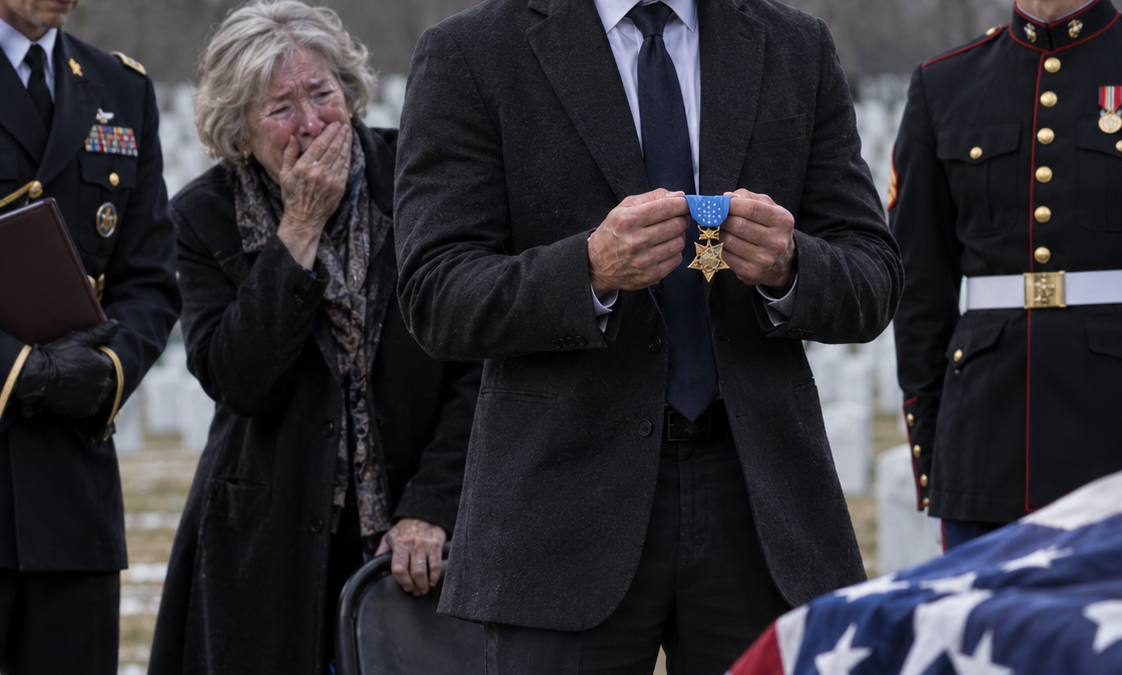
The ceremony was in December. Arlington. Again.
But this time, it was different.
My whole family came. My grandmother. My mother. Uncle Robert. Aunt Patricia. Cousin Michael.
Even Mike came. With his girlfriend. The teacher.
We stood at the grave. The same grave. The same marker.
But it didn’t feel like a grave anymore.
It felt like a homecoming.
Captain Morrison spoke. About Thomas. About his service. About his sacrifice.
Then he looked at me.
“Mr. Kessler. Would you like to say something?”
I hadn’t prepared anything. I hadn’t written a speech.
But I stepped forward anyway.
“Thomas Kessler was my great-uncle,” I said. “I never met him. I never knew him. But I carry him with me every day.”
I rolled up my sleeve.
“This is the SEAL insignia. It’s on my arm. And below it, the names of the men I served with. The men I lost.”
I paused.
“And now, Thomas’s name is there too. Because he was one of us. He was a brother. He was a hero.”
I looked at my grandmother.
“He died so that others might live. And today, we honor him. We remember him. We carry him with us.”
I looked at the crowd. At my family. At the veterans. At the strangers who’d come to pay their respects.
“He’s not forgotten anymore. He’s not erased. He’s here. With us. Always.”
I stepped back.
My grandmother was crying. My mother was crying. Even Michael was wiping his eyes.
Mike nodded at me. Proud.
The ceremony ended. The crowd dispersed.
I stood by the grave. Alone.
My grandmother came up beside me.
“Daniel.”
“Grandma.”
She took my hand. Squeezed it.
“Thank you.”
“For what?”
“For bringing him back. For giving him a voice.”
I looked at her.
“He always had a voice. We just didn’t listen.”
She nodded.
“But we’re listening now.”
She looked at the grave.
“Are you listening, Thomas? We’re here. We remember. We love you.”
She paused.
“Welcome home.”
We stood there for a long time. The sun setting behind us. The wind cold on our faces.
Then we walked back to the car.
Together.
PART 10 — THE TRIDENT
A year later, I was sitting on my porch when the letter came.
It was a warm day. Early summer. The kind of day that makes you forget about winter.
I opened the mailbox. Pulled out the usual bills. And then a white envelope. Official. Stamped.
I opened it.
Dear Mr. Kessler,
We are pleased to inform you that a memorial scholarship has been established in the name of Thomas J. Kessler, UDT-12, United States Navy. The scholarship will be awarded annually to a graduating high school senior entering the military or a first responder program.
The first award will be presented at a ceremony on June 15th. We would be honored if you would attend.
Sincerely,
The Kessler Family Foundation
I read it three times.
The Kessler Family Foundation.
My grandmother had started it. After the ceremony. She’d used her own money. My grandfather’s estate. Set up a foundation in Thomas’s name.
She’d never told me.
I called her.
“Grandma.”
“Daniel. What’s wrong?”
“Nothing. I got the letter. About the scholarship.”
“Oh.”
“You didn’t tell me.”
“I didn’t want to make a fuss.”
“You set up a scholarship. In Thomas’s name.”
“I did.”
“Why didn’t you tell me?”
Silence.
“Grandma?”
“I didn’t want you to think I was trying to buy forgiveness.”
“Grandma—”
“I know it doesn’t make up for it. For what I did. For the years I stayed silent. But I wanted to do something. Something real. Something that would last.”
I closed my eyes.
“You don’t have to buy forgiveness. You already have it.”
“I know. But I wanted to earn it.”
I didn’t say anything.
“The first recipient is a young man from Roanoke. His name is Marcus. He’s going into the Marines. He wants to be a Force Recon.”
Marcus.
The name hit me.
“I want you to meet him,” she said. “At the ceremony. I want you to give him the award.”
“Grandma—”
“I know it’s a lot. But I can’t do it. I’m too old. And you—you’re the one. You’re the one who should do it.”
I was quiet for a moment.
“Okay.”
“Really?”
“Really.”
She let out a breath.
“Thank you, Daniel.”
“Don’t thank me. Just—just keep doing this. Keep making it right.”
“I will. I promise.”
I hung up.
I sat on the porch for a long time.
Marcus.
It was a common name. It didn’t mean anything.
But it felt like something.
The ceremony was in Roanoke. At the high school. A small auditorium. Filled with families. Teachers. Veterans.
I stood at the podium. The medal in my hand. The scholarship certificate.
Marcus walked up. A young man. Tall. Lean. Nervous.
“Mr. Kessler.”
“Marcus.”
He shook my hand. His grip was firm.
“I read about your uncle. About the Medal of Honor.”
“Great-uncle.”
“Right. Great-uncle. He was a hero.”
“He was.”
“I want to be like him.”
I looked at him. At the determination in his eyes.
“You don’t have to be like him. You just have to be the best version of yourself.”
He nodded.
“Yes, sir.”
I handed him the certificate. The medal.
“Congratulations.”
“Thank you, sir.”
He turned to walk away. Then stopped.
“Mr. Kessler?”
“Yeah?”
“Your arm. The tattoo. What are the names?”
I looked at my arm. At the trident. At the five names.
“Men I served with. Men I lost.”
He nodded.
“I’ll carry them too.”
I didn’t say anything.
“I’ll carry all of them. Your uncle. Your men. Everyone who came before.”
I looked at him.
“Good.”
He walked off the stage.
I stood there for a moment.
Then I went home.
The next year, my grandmother died.
It was quiet. Peaceful. She went to sleep and didn’t wake up.
I was the one who found her. In her chair. The ring still on her finger.
I sat with her for a long time.
I thought about the phone call. The one that started everything. “Don’t wear short sleeves.”
I thought about the way she’d looked at me when I walked into the house. The way she’d said my name.
I thought about the last conversation we’d had. About the scholarship. About Marcus.
“I’m proud of you, Daniel.”
“I know, Grandma.”
“I love you.”
“I love you too.”
She’d smiled. A real smile.
And then she was gone.
We buried her next to my grandfather. In the family plot.
But I made sure Thomas’s name was on the stone.
Thomas J. Kessler. 1944–1968. UDT-12. Medal of Honor.
Brother. Hero. Beloved.
I stood at the grave after everyone left.
I looked at the two stones. My grandmother and grandfather. And Thomas.
“You’re together now,” I said. “All of you.”
I paused.
“I hope you’re proud. I hope we did right by you.”
The wind blew. The leaves rustled.
I turned and walked away.
That was five years ago.
I still live in the same house. Still work at the same gym. Still run every morning.
I still have the tattoo. The trident. The five names.
People ask me about it sometimes. At the gym. At the store. At the diner.
I tell them the truth.
“It’s for my men. And for my great-uncle. He was a frogman in Vietnam. He died saving three men.”
They nod. They say they’re sorry. They say thank you.
I say thank you back.
The family is different now.
My mother and I talk every week. Really talk. About everything.
Uncle Robert retired. He volunteers at the VA now. Helps veterans with their benefits.
Cousin Michael is still a lawyer. But he does pro bono work for Gold Star families. He doesn’t brag about it. He just does it.
Mike published his book. It’s about the teams. About the men who came before us. About the ones who never came home.
He dedicated it to Thomas. And to my four men.
I read it. It was good.
My grandmother’s foundation is still running. The scholarship is still awarded every year. To a young man or woman who wants to serve.
I go to the ceremony every year. I give out the award. I tell them about Thomas.
And about Marcus. And Tommy. And David. And Chris.
I tell them about the men who gave everything. So that others could live.
I tell them what it means to serve.
And I tell them what it means to come home.
Last month, I was sitting on my porch. The sun was setting. The sky was pink and gold.
A car pulled into my driveway.
A young man got out. Tall. Lean. Wearing a Marine uniform.
“Mr. Kessler?”
“Yes.”
“It’s me. Marcus. From the scholarship.”
I stood up.
“Marcus.”
He walked up to the porch. Shook my hand.
“I just got back from deployment. My first one.”
“How was it?”
He paused.
“Hard. But I made it.”
“Good.”
He looked at me.
“I wanted to thank you. For the scholarship. For everything.”
“You don’t have to thank me.”
“I know. But I wanted to.”
He paused.
“I also wanted to show you something.”
He rolled up his sleeve.
A tattoo. On his right forearm.
A trident.
Below it, names.
Not mine. Not my men’s. His own. The men he’d served with. The men he’d lost.
“First deployment,” he said. “I lost two.”
I looked at the names.
“I’m sorry.”
“I know. But I wanted to carry them. Like you carry yours.”
I didn’t say anything.
“I want to be like you, Mr. Kessler. I want to serve. I want to honor them. I want to come home and tell their stories.”
I looked at him. At the young man. At the Marine. At the brother.
“You will,” I said. “You already are.”
He nodded.
“Thank you.”
“Thank you.”
He walked back to his car. Got in. Drove away.
I sat back down on the porch.
I looked at my arm. At the trident. At the five names.
I thought about Thomas. About the day he died. About the men he saved.
I thought about my men. About the lives they lived. About the lives they never got to live.
I thought about Marcus. The new Marcus. The one who’d just come home.
I thought about all of them. All the men and women who’d served. Who’d sacrificed. Who’d come home and who hadn’t.
I thought about what it meant to carry them.
And I thought about what it meant to be carried.
I sat there for a long time. The sun went down. The stars came out.
I looked at the sky.
And I said, “Welcome home.”
PART 11 — THE PORCH
The night Marcus left, I couldn’t sleep.
I sat on the porch until two in the morning. Thinking.
About Thomas. About the ring. About the photograph.
About my grandmother. About the way she’d said my name. About the way she’d looked at me when she told me to leave.
About the way she’d looked at me when she said she was proud.
I thought about my grandfather. A man I’d barely known. A man who’d built a family on secrets and lies.
I thought about what he’d taken from us. What he’d buried.
I thought about what we’d found.
I thought about the tattoo parlor. The first time. The second time.
I thought about the needle. The sting. The ink.
I thought about the names.
Marcus. Tommy. David. Chris. Thomas.
Five names. Five men.
I thought about what they’d given me. What they’d taught me.
Courage. Honor. Sacrifice.
And I thought about what I’d given them.
Nothing. Everything.
I thought about the future. About the young man who’d stood on my porch. About the tattoo on his arm.
I thought about the next generation. The ones who’d carry the names after I was gone.
I thought about the trident. The symbol. The meaning.
It wasn’t just a tattoo. It was a promise.
A promise to remember. To honor. To never forget.
I looked at my arm. At the ink. At the names.
“I’m still here,” I said. “I’m still carrying you.”
The wind blew. The trees rustled.
I went inside. Went to bed.
The next morning, I got a call from Mike.
“Hey, Danny.”
“Hey.”
“You okay?”
“Yeah. Why?”
“I don’t know. You sound… different.”
“I’m fine.”
“Okay. I’m in town. You want to get coffee?”
“Sure.”
We met at the diner. The same one. The same booth.
Mike looked good. Happy. Married now. His wife was pregnant.
“Another one on the way,” he said. “Can you believe it?”
“I can believe it.”
“I’m going to name him Thomas.”
I looked at him.
“After your uncle. If that’s okay.”
I didn’t say anything.
“I mean, if you don’t want me to—”
“No. It’s okay. It’s more than okay.”
He nodded.
“Good. Because I already told my wife.”
I laughed.
“You didn’t.”
“I did.”
“You’re an idiot.”
“I know.”
We sat there for a while. Drinking coffee. Talking about nothing.
Then Mike said, “You know, I’ve been thinking.”
“About what?”
“About what we did. About the ceremony. About the article. About everything.”
“And?”
“I think we did something good. Something real.”
“We did.”
“I mean, it’s not every day you get to honor a hero. And it’s not every day you get to see a family come back together.”
I nodded.
“My grandmother—” I paused. “She wasn’t perfect. But she tried. At the end, she tried.”
“She did.”
“She made it right. As much as she could.”
“She did.”
I looked at him.
“I miss her.”
“I know.”
“She drove me crazy. But I miss her.”
He nodded.
“That’s how it works.”
I looked out the window. The sun was up. The sky was blue.
“I’m going to be okay,” I said.
“I know you are.”
“I mean it. I’m going to be okay.”
“I know, Danny. I know.”
We sat there for a while.
Then I got up. Paid the bill. Walked out.
The sun was warm on my face.
I rolled up my sleeve. Looked at the trident.
Five names.
I smiled.
And I went home.
That night, I sat on the porch again. The same porch. The same chair.
I had a beer in my hand. A photograph in my lap.
The photograph of Thomas. The one from the study. The one my grandmother had given me.
I looked at it. At his face. At his smile.
“You know,” I said, “I never met you. But I feel like I know you.”
The wind blew. The trees rustled.
“I hope I did right by you. I hope you’re proud.”
I paused.
“I think you are. I think you’re proud.”
I looked up at the sky. At the stars. At the moon.
“I’m going to keep going,” I said. “I’m going to keep carrying you. All of you.”
I took a sip of my beer.
“I’m going to keep living. For all of you. For the ones who didn’t get to.”
The wind blew. Soft. Gentle.
I smiled.
“Thank you,” I said. “For everything.”
I sat there for a long time.
The stars were bright. The night was quiet.
And for the first time in a long time, I felt at peace.
The story doesn’t really end.
It keeps going. In the foundation. In the scholarship. In the tattoo.
In the young man who stood on my porch.
In the names on my arm.
In the trident.
It keeps going.
And that’s the point.
Thomas died in 1968. But he didn’t really die. He lived in the men he saved. In the families they had. In the children they raised.
He lived in my grandmother’s memory. In the ring she wore. In the photograph in my study.
He lived in me. In the ink on my arm. In the blood in my veins.
He lived.
And now, so do the men I lost. Marcus. Tommy. David. Chris.
They live in me. In the names. In the stories.
They live.
And that’s what the tattoo means.
Not death. Not loss.
Life.
The life they gave. The life I carry.
The life I’ll pass on.
I’m forty-seven years old. I’ve been through things most people can’t imagine. I’ve lost men I loved. I’ve seen things that would break a lesser person.
But I’m still here.
I’m still standing.
I’m still carrying them.
And I always will.
The porch light flickered. I looked up.
A car pulled into the driveway.
I didn’t recognize it.
A woman got out. Middle-aged. Dark hair. A folder in her hand.
“Mr. Kessler?”
“Yes.”
“My name is Sarah Chen. I’m a reporter. With the Roanoke Times.”
“I remember.”
“I wrote the article. About your uncle.”
“I remember.”
She walked up to the porch.
“I want to write another one. About you.”
“About me?”
“About your service. About what you did. About the men you saved.”
I looked at her.
“Why?”
“Because people should know. Because you’re a hero too.”
I shook my head.
“I’m not a hero.”
“You saved three men. You carried your friend three miles through the mountains.”
“I did my job.”
“That’s what heroes say.”
I looked at her. At the determination in her eyes.
“Okay,” I said. “But I have one condition.”
“What?”
“You tell the truth. All of it. About Thomas. About my men. About what it means to serve.”
She nodded.
“I can do that.”
“Then come in. I’ll put on some coffee.”
She smiled.
“Thank you, Mr. Kessler.”
“Call me Daniel.”
She followed me inside.
I turned on the light. Put on the coffee.
We sat at the kitchen table. The photograph of Thomas between us.
“Start from the beginning,” she said.
I did.
I told her about the phone call. About the tattoo. About my grandmother.
I told her about Thomas. About the Medal. About the ceremony.
I told her about my men. About the four names. About the fifth.
I told her everything.
When I was done, she was quiet.
“That’s quite a story,” she said.
“It’s not a story. It’s my life.”
She nodded.
“I know. And I’m going to tell it right.”
“Good.”
She stood up. Held out her hand.
“Thank you, Daniel.”
I shook it.
“Thank you.”
She walked to the door. Stopped.
“One more thing.”
“What?”
“Why did you let me in? Why did you agree to the story?”
I looked at her.
“Because my grandmother was wrong. About a lot of things. But she was right about one thing.”
“What’s that?”
“Secrets destroy families. Truth heals them.”
She nodded.
“Good night, Daniel.”
“Good night.”
She walked out. Got in her car. Drove away.
I sat at the kitchen table. Alone.
I looked at the photograph of Thomas.
“We did it,” I said. “We told the truth.”
I smiled.
“And the truth set us free.”
PART 12 — THE TRIDENT
The article ran a week later.
Front page. Above the fold.
The headline: “The Trident: How One Family’s Secret Shame Became Its Greatest Honor”
I read it in the morning. With coffee. In my kitchen.
It was good. Better than good. It was the truth.
She’d quoted me. “I’m not a hero. I just did my job. The heroes are the ones who didn’t come home.”
She’d quoted Mike. “Daniel carried me three miles through the mountains. He saved my life. And he never asked for anything in return.”
She’d quoted my mother. “I didn’t know my son. Not really. But I know him now. And I’m proud.”
She’d quoted Marcus. The new Marcus. “Mr. Kessler showed me what it means to serve. To sacrifice. To come home.”
The phone started ringing.
Again.
Cousins. Neighbors. Strangers.
They all wanted to talk.
I talked to some of them. Not all.
I was tired. But it was a good tired.
The foundation grew.
My grandmother had left money in her will. For the scholarship. For the ceremony. For the families of fallen SEALs.
We used it. Every penny.
The scholarship was awarded every year. To a young man or woman who wanted to serve.
I went to every ceremony. I gave out every award. I told every story.
Thomas’s story. Marcus’s story. Tommy’s. David’s. Chris’s.
I told them all.
And I told my own.
The years passed.
My mother moved to Roanoke. Closer to me. We had dinner every Sunday. We talked. Really talked.
Uncle Robert retired from surgery. He volunteered at the VA. He helped veterans get their benefits. He said it was the most meaningful work he’d ever done.
Cousin Michael got married. Had kids. Named his son Thomas. He didn’t brag about it. He just did it.
Mike’s book became a bestseller. He donated the proceeds to the foundation. He said it was the least he could do.
I kept working at the gym. Kept running. Kept living.
I was happy. For the first time in a long time, I was happy.
One day, I was sitting on the porch. The sun was setting. The sky was pink and gold.
A car pulled into the driveway.
A young man got out. Tall. Lean. Wearing a Navy uniform.
“Mr. Kessler?”
“Yes.”
“My name is Thomas. Thomas Kessler. I’m your cousin. Your second cousin. Or third. I don’t know.”
I stood up.
“You’re related to Thomas?”
“He was my great-grandfather. My father named me after him.”
I looked at him.
“I read the article. About you. About him. About everything.”
“And?”
“And I wanted to meet you. I wanted to thank you.”
“For what?”
“For bringing him back. For honoring him. For making sure he wasn’t forgotten.”
I looked at the young man. At his face. At his name.
“You don’t have to thank me.”
“I know. But I wanted to.”
He paused.
“I also wanted to show you something.”
He rolled up his sleeve.
A tattoo. On his right forearm.
A trident.
“I got it last week. At the same parlor you went to.”
I didn’t say anything.
“I’m going to BUD/S next month. I want to be a SEAL. Like you. Like him.”
I looked at the tattoo. At the trident.
“Your family know?”
“My parents? Yeah. They’re proud.”
“Good.”
He looked at me.
“Do you have any advice?”
I thought about it.
“Don’t quit.”
“That’s it?”
“That’s it. Don’t quit. Whatever they throw at you. Whatever you go through. Don’t quit.”
He nodded.
“I won’t.”
“Good.”
He shook my hand.
“Thank you, Mr. Kessler.”
“Call me Daniel.”
“Thank you, Daniel.”
He got back in his car. Drove away.
I sat back down on the porch.
I looked at my arm. At the trident. At the five names.
I looked at the sky. At the stars.
I smiled.
“Welcome to the team, Thomas,” I said. “Welcome to the team.”
The story doesn’t end.
It never ends.
It keeps going. In the foundation. In the scholarship. In the tattoo.
In the young man who just left.
In the young man who’ll come next.
In the names. In the trident.
In the blood.
I’m fifty-two years old now. I’ve lived a life most people can’t imagine. I’ve seen things that would break a lesser person.
But I’m still here.
I’m still carrying them.
And I always will.
Thomas Kessler died in 1968. He was twenty-three years old.
He died saving three men. He died for his country.
He was buried. Then forgotten.
Then found.
Now he lives.
In the foundation. In the scholarship. In the tattoo.
In me.
In the young man who stood on my porch.
In the name on my arm.
He lives.
And that’s the point.
That’s always been the point.
I sat on the porch until midnight. The stars were bright. The night was quiet.
I looked at the photograph of Thomas. The one from the study.
“You know,” I said, “I think you’d be proud. I think you’d be proud of all of us.”
The wind blew. The trees rustled.
“I hope so,” I said. “I really hope so.”
I stood up. Walked inside.
I turned off the light.
I went to bed.
And I slept.
