Part 3: “Army? Really? You couldn’t get into a real college, so you’re going to go play soldier?
PART 6 — THE VISITORS
The men came on a Tuesday.
I was at my mother’s house. I’d stopped by to fix a leaky faucet in the kitchen. The kind of thing Richard should have done. The kind of thing he never did.
My mother was in the living room. I was under the sink. I heard the car pull up. I heard the doors open. I heard the footsteps on the porch.
I stopped what I was doing. I listened.
Two sets of footsteps. Heavy. Deliberate. Not neighbors. Not delivery.
The doorbell rang.
“I’ll get it,” my mother said.
“Wait.”
I stood up. I wiped my hands on a rag. I walked to the front of the house.
My mother was already at the door. She opened it.
Two men stood on the porch. Both of them were big. Both of them were wearing dark jackets. One of them had a scar on his chin. The other had a shaved head.
“Mrs. Mercer?” the one with the scar said.
“Yes?”
“We’re looking for your husband. Richard.”
My mother’s face went pale.
“He’s not here,” she said.
“Do you know where he is?”
“No.”
“When will he be back?”
“I don’t know.”
The man with the scar smiled. It wasn’t a nice smile.
“That’s too bad,” he said. “We need to talk to him. About a debt.”
My mother stepped back. The man with the scar stepped forward.
I moved.
I was at the door in three steps. I put myself between the men and my mother. I didn’t say anything. I just stood there.
The man with the scar looked at me. He looked at my posture. He looked at my hands. He looked at my eyes.
“Who are you?” he said.
“That’s not important,” I said. “What’s important is that you’re leaving.”
“We’re not going anywhere until we talk to Richard.”
“Richard isn’t here. You’re talking to me.”
“We don’t want to talk to you.”
“Then we don’t have anything to talk about.”
The man with the shaved head moved. He tried to step around me. I moved with him. I blocked his path. He stopped.
“You’re making a mistake,” he said.
“No,” I said. “You are.”
I said it calmly. The way I’d been trained. The way you talk to a man who’s about to do something stupid. The way you give him one chance to walk away.
The man with the scar looked at me for a long moment. He was trying to figure me out. He was trying to decide if I was a threat. He was trying to decide if I was worth the trouble.
I didn’t help him. I just stood there. Still. Quiet. Patient.
“We’ll be back,” he said.
“I know.”
He turned. He walked down the steps. The man with the shaved head followed him. They got in their car and drove away.
I watched them go. I memorized the license plate. I memorized the car. A black sedan. Nothing special. Nothing that would stand out.
I closed the door.
My mother was sitting on the couch. She was shaking.
“Eli,” she said. “Who were they?”
“Friends of Vincent Corrado.”
“What did they want?”
“Richard. They want to know where he is.”
“Because of the money?”
“Because of the money.”
She started to cry. I sat down next to her. I put my arm around her.
“It’s okay,” I said. “I’m not going to let anything happen to you.”
“How can you promise that?”
I looked at her. At her tired eyes. At her shaking hands.
“Because I’ve done this before,” I said. “And I’m still here.”
I called Danny that night.
“I need you to do something for me,” I said.
“What?”
“I need you to find a man named Richard Mercer. He’s probably in a motel somewhere. Probably drinking.”
“What do you want me to do when I find him?”
“Nothing. Just tell me where he is.”
“Why?”
“Because Vincent Corrado’s men are looking for him. And if they find him before I do, he’s going to end up in a ditch.”
Danny was quiet for a moment.
“You want to protect him?” he said.
“No. I want to find him before they do. I want to make sure he tells the truth. All of it. To the police.”
“You think he’ll do that?”
“He will if he knows what’s good for him.”
Danny called back the next morning.
“I found him,” he said.
“Where?”
“A motel off the highway. The Bluebird. Room 14.”
“He’s still there?”
“Checked in three days ago. Paid for a week. Hasn’t left much.”
“Thank you.”
“Eli—”
“I know.”
“Be careful.”
“Always am.”
The Bluebird Motel was on the south side of town. It was the kind of place that rented rooms by the week. The kind of place where people went when they didn’t have anywhere else to go.
I parked across the street. I watched.
Richard’s car was in the lot. The same beat-up sedan. The same dent in the passenger door.
I waited until dark. Then I walked over.
I knocked on the door. Room 14.
No answer.
I knocked again.
“What do you want?”
“It’s Eli.”
Silence.
Then the door opened.
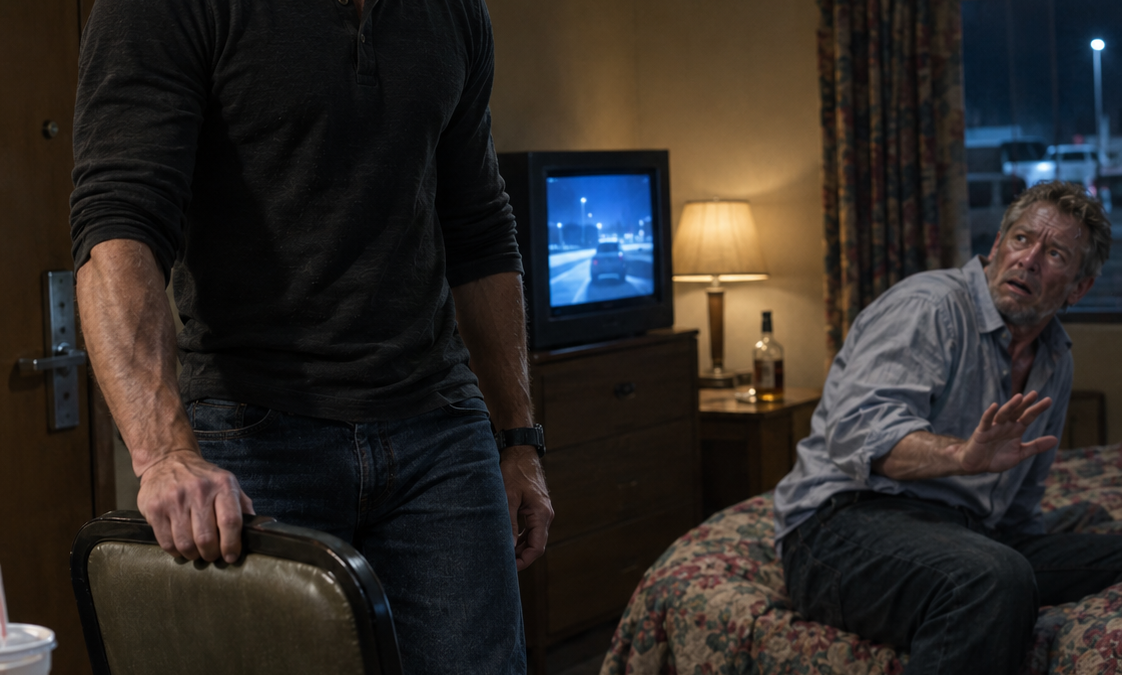
Richard stood there. He looked worse than he had in Reno. Thinner. Grayer. His eyes were sunken. His hands were shaking.
“What are you doing here?” he said.
“We need to talk.”
“I don’t want to talk.”
“I don’t care.”
He stared at me for a long moment. Then he stepped aside.
The room was small. A bed. A chair. A TV. An empty bottle of whiskey on the nightstand. A bag of clothes on the floor.
“Nice place,” I said.
“I’m trying to figure things out.”
“By drinking?”
He didn’t answer.
I closed the door. I stood there. Looking at him.
“Vincent Corrado’s men came to the house,” I said.
His face went white.
“They came looking for you. They wanted to talk about the money. They scared my mother.”
“I—I didn’t know.”
“No. You didn’t. Because you ran. You ran to Reno. You ran to this motel. You’ve been running your whole life, Richard. And you’ve been leaving other people to clean up your mess.”
He sat down on the bed. He put his head in his hands.
“I’m sorry,” he said.
“I’ve heard that before.”
“I mean it.”
“I know you do. But sorry doesn’t fix anything.”
He looked up at me. His eyes were wet.
“What do you want from me?”
“I want you to tell the truth. To the police. About Vincent Corrado. About the money. About everything.”
“I can’t.”
“You can.”
“They’ll kill me.”
“No. They won’t. Because I’m going to make sure they can’t.”
He stared at me.
“How?”
I sat down on the chair. I looked at him.
“Vincent Corrado is in jail,” I said. “He’s going to stay there for a long time. His operation is being taken apart. His men are being arrested. There’s a federal investigation. There’s a grand jury. There’s a prosecutor who wants to make a name for himself.”
“And?”
“And you’re going to help them. You’re going to testify. You’re going to tell them everything you know. And in exchange, you’re going to get immunity. You’re going to get protection. You’re going to get a chance to start over.”
He stared at me.
“Why are you doing this?” he said.
“Because you’re married to my mother. Because she loves you. Because even after everything you’ve done, she still wants you to come home.”
He looked away.
“I don’t deserve her,” he said.
“No. You don’t. But that’s not up to me.”
He was quiet for a long time. Then he nodded.
“Okay,” he said.
“Okay?”
“I’ll do it. I’ll talk to the police. I’ll tell them everything.”
I stood up.
“Good,” I said. “I’ll call the prosecutor in the morning. You’re going to stay here tonight. You’re not going to drink. You’re not going to run. You’re going to be here when they come to get you.”
“And if I’m not?”
“Then I’ll find you. And I won’t be as nice the next time.”
He nodded. He didn’t say anything else.
I left. I got in my truck. I drove home.
The next morning, I called the U.S. Attorney’s office.
I told them I had information about Vincent Corrado. I told them I had a witness. I told them the witness was willing to testify.
They asked who I was. I told them my name. They asked how I was connected. I told them the truth.
They asked if I had any evidence. I told them I had a hard drive. I told them I had ledgers. I told them I had names. Dates. Amounts.
They told me they’d send someone to talk to me. They told me it would be soon.
They were true to their word.
A woman from the U.S. Attorney’s office came to my house two days later. Her name was Linda Chen. She was in her forties. She was sharp. She was direct. She was exactly what I expected.
“Mr. Mercer,” she said. “I’ve read your file. You’re a former Army Ranger. You served three tours in Afghanistan. You were awarded the Bronze Star. You were discharged honorably.”
“That’s right.”
“You’re also the man who broke into a casino in Reno and stole two hundred and forty thousand dollars from a safe.”
I didn’t say anything.
“I’m not here to arrest you,” she said. “I’m here to ask you some questions.”
“Ask.”
She asked. About Vincent Corrado. About the office. About the casino. About the money. About Richard.
I answered. I told her everything. I didn’t leave anything out.
When I was done, she leaned back in her chair.
“You know you could be charged,” she said.
“I know.”
“But you’re not going to be.”
“No.”
“The evidence you provided led to the arrest and conviction of a major organized crime figure. The witness you secured is going to testify in front of a grand jury. You’ve done us a favor.”
“I didn’t do it for you.”
“I know. But that doesn’t change the outcome.”
She stood up.
“We’ll be in touch,” she said.
PART 7 — THE GRAND JURY
Richard testified on a Thursday.
I wasn’t allowed in the room. Grand jury proceedings are sealed. Nobody gets in except the jurors, the prosecutors, the witness, and a court reporter. Not even the witness’s lawyer. Not even family.
I waited in the hallway.
The courthouse was old. Marble floors. High ceilings. The kind of building that made you want to whisper. I sat on a bench outside the grand jury room. I watched the clock. I waited.
Danny was with me. He’d insisted on coming. He said he wanted to see it. I think he wanted to make sure I didn’t do anything stupid.
“You okay?” he asked.
“I’m fine.”
“You don’t look fine.”
“I’m fine.”
He didn’t push. He knew better.
We sat there for four hours. I didn’t move. I didn’t read. I didn’t check my phone. I just sat there. Thinking.
My father used to say that patience was a muscle. You had to exercise it. You had to work at it. You had to practice.
I’d had a lot of practice.
At 2 p.m., the door opened.
Richard came out. He looked worse than I’d ever seen him. His face was gray. His hands were shaking. He walked past me without a word. He walked down the hallway and out the door.
I stood up. I looked at the prosecutor. Linda Chen. She nodded at me.
“He did fine,” she said.
“Fine?”
“He told the truth. All of it. The gambling. The debts. The threats. The money he took from the college fund. The money he lost. The men who came looking for him.”
“He admitted everything?”
“Everything.”
I sat back down on the bench.
“What happens now?” I asked.
“The grand jury will review the evidence. They’ll decide whether to indict. Given what we’ve got, I’d say it’s a formality.”
“Against Corrado?”
“Against Corrado. And his associates. And anyone else who was involved.”
“Richard?”
Linda looked at me. Her expression didn’t change.
“Richard Mercer is a witness,” she said. “He’s cooperating. He’s provided substantial assistance. In exchange, he won’t be charged.”
I nodded.
“That’s what I wanted,” I said.
“Is it?”
I looked at her.
“What do you mean?”
“I mean you could have let him take the fall. You could have let him go to jail. You had the evidence. You had the power. But you didn’t.”
“No.”
“Why?”
I thought about it. About my mother. About the way she’d cried when I’d told her the truth. About the way she still loved him, even after everything.
“Because he’s not the enemy,” I said.
“Then who is?”
“Vincent Corrado. And the people like him. The ones who take advantage of people who can’t protect themselves.”
Linda studied me for a long moment.
“You’re an interesting man, Mr. Mercer,” she said.
“I’ve been called worse.”
She smiled. A small smile.
“We’ll be in touch,” she said.
The indictments came down three weeks later.
Vincent Corrado was charged with money laundering, racketeering, illegal gambling, and extortion. His top lieutenants were charged with the same. His shell companies were seized. His assets were frozen. His casino in Reno was shut down.
The story was everywhere. The local news. The state news. The national news. They called it “the biggest organized crime bust in the region’s history.” They called Corrado “a shadowy figure who’d operated under the radar for years.” They called the investigation “a model of interagency cooperation.”
They didn’t mention me. They didn’t mention Richard. They didn’t mention the college fund.
But I knew. And that was enough.
Richard came back to my mother.
She took him in. I didn’t try to stop her. It wasn’t my place. She was an adult. She could make her own decisions.
But I talked to him first. Alone.
“You hurt her,” I said.
“I know.”
“You took something that wasn’t yours. You lied about it. You ran.”
“I know.”
“If you ever do anything like this again, I’ll find out. And I won’t be as patient.”
He looked at me. His eyes were wet.
“I understand,” he said.
“I don’t think you do. But you will.”
He nodded. He didn’t say anything else.
The weeks turned into months.
Vincent Corrado went to trial. He was convicted on all counts. He was sentenced to twenty years in federal prison. His men got less. His operation was dismantled. The money was seized. The debts were wiped out.
Richard testified at the trial. He was on the stand for two hours. He told the truth. All of it. He didn’t look at me. He didn’t look at my mother. He just answered the questions.
Afterward, Linda Chen called me.
“It’s done,” she said.
“Thank you.”
“You don’t have to thank me. You did the work.”
“I didn’t do it alone.”
“Nobody does.”
I hung up. I sat there for a long time. Thinking.
My mother called me a few days later.
“Eli,” she said. “I need to tell you something.”
“What?”
“Richard told me the truth. About everything. About the money. About Vincent Corrado. About what you did.”
“Okay.”
“I didn’t know. I didn’t know how bad it was. I didn’t know how much he’d taken.”
“It’s not your fault.”
“I know. But I want you to know something else.”
“What?”
“I’m proud of you.”
I didn’t say anything.
“I know I didn’t say it enough when you were growing up. I know I let Richard say things he shouldn’t have said. I know I let him make you feel like you weren’t good enough. And I’m sorry.”
“Mom—”
“Let me finish.”
I waited.
“You went into the Army, and I was scared. I was scared every day. I didn’t understand why you wanted to do it. I didn’t understand what you were trying to prove. But I understand now.”
“What do you understand?”
“I understand that you were trying to become the man your father wanted you to be. And you did. You became more than that.”
I sat there. The phone was warm against my ear.
“Thank you,” I said.
“I love you, Eli.”
“I love you too, Mom.”
I went to see my father’s grave.
It was a small cemetery on the edge of town. The kind of place that was quiet during the week and busy on Memorial Day. I hadn’t been there in years. I’d been overseas. I’d been busy. I’d been avoiding it.
I stood there for a long time. Looking at the headstone.
CHIEF WARRANT OFFICER JAMES MERCER
UNITED STATES NAVY
1955–1998
BELOVED HUSBAND AND FATHER
I didn’t say anything. I didn’t need to. He knew.
I put my hand on the stone. I stood there for a while. Then I turned and walked back to my truck.
PART 8 — THE PORCH
Spring came slow that year.
The oak tree in my mother’s yard budded late. The grass came in patchy. The sky stayed gray longer than it should have. But it came. It always did.
I was sitting on the porch when Richard came out.
It was a Saturday afternoon. I’d driven down for the weekend. Sarah had stayed home. She said she had work to do. I think she just wanted to give me space.
Richard sat down in the chair next to me. He didn’t say anything for a while. We just sat there. Watching the yard.
“You know,” he said finally, “I never understood why you joined the Army.”
I didn’t look at him.
“I know.”
“I thought you were throwing your life away. I thought you were running from something.”
“I was.”
He looked at me.
“What were you running from?”
I thought about it. About the way I’d felt when I was eighteen. About the way I’d felt when I’d watched my father get lowered into the ground. About the way I’d felt when Richard had laughed at me.
“I was running from you,” I said.
He flinched.
“I know,” he said.
“I wanted to prove you wrong. I wanted to be something you couldn’t laugh at.”
“Did you?”
I looked at him. At his gray hair. At his tired eyes. At the way he sat there, waiting for an answer he knew he didn’t deserve.
“Yeah,” I said. “I did.”
He nodded. He looked away.
“I’m sorry,” he said.
“I know.”
“I know it doesn’t fix anything.”
“No. It doesn’t.”
He was quiet for a long moment.
“What can I do?” he asked.
I thought about it.
“Be better,” I said. “That’s all. Just be better.”
He nodded. He didn’t say anything else.
We sat there for a while. The sun was going down. The sky was orange. My mother came out with two glasses of iced tea. She handed one to me and one to Richard.
“Dinner’s in an hour,” she said.
“We’ll be there,” I said.
She went back inside. Richard and I sat there. Watching the sun go down.
I went back home on Sunday.
Sarah was in the kitchen when I walked in. She was making dinner. The house smelled like garlic and onions and something sweet.
“How was it?” she asked.
“It was fine.”
“Just fine?”
“It was good. Richard apologized.”
“What did you say?”
“I told him to be better.”
She smiled. A real smile.
“That’s good,” she said.
“I think so.”
She came over and hugged me. I held her for a long moment.
“I’m proud of you,” she said.
“You keep saying that.”
“Because it’s true.”
Life went back to normal. Or what passed for normal.
I went back to work. I’d taken a job at a security consulting firm after I’d gotten out of the Army. It wasn’t exciting. It wasn’t dangerous. But it was steady. It was something I was good at.
I kept in touch with Danny. We got lunch once a month. We talked about the old days. We talked about the guys we’d lost. We talked about the guys who were still serving.
I kept in touch with Leon. He called me once every few months. Usually when he needed something. Usually when he had something for me. We never talked about the favor I owed him. We both knew it was there.
I visited my mother every few weeks. Richard was always there. He was different. Quieter. He didn’t talk as much. He didn’t laugh as much. He seemed to be thinking about things. I didn’t know what. I didn’t ask.
The money sat in an account.
I didn’t touch it for a long time. I didn’t need it. I had a job. I had savings. I had everything I needed.
But one day, I got an idea.
I called my mother.
“Mom,” I said. “I want to do something with the money.”
“What kind of something?”
“I want to start a scholarship fund. For kids in Millbrook. Kids who want to go to school but can’t afford it.”
She was quiet for a moment.
“Eli,” she said. “That’s—that’s a wonderful idea.”
“It’s what my father would have wanted. He wanted me to have choices. I want to give other kids choices too.”
She started to cry.
“I’m so proud of you,” she said.
“You keep saying that.”
“Because it’s true.”
I called it the James Mercer Scholarship Fund.
It wasn’t big. It wasn’t fancy. It was just a small fund that gave money to kids from Millbrook who wanted to go to college. Kids who’d lost a parent. Kids who came from families that didn’t have much. Kids who just needed a break.
The first year, we gave out two scholarships. The second year, four. The third year, six.
It grew. Slowly. Steadily. The way good things do.
I went to the award ceremony every year. I stood in the back. I watched the kids get their checks. I watched their parents cry. I watched them smile.
And I thought about my father. About the way he’d believed in me. About the way he’d wanted me to have choices.
I had choices now. And I was giving them to other people.
That was enough.
Vincent Corrado died in prison.
It was two years after his conviction. A heart attack. He was sixty-three years old.
I read about it in the paper. I didn’t feel anything. Not relief. Not satisfaction. Not sadness. Just nothing.
He was a man who’d taken from people. He was a man who’d hurt people. He was a man who’d built his life on other people’s pain.
And now he was gone. And the world was a little bit better.
I folded the paper. I put it in the recycling. I went on with my day.
Richard got sick.
It was three years after the trial. He’d been having trouble breathing. He’d been tired. He’d been losing weight.
My mother took him to the doctor. They ran tests. They found cancer. In his lungs. It had spread.
The doctors gave him a year. Maybe less.
My mother called me. She was crying.
“Eli,” she said. “It’s Richard. He’s—he’s dying.”
I sat there. The phone was warm against my ear.
“I’ll be there,” I said.
I drove down that night.
Richard was in the hospital. He looked small. The kind of small that people get when they’re sick. He had tubes in his nose. He had wires on his chest. He had a look in his eyes that I’d seen before. The look of a man who knows he’s running out of time.
“Eli,” he said.
“Richard.”
He tried to smile. It didn’t work.
“I’m glad you came,” he said.
“I’m here.”
He nodded. He closed his eyes. He was quiet for a long moment.
“I want to tell you something,” he said.
“What?”
“I know I wasn’t a good father to you. I know I wasn’t a good husband to your mother. I know I made mistakes.”
“Richard—”
“Let me finish.”
I waited.
“I spent my whole life trying to be something I wasn’t. I tried to be a salesman. I tried to be a real estate agent. I tried to be a financial advisor. I tried to be a big shot. But I was never any of those things.”
He opened his eyes. He looked at me.
“You were the real thing,” he said. “You were a Ranger. You were a soldier. You were a man. And I was jealous.”
I didn’t say anything.
“I was jealous of you. I was jealous of what you’d become. I was jealous of the way your mother looked at you. I was jealous of the way your father’s memory hung over everything.”
He stopped. He took a breath.
“So I tried to tear you down. I tried to make you feel small. I tried to make you feel like you weren’t good enough.”
“I know,” I said.
“I’m sorry.”
“I know.”
He closed his eyes.
“Can you forgive me?” he asked.
I sat there for a long moment. Thinking. About the way he’d laughed at me. About the way he’d taken my father’s money. About the way he’d run when things got hard.
But also about the way he’d come back. About the way he’d testified. About the way he’d tried to be better.
“I forgive you,” I said.
He opened his eyes. They were wet.
“Thank you,” he said.
Richard died three weeks later.
The funeral was small. Just family. Just friends. Just the people who’d known him.
My mother cried. I held her hand. I didn’t cry. I’d learned a long time ago not to cry at funerals.
Afterward, my mother came up to me.
“He loved you,” she said.
I looked at her.
“I know,” I said.
“Do you?”
I thought about it. About the way he’d looked at me in the hospital. About the way he’d said he was sorry. About the way he’d asked for forgiveness.
“Yeah,” I said. “I do.”
She hugged me. She held on tight.
I went to see my father’s grave that afternoon.
The cemetery was quiet. The sun was setting. The sky was orange and pink.
I stood there for a long time. Looking at the headstone.
CHIEF WARRANT OFFICER JAMES MERCER
UNITED STATES NAVY
1955–1998
BELOVED HUSBAND AND FATHER
“I did it,” I said. “I got the money back. I got all of it back.”
The wind blew. The leaves rustled. The sun went down.
“I started a scholarship fund. In your name. For kids who need help.”
I put my hand on the stone.
“I hope you’re proud of me.”
I stood there for a while. Then I turned and walked back to my truck.
I sat in the truck for a long time.
Thinking about my father. About Richard. About Vincent Corrado. About all the men who’d tried to tear me down.
They were all gone now. My father. Richard. Corrado. All of them.
And I was still here.
I thought about the Army. About the Rangers. About the men I’d served with. About the men I’d lost. About the men I’d saved.
I thought about Sarah. About the way she’d stood by me. About the way she’d believed in me. About the way she’d never asked questions she didn’t need answers to.
I thought about my mother. About the way she’d cried when I’d told her the truth. About the way she’d said she was proud of me.
I thought about the scholarship fund. About the kids who’d gotten a chance because of my father’s money. About the lives that would be different because of what I’d done.
I started the truck. I drove home.
Sarah was waiting on the porch when I got there.
She was sitting in the rocking chair. She had a blanket on her lap. She had a cup of coffee in her hand.
“How was it?” she asked.
“It was fine.”
“Just fine?”
“It was good. I said goodbye.”
She nodded. She stood up. She walked over to me. She put her arms around me.
“I’m glad you’re home,” she said.
“I’m glad I’m home too.”
We stood there for a long moment. The sun was gone. The stars were out. The night was quiet.
“You know,” she said, “you never told me what you did in the Army.”
I looked at her.
“You never asked.”
“I’m asking now.”
I thought about it. About the mountains. About the night raids. About the men I’d lost. About the men I’d saved. About the things I’d done that I’d never talk about.
“I was a Ranger,” I said. “I was in the 75th Ranger Regiment. I did three tours in Afghanistan. I did things I can’t talk about.”
She looked at me. Her eyes were soft.
“Were you good at it?” she asked.
I smiled. A small smile.
“Yeah,” I said. “I was good at it.”
She nodded. She didn’t ask anything else. She just took my hand and led me inside.
The years went by.
The scholarship fund grew. We gave out more money. We helped more kids. We put more names on the wall.
My mother moved into a smaller house. She didn’t need the space anymore. She said she wanted to be closer to town. I think she just wanted to be closer to people.
Danny and I stayed friends. We got lunch once a month. We talked about the old days. We talked about the new days. We talked about everything and nothing.
Leon called me once a year. Usually on my birthday. Usually to remind me that I still owed him a favor. I told him I knew. He told me he was patient. I told him I was too.
I never did pay him back. Not in the way he meant. But I think he understood. Some debts can’t be paid. Some debts just sit there. Some debts just remind you who your friends are.
I went back to Millbrook one last time.
It was ten years after the trial. Ten years after Vincent Corrado had gone to prison. Ten years after Richard had died. Ten years after everything had changed.
I drove down on a Saturday. The sun was out. The sky was blue. The oak tree in my mother’s yard was in full leaf.
I parked in the driveway. I got out. I stood there for a moment. Looking at the house.
It was the same. The same porch. The same yard. The same oak tree.
But it was different too. The paint was fresh. The lawn was mowed. There were flowers in the garden.
My mother came out. She was older now. Grayer. But her eyes were the same. Sharp. Bright.
“Eli,” she said.
“Mom.”
She hugged me. She held on tight.
“I’m glad you came,” she said.
“I’m glad I came too.”
We sat on the porch. We drank iced tea. We talked about the old days. We talked about the new days. We talked about everything and nothing.
And I thought about my father. About the way he’d believed in me. About the way he’d wanted me to have choices.
I had choices now. I’d always had choices. I just hadn’t known it.
I looked out at the yard. At the oak tree. At the sky.
And I smiled.
