An Older Billionaire Cornered a Single Dad at the Wedding—“Catch Me Before Someone Else Does” (Part 1)
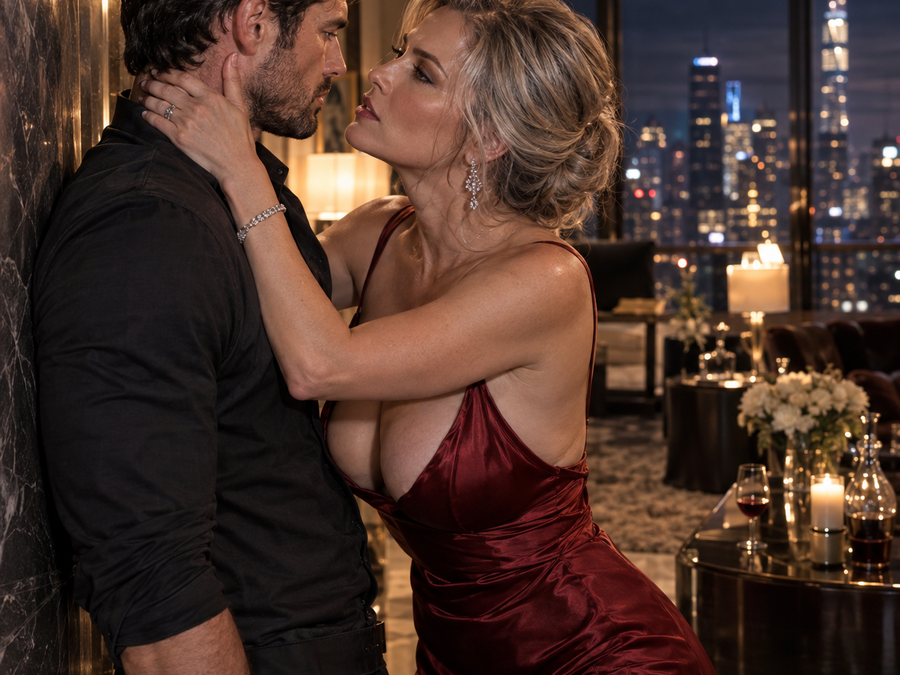
An Older Billionaire Cornered a Single Dad at the Wedding—“Catch Me Before Someone Else Does” (Part 1)

PART 1
She owned three hotels, two towers, and a billion-dollar empire built on 30 years of iron discipline. And tonight, in a quiet hallway away from the cameras and the champagne, she pressed her hand against a maintenance worker’s chest and backed him gently against the wall, not because she wanted a scandal, because she was terrified. Celeste Ardmore, 50 years old, one of the most powerful women in New England, looked up at a man who fixed broken elevators for a living and whispered four words that would destroy everything she had carefully built.
The elevator in the East Wing had been making a grinding noise for 11 days. Mason Redick knew this the way he knew most things about the Westmore Grand, not from a report, not from a complaint ticket, but from listening. He’d been listening to this building for 3 years. He knew when the boiler was running too hot by the smell of the basement corridor. He knew which guest room windows leaked when the wind came from the northeast.
He knew the sound the service door made when it hadn’t been properly oiled, and he knew exactly which floorboard outside the executive suites would announce his presence before he even knocked. He also knew on this particular Friday evening in late October that he had absolutely no business being in the ballroom. “You look like you’re waiting for a dentist appointment,” his sister said, appearing beside him in a cloud of white tulle and hairspray.
“I look fine,” Mason said.
“You look like someone put a suit on a man who hates suits.”
“It fits.”
“It fits like a garbage bag that got ironed.” Leanne squeezed his arm. “Relax. It’s a wedding.”
“It’s your wedding.”
“I’m relaxed.” Mason, you’ve checked your phone four times in the last 2 minutes. He hadn’t realized he was doing it. He pocketed the phone. “Piper. Okay?” Leanne asked softer now. “She’s with Ms. Cartwright from the third floor. She’s fine.” He straightened his collar. “You look beautiful, by the way, in case I forget to say that later when I’m busy being tense.” Leanne laughed the same laugh she’d had since she was 7 years old. Loud and slightly embarrassing and completely genuine. She pressed up on her toes and kissed his cheek. “Don’t disappear into the walls tonight,” she said. “You’re not on shift. You’re a guest. Act like one.”
She was pulled away by a photographer before he could answer. Mason stood alone at the edge of the reception, holding a glass of sparkling water he hadn’t touched, watching 300 people in expensive clothes enjoy a party that probably cost more than his annual salary. He wasn’t bitter about that. He’d made his peace with the math of his life a long time ago. He had a daughter he adored, a job he was genuinely good at, a decent apartment 2 miles from here, and exactly enough money to feel neither desperate nor comfortable. It wasn’t a spectacular life, but it was his.
He was scanning the room for Piper’s empty seat at the family table. She’d begged to come for the ceremony and then been collected by Mrs. Cartwright for the actual reception, a compromise Mason had negotiated with some difficulty when he noticed the shift in the room. It was subtle, the way a current changes underwater before a wave arrives at shore. People were straightening. Women who had been leaning comfortably against their chairs were suddenly sitting upright. Conversations paused mid-sentence and resumed at a different pitch. Two of the hotel’s senior event coordinators standing near the entrance doors exchanged a glance. He recognized the particular alertness of people who had just been reminded of who exactly owned the building they were standing in.
Mason turned. Celeste Ardmore walked into the Westmore Grand Ballroom, the way she walked into every room she owned without announcing herself, without waiting to be acknowledged, and with the particular calm of someone who understood that the room would rearrange itself around her regardless. She was 50 years old. She had silver at her temples that she had never once tried to hide, dark eyes that cataloged everything they passed over, and a posture that suggested she had spent decades carrying things other people put down. She wore a midnight blue gown that was elegant without being theatrical, and she was accompanied by a man Mason had seen in photographs, but never in person.
Preston Vale, 54, investment magnate, known in the financial press for acquisitions and restructurings that politely destroyed smaller companies and made their shareholders extremely wealthy in the process. He had the kind of handsome that came with very good tailoring and regular gym access and the knowledge that nobody in the room was going to tell him he had spinach in his teeth. He kept his hand at the small of Celeste’s back.
Mason watched her move through the room. He watched the way she greeted people warm, precise, genuine in her interest without being excessive. He watched the way she accepted a glass of wine from a passing server with a quiet thank you that the server clearly wasn’t expecting. He watched Preston lean close to say something in her ear, and he watched Celeste’s expression do something he had never quite seen it do before. Not quite a smile, more like the practice performance of one. He looked away.
Mason had met Celeste Ardmore on a Tuesday afternoon 3 years ago in a service corridor behind the hotel’s third-floor restaurant. He’d been called in to fix a faulty electrical panel that had tripped two ceiling fans and a set of ambient lights in the middle of the lunch service. It was a straightforward job. He’d been working on it for about 20 minutes when he became aware that someone was standing nearby and had been for a while.
He turned. A woman in a charcoal blazer was watching him work with the focused attention of someone who was genuinely curious rather than checking up on him. She had a phone in her hand that she clearly wasn’t using. “You found it,” she said.
He hadn’t been told anyone else was coming. “Found what?”
“The actual fault. The other technician said the whole panel needed replacing.” Mason glanced at the circuit he just isolated. “Just this section. Somebody wired the fans into the same circuit as the refrigeration unit in the kitchen below. It gets hot, trips the breaker. Doesn’t need replacing. Needs rewiring.”
The woman looked at the panel, then back at him. “How long to fix it?”
“Hour, maybe less.”
She nodded. “Thank you.” She turned to leave.
“You might want to have someone check the kitchen refrigeration unit, too,” Mason said. “It’s drawing more current than it should. Probably a compressor issue. Not urgent, but it’ll be urgent in about 3 months.”
She stopped. She turned back. “Write it up,” she said. “I’ll have someone look at it.”
Two weeks later, a refrigeration contractor replaced the kitchen compressor. It was only afterward, comparing notes with a colleague that Mason realized the woman in the corridor had been Celeste Ardmore, the owner of the hotel, the founder of Ardmore Meridian Group, and one of the wealthiest women in Massachusetts. He thought about that for approximately one afternoon. Then he went back to work.
Over 3 years, they had developed something that neither of them would have easily categorized. It wasn’t friendship exactly. She was his employer. He was a facility supervisor. There were 18 years between them and a considerable distance in every measurable category of their respective lives. But Celeste Ardmore was, in Mason’s experience, one of the few people in his professional life who talked to him like he was in possession of a functional brain.
She asked his opinion on mechanical issues and actually listened to the answers. She’d stopped by the maintenance workshop twice to understand how something worked the hotel’s cooling system once, the elevator cabling another time, and she’d paid attention the entire time in a way that suggested she found the information genuinely interesting rather than obligatory. He knew things about her that her executive team probably didn’t.
He knew she kept a photograph of her mother on the desk in her private office that she never moved. He knew she hated the smell of the cleaning products used on the third floor hallways and had twice quietly asked him to find an alternative, which he had. He knew she arrived at the hotel at 7:30 most mornings, and that she almost always ate a granola bar from the vending machine near the service entrance for breakfast because she rarely had time for anything else.
He also knew because he was not an idiot that he had developed feelings for her somewhere in the previous 18 months that had no business existing. He had not acted on them. He had not planned to. He was 32 years old with a daughter and a maintenance job and an apartment that had excellent water pressure but questionable heating. Celeste Ardmore had a private jet and a corporate headquarters in downtown Boston and a life that operated in a register he couldn’t touch. He was well aware of all of this. He had filed the feelings under not applicable and gotten on with his life until tonight.
Apparently, he was refilling his water glass at the bar when someone stepped up beside him and ordered a scotch. He didn’t need to look. “Mr. Redick.” Preston Vale’s voice was the kind of voice that expected to be listened to. “I don’t believe we’ve been formally introduced.”
Mason turned. Up close, Preston was precisely what Mason had expected, polished, assured, and deeply comfortable with the assumption that he was the most important person in any given conversation. “Mason Redick,” Mason said. He didn’t extend a hand. Neither did Preston.
“You’re the facility supervisor.” It wasn’t a question. “Leanne Redick’s brother.”
“That’s right.”
Preston accepted his scotch, turned slightly toward Mason, and looked at him the way a man looks at a piece of furniture he’s considering buying. Not hostile appraising. “Beautiful hotel,” Preston said. “Celeste keeps it in excellent condition. She has a good team.”
“I understand you’ve been with the property for three years.”
“About that.”
“She speaks well of you,” Preston said it pleasantly. “The facility’s work here is genuinely impressive for a building this old. You must enjoy the work.”
“I do,” Mason said.
“Good.” Preston took a sip of his scotch. “A man should enjoy what he does, especially when it’s the right fit.”
There was something in that sentence that hadn’t an edge on it, but Preston delivered it so smoothly that calling it out would have seemed paranoid. Mason let it go. “Congratulations on the engagement,” Mason said. “When’s the announcement?”
Preston smiled. “Midnight.” He looked across the room to where Celeste was speaking with a group near the far wall. “She’s remarkable, isn’t she? Everything she’s built, everything she carries.” He paused. “She needs someone in her corner who understands that world, who can actually protect what she’s built.”
Mason looked at his water glass. “I’m sure she does,” he said. He excused himself and walked away before Preston could say anything else.
The cocktail hour stretched toward dinner. Dinner became speeches. Speeches became dancing. And Mason found himself standing in the corridor outside the ballroom at 9:40, jacket slightly loosened, listening to the muffled bass of the band’s third set and wondering why he hadn’t left an hour ago. He had no answer.
He was turning toward the service corridor, old habit, the urge to check on the building to make sure everything was running as it should when he heard footsteps. And then he saw her. Celeste Ardmore was walking toward him from the direction of the east-wing corridor, moving fast in a way that had nothing to do with urgency and everything to do with someone trying to get somewhere without being followed.
Her expression was composed in the precise, controlled way that meant the opposite of composed underneath. She saw him. She stopped. For one long moment, they both simply stood there in the hallway, which was quiet and warmly lit and completely empty except for the two of them. Then Celeste stepped forward.
She raised one hand and placed it flat against Mason’s chest. Not aggressive, not romantic, just present, a grounding gesture. And she backed him gently, slowly against the corridor wall. Mason didn’t move. His heart was doing something complicated that he chose not to examine. Celeste looked up at him, and for the first time in 3 years, he saw something in her face that he had never seen before. Not authority, not composure, not the particular warmth she deployed so effectively and with such precision. Fear. Real unguarded, unmanaged fear.
She leaned close. Her voice dropped to almost nothing. “Catch me,” she said before someone else does. Then she straightened. She took a breath and she walked back toward the ballroom with her chin up and her shoulders level and every visible inch of her looking like a woman who knew exactly what she was doing.
Mason stood against the wall for a long moment. The band played something slow and expensive through the closed ballroom doors. He put his hand against his chest where hers had just been, and he thought, “What does that mean?” And then, because he had spent 3 years watching Celeste Ardmore and paying attention when other people weren’t, what does she know that I don’t?
He found the answer 45 minutes later, sitting in the maintenance office two floors below with his phone and a very uncomfortable conversation with his colleague Daario, who had worked security liaison for the Ardmore properties for 6 years and had a habit of knowing things he probably shouldn’t. “The board situation,” Daario said, leaning back in his chair and looking at the ceiling. “Yeah, it’s not good.”
“Fernandez’s shares from when he died, his estate’s contesting the transfer, locks up almost 20% of the vote, and three of the other directors have been real quiet lately. The kind of quiet that means someone’s been talking to them. Someone like Preston Vale.” Daario looked at him. “Where’d you hear that?”
“I didn’t, I’m guessing.”
A pause. “Smart guess.”
“What does Vale want?”
“From what I’ve heard,” Daario spread his hands. “Everything. But he’s smart enough to want it legal. The engagement makes it clean. Combines the voting power. He gets access to the properties. She keeps the title. He keeps control. Everybody wins.” He paused. “Except her, but that’s a different conversation.”
Mason was quiet. “She’s announcing tonight?” He asked.
“Midnight,” Daario said. “That’s the word. Preston’s been planning it for weeks. Nice optics. Her sister-in-law’s wedding. Romantic setting. Hard to say no in front of that many cameras.”
Mason sat with that for a moment. Catch me before someone else does. It wasn’t about love. It was about a woman who had spent 30 years building something with her own hands, watching it be used against her. It was about someone being maneuvered into a corner so carefully and so slowly that by the time she recognized it, she was already inside the walls. And she’d walked up to the one person in the building she trusted to tell him. Not to rescue her, not to fight for her, just to know.
He checked his watch. 11:17. He had 43 minutes. He put his jacket back on and he went to find his daughter. Piper was asleep in Mrs. Cartwright’s room on the fourth floor when Mason knocked and Mrs. Cartwright led him in with the practiced understanding of a woman who had been helping with Piper since she was five. His daughter was curled on the maid bed in her party dress, one shoe off, her dark hair spread across the pillow. He stood in the doorway and looked at her for a moment. She looked like her mother when she slept. She’d always looked like her mother when she slept.
He was pulling the door almost closed when a small voice said, “Daddy.” He stepped back in. Piper hadn’t opened her eyes. “Hey, Pip, go back to sleep. Did Aunt Leanne have fun?”
“She’s still having fun.” A pause. “Is Miss Celeste okay?”
He went very still. “Why?”
“I saw her earlier.” Piper’s voice was thick with sleep. “When me and Mrs. Cartwright came down to get my sweater, she was standing by the window in the hallway by herself.” A long pause. “She looked like you look when you’re trying not to be sad.”
Mason didn’t say anything for a moment. “What do you mean?”
“Like when you’re being normal, but your eyes are doing the other thing.” Piper finally opened her eyes a little and looked at him. “She’s nice, Daddy. She taught me how to do that card trick.”
“I know.”
“Is she okay?”
He looked at his daughter, 8 years old, one shoe off, reading the room with an accuracy that continually embarrassed him. “I don’t know yet,” he said honestly. “I’m going to go check.”
Piper closed her eyes again. “Good,” she said with the absolute certainty of someone who had already decided the matter was handled. Mason put the door quietly behind him. He looked at his watch. 11:31. 29 minutes. And suddenly, standing in the carpeted quiet of the fourth floor hallway with the distant sound of the band drifting up through the building he had spent 3 years learning like a language, he knew what he was going to do.
The stairwell between the fourth and second floors smelled like old carpet and the particular cold that crept into hotel buildings in late October when the heating system hadn’t fully committed to the season yet. Mason took the stairs because the elevator was still making that grinding noise and he hadn’t gotten around to fixing it today and right now moving through a stairwell that smelled like work and reality felt more appropriate than standing in a gilded elevator car thinking about what he was about to do.
He wasn’t entirely sure what he was about to do. That was the honest answer. He had stood in the fourth floor hallway with 29 minutes on his watch and a decision forming somewhere below his rib cage. And he had told himself he was going to go check on Celeste and that was true. But checking on someone and doing something about what you find are two different categories of action. And Mason had spent 32 years being very clear about which category applied to him in situations involving women who owned the buildings he worked in.
He pushed through the second floor door and walked toward the maintenance office. Daario was still there now with a paper cup of vending machine coffee and the resigned look of a man who had decided to stay until something interesting happened. “You went up,” Daario said.
“I did.”
“You came back down.”
“Apparently.” Daario studied him for a moment.
“You going back to the party?” Mason pulled his jacket straight.
“I need to see something first. The access logs for the executive floors the past 3 months.” Daario’s expression shifted something careful moving behind his eyes.
“What are you looking for?”
“I don’t know yet, but I’ve been writing up irregular access events for 2 months. People using key card codes on the restricted floors at odd hours. I filed the reports. Nothing came back.”
“Nothing came back because nobody acted on them.” Mason sat down at the terminal, which is interesting.
Daario was quiet for a moment. Then he sat down his coffee and leaned over Mason’s shoulder. The access logs for the executive floors, the private conference suites, the record storage corridors, the document handling room on the 14th floor that Mason had always quietly thought was underprotected for what it contained told a story that was not subtle once you were looking for it.
Between August and October, there had been 19 instances of key card access to restricted areas between the hours of 11:00 p.m. and 4:00 a.m. The cards used belonged to four different individuals. Two of them were names Mason recognized as members of the hotel’s overnight cleaning staff. One was a name he didn’t recognize at all. And the fourth was a name that when it appeared on the screen made Daario straighten up and say something under his breath that Mason chose not to repeat.
“That’s Preston Vale’s personal assistant,” Daario said. “I know. She has a key card for the executive floors. Apparently it was issued 3 months ago. System shows it was approved by a director level authorization.” Mason scrolled through the log. “The authorization code is,” he stopped. “It’s Hendrickx. Graham Hendrickx board director.” One of the names Daario had mentioned earlier in the category of people who had been very quiet lately.
Daario pulled up a chair. They sat together in the maintenance office. The two of them. While upstairs, 300 people celebrated Mason’s sister’s wedding. And the band played its fourth set. And somewhere in the ballroom, a 50-year-old woman in a midnight blue gown was running out of time.
“19 access events,” Mason said quietly. “Over 3 months, and she was accessing the document handling room where they store the original partnership agreements,” Daario said, “and the records from the Fernandez estate transaction.”
“The Fernandez estate.” Martin Fernandez, Celeste’s late business partner. The contested shares, the 20% of the vote that was currently locked up and unavailable. Mason looked at the screen. “If someone had access to those documents,” he said, “and they knew what to look for. They could figure out the exact number of votes Celeste needs to maintain control. And they could figure out exactly how far she’s exposed without them.”
Daario’s voice was flat. “And if you know exactly how exposed someone is, you know exactly how much pressure to apply.”
Mason sat back. This was not a man falling in love with a powerful woman and hoping she’d notice him. This was something else entirely. Preston Vale had spent 3 months mapping Celeste Ardmore’s vulnerabilities with the precision of someone planning a siege. He’d identified the fault lines, the contested shares, the uncertain board votes, the legal exposure from the Fernandez estate, and then he’d positioned himself as the solution.
Marriage, combined voting power, a rescue that came with a price tag Celeste hadn’t seen clearly until the walls were already up. And Celeste, who had built an empire on her ability to read situations and people, had been so deep inside the problem that she couldn’t see the shape of it from where she was standing. She needed someone outside. Mason looked at his watch. 11:42.
He stood up. “Print all of this,” he said. “Every log entry, every time stamp, every access code.” He was already moving toward the door. “And Daario, don’t touch anything else. Don’t delete anything. Don’t move anything. Just print it and keep it somewhere safe.” Daario was already at the printer.
“What are you going to do?” Mason paused in the doorway. He thought about Piper’s voice. She looked like you look when you’re trying not to be sad. He thought about a corridor 3 years ago and a woman who listened to him explain a circuit fault and then actually did something about it. He thought about four words whispered against his chest in a quiet hallway.
“I’m going to go be a guest at my sister’s wedding,” he said. For the first time tonight, he took the stairs back up. The party had reached that particular hour when weddings begin to show their true nature. The speeches were over. The formal photographs were done, and what remained was a collection of human beings in expensive clothes who had been drinking since 5:00 p.m. and had loosened into something more honest than their arrival selves.
Mason moved through the edge of the room without drawing attention, which was a skill he had developed over years of moving through spaces that weren’t exactly his. He found a spot near the back wall where he could see the full room. Celeste was at a table near the center speaking with a couple Mason didn’t recognize. Her posture was perfect. Her face was doing everything it was supposed to do. She laughed at something the woman said, the right laugh. The warm and measured laugh that invited people in without committing to anything.
Preston was 20 ft away talking to a cluster of men in suits who had the particular body language of people discussing something they found very satisfying. Mason watched Preston. He watched the way Preston kept one eye on Celeste across the room with the proprietary attention of someone watching an asset. Not love, not even affection, really, management. He watched Preston check his watch. 11:48.
He said something to the men around him. One of them nodded and moved toward the stage where the band was currently finishing a slow number. 12 minutes. Mason made a decision. He crossed the room. He didn’t approach Celeste directly. He moved to the bar which was positioned at the edge of the room in a way that put him within speaking distance without requiring either of them to make a visible effort. He ordered a water the bartender had stopped offering him anything else and he waited.
2 minutes later Celeste appeared beside him. She didn’t look at him immediately. She ordered a club soda and stood at the bar with her eyes on the room and for a moment they were simply two people standing at the same bar at the same event. “I know,” Mason said quietly, not looking at her, “about the board. The Fernandez shares. Why midnight matters.”
A pause. Celeste’s hand moved slightly on the bar top. “Daario,” she asked, “and the access logs from the executive floors.”
“14 months of entry records. Preston’s assistant has been in the document handling room 19 times in 3 months.” Very slowly, Celeste set down her club soda.
“Mason.”
“I filed the access reports,” he said. “2 months ago. They went up the chain and nothing came back because someone in that chain didn’t want them to.” He heard her breath shift slightly. Not panic, something more controlled than that. The sound of a mind reorganizing very quickly.
“What were they accessing?” She asked.
“The Fernandez estate records. The original partnership agreements.” He finally looked at her. “The exact documents that would tell someone precisely how many votes you need and precisely how many you’re short.”
Celeste looked at him for the first time since she’d appeared beside him. Her expression was complicated. Anger moving under the surface of something that might have been relief or might have been the opposite of relief. The feeling of a problem you’d been trying not to name. Finally getting named. “He knew,” she said. It wasn’t a question. “He knew everything before he made his offer. He knew exactly where you were exposed and exactly what it would take for you to believe you had no other option.”
Celeste was quiet. The band was taking a short break. The stage was being reorganized. Mason could see one of Preston’s associates near the microphone speaking with the event coordinator. 10 minutes maybe. “Celeste.” He turned to face her fully, which required some adjustment on his part because she was looking at him the way she’d looked at that circuit panel 3 years ago with the total undivided attention of someone assessing something they’d just realized was more complex than they’d assumed.
“The access logs exist. I have printed records going back 3 months. If there’s an independent review of how the board pressure campaign operated, if someone starts asking how Preston’s team knew exactly where and how to apply leverage, these records are the beginning of that conversation.”
“It’s not enough to stop tonight,” she said, not arguing with him, thinking out loud. “Even if the records are legitimate, even if the investigation begins tomorrow, the votes are the votes. Tonight, he still has them.”
“I know.”
“So, what are you?” She stopped. She looked at him for another moment and something shifted in her expression. “You didn’t come over here to give me a strategic option.”
“No,” he agreed.
“Then what did you come over here for?” Mason picked up his water glass, set it down. He had prepared approximately nothing of what he was about to say, which was either a significant error in judgment or the most honest thing he’d done in 3 years.
“I came over here,” he said carefully, “because 4 hours ago you backed me against a wall in the corridor and whispered something to me. And I’ve been thinking about it ever since. And I want to know when you said that, what did you actually mean?”
Celeste looked at him. The noise of the room continued around them. Somebody laughed loudly at a table behind them. A server passed with a tray of champagne. “I meant what I said,” she said.
“I know, but there are different ways to mean it.”
She was quiet for a long moment. Long enough that Mason thought she wasn’t going to answer. Long enough that he started preparing himself for the version of the next 10 minutes where he’d overread something fundamental and was about to have a very uncomfortable conversation with the woman who owned the building he worked in. Then Celeste said, “Four years ago, I walked into a board meeting with $37 million on the table and three members who thought they could pressure me into a concession that would have cost me twice that over the following decade. I sat through two hours of that meeting without blinking.”
She looked down at her club soda. “I came home afterward and sat in my car in the parking garage for 45 minutes before I could make myself go inside.” Mason waited. “I am not.” She paused. Started again. “I have spent a very long time making sure that nobody sees the parking garage version of me.” She looked up at him. “You’ve seen it.”
“Not because I showed you.”
“Exactly. Because you were paying attention when you weren’t supposed to be.”
“I work on the building,” he said. “I pay attention.”
“You pay attention to everything.” She said it wasn’t a complaint. “The refrigeration unit, the floorboard outside the executive suite, the cleaning products on the third floor, a pause, the photograph of my mother.” He didn’t say anything. “You never mentioned it,” she said. “You never asked. You just noticed.” She looked at him. “Do you know how few people in my life actually notice things without needing something in return for the noticing?”
“Celeste, I’m answering your question,” she said. And there was a slight edge in it. Not unkind but clear. She needed to finish. He let her. “When I said what I said tonight in the corridor, I meant,” she stopped again, pressed her lips together briefly. “I meant that I am about to make a decision for the wrong reasons, and I know it, and I can’t say that to anyone in this building except you, and I don’t entirely know what I want you to do about it, but I needed someone to know. I needed someone to be here.” She looked at him with the kind of directness that cost something. “That is a more complicated answer than you probably wanted.”
“It’s the right answer,” Mason said.
Across the room, Preston had reappeared near the stage. He was speaking to the event coordinator with the comfortable authority of someone who believed the next 15 minutes were already settled. Mason watched him. Then he turned back to Celeste. “8 months after my wife died,” he said, and he watched her go very still. The way people went still when they realized they were about to hear something real. “Piper got pneumonia. She was in the hospital for 5 days. I missed 10 shifts.”
He looked at the bar top. “When I came back, my schedule had been restructured so that Piper’s school pickup fell within my lunch break instead of conflicting with it. Nobody mentioned it. There was just a new schedule in my inbox.” Celeste said nothing. “It took me 2 weeks to figure out who’d done it,” Mason said. “And when I did, I went to thank them. And the person who had arranged it told me it wasn’t a big deal. There was a lot of flexibility in the system.” He looked at her, “which was not true. There was almost no flexibility in the system. They had built the flexibility specifically.”
He paused. “You told me it wasn’t a big deal.”
“It wasn’t,” she said.
“It was to me,” he said. “It was to Piper. It was the first thing in about a year that somebody did for us just because it was the right thing to do and not because they needed something from us.”
The room around them felt simultaneously very close and very far away. “You never said anything,” Celeste said.
“What was I going to say?”
“I don’t know. Something.”
“You run the company I work for. There’s not a version of that conversation that isn’t strange.”
She looked at him. “This conversation is strange,” she said.
“Yes,” he agreed. “It absolutely is.”
Something moved across Celeste’s face that was not quite a smile, but was in the same territory. The first thing he’d seen on her face all evening that wasn’t performing some function. Then Preston Vale appeared at her elbow. He arrived with the smooth inevitability of someone who had been watching them from across the room and had calculated exactly when to close the distance. He put his hand on the small of Celeste’s back, the same gesture Mason had observed when they entered, proprietary and automatic, and he looked at Mason with a pleasant expression that had nothing pleasant in it. “Redick,” he said. “I thought you’d left.”
“Still here,” Mason said.
“Wonderful.” Preston turned to Celeste. “They’re ready for us.” Celeste didn’t move immediately. Preston’s hand pressed slightly more firmly at her back. “Celeste,” his voice was patient. The patience of someone managing a situation. “We discussed this.”
“I know what we discussed,” she said.
“Then,” Preston.
Her voice was quiet and completely controlled. “Give me 2 minutes.” Preston’s pleasant expression did something complicated. He looked at Mason. He looked back at Celeste. Mason watched him make the calculation, the cost of pressing versus the cost of waiting, and watched him arrive at the wrong answer.
“Of course,” Preston said he gave Mason one more look, not hostile, which was somehow worse than hostile, just the look of a man who had already determined that Mason was not a factor, and moved back toward the stage.
Celeste watched him go. “He offered you money,” she said. “It wasn’t entirely a question.”
Mason looked at her earlier tonight before dinner. “How much?”
“Enough.” And I said, “No.”
She absorbed that. “He’ll say, ‘You’re not being realistic.'”
“He said something like that.”
“Yeah, he’s not entirely wrong,” she said. And there was something tired in it that Mason recognized the particular exhaustion of someone who had spent months having variations of a conversation they couldn’t quite win. “The company employs 4,300 people. The board exposure without his votes is real. The Fernandez situation is real. It’s not he didn’t fabricate the problem. He fabricated the solution.”
“I know,” Mason said.
“So, what exactly are you suggesting I do? You’re telling me he engineered this? You’re telling me there are access records that might eventually, after an investigation that will take months, prove that the board pressure was manipulated. But right now, tonight at 11:53,” she looked at him. Her voice was steady, but he could hear the thing underneath it. The real thing, the parking garage version. “What does that change about right now?”
It was a fair question. It was the actual question. Mason looked at her. He thought about what he’d said to Daario downstairs. He thought about Piper’s voice, saying she looked like you look when you’re trying not to be sad. He thought about Celeste in this corridor 18 months ago, standing by the window of her empty office at 2:00 in the morning after her mother’s funeral and Mason replacing the light fixture that had burned out and staying to work on the backup circuit because he could hear her in there. And he knew she didn’t want company, but he didn’t want her to be alone either.
He had never said anything about that night. She had never mentioned it, but she knew he’d been there. “Nothing,” Mason said. “It doesn’t change right now tonight mechanically. The votes are still what they are. The timeline is still what it is.” He looked at her steadily, “but you asked me to catch you. And catching someone doesn’t mean stopping the fall. Sometimes it just means being there when they land. So they land with someone instead of alone.”
Celeste looked at him for a long moment. A long complicated unreadable moment in which Mason became acutely aware that he had just said something extremely revealing to his employer at a wedding where he was a guest and there were 11 minutes until midnight. “That is,” Celeste said slowly, “either the most quietly devastating thing anyone has said to me in years or or I’ve had more club soda than I thought.” She looked at the stage where Preston was conferring with the event coordinator, then back at Mason.
“What would you do if you were me?”
“I’m not you.”
“I’m asking hypothetically.” Mason thought about it, not performing thinking, actually thinking.
“I’d ask myself,” he said finally, “whether the company I was protecting was still mine if I had to purchase it with a marriage I didn’t want. Whether the thing I was saving was worth what I was spending to save it.” He paused. “And I’d remember that the problem is real, but the solution was manufactured, which means there might be another solution that nobody’s had the space to find yet. Because Preston moved fast enough that there was no space to look.”
Celeste was very quiet. “That’s easy to say when 4,300 jobs aren’t yours to protect,” she said.
“You’re right,” Mason said. “It is.” He didn’t apologize for saying it anyway.
Celeste turned her glass on the bar top once, twice. A small physical tick that he’d seen before when she was thinking when the gears were moving fast. “The access record,” she said, “printed and secured downstairs. Dates, names, key card IDs, all of it. 3 months of entries. Graham Hendrickx authorized her card.”
“Yes.” She nodded once. The kind of nod that was less agreement and more arrival at a conclusion.
“Mason.” She looked at him. “I need you to understand something.” Her voice had changed slightly. It had the quality it had in their professional conversations, direct and clear. But underneath it, something else was running. “What you said tonight about being there when someone lands.” She stopped, started again. “I have not let anyone be there in a very long time. I’m not certain I know how.”
“That’s okay,” he said.
“It’s not really okay. It’s a significant personal deficiency.”
“It’s a work in progress,” he said. “Like the elevator in the east wing.”
She stared at him. “Did you just compare me to a broken elevator?”
“The elevator has good bones,” Mason said. “It just needs the right person paying attention to it.”
Something cracked across Celeste’s face. Not a full smile, not quite, but the precursor to one. The thing that happened in the muscles before the decision was made. The thing she hadn’t let anyone see all evening. Then Preston’s voice came through the room speakers. A brief feedback squeal from the microphone. The band pausing. The room settling. “Ladies and gentlemen, if I could have your attention for just a moment.”
Celeste’s expression closed again. Mason watched it happen. Watched her put herself back together in the span of about two seconds. The way someone pulls a coat on before stepping outside. She straightened. She looked toward the stage. Preston was at the microphone, easy and confident, and he was gesturing towards Celeste across the room with the comfortable expectation of someone who had already written the end of the story and was simply waiting for the actors to hit their marks. Celeste took one step in that direction. Mason said nothing.
He had said what he had to say. He had no moves left. He was 32 years old and he worked in facilities and he was standing at a wedding bar in a suit his sister had described as a garbage bag that got ironed and the most complicated woman he had ever met was walking toward a microphone where a man was waiting to announce the rest of her life.
He watched her walk. She stopped. She stood in the middle of the room for a moment. Just a moment. Three seconds, maybe four, with her back to the microphone and her face hidden from Mason at this angle. The room was quieting around Preston’s patient, pleasant introductory preamble. People were turning. Glasses were being set down. And then Celeste turned around.
She wasn’t looking at the stage. She was looking at Mason. Her face was doing the thing it did when she was making a decision she knew was complicated, not calm, not composed, but decided. The look of someone who has weighed the options and knows exactly what she’s choosing and has chosen it anyway. Then Preston spoke her name into the microphone, warm and expectant. Celeste looked at Mason for one more second.
She looked at him like a woman who has been standing at the edge of something for a long time and has just decided to move, not because someone pushed her, not because she ran out of other options, but because standing at the edge was taking more out of her than the jump. Then she turned back toward the stage and Mason, who had spent three years paying attention to things other people walked past, who had spent 32 years learning to be useful rather than important, who had filed feelings under not applicable and gotten on with his life.
Mason set down his water glass and straightened his jacket and followed her. Because catching someone and staying home were two entirely different things, and he had already decided which one he was doing. The ballroom was full of light and people, and the sound of Preston Vale’s voice, filling the room with the comfortable authority of a man who had never once considered that the story might not end the way he’d written it. Mason walked through all of it, and the clock behind the bar read 11:59.
The clock behind the bar read 11:59, and Mason Redick walked into the ballroom like a man who had made a decision he couldn’t unmake and had stopped trying to. He wasn’t running. He wasn’t pushing through the crowd. He moved the way he moved through a building that needed attention with purpose and without performance, reading the room the way he read a floor plan, finding the path through the spaces between people who were all turned toward the stage and didn’t notice a man in a poorly fitted suit moving quietly through their periphery.
Preston Vale was at the microphone. He had the particular ease of someone who had rehearsed this without appearing to rehearse it. Relaxed shoulders, warm smile, the practiced informality of a man who understood that power looked better when it wasn’t trying. He was talking about partnership, about legacy, about the remarkable alignment of two visions for the future of Mason had stopped listening to the specific words. He was reading the shape of it, the architecture of the performance, the way Preston’s eyes tracked Celeste across the room with the satisfaction of someone watching a plan execute itself.
Celeste was 6 ft from the stage. She was standing with her back very straight and her hands still at her sides. And from behind, she looked exactly like a woman who had made peace with something. Mason had seen that posture before. He had seen it the morning after the board meeting. She’d described when she’d arrived at the hotel at 7:40 instead of 7:30, and she’d eaten her granola bar from the vending machine standing up instead of walking. And he’d known without asking that something had cost her the night before.
He was close enough now. Close enough that when he said her name quietly, just her name, she heard it. She turned. The room turned with her, not all at once, but in that ripple effect that crowds produce when someone important changes direction, and the people nearby follow without knowing why. Mason saw the shift travel outward from Celeste like a stone dropped in still water. Heads turning, conversations stalling, eyes moving from the stage to the man standing 10 ft from it, who was not by any visible measure supposed to be there.
Preston noticed his rhythm didn’t break. He was too practiced for that, but his eyes found Mason and something moved behind them quick and cold before the pleasant expression reasserted itself. “Redick,” Preston said, and the microphone caught it, and the name went out into the room like something dropped from a height. Mason kept walking. He reached Celeste.
He stopped in front of her and for a moment the two of them stood facing each other in the middle of 300 people who had gone collectively very quiet in the way that crowds go quiet when they sense they are witnessing something that was not on the program. Celeste looked at him. Her expression was not readable in any simple way. It was the expression of someone receiving information faster than they can process at surprise and recognition and something underneath both of those things that she was not going to let out in front of 300 people.
“Mason,” her voice was very low. “What are you doing?”
“I’m not sure yet,” he said honestly. “But I’m here.”
From the microphone, Preston’s voice arrived with the smoothness of someone who had handled disruptions before. “Ladies and gentlemen, apologies just a small if security could.” Two hotel security staff were moving from the edge of the room toward the stage area. Mason recognized one of them, a broad shouldered man named Carl, who’d worked Westmore events for two years and who Mason had helped move a refrigeration unit for last spring and who, when he met Mason’s eyes now, slowed perceptibly without stopping.
Celeste raised one hand. “Stop,” she said. Carl and his colleagues stopped. Preston’s microphone was still live. “Celeste, give me a moment,” Preston. Not unkind, not uncertain, just clear. Preston did not give her a moment. He stepped away from the microphone and crossed to them in three long strides, arriving at Celeste’s other side with the contained energy of a man exercising significant restraint.
“This is not the time,” he said quietly, his voice intended for Celeste and Mason only. He looked at Mason with something that had finally abandoned the pretense of pleasantness. “You need to leave right now.”
“I don’t work here tonight,” Mason said. “I’m a wedding guest.”
“You’re making a scene at your sister’s wedding.”
“My sister’s having the time of her life. She’s not thinking about me right now.” It was true. Leanne was at a table near the far wall, and when Mason had briefly scanned for her, she was gripping her new husband’s arm with both hands and staring at the unfolding situation with an expression of pure, undisguised fascination that suggested she was going to have an enormous amount to say about this later.
Preston turned to Celeste. “This is beneath you,” he said. “You know what’s at stake tonight. You know what we’ve spent months building toward. Don’t let a” He paused and Mason watched him choose the next word with the precision of someone placing a scalpel. “Don’t let a personal sentiment undo everything you’ve worked for.”
Celeste looked at Preston for a moment. Then she looked at Mason. Then she looked at Preston again. “Personal sentiment?” She said slowly as if testing the weight of the phrase. “Celeste, that’s an interesting way to describe it.”
“I’m being realistic,” Preston.
Her voice was very quiet. The kind of quiet that in Mason’s experience meant a room had gotten considerably colder. “You’ve been realistic with me for 8 months. You’ve been very thorough about it. You’ve explained my exposure and my liability and the number of people who depend on decisions I make, and you have been correct about all of it.” She looked at him steadily. “And tonight, I’m trying to remember when any of that was about me instead of about what I represented to you.”
Preston’s jaw tightened. “That’s not fair.”
“No,” she said. “Maybe not, but it’s honest.”
Around them, the room was holding its breath. Nobody was speaking. The band had laid down their instruments. The servers had stopped moving. 300 people who had come to celebrate a wedding were standing very still in the collective understanding that they were watching something real happen, something unrehearsed, and that it would be rude and also impossible to look away.
Mason had intended to stay quiet. He had walked in here with no speech prepared, no argument organized, no plan beyond the fact of his presence, and he had told himself that the thing Celeste needed was not another person making decisions for her. But Preston looked at him then a long deliberate look and said, “What exactly do you think you’re offering her genuinely? What is this?” And Mason, who had spent three years being precise and careful and realistic about what I was and what he wasn’t, and what the gap was between those two things, and where Celeste fit in that picture, looked back at Preston Vale and said the truest thing he knew.
“She asked me to catch her,” he said. “So, I’m here.”
