‘Who Would Ever Want an Aging Mafia Boss ‘ She Taunted—Then He Made Her Regret It (Part 2)
‘Who Would Ever Want an Aging Mafia Boss ‘ She Taunted—Then He Made Her Regret It (Part 2)
PART 2
When he finally stood up to leave, Nona Natalia extended her hand from the armchair and he bent down to kiss her fingers as if he were in another decade. “Come back,” my aunt said. “Without a package. Just you.” I walked him to the door in silence. I grabbed the wet coat from the rack and handed it to him without looking directly into his eyes. “Thank you for the bread,” I said, because I had to say something. “Thank her. She was the one who offered it.” “I know.”
He already had one foot out the door when the phone in his inner pocket rang. He answered on the first ring, still standing in my doorway, and I saw his face change. It wasn’t a big movement. It was a hardening of the jaw, a narrowing of the eyes, something I’d seen in men from my past before something bad happened. He moved the phone away from his mouth for half a second, looked at me, and said, “Lock the door tonight. Lock them all.” “What happened?” “Just lock them, Mira.”
He put the phone back to his ear, went down the three steps of my garden, got into the dark car parked across the street, which I hadn’t seen before, and which I suspected had been there for hours, and vanished into the rain. I closed the door, turned the key, turned the deadbolt, pushed the handle to check. From the living room, my aunt’s voice. “Girl, what are you doing with that lock?” I rested my forehead against the wood and didn’t answer. I stayed there as long as I needed, listening to the rain beat on the porch roof, trying to understand why his face had changed so much between one sentence of the phone call and the next, and why the word lock in his mouth had sounded like a warning of something already coming.
Friday. A whole week after the reheated coffee of Monday morning, and there was still something missing inside my chest for me to be able to say I was calm. Orsino hadn’t come back to my house since the night of the rain. He’d shown up at the salon twice, always brief, always attentive, always with a question that wasn’t exactly a question. He asked once whether Nona Natalia was eating well. He asked another time whether I’d been leaving alone at night.
“I do,” I’d answered dry, tucking my hair behind my ear like I always have. He hadn’t commented. He just looked at me for a few seconds with that look of someone calculating something they wouldn’t yet reveal and left without anything more. The salon was left with the smell of cold coffee and the silence of someone waiting for a sentence that never came.
That Friday, the salon closed at nine. Ria left before me, saying she had dinner with a cousin and that if I needed anything, I should just call. I stayed finishing the register alone with the muffled noise of the street coming through the closed shutters and the smell of acetone and cold wax the salon always had after hours. That smell I no longer noticed, so used to it, but which that night seemed stronger, more present, as if the space itself were holding its breath.
I put the money in the envelope, locked the drawer, and turned off the lights in the main salon before going out the side door, which opened directly onto the back parking lot. It was cold, the kind of cold Chicago imposes on the weekend, cutting and damp, with the asphalt still dark and shiny from the puddles the afternoon rain had left. My rental car was on the other side of the parking lot, under the only street lamp that worked, and I walked toward it with the case in one hand and the key in the other, the heels of my shoes echoing on the wet concrete in a rhythm that seemed too loud for such an empty place.
I was halfway there when I heard it. “Mira.” My whole body stopped before my brain registered why. It was a voice I hadn’t heard in four years. A voice I had sworn in silence while unpacking two suitcases and calling a taxi that I’d never hear again. I turned slowly. Rocco Landy was leaning against the hood of my rental car with a bottle of something brown in his hand and a smell of alcohol so strong you could feel it two meters away.
He was thinner than I remembered, his face more worn, the dark circles under his eyes deep as if he hadn’t slept right in weeks. His collar open, hair stuck to his forehead from sweat despite the cold. He seemed smaller than I kept in my memory. Or maybe I’d grown bigger. “Rocco.” “I came to talk.” “We have nothing to talk about.” “We do.” He took a step to the side of the hood, the bottle swinging in his hand. “We have money to talk about.”
I held the case tighter than I needed to. I felt the cold metal of the latch against my palm. The rough edge of the clasp pressing my fingers like a reminder that I was still here, still standing. “I don’t have money to give you.” “You do. I saw it. You worked that fancy event last week. Everyone talked about it. The makeup artist for the Vernon wedding. Tell me you didn’t get paid well.” “It’s none of your business.” “It is.”
He advanced two steps. I stepped back one. “It was with you that I paid rent for four years. It was with me that you learned to do that pretty little eyeliner the rich people love. It was my car that took you to your first weddings. It was my name that introduced you at your first salons. You owe me.” “I don’t owe you anything.” “Oh, you do.”
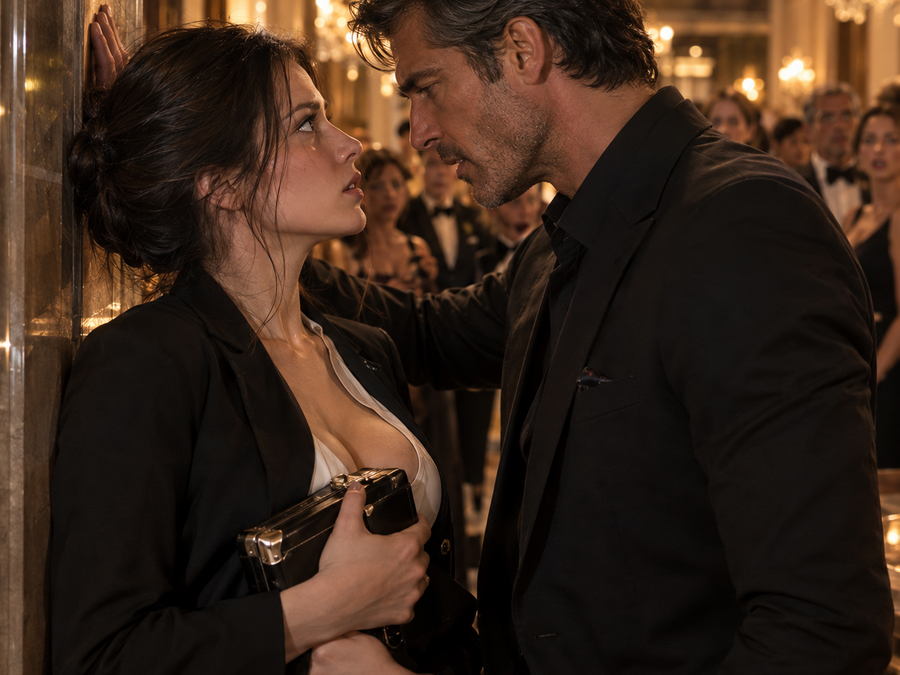
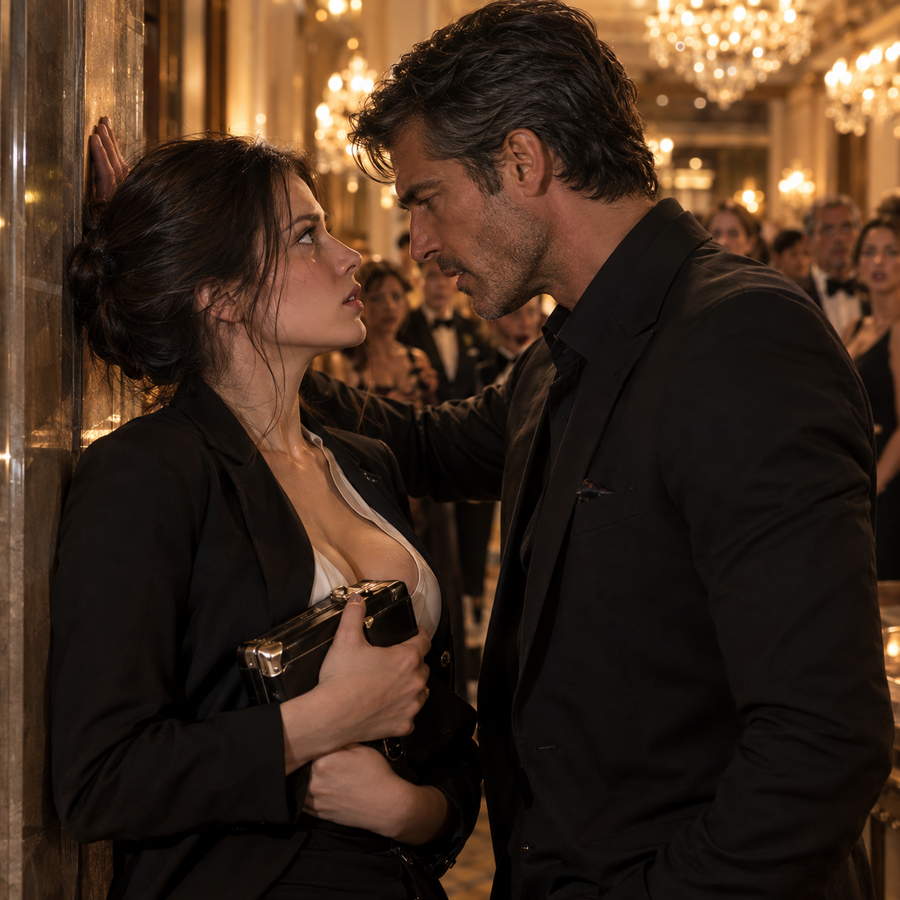
He advanced two more steps and now he was close enough for me to smell the breath of cheap booze mixed with the cold of the night. I tried to step back again and my back hit the sidewall of the salon. The plaster was damp and cold through my coat and the air vanished from my lungs in a way that had nothing to do with the wind. “I don’t have what you want,” I said in the firmest voice I could invent at that moment. “And if you don’t leave here now, I’m going to scream.” “Scream.” He laughed a short, ugly laugh that didn’t come close to his eyes. “There’s no one here. I already checked.”
He reached out and grabbed my arm above the elbow. He squeezed with a strength I knew, with an old and familiar pressure that made me feel sick. My case fell to the ground. One of the latches opened and some brushes rolled across the wet asphalt, stopping at different angles under the distant light of the street lamp, like details of a scene I didn’t want to be living. “Let go.” “Only after we talk.” “Let go.”
A shadow moved from the right side of the parking lot so fast that I didn’t see it happen. I only saw Rocco gasp suddenly, his arm coming off me, his body spun and pinned against the wall beside me with his face pressed to the plaster and a firm forearm at the base of his neck. Dante. Orsino’s man, silent as someone who’d spent his life learning to occupy spaces without being noticed. Lethal. That dry humor he sometimes let slip completely absent at that moment.
“Good evening,” Dante said almost politely, his forearm unshakable against Rocco’s neck. “You must be Mr. Landy.” Rocco tried to answer. Only a wheeze came out. Calm footsteps coming from the other side of the parking lot. I didn’t need to turn. I knew. Orsino appeared under the street lamp’s light in a black suit that absorbed the shadow around it.
His hands at his sides, his face so still it was scary just to look at. He walked toward us with that calm I’d already begun to understand wasn’t patience. It was the opposite of that. It was a man calculating with millimeter precision every second of what was going to happen next. Carrying with him the entire weight of a decision he’d made long before entering that parking lot.
He stopped one meter from Rocco. He looked at my arm. There was a red mark beginning to form where the fingers had squeezed and my coat had ridden up a bit on my shoulder. He looked at that mark for a time that seemed long to me. The muscles in his jaw tightened once, subtle, almost imperceptible. Then he looked at Dante. “Handle it,” he said, very low.
Dante adjusted his position, his forearm lowering slightly to get the angle right. That’s when my voice came back. “No.” All three of them looked at me at the same time. Rocco blinked, confused, thinking for a second that I was defending him. I wasn’t. I was defending something much bigger than him. “He lets go of my ex,” I said, looking directly at Orsino. “You don’t decide that for me.” “Mira—” “No.”
I lifted my chin. I was trembling, my arm burning, the brushes scattered on the asphalt behind me. I didn’t care. “I spent four years with this man treating me like a thing. I’m not going to spend one more second with any other man treating him like a thing in the name of what happened to me. I’m not anyone’s property, Orsino. Not his, not yours.”
The silence that formed in the parking lot was different from any silence I’d ever witnessed near that man. It wasn’t the elegant silence of the Bell with crystal and background music and the sense that the world kept turning somewhere else. It was the silence of a man who wasn’t used to being interrupted, processing in real time the fact that he’d been interrupted and trying to figure out what to do with it.
Orsino looked at Dante. He made a tiny gesture with two fingers, almost imperceptible. Dante loosened his arm slowly. He didn’t let go right away. He slid his hand to Rocco’s shoulder and held him firmly there without the weight from before. The same strength now toned down two notches, like someone waiting for a new order. “Speak,” Orsino told me without taking his eyes off my ex. “What do you want to happen to him?”
I inhaled deeply. The wet air of the parking lot scraped my throat and I let it in all the way to the bottom of my lungs before answering. “I want him to answer for his debts. All of them. The ones from my time and the ones after. To the real police, not yours.” Orsino raised his eyes to me. “Do you know what you’re asking?” “I do. I’m asking for justice, not revenge.”
He stared at me for a time I couldn’t measure. His eyes traveled over my face as if reading something written there, something he still hadn’t fully deciphered. I held the look. My hands were trembling and I held it anyway. “Dante,” he said finally without releasing my gaze. “Mr. Landy has an envelope of notes in my office. Deliver him and the envelope to the central precinct. The clean one, not ours.” “The clean one,” Dante repeated with no irony at all, just confirming the order so there would be no room for doubt. “Do it.” “Yes, boss.”
Dante pulled Rocco by the shoulder, turned him, and began leading him toward a car parked farther ahead in the dark part of the parking lot where the street lamp didn’t reach. Rocco tried to struggle once, his body resisting on instinct. He looked at me over his shoulder, and I didn’t look away. He gave up before I gave up.
When the car disappeared around the corner, and the sound of the engine dissolved into the street, the parking lot was left with only the sound of my own breathing and the slow dripping of some wet gutter up high. The cold reached me again for good now that the adrenaline no longer served as a coat. Orsino didn’t come closer. He stayed where he was, a meter and a half from me, as if respecting a line I’d drawn without words.
“How did you know?” I asked, my voice coming out thinner than I wanted. “How did you know he was coming today?” “I’ve known since Monday.” “Monday?” “The phone call at your door.” That was it. That landed on my chest with a weight that took me two seconds to fully understand. “You knew since Monday and didn’t tell me.” “No.” “Why?”
He looked at his own shoe for a second before answering. It was the first time I’d seen Orsino Valkcanti truly hesitate in front of me without irony, without the elegant shield he normally kept in place. “Because I thought I’d solve it before it reached you alone.” “Yes.” I laughed. It wasn’t a pretty laugh. It was dry, almost angry, with my arm aching and my heart completely out of rhythm.
“My father used to do that,” I said. And my voice went quieter than I expected. Not weaker, just deeper. “Decide alone. Thought it was protection. On the day he decided to leave with a younger woman, he also thought he was protecting me from some truth I couldn’t handle. You know what I couldn’t handle, Orsino? It wasn’t him leaving. It was him deciding alone that I didn’t deserve to be consulted.”
The parking lot went quiet in a different way. Not the silence of danger. The silence of afterward, when the adrenaline begins to drop and only what’s real is left. And what’s real has edges and weight and doesn’t ask permission to hurt. “I’m not your father.” “You’re not.” I lifted my chin again, though my legs wanted to betray me at that exact moment. “But today you did exactly what he did. Decided for me before asking. If you want to be around—and at this point I’m tired of pretending I don’t want you around—you’re going to have to ask first. Always.”
“Always.” “Always.” “Deal.” I didn’t expect him to accept so fast. I didn’t expect him to not even try to argue or explain or find a loophole. I was left with no ready answer. And the silence between us became something completely different from everything that had filled that parking lot in the last few minutes. Softer, more frightening, in a totally different way.
He took a step, just one, stopped. “May I come closer?” I almost laughed again, this time from relief, the kind that hurts a little on the way out. “You may.” He closed the distance slowly, with the same deliberate calm as always, but without the coldness that normally accompanied it. He stopped a hand’s breath from me. He didn’t touch me. He just stood there looking at my arm where the red mark was already beginning to darken slightly on the skin and then looking at my face with an attention that made me want to look away and not be able to.
“You’re trembling.” “I am.” “From fear of him or anger at me?” “Both.” He nodded slowly as if that were the fairest answer I could have given and he knew it. He didn’t try to correct it. He didn’t try to explain again. He just kept that answer whole without trimming the edges. He extended his hand between the two of us, palm turned up and fingers slightly open. He didn’t take mine. He just offered it, leaving the space there, waiting. “Come. Just until you stop trembling.”
I looked at his hand. I looked at my rental car with the brushes scattered on the wet asphalt. I looked at the parking lot gate where Rocco had disappeared into Dante’s car, taking with him four years of things I needed to leave behind for good. And after everything I’d sworn to myself about older men, about protection that turns into control, about never again confusing the two things, I placed my cold hand on top of his hand. He didn’t close his fingers. He stayed still, palm open, leaving the choice entirely to me. I closed mine.
Orsino’s car was too silent. The kind of silence that didn’t come from the expensive engine or the dark leather upholstery cold beneath my thighs, but from the man at the wheel. Firm hands, gaze fixed on the wet road, jaw clenched in a way I’d already learned to recognize over the last few weeks. He was holding himself back, and I, in the passenger seat, still with the taste of the fear of Rocco in my mouth and my arms wrapped around my own body, didn’t know whether I wanted him to keep holding back or not.
“Where are we going?” I asked low. “To a place where you can stop trembling without anyone watching.” It wasn’t a question, but it wasn’t an order either. It was a sentence placed in the middle, in the exact measure of what he was learning to do with me. I looked through the window and saw Chicago pass in stripes of orange and white light. The city seemed quieter at that hour, almost respectful, as if it knew I’d just yelled at two dangerous men in a single night, and needed a few kilometers of silence to understand what I’d done.
The penthouse was at the top of an old restored building in a neighborhood I’d never have the courage to cross alone without a very good reason. The private elevator opened directly onto a vestibule with dark marble floors, a single amber light fixture on the ceiling, and the discrete smell of wood and something clean I couldn’t identify. He went in first, turned on a low light in the living room, took off his jacket, and put it on the back of a chair like someone shedding a second skin. Underneath, the white shirt was slightly wrinkled at the shoulders. It was the most human detail I’d seen in him.
“Water?” he asked. “Please.” He went to the open-plan kitchen, dark marble counter, no ornaments, everything in the right place, and came back with a glass. He didn’t hand it to me directly. He just placed the glass in front of me on the side table and stepped back two full steps. I noticed with a strange tightness in my chest that he was giving me physical space on purpose, as if he knew I needed a margin before anything else.
I took the glass with both hands. They were still shaking. “There’s a blanket on the armchair,” he said, pointing with his chin to a dark armchair near the window. “Grab it. Come to the terrace.” The terrace was enormous, all enclosed with tinted glass from floor to ceiling, with a view of the lake and the constellation of lit windows of the Loop. The wind outside cushioned against the glass. You could feel the cold without it actually reaching you.
I sat in a low wicker chair, wrapped the blanket around my shoulders, and looked at the river of lights below. He leaned against the railing, his back to the city, looking at me with that look that asked permission for nothing. “I almost decided today,” he said. I raised my eyes. “I almost had Dante take Rocco to a place where he’d never bother you again.” His voice came out low, without drama, like someone reporting a fact. “I almost decided for you without asking.”
I gripped the blanket a little tighter. The fabric was thick, warm, and smelled of the same discrete perfume from the vestibule. “I almost let you,” I answered. He closed his eyes for a second. When he opened them, there was something different in his face. Something tired, human, almost beautiful in a way that disarmed me before I could prepare. “That’s why I can’t,” he continued. “If I decide for you once, I decide for you forever. And if you let me once, you let me forever. I know men who did that with their women.” His voice dropped even lower. “They’re not men I want to be.”
I stayed quiet. The glass of water was ice cold in my palms. On the way, I’d rehearsed a thousand harsh sentences in case he tried to boss me around again. None of them fit. “Why do you keep coming?” I asked, and the question came out before I had permission for it. “To the salon, to my house, now here. You’re the most feared mobster in Chicago, Orsino. There’s no shortage of women who want to be chosen by you.”
He took a while to answer. He lifted his chin a bit, looked at the lake, turned his eyes back to me. “Because none of them saw me.” “What do you mean?” “They saw the money, the power, what I could do for them or with them.” His voice was hoarse in a new way, a way I hadn’t heard before. “You saw me old, offended me, kept trembling, and kept talking back. You saw me as a man, Mira. It was the first time in a long time.”
I didn’t know what to do with that. I looked at the glass. I looked at his feet. Dark, expensive shoes, completely still on the terrace floor. I looked at my own lap. I breathed deep once and then again. “My father left when I was fifteen,” I began. And my voice came out firmer than I expected. “He left for a twenty-two-year-old woman. Pretended for months that everything was fine. Decided everything alone, and on a Saturday morning grabbed a suitcase and said, ‘We’ll talk later.’ We never talked later.”
He didn’t interrupt. He didn’t move. “Since that day, I look at any older man and I see that suitcase. I see my mother sitting in the kitchen not knowing what to do with her own body. I see my aunt giving up her life to come take care of us.” I breathed deep. “So when you show up in a black suit and solve everything without asking, I see the suitcase, Orsino. I see the suitcase before I see you.”
He brought a hand to his face and ran his fingers over his temple. The most tired gesture I’d seen in him and in the faces of few people in my life. “What do you want?” he asked. And the question had a weight that filled the whole terrace. “Really, Mira. From life. Not from what I can give you. From what you want.”
I laughed a little without humor. And the sound came out smaller than I wanted. “A studio with my name on the door and an aunt who sleeps peacefully. That’s all.” “I’ll finance it.” “No.” “Why not?” “Because then the sign will have my name hidden behind yours,” I answered, looking directly at him. “I want to buy every letter of that sign with money I earned.”
He smiled. It was a small smile, almost invisible against the low light of the terrace, but I saw it clearly, and I understood with a silent shock that wouldn’t fit in the chest of any sensible person that he was smiling because I’d refused, not despite it. “All right,” he said. “All right. You buy the sign. I buy breakfast.”
He rose from the railing slowly. He took two steps to my chair and stopped. He stood there tall, the wind outside the glass unable to reach him without extending his hand. I looked up. The terrace light caught the wrong angle and cast a shadow on the line of his jaw. “I’m not going to touch you unless you ask,” he said low. “You have to say it out loud.”
My chest rose and fell twice before I could open my mouth. The blanket slipped off one shoulder. I didn’t pull it back. “Touch me.” He touched me. It wasn’t a hungry kiss. It was the opposite of that. His hand came slowly to the nape of my neck. His fingers opening between the strands of my hair with a delicacy I didn’t expect from a man with the hands he had. His mouth found mine like someone surrendering after a war that had gone on too long. He didn’t take me. He gave himself over.
And I, with both hands still gripping the glass of water, felt for the first time in many years that I was being chosen without being traded for anything. He pulled back enough for me to see his eyes up close. The dark brown I’d already memorized without meaning to. “Do you want to stay?” he asked. “I want to stay.” He took the glass from my hand, placed it on the side table, and lifted me by the hand without any rush.
The living room was quiet around us. The bedroom door was at the end of a short hallway with light-colored flooring, and every step I took down that hallway was conscious, mine, entirely chosen. He opened the door, let me go in first, went in after. He closed the door behind us. The door closed softly behind us, and the room on the other side went quiet, holding only the light of the terrace, still on, that no one turned off.
The next morning’s light came through the cracks of the dark curtain, drawing thin, oblique stripes on the wooden floor. I woke slowly, not knowing where I was for exactly three seconds. The wrong ceiling, the wrong silence, the pillow with a scent different from mine. And then I recognized it. His shirt. I was dressed in his shirt, white, too big, with the cuffs going past my fingers and the fabric warm against my skin.
I sat up in bed and looked around. The bedroom was simpler than I’d expected for a man of his stature. A wide bed with gray sheets, a dark armchair in a corner, a large window with the curtain almost closed, no paintings on the walls, no ornaments. It was the bedroom of someone who slept there, not of someone who showed their bedroom to people. I found him in the kitchen, leaning against the marble counter with a cup in his hand, his hair still damp from a shower, a dark gray t-shirt and sweatpants.
Without the suit, without the collared shirt, without the jacket, he looked ten years younger and a thousand times more dangerous, because that was what almost no one in Chicago had the right to see. He raised his eyes when I appeared in the kitchen doorway. The corner of his mouth went up one degree. A little, but enough for me to feel it, even in my knees, and decide to pretend I hadn’t felt it. “Coffee?” he asked. “Coffee.”
He poured a cup without asking how I took it and got it right. Black, no sugar. I don’t know how he knew. Maybe he’d paid attention on the days he showed up at the salon asking for a beard trim he probably didn’t need. The phone vibrated on the counter. He looked at the display and handed it to me without saying anything. “It’s your aunt.” I answered already blushing before I pressed the screen. “Nana.” “Good morning, my girl.”
Her voice was sarcastic and cheerful at the same time. Her usual tone, the one that fooled no one. “Tell me something. Is the mobster still there?” I looked at him. He was pretending he wasn’t listening to every syllable. He was listening. “He is,” I answered low. “Good. Tell him that if he hurts you, I’ll hit him with my cane and tell him I want pono for lunch.” I hung up before dying of embarrassment. I put the phone on the counter with unnecessary care. He had the corner of his mouth raised, the cup frozen in the air halfway. “What did she say?” “That she’s going to hit you with her cane if you hurt me.” “Fair.” “And that she once made pono for lunch.” “Also fair.”
He took a step toward me, set his own cup on the counter calmly, and stood in front of me, looking into my eyes with a new seriousness, different from the seriousness of the suit, different from the seriousness of the terrace railing. It was a morning seriousness with no armor underneath. “Open the studio, Bellafonte,” he said low. “With your name on the door. And let me be the first breakfast client next door.”
I closed my eyes for a second. I heard the refrigerator humming quietly, heard the wind outside trying to get in through the kitchen window without succeeding. When I opened them, he was still there, waiting for an answer, as if it really were up to me to give it. As if none of it had been decided before I spoke. “All right,” I answered. He smiled, a whole smile this time, hiding nothing. And for the first time in many years, I looked at the face of an older man and saw no suitcase at all.
Two weeks passed as if someone had sped up the clock on purpose. The three elite brides who’d been at the Bella Verde that night decided, without arranging it among themselves, that I was the makeup artist they needed to have in their schedule before someone else grabbed her. I signed contracts that paid three months’ rent for a small space in Lake View, a cramped room with a large window facing the street, exactly what I’d designed in my head years before without believing it was real.
Ria left Trevy a few days later, saying in Italian that if I opened without her, she’d break my case. I accepted on the spot. The sign arrived on a Tuesday morning, wrapped in brown paper, heavier than I expected. Dark wood, wine-colored letters, a single surname in the center. Bellafonte. I stood on the sidewalk with the box in my arms longer than I should have because my throat tightened in a way that had nowhere to escape.
The sun struck the street from the side, and the reflection of the letters flickered for a second before I could take my eyes off it. I paid in counted cash with a steady hand and forced the vendor to give me a receipt on letterhead. I kept the folded receipt inside my wallet as if it were a birth certificate. Maybe it was.
On opening day, I woke before the sun. The apartment was still dark and silent, and I stood for a moment at the edge of the bed, listening to the low sound of Chicago waking up outside, a distant bus, a pigeon on the windowsill, the building’s old plumbing making one of its usual clicks. Nona Natalia was sitting in the kitchen when I came down in the blue dress she kept for weddings, leaning on her cane, her hair combed with a delicacy she rarely gave herself. The red lipstick, discreet but exact, was in place as if she’d spent hours getting it right.
“Are you sure you can walk all the way there?” I asked. “I’ll walk to hell if it’s to see the studio of yours.” We both laughed, and the sound inside the kitchen seemed larger than the room allowed. She held my hand for a second before letting go quickly, because Nona Natalia never lingered long in affection, as if too much intimacy would break some tacit agreement she had with herself.
Orsino’s car appeared at the corner when we left the house. It didn’t stop, didn’t open its window. It just followed us from a distance in silence down the whole Lake View street, its dark bodywork gliding slowly on the wet morning asphalt like a shadow choosing to be near without being on top. Nona Natalia noticed and smiled at the tinted glass on the outside slowly, with that small smile she reserved for the things she approved of without wanting to say so out loud. “He’s learned,” she commented quietly. “He’s learned,” I answered.
Ria was at the studio door when we arrived with a tray of coffees she’d prepared herself and a tissue in her hand, ready for the crying she already knew was coming. Two of the Bella Verde guests, now my clients, showed up with flowers, pink gerberas and a bunch of lavender that left the entrance air with a gentle, clean perfume, the kind that seems like a promise fulfilled before it’s even made. Two other new clients showed up without being called, as if the day had spread word on its own. The studio’s storefront gleamed with the morning sun, and the sign up there looked bigger than I’d remembered when I chose the font.
Nona Natalia stopped in the middle of the sidewalk, looked at the sign, and cried for the first time in front of me in thirteen years. It wasn’t a loud cry. It was the silent kind that slides down without the person noticing. And she stood looking up with her eyes shining, her cane firm on the ground, her jaw clenched as if it were possible to hold it back. “Your mother would have liked to see this,” was all she said.
I hugged her tight, my face in her hair, smelling the rosewater scent she’d always worn. That Sunday smell of childhood, of things that remain even when everything else changes. Ria joined the hug without asking permission and without apologizing. The three of us stayed there in front of the door of the Bellafonte studio until the morning client tapped on the glass with two delicate fingers. The day came in through the door with her and didn’t stop after that. Chair occupied, coffee brewing, Ria shouting the name of a brush in Italian, a bride in the mirror, then another, then the afternoon light already striking the counter differently.
Orsino arrived last, a wine-colored suit this time, not black. He stood on the sidewalk across the street, hand in his pocket, his shoulder leaning lightly against the traffic signal post. He didn’t try to come in. He didn’t try to appear in the photos Ria took with her phone raised above her head. He didn’t send a message. He just watched. With that expression I was still learning to read. His eyes serious, his jaw calm, his whole body still in a way that in him never seemed like passivity, but a deliberate choice to occupy less space than he was capable of occupying.
I finished with the last client of the day near the end of the afternoon. The sunlight was already orange, long in the windows, and the studio had that good smell of work done, foundation, a client’s perfume, cold coffee forgotten on the counter. Ria made me take off my apron. Nona Natalia made me put on red lipstick before leaving. I went out, crossed the street, and stopped in front of him. Chicago’s cold wind made the hem of my coat beat against my thighs, and he didn’t move, just waited.
“Did you stay here all day?” I asked. “Not all day. I came back three times.” “Why didn’t you come in?” “Because the day is yours.” I looked at him. He had that contained expression I already knew how to decipher. The one of someone feeling more than they were showing. The kind of restraint that cost real effort and that he still thought went unnoticed. “I don’t want an owner, Orsino.” “I know.” “I want you.”
He took a second before answering. He raised his hand slowly and ran his thumb lightly over my cheek in the same paused way he had on the terrace. As if he always had time. As if hurry were something that didn’t reach him when he was near me. “I know.” He kissed me right there in front of the studio door on the Lake View street, with Ria shouting something in Italian from the other side of the glass that I chose not to translate. It wasn’t long. It was the kiss of someone who had already surrendered before and was now just confirming out loud what they both already knew.
That night, my kitchen smelled of garlic, bread, and the heater turned on low. Nona Natalia was in her chair telling for the fourth time the story of when she met my grandfather at a wedding in a little town in the Italian countryside. The story changed details every time, and I never corrected her because each version seemed true in its own way. Orsino was next to the counter with his shirt sleeves rolled up to the elbow, cutting bread into thick slices with an old knife of my mother’s. He cut without rushing, with a concentration that seemed disproportionate for the task, as if it were an act that required the same care as anything else he decided to do.
I went to the sink to wash a glass. The warm water ran over my fingers, and I looked through the little kitchen window at the dark backyard outside, the hose coiled on its hook, the crooked wicker chair Nona Natalia never threw away, the yellow light from the neighbor’s post cutting across the fence with a thin shadow. For a second, just a second, I thought Orsino still had things he didn’t tell. Not out of bad faith, just out of an old habit of carrying weight in silence, of deciding before asking, of protecting, thinking that protecting was the same as sparing. Men like him take years to unlearn that. And I knew from a place that still hurt a little that this unlearning wasn’t guaranteed just because the love was real.
The thought passed, the way things you don’t yet need to resolve pass. I dried my hands on the towel, turned, and went back to the table. Orsino raised his eyes from the bread and looked at me in a way I felt in the pit of my stomach. Quiet, firm, with that presence he had of occupying the room without needing to move. “What is it?” he asked. “Nothing.” “Liar.” I laughed. I sat next to him on the high stool at the counter, my knee touching his at the edge. I rested my shoulder against his shoulder slowly, like someone choosing a place to land and deciding to stay.
Nona Natalia continued the story as if she hadn’t noticed either of those things, but she noticed, because Nona Natalia noticed everything and pretended not to notice as a form of respect. “Pass the bread?” I asked. He passed it. My fingers touched his for a second longer than they needed to. Across the table, my aunt laughed to herself, to no one in particular, with the glass of water in her hand and the cane leaning against the chair. And I let that second last.
