Nurse Was Humiliated in the ER—Then a Military K9 Did Something No One Expected
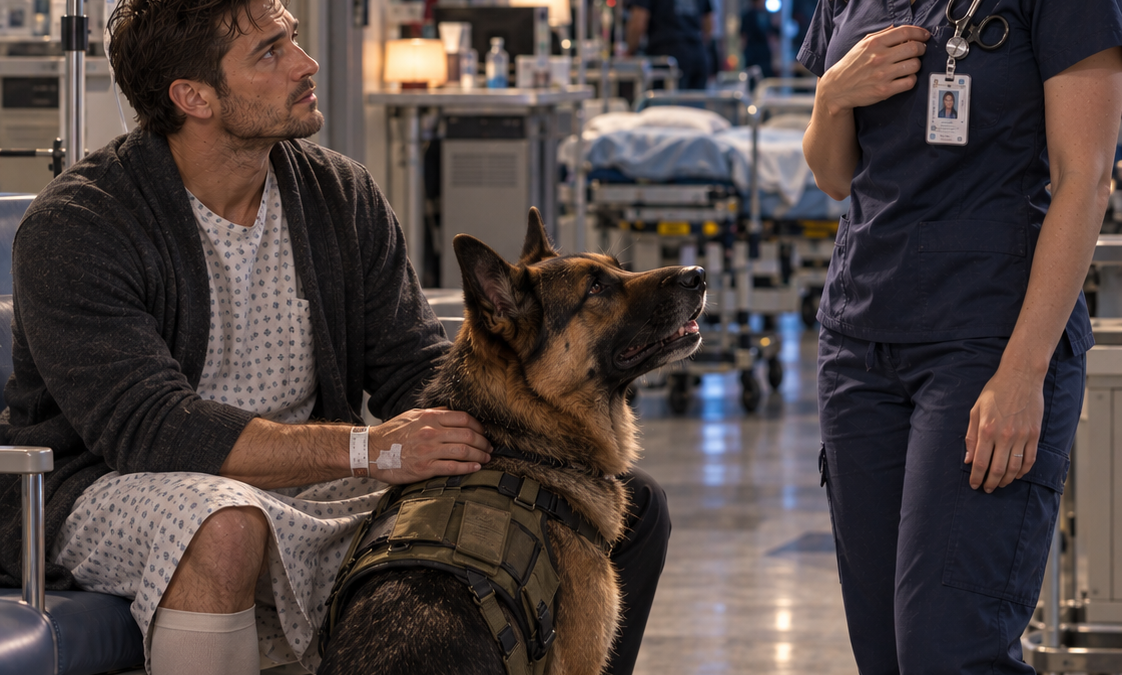
Nurse Was Humiliated in the ER—Then a Military K9 Did Something No One Expected
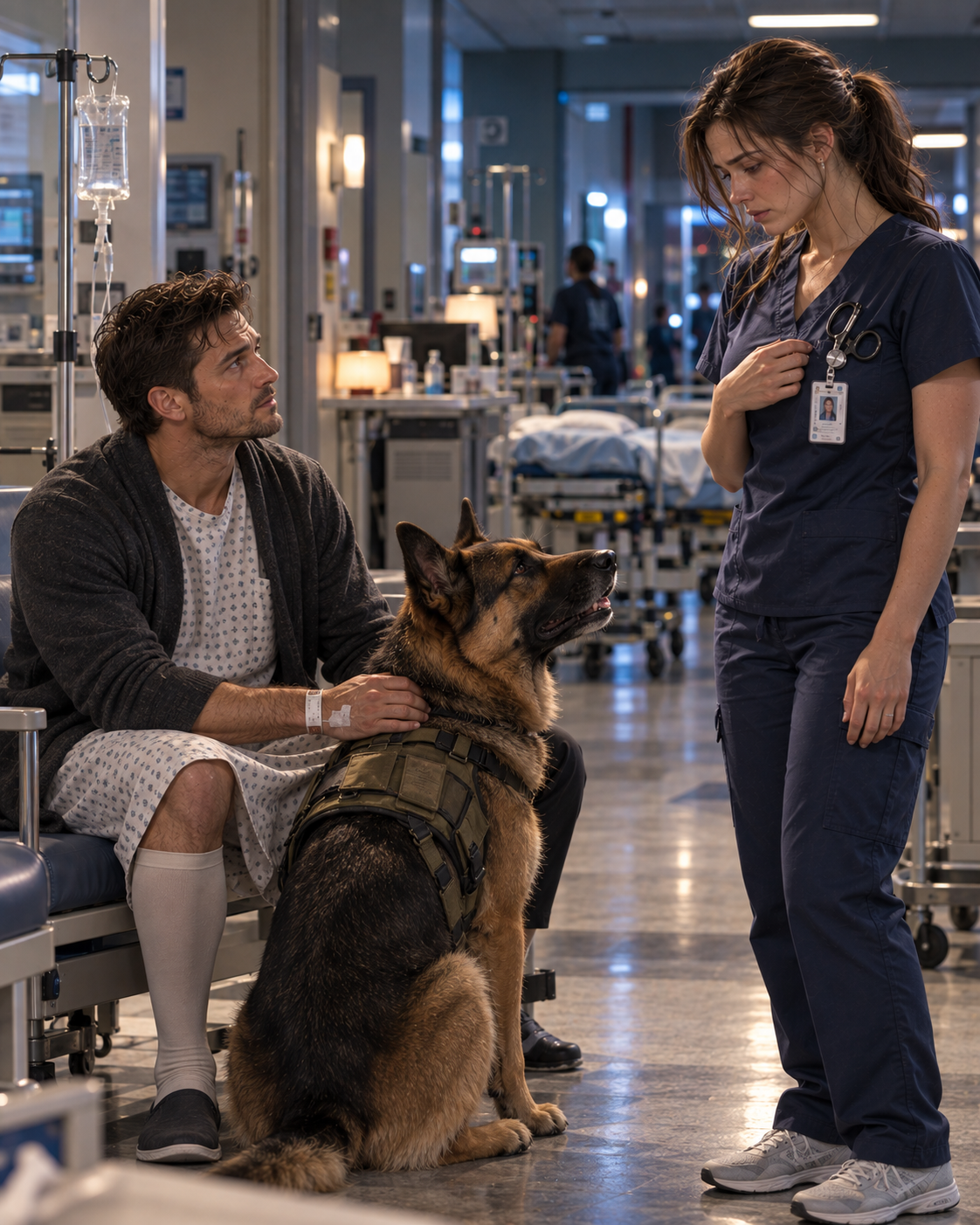
step away from my patient. Dr.Raymond Hol said it loud enough for the entire emergency department to hear. Nurse Sarah released the bed rail slowly, her hands steady, her face giving nothing away.
She had warned him twice. Twice.
The man in bay 4 was bleeding somewhere the monitors hadn’t found yet.
She was certain of it. Hol called it anxiety and ordered observation. Then the dog moved.
The retired military working dog pulled free of the patients weakened grip, crossed the trauma bay in four deliberate strides, and pressed his entire body against Sarah’s leg.
Nobody laughed yet. They would for about 40 seconds.
Then every alarm in Bay 4 erupted at once.
It started 6 hours earlier with a cup of coffee nobody offered her.
The night shift at Kesler Memorial Hospital in Norfick, Virginia, began the way most of Sarah’s nights did, quietly, competently, and without anyone particularly noticing she had arrived.
She badged in at 6:47 p.m., 13 minutes before her shift technically started.
She didn’t do it to impress anyone.
She did it because the 13 minutes gave her time to walk the department without the outgoing day staff watching, checking supply carts, confirming defibrillator charges, noting which trauma bays had been restocked and which hadn’t.
Old habit.
She’d stopped examining why she had it.
The charge nurse that evening was Danny Okafor, who handed off a whiteboard summary with practice speed and the particular brand of exhaustion that came from a 12-hour stretch in a department that had admitted two sepsis cases, one overdose, and a toddler who had swallowed a marbles-sized magnet. Beds two sick, nine are yours, Danny said, already pulling on her coat.
Nine is a hip fracture waiting on ortho. Six is chest pain.
and we’re pretty sure is anxiety.
Two is a 22-year-old with a laceration that needs irrigation and closure. Simple night.
How’s the laceration oriented?
Sarah asked. Dany paused. Excuse me.
The wound. Which direction does it run?
Parallel to the tension lines or across? Dany stared at her for a moment with the expression Sarah had grown accustomed to receiving.
Not quite irritation, not quite confusion.
something in between that people wore when someone asked a question they hadn’t considered and resented being reminded of.
It’s a laceration, Sarah.
Clean the cut. Close the cut.
Right, Sarah said.
I’ll check.
She went to see the 22-year-old first. The laceration ran perpendicular to the natural skin tension along the forearm, which meant a standard closure would heal with more visible scarring than necessary, and the young man, a line cook named Marcus, would spend years explaining the mark on his arm to everyone who noticed it. Sarah spent four additional minutes on the closure technique.
The result would fade properly.
Marcus never asked why she’d taken extra time.
Most patients didn’t.
That was fine. She was midway through a vital signs check on the hip fracture in bed 9.
Mrs.Eleanor Puit, 73, sharp as attack and deeply unhappy about the hospital gown when she heard the voice from the nursing station. Somebody tell the night crew were getting slammed. MVA on Route 64.
Multiple vehicles. Dispatch says at least eight casualties inbound.
The department shifted register immediately. That particular change in atmospheric pressure, the way a calm room tightens when everyone simultaneously recalibrates, was something Sarah had felt in very different places before Kesler Memorial. The feeling was identical.
The geography was not. She finished misss.
Puit’s assessment confirmed the orthopedic consult was still pending and moved to the supply corridor to begin pulling additional trauma kits.
She was on her third kit when nurse Priya Solless appeared around the corner with an expression caught between amusement and irritation.
“You already knew,” Priya said.
“I heard the radio traffic.”
“We all heard it 2 minutes ago.
You’ve been pulling supplies for six.”
Priya leaned against the wall with her arms crossed.
“Sarah, you do know we have a supply tech for that, right?”
He’s on break, so you just Pria gestured vaguely at the growing stack of trauma kits.
The first two units will arrive before we’ve fully cleared the day trauma bay.
Sarah said, “We’ll need them staged.”
Priya looked at the kits. Looked at Sarah, made a small sound that was not quite a laugh and not quite a sigh.
Took one of the kits from the stack and carried it toward the bay without another word. That was how it usually went.
Sarah was not unpopular at Kesler Memorial. Exactly. She was not the subject of open hostility.
What she experienced was subtler and in some ways more corrosive. She was treated as background.
Present but unremarkable.
The kind of nurse who did the job correctly and thoroughly and without drama, which at Kesler Medical was apparently indistinguishable from the kind of nurse who didn’t do anything interesting.
Dr.Dr.Raymond Hol had made this opinion explicit during a department meeting 4 months earlier when Sarah had flagged a concern about a patients respiratory pattern before the attending had completed the primary assessment.
Hol had listened, nodded with the measured patience of a man tolerating a child’s question and said, “Thank you for that, Sarah.
We’ll do medicine now.”
Three of the nurses at the table had laughed. Hol was 44, recently promoted to attending, and possessed of the particular confidence that came from being technically excellent at the portion of medicine that appeared in textbooks. He was not a bad physician.
Sarah had observed him accurately diagnose cases that stumped less experienced colleagues, and she respected competence wherever it lived. What she had less patience for, though she had learned not to express it, was the way Holt seemed to organize the world into people whose instincts deserved space and people who should present information only when directly requested.
She fell firmly in the second category. Nurse Cassidy Whan, who worked dayshift and occasionally overlapped with Sarah during handoffs, had a running commentary on this dynamic that she delivered with the breezy cruelty of someone who believes they are being funny.
Sarah thinks every paper cut is a
puncture wound. She had told the new residents at a department holiday gathering.
She’d make a great trauma nurse in 1994.
The residents had laughed. Cassidy had looked pleased with herself.
Sarah had been standing 6 feet away, refilling a supply cabinet.
She hadn’t said anything.
She never said anything.
It wasn’t passivity, though she understood why people read it that way.
It was a calculation she had made a long time ago in a different context. In a climate far less comfortable than coastal Virginia, some costs were not worth the expenditure.
The attention required to respond to Cassidy Whan’s jokes was attention that belonged elsewhere.
The first ambulance arrived at 7:23 p.m., then the second 40 seconds behind it. Then a third, overlapping with a fire department transport that squeezed into the ambulance bay at an angle that made the paramedic riding the running board visibly wsez.
Eight casualties became six active admits and two discharges after rapid triage.
The department absorbed the reorganization with the controlled chaos that was in Sarah’s experience the honest face of emergency medicine, people moving fast, talking over each other, making decisions with incomplete information, and the constant background awareness that the person on the table might not be there in 20 minutes if someone chose wrong.
She worked Bay 3 and Bay 7 simultaneously, managing a 41-year-old woman with a suspected fractured clavicle and a 17-year-old with a concussion and significant road rash while keeping peripheral awareness of the rest of the floor. This was another habit she had developed elsewhere. full situational awareness, the ability to process your immediate task while maintaining a background register of everything else in the environment.
It was useful in a trauma bay. It had been more urgently useful in other places. At 7:51 p.m., bay 4 received a new patient.
Sarah heard the paramedic report from across the floor while she was applying wound dressing to the teenager’s forearm.
Male patient, 39 years old. Name Ethan Ror.
Former military. Motor vehicle collision. Passenger side impact.
Significant mechanism. The other vehicle had crossed the center line at approximately 50 mph.
Airbag deployment. Blunt force abdominal trauma. Glasggo coma scale of 14 on scene, 15 on arrival, which meant he was oriented and responsive.
Vital signs. Blood pressure 118 over 74.
Heart rate 96, oxygen saturation 97% on room air.
Stable by every number, Sarah glanced up from the teenager’s arm for exactly 2 seconds.
Then she glanced back.
Then she said to the teenager, “Hold pressure here.
Don’t move.”
Pressed his hand against the dressing, stood up, and walked toward the ambulance bay doors just as the gurnie came through. The dog stopped her first.
Not stopped her physically. He was beside the gurnie, leashed to the frame by a carabiner that one of the paramedics had clearly rigged as an improvised solution to the problem of transporting a large Belgian Malininoa in an ambulance. The dog was scanning the department with the rapid systematic assessment that Sarah recognized immediately as working dog behavior.
Not nervous, not aggressive, cataloging. He was about 8 years old, maybe slightly less. Dark sable coat, some gray coming in around the muzzle.
A scar along his left flank that had healed cleanly, but had clearly been significant at the time. He looked at Sarah. She looked at him.
Something moved through the dog’s posture, a change so small that most people in the room would not have registered it.
His ears shifted forward a millimeter, his weight redistributed. The rapid environmental scanning stopped.
He was looking at her the way a dog looks at someone, it is deciding. It already knows.
Who’s traveling with this patient?
Sarah asked the paramedic team. Nobody in the unit.
The lead paramedic said. Dog was in the vehicle.
Handler at the scene confirmed he’s a retired MWD military working dog and the patient’s his owner now.
We couldn’t exactly leave him on the side of the highway.
Rook, Ethan Ror said from the gurnie. His voice was strained but present.
His name’s Rook.
He goes, he broke off for a moment, one hand pressing against his own abdomen in the unconscious guarded gesture of someone whose body is telling them something is wrong, even when the monitors disagree. He goes where I go.
We’ll get him settled, Sarah said to the patient.
Then to Priya, who had appeared beside her, “Can you check whether we have a veteran liaison on call tonight?
The dog needs a temporary handler while we work.
The dog is the least of our problems,” Holt said from behind her.
Sarah turned. He had appeared from the direction of the attending station with a tablet in hand and the particular expression he wore when he had already formed a conclusion and was moving toward documentation.
He glanced at the vital signs readout, skimmed the paramedic notes, and said, “Bay 4.
Let’s get imaging ordered.
Probable soft tissue contusion with mild concussive component. Observation protocol.
Dr.Holt.
Sarah said, “Thank you, Sarah.
It was the dismissal phrasing.”
She recognized it. His abdominal guarding started in the ambulance. She said the paramedic noted it in the transport documentation.
Guarding with a mechanism like this is expected. He took a steering wheel to the midsection.
He didn’t hit the steering wheel.
The impact was passenger side. The mechanism is lap belt compression with lateral force. Holt looked at her.
The look was not hostile. It was something more specific than hostility, more deliberate.
It was the look of a man who has decided that a particular person’s contributions require a certain amount of patient tolerance before the real conversation can resume.
Get him settled in four.
We’ll reassess in 40 minutes.
Sarah did not move immediately. This was not defiance.
She was calculating something. Specifically, she was calculating the difference points between the cost of pushing back now and the cost of not pushing back.
And she was doing it with the flat objectivity of someone who had been forced in other circumstances to make similar calculations very quickly and had learned to trust the math. 40 minutes was a long time.
His pressure is acceptable right now. she said, but his rate is 96 in climbing. His initial presentation in the field was Sarah.
Holt’s voice carried the particular edge of someone who has just decided that patient tolerance has a limit.
Bayour, please. She went.
Ethan Ror was more alert than his numbers might have suggested another detail that snagged something in Sarah’s clinical attention.
People in significant pain with an adrenaline surge from a serious collision sometimes read more alert than their actual physiological state. And that alert presentation could mask how quickly they were compensating. She had seen it before.
In other contexts, the body borrowing against reserves it was rapidly depleting. She set up the monitoring, checked the IV line the upper the paramedic team had started, and began a secondary assessment while the X-ray tech positioned for the chest film Holt had ordered.
You’re going to ask me to rate my pain on a scale, Ethan said.
Not immediately. He watched her hands as she palpated his abdomen.
His jaw tightened. His breathing changed slightly.
It’s not where you’re pressing, he said.
It’s He stopped.
Deeper, Sarah said. He looked at her.
The pressure you’re feeling.
It’s not superficial.
It’s deeper than the contact point.
He nodded once. Sarah noted this in the chart.
Deep visceral discomfort on palpation inconsistent with superficial contusion. She also noted the progression of his heart rate.
96 on arrival. Now 101.
Still within acceptable range, still compensating. Rook had settled under the bed rail.
Somone had unclipped the improvised carabiner, and the dog had moved himself to the position directly beneath Ethan’s left hand, where Ethan’s fingers rested against the dog’s head in a gesture that was clearly automatic.
The contact of two beings who had been in difficult situations together long enough that proximity was simply what they did. But the dog was watching Sarah, not with aggression, not with the alert suspicion that a well-trained working dog directs toward an unknown person in a medical environment.
He was watching her with the specific settled attention of a dog that has already decided about someone and is waiting for them to realize it.
“Were you stationed overseas?”
Sarah asked. The question came out before she had decided to ask it.
clinical information relevant to context. That was how she would have explained it if anyone asked.
Multiple deployments, Ethan said. Why?
I want to understand Rook’s medical history.
Military working dogs sometimes have exposure to treatments or medications.
That Rook’s fine, Ethan said.
He studied her face. There was something in his expression that was not quite recognition and not quite confusion. Something in between like a man trying to locate a smell.
He associates with a specific memory. Were you ever in Djibouti?
The question landed the way a stone lands in still water. Sarah finished her notation in the chart.
I need to check your imaging when it comes back, she said.
That’s not a no, he said quietly.
She left the bay. The department had begun to stabilize from the initial surge. The fracture in bay 3 was being transferred upstairs.
The concussion in seven had been cleared for discharge with instructions and a follow-up referral. The septic workup in bay 1 was proceeding under doctor.
Marasol’s Agira’s oversight, which meant it was in capable hands.
Sarah returned to the nursing station and pulled up Ethan Ror’s paramedic transport notes side by side with his current vitals.
Heart rate 104. She looked at the number for 3 seconds. Then she looked at the mechanism description again.
Passenger side impact, lateral force with lap belt, significant velocity differential between vehicles. She thought about where a lap belt sits against the body in a passenger seat at 50 mph of impact force. She thought about what structures lived in that anatomical zone.
She thought about a training exercise she had completed 11 years ago when an instructor with the kind of face that had been outdoors in difficult conditions for most of his adult life had told a room full of people that compensated hemorrhagic shock looked
from the outside like stability.
That the body was extraordinarily good at maintaining acceptable numbers right up until the moment it wasn’t.
Priya, she said. Priya appeared at her elbow.
What? I need to go back to four.
Holt said 40 minutes. I know what he said. She went back to four.
Ethan’s color was slightly different.
Not dramatically.
The difference between what she saw now and what she had seen 20 minutes ago was the kind of difference that did not photograph well, would not appear in a chart note, and was essentially impossible to articulate to someone who had not spent enough time watching people’s faces in circumstances where the face was the earliest available indicator of a process the machines had not yet caught.
His skin was doing what skin did when perfusion was beginning to change. She repalpated his abdomen. His breathing changed.
I know, he said quietly. The two words carried a flatness that she recognized as the voice of someone who has been in enough bad situations to understand when they are in one and has decided to be honest about it.
I’m going to get Dr.Hol, she said.
He already told you it was fine.
I’m going to get him again.
She found Hol at the attending station writing notes on the sepsis case. Bay four.
She said, “I need you to reassess.”
Holt did not look up immediately. He finished the sentence he was writing. This took approximately 8 seconds, which Sarah counted.
His 40-minute window isn’t up.
His heart rate is 104, and his coloring has changed. His heart rate is reflective of pain and anxiety after a significant collision. Holt closed the chart.
He turned to face her with an expression that had moved past patient tolerance into something that was professionally controlled irritation. Sarah, I understand that you take patient care seriously. That is a commendable quality, but there is a clinical protocol for a reason, and that protocol exists to prevent exactly the kind of premature escalation that creates unnecessary interventions and resource strain.
I’m not asking for escalation, she said.
I’m asking you to look at him.
I looked at him 22 minutes ago.
His imaging hasn’t come back yet.
Holt stood. He did this with the particular quality of a man who is about to demonstrate something.
I’ll take a look, he said in the tone of someone performing a courtesy.
He walked to bay 4. Sarah followed.
Ethan’s vitals on the monitor read BP 11270, heart rate 107.
Holt looked at the monitor. He looked at Ethan, who was lying very still in the way that people lie still when stillness has become a strategy.
He reached over and pressed two fingers briefly to Ethan’s abdomen.
Ethan’s breath caught some tenderness, Holt said.
He straightened, expected. The imaging will confirm soft tissue injury.
We wait for the results. Dr.Holt, step away from my patient. He said it at a volume calibrated precisely to the space.
Loud enough to carry. Loud enough for Priya, who was charting at the station 6 ft away, to look up. Loud enough for the X-ray tech returning from a neighboring bay to pause in the corridor.
Loud enough for Cassidy Whan, who was not even supposed to be on the floor. She was picking up a forgotten personal item from her locker and had detoured through the department to hear it and stop walking. a small smile moving across her face.
Sarah released the bed rail. Her hands were steady. Her face gave nothing.
Rook moved. The dog came out from under the bed rail with a smoothness that had no hesitation in it.
He crossed the 4 ft of floor between Ethan’s bedside and where Sarah was standing and pressed his body against her left leg.
Nobody laughed for about 3 seconds. Then the X-ray tech made a sound.
Cassidy Whan’s small smile became something wider.
Priya covered her mouth, though Sarah could not have said whether she was suppressing a laugh or suppressing something else.
Hol said, “Get that dog back where it belongs and turned toward the door.”
He didn’t make it.
The monitor behind him made a sound that Sarah’s body recognized before her mind had finished processing it.
the specific cascading alarm pattern of simultaneous blood pressure and heart rate divergence. Not just a single reading outside range, the shape of a curve she had seen before.
Code, she said clearly without inflection. Holt turned back.
Ethan’s blood pressure readout was changing.
9862, heart rate 118, and his face his face had gone the color of old wax. The bay opened up into organized emergency.
Priya was calling for the crash cart before Hol had finished processing what he was seeing. The tech at the station activated the trauma response protocol.
Sarah moved to Ethan’s side and began the assessment that the situation now required her hands already knowing what to look for.
Her voice steady as she called out what she found.
Ethan’s hand found her wrist.
His grip was not strong. It was the grip of someone whose resources were depleting and who had chosen to spend some of what remained on this.
His unfocused eyes found hers with the particular terror of a man who has been in enough dangerous situations to to know when he is in one and is not certain he will come out. He said two words, you know. His eyes closed, the monitors redlinined.
Rook pressed harder against Sarah’s leg, not distressed, not panicking.
the dog of a man who trained for difficult situations and passed that philosophy to the animal he worked with, steady under pressure, present, doing the thing it was trained to do, even when the situation was falling apart. Sarah looked at the monitors.
She looked at Ethan’s face.
She looked at the door where Dr.Raymond Hol was standing with an expression she had never seen on him before. the specific unmistakable expression of a man who has just realized that the person he publicly dismissed was right and that the cost of being wrong is now being calculated in front of witnesses.
She turned back to her patient. Priya, she said, get trauma director Soloulless on the phone right now and someone get surgical on standby.
Her voice was exactly what it always was, level clear without performance.
We’re not waiting anymore.
Holt said nothing. Rook did not move from her side.
And somewhere in the back of Sarah Vas’s mind, behind the clinical calculations and the immediate priorities and the familiar weight of a situation requiring everything she had, something was shifting.
The man on the table knew her name. Not her name from the Kesler employee badge that read Saravei Ron. Something else, something older.
His hand had found her wrist in the dark of his own emergency. And he had said two words with the certainty of someone who was not guessing, you know, which meant he knew something, too.
She didn’t have time to think about it yet.
She had a patient dying in front of her and a surgical team that wasn’t in the room and a trauma director who was not going to arrive quickly enough if she spent the next 60 seconds thinking about anything other than keeping Ethan Ror alive.
long enough to get to a table where somebody could fix what was happening inside him. She pressed the call button.
She began the protocol. She did not hide.
The scratched black trauma shears in her locker were 11 years old and had never once been brought to the floor at Kesler Memorial.
right now in bay 4 with every alarm in the bay screaming and a retired military dog pressed against her leg like ballast against a current that wanted to take her somewhere she wasn’t ready to go she felt the weight of them the way you feel something you left in a locked room
still there still hers still waiting the crash card arrived 40 seconds after Sarah called for it which was fast by most standards and not fast enough by hers she was already running the primary assessment by the time the wheels locked against the bay tile airway clear breathing labored but present circulation compromised and deteriorating in the specific way that compensated hemorrhagic shock deteriorated when compensation finally exhausted its reserves.
She had seen this progression before.
She had seen it in conditions that made a Virginia emergency department look like a controlled environment, and the body’s behavior was identical regardless of geography.
The physics of blood loss did not adapt to context. Pressures at 94 over 60. Priya called from the monitoring station.
Rates 122. Push the fluid, Sarah said.
Wide open on the second line.
Hol hasn’t ordered.
Dr.Holt. Sarah said his name without turning around.
I need a fluid order on this patient. There was a pause of approximately 2 seconds, which was 2 seconds longer than there should have been.
Order the fluids, Hol said. Priya moved. Rook had backed against the wall when the crash cart came in.
Not frightened, just intelligent enough to understand that the space around the bed needed to be clear, and that moving himself was more efficient than waiting to be moved.
He sat with his ears forward and his eyes on Ethan’s face.
And Sarah was peripherilally aware of him with the same part of her attention that tracked all environmental information that didn’t require direct focus.
Ethan was conscious, barely but present eyes, half open, tracking movement with the slow lag of someone whose blood pressure was now making cognitive processing expensive. His lips were moving slightly.
Sarah leaned in. Stay with me, she said. Rook, he managed.
He’s here.
He’s right here.
Stay with me, Ethan. His eyes found hers. The recognition in them was still there, diminished, blurred at the edges by what was happening to his body, but present.
The look of a man who knew something and was running out of time to explain it. She straightened. Dr.Marasol Age gear appeared at the bay entrance.
The trauma director had been 4 minutes away when Priya reached her and she had crossed those four minutes at a speed that suggested she had assessed the situation from the phone call alone and decided running was appropriate. She was 53, compact with closecropped gray hair and the particular quality of stillness that very experienced emergency physicians developed as a professional tool. She came to situations the way water came to low ground immediately and without excess motion.
She looked at the monitors, looked at Ethan, looked at Hol.
What’s his mechanism?
She asked. Hol said passenger side MVA lateral impact. Lap belt compression.
Age said probable. Abdominal imaging pending.
Age’s expression did not change.
That was a skill Sarah recognized.
The clinical face, the one that kept the room calm even when the room’s lead physician was visibly recalibrating.
Get the portable ultrasound in here. Fast exam right now.
She moved to the bedside and her hands went to Ethan’s abdomen.
With the practice pressure of someone who had done this specific assessment in this specific circumstance enough times that the data came through her fingers like language she was fluent in Ethan’s breath hissed between his teeth.
Left upper quadrant, Agira said not loudly.
We’ve got free fluid.
Holt said nothing. The portable ultrasound arrived in the bay, pushed by a tech who had clearly run from wherever it had been parked.
Age performed the focused assessment with synography for trauma with the speed of someone for whom speed was not urgency but simply efficiency probe to abdomen systematic sweep. The grayscale image on the screen resolving into information that was no longer ambiguous.
Free fluid in the paranal cavity. Not a small collection.
The kind of finding that explained everything that had been happening to Ethan’s numbers for the past 30 minutes.
He’s bleeding, Agiri said.
Get surgical down here and get him prepped for the O. She said it flatly clinically with no particular inflection. She did not look at Hol when she said it.
She did not look at Sarah either.
She’d arrived at a situation, assessed the situation, and was addressing the situation.
and the organizational politics of how the situation had arrived at this particular moment were a secondary concern that could be examined later. Holt stepped back from the bedside. He did it smoothly, professionally, in the manner of a physician, yielding to a higher ranking colleague with appropriate protocol.
And his face was controlled, and the only indication that anything had shifted inside him was a slight tension in the set of his jaw that Sarah noticed because she noticed things and because she had been watching his face for the past 32 minutes. The bay began to reorganize around the new directive.
Priya was on the phone with the O coordinator. A second nurse appeared to assist with transfer preparation. Someone had located the veteran liaison, a man named Garrett.
Civilian staff who coordinated military patient services, and he was waiting at the bay entrance with the expression of a person who had been briefed on the presence of a military working dog and was attempting to appear calm about it. Rook looked at Garrett.
Garrett looked at Rook.
He won’t bite, Sarah said, not breaking stride as she moved to verify the IV access.
How do you know? Garrett asked.
His ears are relaxed.
If he wanted to bite you, you’d know about it before he moved.
She glanced at Garrett. Crouch down. Let him come to you.
Don’t reach for him.
Garrett crouched.
Rook considered him for about 5 seconds, then walked over and pressed his nose briefly to Garrett’s knee.
the dog equivalent of filing a report. Garrett exhaled.
“Thank you,” he said.
“He needs water,” Sarah said.
“And he’s probably not eaten since this morning.
Check with whoever has his go bag from the vehicle.
” She was back at Ethan’s side before Garrett could respond.
The transfer preparation took 9 minutes.
During those 9 minutes, Ethan’s pressure dropped twice more, each time responding partially to the fluid challenge enough to hold, not enough to signal that the situation was stable.
Sarah stayed at his bedside for all nine of those minutes, managing the lines, monitoring the response, watching his face with the systematic attention that her 12 years of clinical practice had shaped, and that 11 years of something else had made automatic. He grabbed her
wrist again when they started to move the gurnie. His grip was stronger than she expected given his pressure reading, which told her something about the kind of person Ethan Ror was when the situation required it.
“Hey,” he said, his voice was rough.
His eyes were more focused than they had any right to be.
“I know you, Mr.Ror.
We’re moving you to the O.”
“Not from here.”
His eyes didn’t waver.
You were there. The night we he stopped. Something moved across his face.
Not pain. Exactly.
A different kind of effort. I was down.
You were the one who, Ethan. She kept her voice quiet. Level.
I need you to save that for later. If there is a later, there will be, she said, and she said it with the flat certainty of someone making a statement about observable fact rather than offering reassurance. Because reassurance was something you gave people when the outcome was uncertain and you wanted to make them feel better.
This was different. This was clinical conviction and he heard the difference.
His grip loosened. The gurnie moved.
Rook stood and took three steps after it before Garrett’s hand caught his collar gently, carefully with the caution of a man who understood he was managing something trained to a higher standard than he personally possessed.
Rook stopped. He watched the gurnie move toward the O corridor, and the sound he made was not a bark or a wine, but something lower than either.
A sound from the chest controlled the vocalization of an animal that understood the situation and was choosing not to escalate it. Sarah watched the gurnie until the corridor doors closed behind it. Then she stood in the middle of bay 4 in the sudden relative quiet of a space that 30 seconds ago had contained eight people and now contained three and let herself take two full breaths.
The monitors were silent. The crash cart sat where it had been positioned.
The portable ultrasound was being wheeled out by the tech.
On the floor beside the bed rail, almost directly where Rook had been lying, there was a single dark hair from the dog’s coat that had been missed by the quick cleanup.
Priya appeared at the bay entrance.
“He’s going to make it,” Pria said.
She said it with a particular combination of statement and question that nurses used when they wanted to believe something and were checking it against someone whose judgment they trusted.
“He has a good chance,” Sarah said, which was honest.
They got to him in time. Priya looked at her.
There was something in Priya’s expression that was more complex than the usual professional assessment.
Something reading the situation with more dimensions than the immediate clinical one. You called it, Priya said.
You called it from the beginning. Sarah picked up the patient chart from the bay table and began completing the nursing documentation. I observed the symptoms, she said.
Sarah Priya’s voice had changed register.
Quer more direct. You called it and Holt shut you down and you called it again and he pulled you out of the bay in front of everyone.
And then you called it a third time when most people would have walked away and you were right.
You don’t have to minimize that.
Sarah finished a section of the chart. The patient is in the O.
That’s the outcome I was working toward.
That’s not what I’m Pria stopped, took a breath.
Okay, she said. Okay. She left the bay.
Sarah kept writing. The thing about documentation was that it required precision, and precision required attention, and attention kept the other thing from moving into the foreground.
The thing that was not clinical and not professional, and that she was not ready to examine in a trauma bay at 8:47 in the evening with two remaining patients on her assignment and a nursing shift that had 4 hours left on it. I know you. You were there the night she wrote the time.
She wrote the interventions. She wrote the clinical rationale for the escalation in language that was accurate and measured and would read to anyone reviewing it as exactly what it was.
A documented nursing assessment and escalation sequence that had ultimately been validated by imaging and surgical finding. She did not write what she was thinking.
She had no reason to be thinking it. Technically, Ethan Ror was a name she had not heard before tonight.
His face, when she had first seen him on the gurnie, had registered as a stranger’s face, the face of a patient, categorized by mechanism and vital signs and presentation, not by personal history.
But his dog had recognized her, and the way Ethan had said you were there was not the way a person said something they were guessing at. She finished the chart, placed it on the rack, and went to check on Mrs.Eleanor Puit in Bay 9, who had been waiting 45 minutes for orthopedics to arrive, and who expressed this weight by informing Sarah at some length that she had once waited 30 years for a particular apology that also never came, and that hospitals and husbands shared more characteristics than people discussed.
I’ll put in another call to Ortho, Sarah said.
Tell them Eleanor Puit is losing patience, the old woman said. Tell them I said it exactly like that.
I will, Sarah said and did. She was at the nursing station completing the call when Cassidy Whan reappeared.
Cassidy was not supposed to be here.
She’d picked up her forgotten item from the locker.
Sarah could see the gym bag now on her shoulder, and she should have left 20 minutes ago.
She hadn’t.
She was standing near the breakroom entrance with a coffee that someone must have made for her. And she was talking to one of the night shift physicians in a low voice with an expression that kept glancing toward the nursing station where Sarah was standing. Sarah made the ortho call, confirmed the consult, documented it.
Cassidy came over. That was something, she said.
Sarah looked at the chart she was updating. Bay four is clear. I need to check on seven before the discharge.
I’m just saying, Cassidy said drama for a night shift.
She had the particular tone of someone who wanted to say something and was still locating the correct framing for it.
Holt’s pretty good, you know, like technically.
Yes, Sarah said he is.
I’m sure it was just I mean, sometimes these things look like one thing and turn out to be another.
Sarah put down the chart. She looked at Cassidy with the directness she usually reserved for clinical situations because directness in clinical situations was not optional.
And she had decided in the past 30 minutes that she was going to be slightly less careful tonight about conserving that directness for emergencies only. His fast exam showed free fluid in the peritineal cavity.
Sarah said he was bleeding internally.
He’d been bleeding internally since he arrived, and the mechanism of injury was consistent with that, and I flagged it three times.
She kept her voice even. Not angry, not aggressive, just level.
That’s not drama.
That’s clinical assessment.
Cassidy opened her mouth.
He’s in surgery right now, Sarah said.
I hope you find what you came back for. She picked up the chart and walked toward bay 7.
behind her. She heard nothing, which was its own kind of answer.
The discharge in bay 7 went smoothly. The concussed 17-year-old was alert and oriented and had a mother waiting in the family area who had been kept updated and who cried briefly with relief when she saw her son, which was the part of emergency nursing that nobody put on hospital promotional materials.
But that was in Sarah’s private accounting one of the reasons she had stayed in it.
She was completing the discharge paperwork when her pager went off. The message was from the charge station.
Dr.Age requesting nurse Voss in surgical prep. Bay four transition team. Sarah stared at the message for a moment.
Surgical prep was not typically a place emergency nurses went. The O had its own team. The transition between emergency and surgical was managed by protocol, not by requesting specific ER staff.
Aija was requesting her specifically. She told Priya where she was going and walked down the corridor toward surgical prep. Agira was outside the prep area when Sarah arrived.
Standing with a tablet and a look that was harder to read than her clinical expression. This was the expression she apparently wore when she was thinking about something other than immediate patient management.
How’s he doing?
Sarah asked. Surgery started 8 minutes ago. They expect 2 to three hours.
A gear looked at her. Sit down with me for a minute. There was a family consultation al cove adjacent to surgical prep two chairs and a small table in a space designed for exactly the kind of conversation that nobody wanted to have in a corridor.
Agiri gestured toward it. They went in.
Neither of them sat. Walk me through the assessment sequence. Aira said.
Sarah walked her through it. Mechanism of injury, initial presentation, the vital sign trajectory, the abdominal guarding, the progression of heart rate, the documentation she had made at each stage, the escalation she had initiated.
Aira listened without interrupting. She asked two specific technical questions about the assessment methodology, listened to the answers, and then was quiet for a moment.
Where did you train? Age gear asked. Sarah kept her expression neutral.
University of Maryland nursing program. I did my trauma rotation at After that. The two words sat in the air between them.
Sarah looked at a point on the wall approximately 18 in above Aira’s right shoulder.
I worked in several different medical environments, she said. Age looked at her with the particular attention of someone who has heard a non-answer and is deciding whether to pursue the question or allow it.
The escalation documentation you completed is textbook better than textbook. It anticipates the counterarguments and addresses them preemptively.
That’s not standard ER nursing training.
That’s either litigation experience or she stopped.
I take documentation seriously. Sarah said you do.
Age set down her tablet.
Ethan Ror’s emergency contact is listed as his sister in Chesapeake.
She’s been notified and is on her way, but his military records were flagged in the system because of Rook.
The hospital needs to document the dog’s status as a retired service animal for the liability paperwork.
She paused.
When the paramedic team accessed Ror’s emergency information, his prior service record came through as well.
Sarah said nothing. He was a seal.
Team 8. A gear was watching her face carefully, not predatorily, clinically with the same attention she brought to reading a patient.
Multiple deployments. The last one ended 18 months ago.
Medical separation.
That’s his record.
Sarah said not mine. No.
Age said, “Yours, I expect, would look different.
” She picked up her tablet.
I’m not going to push on this tonight.
You have 3 hours left on your shift and two active patients. But Sarah, she waited until Sarah was looking at her directly.
Dr.Hol is going to have to account for the clinical sequence in this case.
The hospital’s standard of care review process is going to look at the timeline at who documented what and when and what happened afterward.
I understand.
You’re going to be asked questions.
I’ll answer them straightforwardly.
