“JUST A NURSE,” They Said — Until a MILITARY K9 Revealed What She Could Really Do (part 4)
Part 4
Marine looked at her.
“Dr.Greg,” she said, “we’ll be taking a leave of absence while the medical board conducts its review.”
Clare waited.
Effective this afternoon, Marin said his behavior toward a member of the nursing staff in the context of what we now know about that staff member’s credentials and history constitutes a pattern the board considers inconsistent with.
She stopped, looked at Clare directly.
He’s gone.
The hallway was quiet for a moment. Mrs.Lyndon in Bay 3, Clare said her discharge paperwork.
I signed it an hour ago, Marin said. Clare nodded.
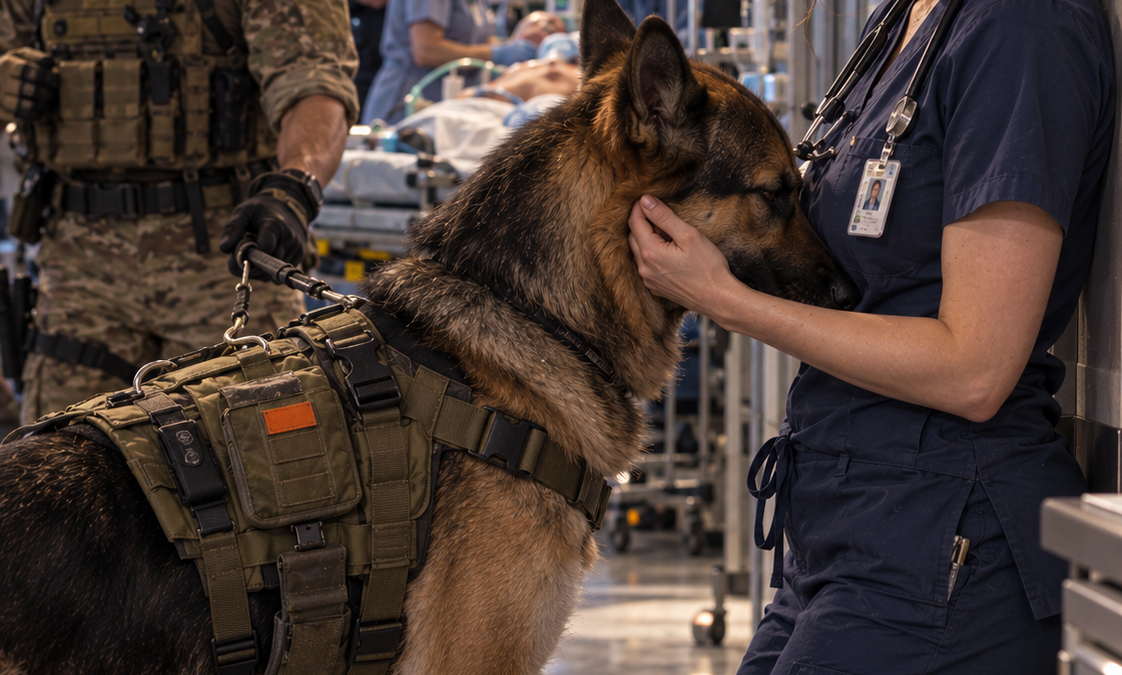
She looked down at Rogue, who was sitting at her left and looking up at her with the patient attention he’d had since the first moment in the corridor that morning.
Not waiting for a command, not watching for a threat, just there. She reached down and put her hand on his head.
From the east corridor, OC’s voice carried, “Lieutenant Vance.”
It was the first time she’d been called that in this building by someone who meant it as something other than an accusation.
She straightened.
She started toward the east corridor and she didn’t notice until she’d taken four steps that she wasn’t walking.
The way she’d walked this building for two years.
The slightly compressed shoulderforward posture of a woman making herself small in a space where being small was a survival strategy. She was walking straight.
The statement took 4 hours.
Not because Oay’s team was inefficient.
They weren’t.
They moved through the process with the methodical precision of people who understood that the value of testimony is directly proportional to how carefully it’s handled.
And they handled it carefully.
The conference room in the East Annex, the same room where Puit had first said iron tide that morning, had been converted into a temporary recording space with equipment that one of O’s agents had retrieved from a vehicle.
And Clare sat across from a senior investigator named Marcus Darby, who had the particular quality of a good interviewer. He listened more than he spoke.
And when he spoke, he asked exactly what he needed to know. She talked for 4 hours.
She started at the beginning, not Iron Tide, but before it, the training, the team, the 14 months she’d spent building working relationships with seven people whose names she now said aloud in a federal recording for the first time since she’d buried them.
Danny Hol, Pria Suresh, Cal Overbeck, Ranatada Lim, James Pharaoh, Tom Vega. She said each name with the flatness of someone who has held them in a specific interior space for so long that the act of releasing them into air was not relief exactly, but a different kind of weight, lighter in some dimensions, heavier in others.
She described the Iron Tide briefing, the operational parameters, the site, the server, the secondary drive she’d pulled in the 40 seconds she’d had before the building went down.
She described the reroute command, the ambush, the 11 hours that followed. She described Rogue finding her in the drainage channel, pressing his body against her in the dark, staying at her side through terrain that had no good options and several very bad ones. She described the fallback position, the decision to disappear, the 8 months of building an identity from components that would survive surface review.
She described the legal structure she’d set up 14 months after Iron Tide, a sealed archive, a contact in a city she now named for the record, a biometric authorization system that had waited 4 years for a morning that looked like this one.
Darby asked good questions.
He asked them at the right moments, and he didn’t ask them twice.
And when she got to the parts that were harder, Holt specifically, and the moment she’d pulled him out of the drainage channel and understood that she was already making the decision that she was going to have to leave him there, he let the silence sit rather than filling it with something that would have been less honest.
When it was done, she signed the formal transcript and sat back and felt the specific exhaustion of having spent a day being without interruption exactly who she was. Rogue was asleep near the door. The archive, Darby said, your legal contact has already transmitted.
I know the documentation on the weapons routing chain.
It’s more complete than anything in the existing archive.
He said it without drama, just fact. It names officers. It names transactions.
It names a congressional liaison who signed off on two of the routing authorizations. He paused. This is not a departmental case anymore.
I know, she said again. The people above Witmore are in that documentation.
She looked at him. The authorization chain goes four levels up from where your current archive stops.
Every level is documented. I pulled everything that was on that server before it went down.
Darby was quiet for a moment. You knew, he said, when you pulled the drive, you knew how high it went.
Yes, that’s why you didn’t surface through normal channels.
normal channels had people in them who were in those documents, she said.
I didn’t know which ones.
I couldn’t risk any of them.
He nodded. He closed his folder. Lieutenant Vance, he said, using the name with the straightforward respect of someone for whom it was simply the correct form of address.
On behalf of this office, I want to say that what you did holding this documentation for four years rather than surfacing in a way that could have been compromised. That decision is the reason this case is what it is today instead of what it would have been otherwise.
She looked at the table. Six people are still dead, she said. Yes.
He said he didn’t qualify it.
They are. She appreciated that. the unqualified acknowledgement of the thing that no amount of documentation or testimony or handcuffed officials on a concrete maintenance pad was going to change.
Six people were still dead and the only thing justice could do for them now was be accurate. She stood, shook his hand, walked out of the conference room into the east annex corridor where Rogue woke up in the moment she opened the door and came to his feet without being asked.
The hospital had reorganized itself the way hospitals do. Not seamlessly because nothing about an institution resets without friction, but functionally. The patients were in their bays.
The staff were at their stations. Sandra Wills was at the charge desk with the expression of someone who had managed a very unusual day and was prepared to manage whatever came next, which was the expression Sandra Wills wore most of the time and which Clare had always respected without adequately saying so.
Bayfors restocked, Sandra said when she saw Clare. I meant to do that this morning. I know you did.
Sandra looked at her, looked at the dog. The board called the formal review is being expedited. She paused.
They used the word expedited about four times, which means someone made a call from somewhere that I’m not going to ask about.
Solace. Clare said, I assumed. Sandra picked up a chart, held it.
Marsh is asking about you.
He wants to know when he’s getting actual pain medication instead of what Dr.Fastbender describes as the cautious approach.
Tell him the cautious approach is because we pulled his IV in an emergency and we’re watching his pressure before we add anything to the system.
Tell him it’ll be another 2 hours.
He’s going to complain.
He’ll complain more if we rush it and something drops.
Sandra wrote that down. Then she looked up. Claire, she said.
There was a pause that had a specific texture.
The pause of someone who has spent years working alongside a person and is only now assembling the full picture and finding it considerably different from the partial version she’d had.
I’ve been a nurse for 19 years, Sandra said.
I know what it looks like when someone knows what they’re doing, and I know what it looks like when someone’s trying to look like they know what they’re doing.
She held Clare’s gaze.
You always knew what you were doing.
I don’t need the rest of the story to know that part was real.
Clare looked at her.
“Thank you,” she said, and meant it in a way she hadn’t let herself mean things for a long time.
She went to check on Marsh. I was awake, alert, and had the energy of a man who had been mildly kidnapped and was processing it through the specific emotional register of military personnel who deal with unexpected events by locating the nearest available irritation and deploying it.
“2 hours,” she said before he could speak.
I heard,” he said.
Sandy told me. He looked at the dressing on his thigh.
Clean, professional, replaced at some point during the afternoon by Fast Bender’s team.
The guys who took me, they handled me like luggage. They were in a hurry. The zip ties were unnecessary.
I agree. He was quiet for a moment.
Then you’re the one who fixed the wrap this morning when I came in.
Yes. That was you figuring out it was wrong, not Greg. It was wrong, she said simply.
Greg wasn’t looking at the wound.
Marsh looked at the ceiling for a moment.
I’ve been in enough medical situations to know the difference between someone who’s doing the job and someone who’s performing the job.
He said, “You were doing it.”
She adjusted his monitoring line.
It didn’t need adjusting.
And noted his blood pressure, which was better, and his color, which was normal.
“You’re going to be fine,” she said.
I know I’m going to be fine.
He looked at her directly. What about you? The question caught her without the buffer she usually maintained, which was the tiredness of the day making her defenses less automatic than usual.
Working on it, she said.
He nodded like that was a fair answer, and he wasn’t going to push it.
Rogue find you this morning, or did you see him coming? He found me. She glanced at the dog who was in the bay doorway.
I didn’t know he’d been with your unit.
14 months, Marsh said. Best 14 months of the job.
He’s He’s good.
He’s better than good.
He paused. He was never fully there with us, though. Not the way some dogs are.
Like he was looking for something. He looked at Rogue.
Guess now I know.
She didn’t answer that.
It didn’t need an answer.
She left Marsh to his cautious pain management and his productive irritation and went back into the corridor where she nearly walked into Captain Solless. Solless looked like someone who had been on the phone for six consecutive hours, which she had.
Her dress blues had lost the crisp perfection of that morning. Not badly, but the day was visible on her, which made her look paradoxically more like someone Clare could trust.
“Walk with me,” Solless said.
They walked to the east annex, past the conference room where the statement had been recorded, to the window at the corridor’s end that looked out over the administration parking lot.
The maintenance vehicles were gone. The dark gray van was gone.
The concrete pad to the south was empty.
It looked like a perfectly ordinary Tuesday afternoon in Redfield, Montana, and it was the most dissonant thing she’d seen all day.
Whitmore is in federal custody.
Solless said he’s been transferred to a detention facility outside the local jurisdiction.
His legal team is already building a case around authorization that he acted within a sanctioned framework, but the documentation your contact transmitted makes that argument very difficult. She paused.
The congressional liaison named in the drive turned himself into the IG office 2 hours ago. His legal council advised cooperation. That was fast.
When the alternative is obstruction charges on top of everything else, people move fast. Solless looked out the window.
The four senior officers connected to the weapons routing operation have been suspended pending investigation. Two of them are career-long. One has been decorated.
She said it without satisfaction or apology.
The investigation will take time, months probably, but it’s federal, it’s documented, and it’s above anyone’s ability to bury.
The routing office analyst, Clare said, Puit said he was used without knowing it.
He’s been cleared.
He cooperated immediately, and his records confirm the query was processed under a borrowed authorization code.
He didn’t know what he was running.
Solless paused.
He’s 26.
He’s been a federal analyst for 2 years.
He’s going to spend the rest of his career checking authorization codes twice.
Good, Clare said.
That’s a useful thing to learn at 26.
Solus was quiet for a moment. Your team, she said, the formal process for postumous recognition is going to begin through Naval Special Warfare Command.
It’ll be official.
Names on record, service acknowledged, the deaths reclassified from the original. She stopped, chose the word carefully. from the original fabricated circumstances to their accurate ones.
She looked at Clare.
They’ll be honored.
Clare looked at the parking lot. She thought about Danny Hol, who had been 28 and had a brother in Phoenix and had a habit of doing crossword puzzles during premission downtime with a pen rather than a pencil because he said pencils were for people who expected to be wrong.
She thought about Pria Suresh, who had been the best medical technician she’d ever worked alongside, and who had a dry, precise sense of humor that arrived without warning.
She thought about all six of them, and the weight of being the seventh, the one who’d stayed alive long enough to be standing in a hospital corridor with a federal officer telling her their names would be said correctly at last.
It didn’t feel like winning.
It felt like the closest thing to justice that the situation allowed, which was not the same thing, and pretending it was would have been an insult to them. Thank you, she said.
There’s one more thing, Solace said.
She waited. Your rank. Solus said, Lieutenant Vance, Naval Special Warfare has authorized a formal reinstatement offer.
Your service record, the real one, not the falsified version, will be restored. The years you were listed as deceased, will be reclassified as active service under exceptional circumstances. She paused.
You could come back. The window looked out over the parking lot.
Beyond it, the administration wing’s roof line.
Beyond that, Montana, the specific, wide, unconcerned expanse of a place that had nothing to say about any of the things that had happened today and was going to be exactly the same tomorrow. She had thought about this in the drainage channel, in the 8 months of building an identity, in the 14 months of setting up the archive, in the two years of being serviceable in a building where she was invisible, she had thought about the version of this day where the offer was made, and the answer was simple.
It wasn’t simple.
No, she said. Solless waited.
I’m a nurse, Clare said.
Not the way I was using it, not as a cover.
I’m a nurse the way someone is something when they’ve done it long enough that the work has become part of how they think.
She looked at Solless. I spent six years doing combat medicine and extraction because I was good at it and because it mattered.
Then I spent 2 years doing this because it mattered. The mission changed.
The medicine didn’t.
There’s a role, Solus said carefully, for someone with your background.
training, curriculum development for military medical teams, extraction protocols, battlefield triage, the kind of institutional knowledge that doesn’t live in manuals because the people who have it usually don’t survive long enough to pass it on.
Attached to a base, part-time contract, flexible, you’d keep your civilian position.
Solace let that sit.
You’d have both.
Clare looked at the window.
Both was not something she’d allowed herself to imagine.
the life she’d built and the life she’d buried.
She’d always understood them as mutually exclusive because the version where they coexisted had required a safety that hadn’t existed until today.
Today had changed the safety.
I’d want to read the contract, she said.
Of course, and I want it in writing that Harlo General’s credentiing review is resolved before anything else is signed.
I’m not leaving a position I haven’t been formally cleared of.
It’s already being processed.
I know it’s being processed.
I want it finished. She looked at Solis directly.
I’m not signing anything while there’s still a folder somewhere with the word serviceable in my file.
Solless almost smiled.
It was small and brief and more genuine than the practiced composure she’d worn most of the day.
Understood, she said. What the afternoon moved toward evening the way Montana afternoons did, slowly with a quality of light that made the exterior of the hospital look briefly like something out of a different story, one with a gentler pace.
The federal vehicles cleared out by five.
OC’s team left with documentation, custody paperwork, and two of Puit’s personnel as liaison escorts.
Solless departed at 5:30 with a handshake that contained, Clare thought, an actual acknowledgement, not of what had been accomplished, but of what it had cost to get there, which was different and more honest. Puit was last. He found her in the main corridor, coat on, rogue on leash at his side.
The leash more formal than functional, a concession to the hospital environment.
We’re going to need to figure out what happens with him, Puit said.
She looked at Rogue. Kellerman, she said.
Kellerman’s a good handler.
Rogue works with him fine. Puit paused.
But you see the situation. She saw it.
An animal who had spent 5 years oriented toward an absence had found what he’d been looking for.
You could not simply reassign that. The work of a dog was not purely procedural. It ran on something older and more specific than training.
Something that training shaped but did not create. He has an active service assignment.
She said, “He does.
Then he should fulfill it.”
She crouched down and Rogue came to her immediately, his broadhead level with her face, his eyes steady and dark. She put both hands on the sides of his face and held him there for a moment.
“You did your job today,” she said.
“You did it better than anyone.
He made the sound low, specific, the one she’d heard that morning in a hospital corridor when he’d first pressed his head into her palms and exhaled 3 years of looking into a single moment of having found.
She pressed her forehead against his for 3 seconds. Then she stood.
He’ll be transferred back to his unit after Marsha’s medical clearance is complete.
Puit said he was giving her information. He was also giving her a moment to have that be the sentence she heard without needing to respond to it. She nodded.
Pruituit, she said. He looked at her.
The six people on my team, she said. When the recognition process starts, I want to be part of it. Whatever the formal structure is, I want to give the testimony about each of them personally, not just the operational record, who they were.
Yes, he said without hesitation.
That’s already yours to do.
He left.
Kellerman collected Rogu’s leash with the careful, respectful efficiency of a young man who had understood something important today about the nature of the work and the animal he was responsible for.
He didn’t say anything when he came to get the dog.
He just looked at Clare for a moment and then he nodded, which was the right response. Rogue went with him.
He looked back once from the corridor entrance with the patient, certain attention he’d had all day.
Then he was gone. She worked the rest of her shift, not because anyone expected her to, not because it was strategic or necessary or a demonstration of anything. She worked because there were four patients still waiting on assessments, because the evening intake had started and Sandra had lost a support nurse to a family emergency.
And because the granola bar she’d eaten at 6:00 in the morning had been the last thing she’d eaten, and working was better than sitting in an empty break room thinking about a dog walking back down a corridor.
She checked on Pool’s dressing.
She ran a secondary assessment on a woman who’d come in at 4 with chest tightness that turned out to be a muscle pull and anxiety.
And she spent 20 minutes with the woman, not because the clinical situation required 20 minutes, but because the woman was alone and scared and needed someone to talk to her like a person rather than a problem. She processed two admissions, caught a medication discrepancy on a chart that Fast Bender had already signed off on, and flagged it without drama through the proper channel. She fixed the bay 4 supply cabinet properly this time.
At 7:15, Joyce Marion came to find her at the nursing station. Marion had the bearing of someone who had spent the day managing a situation well beyond her administrative training and had done it adequately rather than well and knew the difference and was at peace with it. She set a folder on the nursing station counter.
Your credentiing review, she said. Clare looked at it.
Complete.
Marin said the board’s formal finding is that your nursing credentials are valid.
Your clinical record at this institution is exemplary and the suspension recommendation has been withdrawn. She paused.
That’s the formal language.
In plain language, everything Greg flagged has been reviewed and cleared. Clare opened the folder, read the first page, read the second.
The word exemplary appeared twice in two paragraphs, which was not a word she’d ever seen in a document about her professional performance.
She closed the folder. Thank you, she said.
One more thing, Marin said. The position Greg held.
She said it carefully, looking at a point slightly past Clare’s left ear.
We’re restructuring leadership in the trauma division.
Dr.Fastbender will take the senior physician role.
But the senior nursing coordinator position, it’s been effectively vacant for 2 years because Greg was functioning in ways that made the formal designation redundant.
That position is now open. She looked at Clare directly, formally open with a proper title and proper compensation. Clare looked at the folder.
She thought about two years of being the person who fixed things that weren’t her assignment and caught problems that weren’t her responsibility and knew the building’s exits and the patients family members names and which supply cabinet needed restocking and where the lateral door in the maintenance corridor was.
She’d been doing the job.
She just hadn’t had the title.
I’ll think about it, she said.
That’s all I’m asking.
Maring said she left. Sandra Wills had been standing with an earshot of none of this at the far end of the nursing station with the professional discretion of someone who definitely had not heard any of it.
“Senior coordinator,” Sandra said without looking up from her chart.
“Were you listening?”
“I have excellent hearing,” she turned to page.
“You’d be good at it.”
“You’d be good at it,” Clare said.
“I hate administrative work.”
Sandra looked up.
“I like doing the job.”
You like doing the job and understanding the whole system it exists inside of. Those are different things.
She returned to her chart. Think about it.
Clare thought about it for about 30 seconds, which was how long it took her to understand that she’d already made the decision and was simply catching up to it.
At 8:45, the shift changed. Clare sat in the break room, the one with the broken microwave, which was still broken, which was going to require a maintenance request that she was going to file first thing tomorrow.
and she ate a sandwich that someone had left in the refrigerator with a note that said, “Anyone please.”
And drank coffee that was the specific temperature of coffee that’s been sitting for an hour and a half.
And she thought about the day, not the whole of it. The weight of the whole of it was not something you processed in a break room over a borrowed sandwich.
that weight was going to take months and a legal process and testimony and probably some conversations she hadn’t been ready to have for 5 years that she was going to have to be ready for now.
She understood that what she thought about specifically was a question she’d been circling since Puit had left with Rogue.
She’d built the last 5 years around a single operational objective.
Survive long enough for the situation to resolve in a direction that didn’t require her silence to be permanent.
Every decision, the identity, the archive, the legal structure, the exit strategies in every building she’d worked in had been in service of that objective.
The objective had resolved, which meant she was for the first time in 5 years in a situation with no active operational parameters. No immediate threat, no cover to maintain, no single purpose organizing every choice she made. It was, she discovered, a strange feeling.
not empty, strange, like the silence after a sound you’ve lived inside long enough to stop noticing it and then it stops and the silence has its own texture.
She told Solless she was a nurse the way someone is something when the work has become part of how they think. That was true. The six years of combat medicine and the two years of this had shaped the same underlying thing from different directions.
the capacity to be useful to someone who was hurt in whatever conditions existed with whatever resources were available. She had never been able to do that halfway. She had also never been able to stop doing it.
The contract Solis had described the training role, the curriculum work, the institutional knowledge that didn’t live in manuals.
That was not a retreat from the work. That was the work continued in a different register.
passing on the things she knew to people who would need them, making sure that what had cost her team their lives was not lost, but transformed into something that might prevent the same cost for someone else’s team.
That was worth doing.
And the nursing coordinator role, the formal acknowledgement of what she’d been doing informally for 2 years was worth doing, too, for the much simpler reason that the work mattered and the people doing it deserved someone who understood the whole system and was willing to fight for them inside it.
She could do both. She was She understood with the specific clarity that comes at the end of a very long day, not the same person who had walked into this building at 6:00 that morning.
Not because the day had changed her.
She’d been becoming this person for 5 years in the drainage channel and the 8 months and the careful construction of a life that would hold, but because the day had removed the requirement to hide it.
She didn’t have to be small anymore.
She finished the coffee. She wrapped the remaining half of the sandwich for whatever colleague would need it at midnight. She stood, rinsed her cup, and stood at the breakroom sink for a moment, looking at nothing in particular.
She thought about Danny Hol and his crossword puzzles and his pen.
About Priya’s dry humor and Cal Overbeck’s habit of narrating his own navigation when he was lost, which he would deny doing and then do again immediately.
About James Pharaoh, who was a terrible singer and sang constantly. about Ranata Lim, who had been 25 and had kept a photo in her vest pocket of a niece she never talked about.
About Tom Vega, who had told Clare once during a pre-mission equipment check in the dark, that the thing he was most afraid of was that something he’d done would be forgotten before it could matter.
She was going to make sure it mattered. She was going to say their names in a formal record on the right side of history where the names would stay.
That was not everything. It was not enough. It was what she had.
And she was going to do it with the same steadiness she’d brought to every compression wrap and every dosage assessment and every exit strategy she’d ever mapped in every building she’d walked into.
She turned off the breakroom light. She was at the main entrance, coat on, ready to leave.
When she turned back, she didn’t know why exactly.
Instinct or habit or the same reflex that had made her memorize every exit in a building she’d expected to work in for 2 years and ended up working in for 2 years that were also something else entirely.
She turned and looked at the ER bay one where a new patient was being assessed by Fast Bender. Bay two where P was sleeping, his leg wound doing what it was supposed to do. Bay three, where the woman with the chest tightness had finally stopped being scared and was waiting for her discharge paperwork.
The charge desk, where Sandra Wills was on the phone looking at her computer screen with the focused, unhurried attention of someone who does difficult work and does it without needing to be seen doing it. the hospital at the end of a shift. The residue of the day on every surface and underneath it the permanent forward motion of a place that processed human pain for a living and kept moving regardless of what happened to the individual people inside it.
She’d been one of those people for 2 years.
She was still one of those people. The difference was that she was allowed to know it now.
She pushed through the main entrance and stepped out into the Montana evening, cold and clear, with the specific quality of dark that only exists in places far enough from everything that the sky has room to be fully itself. She stood on the pavement outside Harlo General and breathed the air and felt the weight of the day in her legs and her shoulders, and the particular tiredness behind her eyes that comes from having been without interruption or compromise completely
present.
Her phone buzzed.
A text from a number she didn’t recognize.
Sent through a secure routing she recognized immediately because she’d set up the same system herself years ago.
Two sentences. Legal contact confirmed receipt. Archive transfer complete and authenticated.
She looked at it for a long moment. Then she put her phone in her pocket and started walking toward the parking lot.
She walked the way she’d walked the last four steps of the hospital corridor, straight with the posture of someone who has stopped making herself smaller than she is because the reason she’d needed to be small was gone.
And she was not going to carry the habit of it past the day that had made it unnecessary. She had been dismissed. She had been erased.
She had been called serviceable by a man who had mistaken her restraint for limitation and her silence for the absence of anything worth saying. She had survived a mission that was designed to kill her.
She had carried evidence for 4 years through an identity that wasn’t hers in a building where she wasn’t recognized, doing work that mattered while waiting for the one moment that couldn’t be manufactured or forced.
The moment when the truth became impossible to keep underground. That moment had arrived as it arrives without announcement.
On a Monday morning, through a lobby door on the end of a leash that couldn’t hold, the parking lot was quiet.
A few cars, the end of shift, nurses coming and going, the ordinary administration of an ordinary evening in a place that had been today considerably less ordinary than it looked. She reached her car. She put her hand on the door handle and stood there for a moment, and she thought about what it meant to stop running.
Not because running had been wrong. Running had been the correct tactical decision given the available information and the operational constraints, and she was not going to apologize for surviving.
But running had a posture, and the posture was over, and what replaced it was something she was still learning the shape of. It felt like standing straight. It felt like the possibility of a name said correctly in a room full of people who would write it down and keep it.
It felt imperfectly and without the clean satisfaction she’d once imagined, like the beginning of what came after.
She got in her car. Tomorrow there would be a contract to read and a title to formally accept and six names to say in a room where they would be heard properly and a legal process that would take months and would not be easy and would be worth doing regardless. There would be Marsh in Bay One asking about his pain medication schedule.
There would be Pool’s follow-up dressing.
There would be a supply cabinet to audit and an intake protocol she’d been trying to revise for 4 months and a broken microwave that was genuinely becoming a staff morale issue.
There would be all of it. The ordinary and the extraordinary.
The work that mattered and the documentation that made the work possible. The patients who needed someone to talk to them like a person and the colleagues who deserved someone in their corner. There would be a lot of things.
She started the car.
She had spent 5 years being the woman who remembered everything and showed nothing and made herself invisible in every room she walked into because visibility had been a danger and she’d made the correct assessment and survived it.
She was not going to spend the next 5 years the same way. The people who buried the truth had counted on the silence of the people who knew it.
They’d counted on the isolation, the fear, the accumulated weight of living inside a story you couldn’t tell.
They’d done the math on how long a person could carry something alone before the carrying became the whole of them.
They’d been wrong.
Not because she was exceptional, because she was stubborn and precise.
And because she’d had a dog who remembered her, and because the people who try to erase someone occasionally forget that eraser only works if the erased person agrees to stay gone, she pulled out of the parking lot.
She drove through Redfield in the dark, past the bar on Fifth Street, where the staff happy hours happened, and she’d never gone.
Past the overnight diner that was open late and smelled like coffee from the road. She drove through the quiet indifferent streets of a small city that had no idea what had happened inside its regional hospital today.
And she thought that was actually fine.
The world didn’t need to know the shape of every storm.
It only needed to know the outcome. The outcome was the truth was in the right hands now. The outcome was six names would be said correctly.
The outcome was a woman who had been told she was ordinary had turned out to be something else. Not because ordinariness is something to escape, but because the people who called her ordinary had been measuring the wrong thing all along.
She had never been ordinary. She had been quiet.
Those were not the same thing. And the world, the specific, difficult, imperfect, necessary world of doing useful work among people who needed it was still out there, unchanged and waiting.
And she was still in it. She drove home through the Montana dark with the windows cracked, breathing the cold, clear air of a place that had nothing to say about who she had been or who she was becoming.
That was fine. She had plenty to say herself.
—END—
