Nurse Was Humiliated in the ER—Then a Military K9 Did Something No One Expected (part 2)
Part 2
Sarah considered the word. It was specifically chosen. Yes, she said.
Age nodded once. Good.
She turned toward the prep area. Go check on your other patients. Sarah went.
She was passing the corridor junction near the or family waiting area when she heard it. Not loud. coming from the al cove where the surgical family space opened into the main hallway.
A low controlled sound, the kind of sound that a person made when they were exercising significant effort not to make more sound than that. She stopped.
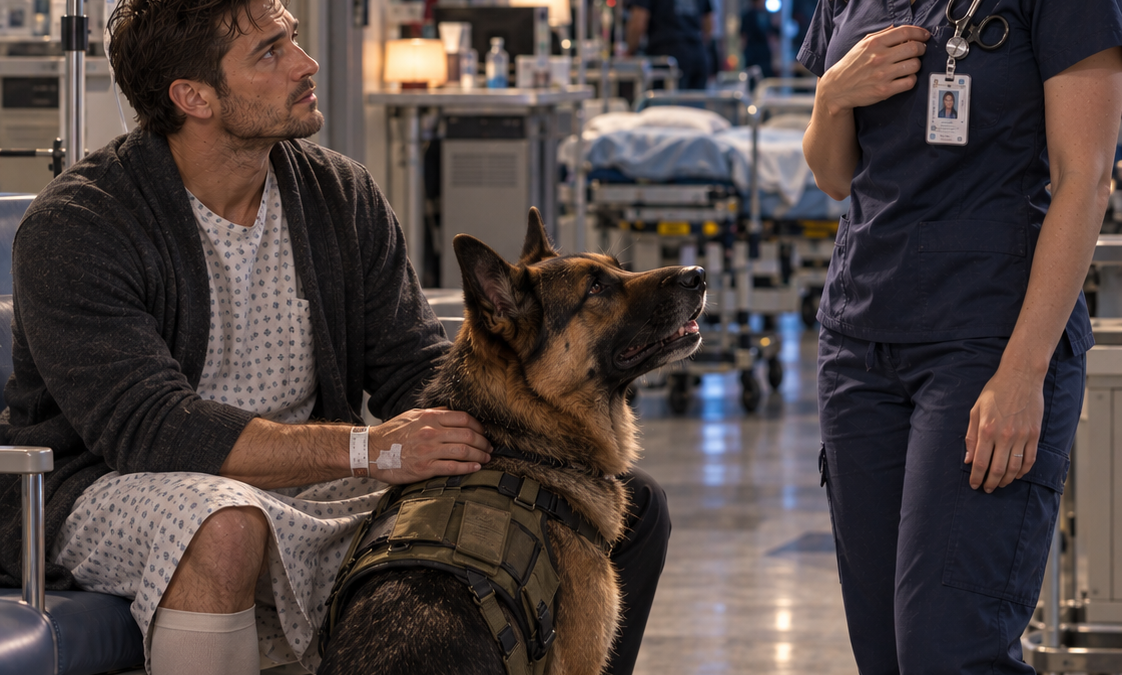
In the waiting al cove, Garrett was sitting with Rook’s leash wrapped twice around his hand, not pulling, just holding, and Rook was sitting beside him with his shoulder pressed against the man’s knee.
The dog was not providing comfort in any theatrical sense. He was simply present in the specific way that well-trained working dogs were present with the full weight of their attention directed at the person beside them.
Garrett looked up when he heard Sarah’s footsteps.
His eyes were red. He looked embarrassed about it.
“Sorry,” he said.
“I was just,” he gestured vaguely.
I was army. Different branch, I know. But he stopped.
You don’t have to explain it, Sarah said.
She sat down across from him.
She didn’t say anything for a moment.
She looked at Rook, who looked back at her with those settled, knowing eyes.
He’s going to make it, she said, not as reassurance, as information.
You sound sure I am. Garrett was quiet for a moment.
Then how do you stay? He searched for the word steady in there.
When it’s like that, Sarah thought about the question honestly, the way she thought about clinical questions without reaching for the answer that sounded right.
You’ve been in situations where panic would have made things worse.
She said, “Yeah, so you learn not to panic.”
She looked at Rook. Same principle. Garrett nodded slowly.
He looked down at the dog.
He didn’t want to stay with me at first.
When they took the patient up, he kept Garrett made a gesture with his free hand indicating direction toward where Sarah had been standing. He kept looking for you.
He’s protective of his owner, Sarah said.
No, that’s Garrett shook his head.
I’ve seen dogs protective of their handlers.
This is different.
The way he acted when he saw you, it wasn’t he wasn’t protecting Ror from you.
It was more like he was he stopped again.
I don’t know.
Like he already knew you.
Sarah looked at the scar on Rook’s flank.
The scar was approximately 6 in long, running diagonally across the left side, healed clean and smooth, but clearly the result of something significant, something that had needed treatment in the field because a civilian surgical facility would not have been accessible. She knew the approximate suture technique the scar suggested. She knew it because she had used that technique before.
She extended her hand palm up toward Rook. The dog pressed his nose against it. Then he shifted and leaned the side of his head against her palm.
And she felt the warmth of him and the specific weight of a dog who has decided that certain humans are categorically different from other humans and behaves accordingly. The scar was under her hand. She remembered her fingers on a very different surface in a very different kind of light.
The flat white of a field treatment area, the particular smell of it, the sounds that had nothing to do with hospital beeps, and everything to do with the kind of emergency that didn’t have nursing stations or crash carts or protocol documentation.
She remembered a younger version of this dog. She remembered the men beside him.
She couldn’t see their faces clearly.
That part of her memory was not organized by faces. It was organized by what she had needed to do and for how long and what the outcomes had been.
But she remembered the dog because the dog had been conscious when his handler wasn’t and had been silent and still in the treatment area in a way that had struck her even then as extraordinary, even injured.
Even while she was working on the man beside him, she had treated the dog too. She had cleaned the wound and closed it with the materials available, which were not ideal, and she had told the dog to stay still, and he had stayed still.
And she had thought, even in the middle of everything else, that this was an animal who understood the situation better than most, 8 years older, gray at the muzzle now, but the same, the same dog. She took her hand back slowly.
Rook watched her. She stood.
Someone will come out to update you on the patients progress, she said to Garrett. Her voice was controlled.
It’ll be at least two more hours.
There’s a coffee station near the family entrance on the left.
Thank you, Garrett said. She walked back toward the emergency department. Her hands were perfectly steady.
They were always steady when it mattered. That was not something she had acquired.
It was something that appeared when it was required and disappeared when it wasn’t.
like a frequency that only certain situations could tune in. Her hands were steady and her mind was doing the thing it did when something important needed to be compartmentalized until there was time to open it properly.
filing, not avoiding, setting the Djibouti question and the scar and the look in Rook’s eyes and Ethan Ror’s you were there into a folder that was closed for now because the shift wasn’t over and there were patients who needed her attention and nothing she had just realized could be examined responsibly while she was still on the floor.
She was almost back to the nursing station when she heard her name.
Not called said the specific way that someone says a name when they are not trying to get the person’s attention but are confirming something to someone else.
She heard Voss.
I’m telling you she went behind my back.
Formally documented a clinical disagreement during an active case without.
She recognized Holt’s voice.
She didn’t stop walking.
She came around the corner to the nursing station where Hol was standing with the night shift senior resident doctor Annayia Maro, 29 years old, 3 months out of her emergency medicine residency, sharp and careful and currently wearing the expression of someone being given information they are not sure what to do with. Hol saw Sarah. He did not change his expression.
He did not look away or lower his voice or display any visible indication that continuing this conversation in front of its subject was inappropriate.
I’m required to tell you, he said, redirecting to Sarah now that the standard of care review process is going to examine the escalation you initiated.
Dr.Agira already told me Sarah said. She reached the station and picked up the chart on the top of the rack. What you did was outside your nursing scope.
She looked at him over the chart. The formal escalation pathway is specifically within nursing scope.
It’s in the hospital’s clinical protocol manual, section 14, subsection 3.
I followed it exactly.
You undermined an attending physician’s clinical judgment during an active case.
I documented a clinical concern and activated the appropriate escalation channel. She held his gaze.
The fast exam confirmed hemorrhage.
He’s in the O right now.
That outcome, Raymon.
A gear’s voice came from the corridor behind Sarah.
They had not heard her approach. A gear had apparently come back from surgical prep by a different route and had been in in the corridor long enough to hear at least part of the conversation.
Her voice was not loud.
It didn’t need to be.
“Go home,” she said to Hol.
“Your shift ended 40 minutes ago.
We can discuss the review timeline in the morning.”
Holt looked at Ageir. He looked at Sarah. He picked up his tablet from the station surface.
She doesn’t belong in trauma, he said, not loudly.
Not to Agira specifically. The way a person said a thing when they wanted it to be on record without it being a statement directed at a specific authority. He walked toward the exit.
Marorrow was looking at Sarah with an expression that Sarah couldn’t immediately categorize.
It wasn’t pity and it wasn’t admiration and it wasn’t the blank professionalism of someone staying out of it.
It was something more like the look of a person who has just witnessed something they’re going to think about later.
A gear came to the station. How are your remaining patients stable? Sarah said Mrs.Puit is still waiting on ortho.
Bay 7 discharged. Good. Age gear looked at the exit where Hol had gone.
Then back at Sarah. His personnel file is going to show a pattern, she said quietly.
This isn’t the first escalation from the nursing staff that he’s characterized as insubordination.
The review is going to establish that.
I didn’t escalate because of the pattern.
Sarah said, “I know.”
Airi picked up her own chart.
That’s what makes it credible.
She moved toward the corridor.
“The rest of your shift is yours, Sarah.
Do your job.”
She did her job.
Mrs.Puit’s ortho consult finally arrived at 10:15 a tired resident who performed the assessment with the mechanical efficiency of someone at the end of a long day and who to his credit confirmed the fracture classification and arranged the admission with appropriate speed once he’d completed the imaging review.
Mrs.Puit informed him that she hoped he eventually got some sleep because he looked dreadful, and the resident seemed genuinely uncertain whether to be offended or grateful.
Sarah completed the transfer paperwork and updated the admission notes and finished the supply inventory she’d started at the beginning of the shift and wrote up the full incident documentation for bay 4 in the specific precise language that Agira’s comment had told her was going to be examined at 11:40.
Priya stopped beside her at the station or called.
She said still on the table but they said it’s going well.
controlled the bleed. Surgeon said another 40 minutes. Sarah nodded.
They also said Priya hesitated.
The surgeon said if he’d come in another 30 minutes later or if fluid resuscitation had been delayed even 15 minutes past when you pushed for it.
She stopped.
Priya, I’m just saying what the surgeon said.
I know Sarah said. Thank you. Priya left.
Sarah sat with the chart and the documentation and the particular quiet of a department between surges and she looked at the empty bay four across the floor bay cleaned. Monitors reset bed rail back in neutral position as if nothing had happened there and she allowed herself for the first time since she had walked into the department that evening to feel the full weight of what she was carrying.
Not the weight of the case.
Not the weight of Holt’s dismissal or Cassid’s smile or the review process or the fact that Agiri was clearly asking questions that were going to require answers.
Sarah had spent 18 months at Kesler Memorial carefully not providing the weight of Rook’s head against her palm.
The weight of you were there. The weight of a scar she recognized. She had a very specific memory.
Not complete, not linear. the way field memories rarely were of a night in a country she did not speak about in conditions she did not describe where she had worked on three men and one dog in a treatment area that was not designed for any of them. She remembered the sounds outside.
She remembered her own hands which had been steadier than they should have been given everything.
She remembered the dog’s dark eyes watching her while she worked on the man beside him.
She had not known their names. She had not asked. That was not the environment for names.
That was the environment for pressure and timing and staying present with the immediate task and not allowing the sound of things outside the tent to occupy the cognitive space that the task required.
She didn’t know afterward what had happened to any of them.
She had not wanted to know. knowing was the beginning of the accounting and she had not been ready for the accounting.
Had not been ready for two years and then three and then the years had accumulated and the not knowing had become simply the way things were. the way she had arranged her understanding of that period of her life.
Closed, done, filed under a category that did not require reopening, except that the dog was down the hall in a surgical waiting room, pressing his shoulder against a veteran liaison’s knee, and the man on the table had looked at her with eyes that had not lost their recognition, even while everything else was shutting down.
And
somewhere in the fog of his deteriorating blood pressure, he had said, “You were there.”
With the certainty of someone stating geography, and she had been. She looked at the Bayour monitors across the floor. Reset and waiting for the next patient.
Her pager went off. She picked it up, read the message, set it down, looked at it again.
The message was from Garrett, the veteran liaison.
Dog won’t settle.
Keeps pulling toward the ER.
says something’s going on, but I don’t know what.
Should I bring him back? Sarah looked at the message. She looked toward the O corridor.
She thought about what she knew and what she was still missing, and about the particular sensation of a closed door that something on the other side was quietly insisting be opened. She thought about the scratched black trauma shears in her locker.
She picked up her pager and typed back, “Stay where you are.
I’m coming to you.”
She stood up, straightened her badge, and walked down the corridor toward what she had spent 18 months trying to leave behind, not knowing yet that leaving it hadn’t worked, that it had simply followed her here and waited with the patience of something that understood the difference between running and being done.
Rook had known before she did.
She was almost at the waiting room when she heard the O coordinator’s voice from the nursing station behind her, sharp and sudden in the corridor quiet.
Somebody get a gear.
We’ve got a complication in room 3.
Room three was Ethan Ror’s O.
Sarah stopped. She did not run.
Running in a hospital corridor during a surgical complication served no purpose. There was nothing she could do in that O. Nothing her presence could change.
no intervention available to a nurse standing outside a room where a surgical team was already responding to whatever had just gone wrong. She stood completely still in the corridor.
And for the first time in 18 months at Kesler Memorial, and longer than that before it, she felt something she had not let herself feel since she stopped being the person who carried those shears out in the open. She felt afraid.
The ORE coordinator’s voice carried the specific texture of controlled urgency, not panic, because OR coordinators who panicked didn’t last in the role, but the tightened down version of alarm that people in surgical environments used when they needed help immediately and needed everyone who heard them to
understand that immediately meant now.
Sarah turned around. She walked back toward the nursing station at a pace that was not running but was faster than her normal stride.
And when she reached the station, she heard enough of the coordinator’s phone conversation to extract the essential information.
Intraoperative hemorrhage, unexpected secondary bleeding site, surgical team requesting additional blood products, and the trauma attending on immediate standby. Not a crash, not a code, a complication being managed by people who were trained to manage it.
She stood at the station and breathed. The coordinator ended the call and looked at her.
You’re the nurse from Bay 4?
Yes, Dr.Aguir is already in there.
The surgical team identified a secondary laceration to the hpatic vein smaller than the primary bleed, but it was behind the initial repair site, and they didn’t see it until they were closing.
The coordinator’s voice was clinical, informational.
They’re managing it, but it’s going to be another hour minimum.
Okay, Sarah said, “You should.”
The coordinator glanced at the floor.
“Is there something you need?”
There was nothing she needed that the coordinator could provide. The surgical team had the situation. A gear was present.
The outcome would be what the outcome was going to be. and Sarah standing at the nursing station or walking to the waiting room or sitting on the floor of an empty supply closet would not change it by a single variable.
“I’m going to check on the dog,” she said and went.
“Garrett was exactly where she had left him in the surgical waiting al cove, but his posture had changed in the way that postures changed when the body received information it didn’t have language for yet.
He was sitting forward with his
elbows on his knees and Rook’s leash slack between his hands and Rook was standing not sitting standing facing the direction of the O corridor with his weight shifted slightly forward and his ears in the alert position that working dogs adopted when they were tracking something that the humans around them hadn’t identified yet.
“Is something wrong?”
Garrett asked when he saw her face.
“There’s a complication in surgery,” she said.
They’re handling it.
It’s going to take longer than they thought.
Garrett absorbed this. He nodded once with the particular economy of a veteran processing bad news, not shutting down, not spiraling, just integrating the information into the current situation and adjusting accordingly.
What kind of complication? Secondary bleed.
Smaller than the primary. The team caught it.
But it’s bad.
It’s serious.
She said there’s a difference.
Rook turned and looked at her. She met his eyes.
The dog made a sound, that same low chest vocalization, controlled, deliberate, and then he crossed to her and pressed his head against her thigh and held it there. Garrett watched this.
His expression had moved into the territory of something he clearly didn’t have adequate vocabulary for.
“I’ve worked with a lot of military animals,” he said quietly.
in this role.
I mean, I’ve seen how they are with their handlers, with handlers families, with other service members.
He paused.
I’ve never seen one behave like that with a stranger.
I’m not entirely a stranger, Sarah said.
It came out before she had decided to say it.
She kept her hand on Rook’s head and did not elaborate, and Garrett, to his credit, did not push.
He simply nodded and looked back at the O corridor and said nothing, which was the correct response and the one she appreciated. They waited. Waiting was the hardest part.
This was true in emergency medicine and it was true in other contexts that Sarah did not discuss. And the reason it was hard was that waiting was the condition in which the mind was freed from the discipline of task.
When there was something to do, the mind organized around the doing of it. When there was nothing to do, the mind organized around everything else.
She thought about Ethan Ror’s hand on her wrist.
She thought about the specific quality of his voice when he’d said, “You were there.”
The certainty in it, the way the sentence arrived, not as a question being tried out, but as a fact being confirmed. She thought about a night in a country that smelled like dust and diesel, and the particular metallic smell of a field treatment area under pressure. She had been 31 years old.
She had been doing the job she was trained to do in the environment she had been assigned to support. She had not expected to be there long.
The extraction was supposed to be clean, which was something people said about extractions before they happened, and which was a phrase she had learned by that point to hold very loosely. Three operators had come in within 7 minutes of each other.
two from the same team, one separated from his unit and brought in by a different route.
All of them had been in the same area when something had gone wrong with the cordon, though she didn’t know the specifics and wasn’t briefed on them and wouldn’t have had time to absorb a briefing anyway.
She had worked on all three.
She had also worked on the dog because the dog had been hit by fragmentation during the same incident and because the dog’s handler, one of the first two operators, the one who was most seriously injured, had been conscious enough at intervals to ask about the dog, and because she had understood that treating the dog was
medically adjacent to treating the man in the way that certain things became adjacent when you were working in conditions with no good options.
The first two operators had survived. The third one, the separated operator, the one who had come in by himself with no team alongside him, had not. His name had been warrant officer Marcus Fielding.
She had not known that at the time. She had known it afterward when the afteraction medical review occurred and the name had been on the page and she had read it with the flat effectless attention of someone who had already spent a long time deciding how to categorize what had happened.
She had saved two men. She had lost one. The math was clear.
The math did not help. It had not helped then and it did not help now. standing in a surgical waiting al cove with a retired military dog pressing his head against her thigh.
Because the calculation she had been performing since the night fielding died was not 2 minus 1’s equals positive one.
It was did I do everything that could have been done? And if there was something else, what was it?
And why didn’t I see it in time?
The honest answer was that she did not know. The review had said the treatment sequence was appropriate.
The review had said the mechanism of injury and the extent of the wound had made the outcome likely regardless of intervention.
The review said several things that were clinically accurate and that she had read and reread and accepted as professionally valid and that had not even cumulatively managed to close the folder in her mind that still opened occasionally when she wasn’t guarding against it.
She had left military medicine 14 months after Fielding’s death.
She had told herself she needed a different pace, a different environment, a civilian hospital, night shifts, the ordinary ongoing work of emergency care without the particular weight of operating in conditions where the margin for error was measured in seconds and the standard of care was whatever you could improvise with what you had. She had told herself that for 3 years.
She had believed it for approximately the first 6 months.
“They’re calling for you,” Garrett said.
She looked up. Priya was standing at the junction of the waiting room corridor and the main hall, and her expression had the quality of urgency that was trying to be quiet about itself. Sarah, Aira wants you in the orant room now.
Sarah moved. The Orana room was a transitional space. Not sterile, not public.
the hallway between the world and the operating room that functioned as the place where communications happened when the surgical team needed to communicate with someone who was not scrubbed in. Aira was there when Sarah arrived, still in her surgical gown with the mask pulled down, and she was not alone. Beside her was a man Sarah did not recognize.
50 or so, militarybearing despite the civilian clothes, the kind of posture that didn’t come from a gym, a lanyard with a government ID that she could not read from where she stood.
Age said, “Close the door behind you.”
Sarah closed the door.
“This is a colleague of Ethan Rors.
” Agira said he’s asked to speak with you.
The man extended his hand. James Aldrich.
He said it with the specific economy of a person who gives their name as information rather than introduction, without the social performance of a handshake. His grip was brief. His eyes were conducting the kind of rapid assessment that Sarah recognized from contexts Kesler Memorial had no framework for.
“I need to ask you something, and I need you to answer it directly.”
“All right,” she said.
“Did Ethan say anything to you before he went under?”
She looked at him for a moment. He said he knew me.
Aldrich nodded once. From where?
He didn’t specify.
But you know where? He said.
Not a question. She held his gaze. I worked in a field medical support capacity attached to special operations units in the Horn of Africa region approximately 7 to 8 years ago.
If Ethan Ror was part of a team that came through my treatment area during that period, then yes, I know where Aldrich was quiet for 3 seconds.
Then he said, “The dog confirmed it.”
Excuse me.
When Rook stayed with you in the ER when he didn’t respond to your colleague and went to you instead, Aldrich looked at her with an expression that was neither warm nor cold.
It was simply precise. Rook was on that mission.
He’s been trained to the standard of alerting to individuals he’s encountered in operational contexts.
Not evidence work, not detection, just recognition. He paused.
He knows people he’s met before, the ones his unit trusted.
Sarah processed this without allowing it to move across her face. His handler during that deployment was Ethan Ror.
Aldrich said, “You treated Ror after the explosion.
You also treated Rook. He looked at the door to the O.
There’s a question I need to ask you and I want you to understand that I’m asking it because it’s relevant to what’s happening in that room right now, not because I’m interrogating you.
Ask it, she said. The third man, Fielding, his voice dropped half a register. What did you see?
The question was structured oddly. Not what happened to Fielding or how did Fielding die, but what did you see?
which was the question someone asked when they wanted to know what her version of the record looked like and what it might contain that the official record had not. She looked at Age.
Age gave her nothing. Not permission, not prohibition. The face of someone who had brought two people into a room and was going to allow the room to determine what happened next.
I saw a man who came in with a specific wound pattern, Sarah said slowly. fragmentation right thoracic with secondary blast injury.
I saw that the primary vascular injury was manageable with what I had. I saw the intervention work for approximately 18 minutes and then I saw it stop working.
She stopped. The review concluded the secondary injury to the pulmonary artery was not survivable with field resources. I have read that conclusion many times.
I accept it as clinically accurate. Do you believe it?
She did not answer immediately. She had answered that question in her own head more times than she could count in the years since it had happened.
And the honest answer was that she believed the clinical conclusion and did not know what to do with the fact that believing it had not been sufficient to close the folder.
“Why are you asking me this?”
she said.
“Tonight, right now.”
Aldrich reached into his jacket and produced a photograph. not on a phone, a physical photograph, the kind printed from a highresolution source. He held it out.
She took it. It was Fielding, not from the night she had seen him. She would not have recognized him from that night because she had never learned his face, only his wounds.
This was Fielding standing in bright daylight in what looked like a team photographs before the deployment. He was grinning.
He had the particular grin of a man who was comfortable in his own capacity and not concerned with whether anyone noticed. Beside him, slightly to the left, was a younger version of Ethan Ror, and at their feet, barely visible at the bottom edge of the photograph, a young Belgian Malininoa with dark eyes and an attentive posture and no gray at his muzzle yet.
Rook Fielding was Ror’s closest friend on the team, Aldrich said.
the reason I’m here tonight.
He stopped. He looked at the door to the O.
Ethan didn’t separate from service because of the mission.
He separated because of what happened after.
He hasn’t.
He’s struggled since.
He was choosing his words with a care that suggested he was editing in real time, removing specifics that weren’t hers to have.
He keeps the dog because Rook is the last another stop.
because some things hold a person in place when they’re having trouble staying.
Sarah looked at the photograph. She thought about what it meant that Rook had come to her.
Not generically, not the way any trained dog might orient toward a person who displayed calm, familiar behavioral markers, but specifically with the deliberate settled quality of recognition.
She thought about the folder in her mind that wouldn’t close.
She thought about the scratched black shears in her locker.
“What are you asking me to do?”
she said.
“Ethan may come out of this surgery with some recovery ahead of him,” Aldrich said.
Physically, “And he’s going to wake up knowing you were there that night.
He’s been carrying his own version of what happened for 7 years, and it is not the careful editing again.
He doesn’t have accurate information about what you did, what was possible, what wasn’t.”
He met her eyes.
He thinks he’s the reason Fielding died.
The room was very quiet.
He wasn’t in the treatment area, Sarah said.
No, he was in and out of consciousness, but he was the team leader. And the way Ror is built, Aldrich paused.
He was supposed to bring everyone home.
He didn’t.
And you’re the only person who was actually there to tell him what that night looked like from the medical side.
Sarah set the photograph down on the table beside her. Her hands were steady.
They were always steady. This was the thing about Sarah Voss that nobody at Kesler Memorial understood that the Cassidy Whan of the department read as coldness or eccentricity or excessive caution. The steadiness was not the absence of feeling.
It was what feeling looked like after a long time in environments where feeling and functioning had to operate simultaneously, where the option of setting one down while you use the other was not available. She felt things. She felt them fully and at the same depth as anyone.
She simply felt them without letting it show in her hands. He needs to recover first, she said. Yes.
And I can’t promise what I’ll tell him.
I’m not asking you to promise.
I can tell him what I saw, she said.
I can tell him what was possible and what wasn’t.
I can tell him what happened in that room in the sequence it happened. She looked at Aldrich.
I can’t tell him whether it was enough because I don’t know that.
I have never known that.
And I’m not going to tell him something I don’t know just because it would be easier for both of us.
Aldrich looked at her for a long moment.
That’s exactly what he needs, he said.
The door opened. One of the surgical residents appeared in scrubs with a mask dangling from one ear. He looked at Agiri.
Dr.Agiri. The hpatic repair is complete.
We’ve got hemostasis.
He’s stable.
Age said closing. Starting now.
Another 40 minutes, maybe 50. The resident left.
Aira looked at Sarah. She looked back.
Something passed between them that was not quite acknowledgement and not quite professional reassessment. something closer to the moment when a long form calculation finally resolves into a number and the number is unexpected but not incomprehensible.
There’s one more thing, Aldrich said.
Sarah turned back to him. He was looking at her with an expression that had changed.
The precision was still there, but something underneath it had shifted.
And what she was reading now was less assessment and more the kind of look that appeared on a person’s face when they were about to say something they had been deciding about for longer than this conversation.
Your service record, he said, the one on file with your current employer is accurate.
She said it’s incomplete.
He said, “The assignments you held in medical support to special operations, the credentiing, the clearances, the scope of care you were practicing in the field, none of that is visible in what Kesler has on file, which means the people you work with don’t know what you’re actually qualified to do.
And after tonight, they’re going to start asking.”
Sarah was quiet.
The review that’s coming, Aldrich continued, is going to look at your clinical judgment in Bay 4.
And the most credible explanation for why your judgment was correct is the one you’ve been keeping hidden.
He paused.
You don’t have to authorize anything, but if you want the record to reflect what you actually brought into that trauma bay tonight, that option is available to you.
She thought about Holt’s voice.
She doesn’t belong in trauma, saying it quietly enough to feel like a private opinion and loudly enough to be a statement made for an audience.
She thought about Cassid’s smile.
She thought about Priya, who said, “You called it three times in one sentence because the sentence needed saying.
” She thought about the new patient who might arrive tomorrow night or next week or 3 months from now with the same mechanism and the same deceptive numbers and the same window that closed faster than the monitors would show.
And she thought about what it would mean if the nurse assigned to that patient had been taught explicitly or by the accumulated weight of a workplace culture that caution was eccentricity and persistence was insubordination. She thought about the scratched black shears in her locker. Not as nostalgia, as information.
I’ll authorize the verification, she said.
Aldrich nodded. I want to see what they pull before anyone else does, she said.
And I want to talk to Dr.Agurer first. Both reasonable, he said.
And Ethan Ror doesn’t find out I’m the one who authorized it.
Not from you.
Not until he’s out of recovery and stable and he can hear it without she stopped without it landing wrong.
Aldrich looked at her with something that she would not have called surprise but that was close to it.
You’ve thought about how it lands on him.
I’ve been thinking about it for the past 2 hours.
She said the conversation I owe him is separate from what you’re describing.
The record verification is institutional. The conversation is, she paused. Personal and it needs to happen on his timeline, not mine.
Aldrich was quiet for a moment.
He’s lucky Rook recognized you, he said finally.
Rook didn’t make the diagnosis, Sarah said.
He just she thought about the dog pressing his head against her thigh. The weight of it, the specific uncomplicated certainty of it.
He made it harder to pretend I wasn’t there.
She left the ant room. She walked back through the corridor toward the emergency department and she was halfway there when her pager activated.
Not the standard notification tone, the urgent tone, the one reserved for immediate responses. The message was two words and a bay number deteriorating Bay 2. She broke into a run.
Bay 2 was the chest pain patient from earlier, the 47year-old woman, Nadia Reyes, who had been admitted as probable anxiety. Sarah had completed a handoff on her two hours ago. The notes from the evening said her ECG had been reviewed and her tropenin at the 4-hour mark had been within range.
The 4-hour mark. Sarah was running the calculation as she ran. Troponin at 4 hours was the initial marker, not the definitive one.
The 6-hour value was the one that mattered for ruling out acute mocardial infarction, and it had not been drawn yet because the shift had been overwhelmed and the timing had slipped, and whoever was managing bay 2 had seen acceptable numbers, and she came through the bay entrance and saw immediately that the acceptable numbers were no
longer acceptable.
Nadia Reyes was diaphoretic drenched in sweat pale with the specific gray white palar that was the body’s visual admission that the heart was in trouble.
She was breathing in short effortful segments. The monitor above her showed ST elevation across multiple leads that had not been present 4 hours ago.
Dr.Annayia Marorrow was at the bedside with her hands already moving. STEM marorrow said without preamble.
I’ve activated the cath lab.
Cardiology is on their way.
Aspirin’s been given.
She needs hepin and I need another set of hands. Sarah was already at the supply cart. When did this change?
She asked. 15 minutes ago. She said her chest felt different.
Described it as pressure moving into her jaw.
Morrow’s voice was steady but had the tight quality of someone managing more than they wanted to manage alone.
I called it immediately.
I looked at the initial workup and I don’t know how this was.
Anxiety presentation can mask early STEMI. Sarah said she was drawing the heperin especially in women.
The classical presentation is frequently absent. She brought the medications to the bedside.
What does cardiology want for the anticogue? Marorrow told her they moved through the protocol in the rapid synchronized way that experienced emergency staff moved when a situation was serious and the goal was clear Sarah drawing and verifying Marorrow administering and documenting.
Both of them talking to Nadia in the low steady voices that were not designed to be soothing but had that effect because controlled people had that effect on frightened ones. Am I having a heart attack?
Nadia Reyes said.
She was 52 years old and had come in that evening thinking she was anxious about her daughter’s custody hearing.
Her voice was the voice of someone who was frightened and was trying to sound less frightened than she was.
“Your heart is under stress,” Marorrow said.
“We’re treating it and we’re getting you to the best possible place for it right now.”
“But you’re in the right place,” Sarah said.
She met the woman’s eyes.
“We have you.”
It was the most direct thing she had said.
all shift that wasn’t clinical.
It came out plainly without performance. And Nadia Reyes looked at her for a moment with the specific expression of someone who has just been given information their body wanted to hear and their mind was not sure whether to trust.
Okay, the woman said the Kath Lab team arrived 9 minutes later and took her. Sarah stood in the emptied bay too and completed the nursing transfer documentation with the same precision she brought to everything else.
And when she was done, she stood for a moment in the bay and let the past 3 hours settle through her the way sediment settled through water that had been disturbed, not disappearing, just finding its level. She was almost back to the nursing station when Marorrow fell into step beside her.
The resident said nothing for approximately 10 ft of corridor. Then I heard about bay 4. Word travels.
Sarah said the whole night shift knows. Mororrow walked with the slightly distracted quality of someone processing two things simultaneously. Holt told me before he left that you overstepped.
I know what he told you.
I’m not Maro stopped walking.
I’m not saying he was right.
I’m saying he told me and I listened to him and then I watched you work for the rest of the shift and I’m not sure the word overstep is.
I’m not sure it’s the accurate word for what you did.
She paused.
I’ve been in this role for 3 months.
I’m still calibrating, watching attendings, watching nursing staff, trying to figure out whose pattern recognition I should be learning from.
Another pause.
I’m going to be learning from yours.
Sarah looked at her. Mara was 29 and tired and wearing the expression of someone who said something true and slightly more vulnerable than they intended. She looked like she wanted to qualify it or retreat into professionalism but was making a decision not to.
That’s a generous thing to say.
Sarah said it’s an accurate thing to say.
Marorrow said there’s a difference.
Sarah recognized those words.
She had said them herself less than two hours ago to someone who hadn’t expected them.
She was about to respond when her pager activated again. And this time when she read the message, it was not urgency but its opposite. The surgical coordinator informing her that Ethan Ror had come out of the operating room and was being moved to post anesthesia recovery.
Stable. She read the word twice.
She put the pager away and stood for a moment in the corridor between Bay 2 and the nursing station with the sound of the department around her monitors and voices and the particular acoustic texture of a working emergency floor at midnight. And she took one full breath and let it out.
Stable, she thought about the photograph, Fielding’s grin in bright daylight, Ethan beside him, Rook at their feet.
She thought about the conversation she was going to have. Not tonight.
not in recovery. But eventually, when Ethan Ror had enough capacity to hear it, and she had enough, she searched for the word enough willingness to say it.
Not to provide comfort, not to offer a narrative that closed cleanly, just to be the person who was actually in the room that night and tell him what the room had looked like. She had spent 7 years not telling anyone. She walked to her locker at the end of the corridor.
She opened it. She looked at what was inside. The scratched black trauma shears were where they always were, pushed to the bottom corner, beneath her personal items and her street shoes and the running jacket she kept there out of habit.
She had carried them to Kesler Memorial every single shift for 18 months and had never once brought them to the floor. She picked them up.
She held them for a moment. The familiar weight, the scratched grip, the particular balance of a tool that was made to do one specific thing and did it well.
Not a symbol, not a metal, a tool with a history. She clipped them to her scrubs beside her hospital badge.
She put the locker. She walked back to the nursing station to complete the rest of her shift. She was three steps from the station when she heard footsteps behind her.
quick, purposeful, the sound of someone who had been searching and had found what they were looking for. She turned.
It was Garrett, and his face had the tight, specific expression of a man delivering information he did not want to deliver. Rook got away from me, he said.
She stared at him. What?
He I had him leashed. I had the leash.
And I turned to check the overboard and he just Garrett spread his hands with the helpless expression of a man explaining how an 8-year-old Belgian Malininoa with 12 years of military training had decided to go somewhere and had gone there. Regardless of what a civilian stood up liaison wanted, he went toward recovery.
I followed him, but the door was closing and the nurses in recovery said there’s a patient in there who Sarah was already moving.
She heard Garrett behind her saying something else.
She didn’t hear what and she moved through the corridor with the stride that was not running but was very close to it through the junction toward the post anesthesia recovery area and she pushed through the door that was supposed to be controlled access and she saw it before she had fully processed
that she was seeing it.
Ethan Ror just transferred from the O tubes and lines and the monitoring equipment of early recovery pale bandaged not yet fully conscious but no longer under general anesthesia in the grrey lit intermediate state between the two. The recovery nurse was standing beside the monitor with an expression that mixed alarm at the dog with the professional containment of someone who understood that the situation required management rather than reaction.
Rook was at the bedside, not the foot of the bed.
The side directly at the level of Ethan’s right hand, where Ethan’s fingers were resting against the rail.
The dog had his chin resting on the mattress, his eyes on Ethan’s face, his entire body given over to the specific quality of stillness that was not passive, but intensely present.
The stillness of a trained animal in a situation it has assessed and decided is where it belongs. The recovery nurse looked at Sarah.
“I’m going to need you to explain this,” she said.
Sarah looked at Rook.
She looked at Ethan’s hand resting 3 in from the dog’s muzzle.
She looked at the monitors, which showed stable postsurgical vitals, the numbers of a man who had come through something difficult and was still here. She looked at the recovery nurse.
“His name is Rook,” she said.
He’s a retired military working dog and he belongs to this patient.
He’s not going to be a problem.
She walked to the side of the bed and put her hand on the rail beside Ethan’s and Rook pressed his nose briefly against her fingers before returning his attention to his handler’s face.
Then Ethan’s eyes opened, not fully, the partial, effortful opening of early emergence from anesthesia.
not conscious in any meaningful way, not oriented, just reaching toward the surface from whatever depth the general anesthetic had put him. His eyes moved without focus, tracking nothing.
Then they found Sarah’s face.
She watched the moment when recognition moved through a mind that was not yet fully operational. The way it traveled slowly, the way his eyes sharpened by degrees. His lips moved.
She leaned in. He was trying to say something.
She couldn’t hear it.
She leaned in closer.
“I remember you,” he said.
His voice was the rough, barely fair voice of a man just out of surgery, scored with the scrape of intubation and the chemical flatness of anesthesia wearing off. He stopped.
His eyes closed for a moment and opened again, and the next words were harder to get out, more effortful, the words of a man pushing through the seditive weight to say something that mattered. fielding that night.
His eyes found hers again. Did you know another stop? Did you know he stayed conscious at the end?
He Sarah’s hand tightened on the rail.
Ethan, she said, you just came out of surgery. You need to rest.
He stayed conscious, Ethan said. His voice was fading at the edges, but the insistence in it was not fading. He said something before his eyes were losing their focus again.
He said he told us where Kamura and Reyes were pinned. The two guys we lost track of in the cordon.
He the sedative weight pulled at him visibly, his eyelids dropping by slow degrees. That information brought them home.
His hand shifted on the mattress, moving toward where Rook’s chin rested, finding it, his fingers settling in the familiar place behind the dog’s ear.
