She Was Hired to Plan a Billionaire’s Wedding—Then He Asked Her to Be His Bride… (part 2)
Part 2
She paused.
That’s just true.
It doesn’t require anything from you.
She left before he could respond. She walked two blocks to the corner where she could get a car and stood in the November air that had turned genuinely cold in the past few days and looked at the street and breathed. She did not regret saying it.
She regretted almost nothing she’d said to him, which was unusual for her because Emma Parker had spent most of her adult life monitoring her own words with the vigilance of someone who knew that what you said could not be unsaid and that unsaid things piled up in ways you eventually had to deal with anyway.
She thought about Lily’s drawing.
Three seahorses. She got in the car and went home to Brooklyn.
She did not sleep well. In the morning, she arrived at the townhouse at 8, reviewed the lighting specifications, and had 20 focused, professional minutes with Grayson in the study before the venue walkthrough. He was exactly as he always was, precise, attentive, making decisions without wasting words.
Whatever the kitchen had held the night before was present between them in the way that acknowledged things are present.
Neither of them pretending it wasn’t there.
Neither of them making it the center of gravity either. They were professionals. They had 8 days in a wedding.
They worked.
The venue walkthrough took 3 hours and produced 11 action items, a revised entrance timeline, and a renegotiated position for the photographers’s second assistant that resolved a long-standing dispute between the photography team and the venue staff.
Emma handled all of it.
She was in the space she knew how to occupy, moving, thinking, solving, and the work was the kind of thing she was genuinely good at in the way that doesn’t require performance.
and she felt for the duration of those 3 hours like herself in the clearest possible sense. Afterward, standing in the empty ballroom with the afternoon light falling through the tall windows and turning the parkquet floor gold, she let herself look at the space properly.
It was beautiful. Genuinely, uncomplicatedly beautiful. The kind of room that had been built for occasions that understood its own purpose and fulfilled it.
In 8 days, it would hold 500 people and 12,000 roses and an orchestra that now had a full compliment and a timeline that she had wrestled into something that would actually work. She had done that. This was her work in all its ordinary significant reality.
Paul Reeves came to stand beside her. He had been in the business long enough to recognize the particular silence of a planner reviewing their own creation.
“It’ll be good,” he said.
“Not flattery, just a professional’s assessment.
” Yeah, Emma said it will.
She went back to the townhouse and found Marcus waiting with three contract amendments that required her review, and she sat at her folding table and worked through them with the same precision she’d brought to everything else, and she did not let herself think about anything that wasn’t on the page in front of her.
Victoria called it four. I want to go over the ceremony program, Victoria said.
There’s been a change.
Of course. What changed?
The reading. A pause.
I’d like to cut it.
The Naruda. Emma had spent two days tracking down a calligrapher for the ceremony program who could do the decorative border Victoria had specified.
It doesn’t feel right anymore, Victoria said, and something in her voice was flatter than usual, quieter than the precise controlled register Emma had come to expect from her.
I’d like something shorter, more straightforward.
I can work with that. Do you have something in mind?
Not yet. Another pause.
Emma. Yes. The silence lasted long enough that Emma moved the phone slightly from her ear to check that the call was still connected.
It was. Is Grayson? Victoria started and stopped.
Never mind. The reading.
I’ll send you something by end of day.
That’s fine.
Emma said. The call ended.
Emma sat very still with the phone in her hand and thought about the flatness in Victoria Langford’s voice and the sentence she had started and not finished, and she felt something moved through her that was not quite guilt and not quite dread, but occupied the same uncomfortable neighborhood.
She thought she knows.
She didn’t know exactly what Victoria knew, or how much, or whether what there was to know was even a defined enough thing to be known.
But she thought about the months Victoria had been engaged to a man who ate pasta alone in his kitchen and barely participated in planning his own wedding. And she thought about the perceptiveness that seemed to run in some families. And she thought that Victoria Langford was quite possibly the sharpest person in this entire situation and the most careful about not saying so.
When Grayson came home that evening, Emma was packing up her bag to leave.
Heading out, he said, “Early.
I have work at my actual office tomorrow morning before I come here. She put her laptop in her bag.
Victoria’s cutting the naruda reading from the ceremony.
He didn’t react the way she expected.
He just said, “Okay.”
And set his own bag down.
She said it didn’t feel right anymore.
He was quiet. Grayson, I heard you.
I think she stopped. She was not his therapist. She was not his friend technically.
She was the person he’d hired, who had said too many true things already and was walking a line she needed to stay on for six more days.
Nothing.
I’ll adjust the program order and send you both an update tomorrow.
Emma, she looked at him. I need to talk to her, he said.
Yes, Emma said simply. You do?
I know I do. He sat down in the chair in the entryway, the one by the front door that existed for putting on shoes and not much else.
and he sat in it like a man who has run out of the energy required to stand.
I’ve been telling myself that after the wedding things would he stopped.
But that’s not that’s not how it works.
No, Emma said it’s not.
If I talked to her before, he rubbed one hand over his face. 3 weeks ago, I was living a life that made a specific kind of sense.
And then you showed up and you’ve said true things every day for 2 weeks.
And now I’m sitting in the hallway not knowing how to He shook his head.
Emma stood with her bag on her shoulder. She looked at him. Really looked at him.
The exhaustion and the decency and the man behind all the construction he’d done around himself.
I can’t tell you what to do, she said.
I wouldn’t if I could.
That’s not that’s yours to figure out.
She paused. But I think you already know.
I think you’ve known for a while.
He looked up at her. And I think she said carefully that the reason you know is not because of me.
I’m not I don’t want you to put that on me or on whatever is between us or isn’t what you know you knew before I got here.
I just She searched for the right word. I just made it harder to ignore.
He was quiet for a long moment. Yeah, he said.
That’s right.
She nodded. Good night, Grayson.
Good night, Emma. She walked out into the cold and the dark and the ordinary noise of the west village at 9:00 and she thought about six more days and a drawing of three seahorses and a man sitting in a hallway chair and she walked to the corner and got her car and went home.
She made herself dinner, real food, not protein bars.
She sat at her own kitchen table in her own apartment in Brooklyn with its familiar secondhand furniture and the corkboard on the wall covered in event timelines and the view of the street below where a couple was arguing cheerfully about something she couldn’t hear through the glass.
She thought about what she’d said.
I just made it harder to ignore.
She thought about whether that was something she’d had the right to do.
She thought about Lily’s drawing for a long time.
Then she opened her laptop and started working on the ceremony program adjustment because the program needed to be redone. And that was something she could do.
And doing things she could do was how Emma Parker had gotten through every hard stretch of the last 30 years. And she was not about to stop now. She adjusted the program.
She sent the update. She went to bed.
3 days later, she found out that Grayson had talked to Victoria.
She found out not because he told her ye he didn’t mention it and she didn’t ask but because Victoria called in the morning with her weekly logistics update and at the end of the call after every vendor had been accounted for and every timeline had been confirmed Victoria said you’ve done exceptional work Emma whatever happens I want you to know that whatever happens Emma sat with those two words for the rest of the morning.
She turned them over the way you turn something over when you’re not sure what shape it is yet.
She didn’t know going into that final week exactly what had been said or decided or acknowledged between Grayson and Victoria in whatever conversation had happened without her.
She didn’t know what whatever happens meant or whether it meant anything specific or just the general fragility of every event she’d ever planned.
What she knew was that there were 5 days left, that the florist was handling a minor substitution on the centerpiece greenery that would not be noticeable to anyone except Emma, that the replacement violinist had passed both rehearsals with flying colors. That Lily had shown her three new drawings of Gerald the betaish, all of which were anatomically inaccurate and entirely correct in spirit.
What she knew was that she was here fully in this strange compressed version of a life that had arrived uninvited and taken up residence in parts of her she’d thought were unavailable for occupancy.
5 days she worked. She did not let herself think too far ahead.
And on the fifth to last evening as she was leaving, Grayson caught her at the door and said quietly, “I told her the truth or the beginning of it.”
He paused.
I don’t know what happens now.
Emma looked at him. That was brave.
She said it didn’t feel brave.
It never does.
She said, “That’s what makes it brave.”
She left and the door closed behind her. And the city did what cities do.
Kept moving, kept making noise, kept existing with magnificent indifference to the things people felt inside their various illuminated windows. 5 days.
She didn’t know, walking home through the November cold, whether that was too much time or not nearly enough.
The last four days before the wedding were the kind that compressed time in a specific way. Each hour arriving and departing with more weight than the previous one. The way pressure builds in a system that has no release valve.
Emma worked through them with the focused momentum of someone who knows that stopping to feel anything would cost her things she couldn’t afford to lose.
She did not see Grayson alone again after the night in the hallway. This was partly circumstance.
The final days were dense with vendor arrivals, venue preparation, logistics calls, and the arrival of Victoria’s extended family from Connecticut, which generated a secondary wave of requests and adjustments that kept Emma’s phone ringing from 7:00 in the morning until past 9 at night.
It was also, Emma
acknowledged to herself with the honesty she applied to everything, partly deliberate. Not avoidance exactly, more like the careful management of a situation that was already complicated enough without adding proximity. She saw him at the morning briefing she held each day at 8, which included Grayson, Marcus, and the venue coordinator on a conference line.
He was present and focused and said exactly what needed to be said. She matched his register and said the same.
They were professional in the way that two people are professional when they are working very hard to take up only the space the work requires. Marcus noticed Emma was fairly certain Marcus noticed everything and that he filed it in the part of his mind that was too professionally disciplined to ever mention.
On the morning 2 days before the wedding, Emma arrived at the townhouse at 7:30 to find Lily in the kitchen in her school uniform eating cereal with the methodical seriousness of a child who has a system for her morning and intends to follow it.
You’re early, Lily said.
I have a lot to do today. Me too, Lily turned her spoon.
We’re doing a science project about water.
Where it goes? The water cycle?
It evaporates, Lily said with the gravity of someone reporting a surprising and slightly troubling fact. It goes up and comes back down again. It does, Emma said.
It always comes back. Lily considered this. Always.
Always. It just takes different forms sometimes.
Lily seemed to find this satisfactory and went back to her cereal. Emma poured her coffee from the pot that Mrs.Alvarez had left.
She had started leaving a full pot, a small wordless acknowledgement of Emma’s early arrivals, and stood at the counter reviewing the day’s list on her phone.
Grayson came down at 7:50, registered Emma’s presence with a slight adjustment in his expression that said he’d known she’d be here and had prepared for it, which Emma recognized as the same thing she’d done.
“Morning,” he said.
“Morning.
The tent pavilion for the outdoor cocktail hour is going up today. I need you available by phone at 11:00 if there are any authorization questions from the venue.
I’ll be available.
Also, the favors need a final count confirmation. Marcus has the number, but the vendor wants direct approval.
I’ll tell him.
And the weather forecast for Saturday changed.
There’s a 30% chance of rain in the afternoon, which is relevant to the outdoor transition timeline.
He looked at her. How relevant? Manageable.
I’ve already spoken with the venue about the alternate indoor setup.
If it rains, we move the cocktail hour to the east gallery. It adds 6 minutes to the guest transition, but the space is good.
Okay. He poured his own coffee.
You’ve got it handled.
I do. I know you do.
He said it simply without weight. And it landed with weight anyway.
Lily looked between them with the attention of a child who is tracking something adults think they’re concealing.
Emma finished her coffee and went to the study. The two days moved like that in the grammar of work, in the language of logistics, in the specific safety of things that needed to be done and could be done and had clear, measurable outcomes.
Emma understood during those days why she had built her life the way she had.
Work was real in a way that feelings weren’t always real.
You could hold work in your hands.
You could point to it and say, “I did this.
This exists.
This is mine.”
Feelings were a different kind of real. less portable, less controllable, more likely to take up residence in your chest and stay there making noise at inconvenient hours. She had both, and she managed both, and she kept moving.
The night before the wedding, Emma did something she hadn’t done since her first year in business.
She went to the venue alone.
She let herself in with the coordinator’s key.
Paul Reeves had given it to her a week ago for final prep access, and she walked through the empty ballroom at 10:30 at night with just the low ambient lighting that the venue kept on overnight. The tables were set, the linens were pressed.
The 12,000 roses were in the refrigeration rooms, waiting for the morning installation.
The orchestra’s chairs and stands were arranged in the precise configuration she’d approved on the last walkthrough.
She walked the room slowly, end to end, in the way a director walks a set before the actors arrive. She looked at every table, every centerpiece position, every element of the lighting design. She looked at the space where the ceremony would be, the floral arch which would be assembled in the morning, its base structure already in place, a skeleton of green wire and wood that would become something extraordinary in 6 hours.
She had made this out of a disaster, out of a lastminute hire and an impossible timeline and 22 days of working with the particular fierce efficiency that had always been her most reliable quality. She had made this.
It was beautiful. It was real. She stood in the middle of the empty ballroom and let herself feel that for exactly as long as she could afford to.
Then she felt the other thing that the thing she’d been managing for 2 weeks with the careful precision she applied to everything else.
The thing that was Grayson in the kitchen at 11:00. Grayson in the hallway chair. Grayson saying I told her the truth.
Lily’s three seahorses.
The photograph on the bookshelf. The drawing she still had a picture of on her phone. Tomorrow this was done.
Tomorrow she would stand in this room and watch it all happen and do her job. And that would be the end of it.
That was the job she’d taken.
That was the arrangement. She stood in the empty ballroom for another few minutes.
Then she turned off the section of lights she’d turned on, locked the doors behind her, and went home.
She slept 4 hours, which was two more than she’d expected.
The wedding day arrived. Emma was at the venue by 5:30 in the morning, 2 hours before the first florist arrived because she needed those 2 hours to move through every element of the setup timeline in her head and be certain there were no surprises left in it. She walked the rooms.
She checked the catering staging area. She confirmed with security that the press perimeter was established and functioning. She stood at the main entrance and looked at the approach, the way the light fell, the placement of the receiving area, the path guests would take from arrival to ceremony.
By 7:30, the venue was alive. Florists arrived with trolleys of roses moving through the space with the practiced efficiency of a team that has been briefed and rebriefed and knows exactly where everything goes.
The catering team began the kitchen setup.
The orchestra’s technician arrived to test the sound levels in the ballroom.
Emma was everywhere at once, which was the only mode she knew on event days. At 9:00, she got a text from Marcus.
Everything on schedule on our end. Grayson asks if you need anything.
She typed back, “Tell him to be at the venue by 2.
Everything else is handled.”
A minute passed.
Then Marcus replied, “He says, “Okay.”
He also says, “Thank you.”
Emma put her phone in her pocket and went back to work. Victoria arrived for hair and makeup at 10:00, accompanied by four bridesmaids and her mother, who swept through the bridal suite with the proprietary energy of a woman who has been planning this day in her head since her daughter was approximately 12.
Emma managed Diane Langford with the focused patience of someone who has developed over 3 weeks a specific understanding of where the woman’s pressure points were and how to redirect her when she started pressing on them.
The greenery on the arch, Diane said, standing in the doorway of the ballroom and squinting at the florist’s work.
It’s different from what I saw in the design.
Slightly darker, Emma said.
The original variety wasn’t available in quantity, so I substituted an equivalent.
The effect is essentially identical and photographs better. Victoria approved this.
Approved. Victoria approved the substitution 10 days ago.
Emma met Diane’s eyes with the steady assurance of someone who documents everything.
I can show you the email if that’s helpful.
Diane looked at her for a moment with the expression of a woman recalibrating.
Then she said, “The effect is actually quite lovely with the particular grace of someone who can change positions without appearing to.
” “Thank you,” Emma said.
“The florists have done excellent work.”
She moved on before Diane could find anything else to squint at.
At 11:15, standing near the catering staging entrance reviewing the appetizer service timing with the head caterer, Emma’s phone rang.
The number was Grayson’s.
She stepped away from the caterer. Is everything okay?
Yeah.
His voice was the version she’d learned to read as controlled.
I’m at the hotel.
Marcus is here.
Lily’s with Mrs.Alvarez.
A pause. I just He stopped.
Grayson.
I’m fine, he said.
I wanted to.
I don’t know why I called.
She looked at the ballroom from across the staging area. The roses, the light, the arch that was now fully assembled and extraordinary. The tables glowing in the warm pre- noon light.
The room is beautiful, she said.
It’s exactly what it should be.
Good. Everything is ready. I know it is.
A pause. Because of you.
Emma said nothing. I just needed to He stopped again.
I’m sorry.
You’re in the middle of everything.
I am, she said.
But it’s okay.
Another pause.
She could hear faintly the ambient sounds of a hotel room, an air conditioning unit, perhaps Marcus’s voice in the background, the particular quiet of a space being occupied by people who aren’t talking.
Emma, Grayson said.
Yeah, I’ll see you there.
I’ll be the one with the earpiece and the clipboard, she said.
A sound that not quite a laugh, but adjacent to one.
I’ll find you, he said, and hung up.
She stood with her phone in her hand for a moment. Then she put it in her pocket and went back to the caterer.
The guest began arriving at 4:00. Emma was at the entrance at 350, positioned where she could see everything, the valet operation, the guest flow toward the ceremony space, the security perimeter. without being in the middle of it.
She wore the dress she always wore for events. Dark navy, clean lines, professional without being invisible. She had her earpiece in the left ear, her clipboard in her left hand, her phone in her right jacket pocket.
She watched 500 people arrive in the gold November afternoon light.
She watched them move through the entrance, watched the ushers direct them to their seats, watched the seating chart she’d spent two weeks perfecting execute itself in real time with the satisfaction of a system working the way it was built to work.
She watched Grayson arrive.
He came through the main entrance at 4:15 with Marcus and a colleague she didn’t recognize.
He was in a dark suit, not black, a charcoal that sat well on him.
and he looked the way people look on significant days when they’ve decided to hold themselves together.
Deliberate, composed, present in the way that takes effort. He saw her immediately across the entrance hall.
Through the movement of arriving guests, he found her with the ease of someone who has learned the specific geography of a person’s presence.
He walked toward her.
It’s He looked around the entrance hall at the floral installation that framed the doorway at the candle light already lit along the pathway to the ceremony space.
Emma, it’s I know, she said.
He looked at her instead of the room. Thank you, he said.
Not the professional version, the other kind. Go, she said.
Marcus knows where you need to be.
I’ll be here.
He held her gaze for a moment, one beat longer than was necessary and not nearly as long as it wanted to be, and then he went. Emma turned back to her clipboard.
The ceremony began at 5:00 with the precision she had built into it. The orchestra played the processional arrangement she had coordinated through three separate rehearsals.
The guests were seated with 3 minutes to spare. The lighting shifted to the warm ceremony setting at exactly the right moment. The arch 12,000 roses and the work of two weeks stood at the front of the space in the golden light and was by any honest measure extraordinary.
Emma stood at the back of the ceremony space near the sound technician station and watched.
Victoria walked in on her father’s arm.
She was genuinely beautiful, the kind of beautiful that has been cultivated and maintained over years, but is real underneath all of it. She walked with the posture of a woman who has been taught how to enter rooms and has always been able to do so.
The guests exhaled collectively in the way guests do at this moment. The release of a breath held since the music changed. Emma watched Grayson watch Victoria walk toward him.
She watched his face very carefully, the way she watched every element of the event she planned, looking for the thing that would tell her whether the system was working or not. and what she saw on his face was something that broke her heart a little quietly and without drama because it was not what a groom should look like watching his bride approach.
He looked like a man trying. He looked like a man doing the right thing with every resource he had, standing at the front of a room full of people who needed him to want to be there and working very hard to be the person they believed him to be.
He did not look happy. He looked resolved, which was a different thing.
and the difference was visible, at least to Emma, who had spent 3 weeks learning the geometry of his expressions. She looked away.
Her job was the event, not the groom’s internal landscape.
She checked the sound levels on her tablet. She confirmed with the caterer via earpiece that the cocktail hour transition was ready.
She watched the light on the ceremony space and noted with professional satisfaction that it was exactly right. The officient spoke.
The vows were exchanged, traditional, prepared, spoken with the care that people bring to words when they know they’re being recorded and witnessed.
Victoria’s voice was steady.
Grayson’s was steady.
Emma stood at the back of the room and did not allow herself to feel anything she couldn’t afford to feel right now.
Then the rings were exchanged and the ceremony ended and the guests rose in the room filled with sound and Emma put her earpiece to full and began the transition to the cocktail hour with the focused competence that had gotten her here. The cocktail hour ran. The weather had held.
The 30% rain had moved north and left the venue’s terrace dry and usable, which Emma noted as one of the few gifts the universe had contributed to this particular event without being asked.
The guests moved through the terrace space, drinking champagne, talking in the way people talk at events where being seen matters as much as being present. Emma circulated without being part of it, checking in with her venue contacts, monitoring the catering timing, making the small adjustments that events always require in the gap between plan and execution. She fixed a lighting queue that had drifted from specification.
She managed a minor disagreement between the catering captain and the events floor manager about the timing of the second appetizer pass. She intercepted Diane Langford twice.
Once before she could approach the orchestra with a request during their break and once before she could redirect a server who was in Dian’s estimation distributing the champagne in the wrong pattern.
She was doing her job. She was excellent at her job. She kept moving.
The ballroom opened for dinner at 7:00. The guests were directed to their tables.
The seating chart she’d restructured, which worked, which guided 500 people to their correct seats in under 11 minutes, which was by any standard a logistical achievement.
The orchestra began the dinner set. The first course arrived on time. The room was full and warm and genuinely beautiful, and Emma stood near the ballroom entrance with her clipboard and watched it working and felt something that was underneath all the other things real professional pride.
She had built this out of chaos and an impossible deadline. She had built something that was functioning exactly as designed.
She was watching the second course service when she felt the change in the room. It was not a visible thing at first, more like a drop in air pressure.
The particular shift that happens when something is about to occur that the room hasn’t been told about yet.
She noticed it at 7:45 when the dinner service was in full execution and the orchestra was between pieces and the room had reached that relaxed midpoint hum that usually preceded the first dance. Grayson had stood up from the head table.
Emma saw him from across the room, saw him stand, saw Marcus register it from his position near the entrance, saw the slight fractional concern that crossed Marcus’s face before he controlled it.
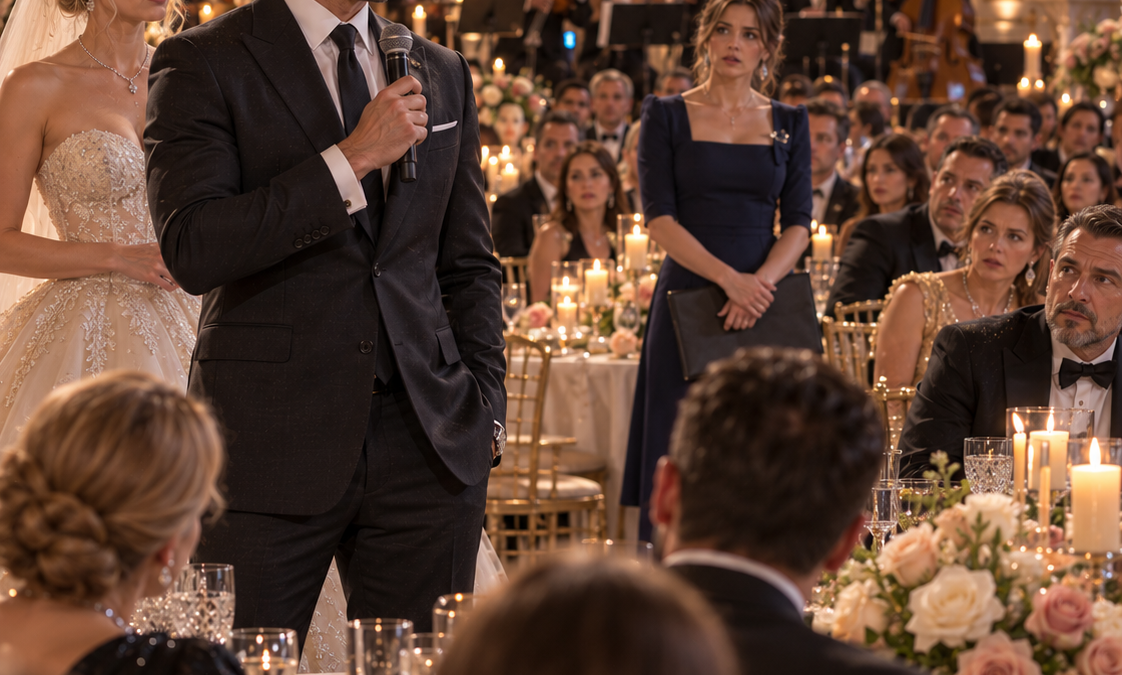
She began moving toward the center of the room. Not quickly, not in a way that would draw attention, but moving. Grayson picked up the microphone from the table.
Emma stopped walking. The orchestra had paused.
The audio technician, perhaps responding to some signal Emma hadn’t seen, had left the microphone active.
Grayson stood at the head table with the microphone in his hand, and 500 people gradually realizing that something was happening. The room quieted in stages.
the way a wave moves, the silence spreading from the head table outward until it reached the edges of the ballroom and 500 people were looking at the man who was supposed to be the groom and trying to understand what his expression meant.
Emma could not see Victoria’s face from where she was standing.
She could see Victoria’s shoulders, the line of her back, the way she was very still.
Grayson looked at the room. He looked at it the way a man looks at something when he has made a decision he cannot unmake and has accepted that fact completely. I need to say something, he said.
His voice through the sound system was clear and steady and Emma recognized the particular quality of it. This was not the boardroom voice, not the press conference voice. This was the voice from the kitchen at 11:00.
The voice from the hallway chair, the voice that said, “I told her the truth.
I’ve spent the last He paused.
not a rhetorical pause, the pause of a man locating the honest thing in real time.
The last 7 months building toward this night, and everyone in this room has been generous enough to come and celebrate it, and I’m aware that what I’m about to say is going to be difficult for a lot of people.
The silence was the kind that has physical weight.
I’m not able to do this, Grayson said.
Not because of anything Victoria has done wrong.
There is nothing she’s done wrong.
She’s Victoria is.
He looked toward her and his voice held something that was not love in the romantic sense, but was real and genuine and specific.
She’s one of the most capable and honest people I’ve known.
And she deserves someone who is standing up here tonight certain. Not someone who has been trying to manufacture certainty for months. Nobody in the ballroom moved.
Emma stood 12 ft from the edge of the head table and did not breathe.
I’ve been living a version of my life that made sense to everyone who was looking at it from the outside, Grayson said, including me for a while.
And I kept thinking I kept telling myself that the feeling would come that I just needed more time. He shook his head.
It’s not fair to Victoria and it’s not fair to any of you and it’s not it’s not who I want to be.
He set the microphones on the table and then Victoria stood up. Emma watched Victoria Langford rise from her chair at the head table with the composed precision of a woman who has been prepared for this moment longer than anyone in the room realized. She picked up the microphone that Grayson had set down.
She was beautiful and controlled, and the expression on her face was not the one that Emma had anticipated. It was not devastation.
It was not fury. It was something more complicated than either.
the expression of a person who has been carrying a heavy thing for a very long time and has finally put it down.
“I’ve known,” Victoria said.
The room, which had thought it had already reached maximum silence, found more.
“Not everything,” she said, “but enough.”
She looked at Grayson, and the look was direct and clear and without theater.
I think we’ve both known for a while that this was, she paused, finding words with the same careful process Emma had watched Grayson use.
This was a sensible arrangement between two people who respect each other and have been very careful not to say the thing that would mean actually changing our lives. A pause. I should have said it earlier.
I didn’t.
That’s on me, too.
She set the microphone down.
The room held the particular stunned silence of 500 people who have witnessed something they didn’t have a category for.
Not a scandal. Exactly.
Not a disaster. Something stranger and more honest than either. A wedding stopping itself.
Two people telling the truth in the same moment in front of everyone. Emma looked at the room. She looked at the roses and the candle light and the orchestra that had set down their boughs.
She looked at the table she had planned and the space she had built and the event that had arrived at a moment she could not have planned for and wouldn’t have known how to plan for.
She thought about what Victoria had said in that last phone call. Whatever happens, she had known.
The silence broke gradually in pieces. Guests turning to each other, the low murmur of people processing, the tentative sound of a room that is not sure whether to respond with discomfort or with something else. There was no screaming, no dramatic exit.
Grayson walked around the head table and he and Victoria had a brief, quiet conversation that lasted maybe 90 seconds, close enough that it was private despite the audience.
And when it was over, Victoria’s mother surged forward and Grayson stepped back and the room reorganized itself around the new shape of the evening.
Marcus appeared at Emma’s elbow.
“Tell me what to do,” he said.
He was 26 and professionally unflapable and right now his face was the face of a young man who was in territory. His training had not covered.
Nothing dramatic, Emma said. She kept her voice level.
The dinner service continues. The orchestra plays the dinner set as planned. We let the room find its own rhythm.
This is still an event with 500 people who have traveled here and are sitting in front of a first course. She looked at him.
Keep it moving quietly. No announcements. No acknowledgements.
Just let the evening continue in the most dignified way it can. Marcus nodded once with the decisiveness of someone who needed a clear instruction and received one. He moved.
Emma stood in the middle of the ballroom and looked at the room she had built. The orchestra began to play again.
The catering team continued the service with professional steadiness because they were experienced people who had seen disruptions and knew that the answer to disruption was always to keep moving. The guests settled in the gradual way guests settle into the altered evening. Small conversations, the particular sound of a room that is absorbed something unexpected and is choosing collectively to continue.
Grayson was at the far end of the room near the terrace doors alone for a moment. A thing that was brief because Marcus would be there shortly because people would approach because men in his position are rarely alone in rooms full of their own guests.
Emma watched him from across the ballroom. He was looking at his hands.
She crossed the room, not quickly, through the tables, around the guests, past the orchestra, along the edge of the space where the evening was still technically happening in the form of dinner and quiet conversation. She moved the way she moved through all events, deliberately, without performance. She reached him.
He looked up when she was close enough that looking up was the natural thing to do. They were standing near the terrace doors, slightly apart from the nearest guests, in the particular pocket of relative privacy that large rooms sometimes produce at their edges.
“You okay?”
she said.
He looked at her, and the expression on his face was not the one she’d seen at the head table or in the hallway or in the kitchen.
It was something older and quieter. the face of a man who has been holding something in his hands very carefully for a very long time and has finally set it down and is standing in the new lightness of that. Yeah, he said I think I actually am.
She looked at him. Is that is that wrong? He said to feel okay.
No, Emma said that’s not wrong.
Victoria is a strong person, Emma said. And you both said true things.
That’s not nothing.
He looked at the room at the 500 people who were eating dinner and talking in the altered geography of the evening. There are going to be consequences, he said. Yes, there are business consequences, family consequences.
Yes, the press is going to Yes. Emma said, all of that is going to happen. None of it is happening right now.
She looked at him. Right now there is a dinner service in progress and a room full of people who need this evening to end with some dignity.
That’s what’s happening right now.
He looked at her with the expression she had learned to recognize as him actually receiving what she was saying rather than filtering it through the layer of what he thought he should feel. Right? He said go talk to your guests, she said.
Be present. Let the evening be what it can still be. She paused.
And go check on your daughter. She came with Mrs.Alvarez.
She’s in the east anti room and she’s been asking about you since 7:00.
Something moved across his face. Something that broke through the composed steadiness and was just a father, just a man who has a six-year-old who was waiting for him. Yeah.
He said, “Yeah, okay.”
He took one step, then turned back.
He was looking at her in a way that said everything that wasn’t being said and had been not being said for weeks.
And Emma met it directly because she was not a person who looked away from things.
Emma, go see Lily,” she said.
He went. Emma turned back to the room.
The orchestra had moved to a softer selection, something instrumental and undemanding that gave the room permission to breathe. The catering team was executing the second course with the calm efficiency of professionals who had decided that the event was continuing and were behaving accordingly. The guests, for the most part, were doing what people do at social events when something unexpected has happened.
Talking more quietly, paying more attention to each other, the shared experience of the room binding them in a different way than a standard wedding reception would have. Emma walked the perimeter. She made two small adjustments.
A lighting cue that needed advancing, a catering captain who needed direction about the dessert timing. She spoke to Paul Reeves, who was managing the venue staff with the weathered professionalism of someone who has genuinely seen everything, and they made the decision together to extend the dinner service by 30 minutes and adjust the conclusion accordingly.
She did her job. At 9:15, when the dinner service was complete and the room had settled into the quiet conclusion of an evening that had become something none of them had planned, Emma stood near the main entrance with her clipboard and her earpiece and the specific stillness of a
person who has spent everything they had and is standing in the aftermath.
She had built this room. She had held it together through an evening that should have broken in 17 directions, and had instead found somehow a strange and quiet dignity. The roses were still extraordinary.
The light was still warm. The 500 people were still there, moving through the end of the evening with the careful thoughtfulness of people who had witnessed something real.
She was exhausted in a way that went deeper than the physical in the place where you feel things when you’ve used up the buffer that keeps feeling at a professional distance.
Marcus came to stand beside her. Mr.Hail is in the anti- room with Lily, he said. He asked me to tell you.
He paused with the slight hesitation of a man reporting something he was not sure fell within his job description.
He asked me to tell you that she’s okay and that he’s okay and a pause.
He said you’d understand.
Emma looked at the room for a moment, at the roses and the light and the evening she had built out of 22 days and a broken timeline and a billionaire’s kitchen and a six-year-old’s drawings and the particular kind of work that takes everything you have and gives you something real in return.
I do, she said. She put her clipboard under her arm and began the quiet work of ending the evening correctly. The morning after the wedding, the internet woke up before Grayson did.
By 6:00 a.m., three separate accounts had posted cell phone footage of the ballroom moment. Shaky, poorly lit, but clear enough to hear his voice through the sound system. By 7, the footage had been picked up by two entertainment news sites and a financial gossip column that normally covered hostile takeovers and earnings calls.
By 8, Hail Halt’s wedding was trending on two platforms, and Marcus had 37 missed calls on his work phone and was sitting in his apartment in Midtown, making a list of which ones required responses before noon.
Grayson found out the way he found out most things that happened outside his direct sphere of control, Marcus told him concisely and without editorializing at 8:15 when Grayson called from the West Village townhouse to check on the day’s situation.
How bad? Grayson said, manageable, Marcus said in the tone that meant significant but not catastrophic.
The coverage is a mix. The financial press is treating it as a business story. Questions about the Langford relationship, what it means for any cross institutional arrangements.
The entertainment side is running with the romance angle. Social media is a pause.
Various various. Some people are calling it honest. Some people are calling it a humiliation.
Some people are debating whether Victoria looked relieved, which Marcus stopped.
I’ll let you watch that discourse on your own time.
I won’t be watching it.
Correct decision. Grayson was standing in the kitchen. He had been standing in the kitchen for 20 minutes, holding coffee that had gone cold, looking at the morning light on the floor, in the way a person looks at things when they are trying to locate themselves in the landscape of a day that is unlike any previous day.
William Langford called.
Marcus said last night after midnight, he didn’t leave a message.
I’ll call him.
Your PR team wants a statement.
I’ll talk to them.
Your mother called. A pause.
I’ll call her.
And but this is the last one.
Your fund’s COO sent an email at 6 this morning.
The subject line is damage assessment.
I’ve forwarded it to you.
Grayson set the cold coffee down. Forward me everything that requires a direct response.
Handle the rest. Already started, Marcus.
Yeah, you’re good at this.
A brief silence. You pay me to be, Marcus said.
But thank you. Grayson hung up and stood in the kitchen a little longer. Lily was still asleep.
Mrs.Alvarez had brought her home from the venue at 9 the previous night, and Grayson had sat on the edge of her bed for a while after, watching her sleep with the particular intensity of a parent who needs to confirm the realness of something anchoring.
She had woken up briefly and looked at him and said with the direct simplicity of a child processing complex events through a child’s framework.
You didn’t get married.
No, he’d said, “Is that okay?”
“Yeah,” he’d said.
“It’s okay.”
She had looked at him for a moment with those serious eyes, evaluating the answer for honesty, and then she’d said, “Okay.”
And gone back to sleep. He had sat there for a long time.
He called William Langford at 9. The call lasted 4 minutes. William Langford was 63 years old and had built his financial institution through 30 years of cultivated relationships and precise management of reputation.
And he was in those four minutes as controlled and deliberate as a man could be while communicating that he was furious. My daughter, William said, handled herself with more grace than the situation required.
She did, Grayson said. Victoria was she was extraordinary.
Whatever I’ve cost her, she didn’t deserve it delivered the way it was delivered.
No, she didn’t.
I know that doesn’t fix anything.
No, it doesn’t.
A pause. I respect that you said it directly.
I don’t respect much else about last night, but I respect that.
Another pause.
We’ll let our respective teams handle the business implications.
I don’t anticipate any actions that benefit either of us from making this worse.
Agreed. The call ended with the particular civility of two men who have decided to manage their mutual damage with efficiency rather than emotion.
And Grayson sat with his phone in his hand and felt the weight of the 38-year-old mistakes he’d made landing in the account they’d been running toward for months.
He had expected to feel worse. He felt bad, genuinely bad, the specific guilt of a person who has hurt someone through his own cowardice and delay, who had let things run too long before being honest. He sat with that guilt and did not try to argue himself out of it because it was accurate and deserved.
But underneath it, quiet and sturdy like a loadbearing wall, was the other thing, the thing that had been there since he’d set down the microphone and said what was true, a kind of stillness he hadn’t felt in.
He couldn’t remember exactly
how long.
He called his PR team. He called his mother who was in Connecticut and who spoke to him for 40 minutes in the specific tone of a woman who is managing her own complicated feelings with great effort and is not entirely succeeding.
He returned three board member calls with the measured transparency that he’d built his professional reputation on.
He did not explain more than was necessary. He did not apologize for the fact of the decision, only for the timing and the method. At noon, he made himself eat something.
At one, Lily woke up and came downstairs and asked if they could go to the park, and he said yes because the park was real and the morning’s phone calls were real.
And sometimes the only answer is to put both of those things in the same day and let them coexist. They went to the park.
Lily ran. Grayson sat on a bench in the cold November air and watched her, and he thought about Emma. He had not called her.
He did not know exactly what calling her would mean or what the right moment for it was. He understood, had understood since the kitchen at 11:00, since the hallway, since every evening conversation that had stretched past its professional purpose, that whatever existed between them was real. He also understood that whatever was real between them needed space to become itself without being rushed, without being defined before it was ready to be defined, without being made into something compensatory or reflexive.
He was not.
He had decided somewhere in the early hours of the previous night going to reach for Emma Parker as a solution to the life he’d just undone.
That would be the wrong thing for both of them. But he was going to reach for her that he was certain of. He watched Lily on the climbing structure, all focused, determination, and small achievement.
And he let himself sit in the cold and the honesty and the particular feeling of a day that was hard in ways he’d chosen and right in ways he couldn’t fully explain.
Emma spent the morning after the wedding in her Brooklyn apartment with her phone turned face down on the kitchen table. She had turned it face down at 7:15 after checking her messages and finding three texts from colleagues who had seen the news.
Two emails from clients who wanted to discuss potential bookings and one voicemail from a reporter at a financial news outlet who had apparently found her name in the vendor documentation and wanted a comment on the Hail Langford wedding. She had deleted the voicemail, responded to the client emails with professional brevity, and put the phone face down.
She needed approximately 1 hour of not being reachable.
She sat at her kitchen table with actual coffee ground and brewed in the ceramic pot she’d bought at a Brooklyn market 3 years ago.
One of the few things she’d spent money on that wasn’t strictly necessary and had never regretted.
And she let herself sit in the morning. She thought about this ballroom.
She thought about Grayson’s voice through the sound system, steady and direct and saying the true thing in front of everyone.
She thought about Victoria standing up and saying, “I’ve known.”
And the room going so quiet you could have heard the roses breathing. She thought about what it must have taken.
What it costs to stand in front of 500 people and say, “I can’t.”
Even when it’s right, especially when it’s right.
She had done her job. She had built the room and managed the evening and held it together through an event that could have fallen into chaos and instead had ended somehow with a strange and unexpected dignity. She was proud of the work in the honest way she was proud of work that was hard and real.
