The CEO Invited Single Dad to Her Family Dinner… Then Told Her Parents, “He Will Be my Husband” – PART 2
PART 2
The patterns we fall into, the ways we self-limit. He looked at Vivian directly, now dropping the pretense of making conversation with the table.
You didn’t take Boston because something held you back.
And I think you know what it was.
I think you’ve known for 7 months.
Theodore.
Margaret’s voice had a warning in it, not much of one, but it was there.
But Vivian raised one hand just slightly, and her mother went quiet. Say it.
Vivian said to Theodore. Whatever you came here to say, stop decorating it.
Theodore set down his fork, and for the first time all evening, the performance dropped. Not completely, men like Theodore never dropped it completely, but enough that Ryan could see the real shape of what was underneath. Not malice, exactly.
Something more complicated and more human than malice.
A man who had loved someone, lost them in a way he still hadn’t processed and constructed a very elegant story in which the loss was her failure rather than his.
You turned down Boston, Theodore said, because you’re afraid.
You’ve always been afraid of the version of yourself that doesn’t need anyone’s approval to exist.
Boston would have been yours. Entirely yours. No family expectations.
No He gestured vaguely toward Ryan. No complications.
Just you and what you built, and whether it was enough. He paused.
And you couldn’t do it.
The table was a held breath. Ryan looked at Vivian. She was looking at Theodore, and her face was He searched for the word and found it unguarded.
Not wounded, not angry. Unguarded in the way that means someone has said something that touched something real, even if the interpretation was wrong, even if the intent was not kind. something true had been used as a weapon, and she was deciding whether to let it land or pick it up herself.
She picked it up.
“You’re right,” she said.
Theodore blinked.
He hadn’t expected agreement.
That was clear.
“I was afraid,” Vivian said.
“I’ve been afraid for 2 years.
Not of Boston, not of the job.”
She set her own fork down with the same quiet intention Ryan had used earlier.
“I was afraid because the last time I made a major decision about my life, I made it in a room where you were standing, and for 6 months afterward, I couldn’t figure out if I’d said no to your proposal because it was wrong or because I’d spent so long inside your version of who I should be that I didn’t trust my own judgment anymore.
No one at the table moved.
That’s what you did,” Vivian said, and her voice didn’t rise, didn’t crack, didn’t perform a single note of it.
“Not on purpose, maybe, but you did it.
You have a way of framing things, your observations, your insights about people that sounds like love but functions like erosion. You reduce people slowly, thoughtfully, and you call it knowing them.
” Theodore’s jaw tightened.
“And for 7 months,” she continued, “I let that erosion affect a decision that had nothing to do with you.
So, yes, I was afraid.
But I want to be very clear about what I was afraid of.”
She paused.
“I was afraid of still being the person you’d made me doubt I was.
And I think I’m starting to think that I’m not her anymore.
” The silence that followed was different from the silences that had come before.
The earlier ones had been taut, loaded, pointed. This one was open, like a window that had finally been raised in a room that had been sealed too long. Henry Shen, at the head of the table, set down his wine glass.
He looked at his daughter for a long moment.
Then he said to no one in particular in the measured tone of a man spending his words carefully, “I think that’s the clearest thing I’ve heard you say in about 2 years.”
Vivian looked at her father.
Something moved across her face, something Ryan recognized because he’d seen it in the hallway 2 days ago when she’d said three times, the look of a person who has been carrying something alone for so long that being heard feels almost unbearable.
Not bad unbearable. The other kind. Margaret said nothing.
Ryan glanced at her and found her looking at her plate, her expression unreadable, her hands very still around her wine glass. Not the stillness of composure, the stillness of a woman who has been confronted with something she needs time to process and is deciding in real time how to do that.
Theodore pushed his chair back slightly.
“I didn’t come here to m- I know why you came,” Vivian said.
“My mother called you.
You thought this was an opening.
You thought if you came back, if you framed it right, if you reminded me of all the ways I’ve been uncertain, I’d remember that you were certain enough for both of us.
” She looked at him steadily.
“That was never a relationship, Theodore.
That was management.”
He stood up. Not explosively, there was no scene, no raised voice.
Theodore Bain was too controlled for scenes.
He stood and he folded his napkin and he placed it beside his plate with the precision of a man who needs something to do with his hands and he said, “I think I should go.
” “I think so, too,” Vivian said.
He looked at Ryan one more time.
The look was complicated, not hostile, not defeated, but the look of a man who has encountered something he didn’t account for and is honest enough with himself, at the very least privately, to recognize it.
“She’s lucky.”
Theodore said.
It wasn’t sarcasm.
Ryan was almost certain it wasn’t sarcasm.
“Other way around.”
Ryan said.
Theodore picked up his jacket from the back of his chair, said goodbye to Henry briefly, to James, to Christine, to Margaret, who said his name softly like an apology she wasn’t sure how to form.
And then he walked through the living room and the front door closed behind him with a sound that was quieter than the whole evening had deserved. The dining room exhaled.
James was the first one to speak because James Ryan had figured out was the person in this family who specialized in breaking the tension that everyone else created.
“Well.”
he said in a tone that was dry and fond and a little bit helpless.
“That was a dinner.”
Christine made a sound that was almost a laugh. Then was actually a laugh. Then James was laughing too quietly and Ryan felt the absurdity of the whole evening rise in his chest like carbonation and had to press his lips together to keep it contained.
Vivian looked at him sideways. Her eyes were bright, not with tears, with something more complicated.
The look of a person who has just run a very long race and is only now registering the distance.
“Stop.”
she said quietly though her mouth was doing the thing.
“I didn’t say anything.”
“You were thinking very loudly.”
“I’m a quiet thinker.”
She pressed her lips together, looked away. Her shoulders dropped not in defeat, in release.
The first genuine unguarded release of tension he’d seen from her all day.
It lasted about 3 seconds before she reassembled herself, but he caught it and he thought that 3 seconds of real might be the most valuable thing that had happened at this table tonight. Margaret stood to clear the the Ryan stood to help her.
She looked at him, surprised he thought in the specific way of a woman who has spent an evening assessing someone and has arrived at a conclusion she didn’t expect to arrive at.
He picked up the serving dish. She picked up the tart plate.
They walked into the kitchen together and she set everything down on the counter and stood for a moment with her back to him and he thought she was going to say something about the logistics of the dishes.
Instead she said without turning around, “She didn’t tell me about Sophie.”
Ryan set the serving dish down carefully.
“No, she didn’t tell me about you either.
Not really.”
A pause.
“She told me she was bringing someone.
She said he was good.”
Margaret turned around then and her face was the face of a woman who has been performing composure for so long she’s forgotten what her real face feels like and is in this moment in this kitchen with a man she’s known for 4 hours getting a glimpse of it.
“I assumed good meant something specific, something that looked a particular way.”
“I know.”
Ryan said.
“She doesn’t bring people home.”
Margaret said, “In 34 years I can count on one hand the number of times she has brought someone into this house.”
She looked at him.
“I invited Theodore because I was afraid she was alone, because I was afraid she’d made a mistake 2 years ago and was too proud to fix it and that she was diminishing, that she was choosing a smaller life.
” “She’s not.”
Ryan said.
“No.”
Margaret’s voice was quieter now.
“No, she’s I see that.”
She was quiet for a moment.
“What she said at the table tonight about decisions, I’ve been She stopped, tried again.
“I think some of the pressure she felt about the decisions about Theodore, about Boston may have come from more places than just him.
Ryan didn’t fill the silence.
He just let it be there because some silences need room. I only ever wanted her not to be alone, Margaret said.
I don’t think I was careful enough about the difference between that and deciding for her what not alone should look like.
It was the most honest thing anyone in the Shen family had said all evening, and it was said in a kitchen over a serving dish to a man who was still technically a stranger. Ryan nodded. I think she knows that, he said.
I think she just needed to hear tonight that she can figure out what it looks like herself. Margaret looked at him for a long moment. Then she picked up a dish towel and handed him one, and they did the dishes in companionable silence.
And outside in the dining room, Ryan could hear Vivian talking to her father, really talking, not performing, not managing.
And her voice had a quality in it he’d never heard through their shared apartment wall.
It sounded like relief. It sounded like someone who had been holding her breath for 2 years and had finally, in the most chaotic and unlikely setting imaginable, decided to stop. He dried the serving dish and set it on the counter and listened to her talk, and the pull in his chest from earlier in the evening was back.
And this time, he didn’t try to categorize it or manage it or set it aside for later examination.
He just let it be what it was. And what it was, he was beginning to understand, was not something that had started tonight.
It had started on a Tuesday with a container of soup left at a door by a woman who had worked very hard to make sure he understood it wasn’t kindness.
He understood it now. He understood it completely. They said goodbye to the family just after 9:00.
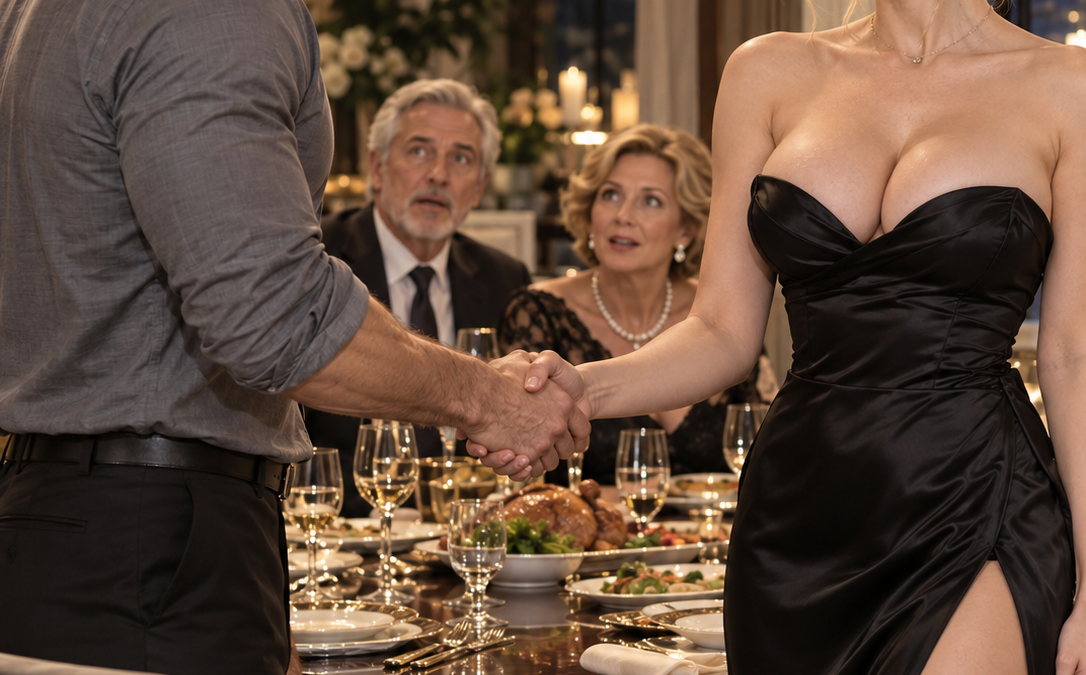
Henry shook Ryan’s hand at the door, a real handshake, not the ceremonial kind, the kind where the grip means something, and said simply, “Come back sometime.”
Not an obligation, not a pleasantry, just a door left open by a man who didn’t leave doors open unless he meant it.
Christine hugged Vivian and whispered something in her ear that made Vivian close her eyes for exactly 1 second. James clapped Ryan on the shoulder in the easy, uncomplicated way of a man who had decided he liked someone and saw no reason to make a production of it.
Margaret stood in the doorway and did something Ryan hadn’t seen her do once during the entire evening.
She reached out and tucked a piece of Vivian’s hair back the way mothers do when their children are small, the way they sometimes still do when their children are 34 and have just dismantled an entire evening’s worth of careful architecture with a few sentences at a dinner table.
Vivian let her. That Ryan thought was its own kind of breakthrough.
They walked to the car. The night had grown cold the way Chicago nights in early spring do, fast and without warning, like the city changes its mind between dinner and dessert.
Their footsteps on the driveway were the only sound. The porch light behind them went off.
The door closed.
And then it was just the two of them and the dark and the particular silence that exists between people who have been through something together and haven’t yet found the words for it.
Vivian stopped at the passenger side of the car.
She didn’t open the door.
She put both hands in her coat pockets and looked up at the sky for a moment, not dramatically, just the way a person does when they need somewhere to put their eyes while their thoughts catch up with them. Ryan stopped on his side and looked at her over the roof of the car.
“You okay?”
he asked.
“I don’t know yet,” she said.
“I think so.”
She paused.
“Ask me again in 20 minutes.”
He nodded. They got in.
She drove the first 10 minutes without speaking, and he didn’t fill it because he’d learned enough about Vivian Shen to know that her silences weren’t empty.
They were working silences. Processing silences. The kind that need to be left alone the way you leave dough alone to rise.
Interrupt them too early and you ruin the thing they’re becoming.
The city came back around them gradually. Streetlights, other cars, the sound of Chicago resuming itself after the suspended reality of the Shen family dining room.
Then Vivian said, “I didn’t tell you about Boston.”
“No.”
Ryan said.
“I didn’t tell anyone.
Not really.”
She kept her eyes on the road.
“I told my company I was declining for personal reasons.
I told my assistant to field the follow-up calls.
I told myself I’d revisit it when I felt clearer.”
She paused.
“I never felt clearer.
” “What was the real reason?”
Ryan asked.
“Not the Theodore version.
Yours.”
She was quiet for a moment. The traffic light ahead turned red and she stopped.
And in the red light her face was open, he thought again. Still unguarded.
The window that had been raised at the dinner table hadn’t closed yet.
“I was building something here.
” She said finally.
“In Chicago.
Something that was mine, not my family’s expectation of what mine should look like.
Not Theodore’s blueprint for what a woman with my ambitions should want.
Just mine.”
She looked at the light.
“And Boston was a bigger title and more money and a corner office with a view of the harbor and every person in my life said I’d be insane not to take it.
And I sat with the offer for 3 weeks and every morning I woke up and the first thing I felt was She stopped.
“What?”
Ryan said quietly.
“Grief.”
She said.
“I felt grief.
Before I even had coffee, before I’d done anything, just grief.
Like I’d already lost something.”
The light turned green. She drove.
“So I said no.
And then I spent 7 months telling myself I’d made the wrong decision because everyone else seemed so certain I had.
And then Theodore showed up at my parents’ dinner table and she exhaled.
“And I realized that the grief wasn’t about Boston.
It was about almost letting other people’s certainty replace my own again.
” Ryan looked at her profile in the passing streetlights.
The clean line of her jaw, the way she held the steering wheel, not tight, not loose, just in control.
“What are you building?”
he asked.
“Here.
The thing that made you stay.”
She glanced at him. A real glance, the quick sideways kind that carries more than a long look sometimes does.
“I don’t entirely know yet,” she said.
“But I know it’s here.
And I know it matters.”
A beat.
“I know that sounds vague.”
“It doesn’t,” he said.
“It sounds like someone who knows what they’re protecting, even when they don’t have the full picture yet.”
She said nothing for a moment.
Then, “You’re very easy to talk to.
” “You say that like it surprises you.”
“It does.”
“A little.”
She changed lanes smoothly.
“Most people I find manageable.
I can read them fast.
I know what they want, what they’re performing, what’s underneath the performance.
You’re She paused.
“You’re the same all the way down.
I’ve been trying to find the layer underneath the layer, and it’s just more of the same thing.
Is that good or bad?”
“It’s disorienting,” she said honestly.
“For me, specifically, it’s disorienting.”
Ryan turned that over quietly. Outside the window, the city moved past a late-night diner with yellow light in its windows.
A man walking a dog, a couple standing outside a bar sharing one umbrella against the cold.
“Can I ask you something?”
he said.
“You’ve been asking me things all evening.”
“One more.”
“Go ahead.
When you introduced me tonight at the door.”
He chose his words.
“Your mother said friend.
You said boyfriend before she even finished the word.”
He paused.
“That wasn’t hesitation.
That was you’d already decided.
” Vivian’s hands shifted on the steering wheel, just slightly.
“Yes.”
she said.
“Before we walked in.”
“Before we walked in.”
“So the parking lot.”
Ryan said.
“Whatever happens in there, you love me.
That wasn’t just for the performance.”
The silence that followed was the longest one of the night. They were 12 blocks from home.

