Single Dad Pulled the CEO From a Cliffside Wreck—Then She Saw His Name and Froze (Part 1)
Single Dad Pulled the CEO From a Cliffside Wreck—Then She Saw His Name and Froze (Part 1)
PART 1
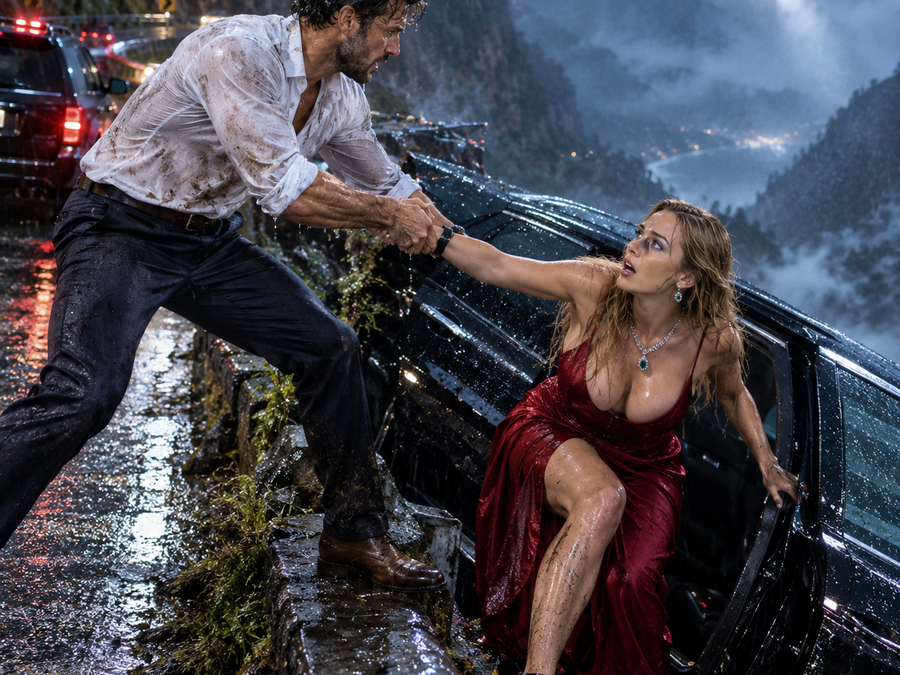
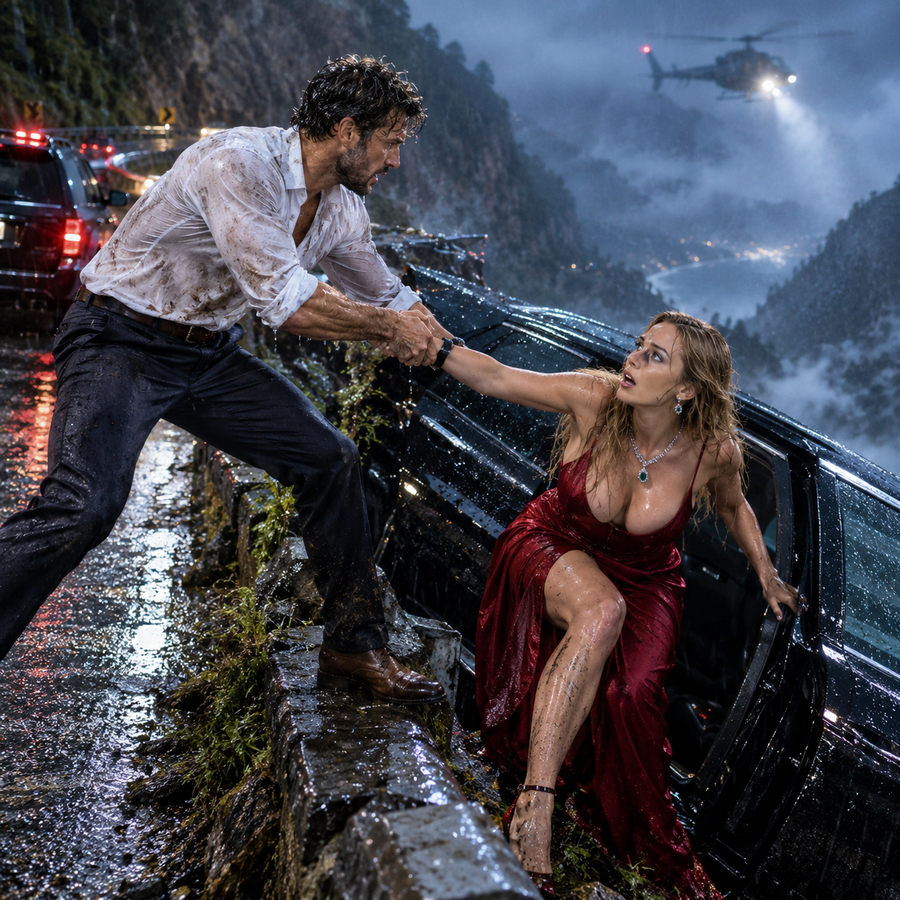
Mason Cole shoved his bare hand through a shattered window, grabbed a bleeding stranger by the collar, and dragged her out of a car that was seconds from disappearing off a cliff while a dozen other people stood on the road and watched. He didn’t know her name. He didn’t ask, but when she finally looked at the rescue report from her hospital bed and saw his name, her face went white as a sheet because 15 years ago, her family had destroyed that man’s entire life.
The storm had been building since noon. By the time Mason Cole was 40 minutes outside of Pine Hollow, it had turned into something ugly. Not the romantic kind of ugly that people in cities think about when they imagine mountain weather, a soft mist and moody skies. This was the other kind. The kind that made experienced drivers grip their steering wheels with both hands and stop talking.
The kind that turned a perfectly maintained mountain road into a wet ribbon of black ice stretching over a gorge that dropped 400 feet straight down to a river that in October ran fast and cold and merciless. Mason had driven this stretch of Route 26 more times than he could count. He knew where the guardrails were weak. He knew which bends collected black ice. He knew the exact spot where during a storm like this one, a cell signal disappeared for 11 consecutive miles.
He was thinking about his daughter when he came around the bend. Emma was 12. She had a science project due Friday that she hadn’t started yet. She’d asked him that morning with the specific tone she used when she already knew the answer was going to be complicated, whether he could help her build a working water filtration model. He’d said yes before she finished the sentence.
He always said yes, not because he was trying to win a father of the year competition, but because Emma was the single most important thing in his life and he hadn’t figured out yet how to say that out loud without sounding like a greeting card. So he said yes to the water filtration project instead. He was running the math on when they could start it tonight after dinner, maybe if the drive home wasn’t too bad, when his headlights swept across the scene ahead and his foot hit the brake before his brain had fully processed what his eyes were seeing.
The luxury SUV was halfway through the guardrail, not resting against it, through it. The driver’s side front panel had punched clean through a section of railing that was already compromised, corroded bolts, bent metal, the kind of maintenance failure that state inspectors kept putting on a list that never quite reached the top of the priority pile. The impact had pushed the vehicle forward and left it perched at a diagonal, front end hanging over nothing, rear wheels still barely touching asphalt. Four hundred feet below, the Deschutes River waited.
Mason counted four other vehicles stopped on the road. Maybe five. People were out of their cars, standing in the rain, holding phones up. A woman in a yellow rain jacket was talking rapidly. Dispatcher, probably calling it in. Two men in their 30s stood at the edge of the road shoulder, looking at the SUV, then at each other, then at their shoes. Nobody was moving toward the car.
Mason put his truck in park. He opened the door into the storm and didn’t think about what he was doing in the way people think about things when they have time to talk themselves out of them. He thought about it the way an electrician thinks about a live wire. You identify the problem. You assess the variables, and then you move, because standing still is also a choice and sometimes it’s the most dangerous one.
The SUV shifted just slightly, maybe two inches forward, front end dropping a fraction as weight and gravity and wet pavement began the slow negotiation that would end one way if someone intervened and another way if they didn’t. Mason was already moving to the bed of his truck. “Hey.” One of the men on the road shoulder said it like a question. “Hey man, what are you doing?” “Getting rope,” Mason said.
“The 911 operator said to stay back.” “Then stay back.” Mason pulled a coil of climbing rope from behind his toolbox. He kept it there for winter recoveries. He’d pulled three other vehicles out of ditches in the past two years, though never anything like this. He grabbed a tow strap next, heavy-duty, rated for 12,000 pounds, which was more than twice what he needed, but he wasn’t in the mood to do the weight calculations precisely. He looped both over his shoulder.
“You’re going to get yourself killed,” the man said. Mason looked at him. Not angry, not dramatic, just direct. “The car’s about to go over,” he said. “There’s someone inside it.” Then he walked to the edge of the road. The hillside below the broken guardrail wasn’t a clean cliff. The first 30 feet was a slope, steep, slicked with rain, covered in loose gravel, and a few scrubby pine saplings that might or might not hold weight.
The saplings were what he was thinking about. He anchored the tow strap around the base of the nearest one, not big enough on its own, so he linked it around a second, then attached the climbing rope to the strap and let the rope fall down the slope alongside the dangling front end of the SUV. Then he got down on his belly in the mud and rain and started moving toward the car.
It took 90 seconds to reach the driver’s door. Later, in the highway patrol report, the timeline would make it seem quick. It wasn’t quick. It was 90 seconds of moving his weight carefully, testing each handhold and foothold before committing, feeling the hillside shift under him twice in ways that made something cold move through his chest that wasn’t the rain. The SUV moved again when he was eight feet away, a slow, grinding lurch forward that sent a cascade of loose gravel over the edge and into the 400 feet of nothing below. He kept moving.
When he reached the driver’s door and pressed his face against the glass, what he found was not what he’d expected. He’d expected panic, screaming, someone clawing at the windows. Instead, he found a woman sitting perfectly still. One hand pressed to a cut above her left temple that was bleeding steadily into her hairline. The other hand gripping the center console like it was the only fixed point in a shifting universe. Her eyes were open, alert. She was breathing.
She was also very clearly the kind of person who was accustomed to being the most in-control person in any given room, even when the room was a car hanging over a gorge. She turned her head slowly and looked at him through the glass. He saw her lips move. He couldn’t hear her over the storm and the rain hammering the roof of the vehicle. He pressed his palm flat against the window. He spoke loudly enough to carry through the glass. “I’m going to get you out.”
Her lips moved again. This time he could read them more clearly. “Emergency services are—” “I know,” he said. “But your car isn’t waiting for them.” She stared at him. He pulled the window punch from his jacket pocket. He carried it for the same reason he carried the rope. Because there are people who drive mountain roads, and there are people who are prepared to drive mountain roads. And Mason had learned the difference between those two things in a way that had cost him more than he’d ever willingly describe.
He struck the corner of the window. The glass shattered inward. “Cover your face,” he said, though she’d already turned away. He reached through the broken window and found the door handle locked. He found the manual lock pin and pulled it. The door opened outward but immediately caught on a crumpled section of the guardrail debris, pinned at about 40 degrees, not enough to get her through. “I need you to slide toward me,” he said. “Can you move?”
“My left shoulder,” her voice was steady, steadier than he would have expected. Steadier, honestly, than his own pulse. “I think it’s dislocated.” “Okay. Can you unbuckle your seat belt with your right hand?” She tried. Her face changed when she reached across. Something flickered there, behind those carefully composed eyes. Pain. But her right hand found the buckle release. “I’ve got you,” Mason said. “Let the belt go.”
She released the buckle. The SUV lurched. This time it wasn’t two inches. It was six. The front end dropped with a sound like stressed metal giving a final warning. And Mason felt the slope shift under his own weight and grabbed the door frame with both hands and held. Not elegantly, not particularly heroically, just with the specific kind of grip that comes from knowing that letting go was not an option he was willing to consider.
“Now,” he said. Not a suggestion. She moved, left arm pulled tight against her body, protecting the dislocated shoulder. She turned herself sideways in the seat and let him take hold of her right arm at the wrist. And he pulled carefully at first, then harder as the car shifted again. And then she was through the door opening, and they were both on the slope, pressed against the wet hillside, one of his arms around her waist, and both of their weights pulling against the rope that was anchored to the saplings 20 feet above them.
The SUV moved. Not gradually this time. It went over the edge with a sound Mason would remember for a long time. A sliding metallic shriek followed by a deep crash that echoed off the gorge walls far below and then was swallowed by the rain for a moment. Neither of them spoke. Then the woman said quietly, “You could have waited.” “I wasn’t going to wait,” Mason said. “Everyone else did.” “I know.”
She turned her head and looked at him. There was blood on her temple and mud on her suit jacket, and her hair was plastered flat by the rain. She looked like someone who had just watched her very expensive vehicle fall 400 feet into a river gorge. She also looked somehow like someone who was already organizing this experience into a series of manageable facts that could be addressed in proper sequence. “You’re going to need to help me up the slope,” she said. “I’m not confident about the shoulder.” “Yeah,” Mason said. “I figured.”
Getting back up took four minutes. He went first, pulling her up step by step, his boots fighting for purchase on the slope, while she climbed with one arm and more controlled determination than most people would have managed on a flat surface with both arms working. She didn’t complain. She didn’t explain. She simply moved upward because that was what needed to happen. When they reached the road, the woman in the yellow rain jacket stopped talking into her phone and stared. The two men who’d watched from the shoulder stared. Everyone stared.
Mason guided the woman to the road shoulder and helped her sit on the tailgate of his truck. “The emergency response team is eight minutes out,” the woman in the yellow jacket said, somewhat unnecessarily. “Good,” Mason said. The woman on his tailgate looked up at him. “You have blood on your hands.” Mason looked down. She was right. He’d caught a jagged edge of the broken window glass at some point during the extraction. Not deep cuts. He hadn’t noticed. “You’re the one who hit your head,” he said.
“Occupational hazard,” she said. There was something in her voice when she said it. Dry. Precise. The edge of someone who deflected things with wit because the alternative was feeling them fully. “I’m in a line of work with fairly frequent head impacts.” “What line of work is that?” She looked at him steadily. “Construction. Infrastructure. Capital projects.”
Something in her expression suggested that this was a statement she normally delivered with a different kind of weight to it, like it came with context or reputation or a particular response. He didn’t give her that response, not because he was being deliberately different, but because he genuinely didn’t know who she was. “Well,” he said, “you picked a bad road for tonight.” “Apparently,” she said.
When the highway patrol arrived, Mason gave his name and a brief account of what had happened. He declined to give a statement to the two camera crews that had arrived. By then, he hadn’t known there were cameras until a trooper warned him. He returned the climbing rope to his truck. He gave the patrol officer the details about the weakened guardrail section, the corroded bolts, the deferred maintenance, because someone needed to flag it formally, and he had 30 years of experience noticing when metal was holding on by less than it should be.
Then he asked if they needed anything else. They didn’t. He got in his truck. He drove home. Emma was asleep when he got there. He stood in the doorway of her room for a moment longer than he needed to. Then he went to the bathroom, cleaned the cuts on his hands, and went to bed. He did not think about the woman’s face when she’d looked at him on the tailgate.
He did not think about the way she’d said “occupational hazard” like she was testing a phrase to see if it would hold. He did not think about the brief pause before she’d told him her line of work, the way it seemed to cost her something, small but real, to answer a direct question without leading with a title. He thought about Emma’s water filtration project. He was asleep in 12 minutes.
Forty miles away in a private room at the Providence Center in Portland, a woman named Clare Davenport was not sleeping. She had a mild concussion, a confirmed dislocated shoulder that had been reduced in the emergency room, a procedure she had undergone with the same tight-jawed composure she brought to difficult board meetings, and 17 text messages from her executive assistant. Four from board members, two from her corporate communications director, and one from her father. She hadn’t answered any of them.
The television in the corner of her room was running a local news segment. She’d left it on because the silence in a hospital room at two in the morning has a quality that she found less tolerable than noise. A reporter she didn’t recognize was describing the accident. Dramatic rescue. Lucky to be alive. Standard packaging for the kind of story that runs in the B-block and gets shared 600 times on social media by morning.
Clare watched it without really watching it. What she was doing primarily was reading the highway initial report on her phone. Her communications director had obtained a copy within the hour. That was part of what her director was paid for, knowing what existed in writing before it reached anyone else. Clare had read the summary twice. Now she was reading the detailed section. Location, time, responding units, civilian involvement.
She scrolled to the line that listed the name of the civilian rescuer. Cole, Mason, R.H., 38. Contractor, Mason Cole Electrical and Mechanical Services, Pine Hollow. She read it twice. Then a third time. Her thumb didn’t move on the screen. The television kept talking. The reporter was saying something about the extraordinary bravery of an ordinary man. The phrase delivered with the specific warm gravity that local news uses for human interest segments.
And Clare was not listening to any of it because somewhere in the part of her mind that never fully stopped working, that never cross-referenced and filed things away with the relentless efficiency of someone who had spent a decade running a company that her father had spent three decades building, something had just made a connection. Mason Cole. She knew that name. Not from tonight. Not from this moment. Not from the man who had put his hand through her window and dragged her out of a car that fell four seconds later. She knew it from a file.
A specific file. One she had reviewed once, briefly, nearly eight years ago, when her father had been explaining to her, carefully, thoroughly, with the patient deliberateness of a man who understood that his daughter was both brilliant and at that point still knew enough to the company to be idealistic, why certain personnel decisions required more than just the standard documentation. Why some situations handled incorrectly could threaten not just a project but an entire company’s future.
The case had been an engineer. Young, talented by some accounts. A structural specialist who had raised concerns about materials on a major project, the Redwood Pass Viaduct, one of the company’s largest mountain infrastructure contracts, the kind of project that anchored a decade of growth and secured relationships with state transportation agencies that were still valuable today. The concerns had been investigated, her father had explained. Found to be without merit.
The engineer had, under scrutiny, turned out to be someone who had manipulated testing data, possibly to create leverage, possibly simply to cover his own mistakes. The disciplinary case had been thorough. The termination had been necessary. Her father had shown her the summary. She remembered the name at the top. Cole. Mason.
She set the phone face down on the hospital bed. She looked at the ceiling. There was a sound in her chest that she didn’t have a name for. Not quite guilt. She hadn’t done anything eight years ago except listen to her father explain a personnel decision and nod with the careful neutrality of someone who trusted the person giving it. Not quite fear. Not quite the specific familiar anger she felt when she discovered that something in her company’s operations was not what it had been presented to her as being. Something older than any of those things. Something that had to do with the specific discomfort of realizing that the story you have been given about the world may have been written by someone with reasons you didn’t know about.
The man who had smashed her window and dragged her off a cliffside had a name. She had seen that name before. And everything she had been told about that name, about the person attached to it, about his character, his honesty, the reasons his career had ended the way it did, had been told to her by the same man whose signature appeared on 30 years of company contracts. Her father.
She lay in the hospital bed and she did not sleep, and she thought about the specific way Mason Cole had looked at her on the tailgate of his truck. Not like a man trying to impress her. Not like a man trying to make her feel indebted to him. Not like a man who expected something in return. He’d looked at her the way someone looks at a problem they’ve solved and are already moving past. He had saved her life and driven home. And she had his name in a personnel file that said he was the kind of man who didn’t deserve to be trusted.
She picked up her phone. She opened a different application. The one she used for confidential research, not the company account, not the system her communications team monitored. Her personal account. The one she paid for separately. She typed his name into the search field. Mason Cole, structural engineer, Oregon. She read for a long time.
What she found was thin. Not in the way that absence of information is sometimes a clean answer. Thin in the way that means someone has been systematically removed from a narrative. A few engineering association records showing a license that had been suspended and then not renewed. A brief mention in a regional construction trade publication from 15 years ago. Personnel changes at Redwood Pass Viaduct contract. Nothing else professional.
On the personal side, a business registration for Mason Cole Electrical and Mechanical, filed 11 years ago in Pine Hollow County. A property tax record for a residential address. No social media, no professional profile, nothing that suggested a man who was trying to tell his side of a story. Just a man who had apparently stopped talking and started fixing electrical systems in mountain lodges. She closed the app. She looked at the television where the reporter had moved on to something else.
She thought about the water that the car must have hit 400 feet below. She thought about the eight minutes emergency services had needed to arrive. She thought about the sound the guardrail had made when Mason’s boots found purchase on the slope above her window. Then she thought about her father’s face. The specific expression he wore when he was explaining something that he had already decided was fully resolved. And she made a decision. Not about what the truth was. She didn’t know that yet. But about what she intended to find out.
Three days after her discharge from Providence, Clare Davenport drove herself to Pine Hollow in a rental car. She did not bring her assistant. She did not tell her communications director. She told her executive security team that she was spending the week at her property in the coast range for recovery, which was partially true in the sense that Pine Hollow was in a mountain range and the drive there involved a coast-adjacent route. And she turned off the company location sharing on her phone.
She found Mason Cole’s business address in the county business registry. It was listed as a maintenance facility on the eastern edge of town, which turned out to be a converted equipment storage building set back from the main road, partly obscured by a stand of Douglas firs. There was a white service truck parked outside and the sound of something mechanical being worked on from within. She sat in the rental car for approximately 45 seconds. Then she got out and walked to the open bay door.
He was under the raised hood of a commercial generator unit, doing something to the wiring harness that required a headlamp and both hands. He didn’t hear her approach, or if he did, he didn’t react. He looked exactly like what he was. A working man in worn work clothes. Competent and present. And entirely uninterested in being observed.
“Mr. Cole,” she said. He straightened, took off the headlamp, looked at her. His expression was careful in a way that told her he had recognized her before she’d finished saying his name. “Ms. Davenport,” he said. She hadn’t told him her name at the accident scene. She was certain of that. “You know who I am,” she said. “I read the news,” he said. “The rescue made the local stations.”
“But you didn’t give a statement.” “I gave the highway patrol everything they needed.” “My communications team called the station three times looking for contact information for you.” “I know,” he said. “I didn’t call back.” He set the headlamp on the workbench beside him. He wasn’t hostile. He wasn’t nervous. He was the same way he’d been on the slope. Assessing the situation, deciding what it required, conserving effort.
“I’m not here about the accident,” she said. “I know that, too,” he said. She let a moment pass. “I’ve been looking at some company records,” she said. “Records that go back 15 years. To the Redwood Pass project.” Something shifted in his face. Not visible to most people, she suspected. Most people would have missed it completely. But she’d spent 15 years watching the faces of men who were deciding how much to show and how much to hold. And she caught it. A brief tightening around the eyes. The specific expression of someone who had waited a long time for something and wasn’t sure whether to believe it had arrived.
“What about it?” he said. “There’s a file on you,” she said. “A disciplinary file. It says you falsified structural testing data on the viaduct project.” “I know what it says. I’d like to know what you say.” He looked at her for a long moment. Then he turned and picked up a shop rag and wiped his hands with the methodical focus of someone who needed a moment before speaking.
“You want to know what I say?” he repeated. “Yes. You’re the CEO of Davenport Infrastructure.” “Yes.” “Which means you’ve had access to that file or a version of it for years.” “I reviewed a summary,” she said carefully. “Eight years ago, when I was first coming into the company.” “Who gave it to you?” She didn’t answer immediately. She didn’t need to. He could read the pause. “Right,” he said quietly.
“Mr. Cole, your father destroyed my career,” he said. It wasn’t an accusation. It was delivered with the same flat precision he’d used to tell her the car wasn’t waiting for emergency services. A statement of observed fact. “He had the original laboratory report removed. He authorized the contractor to proceed with the substitute materials. He had his legal team put together a record that made me look like a troubled employee who fabricated concerns about a project he couldn’t deliver on. And then he moved on.”
He folded the shop rag carefully and set it down. “I spent the next three years trying to get someone to listen. Engineers, state agencies, journalists once. Nobody wanted to challenge a project that was already standing and already signed off and already part of your father’s public record of success.” Clare stood very still.
“So,” he said, “you’re asking me what I say. I say the file is a story your family paid to preserve. I say the original anchor-bolt analysis showed internal cracking risk from the substitute steel that was used. I say that crack is still developing inside those anchorage chambers. Slowly. The way material defects develop in mountain conditions. Freeze cycles, road salt, seasonal moisture. And I say that 15 years of standing isn’t the same as 15 years of safe.”
He picked up the headlamp again. “That’s what I say,” he said. “I imagine it’s not what you expected.” “I don’t know what I expected,” she said. Honestly. “Then you’re ahead of most people who come out here looking for a simple answer.”
She let the silence sit for a moment. “The original anchor-bolt report,” she said. “The one that disappeared. What about it?” “You said disappeared. Not lost. Not misfiled.” His expression didn’t change, but something in his eyes did. A brief adjustment. Like a man who has learned not to react visibly when something important happens, because he’s been disappointed too many times to let the reaction show before he’s sure. “Ask your father,” he said quietly. “Why it disappeared.”
She held his gaze. “I intend to,” she said. She turned to leave. She was at the bay door when he spoke again. “Miss Davenport.” She stopped. “I don’t know what you’re planning,” he said. “I don’t know whether this is a conversation you’re going to have with your legal team before you finish driving home. I don’t know whether that gets quietly updated and this visit never happened.” He paused.
“But I want you to understand something. The bridge isn’t personal to me anymore. I stopped making it personal a long time ago, because personal didn’t help anyone. Those anchor chambers haven’t been properly examined in 11 years. People drive that road every day. Families, truckers, kids in school buses.” Another pause. “That part has nothing to do with what your father did to me.”
She turned back and looked at him. “I know,” she said. Then she walked out to the rental car and she drove back toward Portland, and she was on the phone with the most quietly independent structural engineering firm she knew before she’d cleared the Pine Hollow County line.
There was one thing she hadn’t told him. When she’d reviewed that summary file eight years ago, sitting across from her father in his corner office on the 14th floor of the Davenport building, while he explained carefully and patiently why the Mason Cole situation had required the response it did, she had asked one question. “Is this what you’d want someone to do with one of our people if the situation were reversed?”
Her father had looked at her with the particular combination of pride and mild disappointment that she had spent her entire adult life trying to sort out, as if she were simultaneously more than he expected and not quite enough of what the situation required. “This is business, Clare,” he’d said. “In business, the question isn’t always what’s fair to one person. The question is what protects the most people.”
She had nodded. She had accepted it. She had not thought about Mason Cole again for eight years, until the night he climbed down a rain-slick cliffside toward a car that was about to disappear, toward her specifically, though he didn’t know who she was, and put his hand through the window glass without hesitation, without calculation, without asking a single question about who was worth saving.
She drove through the mountains in the dark and she thought about what it meant to protect the most people. And she thought about her father’s signature on a piece of paper that should have stopped a bridge from being built the way it was built. And she thought about a 12-year-old girl whose father had driven home in a storm and gone to bed without telling anyone what he’d done. And she thought, when you have the power to decide what gets protected, the people who suffer for that decision rarely get to sit in the room where the decision was made.
Mason Cole had never sat in that room, and he told the truth anyway. And she had driven 40 miles into the mountains to find out why that bothered her. She thought she was beginning to understand.
The independent engineering firm Clare hired was called Meridian Structural Consulting. She had used them twice before, once for a third-party review on a bridge expansion in Eastern Washington, once for an arbitration case involving a collapsed retaining wall in Sacramento. They were not the largest firm in the Pacific Northwest. They were the most stubborn.
Their lead engineer, a 61-year-old woman named Dr. Patricia Okafor, had a reputation in the industry for writing reports that said exactly what the data showed and absolutely nothing else. Regardless of who was paying. Clare had called her from the car on the drive back from Pine Hollow. She’d given Okafor the location, the structure type, and three words of context: independent, confidential, urgent.
Okafor had asked one question. “Who else knows you’re doing this?” “Nobody yet,” Clare said. “Good,” Okafor said. “Keep it that way until I’ve seen the anchor chambers.”
That had been four days ago. Now, Clare was sitting in her office on the 14th floor of the Davenport building, looking at a set of preliminary photographs that Okafor’s team had taken during their initial access inspection, and she was having a very specific physical sensation she hadn’t felt in years. The kind that lives in the sternum. Not quite nausea. Not quite fear. The thing underneath both of those. The sensation of knowing, before the data is fully assembled, that the data is going to say something you cannot walk back from.
Her phone rang. It was her executive assistant, Daniel, calling from outside the closed office door. “Dr. Okafor is online too,” he said through the intercom. “She says it’s not a social call.” “Put her through,” Clare said. Okafor’s voice came on without preamble. “I need to show you something in person. Not over the phone. Not by email. In person.” “When?” “Today. Preferably now.”
Clare looked at her afternoon calendar. Board preparation meeting at three. Quarterly earnings call at five. Dinner with the governor’s infrastructure liaison at 7:30. “I’ll move things,” she said. “Where?” “Our office,” Okafor said. “And bring someone who can read a structural diagram.” Clare paused. “I know someone.” “Bring them,” Okafor said, and ended the call.
Clare sat with the dead phone in her hand for a moment. Then she picked it up again and dialed a number she had added to her contacts four days ago and not yet used. It rang three times. “Cole,” he answered. Just the one word, the way contractors answer when they’re in the middle of something. “It’s Clare Davenport,” she said. “I need you to come to Portland.” A beat of silence. “When?” “This afternoon.”
Another beat. Longer. “I’m in the middle of a job,” he said. “I know. I’m asking anyway.” She could hear him thinking. Not hesitating. There was a difference. And she was beginning to understand the specific quality of Mason Cole’s silences. He wasn’t the kind of man who hesitated. He was the kind who made decisions quickly and quietly without announcing the process. “What did they find?” he asked.
“I’d rather you see it in person.” “Clare.” It was the first time he’d used her first name. It landed differently than she expected. Not familiar, exactly. More like a precision tool using exactly the right word for the situation. “What did they find?” She looked at the photographs on her desk. “Cracks,” she said.
The silence that followed was not the decision-making kind. It was the kind that comes after something has been confirmed that a person spent 15 years knowing was true and hoping they were wrong about. “I’ll be there at two,” he said.
He was there at 1:45. Okafor’s office occupied half a floor of a converted brick building in the Pearl District. Her conference room had exposed beams and three whiteboards covered in notation that Clare couldn’t fully parse, and Mason walked into immediately, standing in front of them with his hands at his sides, reading without touching for almost 90 seconds before he turned around.
“You found the eastern anchorage,” he said to Okafor. Okafor looked at him with the specific expression of one engineer recognizing another. “Anchor clusters seven through twelve,” she said. “You know the location.” “I mapped it 15 years ago,” he said. “During the original inspection. Those clusters carry 40% of the primary load distribution on the eastern span.” “Forty-two,” Okafor said, with the slight correction of someone who has just finished measuring the same thing. “I want to show you the core samples.”
What followed was 40 minutes that Clare spent primarily watching two engineers talk in a language she understood at about 70%. Enough to follow the shape of it. Not enough to argue with any of it. Okafor laid out the core samples, the instrument readings, the photographic sequence. Mason asked questions in a flat, focused way, occasionally pointing at a specific data point and asking her to confirm a number. Okafor confirmed. He asked. She confirmed again.
At one point, Clare said, “Tell me what I’m looking at.” Mason picked up one of the core sample photographs and held it so she could see it clearly. “This is internal cracking in the anchor-bolt steel,” he said. “You can’t see it from the surface. You can’t see it from a standard bridge inspection. You can only find it if you go into the anchorage chambers and take core samples from the bolt assemblies themselves.” He set the photograph down. “The cracking follows the exact pattern I predicted when I flagged the substitute steel 15 years ago.”
“The chemistry of the cheaper alloy under repeated freeze-thaw cycling, combined with road salt penetration, causes hydrogen embrittlement in the bolt structure. It develops slowly. Fifteen years is actually faster than I modeled. I thought we’d have twenty.” The room was quiet. “What does that mean practically?” Clare said. Okafor answered. “It means the current safety margin on the eastern anchor clusters is measurably below what the original design specification required. The bridge is not at acute failure risk under normal load. But one severe seismic event, one major overload incident, one bad winter that exceeds the stress modeling—any of those scenarios becomes significantly more dangerous than it should be.” She paused. “The eastern span carries an average of 9,000 vehicles per day.”
Nine thousand vehicles. Clare sat back. “This needs to go to the state,” she said. “Yes,” Okafor said immediately. “That would be my recommendation.” Clare looked at Mason. He was looking at the whiteboard again. His expression was unreadable in the specific way of someone who has organized their face carefully because the alternative is something they don’t want to do in public. “You already knew,” she said. Not a question. “I knew what the steel would do,” he said. “I didn’t know how far along it would be.” He paused. “It’s worse than the middle scenario. Better than the worst one.”
“How long?” she said. “Before it becomes critical.” Okafor and Mason looked at each other. The kind of look between two people who have just reached the same conclusion from different directions. “Two winters,” Mason said. “Maybe three if this one is mild. After that, the cracking propagates into the primary load path, and you’re in a different category of risk.” Two winters. The bridge had been standing for 15 years. It had been driven across approximately 49 million times, by Clare’s rough calculation using Okafor’s daily traffic figures. Forty-nine million crossings. While a structural defect that a 28-year-old engineer had identified and been destroyed for identifying had been quietly developing in the dark.
She stood up. “I need to talk to my father before this goes to the state,” she said. “I want him to hear it from me first.” Mason said nothing. But the quality of his silence said something. The specific neutrality of a man who had learned, at considerable personal cost, not to trust the instinct that tells you to give powerful people warning before consequences arrive. “I know what you’re thinking,” she said. “I’m not thinking anything,” he said. “You’re thinking I’m about to give him time to get ahead of it.” He looked at her steadily. “Are you?” She held his gaze. “No,” she said. She believed it when she said it. She was still mostly right.
Richard Davenport answered the phone on the second ring, which told her he’d been expecting her call. Her father always answered on the second ring when he knew what was coming. Not the first, which would have suggested anxiety. Not the third, which would have suggested avoidance. The second ring was a performance of composure so practiced it had become its own kind of reflex.
“Clare,” he said. Warm. Measured. The voice he used in board meetings when someone raised an inconvenient point. The voice designed to make the other person feel heard while simultaneously making them feel like they had perhaps not thought things through as completely as he had. “I hired Meridian to inspect the Redwood Pass anchor,” she said. A pause. Very brief. Almost imperceptible. “That’s a significant undertaking,” he said. “What prompted that?”
“I think you know. The cracks are there, Dad.” She didn’t raise her voice. There was no version of this conversation that would be improved by raising her voice. “Exactly where Mason Cole said they’d be 15 years ago. Eastern anchor clusters seven through twelve. Hydrogen embrittlement in the bolt steel. Exactly the failure pattern he predicted from the substitute alloy.” Another pause. Longer this time. “The bridge has been standing for 15 years,” he said. “I know. It’s carried millions of vehicles.” “I know that too.” “Whatever that man told you—” “He didn’t tell me anything that the core samples didn’t already show,” she said. “This isn’t about what Mason Cole told me, Dad. This is about what Meridian’s instruments measured.”
The silence that followed had a different quality than the previous ones. Less controlled. She could hear him thinking. Not the quick executive kind of thinking she’d grown up watching him do at dinner tables and conference calls, but something slower. The kind of thinking that happens when a structure you’ve spent 15 years standing on begins to show its first real crack.
“What do you intend to do?” he said finally. “Notify the state transportation authority. Begin emergency reinforcement procurement. And open the original disciplinary record on Mason Cole.” “Clare.” His voice sharpened just slightly. The warmth remained, but something underneath it changed. “Think about what you’re proposing.” “I have,” she said. “For about four days.” “One engineer’s preliminary readings—” “Patricia Okafor’s preliminary readings,” she said, “with core sample documentation, in a conference room with a witness who has 17 years of structural engineering experience and predicted this failure mode from first principles before the bridge was even finished.” She paused. “I’m not having a conversation about the quality of the evidence, Dad. I’m telling you what I’m going to do.”
A very long silence. “If you do this,” he said, and his voice had shifted again, lower now, and she recognized this version too, from the three or four times in her adult life when she’d seen him genuinely concerned, “you will cause significant damage to the company. To investors. To the people whose jobs depend on this company’s reputation.” “I know.” “And to our family.” She closed her eyes briefly. “I know that, too,” she said. “Then I’m asking you,” he said, and the warmth had returned, heavier now, weighted with something she recognized as the specific kind of emotional leverage that only parents can deploy. Not manipulation exactly, or not just manipulation, but something more complicated. The accumulated weight of love and expectation and shared history applied at a pressure point. “To think about this carefully before you act. Give me the weekend. Let me get our legal team to review the findings. Let’s handle this properly.”
She sat with the phone against her ear and the core sample photographs spread across the conference room table in front of her and thought about the specific word he had used. Properly. She thought about the way Mason Cole had picked up that photograph and held it so she could see what she was looking at. No performance in it. No management. Just here is the thing. Here is what it means. Here is the consequence. She thought about 9,000 vehicles a day.
“I’ll come to the house tomorrow morning,” she said. “We’ll talk in person. But I’m filing the preliminary notification with ODOT on Monday, regardless of how that conversation goes.” Another silence. “Fine,” her father said. Quiet. Contained. “Come in the morning.” She ended the call and stood for a moment with the phone in her hand. Then she looked up and found Mason Cole watching her from across the table.
“You heard that,” she said. “Enough of it.” “And?” He was quiet for a moment. “Then you should have filed Monday without the conversation.” “He’s my father.” “I know.” He said it without judgment. “That’s why you should have filed Monday without the conversation.” She didn’t have an answer for that. She put the phone in her pocket and started gathering the photographs into the folder Okafor had prepared.
“I’ll drive back tonight,” Mason said. “Emma’s got school tomorrow.” “How old is she?” Clare said. She hadn’t meant to ask it. It came out of the place where questions live before they’re fully decided. He looked faintly surprised. Not by the question exactly. But by the timing of it. The way it arrived in the middle of something heavy. “Twelve,” he said. “Does she know what happened on the road that night?” “She knows I helped someone.” He picked up his jacket from the back of the chair. “She asked if the person was okay. I told her yes.” “Did she ask anything else?” He paused at the door. “She asked if I was scared.” “What did you tell her?” He pulled the door open. “I told her the truth,” he said. And then he left.
She stood in the conference room for a moment alone with Okafor’s whiteboards and the core samples and the photographs. And the thing she hadn’t asked, which was, “What did you tell her the truth was?” She gathered the folder and followed him out.
That evening in her apartment in the West Hills, Clare went through the company’s archived records with the kind of focus that she usually reserved for the 48 hours before a major acquisition close. Not through the standard database. Through the physical archive storage system, the one that housed the pre-digitization records from the company’s first 30 years of operation. Her access credentials worked. She was CEO. Her credentials worked everywhere.
She found the Redwood Pass project file. She found the contractor approval documents, the materials substitution request, the change order that authorized the switch from the specified high-strength bolt steel to the substitute alloy. At the bottom of the change order, in the signature block where a project executive had to authorize any structural materials substitution over a certain threshold, she found her father’s signature. Dated three days after Mason Cole had submitted his structural concern report to the project engineering team. She photographed it with her personal phone.
Then she kept looking. The original independent laboratory analysis, the one Mason had told her to ask about, was not in the file. There was a reference number, a document identifier from the external testing company, but the document itself was absent. In its place was a brief internal memo dated two weeks after the change order, summarizing the laboratory findings in three sentences. The summary described no structural concerns. It was signed by a project manager who had retired six years ago. The original was gone.
She sat on the floor of the physical archive room, which was actually just the basement of the Davenport building, a room that smelled like old paper and the specific staleness of facts that nobody has disturbed in a long time. And she looked at the reference number for a document that no longer existed. Then she thought about something Mason had said in Pine Hollow. “I spent three years trying to get someone to listen. Nobody wanted to challenge a project that was already standing.” She’d heard that as a statement about his experience, about the walls he’d run into. Now she was beginning to understand it differently.
Those walls hadn’t been passive. They hadn’t been bureaucratic inertia or institutional resistance or the ordinary grinding friction of a large organization that didn’t like to be told it was wrong. Those walls had been built, document by document, signature by signature, replaced report by replaced report. Someone had worked to make sure that if Mason Cole ever came back, if anyone ever came back, the trail would lead nowhere worth following.
She photographed the reference number and the absence of the document it described. Then she photographed the internal memo. Then she stood up, brushed the dust from her slacks, and went upstairs to her office, where she kept the bottle of scotch that her COO had given her when the last major merger closed. She poured two fingers and sat in her chair and looked out at the city and drank it slowly and thought about the fact that she had spent 15 years building on a foundation that someone else had quietly compromised and called solid.
Her phone buzzed. A message from a number she didn’t recognize. She almost didn’t open it. She opened it. “This is Walter Hayes. I worked as a lab tech for Pacific West Testing in 2009. I think you know what I have. I’ve been watching the news. If you’re actually going to do something about it, I need to talk to you.”
She stared at the message for a long time. Then she forwarded it to Mason with no additional text. His reply came back in under two minutes. “I know who Walter is. Let me reach out to him first.” She wrote back. “Why you?” The reply took longer this time. Almost five minutes. She imagined him sitting somewhere in the truck, maybe pulled over on Route 26 somewhere in the dark between Portland and Pine Hollow, deciding what to say.
Then: “Because he’s scared and he needs to hear from someone who already lost everything and is still standing before he’ll believe it’s worth the risk.” She set the phone face down on the desk. She looked at the scotch. She thought about the word everything and what it actually meant when applied to a specific human life. Not abstractly. Not in the way executives used words like sacrifice and difficult decision and the greater good. The actual concrete, specific weight of it.
A career gone. A marriage that couldn’t survive the financial and emotional pressure of a man fighting a wall that wouldn’t move. A daughter who grew up watching her father repair electrical systems in mountain lodges instead of building the bridges he’d been trained to build. And that man, that specific man, had still driven home through a storm and gone to sleep thinking about a science project. She picked the phone back up. She wrote, “Tell Walter whatever he needs to hear. And Mason, thank you.” This time the reply was immediate. “Don’t thank me yet.”
The morning drive to her father’s house in Lake Oswego took 40 minutes in light Saturday traffic. Clare had made the drive hundreds of times. The house was a mid-century modern set back from the water, large but not ostentatious, the kind of place that communicated wealth through restraint. Her father had always understood that the loudest statement of power was not needing to make one.
He met her at the door. He looked exactly like himself, which was, she had come to understand, one of his most effective characteristics. Richard Davenport at 72 looked like a man of 72 who had made decisions and lived with a clean conscience. Straight-backed, clear-eyed. The silver hair and the warm handshake and the measured voice that had reassured investors and regulators and journalists and his own daughter for decades. “Come in,” he said. “Coffee?” “No,” she said. He read the word correctly.
He led her to the study. Not the kitchen, not the informal sitting room where they normally had family conversations. The study, with its desk and its bookshelves and its specific atmosphere of considered authority. She put the folder on his desk. “The change order,” she said. “Your signature. Three days after Mason Cole’s structural concern report was submitted.” He looked at the folder without opening it. “And the document reference number for the Pacific West Lab analysis,” she said, “with the document itself missing from the file.”
He sat down. Not hurried. The measured, deliberate movement of a man who had decided in advance how he intended to conduct this conversation. “Clare,” he said. “I’m not asking you to explain the engineering,” she said. “I’m asking you one question. When you signed the change order, did you know Mason Cole’s concern was legitimate?”
He looked at his desk. Then at the window. Then back at her. “It wasn’t that simple,” he said. “I know it wasn’t simple. I’m asking if you knew.” He folded his hands on the desk. The gesture of a man organizing himself to say something he has been preparing to say for a long time. Possibly for 15 years. Waiting for the conversation that would eventually require it.
