Part 3: “Because I wanted to hurt you. Because I could.”
PART 6 — THE SISTER
Bend, Oregon, sits in the high desert east of the Cascades.
It’s a small town. Maybe a hundred thousand people. Pine trees, volcanic rock, a river that runs through the middle of everything. The kind of place people move to when they want to disappear.
I flew into Redmond at noon. I rented a car. I drove the twenty minutes into Bend.
The bookstore was on a side street off the main drag. It was called The Bookmark. Small. Independent. A bell above the door that rang when I walked in.
A woman was behind the counter. She was in her late thirties, with dark hair pulled back and glasses. She was reading a paperback. She looked up when I walked in.
“Can I help you?”
“Sarah Vance?”
Her face changed. Just a flicker. Then it was neutral again.
“Who’s asking?”
“My name is Daniel Kessler. I’m a former Navy SEAL. I’m here about your brother.”
She set the book down. She didn’t say anything.
“I’m not with the government,” I said. “I’m not with the Navy. I’m just a man who’s trying to find the truth.”
“About what?”
“About Victor Lang. About Meridian Solutions. About what happened to Peter.”
She stared at me for a long moment. Then she walked to the front door and flipped the sign to CLOSED.
“Come in the back,” she said. “We can talk.”
The back room was small. A desk, two chairs, a coffee maker. Sarah poured us both a cup. She didn’t sit down. She leaned against the desk and looked at me.
“How do you know about Peter?” she asked.
“I was at a court-martial six years ago. Your brother was there with Victor Lang. I didn’t know who he was then. I didn’t know what he was doing.”
“And now?”
“Now I know Lang was using him. Now I know Lang had him killed.”
Her face didn’t change. She’d known. She’d known for two years.
“I went to the police,” she said. “I told them it wasn’t an accident. They said there was no evidence. They said Peter fell asleep at the wheel.”
“What do you think happened?”
“I think Lang killed him. I think Lang killed a lot of people.”
I set my coffee down. “Do you have proof?”
She looked at me. “What kind of proof?”
“Anything. Emails. Documents. A journal. Something that can connect Lang to your brother.”
She was quiet for a moment. Then she walked to the desk and opened a drawer. She pulled out a manila envelope.
“Peter sent me this two weeks before he died,” she said. “He said if anything happened to him, I should open it. He said it would explain everything.”
She handed me the envelope.
I opened it. Inside was a USB drive and a letter.
I read the letter first.
It was handwritten. Four pages. Dated March 12, 2019.
Peter Vance had written a full confession.
He’d worked for Meridian for four years. He’d been a logistics coordinator. He’d arranged travel, equipment, and supplies for Lang’s private operations.
He’d also kept records.
He’d documented every shipment. Every payment. Every person who’d come through the pipeline. He’d documented the candidates who’d disappeared. He’d documented the deaths.
He’d documented everything.
“I couldn’t stop it,” he wrote. “I tried. I went to my supervisor. I went to HR. They told me to forget what I’d seen. They told me it was above my pay grade. They told me if I kept asking questions, I’d be the next one to disappear.”
He’d stopped asking questions. He’d kept his head down. He’d done his job.
But he’d also copied everything. Every file. Every record. He’d put it all on a USB drive. He’d sent it to his sister.
“If something happens to me,” he wrote, “give this to someone who can do something. Someone who isn’t afraid of Lang. Someone who will tell the truth.”
I looked at Sarah. She was watching me.
“Have you read this?” I asked.
“I’ve read it a hundred times.”
“And the USB?”
“I’ve looked at it. It’s encrypted. I couldn’t open it.”
I held up the drive. “Do you mind if I take this?”
She looked at me. At the drive. At the letter.
“You’re going to do something with it?”
“I’m going to give it to the FBI. They’re building a case against Lang. This is the proof they need.”
She nodded slowly. Then she said, “Promise me something.”
“What?”
“Promise me you’ll make sure everyone knows what happened. Not just the FBI. Not just the courts. Everyone. Peter didn’t die for nothing. He died because he tried to do the right thing.”
I looked at her. At the woman who’d spent two years waiting for someone to tell her the truth.
“I promise,” I said.
I called Reyes from the car.
“Kessler. Where are you?”
“Bend, Oregon. I have something.”
“What?”
“Peter Vance sent his sister a USB drive before he died. It’s got everything. Shipments. Payments. Names. Dates. The whole pipeline.”
Silence. Then: “Are you serious?”
“I’m looking at it right now.”
“Can you open it?”
“Not yet. It’s encrypted. But I’m bringing it back.”
“Don’t bring it back. Send it to us. We’ll have our people decrypt it.”
“I’m not sending it. I’m bringing it. I want to see Lang’s face when he finds out.”
“Kessler—”
“Reyes, this is the proof you’ve been waiting for. This is the thing that puts him away. I’m not letting it out of my sight.”
She was quiet for a moment. Then: “Okay. But be careful. If Lang finds out you have it—”
“He won’t.”
“You don’t know that.”
“I know I’m not going to let him stop me.”
I hung up.
I flew back to Norfolk the next morning.
Tom picked me up at the airport. He looked at the envelope in my hand.
“That it?”
“Yeah.”
“You open it?”
“Not yet. I wanted to wait.”
We drove to the NCIS office. Reyes and Webb were waiting.
I handed them the envelope. Webb took it. He opened it. He looked at the USB drive.
“We’ll need a couple hours,” he said.
“I’ll wait.”
I waited in the conference room for three hours.
Reyes brought me coffee. Webb came in and out. The door was closed. I couldn’t hear anything.
At noon, Webb came back. He was holding a printout.
“We got it,” he said.
He spread the papers on the table.
Names. Dates. Locations. Payments. Everything.
There were thirty-seven names on the list. Candidates who’d been recruited. Candidates who’d disappeared. Candidates who were dead.
At the bottom of the list was a name I recognized.
Alan Pierce.
“Pierce was on the payroll,” Webb said. “He wasn’t just a liaison. He was a recruiter. He found candidates for Lang. He sent them to the pipeline.”
I stared at the paper. At the name. At the proof.
“So that’s why he called my father,” I said. “That’s why he lied. He wasn’t just doing Cole a favor. He was protecting himself.”
“Exactly. If you started asking questions about the memorial, you might start asking questions about him. And if you started asking questions about him—”
“You’d find out about Lang.”
Webb nodded. “This is it. This is what we need.”
I looked at the papers. At the names. At the dead.
“What happens now?”
“We take this to the U.S. Attorney. We get an arrest warrant. We pick up Lang and Pierce and everyone else involved.”
“How long?”
“A week. Maybe two. We have to be careful. Lang has friends. If he finds out we’re moving, he’ll run.”
“He won’t run. He’s too arrogant. He thinks he’s untouchable.”
“Then we’ll prove him wrong.”
I went home that night.
Elena was waiting. She’d been waiting for three days, ever since I’d left for Oregon. She’d been worried. She’d been scared. But she hadn’t tried to stop me.
“Did you find what you were looking for?” she asked.
“I found it.”
She looked at me. At the envelope in my hand. At the look on my face.
“Then it’s almost over?”
“It’s almost over.”
She took my hand. She led me to the couch. We sat down together.
“Tell me,” she said.
So I told her.
I told her about Sarah Vance. About Peter. About the USB drive. About the names on the list.
I told her about Lang and Pierce and the pipeline.
I told her about the fact that it was almost over.
When I was done, she was quiet for a long time.
“You’re going to testify,” she said.
“Yes.”
“You’re going to put yourself in the middle of this.”
“Yes.”
“You’re going to make enemies.”
“I already have enemies.”
She looked at me. At the man who’d spent twenty-four years doing dangerous things.
“I’m proud of you,” she said.
I looked at her. “Why?”
“Because you didn’t walk away. Because you didn’t let them win. Because you’re still the man I married.”
I didn’t know what to say. So I just held her.
The arrest came two weeks later.
I was at home when Reyes called.
“We got him.”
“Lang?”
“Lang. Pierce. Cole. Everyone.”
I closed my eyes. “Where?”
“Lang was at his office in Coronado. Pierce was at the base. Cole was at his house in San Diego.”
“How did it go?”
“Clean. No shots fired. Lang tried to run. He didn’t get far.”
I opened my eyes. “What happens now?”
“Arraignment. Then trial. Then—”
“Then?”
“Then he goes away for a long time.”
I sat down. I felt something I hadn’t felt in years. Relief.
“Kessler,” Reyes said. “You did this. You and Sarah Vance. You gave us what we needed.”
“I just did what I had to do.”
“I know. That’s what makes it matter.”
I hung up. I looked out the window. At the sky. At the trees.
It was over.
But it wasn’t over.
Two days later, I got a call from the U.S. Attorney’s office. They wanted me to testify. They wanted me to tell my story in front of a grand jury.
I said yes.
A week later, I was in a courtroom in San Diego. I was sitting in a witness box. I was looking at a room full of lawyers and reporters and people I didn’t know.
And I was telling the truth.
I told them about the memorial. About my father. About the stone carver. About the fact that my name wasn’t on the wall.
I told them about Cole. About the review board. About the fact that he’d spent six years hating me.
I told them about Lang. About the business card. About the man with the briefcase.
I told them about Peter Vance. About the USB drive. About the names on the list.
I told them everything.
When I was done, the prosecutor asked me one last question.
“Master Chief Kessler,” he said, “why are you here?”
I looked at him. At the courtroom. At the people watching.
“I’m here because someone tried to erase me,” I said. “They tried to erase my name. They tried to erase my service. They tried to erase the truth.”
I paused.
“I’m here because I’m not going to let them.”
The trial lasted three months.
Lang was convicted on seventeen counts. Fraud. Bribery. Human trafficking. Conspiracy to commit murder.
He was sentenced to forty years in federal prison.
Pierce was convicted on eight counts. He got fifteen years.
Cole was convicted on three counts. He got five years.
It was over.
But the story didn’t end there.
A week after the trial ended, I got a letter.
It was from my father.
It was handwritten. Two pages. The first thing he’d written me in years.
“I watched the trial,” he wrote. “I watched you testify. I watched you tell the truth. I watched you stand up for the men who couldn’t stand up for themselves.”
He wrote about the memorial. About the wall. About the fact that my name wasn’t on it.
“I made a mistake,” he wrote. “I listened to the wrong person. I let someone else tell me who you were. I let someone else tell me what your service meant.”
He wrote about the Silver Star. About the mission. About the men I’d saved.
“I didn’t know,” he wrote. “I didn’t know any of it. And that’s my fault. I should have asked. I should have listened. I should have been your father.”
He wrote about the wall. About the fact that it was still missing my name.
“I’m going to fix it,” he wrote. “I’m going to call the stone carver. I’m going to have your name put where it belongs. And I’m going to stand there when it happens. I’m going to be proud of you. I’m going to tell everyone.”
He wrote about my mother. About my siblings. About the fact that they’d all watched the trial. About the fact that they’d all seen the truth.
“I’m sorry,” he wrote. “I’m sorry for all of it. I’m sorry for the years I wasted. I’m sorry for the things I said. I’m sorry for the wall.”
He signed it: “Your father.”
I read it three times. Then I folded it and put it in my pocket.
I didn’t know what to feel. I didn’t know if I forgave him. I didn’t know if I ever would.
But I knew one thing.
He was trying.
And that was enough.
PART 7 — THE REDEDICATION
The ceremony was scheduled for the second Saturday in June.
My father called me three weeks before. He didn’t ask me to come. He just told me the date and the time and said he hoped I would be there.
I didn’t answer right away. I sat with it for a few days. I talked to Elena. I talked to Tom. I even called Mike Cordell, who told me I was an idiot if I didn’t go.
“He’s trying,” Mike said. “That’s more than most people get.”
“I know.”
“So what’s the problem?”
I didn’t have an answer. Or maybe I did, and I didn’t want to say it.
The problem was that I’d spent twenty years being invisible to my father. And now, suddenly, he wanted to see me. He wanted to make amends. He wanted to put my name on a wall.
But the wall was never the point. The wall was just the thing that finally made it visible.
“The problem,” I told Mike, “is that I don’t know if I can trust it.”
“Trust what?”
“That he means it. That he’s not just doing this because he got caught. Because someone told him the truth and he couldn’t ignore it anymore.”
Mike was quiet for a moment. Then he said, “Does it matter?”
“What?”
“Does it matter why he’s doing it? He’s doing it. That’s what counts.”
I thought about that for a long time.
I flew to Ohio the day before the ceremony.
Elena came with me. She said she wasn’t going to let me do this alone. I didn’t argue.
We stayed at a hotel in town. Not my parents’ house. I wasn’t ready for that.
The morning of the ceremony, I woke up at 5 a.m. I couldn’t sleep. I lay in bed and stared at the ceiling and thought about all the ways this could go wrong.
What if he didn’t do it? What if he changed his mind again?
What if I got there and my name still wasn’t on the wall?
Elena stirred beside me. She reached over and put her hand on my chest.
“Stop,” she said.
“Stop what?”
“Thinking.”
I looked at her. At the woman who knew me better than anyone.
“What if—”
“No,” she said. “No what-ifs. Whatever happens, we handle it. Together.”
I nodded. I didn’t trust myself to speak.
We got to Harlow Park at 9:30.
The park looked different than it had in October. The trees were full. The grass was green. Kids were playing on the swings. A few people were already gathered near the wall.
I saw my mother first. She was standing near the front, in a blue dress and a white hat. She saw me and her hand went to her mouth.
She walked toward me. She didn’t say anything. She just wrapped her arms around me and held on.
“I’m sorry,” she said. “I’m so sorry.”
I held her. I didn’t say anything. I didn’t know what to say.
She pulled back. She looked at my face. At the scar above my eyebrow. At the lines around my eyes.
“You look tired,” she said.
“I’ve been busy.”
“I know.” She touched my cheek. “We watched the trial. All of us. Every day.”
I nodded. I’d known they were watching. I’d seen them in the gallery.
“Your father hasn’t slept in weeks,” she said. “He’s been working on this. He wanted it to be perfect.”
I looked past her. At the wall. At the people gathered around it.
“Where is he?”
“Over there. Talking to the stone carver.”
I saw him. He was standing near the wall, next to Warren Pace. The stone carver was pointing at something. My father was nodding.
He looked older than he had in October. Thinner. His shoulders were stooped. He looked like a man who’d been carrying something heavy for a long time.
I walked toward him.
He saw me coming.
He straightened up. He didn’t smile. He didn’t say anything. He just waited.
I stopped a few feet away.
“Dad.”
“Daniel.”
We stood there. Neither of us moved. Neither of us spoke.
Warren Pace looked at us. Then he cleared his throat.
“I’ll give you two a minute,” he said. And he walked away.
My father looked at me. His eyes were wet.
“I wasn’t sure you’d come,” he said.
“I wasn’t sure either.”
He nodded. He looked at the wall. At the space where my name was supposed to be.
“It’s done,” he said. “I had Warren cut it last week. It’s ready.”
I looked at the wall. At the new letters. At the name.
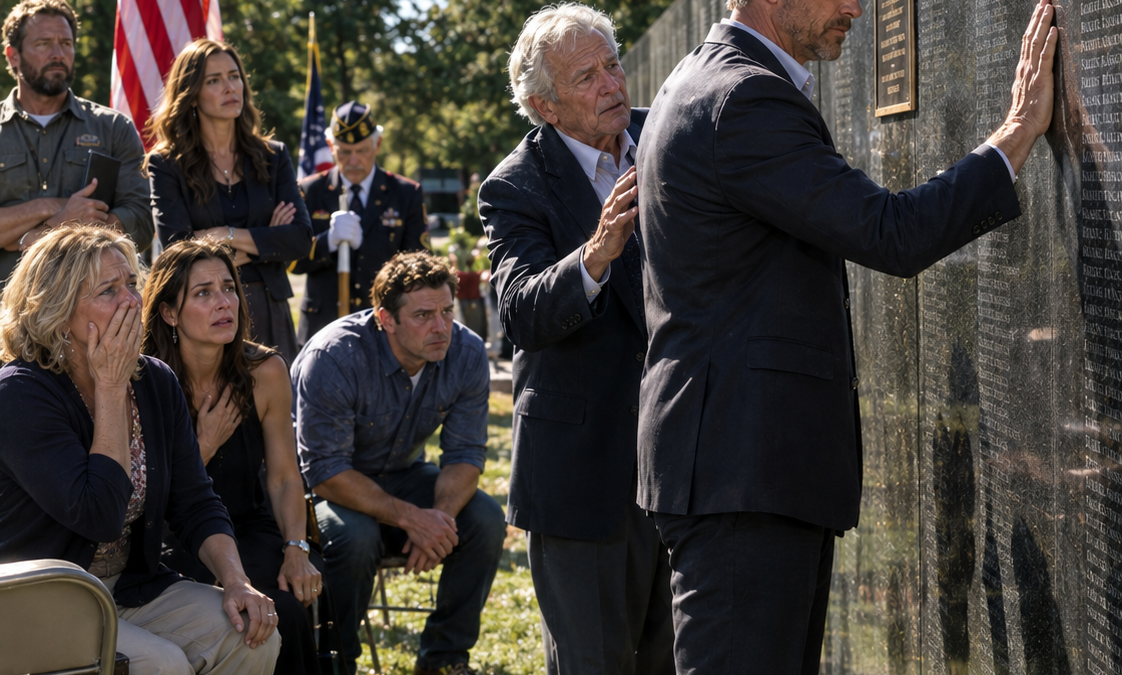
DANIEL R. KESSLER. U.S. NAVY SEAL. 1994–2018.
I stared at it. At the letters. At the stone.
It was real.
“I added the Silver Star,” my father said. “I hope that’s okay.”
I didn’t say anything. I just looked at it.
“I know you never told anyone,” he said. “I know you didn’t want people to know. But I thought—I thought it deserved to be there. It deserved to be seen.”
I turned to him. He was watching me. Waiting.
“Why?” I asked.
“Why what?”
“Why now? Why after all these years?”
He was quiet for a moment. Then he said, “Because I was wrong.”
“About what?”
“About everything.” He looked at the wall. At the names. At the empty space that wasn’t empty anymore. “I thought I knew who you were. I thought I knew what your service meant. I thought—I thought you were running away from this family. From me.”
He paused.
“But you weren’t running. You were serving. You were doing something I couldn’t do. Something I didn’t understand.”
He looked at me.
“I’m sorry, Daniel. I’m sorry for the things I said. I’m sorry for the wall. I’m sorry for all of it.”
I looked at him. At the man who’d spent my whole life pushing me away. At the man who was finally, after everything, trying to make it right.
“I don’t know if I can forgive you,” I said.
He nodded. “I know.”
“I don’t know if I ever will.”
“I know that too.”
He looked at the wall. At my name.
“But I wanted you to know that I see you now,” he said. “I see what you did. I see what you sacrificed. And I’m proud of you.”
I felt something break inside me. Something I’d been holding onto for twenty years.
“I’m proud of you,” he said again.
I didn’t say anything. I couldn’t. I just stood there and looked at the wall and let the words settle.
The ceremony started at 10.
The mayor spoke. The senator spoke. The VFW commander spoke.
Then my father walked to the podium.
He looked out at the crowd. At the people who’d come. At the family. At me.
“I built this wall,” he said, “to honor the men and women in my family who served this country. I wanted it to be a testament to their sacrifice. I wanted it to be a reminder of what they gave.”
He paused.
“But I made a mistake. I left someone off. Someone who deserved to be here. Someone who served with honor and courage and distinction.”
He looked at me.
“My son.”
The crowd was silent.
“I left his name off this wall because I didn’t understand him,” my father said. “I didn’t understand what he’d done. I didn’t understand what he’d sacrificed. I listened to the wrong people. I believed the wrong things.”
He paused again.
“But I know now. I know what he did. I know what he gave. And I know that I was wrong.”
He stepped away from the podium. He walked to the wall. He put his hand on the stone.
“Daniel Kessler,” he said. “Navy SEAL. Silver Star recipient. Purple Heart recipient. My son.”
He turned to me.
“Come here.”
I walked to the wall. I stood next to my father. I looked at the name. At the letters. At the stone.
“I’m sorry,” he said again. “I’m sorry it took me so long.”
I didn’t say anything. I just stood there.
Then I did something I hadn’t done in years.
I put my arm around him.
The ceremony ended at noon. People came up to me afterward. They shook my hand. They thanked me for my service. They told me they’d watched the trial. They told me they were sorry for what I’d been through.
I didn’t know what to say to any of it. So I just nodded and said thank you.
My mother found me near the wall. She was crying. She didn’t say anything. She just held me.
My sister Karen came up. She looked nervous. Like she was waiting for me to yell at her.
“I’m sorry,” she said. “I should have said something. When Dad took your name off—”
“It’s okay.”
“It’s not okay. It was never okay.”
I looked at her. At the sister who’d always been afraid to stand up to our father.
“It’s okay now,” I said.
She nodded. She hugged me. Then she walked away.
My brother Michael came up. He didn’t say anything. He just shook my hand and nodded. It was the most words he’d ever said to me without talking about business.
I took it.
Elena found me sitting on a bench near the wall.
She sat down next to me. She didn’t say anything. She just took my hand.
“How are you?” she asked.
“I don’t know.”
“That’s okay.”
I looked at the wall. At the names. At my name.
“I never thought I’d see it,” I said.
“See what?”
“My name up there. In stone. Like it mattered.”
She squeezed my hand. “It always mattered, Dan. You just couldn’t see it.”
I looked at her. At the woman who’d stood by me for twenty-two years.
“Thank you,” I said.
“For what?”
“For not giving up on me.”
She smiled. “I never would.”
We stayed for a while longer. Then we drove back to the hotel.
That night, I couldn’t sleep again. I lay in bed and thought about the day.
My name was on the wall. My father had apologized. My family had shown up.
It was everything I’d wanted. Everything I’d been waiting for.
But it didn’t feel the way I thought it would.
It didn’t feel like victory. It felt like closure.
I got up at 6 a.m. I made coffee. I sat by the window and looked at the town where I’d grown up.
Elena woke up an hour later. She found me sitting there. She didn’t say anything. She just poured herself a cup of coffee and sat down next to me.
“What are you thinking about?” she asked.
“I’m thinking about what comes next.”
“What do you mean?”
I looked at her. “I’ve spent the last year fighting. Fighting for my name. Fighting for the truth. Fighting for the people who couldn’t fight for themselves.”
“And?”
“And now it’s over. And I don’t know what to do with myself.”
She reached over and took my hand.
“You’ll figure it out,” she said. “You always do.”
I looked at her. At the woman who’d never doubted me.
“I want to do something,” I said.
“What?”
“Something that matters. Something that helps people. Something that uses what I’ve learned.”
She nodded slowly. “What did you have in mind?”
I thought about Peter Vance. About the candidates who’d disappeared. About the men and women who’d been used and thrown away.
“I want to start a foundation,” I said. “For veterans. For families. For people who’ve been told their service doesn’t matter.”
She smiled. “I think that’s a good idea.”
“You do?”
“I do.”
I looked at her. At the morning light. At the town below.
“Okay,” I said. “Then let’s do it.”
PART 8 — THE FOUNDATION
We started the foundation in September.
Elena handled the paperwork. I handled the people. It turned out I was good at that—better than I’d expected. Twenty-four years of leading men in impossible situations had taught me how to listen. How to sit with someone in silence. How to ask the question that mattered and then shut up and let them answer it.
We called it the Vance-Kessler Foundation. Sarah Vance agreed to let us use her brother’s name. She said Peter would have wanted it. She said he would have been proud.
The first thing we did was set up a hotline. A number veterans could call if they’d been approached by someone like Lang. If they’d been offered money to do something that didn’t feel right. If they’d been threatened. If they’d been scared.
Tom Brady helped me staff it. He knew people. Retired operators who’d been through the same things. Men who understood what it was like to be asked to compromise and to say no.
The second thing we did was start a scholarship fund. For the children of SEALs who’d been killed in action. For the families of men who’d been erased like Peter Vance.
The third thing we did was talk. To anyone who would listen. To the Navy. To the FBI. To Congress. To the press.
We told the truth about what had happened. About Lang. About Meridian. About the pipeline. About the men who’d died because someone decided they were expendable.
It wasn’t easy. There were people who didn’t want to hear it. There were people who told us to let it go. There were people who said we were making trouble.
But there were also people who listened. People who came forward. People who said they’d been waiting for someone to say what we were saying.
That was enough.
In October, I got a call from a man named David Okafor.
He was a former SEAL. He’d been in my platoon for two deployments. He’d gotten out in 2015 and gone to work for a defense contractor. He’d been approached by Lang’s people. He’d turned them down.
“I saw you on the news,” he said. “I saw what you did.”
“I didn’t do anything special.”
“You took down Lang. You exposed the pipeline. You gave people like me a reason to come forward.”
“What do you mean?”
He was quiet for a moment. Then he said, “I’ve got information. About Lang. About the people he was working with. About the ones who are still out there.”
I sat up. “What kind of information?”
“The kind that could put more people away.”
I looked at Elena. She was sitting across from me at the kitchen table. She could tell something had changed.
“Can you come to Norfolk?” I asked.
“I can be there tomorrow.”
“Then come.”
David arrived the next day.
He was forty-two, with a shaved head and a scar on his neck. He’d been out of the Teams for seven years, but he still moved like an operator. Still watched the room. Still kept his back to the wall.
He sat down across from me in the foundation office. He didn’t waste time.
“Lang had partners,” he said. “Not just Cole and Pierce. He had people in the Pentagon. People in the State Department. People who helped him get contracts and cover things up.”
“Do you have names?”
He pulled a folder out of his bag. He set it on the desk.
“I’ve been keeping this for three years,” he said. “I didn’t know what to do with it. I was scared. But after what you did—”
He pushed the folder toward me.
“I want to do something with it.”
I opened the folder. Inside were documents. Emails. Photographs. Names I recognized and names I didn’t.
“This is a lot,” I said.
“I know.”
I looked at him. At the man who’d served with me. At the man who’d carried the same weight I had.
“Are you sure about this?” I asked. “Once we open this door, we can’t close it.”
He looked at me. His eyes were steady.
“I’m sure,” he said. “I’ve been quiet long enough.”
We gave the folder to Reyes.
She called me two days later. She didn’t waste time.
“Where did you get this?”
“From a friend. A former SEAL. He’d been holding onto it for years.”
“Do you know what’s in it?”
“I know some of it.”
“This is bigger than Lang,” she said. “This goes all the way to Washington.”
“I know.”
“Are you prepared for what that means?”
I thought about it. About the fight ahead. About the enemies we’d make. About the people who would try to stop us.
“I’m prepared,” I said.
“Then let’s get to work.”
The investigation went on for two years.
It wasn’t fast. It wasn’t clean. There were setbacks. There were leaks. There were moments when I thought we’d lost.
But we didn’t lose.
In the end, fourteen people were indicted. Two assistant secretaries. A Pentagon contracting officer. A State Department official. A retired admiral who’d helped Lang get contracts.
They all went to prison.
Lang himself, already serving his forty years, got another twenty on top of it. He’d never see the outside of a cell again.
It wasn’t enough. It would never be enough. But it was something.
My father died in 2023.
It was sudden. A heart attack. He was seventy-two years old.
I got the call from my mother on a Tuesday morning. I was in the foundation office. I’d been working on a new program—a mentorship initiative for young veterans who were struggling to adjust to civilian life.
I answered the phone. My mother’s voice was shaking.
“Daniel. It’s your father.”
I knew before she said the words. I could hear it in her voice.
“He’s gone,” she said. “He had a heart attack this morning. They tried to—”
She couldn’t finish.
I sat there. I didn’t say anything. I didn’t know what to say.
“Daniel?”
“I’m here.”
“Can you come?”
“I’ll be there tonight.”
I hung up. I sat at my desk and looked at the wall.
It was a different wall. Not the memorial. The wall of my office. It was covered with photographs. Elena. Our daughter. Tom and Mike and the men I’d served with. And one of my father, standing next to me at the rededication, his hand on my shoulder.
I looked at that photograph for a long time.
Then I got up. I packed a bag. I got on a plane.
The funeral was on a Friday.
The church was full. Family. Friends. People from town. Men from the construction business. A few people I didn’t know.
I sat in the front row with my mother and my siblings. I didn’t speak. I didn’t cry. I just sat there and listened.
The pastor talked about my father’s life. About the company he’d built. About the family he’d raised. About the mistakes he’d made and the man he’d tried to become.
“Gerald Kessler was not a perfect man,” the pastor said. “But he was a man who learned. He was a man who grew. He was a man who, in the last years of his life, did everything he could to make things right.”
I looked at the casket. At the flowers. At the photograph of my father that was sitting on an easel.
I thought about the wall. About the empty space where my name had been. About the look on his face when he’d apologized.
I thought about the fact that he’d tried. That even after everything, he’d tried.
That was enough.
After the funeral, I walked to the park.
It was a cold day. Gray. The trees were bare. The wind was blowing. No one else was there.
I stood in front of the memorial. I looked at the names.
My great-great-grandfather. My great-uncle. My father’s cousin. My brother. My sister.
And me.
Daniel R. Kessler. U.S. Navy SEAL. 1994–2018. Silver Star. Purple Heart.
I stood there for a long time. I didn’t say anything. I didn’t need to.
My name was on the wall. My father had put it there. And now, after everything, it was going to stay.
Elena found me an hour later.
She walked up to the wall and stood next to me. She didn’t say anything. She just took my hand.
“He did it,” I said.
“He did.”
“He made it right.”
“He did.”
I looked at her. At the woman who’d been with me through all of it.
“I’m going to miss him,” I said.
She squeezed my hand. “I know.”
I looked back at the wall. At the name. At the stone.
“I spent so long being angry at him,” I said. “So long waiting for him to see me. And then, when he finally did—”
I stopped. I couldn’t finish.
“It’s okay,” Elena said. “You don’t have to say it.”
I nodded. I wiped my eyes.
“I’m glad he lived long enough to do it,” I said. “I’m glad he didn’t die before he could.”
“Me too.”
We stood there for a while longer. Then we walked back to the car. We drove home.
The foundation grew.
By 2025, we had offices in Norfolk, San Diego, and Austin. We’d helped over four hundred veterans and their families. We’d testified in front of Congress three times. We’d helped pass two new laws—one that increased oversight of private military contractors, one that made it easier for veterans to report corruption without fear of retaliation.
We’d also helped Sarah Vance publish her brother’s story. It was a book. It was called “The Man Who Kept Records.” It won an award. It was optioned for a documentary.
Peter Vance didn’t die for nothing. He died so that the truth could live. And now, thanks to his sister, the truth was louder than ever.
In August of 2025, I got a letter.
It was from a young man named Marcus Ellison. He was twenty-three years old. He’d just graduated from BUD/S. He was about to report to his first SEAL team.
He’d read about the foundation. He’d read about what we’d done. He wanted to say thank you.
“I almost quit,” he wrote. “I almost gave up. I was going through a dark time. I didn’t think I belonged. I didn’t think I was good enough.”
He wrote about how he’d found the foundation. How he’d called the hotline. How someone had talked to him for two hours and convinced him to stay.
“I don’t know who I talked to,” he wrote. “But he told me something that changed my life. He told me that the men who doubt themselves are the ones who end up being the best. He told me that the ones who are afraid are the ones who understand what’s at stake.”
He wrote about how he’d finished training. How he’d become a SEAL. How he’d never forgotten that conversation.
“I want to be like you,” he wrote. “I want to help people. I want to do something that matters.”
I read the letter twice. Then I put it in a folder with all the other letters I’d received. All the other veterans who’d reached out. All the other people who’d been helped.
I thought about my father. About the wall. About the fact that he’d spent his last years trying to make things right.
I thought about Peter Vance. About Sarah. About all the men who’d been erased.
I thought about the fact that I’d spent twenty-four years in the Navy, and another ten years fighting for the truth, and now—finally—I was doing something that mattered.
Not because I had to. Because I wanted to.
Elena and I went for a walk that evening.
We walked down to the water. The sun was setting. The sky was orange and pink.
“Are you happy?” she asked.
I looked at her. At the woman who’d been with me for thirty years.
“I think so,” I said.
“You think?”
“I know so.”
She smiled. She took my hand.
“Good,” she said. “You deserve it.”
I looked out at the water. At the sunset. At the world.
My name was on a wall in Ohio. My father had apologized. My family had come back. The truth had been told. The people who’d hurt me had been punished. The people who’d been hurt had been helped.
It wasn’t a perfect ending. There was no such thing. But it was my ending. And it was enough.
“I love you,” I said.
“I love you too,” she said.
We walked home.

