Part 3: “He didn’t love her. He just lived in her house.”
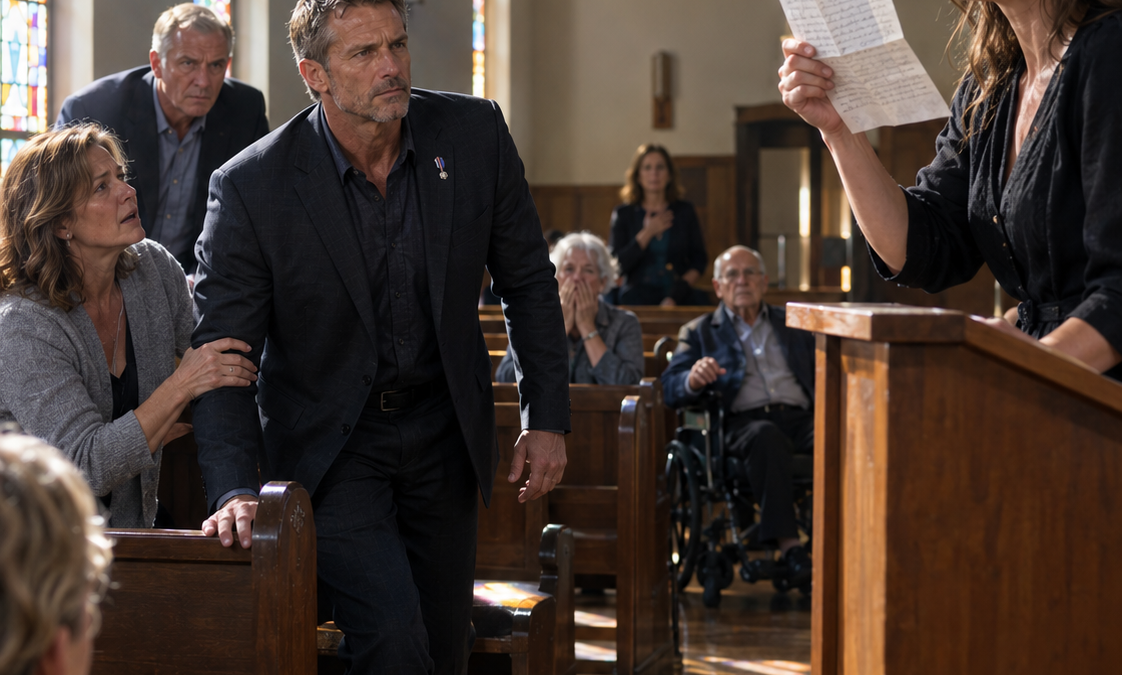
PART 8 — THE CELEBRATION
The memorial was set for the second Saturday in November.
Maria organized everything. She was good at that. She’d been a schoolteacher for thirty years. She knew how to plan things.
She called me every day that week. What kind of food should we serve? Did Elena like the lilies or the daisies better? Should we have music? Did I have a photo I wanted to display?
I didn’t have answers for most of it. Maria figured it out on her own.
Katie helped too. She came by every evening after work. She brought dinner. She sat with me at the kitchen table and we talked.
Not about anything important. Just things. Her job. Her friends. The weather. It was the most we’d talked in twenty-five years.
One night she asked me about the Air Force.
“What was it like?”
I looked at her.
“What part?”
“All of it. The training. The missions. The men you served with.”
I didn’t answer right away.
“It was hard,” I said finally. “Harder than anything I’ve ever done.”
“Was it worth it?”
“Yes.”
“Would you do it again?”
“Yes.”
She looked at me.
“Even though it cost you so much? Even though it cost you time with Mom? With me?”
I looked at her.
“It didn’t cost me you. You were always there. Even when I wasn’t. You were always in the back of my mind.”
She didn’t say anything.
“Every mission. Every jump. Every time I was in the water or on the mountain, I thought about you and your mother. You were the reason I kept going. You were the reason I came home.”
She reached across the table and took my hand.
“I didn’t know that.”
“I know.”
“I wish I had.”
“I know.”
She squeezed my hand.
“Tell me more.”
So I told her.
I told her about the training. The pool work. The drown-proofing. The 4 a.m. runs on the beach in Coronado. The instructors who screamed in your face and the men who quit and the men who didn’t.
I told her about the first time I jumped out of a helicopter. The fear. The cold. The way the water hit you like a wall and you had to trust your gear and your training and the men beside you.
I told her about the missions. Not all of them. Some of them I still couldn’t talk about. But some of them I could.
I told her about the fishing boat off Oregon. The four men I pulled out of the water. The way they looked at me when they realized they were going to live.
I told her about the climber in the Cascades. The broken leg. The storm. The way we had to carry him down the mountain in the dark.
I told her about Harold Beckman. The helicopter pilot I’d pulled out of the water in 1994. The man who showed up at the church with my medal.
“He kept it for thirty years,” I said. “He said it belonged to me.”
“What did you do with it?”
“I put it in the box. With the letters.”
She looked at me.
“Why?”
“Because it’s not about the medal. It’s about what it means. What it represents. The people I saved. The people I couldn’t save. The life I lived.”
She nodded.
“I understand.”
The day of the memorial was cold and clear.
I woke up early. I made coffee. I stood on the deck and looked at the backyard. The leaves had turned. The grass was brown. The grill was still there, rusted and unused.
I thought about all the summers we’d spent out here. Elena in her chair with a book. Katie in the pool. Me at the grill, burning hamburgers.
I smiled.
It wasn’t a sad memory. It was a good one.
I went inside and got dressed. A dark suit. A white shirt. The medal Harold Beckman had given me, pinned to my lapel.
I looked in the mirror.
I didn’t look like a hero. I looked like an old man in a suit.
But that was okay. That was who I was.
The memorial was at the house.
Maria had set up tables in the backyard. White tablecloths. Flowers. Photos of Elena everywhere. The book club had brought food. The neighbors had brought chairs.
People started arriving at noon.
They came in waves. The family. The friends. The neighbors. The book club. Helen with her cane. Tom and Patty from two doors down. The pastor from the church. Some of Elena’s cousins from Richmond.
And Harold Beckman.
He came in his wheelchair, pushed by his granddaughter. He was wearing a suit too. His medal was pinned to his lapel, just like mine.
He wheeled up to me and looked at my lapel.
“You’re wearing it,” he said.
“I am.”
“Good.”
He looked around the backyard.
“This is a nice house.”
“It was hers. Now it’s mine.”
“She had good taste.”
“She did.”
He looked at the photos on the table.
“She was beautiful.”
“She was.”
He looked at me.
“You were lucky.”
“I know.”
He nodded.
“Hold on to that.”
“I will.”
At two o’clock, Maria stood up and called for quiet.
“Thank you all for coming,” she said. “We’re here today to celebrate the life of my sister, Elena. She was a mother, a nurse, a friend, a wife. She was the best person I ever knew.”
She looked at me.
“And she was married to a man who loved her more than anything in the world. A man who spent twenty-five years writing her letters he never sent. A man who served his country with honor and came home to a family he loved.”
She gestured at me.
“Daniel. Would you like to say a few words?”
I stood up.
I walked to the front of the yard.
I looked at the faces. The family. The friends. The neighbors. Katie. Maria. Jim. Harold.
“I’m not good at this,” I said. “I never was.”
The yard was quiet.
“I spent twenty-two years as a Pararescueman. I jumped out of helicopters. I pulled people out of the water. I went into places nobody else wanted to go. I did things I can’t talk about and saw things I can’t forget.”
I looked at the photos of Elena.
“But the hardest thing I ever did was love her.”
I paused.
“Not because she was hard to love. She was the easiest person in the world to love. She was kind. She was funny. She was patient. She was the best thing that ever happened to me.”
I looked at Katie.
“The hardest thing was saying it. Telling her. Showing her. I didn’t know how. I was trained to suppress. To compartmentalize. To keep my feelings locked up in a box. And I did. For twenty-five years.”
I looked at the crowd.
“But she knew. She knew the whole time. She told Maria once that she didn’t need me to say it. She said she could see it in the way I looked at her. In the way I fixed things around the house. In the way I was always the first one to get up when something went wrong.”
I looked at Elena’s photo.
“She was right. She knew me better than I knew myself.”
I reached into my pocket and pulled out a piece of paper.
“I wrote her a letter last week. A new one. The thirty-second. I want to read it to you.”
I unfolded the paper.
“Elena — I know you can’t read this. I know you’re not here. But I’m writing it anyway because that’s what I do. I write letters I never send.”
“I loved you. I loved you from the first time I saw you. I loved you when I was in Kosovo and Afghanistan and Iraq. I loved you when I was in the hospital in Germany with a broken arm and morphine in my veins. I loved you when I was holding your hand in the last hour.”
“I loved you every single day for twenty-five years. I just couldn’t say it.”
“But I’m saying it now. I’m saying it in front of your daughter and your sister and a yard full of people. I’m saying it to your grave and to the sky and to anyone who will listen.”
“I loved you. I love you. I will always love you.”
“— Danny.”
I folded the letter and put it back in my pocket.
I looked at the crowd.
“That’s all I have.”
The yard was silent.
Then Katie stood up.
She walked to the front and stood next to me.
“I want to say something,” she said.
She looked at the crowd.
“I said some terrible things about my stepfather three weeks ago. I said he never loved my mother. I said he was never there. I said he just lived in her house.”
She looked at me.
“I was wrong. He was there. He was always there. He was there in the letters he wrote and never sent. He was there in the missions he flew and the people he saved. He was there in every moment he spent thinking about us while he was halfway around the world.”
She looked at the crowd.
“He’s my dad. He’s the only dad I’ve ever had. And I’m proud of him.”
She reached over and took my hand.
“I’m proud of you, Dan.”
I didn’t say anything.
I couldn’t.
I just held her hand and looked at the crowd and tried not to cry.
The memorial went on for hours.
People ate and talked and laughed. They told stories about Elena. The time she accidentally set the kitchen on fire making Thanksgiving dinner. The time she drove four hours to return a library book she’d found under the couch. The time she gave a stranger her coat on a cold night and walked home shivering.
I listened to all of it.
I’d heard some of these stories before. Some of them were new.
But all of them were her. All of them were Elena.
Harold Beckman found me in the kitchen around six o’clock. His granddaughter had pushed him in and left him by the counter.
“I want to tell you something,” he said.
“Okay.”
“I spent thirty years looking for you. I wanted to thank you. I wanted to tell you what you did for me. I wanted to tell you that you saved my life.”
I looked at him.
“You don’t have to thank me.”
“I know. But I want to.”
He looked at me.
“You saved my life. You gave me thirty more years with my wife. You gave me grandchildren. You gave me a life I wouldn’t have had without you.”
I didn’t say anything.
“So thank you. Thank you for what you did.”
I looked at him.
“You’re welcome.”
He nodded.
“Good.”
He wheeled himself out of the kitchen.
I stood there for a moment.
Then I went back outside.
That night, after everyone had gone home, I sat on the deck with Katie.
We didn’t talk. We just sat there and looked at the stars.
After a while, she spoke.
“Dan.”
“Yeah.”
“I’m going to have a baby.”
I looked at her.
“What?”
“I’m pregnant. Three months.”
I stared at her.
“You’re pregnant?”
“Yes.”
I didn’t say anything.
“I found out two weeks before Mom died. I was going to tell her. I was going to tell everyone. But then she got worse and I couldn’t. I couldn’t tell her. I couldn’t tell anyone.”
She looked at me.
“I’m telling you now.”
I looked at her.
“You’re going to have a baby.”
“Yes.”
“You’re going to be a mother.”
“Yes.”
I reached over and hugged her.
I hadn’t hugged her in years. Maybe ever.
She hugged me back.
“I’m going to name him after you,” she said.
I pulled back.
“What?”
“If it’s a boy. I’m going to name him Daniel.”
I stared at her.
“You don’t have to do that.”
“I want to.”
She looked at me.
“I want him to know who his grandfather is. I want him to know what you did. I want him to know about the letters and the missions and the medal.”
I didn’t say anything.
“I want him to know you.”
I looked at her.
“He will,” I said. “I’ll tell him.”
She smiled.
“Good.”
We sat there in the dark and looked at the stars.
PART 9 — THE NAME
Winter came.
The house was quiet. Quieter than it had ever been. I’d spent twenty-two years learning to be alone in hostile places, and now I had to learn to be alone in my own kitchen.
It wasn’t the same. But I got through it.
Katie came by every Sunday. She brought groceries she insisted I needed and food I didn’t ask for. She sat at the kitchen table and told me about the pregnancy.
The morning sickness. The doctor’s appointments. The name she’d picked out if it was a girl.
“What name?” I asked.
“Elena.”
I looked at her.
“That’s a good name.”
“I know.”
She rubbed her stomach.
“Daniel if it’s a boy.”
“You don’t have to do that.”
“I know I don’t have to.”
She looked at me.
“I want to.”
Jim stayed through Thanksgiving.
He said he wanted to see the memorial. He said he wanted to make sure I was okay. I think he just didn’t want to go home to an empty cabin in Colorado.
We cooked a turkey together. It came out dry. We ate it anyway.
“This is terrible,” Jim said.
“I know.”
“Your wife was a better cook.”
“Everyone was a better cook.”
He laughed.
We sat on the deck after dinner and watched the sun go down.
“You thinking about retiring for real?” he asked.
“I am retired.”
“I mean from this. From the grieving. From the sitting around.”
I looked at him.
“You can’t retire from that.”
“No. But you can decide what to do next.”
I didn’t answer.
“You’ve got a grandkid coming,” he said. “That’s something.”
I looked at the sky.
“Yeah.”
“That’s something.”
Harold Beckman died in January.
His granddaughter called me. She said he’d gone in his sleep. She said he’d been fine the day before. She said he’d told her he wanted me to have something.
She brought it to the house the following week.
It was a letter.
Handwritten. Shaky. On lined paper torn from a notebook.
Daniel —
I’m writing this because my granddaughter says I should. She says if I have something to say, I should say it while I still can.
I never got to thank you properly. I tried at the church. I tried at the memorial. But I don’t think you heard me.
So I’m writing it down.
You saved my life in 1994. I was thirty-four years old. I had a wife named Carol and a daughter named Susan and a whole life ahead of me. When my helicopter went down, I thought it was over. I thought about Carol. I thought about Susan. I thought about all the things I’d never get to do.
Then you showed up.
You pulled me out of that water. You broke two of my ribs doing it. You gave me mouth-to-mouth for twenty minutes while the swells came over both of us. You didn’t stop. You didn’t quit. You just kept going until I breathed.
I got thirty more years because of you. Thirty years with Carol. Thirty years with Susan. I got to walk her down the aisle. I got to hold my grandchildren. I got to live.
I don’t know why you do what you do. I don’t know what makes a man jump out of a helicopter into the ocean at night to save someone he’s never met.
But I’m grateful. I’m grateful every single day.
Thank you.
— Harold
I read the letter three times.
Then I folded it and put it in the box.
With the others.
The baby came in May.
A boy.
Katie called me from the hospital at 4 a.m. Her voice was shaking. She said everything was fine. She said he was healthy. She said he weighed seven pounds, two ounces.
“Can you come?” she asked.
“I’ll be there in twenty minutes.”
I drove to the hospital in the dark.
I found the room. Katie was in bed. Her husband, Mark, was asleep in a chair. The baby was in her arms.
She looked up when I came in.
“Hey, Dad.”
I stopped.
She’d never called me that before. Not once in twenty-five years. She’d called me Dan. She’d called me Daniel. She’d called me him when she was angry.
She’d never called me Dad.
“You okay?” I asked.
“I’m great.”
She held out the baby.
“Want to hold him?”
I looked at the baby.
“I don’t—”
“Hold him.”
I took him.
He was small. Smaller than I expected. He had dark hair and a red face and tiny hands that curled against his chest.
I looked down at him.
“Hello,” I said.
He didn’t answer. He just slept.
I held him for a long time.
Katie watched me.
“What do you think?” she asked.
I looked at her.
“He’s perfect.”
“I know.”
She smiled.
“His name is Daniel.”
I looked down at the baby.
“Daniel Reyes.”
She nodded.
“Daniel Reyes.”
I didn’t say anything.
I just held him and looked at him and tried not to cry.
I went to Elena’s grave the next day.
The permanent headstone had been placed in November. Gray granite. Her name and dates. A line underneath that I’d chosen myself.
BELOVED WIFE, MOTHER, AND FRIEND.
I stood there with my hands in my pockets.
“We have a grandson,” I said. “Katie named him Daniel. After me.”
I looked at the headstone.
“I don’t know why she did that. I told her she didn’t have to.”
I paused.
“He’s beautiful. He’s got dark hair. He looks like her. He looks like Katie when she was small.”
I reached down and touched the stone.
“I wish you were here. I wish you could hold him. I wish you could see him.”
I stood there for a while.
“I’m going to tell him about you. I’m going to tell him everything. The letters. The missions. The medal. The way you laughed at the diner when I told you I was a fireman.”
I smiled.
“He’s going to know you. Even if he never meets you.”
I looked up at the sky.
“I’m going to be there for him. Every birthday. Every holiday. Every graduation. I’m not going to miss anything.”
I looked back at the stone.
“I promise.”
That summer, I started writing again.
Not letters to Elena. Something else.
A journal. For Daniel.
I wrote about my life. The things I’d done. The things I’d seen. The people I’d saved and the people I’d lost. The fear and the guilt and the love I’d never been able to say out loud.
I wrote about Elena. How we met. How she found out what I really did. How she laughed and called me a liar and married me anyway.
I wrote about Katie. How she called me Dad for the first time when she was eight. How she caught herself and ran out the door. How I stood in the kitchen for ten minutes afterward without moving.
I wrote about the letters. The thirty-one of them. Why I wrote them. Why I never sent them.
I wrote: Daniel — if you read this someday, I want you to know something. I wasn’t good at saying things. I was never good at that. But I loved your grandmother more than anything in this world. And I loved your mother like she was my own. And I already love you, even though you’re three months old and all you do is eat and sleep.
That’s the only thing I know how to pass down. Not the medal. Not the letters. Just this. Love loud. Say it out loud. Don’t spend thirty years writing things down and never sending them.
Say it while you can.
Katie and Mark brought Daniel over every Sunday.
He grew fast. He learned to crawl. He learned to walk. He learned to call me Grandpa, which came out Gapa for the first year and then slowly corrected itself.
He liked the attic.
I don’t know why. Maybe it was the boxes. Maybe it was the dust. Maybe it was the fact that I kept the box up there, the wooden one with the duct tape, and he could smell the history on it.
One Sunday, when he was five, he asked me what was in the box.
“Letters,” I said.
“Can I read them?”
“Not yet.”
“Why not?”
“Because you’re five.”
He thought about that.
“When I’m six?”
I laughed.
“When you’re older.”
He accepted that. Kids accept things easily.
He ran off to play with the old flashlight I’d given him.
I sat in the attic and looked at the box.
Thirty-one letters. A medal. A letter from Harold Beckman. A journal for a boy who was still learning to read.
I thought about Elena.
I thought about what she’d say if she could see me now.
She’d probably laugh. She’d probably say something like, Twenty-five years, Danny. Twenty-five years and it took a funeral and a church full of people to get you to talk.
And then she’d smile.
And she’d say, I knew. I always knew.
I closed the box.
I went downstairs.
Daniel was in the living room, playing with the flashlight. Katie was in the kitchen, cutting fruit. Mark was on the deck, reading.
I stood in the doorway for a moment.
Then I walked into the kitchen.
“Katie.”
She looked up.
“Yeah?”
“I love you.”
She stopped cutting.
She looked at me.
For a second, she didn’t say anything.
Then she smiled.
“I love you too, Dad.”
I nodded.
I walked out to the deck and sat down next to Mark.
The sun was going down. The backyard was green. The grill was still rusted. The pool was still there, half-covered.
It was a good life.
It took me a long time to see it.
But it was a good life.

