Part 2: “He didn’t love her. He just lived in her house.”
PART 5 — THE KITCHEN TABLE
Katie arrived at 6:02.
She stood on the porch for a moment before knocking. I watched her through the window. She was wearing the same black dress from the funeral. She looked smaller than she had that day. Tired. Like she hadn’t been sleeping either.
I opened the door.
“Hey.”
She didn’t say anything. She walked past me into the kitchen.
Then she stopped.
The box was on the table. Open. Thirty-one envelopes stacked beside it.
“What’s this?”
“Sit down.”
“I don’t want to sit down.”
“Katie. Sit down.”
She looked at me. Something in my voice made her pull out a chair and sit.
I sat across from her.
Maria arrived ten minutes later. She didn’t knock either. She just walked in the way she always did, like the house belonged to her.
“Daniel. What is this about? I got your message.”
“Sit down.”
She looked at Katie. At the box. At me.
“What’s going on?”
“Sit down, Maria.”
She sat.
Jim arrived last. He came in quietly, the way he always did, and stood by the door with his arms crossed. He didn’t say anything. He didn’t need to.
Katie looked at him.
“Who’s this?”
“That’s Jim. He was my team lead.”
“I told you I didn’t want to meet your military friends.”
“He’s not here as a military friend. He’s here as a witness.”
“A witness to what?”
I looked at the box.
“I want to read you something.”
“I don’t want to hear anything.”
“Katie. Please.”
She crossed her arms.
“Fine. Read.”
I picked up the first letter. The one from 1998.
“Elena — I don’t know how to say this out loud. I’m not built that way. But if something happens to me out here, I want you to know. You’re the best thing that ever happened to me. I love you. — Danny.”
Katie didn’t move.
I picked up the second letter.
“Elena — I’m sitting in a tent in Kosovo and I can’t sleep. I keep thinking about you. About your laugh. About the way you looked at me when you told me you loved me for the first time. I didn’t say it back. I wanted to. I just couldn’t. But I want you to know — I love you. I’ve loved you since the first time I saw you. — Danny.”
Katie’s jaw tightened.
“What is this?”
“Letters. I wrote them every time I deployed. Thirty-one deployments. Thirty-one letters.”
“You wrote letters.”
“Yes.”
“To Mom.”
“Yes.”
“And you never sent them.”
“No.”
She laughed. It was the same laugh from the attic. Not real.
“So you wrote letters and didn’t send them. That’s supposed to prove something?”
I picked up the third letter.
“Elena — Katie called me Dad today. Just once. She was leaving for school and she said, ‘Bye, Dad.’ And then she caught herself and looked embarrassed and ran out the door. I didn’t say anything. I didn’t know what to say. But I want you to know — I’ve never been happier. I don’t know if I’ve earned it. I don’t know if I ever will. But I love that girl. I love her like she’s my own.”
Katie’s face changed.
Just slightly. A flicker.
I picked up the fourth letter.
“Elena — I’m in the Gulf. I can’t tell you where. I can’t tell you what we’re doing. But I can tell you I’m scared. Not for me. For you. For Katie. I keep thinking about what happens if something goes wrong. I keep thinking about you getting the knock on the door. I keep thinking about you having to tell Katie. I don’t want to put you through that.”
Katie stood up.
“Stop.”
I kept reading.
“Elena — I lost a man today. His name was Tommy. He was twenty-four. He had a fiancée named Sarah and a dog named Bo. I was the one who had to tell her. I sat in her kitchen and I told her, and she didn’t cry. She just looked at me like I was the one who killed him. And I don’t know if she was wrong.”
“Stop it.”
“I was the team lead. I made the call. I’m the reason he’s dead. I don’t know how to come home from that. I don’t know how to be the man you think I am. But I’m trying. I’m trying so hard.”
Katie was crying.
I’d never seen her cry. Not at the funeral. Not in the attic. Not in twenty-five years.
She was crying now.
“Stop,” she said. “Please stop.”
I set the letter down.
“I wrote that one in 2003. Two weeks after Tommy died. I was in a tent in Afghanistan. I hadn’t slept in four days. I wrote it because I didn’t know if I was going to make it home. I wrote it because I needed to tell your mother the truth. And then I put it in the box and I never sent it.”
“Why?”
“Because I was afraid.”
“Afraid of what?”
“Afraid she’d read it and realize how broken I was.”
Katie sat back down. She put her hands over her face.
Maria was staring at me. Her mouth was open. She hadn’t said a word since she sat down.
I picked up another letter. 2007.
“Elena — I got the photo. Katie looks so grown up. I can’t believe she’s in college. I can’t believe I missed it. I keep thinking about all the things I’ve missed. All the birthdays and the recitals and the parent-teacher conferences. I know you tell me it’s okay. I know you tell me I’m doing important work. But I don’t know if that’s true anymore.”
I picked up another. 2006.
“Elena — Katie’s graduating high school. I’m going to miss it. I’m going to be in the air when she walks across that stage. I already talked to my commander. I tried to get out of it. I tried everything. But I can’t. I’m so sorry. Tell her I love her. Tell her I’m proud of her. Tell her I’m sorry.”
Katie looked up.
“You tried to get out of it?”
“I tried everything. My commander said no. We were short-handed. I couldn’t leave.”
“You never told me.”
“I didn’t know how.”
She wiped her face with the back of her hand.
“You missed my graduation because of a deployment.”
“Yes.”
“And you wrote a letter about it.”
“Yes.”
“And you never sent it.”
“No.”
She looked at the box.
“How many?”
“Thirty-one.”
“Thirty-one letters.”
“Yes.”
“And you never sent any of them.”
“No.”
She stood up again. She walked to the window. She stood there with her back to us.
“I don’t understand,” she said. “I don’t understand why you would write all of these and never send them. What was the point?”
I looked at the box.
“The point was that I needed to say it. Even if I couldn’t say it to her. I needed to write it down.”
“But she never read them.”
“No.”
“So what was the point?”
“The point was that I loved her. And I needed somewhere to put it.”
She turned around.
“You could have told her.”
“I know.”
“You could have told me.”
“I know.”
“So why didn’t you?”
I looked at her.
“Because I was scared.”
“Of what?”
“Of losing you.”
She stared at me.
“Of losing me?”
“Of losing both of you. I spent twenty-two years jumping out of helicopters into the ocean. I spent twenty-two years running into buildings on fire. I wasn’t scared of dying. I was scared of coming home and finding out I didn’t belong there anymore. I was scared of being the stranger in my own house. I was scared of you and your mother realizing you didn’t need me.”
Katie didn’t say anything.
“So I stayed quiet. I kept my mouth shut. I wrote my letters and I put them in a box and I never sent them because I was afraid that if I said too much, I’d lose everything.”
Maria finally spoke.
“Daniel.”
I looked at her.
“I didn’t know.”
“I know.”
“I didn’t know any of this.”
“I know.”
She looked at the box. At the letters. At me.
“Elena knew.”
I looked at her.
“What?”
“Elena knew.”
“Knew what?”
“That you loved her.”
I didn’t say anything.
“She told me. Years ago. She said, ‘Maria, I know he loves me. He just can’t say it. But I know.'”
I stared at her.
“She said that?”
“She said it more than once. She said she didn’t need you to say it. She said she could see it in the way you looked at her. In the way you fixed things around the house. In the way you were always the first one to get up when something went wrong.”
I put my hand over my mouth.
“I didn’t know,” I said.
“She didn’t want you to know. She said if you knew she knew, you’d feel pressure. She said she just wanted you to be yourself.”
I sat there.
Twenty-five years. Twenty-five years of thinking Elena didn’t know. Twenty-five years of thinking I was failing her. Twenty-five years of writing letters she’d never read.
And she knew the whole time.
Katie was crying again.
Maria reached across the table and took my hand.
“I’m sorry,” she said. “I’m sorry I said what I said. About the funeral. About you not loving her.”
I looked at her.
“You didn’t say it. Katie did.”
“I know. But I believed it. I believed it for twenty-five years.”
I looked at Katie.
She was standing by the window with her arms wrapped around herself.
“Katie.”
She didn’t turn around.
“Katie. Look at me.”
She turned.
“I’m not going to fight you for the house.”
She stared at me.
“What?”
“I’m not going to fight you. You can have it. If you want it, it’s yours.”
She didn’t say anything.
“But before you decide, I want you to read these letters. All of them. Not because I want you to forgive me. Not because I want you to change your mind about the house. Because I want you to know who your mother was married to.”
She looked at the box.
“I don’t—”
“Read them. That’s all I’m asking. Read them and then decide.”
She was quiet for a long time.
Then she walked to the table and picked up the box.
She held it in her arms the way you hold something fragile.
“I’ll read them,” she said.
She walked to the door.
She stopped with her hand on the knob.
“Dan.”
“Yeah.”
“I’m sorry.”
“I know.”
She opened the door and walked out.
I sat at the table with Maria and Jim.
Nobody said anything for a long time.
Then Jim spoke.
“That was the right thing.”
I looked at him.
“I don’t know if it was.”
“It was.”
Maria squeezed my hand.
“She’ll read them,” she said. “She’ll read them and she’ll understand.”
I looked at the door.
“I hope so.”
PART 6 — THE READING
Katie didn’t call for three days.
I didn’t call her either. I sat in the house and waited. Jim stayed with me. We didn’t talk much. We just sat on the deck in the evenings and watched the sun go down and drank coffee that neither of us finished.
On the third day, Maria called.
“She read them,” she said.
“How do you know?”
“She called me. She was crying. She said she couldn’t talk. She said she needed to be alone.”
“Is she okay?”
“I don’t know. But she read them.”
I didn’t say anything.
“Daniel.”
“Yeah.”
“Read them again. I want you to read them again.”
“Why?”
“Because you need to remember who you are. You’ve spent twenty-five years forgetting.”
She hung up.
I went to the attic and brought down the box.
Not the same box. I’d given the letters to Katie. But I had copies. I’d made copies of all of them in 2015, when I retired. I don’t know why. I guess I wanted to have them. I guess I wanted to remember.
I sat at the kitchen table and I read them. All thirty-one. Out loud. In the empty house.
By the time I finished, it was dark. I didn’t turn on the lights. I just sat there in the dark.
The next morning, there was a knock at the door.
I opened it.
It was Katie.
She was wearing jeans and a sweatshirt. Her hair was messy. Her eyes were red. She looked like she’d been crying for three days straight.
“Hey,” she said.
“Hey.”
She held up the box.
“I read them.”
“I know.”
“I read every single one. Twice.”
I stepped back.
“Come in.”
She came inside. She sat at the kitchen table. I made coffee. She didn’t drink it. She just held the cup.
“I didn’t know,” she said.
“I know you didn’t.”
“I didn’t know any of it. The missions. The fear. The letters. The fact that you wrote them and never sent them. The fact that you were carrying all of that and you never said a word.”
I sat across from her.
“I didn’t know how to say it.”
“You wrote it down.”
“Yes.”
“You wrote it down and you never sent it.”
“No.”
She looked at the box.
“Why not?”
“I told you. I was afraid.”
“Afraid of what?”
“Afraid of being seen.”
She looked at me.
“Being seen?”
“Afraid that if you read those letters, you’d realize I wasn’t the man you thought I was. That I was scared. That I was broken. That I was carrying things I couldn’t put down.”
“You were a hero.”
“I was a man doing a job.”
“No.” She shook her head. “You were a hero. I read the letters. I read what you did. The people you saved. The things you saw. You were a hero.”
“I was a man.”
She looked at me.
“Mom knew.”
“I know.”
“She knew the whole time.”
“Yes.”
“She never told me.”
“No.”
“I wish she had.”
I looked at her.
“I wish I had.”
She was quiet for a moment.
“I’m sorry,” she said. “For what I said at the funeral. For what I said in the attic. For the lawsuit. I’m sorry for all of it.”
I didn’t say anything.
“I was angry,” she said. “I was angry at you for not being there. For not saying the things I needed you to say. For not being the father I wanted you to be. And then Mom died, and I needed someone to blame, and you were the only one there.”
“I know.”
“I was wrong.”
“You weren’t wrong.”
She looked at me.
“What?”
“I wasn’t there enough. I missed things I should have been there for. I didn’t say the things I should have said. You were right about all of that.”
“But you loved her.”
“Yes.”
“And you loved me.”
“Yes.”
She put her hand over her mouth.
“I didn’t know.”
“I know.”
“I didn’t know you loved me.”
“I know.”
She was crying again.
“I’m sorry,” she said. “I’m so sorry.”
I reached across the table and took her hand.
“It’s okay.”
“It’s not okay.”
“It’s okay now.”
She looked at me.
“How can you say that?”
“Because I’ve been carrying this for twenty-five years. And now you know. That’s all I ever wanted. For someone to know.”
She squeezed my hand.
“I know now.”
“Good.”
“I’m going to fix this. The lawsuit. The things I said. I’m going to fix all of it.”
“You don’t have to.”
“I want to.”
I looked at her.
“Okay.”
She let go of my hand and stood up.
“I need to make a phone call.”
“To who?”
“My lawyer. I’m dropping the lawsuit.”
“You don’t have to do that.”
“I want to.”
She walked to the door. She stopped with her hand on the knob.
“Dan.”
“Yeah.”
“I’m going to tell people. The truth. About the letters. About everything.”
“You don’t have to do that either.”
“I want to.”
“Why?”
She turned around.
“Because you spent twenty-five years being invisible. And I spent twenty-five years letting you be. That’s not fair. And I’m going to fix it.”
She opened the door.
“Katie.”
She stopped.
“Your mother knew. That’s what matters. She knew.”
Katie looked at me.
“I know. But you deserve to be known too.”
She walked out.
I sat at the table for a long time.
The next day, Katie called a meeting at the church.
Not a funeral. Not a service. Just a meeting. She called everyone. The family. The neighbors. The book club. The people who’d been at the funeral. She called all of them.
She didn’t tell them what it was about. She just told them to be there.
I didn’t know she was doing it until Maria called me.
“You need to be there,” Maria said.
“Be where?”
“The church. Tomorrow. At noon.”
“Why?”
“Katie’s calling a meeting.”
“A meeting about what?”
“About you.”
I didn’t say anything.
“Daniel. You need to be there.”
“I don’t know if I want to be.”
“You need to be.”
“Why?”
“Because she’s going to tell the truth. And you need to hear it.”
I was quiet.
“Daniel.”
“Okay.”
“Good.”
She hung up.
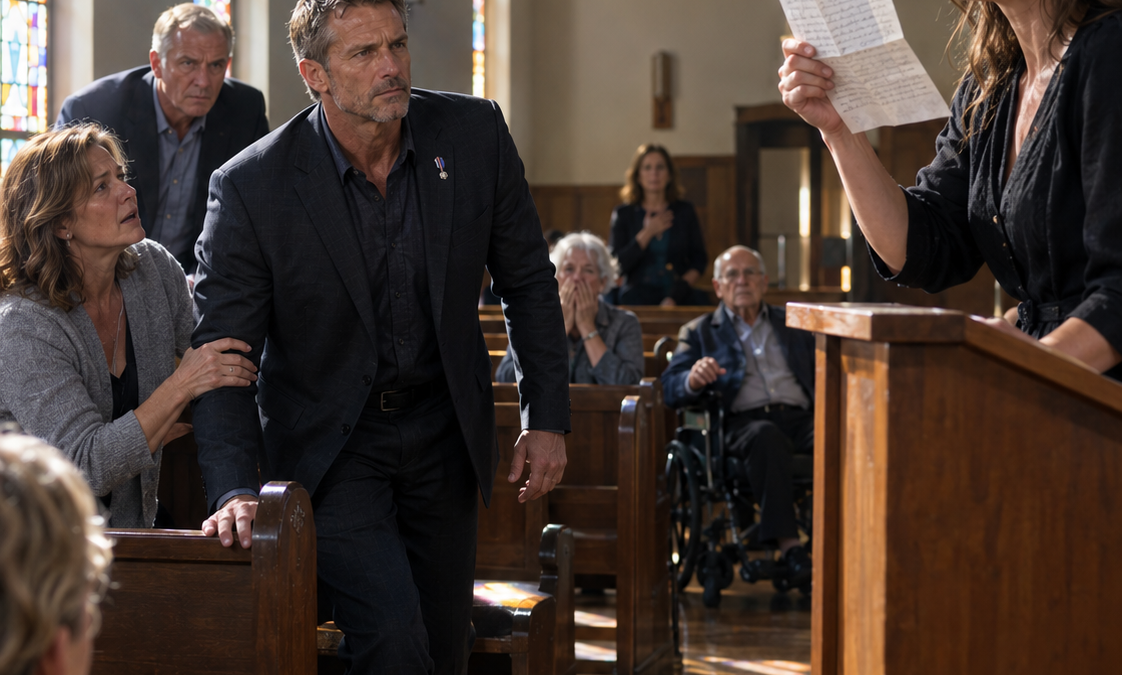
The next day, I walked into the church.
It was the same church where we’d held Elena’s funeral. The same pews. The same stained glass. The same smell of lilies and old wood.
But it was different now. The coffin was gone. The flowers were gone. The altar was bare.
And there were people in the pews.
Not four hundred. But close. Maybe two hundred. They were all there. The family. The neighbors. The book club. The people who’d looked at me like I was a stranger.
I walked down the aisle.
I didn’t know where to sit. I’d sat in the front pew at the funeral. I didn’t want to sit there now.
Maria waved at me from the third row. I walked over and sat next to her.
Jim was in the back. He nodded at me.
Katie walked to the podium.
She was wearing a simple black dress. Her hair was pulled back. She looked calm.
“I asked you all here today,” she said, “because I said something at my mother’s funeral that wasn’t true.”
The room went quiet.
“I said my stepfather never loved my mother. I said he was never there. I said he just lived in her house.”
She looked down at me.
“I was wrong.”
She reached under the podium and pulled out a box.
“This is a box of letters,” she said. “Thirty-one letters. My stepfather wrote them to my mother every time he deployed. Every single time he left. For twenty-five years.”
She opened the box.
“He never sent them. He wrote them and put them in this box and never sent them. Because he was afraid.”
She picked up a letter.
“I’m going to read some of them to you. Because I think you should know who my stepfather really is.”
She read the first letter.
“Elena — I don’t know how to say this out loud. I’m not built that way. But if something happens to me out here, I want you to know. You’re the best thing that ever happened to me. I love you. — Danny.”
She read the second one.
“Elena — Katie called me Dad today. Just once. She was leaving for school and she said, ‘Bye, Dad.’ And then she caught herself and looked embarrassed and ran out the door. I didn’t say anything. I didn’t know what to say. But I want you to know — I’ve never been happier. I don’t know if I’ve earned it. I don’t know if I ever will. But I love that girl. I love her like she’s my own. — Danny.”
She read the third one.
“Elena — I lost a man today. His name was Tommy. He was twenty-four. He had a fiancée named Sarah and a dog named Bo. I was the one who had to tell her. I sat in her kitchen and I told her, and she didn’t cry. She just looked at me like I was the one who killed him. And I don’t know if she was wrong. — Danny.”
She read for twenty minutes.
She read letters about missions and fear and loneliness. Letters about missing birthdays and graduations and anniversaries. Letters about love and loss and the things he couldn’t say out loud.
When she finished, she set the letters down.
“My stepfather spent twenty-two years as an Air Force Pararescueman,” she said. “He jumped out of helicopters into the ocean to save people. He went into mountains and floods and war zones. He saved lives. He lost friends. He carried things most of us can’t imagine carrying.”
She looked at the crowd.
“And he never told anyone. He never bragged. He never asked for recognition. He just did his job and came home and loved my mother as best he could.”
She looked at me.
“He loved her,” she said. “He loved her more than anything in the world. He just couldn’t say it. And I punished him for that. I stood at this podium three weeks ago and I told four hundred people he didn’t love her. And I was wrong.”
She stepped back from the podium.
“I’m sorry, Dan. I’m sorry for what I said. I’m sorry for what I did. I’m sorry for all of it.”
The room was silent.
I stood up.
I walked to the front of the church.
I stood next to Katie.
I looked out at the two hundred people who’d come to hear the truth.
“I don’t have anything to say,” I said. “I never did. That’s the problem.”
I looked at Katie.
“But I want you to know — I loved your mother. I loved her from the first time I saw her. And I loved you. I loved you like you were my own. I just didn’t know how to tell you.”
I looked at the crowd.
“That’s all I have.”
I sat back down.
The room was quiet for a moment.
Then someone started clapping.
It was Jim. In the back. Standing up.
Then Maria.
Then one by one, the whole church.
I didn’t know what to do. I just sat there.
Katie reached down and took my hand.
“Thank you,” she said.
I looked at her.
“For what?”
“For being my dad.”
PART 7 — THE GRAVE
The church emptied slowly.
People came up to me one by one. Some of them shook my hand. Some of them hugged me. Some of them just stood there and looked at me like they were seeing me for the first time.
Elena’s book club came up together. Six women in their sixties and seventies. They’d known Elena for thirty years. They’d known me as the quiet man who fixed the porch light and never stayed for dessert.
“We didn’t know,” one of them said. Her name was Helen. She had white hair and a cane.
“I know.”
“We didn’t know any of it.”
“I know.”
She took my hand.
“Elena talked about you all the time. She said you were the best man she’d ever known. We thought she was being kind.”
I didn’t say anything.
“She wasn’t being kind. She was being honest.”
She squeezed my hand and walked away.
The neighbors came next. A man named Tom who lived two doors down. His wife, Patty. They’d been at the funeral. They’d heard what Katie said.
“We’re sorry,” Tom said. “We didn’t know.”
“It’s okay.”
“It’s not okay. We should have asked. We should have gotten to know you.”
I looked at him.
“You knew me. You just didn’t know what I did.”
He nodded.
“I know now.”
He shook my hand and walked away.
The last person to come up was an old man in a wheelchair.
I didn’t recognize him. He was thin and frail and his hands shook when he pushed the wheels. He stopped in front of me and looked up.
“Daniel Reyes?”
“Yes.”
“You don’t remember me.”
I looked at him. At his face. At his eyes.
“No. I’m sorry.”
He reached into his pocket and pulled out something. A medal. A small, silver medal on a blue ribbon.
“You gave me this,” he said. “1994. Off the coast of San Diego. My helicopter went down in the water. You jumped in and pulled me out.”
I stared at him.
“Chief Warrant Officer Harold Beckman. You pulled me out of the water and gave me mouth-to-mouth for twenty minutes. You broke two of my ribs. You saved my life.”
I didn’t say anything.
“I’ve been looking for you for thirty years,” he said. “I found you three weeks ago. I came to the funeral. I heard what your stepdaughter said. I wanted to stand up and tell everyone the truth. But I didn’t. I didn’t want to make a scene.”
He held out the medal.
“I want you to have this back.”
I looked at the medal.
“It’s yours.”
“No. It’s yours. I’ve been carrying it for thirty years. It belongs to the man who saved my life.”
I took the medal.
I looked at it. At the blue ribbon. At the silver cross.
“I don’t remember you,” I said.
“I know. You saved hundreds of people. You don’t remember all of them. But I remember you.”
He reached up and took my hand.
“Thank you,” he said.
I didn’t say anything.
He let go of my hand and wheeled himself away.
I stood there in the empty church with a medal in my hand and no words.
Katie drove me home.
We didn’t talk in the car. We just sat there. The radio was off. The windows were down. The October air was cool and clean.
She pulled into the driveway and parked.
“You okay?” she asked.
“I don’t know.”
“Do you want me to stay?”
“No.”
She looked at me.
“You sure?”
“I’m sure.”
She nodded.
“I dropped the lawsuit,” she said. “This morning. Before the meeting. It’s done.”
“Okay.”
“The house is yours. It was always yours.”
“Okay.”
She looked at me.
“I’m going to come by tomorrow. If that’s okay.”
“Okay.”
She reached over and squeezed my hand.
“I love you, Dan.”
I looked at her.
“I love you too.”
She smiled. Just slightly.
Then she got out of the car and walked to her own car and drove away.
I sat in the driveway for a long time.
The next morning, I drove to the cemetery.
I parked on the gravel road and walked to Elena’s grave. The metal marker was still there. The dirt was still fresh. The grass hadn’t grown.
I stood there for a while.
Then I sat down on the ground next to her.
“I read them all,” I said. “Out loud. In the church. Katie read some of them. The ones about you. The ones about her. The ones about Tommy.”
I looked at the marker.
“People know now. They know I loved you. They know I loved her. They know I was afraid. They know everything.”
I picked up a handful of dirt and let it run through my fingers.
“I wish you were here. I wish I could tell you in person. I wish I could say it out loud.”
I looked up at the sky.
“Katie called me Dad. She said it in front of two hundred people. She said, ‘Thanks for being my dad.'”
I smiled.
“I don’t know if I earned it. I don’t know if I ever will. But she said it.”
I sat there for a while longer.
Then I reached into my jacket and pulled out a piece of paper.
It was a letter. A new one. The thirty-second.
I’d written it the night before.
Elena — I know you can’t read this. I know you’re not here. But I’m writing it anyway because that’s what I do. I write letters I never send.
I loved you. I loved you from the first time I saw you. I loved you when I was in Kosovo and Afghanistan and Iraq. I loved you when I was in the hospital in Germany with a broken arm and morphine in my veins. I loved you when I was holding your hand in the last hour.
I loved you every single day for twenty-five years. I just couldn’t say it.
But I’m saying it now. I’m saying it in front of your daughter and your sister and a church full of people. I’m saying it to your grave and to the sky and to anyone who will listen.
I loved you. I love you. I will always love you.
— Danny
I folded the letter and placed it on the grave.
Then I stood up.
I looked at the marker one more time.
“I’ll be back,” I said. “I’ll be back every week. I’ll bring you flowers. I’ll talk to you. I’ll tell you things I should have told you when you were here.”
I turned and walked back to my truck.
That afternoon, Katie came by.
She brought lunch. Sandwiches from the deli on Main Street. She set them on the kitchen table and sat down across from me.
“I talked to Maria,” she said. “She wants to have a memorial. A real one. Not a funeral. A celebration.”
“A celebration of what?”
“Of Mom. Of her life. Of everything she was.”
I looked at her.
“That sounds good.”
“She wants to do it next month. At the house. She wants to invite everyone. The whole family. The book club. The neighbors.”
“Okay.”
“And she wants you to speak.”
I looked at her.
“I don’t speak.”
“You do now.”
“I don’t know what to say.”
“You’ll figure it out.”
She picked up her sandwich and took a bite.
“I read the letters again last night,” she said. “All of them. Again.”
“Why?”
“Because I wanted to understand.”
“Did you?”
“I think so. I think I understand now. You weren’t distant because you didn’t love her. You were distant because you loved her too much. You were afraid of losing her. So you kept everything inside.”
I didn’t say anything.
“I do the same thing,” she said. “I did the same thing with Mom. When she got sick, I couldn’t talk about it. I couldn’t tell her how scared I was. I just pretended everything was fine.”
She looked at me.
“I learned that from you.”
I looked at her.
“I’m sorry.”
“Don’t be. I’m not. It’s who I am. It’s who you are. We’re the same.”
She set her sandwich down.
“But we don’t have to stay that way. We can learn to talk. We can learn to say the things we need to say.”
I looked at her.
“Okay.”
“Okay?”
“Okay. I’ll try.”
She smiled.
“Good.”
She picked up her sandwich again.
“Now eat your lunch. You look like you haven’t eaten in a week.”
I picked up my sandwich.
“I haven’t.”
“I know. Eat.”
I ate.
That night, I sat on the deck and looked at the stars.
Jim came out and sat next to me.
“You okay?” he asked.
“I think so.”
“You think so?”
“I don’t know. I’ve spent twenty-five years keeping everything inside. I don’t know how to do anything else.”
He looked at me.
“You don’t have to do anything else. You just have to keep going.”
I looked at him.
“That’s it?”
“That’s it. You keep going. You keep talking. You keep writing letters. You keep showing up. That’s all any of us can do.”
I looked at the sky.
“I miss her.”
“I know.”
“I miss her so much.”
“I know.”
He put his hand on my shoulder.
“You’re not alone, Dan. You never were.”
I looked at him.
“I know.”
“Good.”
We sat there in the dark and looked at the stars.
 [Tap here for the Next Part ]


