“I need to know you’re not after my son’s money.”
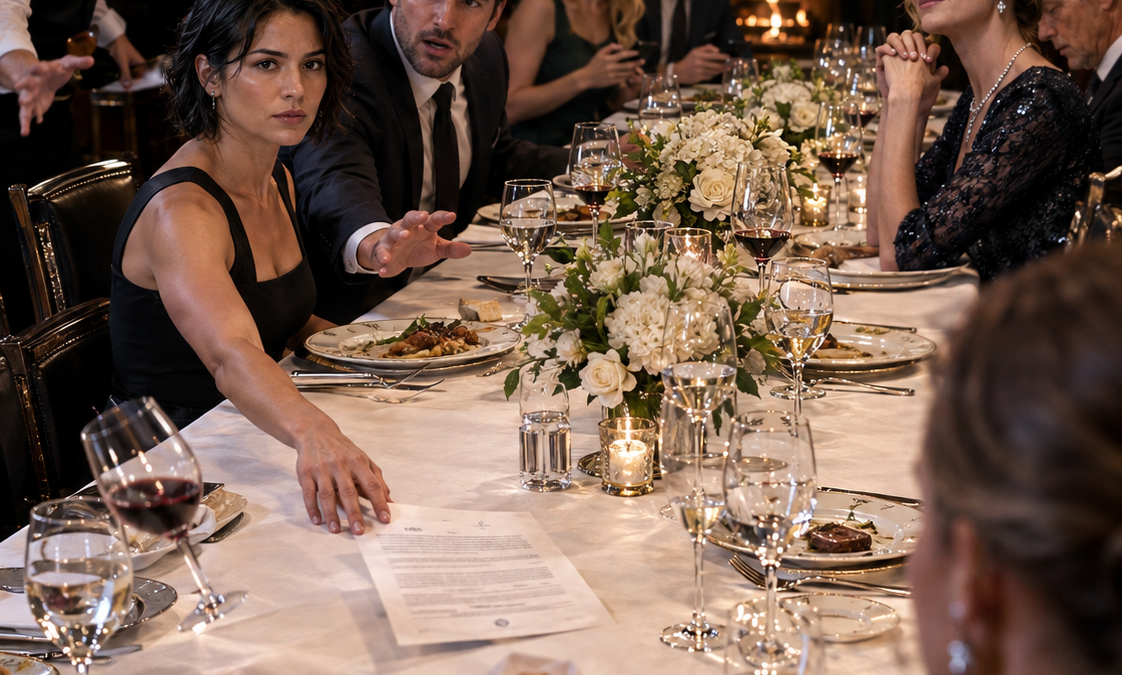
“I need to know you’re not after my son’s money.”
The polygraph contract landed on the table between the bread basket and the wine glasses.
I watched it slide across the white linen. A single sheet of paper, printed neatly, with a logo at the top. The words “Pre-Employment and Personal Verification Services” were stamped beneath it in dark blue.
Diane Whitmore folded her hands on the table and looked at me the way a supervisor looks at a problem employee.
“I need to know you’re not after my son’s money,” she said.
Nobody at the table spoke.
The sommelier, a young man in a black vest who had been about to pour the Cabernet, froze mid-pour. He looked at the bottle, then at the table, then back at the bottle. He set it down and stepped away without a word.
Sixteen people had come to the rehearsal dinner. It was the night before my wedding. The private dining room at The Alder Club was warm and low-lit, with dark wood paneling and a fireplace at the far end that was lit for atmosphere even though it was May. Family sat on both sides of a long rectangular table. Marcus was beside me, his hand on my knee under the table, squeezing once.
His mother sat across from me. She had ordered the sea bass. She had barely touched it.
I looked at the paper. Then I looked at her.
“What exactly are you proposing?” I asked.
My voice was even. It always is. That was the first thing Force Recon taught me, and the last thing I ever forgot. When the shooting starts, the man who stays flat wins. When the world goes loud, the man who stays quiet survives.
Diane smiled. It was a polite smile. The kind you give a waiter who’s done something slightly wrong.
“A polygraph. It’s simple. You go in, you answer a few questions, and we all move forward with peace of mind. The appointment is already set. Tomorrow morning, nine o’clock, before the ceremony.”
Someone at the far end of the table — Marcus’s aunt, I think — made a small sound. Not quite a gasp. More like the noise a person makes when they’ve heard something shocking on the news and haven’t decided yet how to feel about it.
Marcus’s hand went still on my knee.
“Mom,” he said. “What the hell are you doing?”
“Watch your language.”
“This is—you can’t be serious. This is insane.”
“I’m completely serious.” Diane turned to face him, and her voice softened into something that sounded almost reasonable. That was her gift. She could say the most cutting thing in the world and make it sound like it came from a place of concern. “Marcus, sweetheart, I love you. Your father and I have built something over forty years. We’ve seen people come and go. We’ve watched people try to take advantage of this family. This is not a judgment. It’s a precaution. I would do the same for your sister.”
“You didn’t do it for Kevin,” Marcus said.
Diane’s expression flickered. Just for a second. “Kevin is different.”
My name is Elena Vasquez-Reyes. I’m thirty-six years old. I spent eleven years on active duty in the United States Marine Corps, six of those in Force Recon, and I have done things in places that don’t appear on any map that a cartographer would recognize. I have been shot at, blown up, and once left for dead in a drainage ditch outside a village I will never name in a country I will never name. I was thirty-three years old when my team pulled me out of that ditch, and thirty-four when I decided I’d had enough and took an honorable discharge with a service record that includes two Bronze Stars, a Purple Heart, and a stack of classified commendations I can never talk about.
I now run a small consulting firm that helps defense contractors navigate federal procurement. My clients pay me well. I have invested carefully and patiently for over a decade. My net worth is not something I think about often, but it is substantial.
Diane Whitmore did not know any of that. She knew only what she had decided to see: a woman with a Spanish last name and a plain military background who had somehow caught the attention of her son, the heir to the Whitmore Hotel Group.
What she didn’t know was that the night before this dinner, my attorney had called to confirm something. Something that would make the paper on this table look like exactly what it was — a joke dressed up as protocol.
I didn’t tell her that. Not yet. Timing is everything.
I picked up the contract and read it.
The table was quiet. I read every line. It took me about forty seconds. I noticed the fine print at the bottom that authorized the examiner to share all results with the contracting party and to retain the recordings indefinitely. I noticed that the appointment was at a facility in an office park near the airport — not a licensed clinical setting, but a private outfit. I noticed the name of the examiner: Roland Trask.
I set the paper down.
“Mrs. Whitmore,” I said. “You’re asking me to prove I’m not a gold digger the night before I marry your son.”
“I’m asking for transparency.”
“You’re asking for submission.”
Her eyes narrowed. “I’m asking you to respect this family’s concerns.”
“Have you done a polygraph on your daughter’s husband?”
“I don’t see how that’s relevant.”
“Kevin married your daughter four years ago. He has a trust fund and no job. Did you ask him to prove anything?”
Diane’s jaw tightened. She didn’t answer.
I looked at Marcus. He was staring at his mother with an expression I hadn’t seen before — something between rage and grief. His father, Gerald Whitmore, sat at the head of the table with the blank, practiced expression of a man who had spent decades letting his wife fight his battles for him.
“I think we should all calm down,” Gerald said. “Diane, this is a bit much.”
“A bit much?” Marcus’s voice cracked. “Dad, she just handed my fiancée a lie detector contract at her own rehearsal dinner.”
“It’s not a lie detector, it’s a polygraph,” Diane said. “There’s a difference.”
“There’s no difference.”
“There is a procedural difference—”
“Mom, I don’t care about the procedure. I care that you’re—”
“Marcus.” I said it quietly.
He stopped. He looked at me.
I put my hand on his. His knuckles were white.
“It’s okay,” I said.
“It is not okay.”
“I know.” I turned back to Diane. “Mrs. Whitmore, I’ll consider it. I need to talk to my lawyer.”
Her eyebrows went up. “Your lawyer?”
“Yes.”
“For what? It’s a simple test.”
“Everything with legal implications gets a lawyer. That’s just how I operate.” I folded the contract in half and slid it into my purse. “I’ll give you my answer in the morning.”
Diane’s mouth opened, then closed. She had not expected this. She had expected me to crumble, or to refuse outright, or to cry. She had not expected me to take the paper and say I’d have my attorney review it.
That was the first crack. It was small. But I saw it.
The rest of the dinner was a performance. People talked about the wedding. About the flowers. About the seating arrangement. Diane smiled and laughed and acted like nothing had happened. Marcus’s sister, Claire, asked me twice if I was okay in a tone that suggested she already knew the answer and wanted to be seen asking. Kevin, her husband, spent the whole meal on his phone.
I ate my salmon. I drank one glass of water. I watched the room.
What nobody at that table knew was that I had spent the afternoon on a secure conference call with two people. One was my attorney, a woman named Anika Patel who had spent twelve years at the Department of Justice before going private. The other was my financial manager, a man named David Chen, who had been handling my portfolio since I left the service.
I had asked them both the same question: if I chose to, could I document every dollar I had ever earned, saved, or invested, to the penny, with a clean paper trail going back eleven years?
Anika had said yes. David had said yes faster.
I had also asked Anika something else. Something about a private polygraph firm in an office park.
She had run the name. Roland Trask.
I hadn’t heard back yet. But I knew what she would find, because I had already done some checking of my own. That’s what Force Recon does. Before you move, you learn the terrain. Before you fight, you know your enemy’s habits, his weaknesses, his patterns. I had spent the last six months quietly learning Diane Whitmore’s patterns. Not because I was paranoid. Because I had learned a long time ago that the person who assumes goodwill from everyone is the person who ends up in the ditch.
I loved Marcus. I still do. He is a good man, a kind man, and the only person in his family who ever treated me like a human being. But I was not naïve enough to believe that love alone would survive a mother-in-law who saw me as a threat.
So I had prepared. Quietly. The way I was trained.
After dinner, Marcus walked me to my car. His face was pale under the parking lot lights.
“I’m so sorry,” he said.
“You don’t have to apologize for her.”
“I do. She’s my mother.”
“She’s her own person.”
“That’s not how families work.”
I looked at him. He looked like he was about to cry.
“Marcus,” I said. “Do you trust me?”
“Of course.”
“Then let me handle this. I need you to not fight with your mother tonight. I need you to go home, go to sleep, and trust that whatever happens tomorrow, I’ll be fine.”
He stared at me for a long moment.
“What are you going to do?”
“I’m going to answer her question.”
He blinked. “You’re going to take the polygraph?”
“I didn’t say that. I said I’m going to answer her question. There’s a difference.”
He didn’t understand. That was okay. He didn’t need to.
I kissed him. I got in my car. I drove home to my apartment, which is a two-bedroom on the sixth floor of a building downtown that Diane had once called “quaint” in a tone that meant the opposite. I made tea. I sat on my couch. I opened my laptop and read the email Anika had sent me three hours earlier.
Roland Trask had been cited twice by a state regulatory board for improper handling of test results. Once for sharing results with a third party without consent. Once for using an unlicensed examiner.
I smiled. Just a little.
Then I opened another email. This one was from David Chen. It was the summary of my portfolio that I had requested. A clean, simple, single-page document with a total at the bottom.
I read the number. I read it again.
I closed the laptop.
What Diane Whitmore didn’t know — what nobody in that family knew — was that I had done something that morning that none of them would ever have expected. I had called my attorney and asked her to prepare something. Not a defense. Not a statement. A disclosure.
Anika had asked me if I was sure.
I had said yes.
The polygraph was scheduled for nine o’clock. By eight-thirty, everyone would know exactly who I was.
I slept fine that night. I always do.
PART 2 — THE OFFICE PARK
The building was beige. Two stories. A sign out front that said “MERIDIAN VERIFICATION SERVICES” in letters that had faded from black to gray. A parking lot with four cars in it. A strip mall on one side, a self-storage facility on the other.
I pulled in at 8:47. Marcus was already there, leaning against his car with his arms crossed. He looked like he hadn’t slept.
“You came,” I said.
“I wasn’t going to let you do this alone.”
“I told you I’d be fine.”
“I know what you told me.” He pushed off the car and walked toward me. “I also know my mother. She’s going to try to make this as humiliating as possible.”
“She can try.”
He looked at me. “You’re not nervous.”
“No.”
“Why not?”
I touched his face. Just once. “Because I know something she doesn’t.”
He waited for me to explain. I didn’t.
Inside, the office was exactly what I expected. Beige carpet. Fluorescent lights. A receptionist behind a glass partition who asked for my ID and told me to have a seat. The waiting room had six chairs and a coffee table with magazines from three years ago. A water cooler hummed in the corner.
Diane was already there. She sat in one of the chairs with her purse on her lap and her phone in her hand. She was wearing a cream-colored blazer and pearls. She looked like she was attending a charity luncheon, not a polygraph appointment.
Gerald sat beside her, looking uncomfortable. Claire sat on the other side, typing on her phone. Kevin was not there.
“Elena,” Diane said. “You came.”
“I said I would.”
“I wasn’t sure.”
“I know.”
Marcus sat down next to me. Diane’s eyes followed him, and something flickered across her face — irritation, maybe, or the smallest hint of guilt.
The receptionist called my name at 9:02. I stood up.
“Just me,” I said, before Marcus could move.
He looked at me. “Elena—”
“It’s fine. Stay here.”
I walked through the door. The examiner’s office was a small room with a desk and a chair and a machine on a cart in the corner. The machine was old. Not antique — just old. The kind of equipment that had been state-of-the-art fifteen years ago and had been replaced in every legitimate facility since.
Roland Trask stood behind the desk. He was a heavyset man in his late fifties with a comb-over and a short-sleeved shirt. He had the look of a man who had once been in law enforcement and had not quite accepted that he wasn’t anymore.
“Ms. Vasquez-Reyes,” he said. “Have a seat.”
I sat down.
He went through the spiel. The questions would be simple. Yes or no. The machine would measure my respiration, my heart rate, my sweat response. He would ask a few baseline questions first, then move to the relevant ones. The whole thing would take about an hour.
“Do you have any questions?” he asked.
“Just one,” I said. “Are you licensed in this state?”
He blinked. “Excuse me?”
“Your license. Are you currently licensed to administer polygraph examinations in this state?”
His face shifted. Just a little. Just enough. “I’ve been doing this for twenty-two years.”
“That’s not what I asked.”
“I’m certified.”
“Certified by whom?”
He stared at me. The room was quiet. The machine hummed.
“I’m going to have to ask you to cooperate,” he said. “Or I’ll have to note in my report that you refused to answer questions.”
“I haven’t refused anything. I asked a simple question. Are you licensed in this state?”
He didn’t answer.
I reached into my purse and took out a folded piece of paper. I set it on the desk.
“What’s that?” he asked.
“A copy of an administrative complaint filed with the state board of examiners six years ago. It cites you for sharing test results with a third party without the subject’s consent. There’s a second complaint three years after that. Unlicensed examiner. Both were settled.”
Trask’s face went red, then white, then red again.
“Where did you get that?”
“Public records.”
“That’s—those are—”
“Public records,” I said again. “I checked.”
He stood up. “I don’t have to take this.”
“You don’t. But if you walk out of this room, I’ll note in my own report that the examiner refused to verify his credentials. And then I’ll make sure that report finds its way to every regulatory body that might be interested.”
He stared at me.
I stared back.
I have been stared at by men with rifles in three countries. Roland Trask was not going to be the one who broke me.
He sat back down.
“Fine,” he said. “We’ll do the test.”
“No,” I said. “We won’t.”
“What?”
“I’m not taking a polygraph. Not today, not ever. What I am going to do is give you a statement. You can write it down. You can record it. You can do whatever you want with it. But I’m not hooking up to a machine operated by a man with a history of sharing results with whoever’s paying him.”
His mouth opened. Closed.
“That’s not how this works,” he said.
“That’s exactly how this works,” I said. “And if you don’t like it, you can call Mrs. Whitmore and tell her I walked out.”
I stood up.
I walked to the door.
Then I stopped, and turned back.
“One more thing,” I said.
He looked at me like I’d just pulled a knife.
“Tell Mrs. Whitmore that I’ll be at the wedding rehearsal at noon. If she has any questions for me, she can ask them there. In front of everyone.”
I walked out.
The waiting room was silent when I came through the door. Four faces turned toward me.
Marcus stood up first. “What happened?”
I looked at Diane.
“Mr. Trask is not licensed in this state,” I said. “He has two prior complaints against him for improper handling of results. I declined to proceed.”
Diane’s face went very still.
“That’s—that’s not true,” she said.
“It is. You can check.”
“He said he was certified.”
“He is. By an organization he founded.”
Diane’s jaw tightened. She looked at Gerald, who was suddenly very interested in his phone. She looked at Claire, who had stopped typing and was staring at me with an expression I couldn’t read.
“You set this up,” Diane said. “You knew.”
“I looked into him. Yes.”
“How?”
“I have a lawyer. And I know how to do basic research.” I picked up my purse. “I’ll see you at noon.”
I walked past her.
Marcus followed me out the door.
“Elena,” he said, catching up to me in the parking lot. “What the hell just happened?”
“I told you. I answered her question.”
“You didn’t answer anything. You just—you walked out.”
“I walked out of a fraudulent test. That’s not the same thing.”
He stared at me. “You knew he was a fraud.”
“I suspected. Now I know.”
“Since when do you have a lawyer who runs background checks on polygraph examiners?”
I looked at him. The morning light was bright on his face. He looked tired and confused and a little bit afraid.
“Since I started planning for the possibility that your mother would try to destroy me,” I said.
He didn’t say anything.
“I love you,” I said. “I’m marrying you tomorrow. But I am not going to let your mother treat me like a suspect. And if that means I have to prepare for a fight, then that’s what I’m going to do.”
He swallowed.
“I’m sorry,” he said.
“I know.”
“I’ll talk to her.”
“You can. But I don’t think it’ll help.”
We stood there for a moment. A car drove past. The sky was pale blue. It was going to be a warm day.
“Come on,” I said. “Let’s go get breakfast.”
The rehearsal was at noon at St. Ambrose, a stone church on the east side of town with a garden and a fountain and a parking lot that was already half full when we arrived. The wedding coordinator was a woman named Beth who had a clipboard and a headset and the kind of frantic energy that comes from being responsible for other people’s happiness.
The rehearsal itself was fine. We walked through the processional, the vows, the recessional. Marcus’s brother-in-law Kevin showed up late with a coffee and stood in the back. Claire stood up as a bridesmaid and cried at the right moments. Diane stood in the front pew with her hands folded and a smile that didn’t reach her eyes.
I had one bridesmaid. Her name was Tanya Ingram, and she had been my team leader for three years in Recon before she got out and became a paramedic in Arizona. She’d flown in that morning. She stood beside me in a navy dress and heels, and when she saw Diane watching us, she leaned over and said, in a voice low enough that only I could hear: “That’s the woman?”
“That’s her.”
“She’s got the face of a CO who’s about to write you up for something you didn’t do.”
“Pretty much.”
Tanya straightened up. “I don’t like her.”
“You don’t have to.”
“I don’t like that you have to.”
I smiled. “I don’t have to. I just have to get through tomorrow.”
After the rehearsal, everyone gathered in the church hall for a light lunch. Sandwiches, fruit, lemonade. People stood in small groups and made small talk. I stayed near Tanya. Marcus stayed near me.
Diane worked the room. She shook hands, smiled, laughed. She was good at this. She had been doing it for forty years.
Then she walked over to me.
“Elena,” she said. “May I speak with you for a moment?”
“Of course.”
She led me to a corner of the hall, near the window. The light was bright and warm. Outside, the fountain was running.
“I want to apologize,” she said.
I looked at her.
“For this morning. It was not my intention to make you feel like—”
“Mrs. Whitmore,” I said. “You handed me a lie detector contract at my rehearsal dinner. That was your intention.”
She paused. Her smile stayed in place. “You’re very direct.”
“I’ve learned to be.”
“I can see that.” She folded her hands. “I’ll be honest with you. I’m not entirely comfortable with this marriage. You’re a lovely person, and I’m sure you’ve had a very interesting life. But my son is going to inherit a great deal of responsibility. And I have a duty to protect this family.”
“I understand.”
“Do you?”
“Yes.” I looked at her. “You think I’m after his money.”
“I didn’t say that.”
“You didn’t have to.”
She studied me. The smile had faded. What was left was something colder. More honest.
“Can you blame me?” she said. “You appear out of nowhere. You have no family, no connections, no money. You’re marrying my son six months after you meet him. What am I supposed to think?”
I felt the old calm settle over me. The same calm that had gotten me through the ditch, through the firefights, through the long nights in places I can’t name.
“You’re supposed to ask,” I said. “Instead of assuming.”
“I’m asking now.”
“No. You’re accusing.”
Her eyes narrowed. “You’re very confident for a woman with nothing.”
I looked at her for a long moment.
Then I said: “What makes you think I have nothing?”
She didn’t answer.
I walked away.
Marcus was waiting by the door. Tanya was beside him.
“Everything okay?” he asked.
“Yeah,” I said. “Everything’s fine.”
That was a lie. But it was a small one. And it was going to be the last one I told.
PART 3 — WHAT I DIDN’T TELL THEM
I joined the Marine Corps when I was eighteen years old. I did it because I grew up in a house in El Paso with a mother who worked two jobs and a father who left when I was six, and I knew that if I didn’t find a way out, I would spend the rest of my life in the same neighborhood, doing the same things, watching the same sunsets.
The recruiter told me I could do anything I wanted. I told him I wanted to do the hardest thing.
He laughed. Then he looked at my ASVAB scores and stopped laughing.
I went through boot camp at Parris Island. I went through School of Infantry at Camp Lejeune. I volunteered for Recon the day I was eligible, and I spent the next two years training harder than I had ever trained for anything in my life. I learned to swim, to dive, to parachute, to shoot, to survive, to lead. I learned to stay calm in the middle of chaos. I learned to think three moves ahead. I learned to trust the people beside me more than I trusted myself.
I deployed four times. Three of those deployments are still classified. The fourth was in support of an operation I am not allowed to describe. I was awarded the Bronze Star twice. The first was for a mission where I pulled three of my teammates out of a burning vehicle under fire. The second was for a mission that I cannot talk about at all.
The Purple Heart came from the ditch. The ditch was in a country I will never name, on a night I will never forget. We were ambushed. I was hit in the leg and the shoulder. My team pulled me out. I spent three weeks in a hospital in Germany. I spent three months in rehab. I walked with a cane for a year.
I got out when I was twenty-nine. I had a service record, a security clearance, and a body that had been broken and put back together more times than I could count. I had no idea what to do next.
What I did was start a business.
I started it with a laptop and a phone and a small office in a strip mall in Virginia. I called it Vasquez-Reyes Consulting. I had no clients for the first four months. I had one client in the fifth month. By the end of the first year, I had six.
Defense contracting is a strange business. It’s built on relationships and reputation and the kind of trust that takes years to build. But I had something that most people in that world didn’t have: I knew what it was like to be on the other side. I knew what the operators needed. I knew what the procurement officers were afraid of. I knew how to translate between the two.
I also knew how to invest.
I had started investing when I was in the service. Nothing fancy. Just a percentage of every paycheck into an index fund. Then, when I got out, I started being more aggressive. I read everything I could find about markets and real estate and private equity. I took risks. Some of them paid off. Some of them didn’t. But I was patient. I was disciplined. I was willing to wait.
By the time I met Marcus, I had been doing this for seven years. My portfolio was worth more than most people would believe. I had real estate in three states. I had a stake in a private security firm that had gone public. I had an investment account that I had never touched, that had been growing quietly in the background since the day I opened it.
I didn’t tell Marcus about any of this. Not because I was hiding it. Because it never came up. He knew I ran a consulting firm. He knew I was comfortable. He didn’t know the numbers. He didn’t ask. He was the kind of person who cared more about who you were than what you had.
Diane was not.
I had met Diane three months after Marcus and I started dating. It was a dinner at their house — a large, beautiful house on a hill overlooking the city. I had worn a simple dress and brought a bottle of wine. Diane had greeted me with a smile that I could see through in about four seconds.
The dinner had been polite. The conversation had been light. But I had noticed the way she looked at my shoes, at my watch, at my car when I pulled up. I had noticed the way she asked about my background, and the way her expression changed when I said “military.”
“Military,” she had repeated. “How interesting.”
“Marine Corps,” I said.
“Oh. And what did you do?”
“I was in Recon.”
“Recon.” She had smiled. “That sounds very physical.”
I had let it go. I had let a lot of things go over the next few months. The comments about my “humble beginnings.” The questions about my “long-term plans.” The way she always seemed to find a way to bring up the Whitmore family’s charitable work, their connections, their reputation.
I had let it go because I loved Marcus. And because I had learned a long time ago that some battles aren’t worth fighting.
But then came the polygraph. And that was different.
That was a line. And once someone crosses a line, you have to decide what you’re going to do about it.
After the rehearsal lunch, I drove home and called Anika Patel.
“What did Trask say?” she asked.
“He was not happy. But he confirmed he’s not licensed in the state.”
“Good. I already sent a formal complaint to the board.”
“How long will that take?”
“To be processed? A few weeks. To be acted on? Maybe a month. Depends on the backlog.”
“Can you speed it up?”
“I can try. But that’s not the thing I called you about.”
“What is?”
“I got a call this morning from a woman named Patricia Hall. She works for the state bar.”
I sat down on my couch. “The state bar.”
“She’s investigating a complaint filed against Diane Whitmore’s attorney. A man named Charles Dunhill.”
I knew the name. Charles Dunhill had been the Whitmore family’s attorney for twenty years. He had handled their real estate, their trusts, their business deals. He had also, apparently, handled something else.
“What’s the complaint?” I asked.
“Allegedly, Dunhill used his position to access confidential financial records of a client’s family member without authorization. The complaint was filed by that family member six weeks ago.”
“Who filed it?”
“A woman named Claire Whitmore.”
I stared at the wall.
“Claire? Marcus’s sister?”
“The same.”
“What records?”
“According to the complaint, Dunhill accessed Claire’s husband’s financial records — Kevin’s — and shared them with Diane. Kevin found out. He confronted Diane. There was a fight. He filed a complaint.”
I closed my eyes.
“What happened after?”
“The complaint is still pending. But here’s the interesting part. Dunhill is scheduled to appear before a disciplinary hearing next week. And one of the issues the bar is looking at is whether he also accessed records for other family members.”
“Like Marcus.”
“Like Marcus. And like anyone else connected to the family.”
I opened my eyes.
“When is the hearing?”
“Friday. Two days after your wedding.”
I let out a slow breath. “Anika. I need you to do something.”
“What?”
“File a formal request for discovery. I want to know if Dunhill accessed my records. I want to know if Diane asked him to.”
“You want to go after her.”
“I want to know what she did. And I want it on the record.”
Anika was quiet for a moment.
“You’re sure?” she asked.
“I’m sure.”
“Okay. I’ll file it tomorrow morning.”
“Thank you.”
I hung up.
I sat on my couch for a long time. The sun was going down outside. The city was getting dark.
I thought about Claire. I thought about Kevin. I thought about the fact that Diane had apparently been spying on her own family for years — not just me, but her daughter’s husband. I thought about what that meant.
Then I thought about Marcus. And what it would mean when he found out.
PART 4 — THE WEDDING
The wedding was at four o’clock on Saturday afternoon.
The weather was perfect. Blue sky, light breeze, temperature in the low seventies. St. Ambrose was decorated with white flowers and ribbons. The garden was set up with rows of chairs facing a small altar. A string quartet played Vivaldi as the guests arrived.
I got ready in the bridal suite with Tanya and one other friend. My dress was simple — ivory, floor-length, no train. I had bought it at a small shop downtown for less than a thousand dollars. Diane had offered to pay for something more elaborate. I had declined.
“You look nervous,” Tanya said, adjusting the veil.
“I’m not.”
“You’re doing that thing.”
“What thing?”
“The thing where you go quiet and still. Like you’re waiting for something.”
I looked at her in the mirror.
“Old habit,” I said.
“Old habit my ass. You’re planning something.”
“No. I’m just ready.”
“For what?”
“For whatever happens.”
She looked at me for a moment. Then she nodded.
“Okay,” she said. “I’ve got your back. Whatever it is.”
“I know.”
The ceremony was beautiful.
Marcus cried when I walked down the aisle. So did his father, which surprised me. Diane did not cry. She sat in the front row in a champagne-colored dress and watched me with an expression that was impossible to read.
We said our vows. We exchanged rings. The priest pronounced us husband and wife. Marcus kissed me. The guests applauded.
For a moment — just a moment — everything felt perfect.
Then we went to the reception.
The reception was at The Whitmore, the flagship hotel of the family’s chain. The ballroom was enormous, with crystal chandeliers and a marble floor and a stage at one end where a band was setting up. There were two hundred guests. White tablecloths. Tall floral arrangements. A menu that included filet mignon and lobster.
I walked in on Marcus’s arm. The band played. People stood and clapped.
Diane was already seated at the head table. She smiled when she saw us. It was a good smile. Almost convincing.
We sat down. The dinner was served. The toasts began.
Claire gave a toast. It was sweet and a little rambling. Kevin gave a toast. It was short and nervous. Gerald gave a toast. It was long and boring and full of references to the “Whitmore legacy.”
Then Diane stood up.
“May I say a few words?” she asked.
The room went quiet. Marcus looked at me. I nodded.
Diane took a glass of champagne and turned to face the crowd.
“I want to welcome everyone,” she said. “And I want to say how happy I am to see my son so happy.”
She paused. People clapped.
“When Marcus told me he was going to marry Elena, I’ll be honest — I had my concerns.”
A few people laughed. Nervous laughter.
“Elena comes from a different world than we do. A different background. A different set of experiences. And I’ll admit, I didn’t know what to make of her at first.”
I sat very still.
“But over the past few months, I’ve come to see that she is a woman of great character. And I know she loves my son. And that’s what matters.”
She raised her glass.
“To Elena and Marcus.”
The room raised their glasses.
“To Elena and Marcus.”
I raised my glass. I drank.
Then I set it down.
Marcus was looking at me. He knew something was wrong. He always knows.
“Elena,” he said, quietly. “What is it?”
I looked at him.
“Nothing,” I said. “Let’s just get through this.”
The reception went on. People danced. People drank. I moved through the crowd the way I had learned to move through everything — calm, observant, patient. I shook hands. I smiled. I posed for pictures.
At around nine o’clock, Diane’s phone rang.
She was standing near the bar, talking to a group of friends. I saw her look at the screen. I saw her frown. She stepped away from the group and answered.
I was watching her from across the room.
I saw her face change. I saw her hand go to her throat. I saw her turn and walk quickly out of the ballroom, toward the hallway.
Marcus was on the dance floor with his niece. He hadn’t seen.
I followed Diane.
She was in the hallway, near the restrooms, with her phone pressed to her ear.
“No,” she was saying. “No, that’s not possible. You told me this was handled.”
She listened.
“I don’t care. You need to fix this. You need to fix this now.”
She listened.
“Charles, I’m telling you, if this gets out—”
She stopped. She turned. She saw me.
Her face went white.
“Mrs. Whitmore,” I said.
She lowered the phone. “Elena. What are you doing here?”
“I saw you leave. I wanted to make sure you were okay.”
“I’m fine.”
“You don’t look fine.”
She stared at me. Her hand was shaking.
“What did you do?” she asked.
I looked at her.
“What do you mean?”
“You know what I mean. What did you do?”
I took a step closer.
“I filed a request for discovery,” I said. “With the state bar. Regarding your attorney, Charles Dunhill, and his access to my financial records.”
Her mouth opened. No sound came out.
“The request was filed on Thursday,” I continued. “It was entered into the record yesterday. Which means that as of this morning, Charles Dunhill is under formal investigation. And so are you.”
“You—” She stopped. Swallowed. “You can’t do that.”
“I can. I did.”
“Why?”
“Because you tried to humiliate me. Because you tried to make me prove I wasn’t after your son’s money. Because you sent a man to put me on a lie detector machine. And because I found out you’ve been doing this to other people in your family for years.”
Diane’s face twisted.
“You don’t know anything,” she said.
“I know about Kevin. I know about the complaint. I know about Claire.”
“Claire is my daughter. I was protecting her.”
“From what? From her husband? From the man she chose?”
“You don’t understand.”
“I understand perfectly. You don’t love your family. You control your family. And when someone in your family chooses someone you didn’t pick, you try to destroy them.”
Diane’s voice was shaking. “You don’t know what you’re talking about.”
“I know exactly what I’m talking about.” I reached into my clutch and pulled out a folded piece of paper. I held it up. “This is a subpoena. It’s for Charles Dunhill. It requires him to produce all records related to his access of my financial information, as well as any other family members’ information, going back five years.”
Diane stared at the paper.
“The hearing is on Friday,” I said. “You’ll want to have your own attorney present. I don’t think Mr. Dunhill is going to be able to help you.”
She looked at me. Her eyes were bright with something — anger, fear, humiliation.
“Who are you?” she said.
I folded the paper and put it back in my clutch.
“My name is Elena Vasquez-Reyes,” I said. “I’m a former Marine. I was in Force Recon for six years. I’ve been shot, stabbed, and blown up. I’ve buried friends and I’ve pulled friends out of burning vehicles. I’ve done things you can’t imagine in places you’ll never know. And I’ve done all of it without ever once needing your approval.”
She didn’t move.
“You wanted to know if I was good enough for your son,” I said. “The answer is yes. But that’s not the question anymore. The question is whether you’re good enough to be part of his life. And that’s a question only he can answer.”
I turned and walked back toward the ballroom.
I didn’t look back.
PART 5 — THE FALLOUT
Marcus found me ten minutes later.
I was standing by the window in the hallway, looking out at the city lights. I had a glass of water in my hand. My wedding ring was heavy on my finger.
“Elena,” he said.
I turned.
His face was pale. He looked like he’d been crying.
“I talked to my mother,” he said.
“I know.”
“She told me what you said. About the lawyer. About the hearing.”
“I know.”
He stared at me.
“Is it true?”
“Yes.”
“You filed a subpoena? Against Charles Dunhill?”
“Yes.”
“Why didn’t you tell me?”
I looked at him.
“Because you would have tried to stop me,” I said. “Because you would have said it was too much, or that we should talk to her first, or that I should give her a chance. And I didn’t want to hear that.”
He swallowed.
“You should have told me,” he said.
“Maybe. But I didn’t.”
“Why not?”
I set the glass down on the windowsill.
“Marcus,” I said. “Your mother hired a man to put me on a lie detector machine. She tried to humiliate me in front of your entire family. She’s been spying on her own daughter and her own son for years. And you’re asking me why I didn’t tell you I was going to fight back?”
He looked away.
“I’m sorry,” he said.
“I know you are. But sorry doesn’t fix anything.”
He was quiet for a long moment.
“What happens now?” he asked.
“I don’t know. The hearing is Friday. Charles Dunhill will be there. I’ll be there. Your mother will be there. What happens after that depends on what the bar finds.”
“Will you press charges?”
“I don’t know. Maybe. That depends on what they find.”
He nodded slowly.
“Do you want me to come with you?”
I looked at him.
“Yes,” I said. “I do.”
He reached for my hand. I let him take it.
“I love you,” he said.
“I know.”
“I’m on your side.”
“I know.”
“Then why—”
“Because being on my side isn’t the same thing as standing up for me. And I need you to stand up for me, Marcus. Not just say you’re on my side. Actually stand up.”
He looked at me.
“I will,” he said.
“Good.”
I picked up my water and drank it.
“Come on,” I said. “Let’s go back to our party.”
The rest of the reception was a blur.
People danced. People drank. People gave us money and wished us well. I smiled and thanked them. Marcus stayed close to me all night. Diane stayed on the other side of the room, talking to her friends, pretending nothing had happened.
At midnight, we left. We drove to a hotel downtown — not The Whitmore, but a small boutique place on Main Street that I had booked months earlier. We checked in. We went up to our room.
I took off my dress. I took off my shoes. I lay down on the bed.
Marcus lay down next to me.
“Are you okay?” he asked.
“No,” I said.
He didn’t say anything. He just took my hand.
We lay there in the dark. The city hummed outside. The wedding was over. The rest of my life was starting.
The next morning, I got up early. I went for a run. Six miles along the river, at a pace that would have killed most people. The air was cool. The sky was gray. I ran until my legs burned and my lungs ached.
When I got back to the hotel, Marcus was awake. He had ordered breakfast. Coffee, eggs, toast.
“You ran,” he said.
“Yeah.”
“How far?”
“Six.”
He shook his head. “You’re a machine.”
“I’m a Marine.”
We ate breakfast. We didn’t talk about his mother. We didn’t talk about the hearing. We just sat there, two people in a hotel room, eating eggs and drinking coffee.
At ten o’clock, my phone rang.
It was Anika.
“Good morning,” she said. “How’s married life?”
“Fine. What’s up?”
“I got a call from Charles Dunhill’s office. They want to settle.”
I set down my coffee.
“Settle?”
“They want to offer you a deal. They’ll produce the records, agree to a formal reprimand, and pay a fine. In exchange, you drop the subpoena and agree not to pursue criminal charges.”
I looked at Marcus. He was watching me.
“What did you say?” I asked.
“I said I’d talk to you.”
“Good.”
“What do you want to do?”
I thought about it.
Diane had tried to humiliate me. She had tried to make me prove I wasn’t a gold digger. She had been spying on her own children for years. She had used her money and her connections to try to control everyone around her.
What did I want?
I wanted her to face consequences.
“I want the hearing,” I said. “I want it on the record. I want the bar to make a formal finding.”
“That’s not what they’re offering.”
“I know.”
“Are you sure?”
“Yes.”
“Okay. Then I’ll tell them no.”
“Thank you.”
I hung up.
Marcus was staring at me.
“What?” I said.
“You’re really going to do this.”
“Yeah.”
“Even if it tears my family apart.”
I looked at him.
“Marcus,” I said. “Your family is already torn apart. Your mother tore it apart. Years ago. I’m just the one who’s finally saying it out loud.”
He didn’t answer.
I stood up.
“I’m going to take a shower,” I said. “Then I’m going to call Tanya and see if she wants to get lunch.”
I walked into the bathroom.
I closed the door.
I leaned against it for a moment.
Then I turned on the water and got in.
 [Tap here for the Next Part ]


